By Jack Thompson
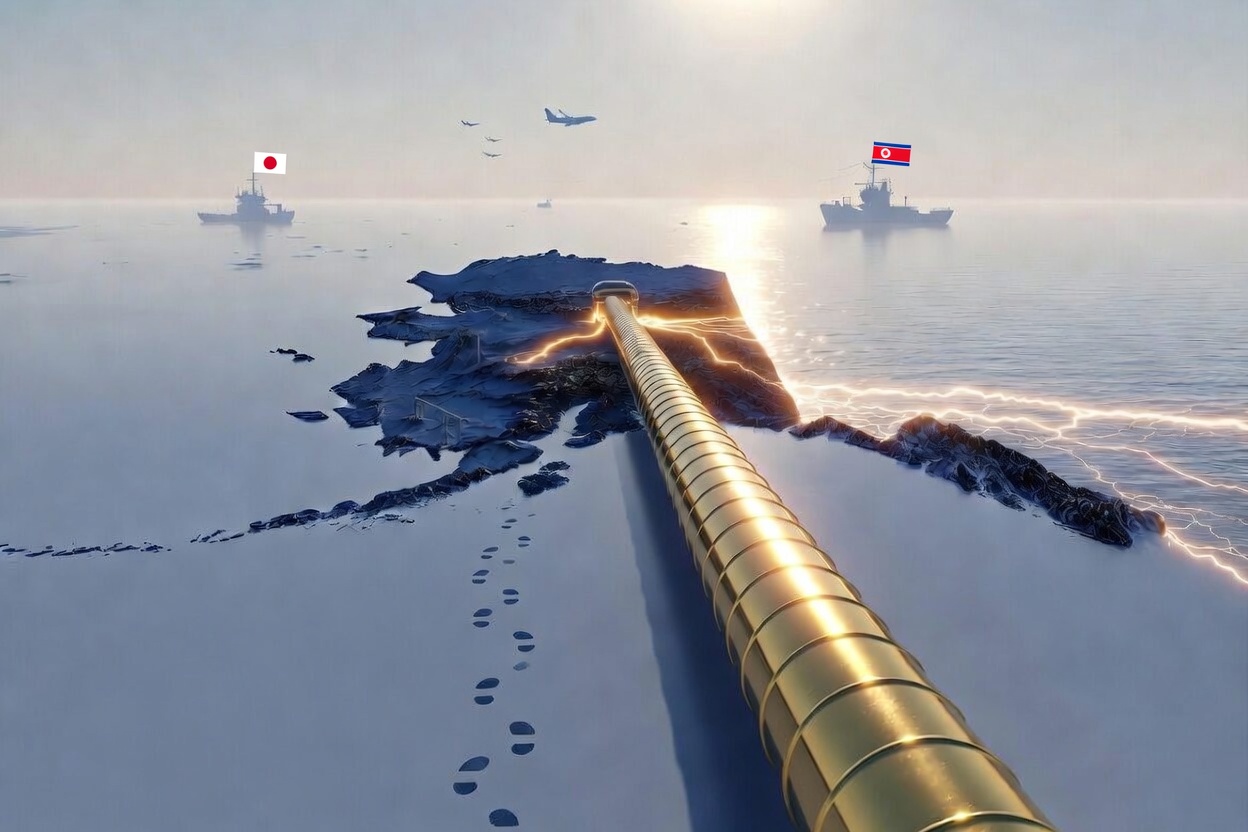
In 1867, Secretary of State William Seward paid Russia $7.2 million for a frozen, seemingly worthless expanse that the press of the day mocked as “Seward’s Folly.” A century and a half later, the punchline has become prophecy. The territory Washington once shrugged off now sits at the hinge point of a new contest among great powers, and the object of that contest is not a warship or a satellite constellation. It is a pipeline.
The Alaska LNG project, an 800-mile line meant to carry North Slope natural gas from Prudhoe Bay to a liquefaction terminal at Nikiski, tends to get discussed in Juneau in the narrow language of tax credits and construction contracts. That framing is not wrong so much as incomplete. Strip away the accounting and what remains is a project that will help decide how the United States competes in the Indo-Pacific, how firmly Washington’s Asian allies stay tethered to it, and what kind of state my generation of Alaskans inherits. For those of us who want more than anything to spend our lives, raise families, and build careers in this state, that is the part of the story that actually matters.

Start with the geography. Once built, the project is designed to move gas to Alaskans starting in 2029 and to load LNG carriers bound for Asia beginning in 2031, with capacity to export roughly 20 million tonnes a year. Glenfarne Group, the New York developer now leading construction, holds a 75 percent stake; the state’s own Alaska Gasline Development Corporation holds the rest. That state ownership matters. It means Alaska is not merely a landlord collecting royalties. It is a co-owner of a facility with indispensable strategic weight.
Japan and South Korea, the world’s second and third largest LNG importers, have spent the past year weighing how deeply to tie their energy security to this project, and Taiwan’s state oil company has already signed a letter of intent to buy six million tonnes of Alaska gas annually, with talk of direct investment to follow. None of this is happening in a vacuum. Analysts at the Center for Strategic and International Studies have noted that an LNG tanker can reach Japan from Alaska in about a week, versus roughly a month from the Gulf of Mexico by way of the Panama Canal, and that the Pacific crossing avoids the choke points, the Strait of Hormuz, the South China Sea, the waters off a tense Taiwan, that make Middle Eastern and Gulf gas a strategic liability as much as an asset. The recent war in Iran and its seismic ripple effects through global energy markets only sharpened that logic. When Tokyo, Seoul, and Taipei study a map, Alaska is not a remote afterthought. It is the shortest, safest line back to an ally.
That logic cuts both ways. While Washington courts its Pacific partners with American gas, Moscow and Beijing have spent the same years deepening their own Arctic partnership, from joint naval patrols near Alaskan waters to China’s self-styled “Polar Silk Road” investments along Russia’s Northern Sea Route. The Arctic Council, once a rare venue where the United States, Russia, and the Nordic states could still find common ground, has been hollowed out by the broader collapse in U.S.-Russia relations. Great powers are redrawing the map of the top of the world, and Alaska is not a spectator to that process. It is a tangible, direct, and integral participant, whether or not any given politician in Juneau thinks of it that way.
None of this happens in isolation from Alaska’s other strategic assets. The F-35 wings at Eielson Air Force Base, the Army’s Arctic-focused units at Joint Base Elmendorf-Richardson, and the Coast Guard’s growing icebreaker program already make Alaska the country’s most
forward-deployed Arctic asset. A gasline that turns the state into an energy supplier for allies builds economic leverage on top of military presence, giving Washington a fuller hand to play in a region where Russia holds most of the Arctic coastline, and China has made no secret of wanting a foothold near it.
This is also, unmistakably, a generational story, and not only in the abstract way that geopolitics always is. Our grandparents’ generation of Alaskans that came before us built the Trans-Alaska Pipeline in the 1970s in response to an oil shock, and the royalties from that pipeline still fund the Permanent Fund dividend that Governor Jay Hammond designed so that oil wealth would not be spent by one generation and lost to the next. The gasline is being built in the shadow of a different but related crisis: a looming shortfall in Cook Inlet gas that threatens to raise heating and electricity costs across the Railbelt, from Fairbanks to the Kenai Peninsula, for the very Alaskans who will spend their careers here. As I write this, Juneau is gearing up for a third special session on the project, set to convene July 27, after the House and Senate failed to agree on the incentive package developers say they need to reach a final investment decision.
Whatever one thinks of the specifics still being fought over, the Legislature has had fifty years to get ready for this moment, and a small handful of its members is still standing in the way. Three special sessions in, that is not caution. That is a small group killing Alaska’s gasline for the entire state and playing politics with its future.
For young Alaskans, the choice this project poses is not an abstract idea. It is whether we inherit a state whose leverage in the world rests on being a genuine strategic partner to democracies across the Pacific, with the jobs, revenue, and diplomatic standing that follow from that role, or a state that let the moment pass and watched Qatar, Australia, and eventually Russia’s own Arctic export terminals fill the gap instead. Alaska has spent fifty years talking about a gasline. This is the closest the state has come to building one.
That is why this cannot be settled by legislators, developers, and foreign ministries alone. The Alaskans who will actually be paying Railbelt utility bills and living with Arctic security for the next fifty years are not hypothetical. They are here now, desperate for an Alaska they can have a future in, whether anyone has thought to ask them or not. If the gasline is going to define our working lives the way the Trans-Alaska Pipeline defined the Alaskan generations predating us, we owe it to ourselves to understand the project on its own terms, geopolitical as well as financial, and to show up in the rooms where its future is being decided.
Seward bought Alaska for pennies an acre and was mocked for it. History remembers his purchase differently now. The gasline is asking my generation of Alaskans a similar question: whether we recognize what is being built in front of us before the rest of the world decides its
value for us.
Jack Thompson, 19, is the youngest Alaskan to work as a staffer in the State’s 34th Legislature. He has also served on the Anchorage Municipal Historic Preservation Commission, the Executive Board of the South Addition Community Council, and interned with the Alaska World Affairs council. He is currently working for a statewide campaign and studying International Relations at the University of Alaska Anchorage.