One of the more disappointing reads of the season was the Oct. 27 opinion essay in The Washington Post penned by Alaska’s own Chief Medical Officer Anne Zink.
Most of it is an acceptable accounting of Alaska’s experience with Covid-19. We did pretty well in the beginning, and Gov. Mike Dunleavy’s administration, including Zink, did a phenomenal job getting test kits manufactured in-state, when it was nearly impossible to get supplies. They got protective gear shipped over from China in record time.
Alaskans followed Dr. Zink’s advice in February of 2020 to wash their hands frequently for 20 seconds and sneeze into their sleeves. She is on the record early in the pandemic for saying that surgical masks are essentially petrie dishes.
“A mask is a wet, moist environment that’s collecting viruses and bacteria … It’s not useful to protect you from other people,” she told a legislative hearing.
By June, 2020, Zink had changed her tune about why she wears a mask: “Humility: I don’t know if I have COVID as it is clear that people can spread the disease before they have symptoms. 2. Kindness: I don’t know if the person I am near has a kid battling cancer, or cares for their elderly mom. While I might be fine, they might not. 3. Community: I want my community to thrive, businesses to stay open, employees to stay healthy. Keeping a lid on COVID helps us all.”
That’s very laudable and noble, but 180-degrees from what she had said in February, 2020, and not particularly backed by science.
In The Washington Post last month, Zink took credit for Alaska’s great look on the national stage early in the pandemic, and then blamed Alaskans for the outbreak in the fall of 2021, when case loads spiked.
Alaskans fell prey to misinformation, she said.
This is a curious argument: Alaskans, evidently, have some unique quality that makes them fall for misinformation when people in Florida, with some of the lowest Covid case counts in the world, do not.
Today, the case loads are spiking in Iowa and Kansas. It must be that people are suddenly falling for misinformation in Iowa, but not in Alaska, because within weeks of spiking and causing concern in hospitals in late September, Alaska’s numbers have returned to what the World Health Organization considers the “green zone” of viral transmission — below 5% for the past two weeks. Alaskans should pat themselves on the back for not falling for misinformation.
The blame for misinformation rests on the medical community, policy makers, and on social media, but perhaps unequally. Let’s take the medical community first.
The struggle to understand what is probably a bioweapon, while filtering data through the sieve of medical experience and teachings, has led the medical profession to make imperfect recommendations to the public, and to exclude important avenues of inquiry, such as early treatment.
The medical community, led by people in charge such as Dr. Zink and Dr. Anthony Fauci, have pushed masks, distancing, and finally a leaky vaccine as the primary methods for controlling the disease. And yet, with this sneaky virus, it’s apparent that the vaccine is not going to succeed, as in less than two years the virus has evolved from its initial stage, to the more virulent Delta, and now to the even worse variant being called “omicron.” This virus, unlike viruses that come from nature, reminds us of the Greek mythological creature Hydra; every time one head is chopped off, two more grow back.
The jury is still out on whether the mass vaccination program is a good idea, but Zink’s assertion that low vaccination rates and vaccine hesitancy in Alaska is a big reason for the September surge is unsupported. 81 percent of the Juneau population is vaccinated, and yet there were 19 new cases diagnosed Wednesday. This, in what is one of the most vaccinated communities in the country — a town of 30,000 that also has instituted forced masking, six-foot distancing, and mandatory limits on gatherings. Not quite Australia, but they can see it from there.
What’s more, the breakthroughs and reinfections are on the rise in Alaska already. Through the end of September 2021, a total of 13,265 Covid-19 vaccine breakthrough cases were documented among Alaska residents, according to the Alaska Department of Health and Social Services. We must keep in mind that most Alaskans did not even have access to the vaccine until March of 2021, and yet by September, the breakthroughs were growing by leaps and bounds.
If the medical community has suffered reputation damage because of its changing and flawed advice, and if the political class has outdone itself in the scare tactics its perpetuated, the mosh pit of social media hasn’t been all that helpful either. This virus is serious, and those who diminish or dismiss its dangers do so at their own peril, and the greater community’s as well.
But the people of social media are not to blame for the misinformation. Much of what they are trading in is no more misinformed than what is being fed to them by Big Pharma and its handmaidens at the FDA, CDC, and in the mainstream media. Alaskans are reading widely; are they to dismiss the repression they see occurring around the world? Should Alaskans not make a stand so their communities don’t resemble the quarantine camps of Australia? Should they not fight for the Constitution?
Are the experiences of Israelis to be discounted? Is Ivermectin, which is a drug commonly used to treat Covid around the globe, such a danger that Alaskans can’t have access to it? What would be the harm of telling Alaskans to load up on Vitamin D, lose weight, build their immune systems with zinc and quercetin, and get plenty of exercise?
What of the stories Alaskans have told Must Read Alaska about doctors, nurses, and health practitioners discriminating against the unvaccinated or refusing to treat them altogether? Are those stories not relevant? What of the mandates on workers to get vaccinated or lose their jobs? Are these Alaskans’ experiences “misinformation”?
And importantly, what exactly is misinformation in an era in which some doctors, from Dr. Fauci to our local medical mafia at Providence, have become politicized and are telling leaders in Anchorage to enact behavioral mandates? From this perch, it appears that only because of the strong libertarian streak in Alaskans have we been able to avoid the vaccine passports now enacted in Washington, Oregon, and California.
Dr. Zink’s writing in the Wa-Po belittled Alaskans. It shifted the blame to them for a virus that is a global roller-coaster of increasing intensity and challenge. She didn’t help the case of doctors, and she insulted Alaskans by characterizing them as too stupid or hardheaded to know good information from bad in a world where the information is rapidly changing, and where much has been worthy of doubt.
Suzanne Downing is the publisher of Must Read Alaska.
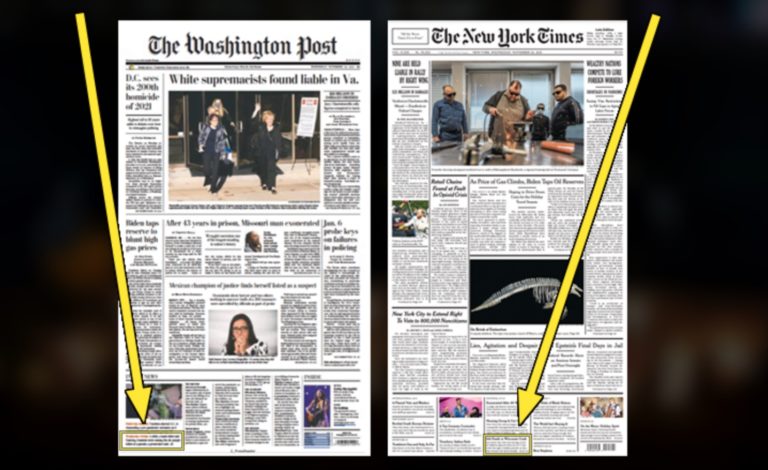
An analysis by the Washington Free Beacon shows that the mainstream media, unlike its obsession with the Kyle Rittenhouse “white supremacist” narrative, has lost interest in the massacre ofsix people and the injury of 40 more at a Christmas parade in Waukesha, Wisconsin, a suburb of Milwaukee.
On Sunday, Darrell Brooks, 39, allegedly plowed his maroon SUV through the parade, running over grandmothers and children alike, and creating a horrific scene that was described by CNN, MSNBC, CBS, The Washington Post, and other outlets as an “incident” and a “crash.”
The driver of the SUV was not white, and the corporate media has quickly lost interest, barely mentioning the sixth death, that of a child, on its front pages on Wednesday.
Instead, the Washington Post led with a story about white supremacists, as did the New York Times, writing about a 2017 Charlottesville, Va. rally during which James Alex Fields Jr. rammed his car into a crowd of counter-protesters, killing one and injury 35.
After Sunday’s attack, Brooks was officially charged on Tuesdaywith five counts of first-degree intentional homicide, and a sixth charge was expected after the death of the child. Waukesha Police Chief Daniel said, “This is not a terrorist event.”
Brooks, who had been released on previous charges, is the product of the progressive criminal justice reform movement, similar to what Alaska Gov. Bill Walker signed into law with Senate Bill 91 in 2016, which was repealed by the Alaska Legislature and Gov. Mike Dunleavy as one of their first acts in 2018.
Brooks was let out of jail after having two weeks earlier allegedly punching and running over his girlfriend said to be the mother of his child.
Wednesday’s edition of The Washington Post mentioned the mass slaughter at the bottom of the front page, and the Times also positioned it at the bottom of Page One, calling it a crash.
“CNN, meanwhile, was not featuring a single story about the Waukesha tragedy on its homepage as of Wednesday afternoon. The news network, however, did prominently feature an ‘analysis’ piece headlined ‘Biden spins a message of hope as an anxious nation readies for Thanksgiving,’ as well as a report that former president Donald Trump ‘now has a ninth-degree black belt in taekwondo,'” The Beacon described.
The number of positive Covid cases in Alaska on Wednesday was 138, a 31 percent decrease from last week.
There were 89 people currently hospitalized for Covid in Alaska on Wednesday, which represents 9.4 percent of all hospitalizations. Just eight people are on ventilators due to Covid effects. These numbers are a fraction of what they were in September, when Alaska saw spiking hospitalizations and when the state was making national news and being criticized for not having stricter lockdown and masking rules. For example, on Sept. 30, Alaska had 1,270 new cases and 203 hospitalizations due to Covid. On Nov. 1, there were 1,547 new cases and 202 hospitalizations.
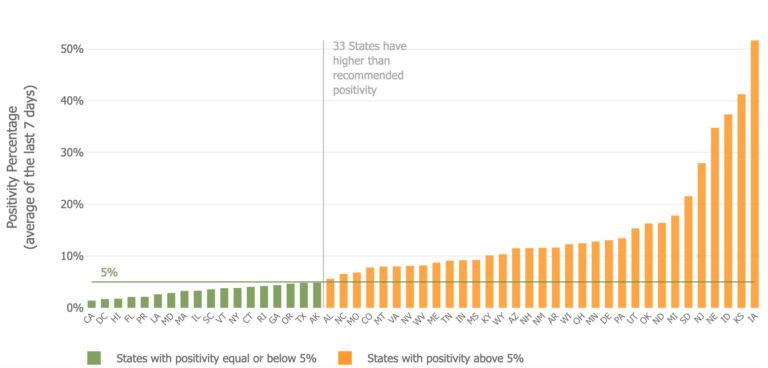
According to Johns Hopkins University, Alaska has made the coveted list of those states with the lowest rate of positivity, at 4.84 percent.
The World Health Organization advised governments that before reopening, rates of positivity in testing (ie, out of all tests conducted, how many came back positive for Covid-19) should remain below 5% for at least 14 days. Alaska has reached that goal.
For comparison, Florida’s positivity rate is quite low at 2.2%, while Idaho, where the virus is spiking, is over 37%.
Alaska’s own data dashboard has Alaska’s positivity rate higher — at 5.7 percent. And the state dashboard still has nearly the entire state in the “red” zone of high transmissibility.
On the hospital capacity dashboard, nearly all intensive care units in the state are open, with the exception of Providence Medical Center, which is at capacity. All non-ICU units are open.
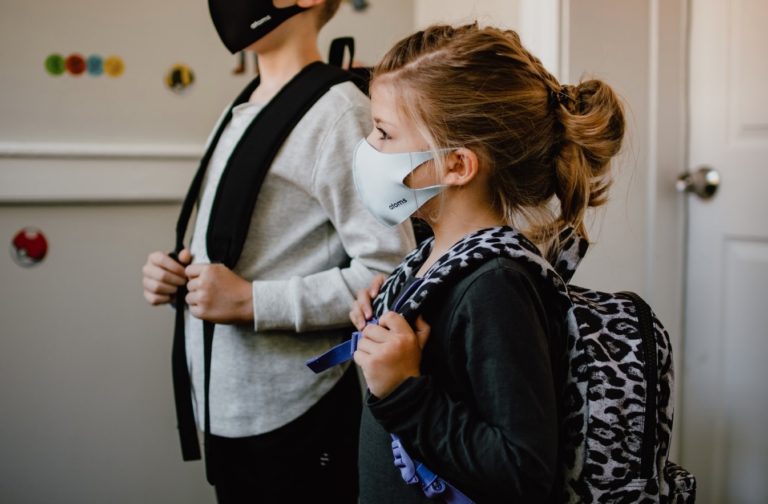
Where are the goal posts? How and when will the children of Anchorage be able to breathe freely again in school?
The Anchorage School District Board and superintendent may not be able to make this decision rationally. If asked, they will point to recommendations from the now discredited Centers for Disease Control and Prevention. They will direct your attention to a fancy colored CDC chart with indicators for risk of introduction and transmission of Covid-19 in schools.
Such indicators include number of new cases, percentage of positive PCR tests, percentage of hospital beds occupied and beds occupied by Covid patients. This decision matrix is fuzzy at best and it’s a bit hard to tell which way the wind is blowing the flags on top of the posts.
Reflecting on a few short months ago, the district conducted a Covid-free and mask-optional summer school. We thought we might be done with the mask mandate insanity.
Then Superintendent Deena Bishop huddled up and had conversations. Bishop claims she based this decision to mask up the kids for the fall of 2021 on conversations with staff and members of the community.
I am not aware of any survey asking for public or school district employee input. My opinion was never solicited. Nobody I know was asked to give their two cents. Bishop’s mask mandate e-mail announcement was issued Saturday July 31 at 7 pm. The only board meeting before the start of school was on Aug. 3, where in-person testimony was overwhelmingly against the mandate. Aug. 17 was the first day of school this year.
Make no mistake, this is Bishop’s mandate we currently enjoy. The superintendent made the recommendation to the school board and they took her advice.
The view of the end zone suddenly became blurry and undefinable at that point.
Every athlete or team that takes a beating on the field is reminded by their coach, not to hate the opposing players, instead direct your anger toward the game. It is not an easy perspective to achieve given all of the bad calls and late hits that have been made by the opponent.
This is, unfortunately, not a game. Numbers and statistics are discussed to the point of exhaustion. The failed “lockdown”, “shut out” and “mask up” plays are analyzed, but no apologies are offered. Mistakes have been made. Child development and education have suffered. The children of Anchorage will never get that lost, lockdown spring semester of 2020 back.
Suffering from the delayed academic achievements and social skill deficiencies continue as a consequence today. Look at the test scores. Look at the in-school violence.
As a constant reminder of the failure that is ASD leadership, students continue to suffer under the mask mandate. One should not dwell on the last broken play. The only thing that matters is the next play.
And here it comes. As recently as Nov. 23, a principal sent out a “Mask Wearing Reminder” notice. In that notice it stated “Correct mask wearing always means over the nose and mouth unless eating or drinking” (when Covid apparently is unable to spread or be caught). The notice goes on to say, “Students who fail to comply with wearing their mask properly will receive detention. It is important that we continue to enforce the districts universal mask wearing policy.”
One of only two possible situations can exist here. Option one: Either we have a huge outbreak of a virus which is 99.997% harmless to the 19 and under age group or, Option two: This is all about compliance, universal compliance.
I figured the numbers on the ASD web site would surely tell the story — and boy do they ever. ASD maintains a list of every ASD school, updated in real time and it reflects the number of active Covid cases involving both students and staff that are in a 10-day isolation situation with a confirmed positive Covid test.
Of the 103 ASD schools, 32 of them had zero active Covid cases on Nov. 23, 2021.
Twenty-eight additional schools had only one active Covid case. The most that any single school had was 9 Covid cases.
Translation: 58 percent of ASD schools have one Covid case or less. If one or less cases in a school is not the goal, then only zero cases must be the goal.
But no. The previously mentioned principal’s letter came from a high school with zero Covid cases. I think the Anchorage School District is running the “Option Two” play in this situation.
It’s not the players, it’s the game. There is no recognition of individual schools and their unique statistics. This is like saying, “The second place team in the Super Bowl is a bunch of losers,” even though they have nine future Hall of Fame players on their active roster.
Currently, 32 schools with zero Covid must continue to suffer the mask mandate, as they are on the losing ASD team under the rules of this game.
The rules need to be changed. Anything done in the name of universal compliance has got to be an automatic question mark in a rational mind.
There is a young generation of Anchorage students who know of no other type of school except the masked kind of school. The damages to academic achievement and social development are real, especially for the youngest students.
Are the school board and superintendent nimble enough to make changes to their own mask mandate policy? Remember, this is not a CDC policy. This is an Anchorage School District policy. They demonstrated that they have the ability to call an audible and make last minute changes like reintroduction of the mask mandate last fall. In the second half of the 21/22 season will the ASD leadership be able to move the ball the other direction?
If you could run in the next play from the sidelines, you might tell the ASD quarterback to make masking up optional when a school has one or fewer active cases of Covid-19. Or maybe 5 or fewer cases should be the threshold since we are just making up rules as we go for the last couple years. This really needs to be addressed on an individual school basis. The universal policy approach does not acknowledge the conditions on the ground or within the confines of a single school.
The Anchorage School District has a School Board Meeting on its schedule for Monday Dec. 6 at 6pm. I would hope that enough people express their concerns, and that logic and reason prevail. It is possible that we can give the kids here an early Christmas present and win the Covid Bowl. Eliminating the universal useless and harmful mask mandate could be the play that breaks the game wide open.
Dan Smith is a lifelong Alaskan and Anchorage residentand senior contributor at Must Read Alaska.
Due to a new variant of the Covid-19 virus, the Biden Administration on Monday will ban travel to the United States from South Africa and seven other countries, according to numerous news organizations, which cited unnamed Administration officials.
The ban also pertains to Botswana, Zimbabwe, Namibia, Lesotho, Eswatini, Mozambique, and Malawi. The administration’s decision was advised by Dr. Anthony Fauci, the president’s chief medical adviser, and the Centers for Disease Control and Prevention, according to Politico. The new variant of Covid, which the World Health Organization has called omicron, is also known as “B.1.1.529.”
Fauci said Friday there is no indication that the new variant is already in the United States, although other medical professionals say it’s likely already landed. It has already been detected in Belgium.
Do travel restrictions work? Early in the pandemic, President Donald Trump put travel restrictions on China, but the virus still quickly found its way to the United States.
The new variant is believe to have a greater ability to evade the vaccines in use now to combat the original Covid virus and the Delta variant. It is also believed to be more transmissible and more severe.
The stock market fell in response to the news about the new variant. The Dow Jones Industrial Average fell 900 points, or about 2.53 percent.
History does not repeat. Yesterday will never be today or tomorrow, but historic patterns do repeat. History shows a pattern of the nations’ emergence, growth and decline. It provides facts and allows us to search for underlying causes of historic events.
Elected government officials, policy makers, educators and the society at large must clearly understand that ignorance, irresponsible government mandates and ignorance of historic patterns may create an irreversible socio–economic schisms.
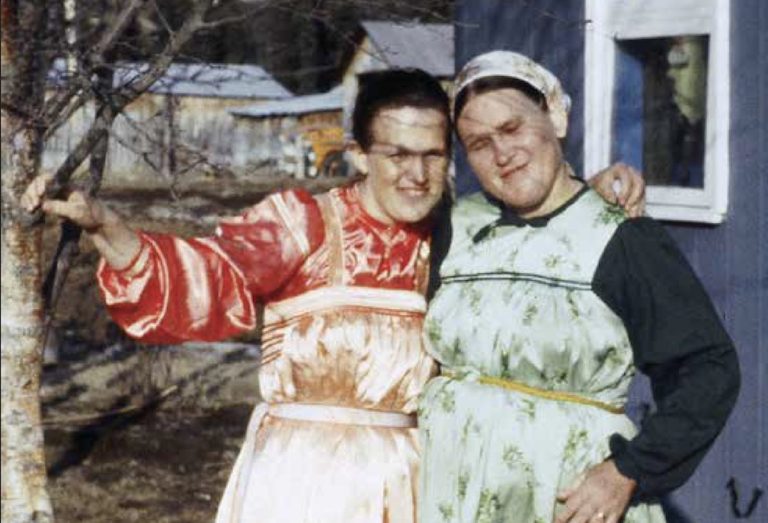
The “Great Schism” of the Russian Orthodox Church may serve as a living example of possible societal disasters and dislocation of millions of people. Russian Old Believers in Alaska, and elsewhere, are victims of this type of authoritarian and tragic historic event.
Alexander Dolitsky
The Mongolian domination, the shift of Russian statehood northward, and isolation of the Russian Orthodox Church from Byzantine theology, led to a decline of learning, which resulted in many errors in translating the Holy Texts from Greek into Church Slavonic. As early as the mid–16th century, attempts were made to correct the errors in order and attain conformity in rituals.
Only in the mid–17th century (1652–66), however, were the Russian Orthodox Church and all of Russia shaken to the core by what has since been called the “Great Schism” (Raskol). At the time, Nikon (1605–1681), a strong–minded patriarch, scholar and strict disciplinarian, wanted to correct the Holy Texts by introducing revisions in the church books and liturgical practice, which the masses had used since the inception of Christianity in Russia in the 10th century.
These changes revised church books where errors, marginal notes, and mistranslations had occurred over time. They also included revising several of the actions the faithful and illiterate peasants had internalized as part of the mystical context of their worship.
Nikon demanded that church practices conform at every point to the standard of the four ancient patriarchates, and that the Russian service books be altered wherever they differed from the Greek.
In 1653, Nikon sent a memorandum to churches across the land, instructing them in various revisions. Among major points of contention were: (1) how many fingers would be used to make the sign of the cross—two or three. The conservatives maintained that the sign of the cross with two fingers rather than three (the latter being the proposed reform) signified the dual nature of Christ. They cited many old icons where Christ and the saints were depicted with the two-fingered sign. The three-fingered sign was intended to acknowledge the Holy Trinity.
But this was considered by the conservative dissenters to represent Greek heresy; (2) the spelling of Jesus’ name, (3) whether “Alleluia” should be sung two or three times; (4) the retention of certain words and phrases in the Creed, (5) the number of hosts to be used in the liturgy; and (6) whether the priests should walk around the altar with or against the passage of the sun. This policy was aimed at those who regarded Moscow as the Third Rome and Russia as the stronghold and norm of Orthodoxy.
By establishing Greek practices in Russia, Nikon also pursued a second goal: to make the church supreme over the state. The Russians certainly respected the memory of the Mother Church of Byzantium from which they had received the faith, but they did not feel the same reverence for contemporary Greeks.
This may seem a trivial matter, but in the eyes of simple believers a change in a symbol constituted altering the faith.
Changes proposed by the Patriarch Nikon became the focus of opposition for those who held onto the old ritual. Labeled Raskolniki (people of the schism) by the reformers, they called themselves Old Believers (Starovery) or True Believers. Old Believers stubbornly pointed out that they were not splitting from the church, but that the reformers were drawing the church away from the true Orthodox rituals. No doctrinal point, however, was involved in the schism.
Many Russians stubbornly opposed the changes in rituals simply because Nikon promoted them. Others refused to conform to them, strongly questioning the authority of the patriarch to make such alterations. After all, the Orthodox Church, with the purity of its apostolic succession traced to St. Andrew, had protected itself from the “Roman Heresy” and had steadfastly remained untainted while Constantinople, the capital of Byzantium, or the “Second Rome,” fell into the hands of the Turks in 1453.
While Moscow increased its power, independence and territories, in particular the acquisition of Kiev in 1667, many favored the concept of Moscow as the “Third Rome.” Having preserved its purity, while the others had lost theirs, Russian Orthodoxy was believed by the Russians to be the only remaining survivor of the true church and they counseled a deliberate withdrawal from Greek tutelage.
Given these considerations, how could Patriarch Nikon dare to order changes? Opposition to the innovations was also tied to an important psychological factor: the traditional forms and familiar routines provided a sense of security. The people, insecure amid chronic religious disorders, bitterly opposed new and further efforts to uproot old rituals.
Old Believers thought that the Russian state was of the Antichrist and that the end of the world was at hand. They also believed that the Antichrist’s evil spirit was at work through Nikon and the Tsar Alexis himself was the Antichrist. This belief demanded resistance to the state and the official church—the instruments of the Antichrist. For, in both symbolic and practical terms, the faithful were not to submit to his power.
Though the schism was basically a religious phenomenon, it involved broader socio-political factors. In order to understand this historical event, one must realize that the church was not an isolated institution within the state, but part of the ideological norms and values of 17th-century Russia.
Two distinct classes of clergy in the Russian Orthodox Church controlled social and political attitudes. Parish priests, known as white clergy because of the white garments they wore, represented the common people and peasants in many ways. They served two masters—the village commune that selected and paid them and limited their actions, and the higher ecclesiastics by whom they were taxed.
The higher clergy, called the black clergy, were all monks. They were the servants of the tsar, just as the white clergy served the villages. White clergy could never hope for promotion to the places of power and wealth, such as the bishoprics and archbishoprics, since these were the monopoly of black clergy.
Between the black and the white clergies existed an almost unbridgeable gap and constant controversies. Rebellions against the authority of the higher churchmen were frequent, and there was persistent opposition from the white clergy toward efforts to increase and centralize clerical authority. These efforts climaxed during the Patriarchate of Nikon (1652–58).
In fact, he was not the first to attempt to adopt changes in the Russian Church, nor did his efforts initially arouse opposition. But his reforms became the immediate cause of the “Great Schism,” partly because he had many personal enemies who used the controversy to eliminate Nikon from the center of Church authority. In 1658, Nikon withdrew into semi-retirement but did not resign the office of Patriarch. For eight years, the Russian Church remained without an effective head, until Tsar Alexis requested a great council in Moscow between 1666–1667 over which the patriarchs of Alexandria and Antioch presided.
The author with an Old Believer.
The specific opposition to Nikon’s reform was at first confined to the higher (black) clergy, but under the leadership of Nikita Dobrynin and Archpriest Avvakum, the movement spread widely to the streets of Moscow and beyond. Avvakum and his followers regarded the tiny changes in spelling suggested by Nikon as a cardinal criterion of Christianity as such, and a portent of the coming of the Antichrist.
By mobilizing Russians against the official church and against Nikon, the early Old Believers helped lay the intellectual foundations of Old Belief and Old Russia Text. Old Believers had a large following, which included both ordinary laymen and prominent members of the local church hierarchy. As a result of the popular rebellion against the church, Patriarch Nikon lost the favor of Tsar Alexis and his enemies removed him from control of the church, but the quarrel raged on between those who supported the changes and those who opposed them.
Finally, the Church Council called in 1666–1667 decided in favor of Nikon’s reforms, but against him personally. Violence began almost at once and was marked by monstrous cruelties for four decades. Nikon’s changes in the service books and above all his ruling on the sign of the Cross were confirmed, but Nikon himself was deposed and exiled; a new patriarch was appointed in his place. The Council was, therefore, a triumph for Nikon’s policy of imposing Greek practices on the Russian Orthodox Church, but a defeat for his attempt to set the patriarch above the tsar.
Tsar Alexis sided with reformers and eventually approved the reforms, making refusal to conform not just an offense against the church, but a civil offense as well. He openly waged campaigns against the conservatives. Tsarist approval of the church reforms involved political motivations, such as national independence from the Byzantium and Greek Orthodoxy influence, governmental control of the ideological institutions, the long process of territorial growth of the Russian state and continuing efforts of political and economic centralization of Russian lands under Moscow authorities.
The schism and purge also weakened the church and later made it easier for Peter the Great (1672–1725) to subordinate it in order to strengthen his autocracy and enforce new socio-political reforms in Russia. Peter the Great identified himself with the official church by placing it under the rule of the absolutist state. In 1721, the tsar abolished the patriarchate as well as the church council and assumed the position as supreme head of the church through control of a chief procurator called “The Tsar’s Eye.” Peter sought not only to deprive the church of leadership, but also to eliminate it from any participation in social and government work.
Because the power of the tsar stood behind the Church Council of 1666–1667, the schismatics were in fact rebels against both church and state. To oppose imminent unrest among Russian masses, the government searched for and punished the most active rebels. Archpriest Avvakum, the most instrumental and effective leader of the Old Believers, was burned at the stake in 1682 after having been exiled for 10 years and imprisoned for 22. From then on, the decree of 1685, issued by the Regent Sophia, sanctioned burning at the stake and jailing or exiling those who preached old beliefs and refused to repent. In protest, whole communities of Old Believers often would lock themselves in their wooden chapels and set them on fire, preferring self-inflicted death.
A prominent Russian historian of the 19th century Nikolay Kostomarov (1817–1885), preserved a graphic account of a case which manifests how and why the Raskol became so contentious:
“It was in Tumen, a town in Western Siberia; time, Sunday morning. The priests were celebrating the mass in the cathedral on the lines of the new missals, as usual. The congregation was listening calmly to the service, when, at the moment of the solemn appearance of the consecrated water, a female voice shouted, “Orthodox! Do not bow! They carry a dead body; the water is stamped with the unholy cross, the seal of Antichrist. The speaker was a female Raskolnik, accompanied by a male coreligionist of hers, who thus interrupted the service. The man and woman were seized, knouted in the public square, and thrown into prison. But their act produced its effect. When another Raskolnik, the monk Danilo, shortly after appeared on the same spot and began to preach, an excited crowd at once gathered around him. His words affected his audience so deeply that girls and old women began to see the skies open above them, and the Virgin Mary, with the angels, holding a crown of glory over those who refused to pray as they were ordered by the authorities. Danilo persuaded them to flee into the wilderness for the sake of the true faith. Three hundred people, both men and women, joined him, but a strong body of armed men was sent in pursuit. They could not escape, and Danilo seized the moment to preach to them, and persuade them that the hour had come for all of them to receive “the baptism of fire.” By this he meant they were to burn themselves alive. They accordingly locked themselves up in a big wooden shed, set fire to it, and perished in the flames—all the three hundred, with their leader.”
Another graphic account of Old Believer opposition by means of collective self–mutilation was described by French historian Henri Troyat:
“Some sectarians slept in coffins, others flagellated each other, still others condemned themselves to eternal silence, castrated themselves, cut one another’s throats, or locked themselves up in a house with their families, set fire to piles of straw, and perished in the flames singing hymns to be sure of entering paradise. Under pressure from their fanatical parents, children would say: ‘We will go to the stake; in the other world we will have little red boots and shirts embroidered with gold thread; they will give us all the honey, nuts, and apples we want; we will not bow down before the Antichrist.’ Soldiers were sent to prevent these autos-da-fe [ritual of public penance]. But their arrival only precipitated the madness of the fanatics, who would throw themselves by hundreds into the purifying flames. The most reasonable of the schismatics sought refuge in the forests, organized themselves into autonomous communities, and lived soberly by their labor, refusing the aid of the priests and professing among themselves the faith of the ancestors. Thus, Russians’ heresy included a whole psychological spectrum, from demented excesses of some to the quiet protest of others.”
Although many were purged, the movement to preserve Old Orthodox rituals still persisted. Many risked persecution, exile or death rather than give up old rituals and traditions. As the government embarked upon the repression, most rebels fled from the major population areas of the Russian State.
Their protest was soon to be eclipsed by other problems that beset the growing and developing Russian nation state. As Russia lumbered through its wars and social strife, the Old Believers took refuge in undeveloped areas of the country, thereby avoiding persecution for their continued lack of obedience to the tsar’s commands. Periodic reprieves and attempts to re-incorporate these people as yedinovertsy (monobelievers) met with only moderate success.
Thus, Old Believers came to represent the groups that rejected the church reforms and found themselves in opposition to the established Orthodox Church and Russian tsarist authorities.
Indeed, lessons and historic patterns must be learned from the “Great Schism” in order to apply them to modern American socio-economic disputes.
Alexander B. Dolitsky was born and raised in Kiev in the former Soviet Union. He received an M.A. in history from Kiev Pedagogical Institute, Ukraine, in 1976; an M.A. in anthropology and archaeology from Brown University in 1983; and was enroled in the Ph.D. program in Anthropology at Bryn Mawr College from 1983 to 1985, where he was also a lecturer in the Russian Center. In the U.S.S.R., he was a social studies teacher for three years, and an archaeologist for five years for the Ukranian Academy of Sciences. In 1978, he settled in the United States. Dolitsky visited Alaska for the first time in 1981, while conducting field research for graduate school at Brown. He lived first in Sitka in 1985 and then settled in Juneau in 1986. From 1985 to 1987, he was a U.S. Forest Service archaeologist and social scientist. He was an Adjunct Assistant Professor of Russian Studies at the University of Alaska Southeast from 1985 to 1999; Social Studies Instructor at the Alyeska Central School, Alaska Department of Education from 1988 to 2006; and has been the Director of the Alaska-Siberia Research Center (see www.aksrc.homestead.com) from 1990 to present. He has conducted about 30 field studies in various areas of the former Soviet Union (including Siberia), Central Asia, South America, Eastern Europe and the United States (including Alaska). Dolitsky has been a lecturer on the World Discoverer, Spirit of Oceanus, andClipper Odyssey vessels in the Arctic and sub-Arctic regions. He was the Project Manager for the WWII Alaska-Siberia Lend Lease Memorial, which was erected in Fairbanks in 2006. He has published extensively in the fields of anthropology, history, archaeology, and ethnography. His more recent publications include Fairy Tales and Myths of the Bering Strait Chukchi, Ancient Tales of Kamchatka; Tales and Legends of the Yupik Eskimos of Siberia; Old Russia in Modern America: Russian Old Believers in Alaska; Allies in Wartime: The Alaska-Siberia Airway During WWII; Spirit of the Siberian Tiger: Folktales of the Russian Far East; Living Wisdom of the Far North: Tales and Legends from Chukotka and Alaska; Pipeline to Russia; The Alaska-Siberia Air Route in WWII; and Old Russia in Modern America: Living Traditions of the Russian Old Believers; Ancient Tales of Chukotka, and Ancient Tales of Kamchatka.
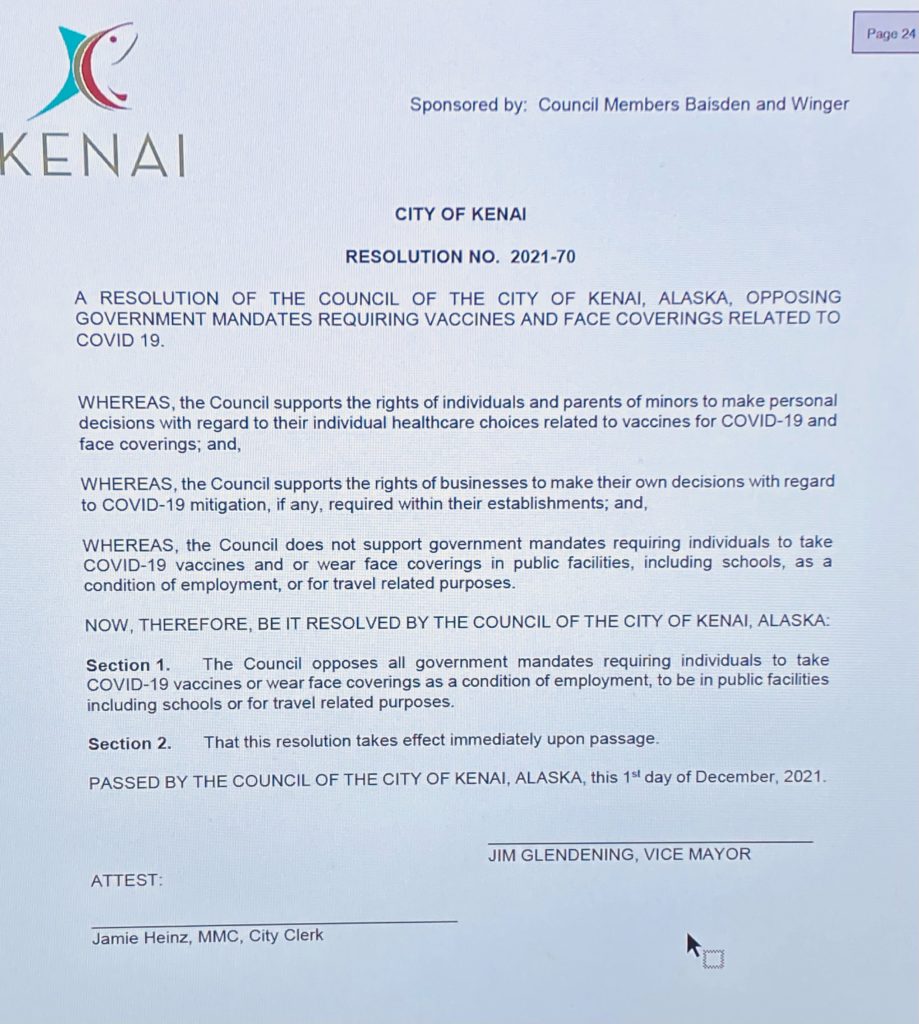
Members of the Kenai City Council will consider a resolution next week to oppose government mandates requiring people to become vaccinated against Covid-19 or to wear face coverings as a condition of employment or for access to public facilities, including schools or travel-related purposes.
The resolution doesn’t take a stand about the effectiveness of vaccines or face coverings in combating Covid and its spread, nor does it discuss any risks associated with vaccines, but instead supports the choice of individuals and private businesses to manage their own decisions about the worldwide infection.
The resolution is being offered by Council members James Baisden and Teea Winger and will be taken up at the Dec. 1 meeting, and would take effect immediately once approved.
Providence Alaska Medical Center moved from “red” to “orange” level on Wednesday, which means limited visitors will be allowed after the no-visitor policy that had been in effect for many months due to Covid-19 case loads.
Alaska Regional Hospital had relaxed its visitor policy last week.
Neither hospital allows visitors for Covid-positive patients except pediatric, maternity, and end of life.
Mat-Su Regional Medical Center is still not allowing visitors except in limited circumstances, including maternity. Also,
OB patients may have one designated labor support person.
Children under 18 years of age may have two designated caregivers.
Patients who are at end-of-life.
Patients with disabilities or special needs are reviewed on an individual basis.
Patients seeking care in the emergency department will not be able to have a support person accompany them to the treatment room, unless the patient is a minor or has special needs.
“Peeling the onion” is an expression often used as a metaphor for digging deeper into an issue or not accepting something at face value.
There is no denying that that the history of Thanksgiving has been typically portrayed as a romanticized account of the encounter and relationship of European colonists and Native Americans in the 1600’s.
The decimation of entire tribes resulting from conflicts between European settlers and Indigenous peoples and diseases introduced into America, was largely left out of history books. Fortunately, that is changing and there is growing acknowledgement of the contributions of Native Americans and their part in American history.
Similar historical inaccuracies have occurred over time with Black Americans and other minorities.
But, in their zeal to amend history, many have painted our Founding Fathers and America itself, as irredeemably racist. Critical race theory has infiltrated corporate culture and our education systems. In some school districts, kids are told that skin color is their primary defining characteristic and that virtually everything they have been taught, including mathematics and science, is racist. And one of America’s most treasured holidays, Thanksgiving, is nothing more than celebration of white supremacy.
History is more complicated than that. Nothing about human history is ever as simple as it appears. Recognition of what we did wrong, as well as what we did right, is part of understanding the nuance and complexity of the many layers of history.
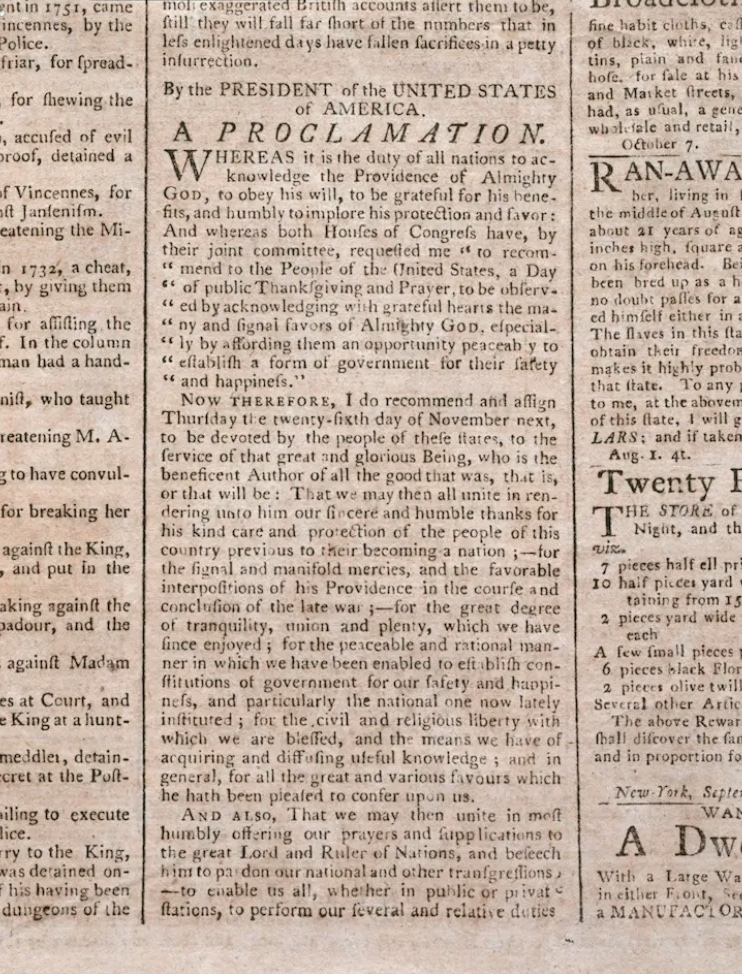
Over 200 years ago George Washington recognized several noble reasons for Americans to express thanks.
In his 1789 National Thanksgiving Proclamation, our first president gave thanks for “civil and religious liberty”, God’s “kind care” and “His Providence”. His purpose was to celebrate both the end of the Revolutionary War and the recent ratification of the U.S. Constitution.
In 1827, the noted magazine editor and prolific writer Sarah Josepha Hale — author of the nursery rhyme “Mary Had a Little Lamb” — launched a campaign to establish Thanksgiving as a national holiday. For 36 years, she published numerous editorials and sent scores of letters to governors, senators, presidents and other politicians, earning her the nickname the “Mother of Thanksgiving.”
Due to her efforts and others, Thanksgiving eventually took its place as an American traditional holiday. On Oct. 3, 1863, during America’s bloodiest war, President Abraham Lincoln issued a proclamation establishing a national day of thanksgiving on the last Thursday of November. Drafted, at Lincoln’s request, by Secretary of State William Seward, both men hoped the proclamation would help “heal the wounds of the nation” caused by the Civil War while expressing gratitude for a pivotal Union Army victory at Gettysburg.
On Nov. 19, 1863, one week prior to America’s first national Thanksgiving, Abraham Lincoln delivered one of the most memorable speeches in American history. At the dedication of a military cemetery at Gettysburg, Pennsylvania, Lincoln stirringly reminded a war-weary public why the Union had to fight, and win, the war to end slavery. The Gettysburg Address has since become one of the most historically influential statements of American national purpose.
Echoing the sentiments of his Thanksgiving Day proclamation one month earlier, Lincoln recognized the blessings of our country and then thanked those who sacrificed so much, saying in part:
“Four score and seven years ago our fathers brought forth upon this continent, a new nation, conceived in Liberty, and dedicated to the proposition that all men are created equal.… these dead shall not have died in vain—that this nation, under God, shall have a new birth of freedom—and that government of the people, by the people, for the people, shall not perish from the earth.”
That our nation is imperfect, sometimes struggling to live up to those principles, does not detract from our stated purpose or the progress made towards those ideals.
America still remains a beacon of hope and opportunity for millions of people around the world and, on Thanksgiving Day, we should celebrate that.
After retiring as the senior vice president in charge of business banking for Key Bank in Alaska, Win Gruening began writing op-eds for local and statewide media. He was born and raised in Juneau and graduated from the U.S. Air Force Academy in 1970. He is involved in various local and statewide organizations and currently serves on the board of the Alaska Policy Forum.