Another day in court for Rep. David Eastman of Wasilla, who is defending himself against a “lawfare” (legal political warfare) attack by the Left, which is challenging whether he can serve as a legislator due to his membership in an organization that became associated with the Jan. 6, 2021 incident at the U.S. Capitol.
Eastman’s hearing in front of Judge Jack McKenna on Tuesday at 2 pm is not the trial itself, but will involve witnesses and the question of whether the trial can be moved to Palmer Superior Court, closest to where Eastman lives. Eastman has requested a change of venue. It’s speculated by some that McKenna will rule the trial must be in Anchorage, in order to have a more Democrat-voting jury, and the Northern Justice Project, which represents Kowalke, will fight to keep it in Anchorage. The case is 3AN-22-07404CI at this link.
McKenna has ordered the Division of Elections to delay certification of House District 27 election results pending the result of the trial that he has already granted. But he also decided that Eastman could remain on the November ballot. The trial itself is currently scheduled for Dec. 12, although court dates often change.
Before today’s hearing, a crowd may gather in front of the Nesbett Courthouse in the hour preceding the hearing, as civil libertarians from the right side of the political spectrum have put out the word to rally in support of Eastman’s rights under the U.S. Constitution to have his free speech and freedom of association honored.
The case against Eastman is an attempt to get the State Division of Elections to rule that Eastman is not eligible to serve as a lawmaker, since the Oath Keepers, of which he has a lifetime membership, is deemed by some people who call themselves experts to be a group that attempted to overthrow the U.S. government. The complainants say that his membership in that group violates the “disloyalty” clause of the Alaska Constitution.
Although Eastman was in Washington, D.C. on Jan. 6, 2021, he did not go inside the Capitol, but remained at a distance with a group of Alaskans who support Donald Trump. It’s not clear he was in D.C. in his role as a member of Oath Keepers, or simply as a supporter of the former president.
Former Sen. Cathy Giessel, a Republican trying to win back her seat in the Alaska Senate, appeared at a shared event with Matt Claman, who is a hardline Democrat running against Republican Sen. Mia Costello. The event took place in Girdwood on Monday evening at a private home.
This is not the first betrayal of the Republican Party by Giessel, who is also a campaign co-chair for former Gov. Bill Walker, who is not currently registered to vote in either major party.
Giessel took a hardened position against the Permanent Fund dividend and against Gov. Mike Dunleavy, immediately after he became governor. While Giessel was once pro-Permanent Fund and criticized Walker for stealing Alaskans’ share of oil royalties, she has tacked to the left and says that Walker is the right candidate. She also has come out in opposition to a constitutional convention.
Voters removed Giessel in 2020, replacing her with Sen. Roger Holland in what was Seat N, but is now called Seat E. Giessel was one of seven Republicans who lost primary elections for legislative seats in 2020, as voters were fed up with how the Legislature was handling the Permanent Fund dividend.
Due to the magic of ranked choice voting, however, with Giessel now aligned with the far left, she can collect all the Democrat votes from candidate Roselynn Cacy during the second round of counting, if Holland does not win with a 50+1 majority.
As for Claman, he is one of the farthest-left members of the House of Representatives in the Alaska Legislature, and is now challenging Sen. Costello for a newly drawn district, now called Senate Seat H, that may be more difficult for her to win. It stretches up into the super-liberal Turnagain neighborhoods of West Anchorage, where Claman signs have sprouted like dandelions.
Costello has been a committed crime-fighter, leading the charge to roll back SB 91, the catch-and-release bill that was passed by the Legislature and signed into law by former Gov. Walker. That law, which reformed bail and sentencing, led to a massive crime wave across Alaska until Costello forced a repeal measure out of committee so that it could be voted on by the Senate. Gov. Mike Dunleavy signed a repeal the following year. While Costello and Claman had both voted for SB 91, Costello realized the damage it was doing to Alaska and took action, and political risk to get the law repealed, while Claman fought to keep SB 91 in law.
In an opinion piece in the Anchorage Daily News, Claman defended the crime-creating SB 91.
“Public safety has always been an essential government service in our country. ‘Repeal SB 91’ is just an empty bumper-sticker phrase that misleads the public and detracts from the legislature’s bipartisan work since 2014,” Claman wrote.
Claman says Alaskans want a reasonable PFD and no new taxes, but in an Anchorage Chamber forum, he sees that as a choice — a the only way to avoid taxes is to have a small PFD. He is also on record supporting new taxes — he has sponsored income tax legislation, and voted for new taxes.
DURING BILL WALKER TALKS WITH CHINA, ALASKA STATE COMPUTERS ATTACKED BY CHINA UNIVERSITY
The Department of Justice said on Monday the China Ministry of State Security has used at least one fake think tank and U.S. universities to recruit and manage a network of spies in the United States that involve professors, researchers, and law enforcement.
“Over the past week, the Justice Department has taken several actions to disrupt criminal activity by individuals working on behalf of the government of the People’s Republic of China,” U.S. Attorney General Merrick Garland said.
In an indictment, the Justice Department accused Wang Lin and three others of systematic efforts to recruit professors at U.S. universities, as well as former federal law enforcement officials, a state homeland security official, and others, to spy on the U.S. on behalf of the Institute for International Studies at Ocean University of China, which is a fake think tank, and false front for intelligence operations.
Among the operations underway by the China spy network was an effort to force repatriation of Chinese political dissidents living in the United States.
Cases unveiled so far show “the threat the PRC (People’s Republic of China) government poses to our institutions and the rights of people in the United States,” said Assistant Attorney General Matthew G. Olsen of the Justice Department’s National Security Division.
Alaska had brushes with Chinese spying during the Walker Administration. The Chinese government, which signed loan agreements with former Gov. Bill Walker in 2017, would have established Alaska as a “debt trap” province of communist Chinese entities. China began spying on State of Alaska computers during Walker’s overtures to President Xi Jinping, as part of Walker’s quest to get financing for the Alaska Gasline.
During the 2017 Walker-China trade mission and negotiations, Alaska’s state government computers were targeted by China, both before and after Walker traveled to China to get investment agreements from entities owned by the communist government. The hackers were based at a university in Beijing, according to a cyber security firm.
“We also identified network reconnaissance activities being conducted from the same Tsinghua University infrastructure targeting many geopolitical organizations, including the State of Alaska Government, Alaska’s Department of Natural Resources, the United Nations office in Nairobi, and the Kenya Ports Authority. Additionally, we identified the targeted scanning of German automotive multinational Daimler AG that began a day after it cut its profit outlook for the year, citing the growing trade tensions between the U.S. and China. In several cases, these activities occurred during periods of Chinese dialogue for economic cooperation with these countries or organizations,” reported the cyber security company that uncovered the scheme.
Key findings from that security report concluded that Tsinghua University “engaged in network reconnaissance targeting organizations in Alaska, Kenya, Brazil, and Mongolia during times of economic dialogue or publicity around China’s investment in foreign infrastructure projects concerning China’s flagship Belt and Road Initiative (BRI). Further, the company reported that “The network reconnaissance activity against Alaskan organizations increased following the governor of Alaska’s trade delegation trip to China in late May.”
The communist Chinese use of think tanks and universities to steal American technology and innovation also has come through programs such as the Thousand Talents Program.
In 2020, director of the “talents” program was caught using approximately $4.1 million in grants from National Institutes of Health to develop China’s expertise in the areas of rheumatology and immunology. After being interviewed by the FBI, the Chinese scientist fled Columbus, Ohio, where he had been working at Ohio State University, and was arrested by federal agents in Anchorage, while trying to board a jet and escape back to China. Read more here.
The latest arrests of Chinese spies in the U.S. come at the same time that China President Xi Jinping has wrapped up the 20th Congress of the Chinese Communist Party and secured his third five-year term, consolidating power like no other Chinese president before him since Mao Zedong. Over the weekend, Xi forced the retirement of party members who were not considered loyal enough, and replaced them with handpicked members. He now controls the governing committee of the Communist Party and has few checks on his dictatorial powers.
While former Gov. Walker was making deals with Xi, the Chinese dictator was rolling out the forced repatriation program: Operation Fox Hunt, in which he targeted Chinese nationals to force them back to China, by kidnapping, if necessary.
Wang Lin, arrested last week by the Justice Department, had been part of Operation Fox Hunt from 1997 through at least 2018, according to Department of Justice court filings.He and another Chinese national were arrested Oct. 20.
“China describes [Operation] Fox Hunt as some kind of international anti-corruption campaign. It is not. Instead, Fox Hunt is a sweeping bid by Xi to target Chinese nationals who he sees as threats and who live outside of China, across the world. We’re talking about political rivals, dissidents, and critics seeking to expose China’s extensive human rights violations,” said FBI Director Christopher Wray in 2020.
“As these cases demonstrate, the government of China sought to interfere with the rights and freedoms of individuals in the United States and to undermine our judicial system that protects those rights. They did not succeed. The Justice Department will not tolerate attempts by any foreign power to undermine the Rule of Law upon which our democracy is based. We will continue to fiercely protect the rights guaranteed to everyone in our country. And we will defend the integrity of our institutions,” said Garland.
In one of the cases revealed in the indictments, Chinese operatives targeted a professor who was also a former law enforcement and homeland security official. The spies paid for the professor’s trips to China in 2008 and 2018, and attempted to get sensitive fingerprint technology and information from the professor.
“In three separate cases in the U.S. Attorneys’ Offices for the Eastern District of New York and the District of New Jersey, the Justice Department charged 13 individuals, including members of the People’s Republic of China (PRC) security and intelligence apparatus and their agents, for alleged efforts to unlawfully exert influence in the United States for the benefit of the government of the PRC,” the Justice Department wrote.
The indictment in New York included eight counts charging seven Chinese nationals, who of whom were arrest in New York, with participating in a scheme to cause the forced repatriation of a Chinese national residing in the United States. Other defendants remain at large.
In the District of New Jersey, another indictment charges four Chinese nationals, including three Ministry of State Security (MSS) intelligence officers, in connection with a long-running intelligence campaign targeting individuals in the United States to act as agents of the PRC.
“The actions announced today take place against a backdrop of malign activity from the government of the People’s Republic of China that includes espionage, attempts to disrupt our justice system, harassment of individuals, and ongoing efforts to steal sensitive U.S. technology,” said Deputy Attorney General Lisa O. Monaco.
“These indictments of PRC intelligence officers and government officials – for trying to obstruct a U.S. trial of a Chinese company, masquerading as university professors to steal sensitive information, and trying to strong-arm a victim into returning to China – again expose the PRC’s outrageous behavior within our own borders,” said FBI Director Wray.
The Anchorage School District has put itself in a real financial bind. Over the years, the district has lost students while maintaining the same infrastructure.
Now, the school board must make the difficult decisions on how to close a $68 million budget gap. Some solutions put forth include school closures/consolidations, eliminating language immersion classes, and elimination of the gifted Ignite program.
Each of these programs has its own vocal supporters. At its Oct. 4 meeting the board room overflowed with parents and students who were strong supporters of the several language immersion programs. They testified to the value of the programs.
Although these language programs are of value to a small group of students, the question to the board should be, “Can students learn languages just as well without immersion programs?” It is important to look at the greater good; however, expect a huge push back from the supporters.
The most obvious area to target in reducing expenses is the closing/consolidation of excess schools.
The Fairbanks North Star Borough School District did just that when it decided to close three elementary schools for the current school year. It estimated a cost savings of about $1 million per school.
On the other hand, the Anchorage School District estimates only about half a million dollars to close one elementary school.
The district states that today it has 18 schools operating at less than 65% capacity. According to the latest Capital Improvement Plan, 16 of these are elementary schools.
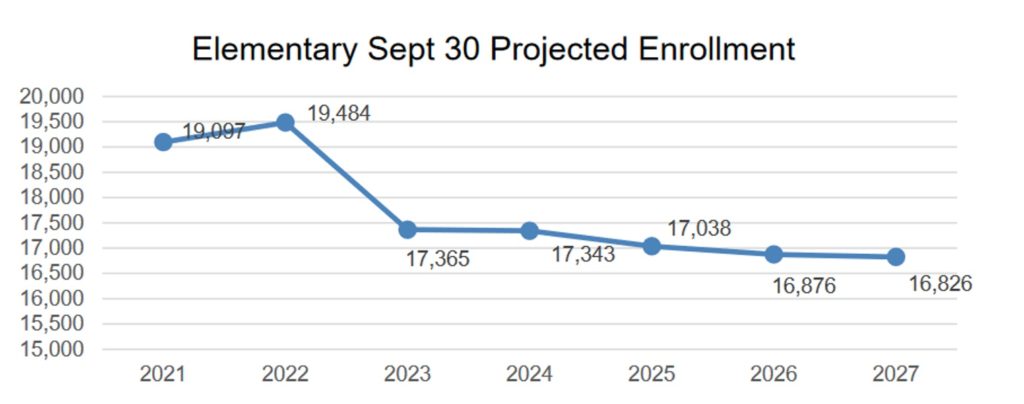
And the number of elementary students is projected to decrease more than 2,500 by the 2027/28 school year.
Add to this a bigger issue—are these the only schools with less than 65% capacity? And how does the district compute school capacity?
One thing for sure, the district does not use the State’s specification of 114 square feet/student for calculating elementary school capacity. Instead, it uses its own specification called “Program Capacity.”
Through this Program Capacity, the district has changed the school capacity metric at least twice during the past 12 years.
As an example, using the State’s specification for Kincaid, Russian Jack and Lake Hood Elementary Schools, each would have a capacity of 536 students. Using the ASD “Program Capacity,” Kincaid would have room for 484 students, Russian Jack would accommodate 399 students, and Lake Hood would hold 515 students.
The total difference is 210 fewer students using the district’s specifications versus the state’s specifications.
By using its own specification, the district has manipulated the data to show that schools are at higher student occupancy rates when there is really excess capacity.
Using Inlet View Elementary School as an example, here is how the district changed its specification over the years. All these data are from the ASD Capital Improvement Program documents. Note there were no substantial changes to the building itself to increase square footage. The building did not shrink.
Inlet View Elementary School Capacity
Year Student Capacity
2011 235
2013 243
2014 271
2015 271
2016 233
2017 170
2022 170
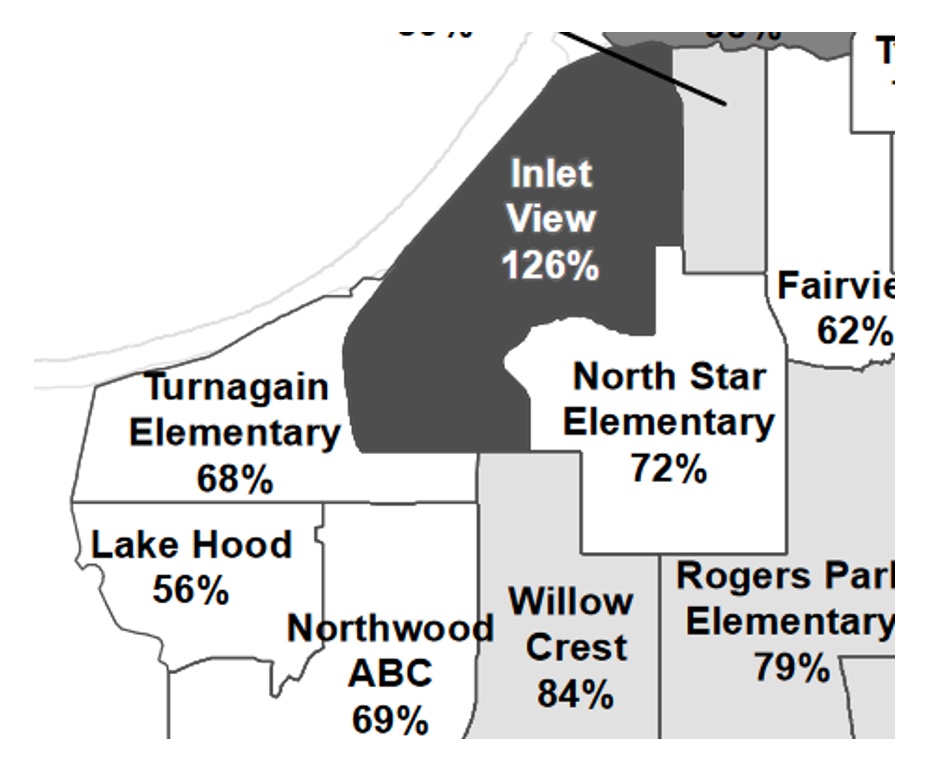
However, even the district’s data show that there is extra space, i.e., buildings, that either need to be closed or repurposed. In the case of Inlet View ES, there are several nearby schools with unused capacity. Here is a map showing how the Inlet View students could be transferred to nearby schools (the percentages are the district’s capacities):
The school district could save monies and at the same time increase the teachers in other schools to meet those students’ needs. If this is true for Inlet View ES, then the significant change in student capacity may be true for other elementary schools.
But the school board, in defiance of Anchorage voters, is unnecessarily considering building a new Inlet View school. Anchorage voters said “no” to this on last year’s ASD bond issue.
Here is a list of the 16 elementary schools with ASD Program Capacity (2022 Capital Improvement Plan) and the State Capacity (114 sq ft/student):
SCHOOL
ASD CAPACITY (%)
STATE CAPACITY (%)
Abbott Loop
65
49
Aurora
58
49
Baxter
49
39
Birchwood ABC
51
48
Eagle River
55
51
Fairview
62
51
Fire Lake
57
54
Homestead
55
60
Kasuun
61
53
Lake Hood
56
53
Mirror Lake
58
—–
Mt View
65
60
Nunaka Valley
58
49
Orion
49
34
Russian Jack
59
51
Wonder Park
55
58
The above State capacities do not make allowances for supplemental capacities but only show the State’s basic square foot allowance per elementary student.
It gets worse.
The total “Program Capacity” for elementary schools today would hold 26,432 students. The actual number of students in 2022 was 19,484, a nearly 7,000 student excess capacity.
There is even a further downward trend in the future until the projected number of elementary students is 16,826 in 2027, nearly 10,000 students fewer than the district’s capacity.
Language immersion, ABC curriculum (Birchwood Elementary School), and the Ignite programs are much more important than the building infrastructure.
It will be difficult for the board to withstand the pressures of the various community interests. But the excess infrastructure needs to be closed/repurposed so revenue can be focused on the classroom—where education happens.
This would benefit the community, especially the students.
David Boyle is an education writer for Must Read Alaska.He is former executive director of the Alaska Policy Forum.
The family of the late Ben Stevens has announced services for the late former senator, who died Oct. 13, while hiking in Seward with his wife Elizabeth.
On Oct. 27, there will be a visitation at Evergreen Memorial Chapel from 5-7 pm.
On Oct. 28, a funeral Mass will be held at the Cathedral of Our Lady of Guadalupe in Anchorage, starting at noon.
A reception will be held after the Mass at the Special Olympics Alaska Jim Balamaci Training Center, 3200 Mountain View Drive, Anchorage, from 3-5 pm.
“The Ben Stevens family is deeply grateful for the love and support that we have received since Ben’s passing. We invite Ben’s friends and other Alaskans to join us in commemorating his life and legacy,” the family wrote.
Stevens was born March 18, 1959 to Alaska U.S. Sen. Ted and Ann Stevens. At the time of his death, he was with ConocoPhillips Alaska as vice president of external affairs and transportation. Before that, he was chief of staff to Gov. Mike Dunleavy, and was president of the Alaska State Senate. He also worked as as a commercial fisherman, operated a tug and barge company, and was president of the 2001 Special Olympics World Winter Games in Anchorage.
The governor has lowered the flag from Oct. 27-29.
Alaska U.S. Sen. Lisa Murkowski, censured by her own Alaska Republican Party more than 18 months ago, is giving the state party’s grassroots leaders the back of her hand.
Or maybe it’s her middle finger. Murkowski is not only battling back against her own state party, which supported her in 2016 but not this year, Murkowski is now going rogue on her Republican donors, who cannot be terribly happy with her move to try to keep House Speaker Nancy Pelosi in power.
Instead of supporting Nick Begich III, who is the Alaska Republican Party’s only endorsed candidate for Congress, Murkowski said the quiet part out loud: She will vote for Democrat Congresswoman Mary Peltola, who was ushered into office via the same open primary and ranked choice voting system that helped Murkowski get to the Nov. 8 general election.
You read that right: Rather than publicly support Republican-endorsed Begich or even the unendorsed Republican Sarah Palin, Murkowski has gone to the other side, and through Peltola, Alaska’s senior senator is supporting Pelosi, President Joe Biden, and the failed policies of the Democrats. If McConnell is supporting Murkowski at this point, then McConnell himself is sending Pelosi another foot soldier.
For Murkowski and the Republicans in Alaska, it’s all over but the shouting.
Murkowski’s valentine to the Democrats came during the weekend when the Alaska Republican Party polled its district officers to decide on whether to censure Sen. Mitch McConnell (R-Kan.) and his Senate Leadership Fund for the air-bombing campaign ads attacking the state party’s endorsed candidate for U.S. Senate, Kelly Tshibaka.
That vote, completed over the weekend, was 49-8 in favor of a strong resolution telling McConnell to cease and desist his attacks on the Alaska Republicans’ candidate. News of Murkowski’s endorsement of the opposing team for office cannot have helped her with any sympathetic Republican committee officers.
Now, the Alaska Republican Party is not only fighting Sen. Murkowski, who has been in office since 2002, it’s fighting Sen. McConnell, Senate Minority Leader.
This is the same Republican Party of Alaska that, in 2021, voted by 77% to censure Murkowski, and to endorse Murkowski’s opponent Kelly Tshibaka. This weekend, the vote to censure Sen. McConnell passed by a whopping 86%. Obviously, the attack ads by McConnell are having the opposite of Mcconnell’s desired effect: He’s irritating the base.
Even without Republicans, Murkowski may have hacked a win out of a tight race. Alaskans ushered in a new “open primary and ranked choice voting system” designed by Murkowski’s top supporters. Since most Alaskans are not aligned with any party, the plan from Camp Murkowski always was to help her sweep up more than enough Democrat and unaligned votes to win in November, and her endorsement of Peltola will help her in that effort.
Murkowski and Peltola represent a state that gave Trump a solid win in 2016 and 2020. This is the black magic of ranked choice voting combined with Murkowski now riding Peltola’s populist coattails.
Over the weekend, the state’s largest Alaska Native political group, Alaska Federation of Natives, endorsed both Murkowski and Peltola. Normally, the Democrat-leaning group would endorse the most leftist candidates running, but in this case, AFN has skipped over the Democrat – Patricia Chesbro – and stuck with middle-left Murkowski, pairing her with progressive Peltola as the champions for AFN’s Native-centric interests.
Murkowski seems determined to put Alaska in the minority in Congress, which is moving almost certainly to Republican control in the November election. With just one at-large seat representing a Republican-leaning state, it seems almost impossible to think that Alaska could elect Peltola, but that’s the ranked choice way. Murkowski has done the math. She knows how this works.
For the 49th state, much is at stake. If the Senate stays under the control of Sen. Chuck Schumer, and if the House flips to GOP leadership, but Peltola wins for the Democrats, Alaska will be in the minority in both the Senate and the House.
Murkowski doesn’t appear to care. She’ll be 66 in May, and 71 during what would be her next election cycle. Chances are this election is her last, no matter which way it goes.
This scenario is all a first for Alaska, but this may also be a first for Republicans at the national level: The highest-ranking elected Republican in the country – McConnell – is doing battle with a state party 3,500 miles away to prevent a state party from being able to self-determine its own Republican candidate.
McConnell may hope for a minority he can control, rather than a majority he cannot, and doesn’t seem to care one iota that his candidate – Murkowski – is now openly batting for the Democrat team.
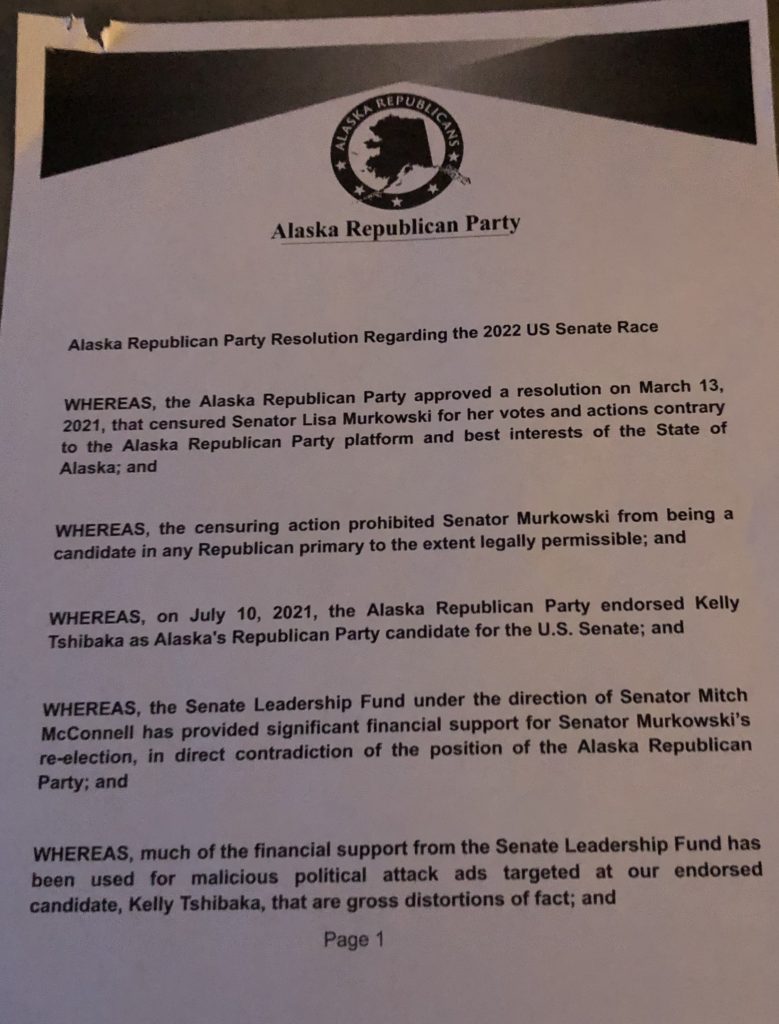
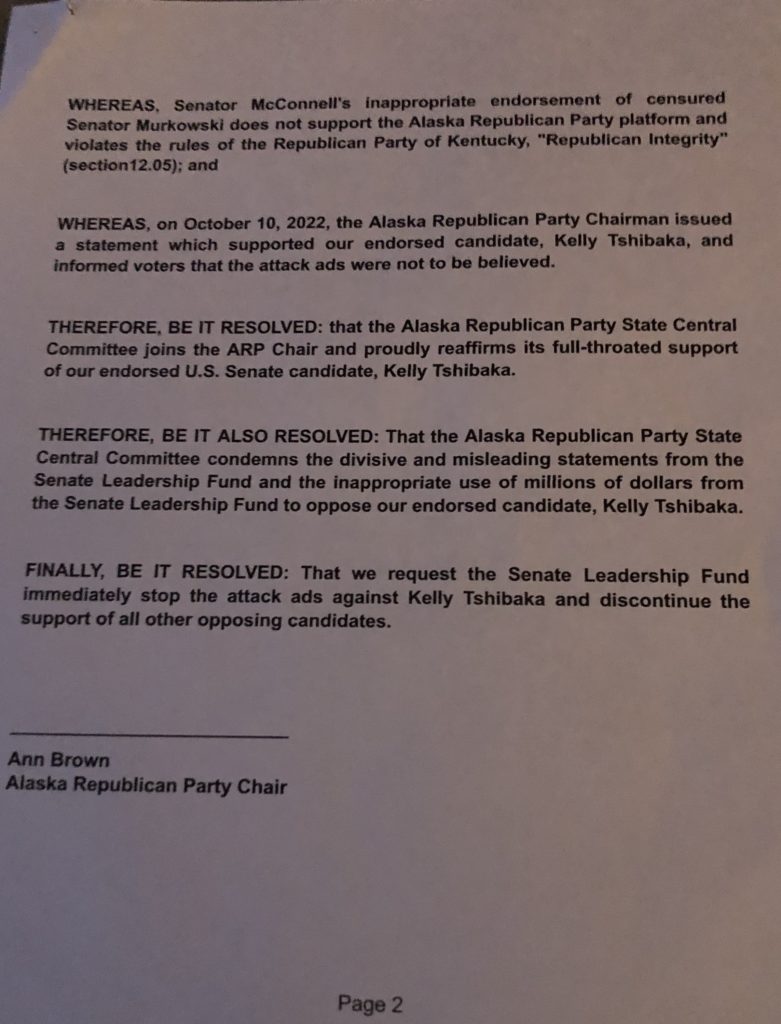
A groundswell from the grassroots has risen and reached the Alaska Republican Party leadership. After voting members of the Alaska Republican Party State Central Committee asked party leadership to take action, the entire body was polled by Chairwoman Ann Brown on whether to censure Sen. Mitch McConnell for bullying Alaska Republican Senate candidate Kelly Tshibaka.
The result was 49-8 in favor of the resolution to censure McConnell and his Senate Leadership Fund for attacking Tshibaka on behalf of McConnell’s favored candidate, Sen. Lisa Murkowski.
Several districts had already conducted separate votes as subcommittees of the State Central Committee. The District 26 resolution requested that the entire party take a vote, which triggered the statewide question.
On Friday night, Chairwoman Ann Brown sent out a note to voting members and balloting began, ending on Sunday evening. Results were sent out to the party’s voting members on Monday morning.
McConnell, who runs the Senate Leadership Fund, has been running anti-Tshibaka ads since Labor Day in his effort to support the reelection of Murkowski. But Tshibaka is the endorsed candidate of the Alaska Republican Party since June of 2021, while Murkowski was censured and asked to leave the party in March of 2021.
“That the Alaska Republican Party State Central Committee condemns the divisive and misleading statements from the Senate Leadership Fund and the inappropriate use of millions of dollars from the Senate Leadership Fund to oppose our endorsed candidate, Kelly Tshibaka,” the resolution reads in part, “Finally, be it resolved that we request the Senate Leadership Fund immediately stop the attack ads against Kelly Tshibaka and discontinue the support of all other opposing candidates.”
The party is unhappy with Murkowski because she works against the party platform and against the best interest of the state she represents, the resolutions says. In an overwhelming vote in 2021, the party’s censure action also prohibited Murkowski from being a candidate in any Republican primary, a condition that has been superseded by Ballot Measure 2, which destroyed the Republican primary.
While the 49-8 vote shows overwhelming for the censure, no subcommittee of the party has risen to defend McConnell’s action against the Alaska Republican Party.
“No one from Alaska wants big shots from the Lower 48 meddling in our elections, and they certainly don’t want D.C. Republicans lying about the candidate who’s been endorsed by the Alaska GOP. Alaska Republicans are telling Mitch McConnell to stay out of it. But this goes to show you who Lisa Murkowski is aligned with. She’s wearing the jersey of the Washington establishment of Biden, Pelosi, and McConnell, and she’s not on Alaska’s team,” said Mary Ann Pruitt, adviser to the Tshibaka campaign.
The vote comes at a time when Murkowski has endorsed a Democrat for Congress. Over the weekend, Murkowski skipped over the two Republicans running for Alaska’s lone House seat in Congress, and endorsed Mary Peltola.
The vote was to be posted on the Alaska Republican Party’s Facebook page, but Chairwoman Brown made no mention about sending it to the National Republican Committee, McConnell, or the Senate Leadership Fund.
Canadians lost their right to protect themselves and their families on Friday, as Canadian Prime Minister Justin Trudeau announced that the ban on the sale, purchase, or transfer of handguns has gone into effect.
“When people are being killed, when people are being hurt, responsible leadership requires us to act,” Trudeau said at a press conference. “Recently again, we have seen too many examples of horrific tragedies involving firearms.”
The ban on handguns was passed by Parliament in May but was just now enacted. Lawmakers in Parliament are still debating the passage of a separate bill that has even more restrictions on guns, including enhancements to “red flag laws,” giving the government more avenues to seize guns from anyone who authorities deem to be dangerous. The proposed law has numerous other curbs on guns, ammunition, and licensing, and bans of alterations of cartridge magazines.
The law is partly a response to an April 2020 mass shooting that resulted in 13 deaths in Portapique and related communities in Nova Scotia. That incident was a 13-hour rampage, the deadliest mass shooting in Canada history; the assailant, driving a fake police car, also killed nine others in a fire he set. The new ban is also a response to the Uvalde, Texas shooting at an elementary school earlier this year.
Canada had already placed bans on 1,500 different types and brands of guns, with legislation from 2020.
“The national handgun freeze is part of the government’s comprehensive plan to tackle gun violence. We have already banned over 1,500 types of assault-style firearms and have strengthened our gun control laws to expand background checks. Bill C-21 proposes further measures to keep guns out of the wrong hands like revoking the firearms licences of those involved in acts of domestic violence or criminal harassment, continuing to fight gun smuggling and trafficking, and providing law enforcement more tools to investigate firearms crimes,” the Trudeau government reported.
“We will continue to do whatever it takes to keep guns out of our communities and build a safer country, for everyone,” the Trudeau government wrote.
Canada’s gun homicide rate is less than one-fifth the U.S. rate, but has been rising, according to the Canadian Centre for Justice and Community Safety Standards. Canada has 70 percent more handguns in 2022 than it did in 2010.
“Firearm-related violent crime represents a small proportion of police-reported violent crime in Canada, accounting for 2.8% of all victims of violent crime reported by police in 2020,” the agency reported.
Alaska Gov. Dunleavy is part of a chorus of Republican governors who sat they won’t adopt the Covid-19 vaccine as a required shot for children enrolled in Alaska schools.
“There are not, nor will there be Covid vaccine mandates for the following reasons,” he said in a note to Must Read Alaska. “CDC cannot mandate them. HSS would have to change regs. They will not. They know my position. Statute would have to be passed by the legislature as well. Won’t happen. I would have to sign it. Won’t happen.”
Last week, the Centers for Disease Control and Prevention’s vaccine advisory committee voted unanimously to recommend a Covid vaccine as part of the regular required schedule for children, who already have a long list of vaccination requirements for school attendance. But even when CDC Director Rochelle Walensky signs off on the order, the matter is still left to the states. Some states have laws that automatically trigger mandates upon the recommendation of the CDC. But not Alaska.
Several other governors — all Republican — have said the Covid vaccine will not be added to their state schedules for children. They include Florida Gov. Ron DeSantis, who said, “I get a kick out of it when people kind of compare it to (measles, mumps and rubella shots) and things that have been around for decades and decades. These are new shots.”
Iowa Gov. Kim Reynolds said, “Under my watch, there will be no COVID vaccine mandates for kids — period. In fact, we signed a law that prevents it. It’s the parent’s decision, not the government’s.”
The Informed Consent Action Network, a Texas-based group that promotes transparency in health information and fights medical coercion, said it will sue any state that adds the mandate for children.