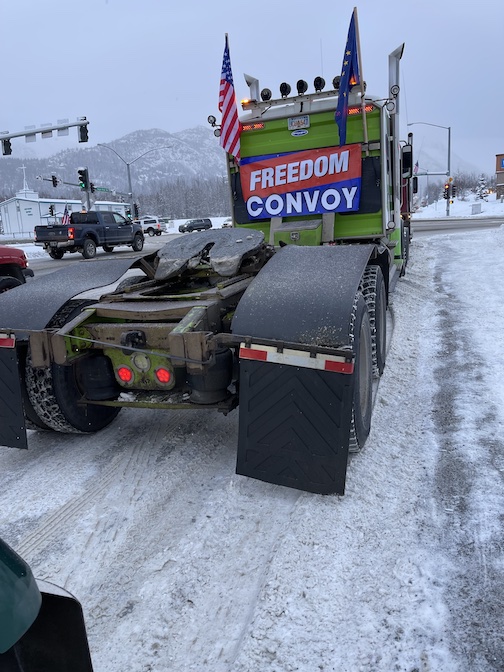
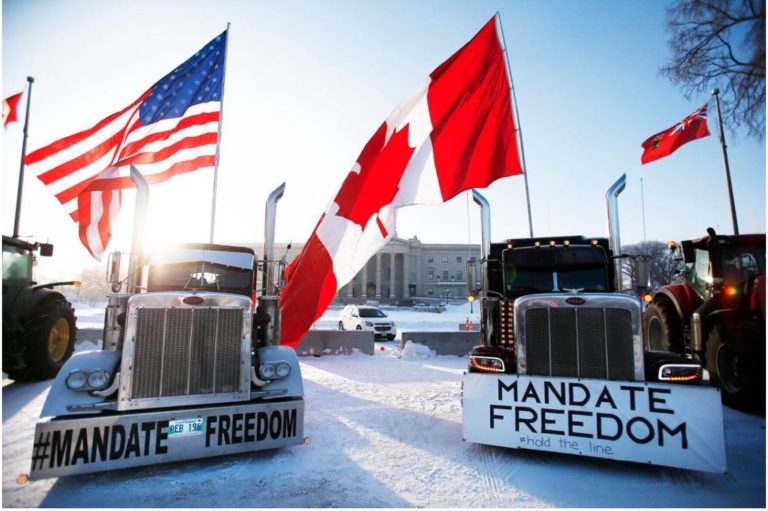
Over a hundred big trucks, and hundreds of smaller vehicles turned out in Anchorage on Sunday for the convoy to Eagle River to show support for the Canadian truckers, who are protesting in Ottawa and at the U.S. border over vaccine mandates.
The convoy, organized by Anchorage Assemblywoman Jamie Allard and others, moved slowly from Cabela’s in South Anchorage, north to Dimond Blvd. and east to the New Seward Highway, joining the Glenn Highway that carried the participants to the Eagle River exit and on to the Lion’s Club parking lot rally location.
Truckers communicated to each other about the route conditions and breaks in the convoy or stoplight delays over their “Haul Road” CB channel. Nick Means, the pilot car driver and one of the organizers, kept a slow and steady pace to ensure everyone stayed reasonably together, and at one point the convoy stretched from C Street by Costco all the way to the Lions Club in Eagle River.
“We need this mandate gone even for what we do,” said Means. “It affects our heavy haul industry to the North Slope with loads that come from Canada and from the Lower 48 that get hauled up to Alaska for the lifeline of our industry. We depend on the oil fields for work.”
Means, who owns Scrap Alaska Pilot Car Services in Wasilla and employs five drivers, was among several who took charge of the event to ensure it went safely and was managed professionally.
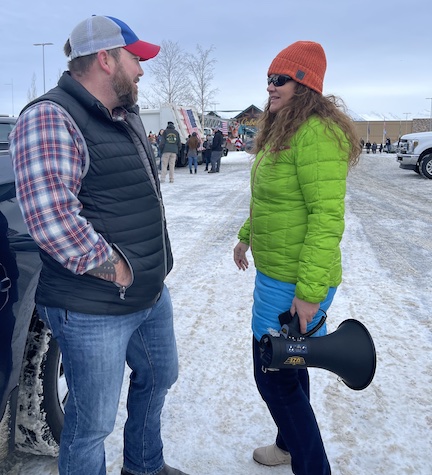
Chugiak-Eagle River Assemblywoman Allard rode in a pilot car and spoke before the rally. Senate candidate Kelly Tshibaka also spoke at the Cabela’s rallying point to a crowd filled with flag-waving patriots, and she challenged Sen. Lisa Murkowski over her record. In Eagle River, U.S. Sen. Dan Sullivan and Anchorage Mayor Dave Bronson joined Assemblywoman Allard on the flatbed truck stage to thank everyone for coming and to state their opposition to government-forced Covid vaccines.
Other organizers included Randi Matheson, a driver who also operates theAlaska Alaska Highway Conditions for Truckers and Pilot Cars Facebook page, which is popular with commercial truckers for real-time road conditions shared in a closed group.
An estimated 400 people took part in Sunday’s convoy, with many more on overpasses waving flags and signs to support the drivers.
Those wishing to financially support the Canadian truckers were encouraged to donate to the new primary site for the distribution of trucker aid at https://www.givesendgo.com/freedomconvoy2022. The group supporting the Canadian truckers has had to abandon the GoFundMe fundraising site because the GoFundMe corporate leaders refused to help the truckers and threatened to withhold the money from the donors. GiveSendGo is the new donation site the Canadian group is using to distribute the aid to help with fuel, food, and other expenses of the Canadian vaccine mandate protesters.
(With thanks to Jimmy Johnson Enterprises for providing bird’s-eye view transportation for Must Read Alaska.)
An Anchorage resident who has a communication position in the Alaska Democratic Party has asked the Anchorage Assembly to take action Chugiak-Eagle River Assemblywoman Jamie Allard, because he says she supports a truckers convoy organized for Feb. 6 in Anchorage.
“I wanted to write this morning to encourage the assembly to take immeidiate action to condem Member Allard’s activity organizing a fundraiser to support white supremacist and terrorism activity. It appears that Member Allard, according to the attached flier, has organized a truck convoy, at the start of Black History Month no less, to raise money in support of the illegal occupation of the Ottawa, the capital of Canada, an ally of the United States by white supremacists, holocost deniers, and racists,” Leon Jaimes wrote to the entire Assembly.
Jaimes is a Democrat activist who was a delegate to the 2020 Democratic National Convention and more recently became chair of the Communications and Social Media Committee for the Anchorage Democrats.
Jaimes quoted the Canadian Parliament’s Black Caucus, which said the Freedom Convoy across Canada over recent days was an “opportunity for White supremacists and others with extreme and disturbing views to parade their odious views in public.”
The Canadian Parliament’s Black Caucus caucus made other false claims that Jaimes quoted in his letter. “This is unacceptable. These displays of hatred and violence offend Canadians and have no place in our country.”
Jaimes went on to say that “Allard has posted pictures of herself with the III% flag flying overhead. The Three Percenters Original National Council was one of the organizations that sent their members to attack our U.S. Capitol on January 6th, 2021…”
As for Allard, she said she isn’t clear who the three percenters are or to what what photo Jaime is referring.
“This behavior by the Member is unacceptable. It is contrary to the interest of Alaksans. In addition to being our allies, much of our supply chain comes through Canada. We should not and cannot afford to be supporting illegal hate and terrorim activities against their national capitol,” Jaimes wrote, apparently quite hurriedly and without checking his work for typos.
Allard, who represents Eagle River and Chugiak on the Assembly, has shared a social media flyer about a truck convoy being held Sunday at 1:30 pm, starting on C Street near Cabela’s and traveling to a rally at the Eagle River Lions Club the to support Canadian truckers who are protesting Prime Minister Justin Trudeau’s vaccine mandates.”
On Sunday, Must Read Alaska’s website will transition to a new design.
While our WordPress development team expects the transition to go smoothly, it’s possible there will be a bump or two as every one of the 7,500 stories, the 128,000 comments, and thousands of digital images and documents migrate into their new categories.
If you see an error on the site, don’t give up, as we’ll be paying attention and fixing the problems that may arise as we go through the design makeover during the next few days.
The website has retained the original design since launching six years ago, and while the format is serviceable, it is time for a fresh look. Our new theme is a modern, cutting-edge news design.
Must Read Alaska launched in 2015 to give a voice to conservatives in the state. At the outset it was a newsletter, and in 2016 it added a website to balance the leftist bias of the mainstream media in Alaska. Today, the website reaches more than tens of thousands of Alaskans every day. The newsletter continues three times a week.
If you are interesting in supporting Must Read Alaska, and getting your ad in front of thousands of conservatives (and liberals) every day, please contact John Quick, Vice President for Business Development, at [email protected].
The Freedom Convoy in support of the Canadian truckers anti-mandate convoy is spreading across Alaska. Drivers should on Sunday expect to encounter long convoys of trucks and cars in numerous communities, to include:
Mat-Su convoy to Anchorage starts at 11 am
Anchorage convoy to Eagle River starts at 1:30 pm
Eagle River post-convoy event starts at 3 pm
Kenai convoy starts at 1:30 pm
Interior convoy w/potluck dinner & BBQ starts at 3 pm
MAT-SU VALLEY: Sunday, Feb. 611am – Depart from Trunk Road Park ‘n Ride and travel to Anchorage to meet up with Anchorage convoy at Cabela’s Rally Route: From Trunk Road Park ‘n Ride, head south (inbound) to Anchorage, left on C St., left on 100th, then take the second right and follow to Cabela’s. Information about the Anchorage to Eagle River convoy is at the bottom of this page.
KENAI PENINSULA: Sunday, February 6th 1:30pm – Depart from the Kenai Walmart (10096 Kenai Spur Hwy)
INTERIOR (Delta, Healy and surrounding communities to Fairbanks): Sunday, Feb. 6 3pm – Join at the Carlson Center or along the route to the second rally point at the Safeway Parking Lot in North Pole; convoy route is from Carlson Center to North Pole Shopping Center:
Leave the Carlson Center towards Airport Way traveling SOUTH on Wilber Street; Turn right on Airport Way traveling WEST past Pioneer Park towards Peger Road; Turn right on Peger Road traveling NORTH toward the Johansen Expressway; Take the On-Ramp onto the Johansen Expressway traveling EAST towards the Steese Hwy; Turn right on the Steese Hwy traveling SOUTH towards North Pole to the Santa Clause Exit;
Plan extra time, depending on participation it may be slow-going, organizers said. The group says its best guess is that the convoy will leaving the Carlson Center at around 4 pm.
The Southcentral Alaska group that is promoting a Freedom Convoy 2022 in support of Canadian truckers opposed to vaccine mandates is gathering momentum. The group will stage their trucks near Cabela’s on C Street in Anchorage on Sunday, starting at 1:30 pm. They plan to drive to the Eagle River Lion’s Club.
The route has changed and may change slightly again, organizers said, but currently is going to go to O’Malley Drive, and then turn onto the New Seward Highway going north. Drivers in the convoy will try to remain in the right-hand lane but will be going slowly to keep the convoy together through the lights starting at 36th Ave. The convoy will turn onto the Glenn Highway and head toward Eagle River.
The mayor of Anchorage, Anchorage Police Department, and the State Departments of Transportation and Public Safety have been advised, and the truck scales by JBER will be closed on Sunday, so trucks may bypass.
Drivers in the Anchorage area should be advised that potentially hundreds of trucks and cars will participate and that the route will be jammed with vehicles of all sizes. There are people planning to be on overpasses waving at the convoy as it passes.
The group of people organizing the event will be raising funds to support the Canadian truckers, but will not be using the GoFundMe fundraising platform, which seized the funds that have already been raised, threatened to forward the donated money to the charities of GoFundMe’s choice, and then came under threat of a fraud investigation by the State of Florida. The GoFundMe platform has disqualified itself for use to support the truckers.
Instead, the Anchorage group is planning to use an alternate fundraising platform that respects the concerns of conservatives. Details on that fundraising method for the truckers will be revealed on Sunday.
A massive coverup is underway by the leftist majority of the Anchorage Assembly. And it is likely to go to court.
Nine Assembly members on Tuesday night approved keeping over 590 pages of requested emails by a citizen member of Reclaim Midtown, an activist group concerned with fraud, waste, and abuse of power.
Some of the emails being kept locked up forever are addressed to a fictitious person named “Tom Sconce,” with an email address set up for Sconce at [email protected]. Some emails are to or from the leftwing blog The Blue Alaskan and the Anchorage Press, or involve those publications.
Other correspondence are between Assembly Members Chris Constant, Felix Rivera, and Austin Quinn-Davidson to a D.C. advocacy lawyer who had neither a letter of engagement or contract with the Assembly nor a license to practice law in Alaska. Those emails are being kept secret under the claim of “attorney-client privilege.”
During Tuesday’s meeting, the Anchorage Assembly went into executive session for two hours, and when they emerged, on a vote of 9-0 they denied allowing citizen Russell Biggs the ability to appeal their decision to black out reams and reams of correspondence between certain members on the Assembly, as well as former acting mayor Quinn-Davidson. Assembly members Jamie Allard and John Weddleton left the room, rather than voting, since the Assembly’s attorney Dean Gates could not adequately explain to them what they were voting on.
Those believed to be involved in the coverup include Assemblyman Chris Constant, Assemblyman Felix Rivera, Assemblywoman Austin Quinn-Davidson, and Assemblyman Forrest Dunbar. It’s not clear if Assemblywoman Meg Zaletel, Assemblyman Pete Petersen, and Assembly Chair Suzanne LaFrance were part of the communications that are now being hidden from the public.
Biggs has argued that the documents “were excessively and unlawfully redacted contrary to Anchorage Municipal Code and state law requirements for transparency of public records.”
It appears that the Assembly’s Attorney Dean Gates is involved in the cover-up, as he struggled to explain the rationale during the public meeting.
Of note, the Anchorage Press was last year awarded a $70,000 sole source contract by the Assembly to do Covid-19 outreach.
BACKGROUND
On April 28, 2021, Biggs filed Public Records Request 2021-11, seeking emails to and from the accounts of: All current Assembly members using these search terms. “Tom Sconce,” “[email protected],” “Blue Alaskan,” and “Anchorage Press.” The date ranges for the emails requested were Jan. 1, 2020 through April 30, 2021.
A batch of the records were made available to Biggs in July. A second batch was not made available until Dec. 17, but when they were sent to Biggs, over 590 pages were redacted, many of those redacted in full. There were no “to” or “from” showing, no dates, no subject lines, and no page numbers. What they sent to Biggs were blank pages.
On Dec. 30, Biggs appealed the heavily redacted disclosures to the mayor on six different bases:
No “slips” were provided to him. These are logs saying what is being redacted that are required by AMC 3.90.060(A).
Casey Pick, one of the people involved in the emails, is an attorney from outside the state acting as a consultant, not an attorney, and the communication is not privileged.
Many of the redactions include “to and from” information so there is no way to know if they are actually communications with an attorney.
The applicable municipal law on attorney client privilege is AMC 3.90.040(A)which only applies to legal questions concerning pending or actual litigation.
Biggs asked for communications referencing specific names and a specific email address. “I find it hard to believe an email mentioning any of these is a communication for the purpose of providing legal advice,” Biggs said.
AMC 3.90.010 adopts a public policy favoring “full disclosure” and Biggs believes any claim of privilege as to these specific records deviates from this policy by making privilege claims on an overly broad basis.
On Jan, 12, The Municipal Attorney Patrick Bergt determined the appeal should go to the Assembly, not the mayor. Biggs then e-mailed his appeal request to Assembly Chair Suzanne LaFrance on Jan. 13.
LaFrance set the appeal for the Feb. 1 meeting, but Biggs was out of the country on vacation, and had limited communication at that point. He asked it be delayed to a later time so he could return. The Assembly leftist majority refused.
In a letter from his attorney, Biggs said he had been given only 14 hours to formulate a response after waiting for many months for the documents he requested.
“Mr. Gates, Assembly Counsel, first provided a privilege log on January 27, 2022. That is nine months after the original request was made. Mr. Biggs is presently out of Alaska, on vacation. He has not had a chance to review the privilege log, compare it to the documents, or consult counsel,” Biggs’ lawyer wrote.
Gates wrote to Biggs that he could provide a statement by noon on Jan. 28. The letter giving Biggs a deadline of Jan. 28 was transmitted by e-mail on Jan. 27 at 10:10 pm, giving him just 14 hours of overnight time to formulate his response.
Many of the emails involving Casey Pick, who is counsel to a LGBTQ organization that advises on transgender youth would not be privileged information, because Pick has no contract with the Assembly.
Pick’s LinkedIn profile says she is a “Senior Fellow for Advocacy and Government Affairs, I help lead our work advancing policies and positions that support LGBTQ youth in crisis by executing the Trevor Project’s advocacy agenda on the federal, state, and local level and in the executive, legislative and judicial branches. This role focuses not just on LGBTQ issues, but also on mental health and suicide prevention overall, with a major focus on leading The Trevor Project’s efforts to end conversion therapy.
“My responsibilities include performing in-depth legal research on questions of state and federal law or administrative policy; managing Trevor’s amicus brief filings; drafting state and federal legislation; and being on-call for rapid-response analysis of new or amended legislation in the states or Congress.”
It is likely that the gay members of the Assembly — Constant, Rivera, Quinn-Davidson (then as acting mayor) and possibly two others were using Pick to advise them on AO 2021-65, the ordinance involving conversion therapy bans for youth with gender identify confusion. That controversial ordinance was the subject of much debate in the summer of 2021, when the emails were being sent. It may be also the case that only Constant was using Pick to advise him, as evidenced in his comments in the video clip above.
What’s also becoming more clear is that certain Assembly members are hiding their involvement with a leftwing blog, The Blue Alaskan, which they have been feeding information to for months. The identity of the owner and publisher of The Blue Alaskan is a secret, but insiders believe Chris Constant, Forrest Dunbar, Felix Rivera, and Austin Quinn-Davidson have an arrangement with the blog to use it as a way to shape their message. Such communications to the media are not privileged information and the redactions of those pages would likely be found illegal by a court. Unless, of course, Bill Falsey is involved. He is the former city manager and city attorney who has a contract with the Assembly to work on land issues, and more recently to defend the Assembly in a separation of powers issue.
Biggs’ attorney Sam Severin wrote that the attorney-client privilege may not be appropriately asserted in the case of Pick. “The privilege log states that the e-mails are between members of the Assembly, Mr. Gates, and ‘legal consultants.’ It is unclear what a legal consultant is and who the legal consultants are. The information is likely not privileged. Alaska law speaks of ‘attorneys,’ not legal consultants. At least one federal circuit court has ruled that ‘Hiring lawyers to do consultants’ work does not bring a privilege into play.'”
Severin continued, “For example, the very first e-mail is between Christopher Constant and Casey Pick. Mr. Gates is not on the e-mail, so the privilege would only apply if Pick is an attorney, if Pick is rendering legal advice, or ‘professional legal services,’ and if Mr. Constant is Pick’s client.
“The cornerstone of a democracy is the ability of its people to question, investigate and monitor the government. Free access to public records is a central building block of our constitutional framework enabling citizen participation in monitoring the machinations of the republic. Conversely, the hallmark of totalitarianism is secrecy and the foundation of tyranny is ignorance.”
The redactions are so thorough, there is no ability to tell at all why certain members of the council are corresponding with an attorney, Severin argued.
“The titles should not be redacted. There may be an argument to redact some titles if they contain thoughts or mental impressions, but it is not possible to evaluate whether that is the case,” he wrote.
“Some, such as page 21, 29, 37, 60, do not even contain the names of the recipients or the sender. They are so heavily redacted, it is not possible to even determine what the document is or who sent it. Page 219 is an e-mail from Mr. Gates to unknown recipients. Mr. Biggs cannot evaluate that for whether the privilege was appropriately asserted; neither can the Assembly. Nor can a court. These are but examples,” he wrote.
The Assembly instructed its attorney Gates to answer four of six complaints by Biggs over the redactions. Must Read Alaska filmed and posted the public portion of the unfolding scandal on the MRAK Facebook page on Tuesday night.
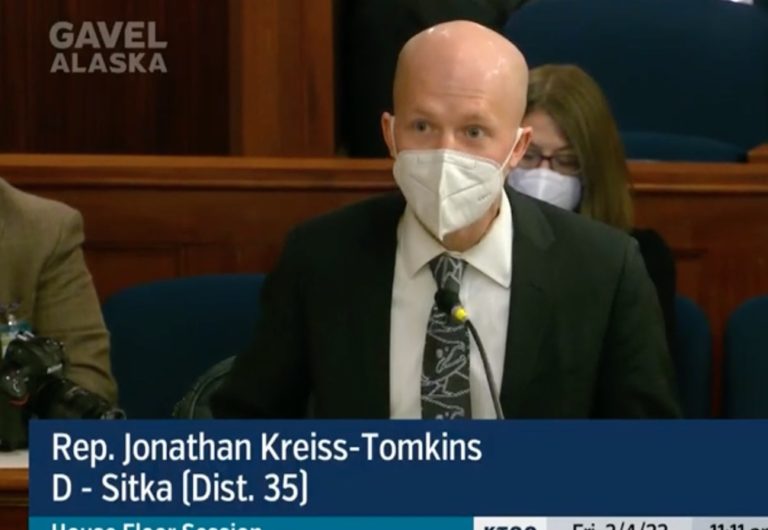
House Bill 118 passed the House on Friday. The bill would remove the restriction on prisoners that keeps them from having computers in their cells, and it expands access to the internet for the purpose of rehabilitation and reintegration into society.
The bill, sponsored by Sitka’s Rep. Jonathan Kreiss-Tomkins, is intended to give prisoners an avenue to rehabilitate and prepare themselves to reenter society. According to Kreiss-Tomkins, recidivism is strongly linked to the inability to get a job after being released, which is why 68 percent of prisoners are re-arrested within three years, and 83 percent within nine years of being released. Without access to computers, those in prison will become unemployable.
An amendment by Rep. George Rauscher put sideboards on how much internet access prisoners would have. That amendment was rejected by the liberal majority of Matt Claman, Harriet Drummond, Bryce Edgmon, Zack Fields, Sarah Hannan, Grice Hopkins, Andy Josephson, Kreiss-Tomkins, Kelly Merrick, Daniel Ortiz, Calvin Schrage, Liz Snyder, Ivy Spohnholz, Andi Story, Louise Stutes, Geran Tarr, Chris Tuck, Adam Wool, and Tiffany Zulkosky.
The bill passed 31-1, with six absent. Rep. DeLena Johnson was the lone “no” vote. It now goes to the Senate for consideration.
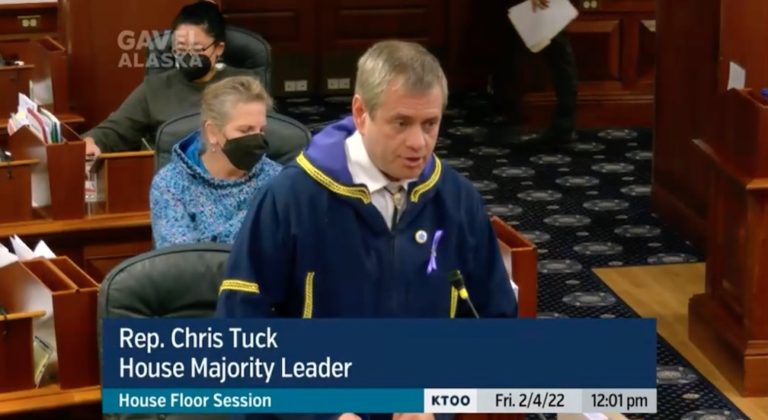
After the Legislature has been in session three weeks, Democrat Rep. Chris Tuck of South Anchorage has set a hearing for Feb. 10 to dig into the military veterans and police and fire veterans group known as Oath Keepers. Testimony will be by invitation only at the discretion of Tuck.
Tuck, who chairs the House Committee on Military and Veterans Affairs, said on the House floor on Monday that any Alaskan who belongs to a group that has the mission of overthrowing the government may not serve in office. He was referring to Rep. David Eastman of Wasilla, and he was referring to Eastman’s membership in the Oath Keepers, a 501(c) group that enjoys a charitable listing with the federal government.
Members of Tuck’s Democrat-dominated caucus have been attempting to remove Eastman from all of his committees because of his lifetime membership with the Oath Keepers, whose leaders are accused but not convicted of various crimes relating to the riot at the U.S. Capitol on Jan. 6, 2021.
Who Tuck will get to come testify is still a secret. The only known member of Oath Keepers in the Legislature is Eastman, but he says he has not received an invitation to testify. On the floor of the House he asked people to send him names of those he should invite. Tuck says that many Alaskans are interested in the topic, especially the coalition of leftist groups that have banded together and named themselves “Expel Eastman.” Tuck himself has not served in the military but has been an officer for the IBEW, an organization that has beenplagued by corruption.
The leftist majority in the House has not been able to muster the 21 votes to remove Eastman from his committees, and is far short of the 27 votes needed to expel him, so Tuck is taking charge to prove that the Oath Keepers membership violates the Alaska Constitution’s disloyalty clause, hoping to persuade some members of the Republican minority to take action against one of its members.
Democrats in the U.S. House have set up a Jan. 6 committee to investigate the chaos that ensued on Jan. 6, 2021, when members of the public stormed the Capitol to interrupt the certification of the Electoral College vote. The committee has subpoenaed dozens of people. Whether Tuck will try to turn his committee into a tribunal against veterans who went to D.C. on Jan. 6, such as Eastman, remains to be seen.
Members of the Anchorage Assembly who are involved in a coverup of emails with a fictitious character named Tom Sconce are not answering the simple question: Who is Tom Sconce?
Sconce is a name created by some person or persons associated with the Assembly majority who are trying to communicate without being detected.
The name has become associated with the Anchorage Press and its ally publication The Blue Alaskan, at the very least, according to Must Read Alaska research, which has also found trails to former city manager and city attorney Bill Falsey, who unsuccessfully ran for mayor in 2021 and is now an attorney in private practice.
Must Read Alaska sent a message to all members of the Assembly asking them who “Tom Sconce” is and why some of them are in a group email with him at his email address “[email protected].”
The three Assembly members who answered the Must Read Alaska query were Jamie Allard, Crystal Kennedy, and John Weddleton; all three said they don’t know who Tom Sconce is or what the email address is being used for.
The other members– Assembly Chair Suzanne LaFrance, Vice Chair Chris Constant, and members Austin Quinn-Davidson, Pete Petersen, Forrest Dunbar, Meg Zaletel, and Felix Rivera — did not answer the question after being given a more than 24-hour period.
Must Read Alaska obtained a memo from attorney Sam Severin to citizen activist Russell Biggs, Severin’s client in this matter, that shows that the Assembly is withholding over 590 emails from a public records request, and the Assembly has given no valid reason for the withholding or redaction of many of those emails.
Severin wrote to the Assembly, “Simply blacking out every single line of every e-mail and attachment is not lawful. It is completely contrary to the municipal code and state law mandate of transparency.”
The coverup continued during a closed meeting of the Assembly on Tuesday, after which Assemblyman Chris Constant insisted that even the recording of the meeting itself can never be made public. The leftist majority agreed that the audio tapes from that meeting will be sealed forever.
The Assembly majority is, according to its actions on Tuesday, saying that messages to Tom Sconce are covered by an unspecified privilege.
The two-hour executive session likely covered material that cannot be considered privileged in a secret meeting by law, and it now, with eight members of the Assembly silent on the matter, it appears there is a coverup under way.
Much of the material being kept secret appears to involve an out-of-state transgender rights advocate named Casey Pick, whose mission it is to formulate and defend laws for transgender individuals.
The emails to and from Casey Pick were during the timeframe when the Assembly was passing the conversion therapy ban and trying to force the faith-based Downtown Hope Center to accept transgender overnight guests in its women-only shelter.
Whether an attorney-client privilege existed or could exist without a contract is an issue, because making blanket claim of attorney-client privilege when there was no relationship other than a shared LGBTQ agenda creates a black hole of privilege, particularly after the fact.
It is almost certain that the citizen who is pursing these public records will file a lawsuit against the Assembly and its attorney Dean Gates.