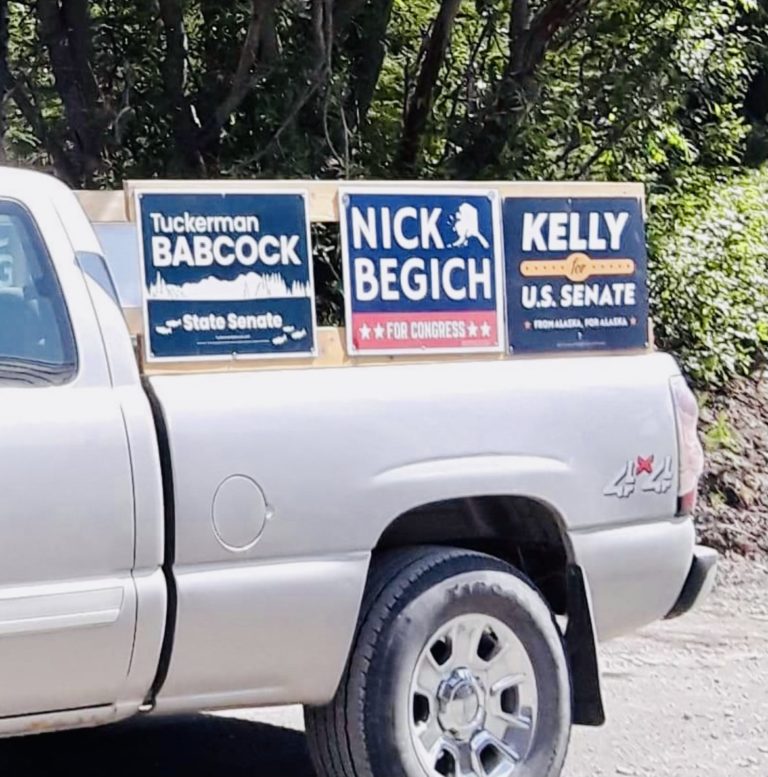
Political observers are waiting for the other shoe to drop in court to challenge the Division of Elections on its decision to move the special general election ballot ahead with just three candidates: Sarah Palin, Nick Begich, and Mary Peltola. Al Gross has dropped from the race after the primary results put him in third place.
Although the Tara Sweeney campaign does not intend to sue over the decision to not allow Sweeney to move up, another group may do so today. Stay tuned. It’s dynamic.
An updated statement from the Sweeney campaign on Wednesday indicates a court challenge is underway:
“The special primary election has not been certified yet, but it looks like Nick Begich has already called in the lawyers. Our campaign will continue to wait for the election to be certified. While we do not intend to litigate the Division of Elections’ current opinion, this matter may ultimately be decided by the courts.” – Karina Waller, campaign manager (emphasis ours).
Endorsements: Former Sen. John Coghill has endorsed Nick Begich for Congress. Coghill was a candidate in the special primary election. Eddie Grasser has also endorsed Nick Begich for Congress. He’s in the Dunleavy Administration, the director of Wildlife Conservation at ADF&G and a retired guide from Palmer.
Events: Lots and lots of events piling up this week. Check recent editions of “Notes from the trail” for others not included here.
Today in Wasilla, a fundraiser for Nick Begich for Congress has well over 100 co-hosts:
Suzanne Downing and Bernadette Wilson will be guys speakers at the Kenai Peninsula Republican Women’s luncheon at Paradisos Restaurant on Friday:
On Saturday, look for your friends and car-fans at the Charlie Pierce Car Show:
Tuckerman Babcock for Senate (Kenai) will be in Anchorage for a fundraiser on June 28:
In Fairbanks, Elijah Verhagen is vying for Senate Seat R and has a fundraiser on June 28 at The Pump House:
(Editor’s note: This column was published at Must Read Alaska on June 19, 2020 and is republished on June 22, 2021.)
Americans are being carpet-bombed by stories about Juneteenth, celebrating the day that 155 years ago the final fighters of the Civil War got the memo that the slaves were emancipated. We’ll leave that to the other pundits to discuss, because we’ve got our own Civil War history in Alaska to review.
While Texas was just getting word of the end of the war on this day in 1865, a Confederate war ship was still prosecuting a sponsored piracy campaign and taking down the commerce of the Union whaling industry.
Few in America have heard of Alaska’s unique role in the end of the Civil War.
In June of 1865, the Confederate raiding ship CSS Shenandoah was underway toward St. Lawrence Island, in the Western Bering Sea, where Yankee whaling ships were working.
The war ship was burning and sinking the U.S. whaling fleet in its path after the captain of the Shenandoah had gotten rough coordinates for where the Yankee whalers were working. He took them from a whaling ship in the North Pacific.
By this time in 1865, the Shenandoah had destroyed a number of these American whaling ships — as many as 20.
On June 22, 1865 the Shenandoah fired what is said in some accounts to be “the last shot” of the Civil War, aiming upon Yankee whalers, some 74 days after General Robert E. Lee had surrendered his Confederate forces at the Appomattox courthouse, and nearly two months after Confederate Army had actually ended the war on land.
There are lots of credible sources that say the event occurred on June 28, 1865, and that whaling ships were still being burned and sunk right and left on June 22, but most historians agree on one thing: This was a well-executed mission and it decimated the whaling fleet.
When Commanding Officer Lt. James Iredell Waddell of the Shenandoah learned of the South’s surrender, he made his way south. Some accounts say he didn’t believe the war was over and was heading to the young state of California to shell San Francisco, another commercial center. California had supplied thousands of soldiers for the Union war effort, and troops from California had pushed the Confederate Army out of Arizona and New Mexico in 1862.
On the way south, his ship encountered a British ship that confirmed the war had ended and that if he showed back up in the United States he would be tried and hanged.
By this time, Waddell had a bounty on his head and he decided to sail his teak-hulled war ship on to Liverpool, England, where he surrendered on Nov. 6, 1865.
Waddell’s was the last surrender of the Civil War, and he presided over the lowering of the Confederate flag on his ship while at anchor on the River Mersey.
The ship itself was put in the custody of the British government via a letter that Captain Waddell penned himself and walked up the steps to the Liverpool Town Hall, presenting it to the Mayor of Liverpool.
The Shenandoah is the only Confederate ship to circumnavigate the globe. Her flag is now in the possession of the American Civil War Museum, which brings it out only occasionally, due to its size.
The Shenandoah’s flag is rarelydisplayed due to its size (roughly 7 feet x 12 feet).
The Shenandoah, which was commissioned to destroy the commerce of the North, had spent nearly a year at sea and had captured 38 ships — two thirds of them after the Confederacy had surrendered. Waddell had reportedly taken more than 1,000 Union prisoners.
The history of how the news reached Captain Waddell is conflicted. The Civil War Museum says that raids continued in Alaska, which was in Russian ownership at the time, until August.
After the Civil War ended, the whaling business fell on hard times, as it was no longer essential to the war effort, and with so many of the Union whaling vessels destroyed, America lost footing in the world as a leader in shipping.
And now, 155 years later, Democrats are destroying the monuments to their Confederate war heroes, and, ironically, they are still trying to destroy United States commerce. Also somewhat ironically, Republicans are still trying to respect the confederacy and its history, because it is the history of the nation.
Alaska had a unique role back in the 1860s. It was not American territory, but it soon became part of the United States under the advocacy of abolitionist William Seward, secretary of State for President Abraham Lincoln. Democrats in Alaska are now trying to remove the statue of Seward from in front of the Capitol.
A nation should be able to talk about its Civil War without getting into another one. The important lesson is that we learn from history, so that we don’t repeat it.
Suzanne Downing is editor and publisher of Must Read Alaska and writes a Must Read America column for NewsMax.
As the election for Alaska’s temporary congressional seat moves to the next phase, 161,274 primary ballots have been counted by the Division of Elections as of Tuesday, June 21, the last day when votes were counted. The turnout was 27.52% of registered voters for the election that began April 27 and ended June 11. It was an all-mail-in election, the first in Alaska history, and there were 48 names on the ballot of those who hoped to have a seat in Congress until the next congressperson is sworn in in January, 2023.
The standings haven’t changed much over the past several days:
Sarah Palin gained 2,275 votes to reach 43,577, or 27.02% of the vote.
Nick Begich gained 1,992 votes to reach 30,851, for 19.13% of the vote.
Mary Peltola gained 2,085 votes, for 10% of the vote. 16,218 voters chose Peltola.
Al Gross, who dropped out of contention on Monday, reached 20,371, or 12.75% of the vote. He will not appear on the special general election ballot, due to having withdrawn from the race.
The state review board begins it work on June 22, and certification of the election is scheduled for June 25. Candidates may withdraw from the special general election ballot as late as June 26, and the sample ballot is to be posted by June 28, also the date that the printing of ballots will begin for the Aug. 16 combination election that will have a regular primary election and a special general election for the temporary congressional seat.
Still uncertain is whether there will be a lawsuit by one or more parties who disagree with the Division of Elections decision to allow Gross to drop from the ballot, but not allow the fifth-place finisher to slide into that spot.
The left-leaning, Democrats’ favorite candidate for the new Assembly seat for downtown Anchorage is leading in the hyper-local election that ended Tuesday night.
With 3,801 votes counted, Daniel Volland won 1,452, or 38.49% of ballots counted so far. 3,801 ballots were cast of the 36,655 voters mailed ballots in the district. The results are unofficial but unlikely to change with any remaining ballots still in the mail.
The election for the 12th seat was held after Assemblyman Chris Constant asked Anchorage voters to award downtown Anchorage a second seat on the Assembly, and voters approved. Only voters in the Assembly District 1 voted in this race.
Sen. Lisa Murkowski voted with 13 other Republican senators to advance the gun control legislation currently before the Senate. The 80-page gun-control measure moved ahead on a vote of 64 to 34, a vote taken an hour after the negotiators of the bill had released its details.
The National Rifle Association has come out against the bill, saying the group will support legislation that improves school security, promotes mental health services, and helps reduce violent crime, but the NRA said the bill falls short.
“However, we will oppose this gun control legislation because it falls short at every level. It does little to truly address violent crime while opening the door to unnecessary burdens on the exercise of Second Amendment freedom by law-abiding gun owners,” the NRA said.
The legislation can be abused to restrict lawful gun purchases, infringe upon the rights of law-abiding Americans, and use federal dollars to fund various gun control measures being adopted by state and local entities, the NRA said, leaving too much discretion in the hands of government officials. It also contains undefined and over broad provisions – inviting interference with constitutional freedoms.
“Decisions by the Supreme Court of the United States in the Heller and McDonald cases make clear that the Second Amendment is an individual constitutional freedom. We will always fight for those freedoms – and the fundamental values we have defended for over 150 years,” the NRA said.
The NAACP took the opposite approach, praising the bill as a step in the right direction and asking Congress to pass it swiftly.
“We are encouraged with the outcome of the bipartisan effort. This bill will save lives and we urge Congress to bring it to the President’s desk promptly,” said NAACP President Derrick Johnson’s statement.
Alaska Republican U.S. Senate candidate Kelly Tshibaka issued remarks critical of Murkowski’s vote:
“Time after time, Lisa Murkowski demonstrates why people on both sides of important issues just don’t trust her. When she visits Alaska, she pretends to be a friend of the 2nd Amendment, but when she’s in Washington, D.C., she sides with the elites and the insiders and votes against the interests of law-abiding Alaskans. At least Democrat Pat Chesbro is honest about her support for restricting the rights of our citizens, so you know where she stands,” Tshibaka said.
“The lawful ownership of firearms is part of who we are as Alaskans, both for hunting and for self-defense. Perhaps Murkowski missed the part of the 2nd Amendment where it says, ‘shall not be infringed.’ After 21 years in the Senate for Murkowski, there is no question that it’s time for a change. When I’m the next senator from Alaska, I will always fight for the constitutional rights of our people, and I will always defend the 2nd Amendment,” Tshibaka said.
Among its provisions, the bill incentivizes states to pass red flag laws and requires background and mental health checks for 18- to 21-year-olds.
Tshibaka is challenging Murkowski from the right; both are Republicans, but Murkowski is a centrist who often votes with Democrats.
Anchorage Mayor Dave Bronson today has selected Mario Bird as the Anchorage Municipal Attorney, and Michael Braniff as the Director of the Parks and Recreation Department, Courtney Petersen as the director of the Office of Management and Budget.
Bird will replace Patrick Bergt, who joined Alaska Communications. Bird was born in Soldotna, Alaska and graduated from Nikiski High School. He is a graduate of the University of Notre Dame with a bachelor of arts in film (magna cum laude). He received his juris doctor from the Ave Maria School of Law (magna cum laude) in Naples, Florida and served on the Ave Maria Law Review. He has been a practicing attorney for 10 years. Prior to pursuing a legal career, he worked as a photographer and editor for The Alaska Channel and as a teacher and coach for Holy Rosary Academy.
Braniff will replace Josh Durand who will be moving with his family to Colorado. Braniff is a graduate of University of Alaska Fairbanks with a degree in Business Administration with a focus in Management and Operations. He has worked 16 years in the public and private sectors, including 13 years managing work projects and activities with parks throughout Anchorage.
Petersen will replace Cheryl Frasca who retired in May. Petersen was raised in Dutch Harbor, Alaska and has worked in accounting and purchasing in Minnesota and Alaska. She has worked as a budget analyst for the past 15 years including nine with Municipality of Anchorage in the Office of Management and Budget.
“I appreciate the hard work, dedication, and commitment that Cheryl, Patrick, and Josh displayed in their roles for the Municipality of Anchorage,” Bronson said. “I thank them and their families for their sacrifices to make our city a better place. I look forward to the additions of Courtney, Mario, and Michael to the administration and seeing them display their skillsets for the benefit of the Municipality.”
The Mayor’s appointees will be submitted to the Anchorage Assembly for approval.
In the August special general election to decide a U.S. House representative for Alaska, there will be only three names for the ranked-choice ballot. Not four.
A decision today by the Division of Elections thwarts the plans of some who wish to have fifth-place candidate Tara Sweeney move into the fourth place position on the August special general election ballot for Congress, now that one of the four top finishers has dropped out.
The sudden exit of third-place Al Gross, who had earned 18,936, or 12.65% of the vote during the special primary election to replace Congressman Don Young, created a dilemma: Did Ballot Measure 2, which muddied the election laws in Alaska in 2020, intend for a fifth-place finisher to be able to move up if one of the top four quit or died after a special primary election? Does that slot on the ranked-choice ballot remain blank? Or does it contain the quitter’s name? According to the Division of Elections, it remains blank. Three continue on.
Division of Elections Director Gail Fenumiai said, in an explanation, that Gross’ name will be removed, as requested, from the ballot for the special general election. But “Because this withdrawal occurred less than 64 days before the election, Alaska law does not permit the fifth-place candidate to advance.”
She cited Alaska Statute 15.25.100(c), which says, “if a candidate nominated at the primary election … withdraws … after the primary election and 64 or more days before the general election, the vacancy shall be filled by the director by replacing the withdrawn candidate with the candidate who received the fifth most votes in the primary election.”
Fenumiai said that any party wishing to challenge her ruling should do so quickly because the Division requires a final determination from the courts by noon on June 28 in order to print the ballots in time to meet state and federal deadlines and keep the special general election on schedule to be combined with the regular Aug. 16 primary.
Former congressional candidate Al Gross issued a statement to his supporters on Tuesday morning, with an explanation as to why he has quit the race to replace the late Congressman Don Young: “It’s too hard to run as a nonpartisan.”
“I am a lifelong Alaskan with a passion for this state and its people. I know that polarizing partisanship is not how solutions are achieved. It takes leadership and work. Unfortunately, Alaska and America are stuck right now, and Monica and I have decided it is just too hard to run as a nonpartisan candidate in this race. I still believe that when people with differing opinions listen to each other and work together, problems get solved. Maybe we can reach that place sometime in the future. I hope we do,” Gross wrote.
Gross talked in generalities about what is needed in the U.S. Capitol: fixing inflation, ending partisan gridlock, and engaging in less grandstanding. He outlined points important to him, including bringing government spending under control and expanding Alaska’s role in defense. But wants to expand free health care to all, preserve abortion rights of Roe v. Wade, and legalize pot.
Gross appeared to be campaigning hard and was in third place behind Sarah Palin and Nick Begich right up until the moment he pulled the plug on Monday afternoon, when his campaign first leaked news to a left-leaning blogger that he was pulling out of the race.
By evening, he had posted a short and carefully worded statement of withdrawal from the race for Congress. He gave no explanation.
Gross had earlier agreed to caucus with the Democrats in Congress, but that was not enough for the Alaska Democratic Party, which took to social media to call him a “proven loser,” who could not even win a seat on his local Petersburg hospital board and who had lost to Sen. Dan Sullivan in 2020.
By the time he filed his mid-May campaign finance report with the Federal Elections Commission, he had raised over half a million dollars in funds, much of it from social media, where he said he was taking on the “quitter” Sarah Palin.
Palin issued a statement in response to the news encouraging all of his supporters to take a look at her candidacy”
“Nothing should surprise voters in this unconventional election. In many aspects, new voting systems are confusing at best, and not conducive to growing voter turnout. However, let’s not let that dampen enthusiasm to get government on the right track.
“Al Gross was the top democrat vote-getter. His quitting the race leads to much speculation as to motive, but I’ll leave the speculating to others. My mission is to continue connecting with all Alaskans on the issues most important to our families and businesses, along with strengthening relationships our State needs in order to get nationwide Congressional support for Alaska’s interests.
“I welcome the new addition to the top four, and am excited to continue campaigning on resource development, lower fuel costs, affordable groceries, ensuring individual rights… all to create a brighter future for all Alaskans.
“Now that Al Gross supporters lost their candidate, I hope they will take a look at where I stand on the issues, and how I will never stop fighting for the greatest state in the Union,” she said.
Must Read Alaska has a query on file with the Division of Elections to learn what the process is for deciding if Sweeney can slide into the fourth slot on the special election ballot.
Meanwhile, the group promoting Tara Sweeney for Congress was on Monday afternoon busy asking the Division of Elections to put Sweeney on the fourth spot on the ballot.
The news began with startled text messages around Alaska Monday afternoon. With less than a week to go before candidates can drop their efforts to win election to the highest offices in the land, a massive shakeup throttled the race for the state’s lone seat in the United States Congress.
Al Gross, the son of a former state attorney general and the Democratic Party’s standard bearer for the United States Senate race in 2020, suddenly and suspiciously dropped his bid to succeed the late Congressman Don Young.
Earlier this month Gross had fetched the most votes from Alaskans on the center to left side of the political spectrum during the first ever jungle primary system.
An Al Gross ad that ran four days before he pulled out of the race.
Former Gov. Sarah Palin topped the rankings, followed by first-time candidate Nick Begich, who combined nearly half of all eligible votes. Gross and former state legislator Mary Peltola rounded out what was shaping up to be the four options in August for the special general election.
Gross entered the race with the highest name recognition of any non-conservative candidate. Coupled with the scar tissue of a recent bout at the ballot box, Gross had activated his network throughout all corners of the state, as evidenced by the cropping up of his campaign signs throughout liberal Alaskan bastions.
Those campaign signs are now headed for the crawl space. In a prepared statement Monday afternoon, Gross all but encouraged his supporters to go for either Mary Peltola or Tara Sweeney. Both are prominent Alaska Native women.
Sweeney, the highest ranking Alaska Native to hold office in the federal government, was an undersecretary for the Department of Interior under President Donald Trump. Sweeney finished 5th in the rankings during the special primary election, though at a considerable distance from Peltola. The assumption in Gross’ statement is, by withdrawing from the race, Sweeney will automatically be elevated to the next spot, and therefore eligible for the special election in August.
If it’s true that Gross has allowed Sweeney to ascend to fourth place, Monday’s announcement likely harkens to one of the great political maneuvers in the past decade. Sweeney, a registered Republican, is the proverbial darling of resource development organizations throughout Alaska. Her empassioned advocacy on behalf of the North Slope and the Arctic Slope Regional Corporation put her distinctly at odds with the crunchy environmentalism that defined Gross’ campaigns. One of the few things either camp had in common were relationships to opponents of the Pebble Mine project in western Alaska.
Those opponents share something else in common: an affection and devotion to the current senior senator from Alaska, Lisa Murkowski. Murkowski, an incumbent since 2002 when she was appointed by her father, the outgoing U.S. senator and incoming Gov. Frank Murkowski, has made no secret of her opposition to the large gold and copper deposit. Some of Murkowski’s most vigorous supporters have pointed to Murkowski’s staunch resistance to the project as proof of her independent bona fides. Those same supporters are some of Sweeney’s greatest surrogates.
What was made abundantly clear this week is that, though the news is about the congressional race, the story is how these events are colluding to assist in the race for the United States Senate.
The parallels to the circumstances that kept Murkowski in office and conspiring to install Sweeney are eerie. In 2010, after she lost the Republican Primary to Joe Miller, Murkowski launched a write-in campaign. With support from centrist Republicans, Democrats, and a huge turnout of the Alaska Native vote terrified of a Miller senatorial career, Murkowski won the first write-in for Senate since Strom Thurmond in 1948.
That victory untethered Murkowski from the Republican party, and to a new ad hoc coalition that composed eccentric bedfellows. Byron Mallott, a future lieutenant governor (before resigning under sexual harrassment allegations) was her write-in campaigning co-chair, as was former Republican state legislator Andrew Halcro.
By the time she faced re-election again in 2016, Murkowski had laid the groundwork to crowd out a primary challenge, assisted by the massive war chest her coalition had helped swell. However, Miller returned as a Libertarian to fetch the second highest vote count in the state. That same election saw the upset of Donald Trump over Hillary Clinton for President, and the beginning of a collision course with the Alaskan senior Senator.
Despite working on the landmark Tax Reform of 2017 which, among other achievements, opened up ANWR to oil and gas exploration, Murkowski waged an open war on the former President Donald Trump. Those skirmishes included denouncing the nomination of Brett Kavanaugh to the Supreme Court, and ultimately voting to impeach President Trump in 2021. These, combined with other bouts, brought the mercurial American President into the Alaskan orbit, and with a targeted vengeance for Murkowski.
Murkowski’s supporters and powerful proxies anticipated a hard fought primary in 2022, her next scheduled election. In 2020, a ballot initiative narrowly passed the Alaskan public into law.
Characterized as a reform to make elections more accessible for independents, the initiative, written by lawyers openly allied with Murkowski, have the effect of gutting the traditional party primary, and coupling it with the ranked choice general election. During the 2020 debates, the initiative, opposed by both Republican and Democratic party officials, was seen as an obvious ploy by Murkowski to protect her from a repeat of her defeat in 2010.
This year, Murkowski faces Kelly Tshibaka. A Harvard Law School graduate and former Inspector General and state commissioner, Tshibaka represents Murkowski’s most formidable opponent to date. Tshibaka also has the seal of approval from President Trump, and much of the Republican Party faithful. Despite that, Murkowski is looking to the benefits of the new election law to assist her, relying on the coalition of centrists, soft liberals, Alaska Native allies, and trade association Republicans to carry her.
A massive distortion that could affect this would be the turnout in any other race, drawing in voters who would likely also be skeptical of retaining the sitting senator. Enter Sarah Palin.
The former governor and vice presidential candidate and no fan of Murkowski herself, Palin stormed into the top of the polls after entering the race on the very last eligible day. It was Palin’s support from the sidelines in 2010 that heavily tilted against Murkowski. Over a decade later, it is clear that a Congressional race with huge enthusiasm from the populist right has the chance to swamp into the Senate race, and give Tshibaka the edge she needs.
The only way this dynamic would change is if traditional Murkowski voters had a candidate they could support financially and at the ballot box.
Unfortunately, that candidate was Sweeney, who despite record levels of fundraising, came up short in the primary. Barring a massive change, Sweeney appeared to be blocked from August, and with that likely the general elections as well.
Sweeney’s parallels with Murkowski run deep. The political consultants who have orbited the D.C. circles of the Senator are around the Sweeney Camp. It goes even deeper, with Sweeney and her husband at various points either working for Murkowski or being supported by the Senator for federal posts. Sweeney is the Murkowski camp’s candidate, and it was crucial for her to have another shot at populating the Congressional ballot.
It will likely never be known what is the true story behind Gross’ sudden departure. Perhaps his public statement can be taken at face value, and the Bear Doctor who was an idol of the Lincoln Project sincerely wants to clear the path for two prominent Alaska Native Women. But the facts on the ground point to different circumstances. Something was suddenly — over the weekend — very persuasive to Gross and in politics that usually means an opposition research file.
What happens next seems clear: The Senate race will have a proxy war open up in the Congressional race, as camp Sweeney and camp Murkowski can now overtly join forces for a D.C. centric ticket that appeals to centrist voters. With less than 6,000 votes that went her way in the primary, however, Sweeney has her work cut out for her.
The Republican territory in the conservative bastions have already been split between the Palin and Begich camps. And Peltola, the farther-left Alaska Native candidate, performed the best with the least amount of financial backing. The resources that will now be brought to bear to raise Sweeney up will be on another level.
All the events Monday affirmed the concerns of opponents of the new electoral system brought by Ballot Measure 2, thanks to “Alaskans for Better Elections.”
By having more candidates and variables through the jungle primary and ranked choice general, the options for political operatives to engage in legalized gamesmanship — or worse — has never been higher. Voters know less today about who is asking to represent them in Congress than at any time in the state’s history.
It is hard to say that Alaska now has better elections.