The Alaska Division of Elections Review Board says that the top reason that ballots were rejected during the special congressional primary election was due to missing witness signatures. Over 36% of the 7,489 ballots rejected were missing the witness signature. Another 26% had late postmarks, and 21% were missing an identifier.
For example, in District 12 Eagle River, 5,645 ballots were received, with 23 not having an identifier matching voter records, 2 ballots hand delivered after election day, 1 duplicate ballot, 1 empty ballot envelope, 44 with no identifier provided, 1 with registration inactive, 43 postmarked after Election Day, 1 voter not registered, 58 improper or insufficient witnessing and 10 that were unsigned by voters.
In District 39 Nome, 1,756 ballots were accepted, and 296 rejected. Of those rejected, 34 had an identifier that did not match voter records, 1 was a duplicate ballot, 45 had no identifier provided, 2 came from people who registered too late, 4 ballots were received too late, 174 had improper or insufficient witness signatures, 36 voters neglected to sign their ballot envelope.
The mail-in congressional special primary is part of the process for determining who will fill the remaining term of the late Congressman Don Young, who died March 18. Until that is decided by voters, Alaska is without representation in the U.S. House of Representatives. The special general election for this seat is Aug. 16, at the same time the regular primary is conducted for House, Senate, Governor, and state House and Senate districts.
All the districts’ raw data on rejected ballots is contained in this PDF:
3:30 pm update: The Railroad Dock will remained closed to allow an engineer to assess the damage. Ships being reaccommodated are: Carnival Miracle, after dock, tendering passengers to the Small Boat Harbor; Ruby Princess, Broadway Dock, Norwegian Jewel, Ore Dock.
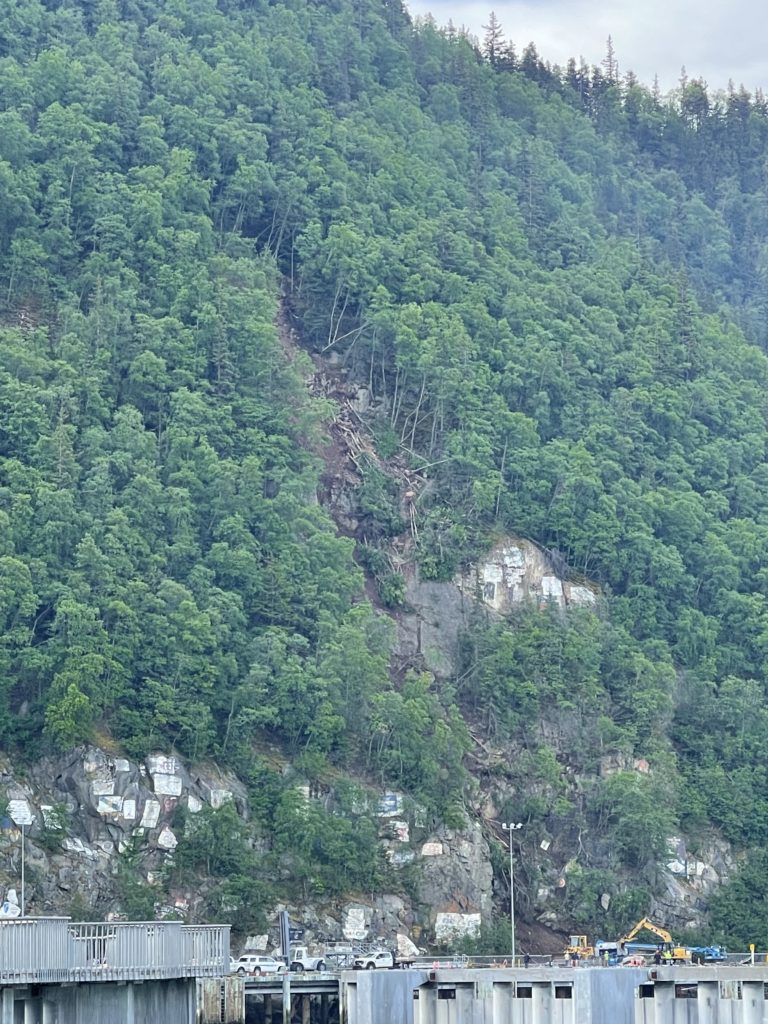
An early morning rockslide in Skagway at the cruise ship dock rained down massive boulders onto the dock that just minutes later would have been filled with tourists disembarking a cruise ship. Portions of the dock are crushed but the dock is still usable. The damage is on the east side of the dock, rather than the west side, where the ships are tied up. Geotechnical engineers are coming to Skagway on Friday to assess the damage.
The area has been problematic in the past and presents an ongoing challenge for Skagway. The rockslide came from property owned by the Municipality of Skagway.
This morning, longshoremen were on the dock, tying up the Discovery Princess in the forward berth and placing the ramp that passengers use to leave the ship.
About 20 minutes after the longshoremen left and about 20 minutes before passengers would have started to disembark, the rocks came down in the area that last slid in 2017. This slide is in a nearby steep area, not in the same area as the 2017 slide.
The Discovery ship was subsequently moved to the aft berth and passengers are being tendered by small boats into the small boat harbor.
As a result, the cruise ship Quantum of the Seas has skipped its Skagway stop this morning, as there is no place for it to tie up. The dock is the only one that can handle the largest class of cruise ships that come into Southeast Alaska.
Rocks came down off the mountain onto the cruise ship dock in Skagway, but no one was injured.
By a vote of 6-3, the U.S. Supreme Court has invalidated a New York law that limits who can get a permit to carry a concealed handgun in public.
New York required people wanting a license to carry a concealed handgun outside their home to show “proper cause,” which the New York courts determined had to be something more than a simple desire to protect themselves or their property. Applicants had to prove that they had a heightened need for self defense, such as that they were the subject of repeated physical threats. Other states with similar laws include California, Hawaii, Maryland, Massachusetts, and New Jersey.
The New York law has been on the books for a century until two men in New York challenged it after their applications for concealed-carry licenses were denied.
Theopinion in New York State Rifle & Pistol Association v. Bruen was authored by Justice Clarence Thomas, with the court’s three liberal justices — Elena Kagan, Sonia Sotomayor and Stephen Breyer — dissenting.
The court wrote that Americans have a right to carry “commonly used” firearms in public for personal defense and that the Second Amendment is not “second class” constitutional right that is subject to greater restrictions “than other Bill of Rights guarantees,” he wrote.
Earlier this week, the U.S. Senate advanced legislation that would create stricter gun laws across the states, including allowing states to enact red flag laws, which provide legal paths for removing firearms from people deemed by authorities to be unstable. The proposed law would also require mental health checks of 18- to 21-year-olds who are buying firearms and the law has numerous other provisions.
As the special primary election to fill Alaska’s vacant seat in Congress is wrapping up, and the final votes are being counted and certified, I thought it would be a good time to dispel some of the misinformation that continues to be spread across the state regarding ballots, our voting process, and the equipment we use to conduct the various elections.
First, let me clarify that I, along with everyone at the Division of Elections, am committed to overseeing fair and honest elections in Alaska.
I have heard allegations that our by-mail primary election was conducted illegally. This is false: Alaska conducts all state elections in accordance with state law and has been given authority under Alaska Statute 15.20.800 to conduct elections by mail when they are not held at the usual time for an election.
In this case, state law requires the special primary election to be held on a date that is no less than 60 nor more than 90 days from the vacancy of the seat.
The short window of time caused challenges because the Division of Elections could not recruit and train the more than 2,000 personnel and deploy the equipment necessary for an in-person statewide election by that time. We have more than 400 precincts to staff across the state, including the very small rural villages. This means the Division needed to conduct the special primary election by mail. Note that this is the only by-mail election; the regular primary and general elections will be conducted normally, as directed by state law.
There will be just two more statewide federal elections this year, our regular primary election will be held on Aug. 16, and this ballot will include the special general election for the vacant congressional seat.
Both the special general (Aug. 16) and regular general (Nov. 8) ballots will be formatted according to the new election law, and voters will have to rank their choices for each race. There will be abundant voter education coming from the Division, candidates, and other parties over the next four to five months. Please take a minute to learn about this new process or request a presentation.
Over the past four years, I have heard that Alaska’s voter rolls are inaccurate and contain more voters than eligible adults currently in the state. The Division of Elections conducts continual voter list maintenance as Federal and State laws prescribe. Once a voter is on the list, removing a non-voter takes about four to five years — this is a Federal law.
The increased number of registered voters is directly tied to Alaska’s Automatic Voter Registration system through the Permanent Fund dividend. We have thousands of Alaskans on the voter list who did not ask to be registered, do not plan to vote, and may not live in-state any longer. Without their direct communication with the Division, removing them from the master list is incredibly difficult. This automatic voter registration when applying for a PFD was enacted by initiative, and for the Division of Elections to keep our list accurate, it needs to be changed.
Last legislative session, Gov. Mike Dunleavy and I advocated for a simple change to the law that would require voters affirmatively opt-in to the voter registration portion of the PFD application. This will significantly help clean up the voter rolls properly and efficiently. This will ensure those who want to be registered voters, will be registered. Those who don’t, won’t be. Unfortunately, the Legislature was not able to get an election reform bill passed this session. I hope they address this issue in 2023.
There continues to be misinformation that our Dominion equipment changes votes and reports fraudulent results — this is simply untrue. We do not use voting machines — rather, we utilize ballot tabulators that are not connected to the internet and simply count the voted paper ballots.
After extensive hand recounts of random precincts in all 40 house districts, some challenged districts, and the statewide initiative Ballot Measure No. 2, the state nonpartisan review boards found no examples of widespread fraud or intentional misconduct by election officials and no evidence that the equipment used to tabulate and report election results functioned improperly. The Dominion equipment is tested by a non-partisan review board before being deployed to the precincts.
The state conducted multiple reviews and hand counts of 2020 election races, all of which affirmed the tabulator results. Those general election hand count results are available on the Division’s website. Additionally, Alaska has been, and always will be, a paper-ballot state. We will always have the ballots to review and verify our elections’ results.
We receive multiple emails and phone calls per week propagating the same misunderstandings and misinformation about elections being spread by national groups with no connection to Alaska or understanding of how elections are run here in the Last Frontier. But please find out for yourself, volunteer to help at the polling places, volunteer for early or absentee voting, or simply be an observer on election day. We want and need your help!
Please verify the information you read before sharing or retweeting allegations that have no basis on how we do elections in Alaska. For more information, please visit the Alaska Division of Elections website: www.elections.alaska.gov. Don’t hesitate to contact us if you feel something doesn’t look correct. We will have the state troopers investigate election fraud.
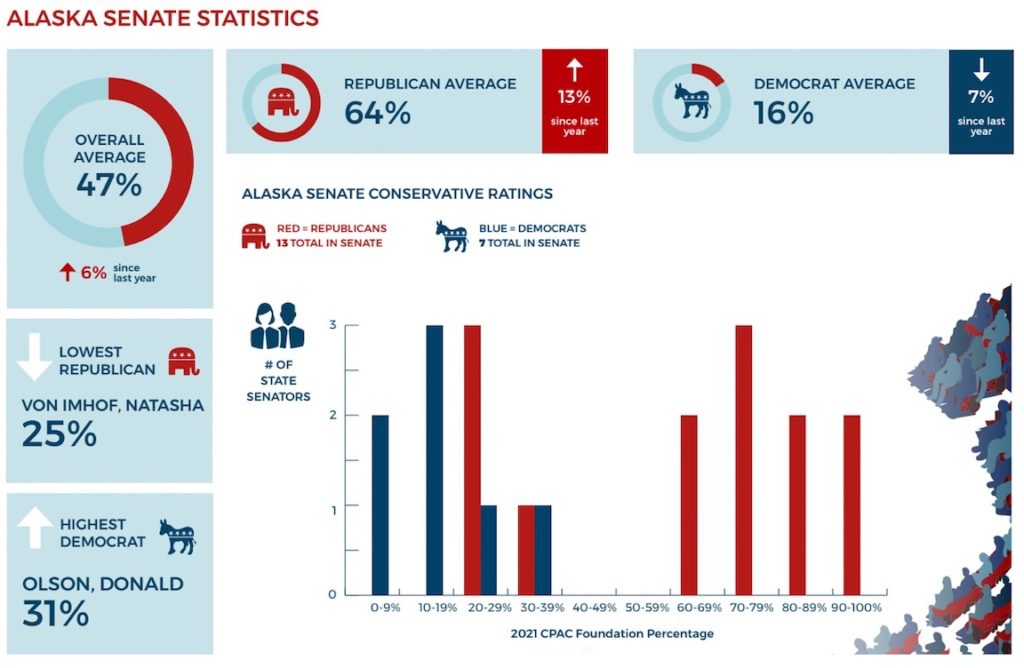
Alaska’s Legislature continues to fall short, according to a new scorecard from the CPAC Foundation and the American Conservative Union Foundation. In fact, Alaska has a last place finish among Republican states, when the policy evaluators rated how well each of Alaska’s lawmakers adhered to conservative principles in 2021.
The Alaska State Legislature earned an overall conservative rating of 46%. Alaska trails behind top-ranked legislatures such as Alabama (74%) and Florida (73%), and the state even falls short of the national average of 49%, the group said.
The conservative rating is based on lawmaker voting across 186 policy areas ranging from cultural and life to tax, fiscal and regulatory policies. The entire scoring and methodology is at this link.
The state’s least conservative Republican is Rep. Louise Stutes of Kodiak, with a score of 22%. She scored lower than the most conservative of the Democrats, Chris Tuck, who was ranked 23% conservative.
Sen. Natasha Von Imhof was the least conservative Republican senator, with a 25% score. She is not running for reelection. Sen. Donny Olson, a Democrat, was the most conservative of his party, at 31%.
The top conservatives, according to the analysis:
Rep. David Eastman, Rep. Chris Kurka, Rep. Sarah Vance all received a 100% score. Rep. George Rauscher and Rep. Ben Carpenter were close behind at 95% and 95% respectively.
Representatives Kevin McCabe, Ron Gillham, James Kaufman, Cathy Tilton, Thomas McKay were all scored in the 90s.
Dead last for conservatives in the House were Democrats Reps. Geran Tarr (5%), Liz Snyder (4%), and Sara Hannan, (4%).
In the Senate, Sens. Rob Myers and Lora Reinbold were both scored 92% conservative.
The ratings have also been incorporated into CPAC’s new Lawmaker Comparison Tool, which runs head-to-head comparisons on lawmakers’ strongest and weakest policy areas.
The Center for Legislative Accountability is the first and only organization to annually publish individual ratings for all 8,000 federal and state lawmakers in America. The CLA is also home to the nation’s most comprehensive conservative policy database, containing over 17,500 detailed bill analyses which span 50 years of Congress and all 50 state legislatures.
From 1955 to 1956, during Alaska’s constitutional convention, our state constitution was crafted by a majority of New Deal Democrats. They wanted to construct a model utopian state constitution. This all occurred during a time when the expansion and strengthening of government control and power were the collectivist goals of the federal government as it evolved into progressivism.
Seems like nothing has changed.
In developing the embryotic framework of Alaska’s state government, the delegates modeled our state constitution using many resources.
At the time, progressive organizations helped to influence Alaska’s public policy.The draft state constitution embodied the new ideology promoted by the Theodore Roosevelt and Woodrow Wilson progressive era at the turn of the 20th Century. The impetus for this was already deep in 19th Century American intellectuals who enjoyed reading the European and American journalists and popular writers of the day. One notable example in the mid 1800’s was Horace Greeley’s New York Tribune’s stable of writers, which included writers like Charles Anderson Dana, a utopian socialist, Friedrich Engels, and Karl Marx. Marx and Engels had already published “The Communist Manifesto.”
This authoritarian culture infused its influence subtly throughout America’s civic fabric including Alaska’s newborn fantasies of sovereignty, which today have transformed into delusions of colonialism.
The progressive objective was to establish and centralize government power and control in a superior posture over individual rights and states sovereignty. This purpose opposed some of the guarantees found in the U.S. Constitution and the Bill of Rights.
Today, a new group, who may be the reincarnation in the spirit of FDR New Deal Democrats, has formed to tell you, the Alaskan voter, not to vote “Yes” for a constitutional convention on Nov. 8, 2022.
The group calls itself “Defend Our Constitution.” It has a website located at defendakconstitution.com.
One of Defend Our Constitution’s major financial backers is the National Education Association-Alaska Political Action Committee for Education. This is the same public union responsible for the status of Alaska education.
Defend Our Constitution states correctly that Alaska voters have never approved a constitutional convention. Odds are Alaskans may not approve one this time. They warn, “The risks outweigh the rewards.”
If the voters have never approved a constitutional convention and the chances in November 2022 are slim that the voters will approve it this time, then why is the NEA-Alaska-PACE underwriting the effort to reject a constitutional convention?
The group claims a constitutional convention could create “the opportunity for outside special interest groups and dark money to change Alaska’s laws to promote their agenda over the interest of Alaskans.”
Isn’t that what Alaskans have experienced for decades?
Our state government is controlled by “outside special interests and dark money.” Our largest urban centers are controlled by “outside special interests and dark money.” Our legislature and judiciary appear to be controlled by “outside special interests and dark money.” Our election system is now controlled by “outside special interests and dark money.”
If it wasn’t, the 1955-56 delegates would have included Delegate Ralph Robertson’s right of work contribution to be added to our state constitution.
If it wasn’t, the capitol would have moved closer to the state’s population.
If it wasn’t, the Citizens Advisory Commission on Federal Areas and the Alaska State Lands Advisory Group petition recommendations would have been submitted to and followed up with the President and Congress on restructuring ownership and management of federal lands in Alaska to continue maintaining the environment and biodiversity, allow public access to public resources as guaranteed by Congress, and bolster economic development.
If it wasn’t, education would produce literacy and other scholastic standards with exemplary results at a fraction of the current costs.
If it wasn’t, health care costs would be competitive with the rest of the nation.
If it wasn’t, the development of the state’s natural resources would be the largest economic driver in the state, not government.
If it wasn’t, every eligible Alaskan would have received their legal full past due Permanent Fund Dividend balances owed to them by the State.
Have you ever been told by somebody that they know more than you so do what we say?
In simple terms, those, who want you to not vote “Yes” for a constitutional convention in the Nov. 8, 2022 election, are projecting on all of us what we should do through risk, fear and doubt.
Has Alaska had enough of this manipulation? Will we all stand as Alaskans, certain, faithful, and confident in our capability to guide and construct the framework of our state government?
Will Alaska vote “Yes” for a constitutional convention?
Michael Tavoliero is a realtor in Eagle River, is active in the Alaska Republican Party and chaired Eaglexit.
President Joe Biden on Wednesday called on states and Congress Wednesday to declare a federal and state gas tax holiday, as the price of a gallon of gas is averaging about $5 nationwide. Biden wants Congress to suspend the 18.4-cent-per-gallon federal gas tax for 90 days, or “through the busy summer season.”
“It’s important because we use it for the Highway Trust Fund to keep our highways going, but what I’m proposing is suspending the federal gas tax without affecting the Highway Trust Fund, and here’s how we do that,” said Biden. “With revenues up this year and deficits down over $1.6 trillion this year alone, we’ll still be able to fix our highways and bring down prices of gas.”
Biden said oil companies should pass the tax savings onto consumers and also said they should increase production and refining capacity, activities his administration has made unlikely through increased regulation. He also called on states to suspend their state gas taxes, which would impact states in varying ways: Washington State has a 49-cent per gallon gas tax that it uses to fund highway maintenance, while Alaska’s tax on gas is 8 cents. The average state gas tax is 30 cents per gallon.
If achieved, the gas tax holiday would save average motorist $8.59 for the 90-day period. For example, it would reduce the cost of a 15-gallon fill-up in Alaska from $81 to $78.41; the savings is $2.59.
Biden has been in office for 518 days; gasoline is about $3 more per gallon than it was when was sworn in.
The Anchorage Assembly on Tuesday night voted to take over the authority for the Youth Advisory Commission from the mayor’s office, in spite of the objections of the mayor, the public, and the youth commission members.
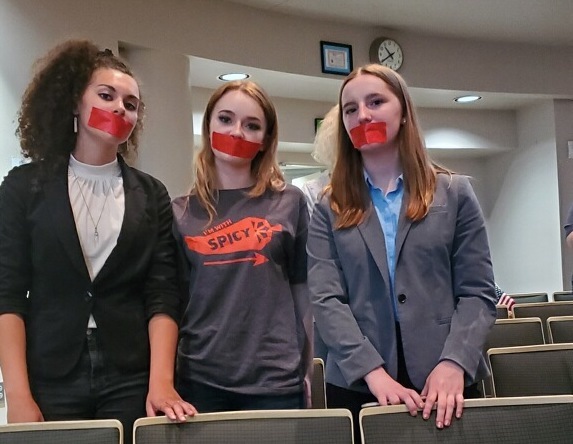
Members of the Youth Advisory Commission spoke against it led a silent protest, as the public at the Tuesday meeting joined in by taping their mouths in solidarity against the ordinance advanced by Assembly Chairwoman Suzanne LaFrance. After a few minutes, people began humming the Star Spangled Banner through their taped mouths.
Those voting against the takeover were Assembly members Kevin Cross, Randy Sulte, and Jamie Allard.
In the past, the YAC was made up of more liberal youth members during the Berkowitz Administration. Then, during Covid-19 pandemic policies, the youth did not meet and the commission essentially fell apart. It came back together under Mayor Dave Bronson with a diverse but politically more balanced group of young people ages 14-22; the youth voted that Sarah Price of Chugiak would be the group’s representative to the Anchorage Assembly in the non-voting position created by the Assembly.
Price, confirmed to her Assembly role in May, has turned out to be a thorn in the side for the Assembly’s Leftist majority, leading to the ordinance to put the kids under the authority of the Assembly. The Youth Advisory Commission said it was an ambush.
Assemblyman Kameron Perez-Verdia said he was saddened that the “children” of the youth commission were being “used” politically as pawns by the Bronson Administration. Assembly Chair Suzanne LaFrance allowed the impugning of the mayor’s motives, something she is supposed to rule out of order.
Mayor Bronson said the YAC members under the authority of the Assembly would be subject to indoctrination under the leadership on the Assembly.
Testimony received went heavily against the Assembly. Members of the Youth Advisory Commission said they were never told about the ordinance. Neither was their adviser in the Mayor’s Office, Brice Wilbanks. Nor was the mayor told about the ordinance.
Rebekah Dunfee, who is currently the YAC chairwoman, told the Assembly that she could feel the hatred from the Assembly toward the group. Allard, clearly in the corner of the YAC, said that on behalf of the Assembly, she apologized for how the Assembly had made the YAC members feel and said no person should be treated like that by the Assembly.
Assemblyman Randy Sulte, who opposed the ordinance, called it a “Trojan horse to take away ability of youth to pick their member to assembly.”
Assemblyman Kevin Cross said he has been highly impressed with Sarah Price, the youth representative on the Assembly who is currently in basic training for the military. “I was wildly impressed the first time I heard her speak. Do we need to expand the [YAC]? We don’t expand youthful participation by increasing Assembly control.”
Assemblywoman Allard read a letter from Anchorage School Superintendent Deena Bishop:
“A young leader, Rebekah Dunfee, contacted me regarding your upcoming vote to create an Ordinance to select your youth representative to the Assembly. She shared that you are modeling your youth voice after the ASD student member. Her concern was around your direct selection rather than your allowance of the youth commission to choose who represents them. Please know ASD does not interfere with student elections of its representative to the School Board.
“While the ASD Board does appoint a student member, this member is selected from his/her peers in our student government organization, the Student Advisory Board. I have included our policy language regarding this.
“I have met your outgoing student member; and she has spoken at our joint meeting recently. She is a strong leader. She has advocated at ASD Board meetings for many years. Sarah Price is smart and engaging. She also has expressed many differences of opinion from me. I expect this conflict as while we are both leaders, we sit in different places. Hence, our stand on issues is different and complex. I value her leadership, while not agreeing on all her assertions. She is, by far, one of the most researched and articulate 18 year olds I have known!
“The fear from our city’s youth is that you are taking away their voice (or controlling who speaks) because you do not agree. I would caution this move. We often ask why our kids don’t speak up—perhaps it is because we adults are not listening when they do. From a person who received criticism from Sarah and other youth during the trying times of the pandemic, it was their voice that mattered most. It counted, always.
“ASD does not limit comment nor supersede our student voice. It is raw and pointedly their truth. I encourage you to allow the Anchorage Youth Advisory Commission to select their representation from their organization without adult interference. Let’s serve them,” Bishop wrote.
Allard pointed out that the Youth Advisory Commission is far more diverse than the Assembly. Forty percent of the members of the YAC are minorities.
In spite of all the testimony received, the question was called and the vote was in favor of the takeover. What remains to be seen is whether the YAC members simply resign, reform their group as their own alternative commission, or try to work with the heavy authoritarian hand coming down on them from the Anchorage Assembly.
The majority of Republican and Independent voters think “red flag” gun laws that allow judges to confiscate individuals’ firearms can be abused for political reasons, according to a new poll.
Convention of States Action, along with the Trafalgar Group, released polling data Wednesday that shows that 72.2% of Republicans and 52.3% of Independents “believe that ‘red flag’ gun control laws that are designed to temporarily take guns away from individuals have the potential to be abused by local authorities and government officials to disarm their political opponents and/or citizens who disagree with them.”
Only 16.4% of Democrats agreed. Overall, 46.7% of all surveyed said there was potential for abuse while 30.8% said there was no potential for abuse of the laws.
“Americans want real, workable solutions to the mass shootings we are seeing in this nation, but it’s obvious that they don’t see the proposed ‘red flag’ laws as the answer,” said Mark Meckler, president of Convention of States Action. “More and more Americans are coming to the conclusion that the government abuses any power it’s given, and they are responding accordingly.”
The poll is timely since the U.S. Senate voted late Tuesday to advance a round of gun control measures that included support from 14 Republicans.
Among those voting for the bill that allows states to enact red flag laws was Alaska Sen. Lisa Murkowski.
The bill included mental health and safety funding, but most attention has gone to gun control restrictions that Democrats have reupped their support for since the tragic shootings in Uvalde, Texas, and Buffalo, New York.
Notably, the senators agreed to provide funding for states to implement red flag laws under another name, calling them “crisis intervention” orders, which allow judges to intervene to “ensure deadly weapons are kept out of the hands of individuals whom a court has determined to be a significant danger to themselves or others.”
“Today, we finalized bipartisan, commonsense legislation to protect America’s children, keep our schools safe, and reduce the threat of violence across our country,” the leaders of the negotiations, Sens. Chris Murphy, D-Conn.; John Cornyn, R-Texas; Kyrsten Sinema, D-Ariz., and Thom Tillis, R-N.C. said in a joint statement. “Our legislation will save lives and will not infringe on any law-abiding American’s Second Amendment rights. We look forward to earning broad, bipartisan support and passing our commonsense legislation into law.”
The House passed a round of its own gun control measures earlier this month, including red flag provisions in the Federal Extreme Risk Protection Order Act. How many of those House provisions will make it into the final legislation agreed upon by both chambers remains to be seen.
Critics have made the argument laid out in the poll, saying that activists or rogue individuals could inappropriately report others for a variety of personal or political reasons, having their guns confiscated and leaving the gun owner to navigate a difficult, bureaucratic process to have their firearms returned.
“I oppose the Senate gun control bill released today because I oppose all efforts to infringe on the Second Amendment rights of my constituents with ‘red flag’ gun confiscation,” U.S. Rep. Mary Miller, R-Ill., wrote on Twitter. “The leftists pushing gun confiscation policies have created a crime wave with their ‘woke’ soft-on-crime and open southern border policies. If they cared about public safety, they would secure the border and these leftist DAs would prosecute criminals instead of releasing them.”
The poll surveyed more than 1,000 likely 2022 voters June 16th through June 19th.
This story first appeared at The Center Square and is reprinted with permission.