Ballot Measure 2 was supposed to make elections less dirty. It does not seem to have done that. Al Gross is pulling out of the race for Congress due to personal reasons, and he is throwing his support to two Native women candidates.
Gross, the third top-vote getter in the special primary election, will drop his name from the regular primary election ballot and throw his support to Mary Peltola, a Democrat, and Tara Sweeney, the Republican who was formerly in fifth place. It’s the hope of the Sweeney campaign that she will be able to move into fourth place.
Others appearing on the Aug. 16 ballot are Sarah Palin and Nick Begich.
Gross had received 12.65% of the vote by Friday’s count by the Division of Elections. Here’s where the leaders were as of Friday:
Palin: 41,302, 27.59%
Begich: 28,859, 19.27%
Gross: 18,936, 12.65%
Peltola: 14,133, 9.44%
Sweeney: 8,671, 5.79%
With Gross leaving the race, that makes three Republicans and one Democrat on the Aug. 16 special general election ballot, which will be decided by ranked choice voting.
The reasons for Gross’ sudden departure are unclear. Word is that former staffers from his 2020 campaign against Sen. Dan Sullivan have turned on him and are providing material that could be used for blackmail. Politicos say that political operative, lawyer, and author of Ballot Measure 2 Scott Kendall, who is part of the team supporting Sweeney, is behind the entire operation. Kendall has threatened a lawsuit over this crossed-through statement unless it is retracted and an apology is issued. In the interest of the solvency of Must Read Alaska, an apology is issued and the statement is retracted.
Gross had returned from a trip to Asia after the death of Congressman Don Young, and quickly joined a crowded field of 47 other candidates who hoped to replace Young.
He filed as an nonpartisan candidate and pledged to caucus with the Democrats. But his fall from grace may be a combination of the dislike of him by the the Alaska Democratic Party, and an opposition research file on his personal life by some other campaign group.
Gross, who is a surgeon by day, ran for Senate against Sen. Dan Sullivan in 2020. He had been savaged by the Alaska Democratic Party after losing to Sullivan; the party endorsed Chris Constant and Mary Peltola.
Gross had just been endorsed by IBEW 1547 on Friday, and had started raising money through an aggressive social media-based campaign to beat Sarah Palin over the weekend. He was also at a brewery over the weekend, taking pictures and posting them on social media. It appears that his campaign melted down quickly after that.
Whether Sweeney can actually be slipped into the top four is unclear. Ballot Measure 2 says that the fifth candidate can only be put in the final four if the withdrawal of one of the four happens within 64 days; it may be that Kendall thinks he found the loophole in the law that he wrote and that voters approved in 2020.
The Department of Law will be reviewing the matter on Tuesday, MRAK has learned.
The Division of Elections will be conducting the final count of ballots in the special primary election on Tuesday, June 21, and plans to certify the election on June 25. What is now uncertain is what may happen if there are lawsuits over the ability of Sweeney to join the final four that will appear on the Aug. 16 ballot.
Anchorage Assemblyman Chris Constant was not an invited speaker at the 2022 Juneteenth event at the Delaney Park Strip on Saturday. But that didn’t stop him: He grabbed the microphone and, to a crowd of celebrants marking the end of slavery in America, went through a checklist of things that “white men” who are “privileged” can to do make up for the inequities of America.
The organizers, according to numerous sources, were uncomfortable with what were characterized to Must Read Alaska as inappropriate remarks for the occasion, remarks that appeared to be directed at Mayor Dave Bronson.
Indeed, Constant spoke after Bronson had welcomed the crowd of hundreds who were enjoying food booths, music, and family time in recognition of the anniversary of General Order No. 3 by Union Army Gen. Gordon Granger on June 19, 1865, proclaiming freedom for enslaved people in Texas, the last enslaved people in the continental United States. (Slavery persisted among the Tlingit Indians in Alaska until the early 1900s.) It was generally a joyful occasion marred only by the one speaker — Constant — who had to focus on racism, rather than emancipation.
It’s not the first time Constant has made a group uncomfortable. In 2020, an Anchorage rabbi testified that a planned drug rehab/homeless center at the Golden Lion Hotel was not compatible with the nearby Jewish Center preschool program. Assembly member Constant then brought up Nazi Germany and asked the rabbi to comment on whether the homeless were like the Jews under the Nazis, who should be rounded up and put behind a fence. Members of the Jewish community expressed dismay at his pointed remarks toward the rabbi, and in a subsequent week, Constant apologized.
The international swimming federation announced a new rule that says transgender women who have gone through male puberty may not compete in elite women’s swimming competitions.
FINA’s rule was finalized Sunday. It is in response to the increasing number of men competing as women in swimming competitions, a trend that has led legislatures around the country and even local school districts such as the Mat-Su Borough School District in Alaska to establish rules, guidelines, and laws protecting female athletes from physically advantaged males who have gone through chemical or surgical transformations to present themselves and compete as females.
FINA began reworking its rules in response to the International Olympic Committee, which issued a new “Framework on Fairness, Inclusion and Non-Discrimination on the Basis of Gender Identity and Sex Variations” in November, encouraging all international federations to develop eligibility criteria for the women’s competition category “that reflect the specificities of their particular sports but that include to the maximum extent possible athletes who, without regard to their sex or sex-linked traits, identify as women.”
The vote by FINA effectively bans transgenders from competing in women’s categories unless they began medical treatments to suppress production of testosterone before puberty, or by age 12, whichever happens later. The rules are at this link.
The FINA delegates heard from two Olympic swimming champions, Summer Sanders and Kate Campbell, who advocated for fairness for women. Their testimony can be seen at this link.
“Historically, Aquatics sport has been separated into men’s and women’s competition categories. The separation reflects the sport’s commitment to: (1) ensuring equal opportunity for both male and female athletes to participate and succeed in the sport, including through the equal representation in its programs and competitions of athletes of both biological sexes; (2) ensuring competitive fairness and physical safety within its competition categories; and (3) developing the sport and promoting its popular appeal and commercial value. Because of the performance gap that emerges at puberty between biological males as a group and biological females as a group, separate sex competition is necessary for the attainment of these objectives. Without eligibility standards based on biological sex or sex-linked traits, we are very unlikely to see biological females in finals, on podiums, or in championship positions; and in sports and events involving collisions and projectiles, biological female athletes would be at greater risk of injury,” FINA explained in its new rule.
Transitioning before puberty creates serious health and ethical challenges. Side effects from medications include infertility, and a higher risk for heart disease or diabetes later in life. Blood clots are a risk for those who start estrogen. Individuals who attempt to switch gender identities are saddled with a lifetime of medications, often paid for by taxpayers, to maintain the physical characteristics they are seeking.
Some children begin puberty as young as eight years old. For all children, an ethical question is raised about whether a child is qualified to determine a new gender identity for themselves, an identity that has lifetime implications.
“The Science Group [of FINA] reported that biological sex is a key determinant of athletic performance, with males outperforming females in sports (including Aquatics sports) that are primarily determined by neuromuscular, cardiovascular, and respiratory function, and anthropometrics including body and limb size. The extent of the male/female performance gap varies by sport and competition, but the gap universally emerges starting from the onset of puberty. The group reported that there are sex-linked biological differences in Aquatics, especially among elite athletes, that are largely the result of the substantially higher levels of testosterone to which males are exposed from puberty onwards. Prior to puberty, testosterone levels are similar in females and males. During puberty, however, testes-derived testosterone concentrations increase 20-fold in males, while testosterone concentrations remain low in females so that post-pubescent males have circulating testosterone concentrations at least 15 times higher than post-pubescent females (15-20 nmol/L in adult males versus c.1 nmol/L in typical females of any age). High testosterone levels generate not only anatomical divergence in the reproductive system but also measurably different body types/compositions between sexes,” the new rule explains.
University of Kentuckyswimmer Riley Gaines, who tied with transgender UPenn swimmer Lia Thomasfor fifth place in an April NCAA 200-freestyle championship, applauded the decision to restrict Thomas and other transgender swimmers.
At the NCAA championships, Gaines (pictured above with transgender swimmer Thomas) was told by the NCAA that the fifth place trophy would be given to Thomas, and hers would be mailed to her later, even though there was a tie.
Earlier this year, Thomas, who had competed as a male at the collegiate level just two years before, took the top trophy at the NCAA Women’s Swimming and Diving Championships in the 500-yard. According to USA Swimming’s rule, no transgender athlete can compete in a women’s category prior to showing that his concentration of testosterone in serum has been less than 5 nmol/L continuously for 36 months prior to the competition. There is no rule that protects females from males who transition after male puberty has conferred physical advantages on them.
In the Alaska Legislature SB 140 by Sen. Shelley Hughes would have protected girls’ athletics; introduced last year, it failed to make progress through the Senate and was ultimately tabled, as liberal senators outmaneuvered Hughes on her attempts to protect female athletics from being overtaken by transgenders in Alaska.
In school districts in Alaska, the policies vary by community. While the Mat-Su School District has put biological sideboards on some sports, the Anchorage School District allows boys to compete in girls’ divisions if they choose. A young boy is now signed up to compete in a track and field competition in one of the Anchorage middle schools, and transgenders have competed against girls in other communities in Alaska.
In 2020, a 29-year-old transgender Alaskan, born male but with the help of drugs living as a woman, was the first transgender athlete to compete in the U.S. Olympic marathon trials in Atlanta.
Megan Youngren qualified for the women’s marathon trials by placing 40th in Sacramento at the California International Marathon, and then competed in the Olympic marathon trial in 2021. Younger had started taking female hormones just two years earlier, and brought with him all the lung capacity, musculature, bone density, and lean mass of a fully mature male who was suppressing testosterone in order to compete with women.
The Alaska primary election is 57 days away, not a lot of time for unknown candidates to get their names known for voters who will face a dizzying array of candidates.
Case in point: At the Democrats’ Bartlett Club in Anchorage, they’ll host “Bob Walker” as their special guest on June 23, only the photo is of former Gov. Bill Walker, still working on that name ID with the Democrats, who are endorsing Les Gara for governor but still give former Gov. Walker, who they endorsed in 2014, a forum.
For the June 11 special primary election (Alaska’s only congressional seat), the vote counting continues Tuesday for the final tally, which will not change the ultimate final four appearing on the special general election ballot on Aug. 16: Sarah Palin, Nick Begich, Al Gross, Mary Peltola.
Endorsements: Nick Begich has received the endorsement of yet another legislator: Sen. Rob Myers of North Pole. That makes over 60 Alaska elected officials endorsing him.
Kelly Tshibaka and friends at Midnight Sun Festival in Fairbanks.
Spotted in Fairbanks: Kelly Tshibaka for Senate was at the Fairbanks Midnight Sun Festival. The Republican candidate is on the trail for the U.S. Senate seat against Sen. Lisa Murkowski.
Earl Lackey of Alaska Raceway Park and Nick Begich for Congress.
Spotted in Palmer-Butte: Nick Begich at the Alaska Raceway, above, shaking hands, admiring cars, and even getting to wave the flag to start the race. He is running for Congress in the final four for the Aug. 16 special primary election.
Democrat for Lt. Gov. Jessica Cook, and U.S. Sen. Lisa Murkowski at the Juneteenth celebration in Anchorage. U.S. Sen. Lisa Murkowski and Democrat state senate candidate Janice Park at the Juneteenth celebration in Anchorage.
Spotted on the Anchorage Delaney Park Strip: Sen. Lisa Murkowski, posing for pics with Democrat Lt. Gov. candidate Jessica Cook and Democrat state Senate candidate Janice Park, running for state Senate Seat F against Republican James Kaufman.
The event was the Juneteenth celebration, also attended by Mayor Dave Bronson, who welcomed the crowd and opened the festival, which marks the end of slavery in America.
Les Gara and a group of young people at Juneteenth.
Also spotted at Juneteenth in Anchorage was Les Gara for governor. Former Gov. Bill Walker was in Fairbanks over the weekend.
Fundraisers: Sen. Click Bishop had a fundraiser on Thursday with a diverse collection of bipartisan support, including former labor boss Vince Beltrami, and former Senate Rules Chairman John Coghill.
The negatives: Al Gross for Congress is raising money nationally by bashing Sarah Palin on Twitter. He is in the right neighborhood, looking for the anti-Palin money coming through the Twitterverse, which is truly hostile to Palin. Gross is in third place, behind Nick Begich and pack-leader Palin for the congressional special general election on Aug. 16.
Not spotted: Sarah Palin has kept a very low profile, with no social media posts since June 14 for Instagram, Facebook, or Twitter, except for the national news service she is using for her constantly updated Facebook feed filled with stories from the national scene.
Media coverage: A New York federal court of appeals on June 16 rejected Sarah Palin’s petition for seeking a new defamation trial against The New York Times. Story at this link.
With more than 3,366 ballots received by the Anchorage Municipal Clerk as of Friday, the election for the 12th member of the Anchorage Assembly will end Tuesday, June 21. About 36,000 ballot envelopes were mailed to voters living in North Anchorage on May 31.
The turnout at the latest count was 9.35%.
Anchorage voters approved creating the 12th seat for Anchorage during last year’s municipal election. However, before it could be populated with an Assembly member, the Assembly undertook redistricting, redrawing the political boundaries for Anchorage, so the Assembly Leftist majority could diminish the power of the growing Eagle River conservative vote.
The new downtown seat will create more power for the already powerful Leftist majority, adding strength to the ability to override a mayor’s veto.
The election underway is only for those living in Assembly District 1, which is currently represented by Assemblyman Chris Constant. The new seat will give Constant more power, too, and creates an even number of members for the Assembly, which could be a problem in the future if there is a tie vote. Right now, the problem is theoretical, since the Assembly is heavily dominated by Leftists who typically vote in lock step with each other.
The candidates running for the 12th seat include Robin Phillips, Stephanie Taylor, Daniel Volland, Tasha Hotch, Rob Forbes, and Cliff Baker.
The Democrats on the Assembly have been pushing Volland for this seat. Wherever a Les Gara for governor sign or a Zack Fields for House sign is posted, you’ll find a Volland sign alongside it. In fact, Volland has the endorsement of a number of hardline Democrats, including Reps. Andy Josphson, Zack Fields, Harriet Drummond, and Sens. Tom Begich and Elvi Gray-Jackson.
Hardline left politicos line up for Volland for Assembly.
But Tasha Hotch, who has run for school board in the past, has been making a push for her candidacy, with a promise of cleared roads within 24 hours. She is endorsed by Anchorage Democrats, who have also endorsed Volland.
Tasha Hotch promises to clear the snow, if she has to do it herself.
As for actually clearing roads, candidate Stephanie Taylor was spotted pushing a broken-down truck out of the road in the district, while sporting a pack of campaign cards in her back pocket. Stephanie is fresh from a winter campaign against Forrest Dunbar, who serves East Anchorage. Redistricting gave Taylor the opportunity to run again in her new district. After pushing the truck, she continued door-to-door, and then went to cast her own ballot at a secure drop box in the district.
Stephanie Taylor pushes a truck out of the road in the North Anchorage district.
Candidate Rob Forbes is a business developer who trends Libertarian who says he won’t vote in a bloc with anyone, but will represent his district. He lives in the South Addition neighborhood.
Candidate Cliff Baker is a land surveyor and wilderness first responder.
Candidate Phillips is employed by the Ted Stevens Foundation and has been active in politics her whole life. Her late mother Gail Phillips was House Speaker.
Because Monday is a federal holiday, U.S. Postal Service is closed for business. Voters may vote at City Hall or drop their ballot envelope at a secure dropbox by 8 pm on June 21.
There will be a celebration of the life of Lee Jean Ruble is planned for June 25 at the Main Event Grill, 1041 East 76th Avenue in Anchorage, behind Mr. Prime Beef. Hot rods will be welcomed, weather permitting.
Ruble was born June. 28, 1950 and died Nov. 14, 2021. His obituary ran in January:
On Nov. 14, 2021, we lost a loving husband a dear friend, co-worker and successful entrepreneur. Lee was born in Carmel, Calif., and attended local schools prior to moving to Fairbanks, Alaska, with his family in 1959. He attended school in Fairbanks before moving back to California with his family. In his younger years he worked as a mechanic starting out at Weser Volkswagen in Monterey, Calif. He later became a crane operator working starting in Southern California before working on some of the largest cranes worldwide. Lee later returned to Fairbanks, where he worked a gold mine running a dragline and a D8 Caterpillar.
After his days of mining Lee moved to Anchorage, Alaska, and started his own crane company. He later sold the crane company and started a piledriving business, working throughout Alaska before retiring to spend more time on his sailboat and building his hot rods.
Lee’s absolute total passion was the love and devotion to his wife Peggy. They spent many days apart because of work, so when they were together it was a fire to behold.
Lee was a devoted hot rod builder and always present in the hot rod community helping others with their projects. He especially enjoyed showing his ’57 Corvette retro mod at the local car shows.
Lee was an avid pilot with both helicopter and fixed wing aircraft, and he especially enjoyed flying his T-28.
Lee was an avid motorcycle enthusiast, having owned an Indian motorcycle as well as a BMW that he used to take on long trips with his wife.
Lee was the captain of their 53′ sailboat. Both Lee and Peggy thoroughly enjoyed their boat, sailing throughout Central and North America the Caribbean and the waters of both the Pacific and the Atlantic oceans.
There was never a challenge or an adventure that Lee was not willing to take on and complete.
Lee passed knowing he was/is loved. He will be sorely missed by his family and many friends, especially his hot rod buddies.
Lee is survived by Peggy, his wife of 33 years; sister, Donna; his brother; and mother. Lee was preceded in death by brother, Roy; and father, Don.
Ballot Measure 2, which created ranked choice voting in Alaska, was sold to voters as a way to keep something called “dark money” out of Alaska politics.
Instead, it was Outside dark money that convinced voters to approve a voting scheme unlike anywhere in the world.
Alaskans are now stuck with a dystopian election system that no one seems to be able to clearly explain — not even the small group of Democrat-leaning activists who tricked voters into passing it, a group that which has anointed itself as the official “explainer,” helping bewildered voters understand jungle primaries and ranked choice voting general elections.
Alaskans for Better Elections, as the group is called, is the activist organization that created the system Alaskans voted for, 50.55% in favor and 49.45% against, in 2020. It’s now the group explaining the system to those same voters, many of whom are mystified about what they have done in passing this initiative.
ABE is doing the explaining through outreach to “influencers,” through civic organizations such as Rotary, and “opinion leaders,” but mainly through left-leaning entities.
It has had little success reaching conservative voters, and its faint attempts have not been enthusiastically received by the hard Right. After all, given a choice to rank Gov. Mike Dunleavy against Bill Walker and Les Gara, many conservatives will just fill in the name by Dunleavy and then walk away from the dilemma choice between Walker and Gara. This is called bullet voting, or single-shot voting, which is when, in an election where a voters are entitled to vote for more than one candidate, instead only votes for one.
A voter might do this either because it is easier than evaluating all the candidates, or as a form of tactical voting. This tactic can be used to maximize the chance that the voter’s favourite candidate will be elected, while increasing the risk that other favored candidates will lose. A group of voters using this tactic consistently has a better chance for one favorite candidate to be elected, according to an explanation in Wikipedia.
Outside money totaling $7 million was spent to persuade Alaskans to give Ranked Choice Voting a go. Alaskans were told that the scheme gives people “more choice.” The ballot initiative was 25 pages long, but what voters saw on the ballot itself was a thin summary.
Alaskans for Better Elections, which birthed Ballot Measure 2, is led by former Rep. Jason Grenn, who himself admits that people should not cast a vote for anyone they don’t wish to see in office.
Yet in other messaging, the group says that if voters don’t rank second and third place choices, their ballots may lose their power if their first-choice candidate does not advance.
Some analysts say that those in favor of Chris Kurka for governor are bullet-voters, who will only vote for Kurka and then walk away, finding the other choices too distasteful.
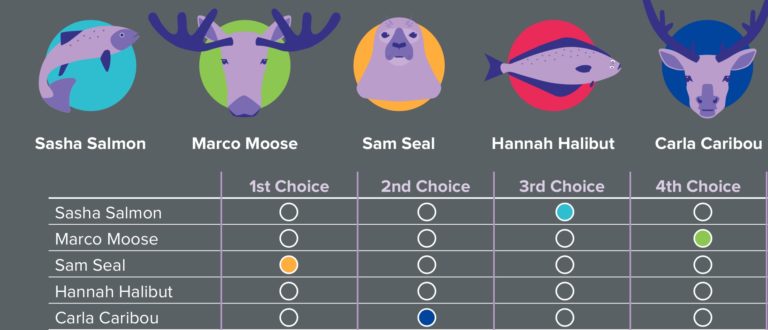
The Alaskans for Better Elections group has published a train-the-trainer guide for civic leaders and other influencers that all but admits in the lower right corner there will be questions the trained individuals cannot answer:
Alaskans for Better Elections, after winning Ballot Measure 2, became the standing 501(c)(3) nonprofit organization whose mission it is to keep the system from being axed by legislators, something which the Legislature is entitled to do two years after an initiative passes. It’s funded by Outside money.
The organization is steered by hardcore leftists.
On the steering committee for Alaskans for Better Elections:
Barbara ‘Wáahlaal Gidáak Blake – Nonpartisan, hardline leftist Alaska Native who is on the Juneau Assembly; a former Bill Walker staffer.
Sheldon Fisher – Republican, former Gov. Bill Walker’s commissioner of Revenue and commissioner of Administration.
Penny Gage – Undeclared party, National Congress of American Indians.
Jan Hardy – Nonpartisan, self-described labor activist in Anchorage, signer of Recall Dunleavy petition.
Katherine Jernstrom – Undeclared party, co-founder of The Boardroom, where nonprofits are housed, and where leftist campaign office of Ship Creek Group is located.
Karl Kassel – Undeclared party, former mayor of Fairbanks North Star Borough, and tightly knit with Walker World, signer of the Recall Dunleavy petition.
Ben Kellie – CEO & founder of The Launch Company, and signer of the Recall Dunleavy petition.
Cordelia Kellie – Special assistant for rural affairs for U.S. Sen. Lisa Murkowski.
Albert Kookesh – Democrat, former Democrat state senator, Native elder.
Lesil McGuire – former Republican state senator and representative.
Mike Navarre – Democrat, former mayor of Kenai.
La Quen Náay Liz Medicine Crow – Sealaska employee, First Alaskans Institute, political activist.
Pamela Parker – Democrat, Soldotna Chamber of Commerce, signer of the Recall Dunleavy petition.
Pat Race – Democrat activist, blogger, Juneau podcaster, signer of Recall Dunleavy and active with the Recall Dunleavy group.
Greg Razo – Democrat activist and signer of the Recall Dunleavy petition.
Derek Reed – Democrat, former president of Anchorage Democrats, and signer of the Recall Dunleavy petition.
Kimberly Waller – Democrat, Director, Diversity and Inclusion at The Foraker Group, mainly funded by the Rasmuson Foundation.
Fully 15 of the 17 members of the steering committee are demonstrably left-leaning, with only two registered Republicans on the entire committee, one of whom was a high-ranking official in the Democrat-endorsed Gov. Bill Walker administration.
Forty-one percent of the Alaskans for Better Elections steering committee signed the petition to recall Gov. Mike Dunleavy.
What works “better” for the Alaskans for Better Elections steering committee is to ensure Democrat voters are educated on how to vote, and to ensure Republican voters are confused and discouraged from voting altogether.
What will work best for Republicans is to vote with gusto on Aug. 16 and in November, and elect members to the Legislature who will take care of the Democrat-favoring Ballot Measure 2.
Today, Centers for Disease Control and Prevention Director Rochelle P. Walensky approved a committee recommendation that all children 6 months through 5 years of age should receive a COVID-19 vaccine.
This expands the shot availability to nearly 20 million additional children. Parents and guardians can get their babies shot with the Pfizer-BioNTech or Moderna vaccines, whichever is available to them, “to better protect them from COVID-19,” the CDC said.
“All children, including children who have already had COVID-19, should get vaccinated,” the agency said, adding that the Covid-19 vaccines “have undergone—and will continue to undergo—the most intensive safety monitoring in U.S. history. Parents and caregivers can play an active role in monitoring the safety of these vaccines by signing their children up for v-safe – personalized and confidential health check-ins via text messages and web surveys where they can easily share with CDC how a child feels after getting a COVID-19 vaccine.”
The shots for the children will be available by Tuesday, as Monday is a federal holiday. Distribution of pediatric vaccinations for these younger children has started across the country, and will be available at thousands of pediatric practices, pharmacies, federally qualified health centers, local health departments, clinics, and other locations.
“Today is a day of huge relief for parents and families across America,” said President Joe Biden.
Moderna is on the record saying its vaccine is 51% effective against infection, among babies from 6 months to under age 2, and only 37% effective for those aged 2 to 5. Moderna is a two-shot regimen given four weeks apart, while Pfizer for the youngest children needs three shots, the first two given three weeks apart and the last shot given more than two months later.
Officials believe that about three quarters of American children have already had Covid. Just 30% of children between 5 and 11 have gotten vaccinated since the Pfizer shots become available for that age group in November. Parents are hesitant because of the stories they have heard about side effects. The most common effect is headache and soreness. Learn more about side effects from the CDC website.
“Together, with science leading the charge, we have taken another important step forward in our nation’s fight against COVID-19,” Walensky said. “We know millions of parents and caregivers are eager to get their young children vaccinated, and with today’s decision, they can. I encourage parents and caregivers with questions to talk to their doctor, nurse, or local pharmacist to learn more about the benefits of vaccinations and the importance of protecting their children by getting them vaccinated.”
If things aboard Alaska Airlines flights seem a bit gay-obsessed this month, it’s because the company has gone to new heights to celebrate Pride Month. For some, it’s a form of mass grooming of captive passengers, while to others, it is just another day in woke corporate America.
The airlines gave passengers on a “Pride” plane flight from San Francisco to Los Angeles a free trip to anywhere the company flies. As passengers prepared to board, they were greeted by Ravi, a personality and host of a gay travel company. He was dressed in a rainbow smock, holding a microphone, while prancing and chanting “I say Gay, you say Gay!” to the passengers in the terminal as he announced the free trips for the passengers waiting for their flight.
Last year, Alaska painted one of its planes with a “Fly with Pride” theme, with the jet’s body covered with painted rainbow plane decorations. This year, passengers can watch LGBTQ-theme movies, such as, “RuPaul’s Drag Race,” “Love Simon,” “Transfinite” and “The Birdcage.” As customers board this month, the airlines is playing gay-friendly boarding music by artists such as Torii Wolf, Sarah, the Illstrumentalist, and Low Girl.
Flight attendants are also wearing pronoun pins.
Alaska Airlines pronoun pins.
Alaska Airlines is committed to pushing gay theme throughout the year by sponsoring parades in the following communities:
Portland, June 19
San Francisco, June 26
Seattle, June 26
San Diego, July 16
Boise, Sept. 9-11
Honolulu, Oct. 15
Palm Springs, Nov. 4-6
The airlines, whose headquarters is in Seattle, celebrated the engagement of one of its pilots to a flight attendant, aboard the Pride Plane. The love story is prominently featured on its blog, which also has a photo of a young boy inside a gay-decorated airplane, as he sports a Pride Plane t-shirt.