
Jamie Allard, assemblywoman for Eagle River, has a fundraiser at Bell’s Nursery on June 23 for her campaign for State House for District 23. Details are in the flyer posted above.
Notes from the trail: Money isn’t everything, Peltola shows

Most of the 11,700 votes to be counted in the special congressional primary mail-in election are from the Anchorage area, with a sprinkling from Juneau and Kenai. The next count will be on June 21 and with this trend, it looks like — this is a prediction — Sarah Palin will be at about 27%, Nick Begich holding steady at 19.3%, with Al Gross near 12.8% and Mary Peltola at 9.5%.
The ballots accepted by the Division of Elections now total 161,414, which includes 157,033 absentee ballots (mail in) and 4,381 early votes.
Money isn’t everything in Alaska campaigns: One of the most intriguing aspects of this election is the Mary Peltola (pictured above) dark horse candidacy.
Peltola raised and spent the least amount of funds among the top finishers during the first reporting period. She received $81,636, spent just $38,320, leaving her with $43,315 and change to work with (reporting coverage period ending May 22). Nearly all of her funds came from individual donations from Alaskans, not from political action committees. There was no independent expenditure group coming alongside to support her, either.
Many Alaskans reacted to Peltola reaching the top four with the question: “Mary Who?”
Peltola is using the Democrats’-choice Ship Creek Group as her campaign consultant. She paid the group $10,000 as of May 22.
It was a good bet for Ship Creek Group. Presumably the big Democrat Party money is now coming to aid Peltola, while the Republican Party will likely remain paralyzed because there are two strong Republicans on the final ballot — Nick Begich and Sarah Palin.
Only Nick Begich is endorsed by the party, but the Palin factor is an undeniable consideration, and she is the top vote-getter in the primary. Her attacks on the Republican Party are going to make it awkward in terms of getting financial or moral support.
The ranked choice system disadvantages the Republican Party as an organization on many levels, the first of which is that Ballot Measure 2 took away the separate ballot that Republicans had previously used to ensure that registered Democrats didn’t cross over and install a bad candidate for the GOP for the general election. Now, the system makes it politically difficult for Republicans because, in Alaska, more than one Republican will be on so many ballots.
One of the tough questions is: What will Native corporations do now? Several of them backed Republican Tara Sweeney, with over $435,000 dropped into a super PAC supporting Sweeney (as of May 22). Sweeney’s campaign also spent over $80,000 and she ran an aggressive name-ID campaign.
Peltola’s stance on development of Alaska’s resources may worry the greater business community. But she is as Alaska Native as they come, and that creates a conundrum for the Native Corporation board room discussions. Their problem with Mary Peltola is that she is a genuinely nice person nobody in the Native community has much bad to say about her.
Fifty-nine days until Aug. 16: The four remaining candidates for Congress have just 59 days left to make their case to the voters for both the temporary and the regular seat for Congress. Although some candidates who are not going to be on the special general election ballot have declared they are dropping from the regular primary election, there are still 30 names on that list for Aug. 16.
At the same time, all the other candidates hoping for voter support (state House, Senate, U.S. Senate, Governor) also have but 59 days to try to get some attention before they, too, find out if they advance to the November ballot or just go fishing for silvers in late August.
James Kaufman for Senate Seat F kickoff:
Kaufman, a Republican, is running against Janice Park, a perennial Democrat candidate in this R-leaning district of South Anchorage:

Laddie Shaw for House Kickoff:
Shaw’s new House District is #9; he’s running against Democrat David Schaaf.

Nick Begich Wasilla spectacular:
Just look at that list of names in Wasilla, including Rep. George Rauscher, Rep. Kevin McCabe, Sen. Mike Shower, Rep. Delena Johnson, Sen. Shelley Hughes, and Rep. Cathy Tilton; also Assembly members DeeDee McKee, Jesse Sumner and Rob Yundt; Wasilla Mayor Glenda Ledford, Councilwoman Colleen Sullivan-Leonard, Palmer Councilwoman Pamela Melin, and more…

Jamie Allard for House kickoff:
Allard, coming from the Anchorage Assembly where she has been tackling the radical Left, is running against perennial candidate Roger Branson, also a Republican, for House District 23, Eagle River. Her kick off is Thursday at Bell’s Nursery:

Endorsements: IBEW 1547 has endorsed Al Gross for Congress. Emil Notti, an also-ran on the ballot of 48 congressional contenders, stated he endorses Mary Peltola for Congress. Republican Aletha St. Martin of Fairbanks added her name to the list of Nick Begich for Congress endorsers, as did Denise Hall of Sterling. Dr. Lindy Jones of Juneau endorsed Bill Walker for governor.
Les Gara for Governor: The Democrat candidate for governor wants red flag laws: “I’ve said we can come together where we can & pass a carefully written Red Flag law while respecting the 2nd Amendment.”

Bill Walker for Governor: Walker and Heidi Drygas were at Chena Hot Springs touring the ice hotel and greenhouses.
Charlie Pierce for Governor: Pierce had a big barbecue scheduled in Utqiagvik (Barrow) this week, but the plane turned around. “Our flight was turned around just before landing and cancelled.”
Dear John: Mediators up and quit the homelessness negotiations between mayor and Anchorage Assembly

The year-long debate between the Bronson Administration and the Anchorage Assembly over mitigating homelessness in Anchorage took another turn on Friday when the hired mediators quit, saying that the two sides were just not working well together.
In a letter, retired Admiral Tom Barrett and Belinda Breaux, who were the mediators, said they’re done. The letter was vague and did not cast all the blame on one side or the other.
“We want to inform you we are concluding our work facilitating efforts by the Municipality and the Anchorage Assembly to improve the homeless situation in our community. We do not believe at this point we can add value implementing the client and community focused strategy the Assembly and Municipality have agreed to,” the two wrote.
“Homelessness is a complex, multifaceted issue impacting some of the most vulnerable members of our community and the quality of life of our community itself. Successfully addressing it takes proactive engaged, transparent collaboration among multiple government, philanthropic, service, business and religious organizations willing to rise above differences and partner with each other in positive, creative ways to achieve common goals, Barrett and Breaux wrote. The Mayor’s Office and the Assembly had brought in community partners such as Weidner Apartments and the Rasmuson Foundation to solve the complexities of homelessness in Anchorage.
At the end of the month, the Sullivan Arena is closing as a temporary shelter, after having been used as such for two-and-a-half years.
“Much progress has been made over the past year in Anchorage because of extraordinary work by many dedicated individuals and organizations. The Anchorage community can be proud of this progress, and we are proud of helping advance that work. We thank the Assembly and Mayor Bronson for the opportunity,” the mediators wrote.
“However, the transparency, candor and ‘we are all in this together’ attitude that enabled that earlier progress has in our opinion broken down in recent months. The decision framework approach we apply to support issue resolution depends on willingness to engage on tough issues with transparency, candor, accurate data, and credible information. We are no longer in such an environment and are thus unable to add value supporting decision-making needed to successfully exit mass care at Sullivan arena and implement agreed to planks of the client and community centered homeless strategy. We encourage the Administration to continue working together with the Assembly and community partners over coming weeks as Sullivan Arena is closed, operating plans for a navigation center are developed, and for the long term given that gaps remain in supportive low-cost housing availability in Anchorage,” they wrote.
A major component of the homelessness plan was the mayor’s hope for a navigation center, where people who are down on their luck could begin a journey back to productivity and a stable life. That has been met with a lot of resistance from the Assembly, as has his desire to work more closely with the faith-based nonprofits who are already providing services to homeless and vagrants in Anchorage.
Michael Tavoliero: Anchorage Assembly’s kindergarten tyranny traces its roots to unification in 1975

By MICHAEL TAVOLIERO
In 2013, then-Mayor Dan Sullivan and the Anchorage Assembly passed AO37 into law. It was deemed the “Responsible Labor Law.”
It provided a legal standard for the costs of union contracts, as well as changed the original 25-year-old labor law, eliminating all pay incentives. Unions could no longer bargain for increased pay for specialized training or for earning a college degree. The mayor and the Assembly believed the incentives didn’t provide any benefits to the city, so why include it in the city’s labor negotiations?
It made sense. After all, it was our tax money, not the public unions.
On Nov. 4, 2014, Anchorage Municipality voters repealed AO37.
This was the equivalent of the Fall of Vicksburg for the special interests’ takeover of what Italian communist Antonio Gramsci described in the 1930’s: “ Socialism will triumph by first capturing the culture via infiltration of schools, universities, churches, and the media by transforming the consciousness of society.”
The repeal of AO37 was a clandestine operation through our most impressionable institutions to change cultural, political, and societal behavior locally.
As Christopher F. Rufo, founder and director of the public policy research center Battlefront and senior fellow at the Manhattan Institute, recently pointed out “the revolutionary ideas of the ‘60’s have been repackaged, repurposed and injected into American life at the institutional level.”
Having lived through Woodstock and my college days living in Berkeley with experiences never to be revealed publicly, I can only say that that is correct.
In Anchorage, we now see this in our Assembly and our school district. We are witnessing the ideological division perpetrated by the elected representatives of the most populated community in the State of Alaska. Like some many other large urban centers around our nation, this handful of elected officials by simple ideological determination controls our future and that of our children.
There is a conditioning approach to all its legislation, creating a public policy where government restricts its people. AO 2022-60 was drafted to give the Assembly a path to allow the Assembly to remove the mayor or any elected official for almost any reason. With declaring that under the authority of the municipal charter Section 7.01(b), the Assembly is establishing specific procedures for the removal of an elected official for breach of the public trust.
Hey, why not? This is true behavioral modification.
The parameters they have given themselves are broad and vague. Nonetheless, they do create a procedural approach for the removal of an elected official who may not be using the same ideological compass as most of the Assembly.
If the ordinance passes, and it appears likely, it may be contested in court as a breach of the separation of powers and constitutional rights. Given the current judicial activist penchant of our Alaskan judiciary, this next level of litigious well-intentioned behavior on the part of the liberty minded conservatives may well end in another darkly polished example of bad case law.
Haven’t we had enough?
If defeated in court, what can happen next?
I point to the short life of AO-37.
May I also point out the more recent failed contests which were costly to Anchorage conservatives? Both recent recall elections of Assembly members Felix Rivera and Meg Zalatel were defeated. Five of the 7 conservative candidates on the ballot were defeated.
Given the pattern, the likelihood of a conservative prevalence in an election to repeal AO 2022-60, I suspect, will not be successful.
Where does that leave the most embattled mayor in the history of Anchorage?
You got it. He is now prey to a continued and vicious attack by the members of the Assembly and their minions with even less defense. He’s gelded and ready for the glue factory.
Which brings me to my point.
All of this defense will cost the mayor, his supporters and the Anchorage taxpayers money, time and wasted elected executive efforts. Given the track record of over the past decade of conservative disappointment, I am not optimistic that this next litigious carnival or election effort will be successful or even effective.
Even if it is, the mayor during the remainder of his term will be effectively distracted just like Trump was by Pelosi and Schumer with the continued obstacles the Assembly puts in his way with little to no accomplishments and perhaps impeachment, removal and/or a one term Mayor.
In the Anchorage political scene, it’s kind of like banging your head against the wall. When you stop, it feels good.
Same cycle same scenario and no sign of it changing soon.
I have an idea: Decentralize the Municipality of Anchorage.
Yes, de-unify the Unified Municipality of Anchorage.
This half century experiment which unified the state’s largest population into a centralized local government is a tragic political, financial, and social failure.
The mayor should consider this as the one true offensive measure which may potentially remove all power and control from the Anchorage special interests. The mayor, with the Alaska Local Boundary Commission’s approval, may submit a petition under 3 AAC 110.410(a)(3) to effect boundary changes.
Remember if Chugiak-Eagle River had not been involved in being a borough during the vote for the unification charter commission, the unified Municipality of Anchorage may have never been. The Eagle River-Chugiak voters were not residents of the Greater Anchorage Areawide Borough in February 1975 when Greater Anchorage Areawide Borough voters approved the concept of unification and elected members to the Charter Commission.
The irony is if the conservative Eagle River-Chugiak voters had voted in that election, the probability of the commission being approved was unlikely and today’s exercise in kindergarten tyranny may never have happened.
Michael Tavoliero is a realtor in Eagle River, is active in the Alaska Republican Party and chaired Eaglexit.
Assembly vice chair cuts mic of youth member, who tries to defend Youth Advisory Commission’s authority
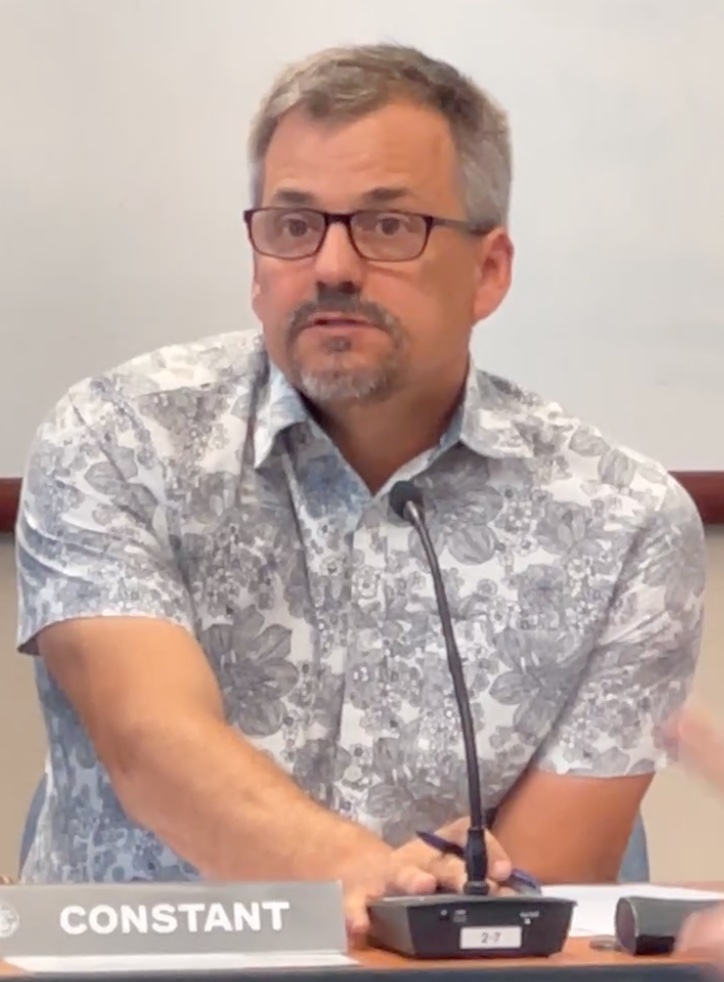
Anchorage Assembly continued today to try to take away power from the Youth Advisory Commission; the Assembly’s left-leaning majority doesn’t like the direction the commission has taken, which is often contrary to the majority’s positions.
A Friday work session got testy when Assemblyman Chris Constant muted the microphones of Assemblywoman Jamie Allard and Youth Advisory Commission Assembly representative Sarah Price. Constant cut off Price, after sarcastically thanking her for repeating the points she had made at the previous full Assembly meeting, and as Price was trying to say that the leftist Assembly was acting in a partisan manner.
Constant ruled that statement out of order.
Allard, who attended by phone, said that Constant was discriminating against women by cutting off Price’s microphone, at which point Constant also cut off Allard’s microphone. Allard later said this is part of a pattern of discrimination against women by Constant.
The Assembly majority is trying to remove the youth commission from the mayor’s office and make the appointments to the commission itself, so it can return the youth commission to a left-leaning indoctrination organization.
The effort to take the power away from the Youth Advisory Commission is a new- development on the Assembly, whose majority has not attended any of the YAC meetings this year.
The youth commission has a firebrand representative sitting on the dais at the Assembly meetings; Sarah Price has not been shy about stating a strong viewpoint against the Assembly majority at times. She is not a voting member of the Assembly but her vote is recorded.
The ordinance will come up on Tuesday for a possible vote during the regular Assembly meeting, which starts at 5 pm in the ground floor of the Loussac Library. The Assembly agenda is at this link.
And another 2,493 votes counted, some coming from Fairbanks

Alaska’s congressional candidate leaders continue to lead, with no discernible change for the final four for the August ballot.
The vote total in the special congressional primary is now 150,036, which is 2,493 votes more than announced at 1 pm. Most of the latest votes appear to have come from Fairbanks, with both Adam Wool and John Coghill gaining a few votes, although they are far down from the final four. Wool and Coghill are well-known Fairbanksans.
There were 48 names on the ballot to choose from in the June 11 special primary election to replace Congressman Don Young until the voters make their final decision in November.
The leader standing, as of 2:20 pm on Friday:
- Palin: 41,302, 27.59%
- Begich: 28,859, 19.27%
- Gross: 18,936, 12.65%
- Peltola: 14,133, 9.44%
The top four above will appear on the Aug. 16 ballot, where voters will rank them in their order of preference.
More votes counted: 147,543, as Peltola notches more votes, locking fourth place in congressional race

The Division of Elections counted another 13,364 ballots on Friday in the special primary election to seat a temporary congressional representative for Alaska.
As of 1 pm Friday, the total votes counted by the Division are 147,543 out of 587,174 received for a 25.13% turnout.
The overall results haven’t shifted: Sarah Palin, Nick Begich, Al Gross, and Mary Peltola are still headed for the special general election on Aug. 16. But the percentages have shifted slightly:
- Palin: 40,644, 27.61%
- Begich: 28,430, 19.31%
- Gross: 18,644, 12.66%
- Peltola: 13,893, 9.44%
The gap between Palin and Begich has tightened by two points since election night on Saturday. Peltola went from 8.86% election night to 9.44% today.
Democrats, including non-declared Democrat Al Gross, have received 27% of the vote.
The final vote count will take place on Tuesday and the election certified on June 25. About 3.56% of ballots received in this mail-in election have been rejected by the Division of Elections. Most of the rejections are probably because there is no witness signature on the mail-in envelope.
Cautionary tale: Candidate for Alaska House takes child to drag-themed adult events, and crows about it on Facebook

Andrew Timothy Gray is a frequent figure at the Anchorage Assembly meetings, most often testifying on behalf of leftwing causes and perspectives. He is a rising star in the Democratic Party.
Then Gray decided to run for an open seat for the Alaska House, and his judgment to serve the state came under greater scrutiny. This month, Gray posted a photo on Facebook of a child — his child — appearing at a drag-themed event at an Anchorage cafe, and winning one of the coveted prize cards for a card game that involved drag queen personalities.
Drag Queen Loteria is a bingo game with drag theme cards. A monthly event at Cafecito Bonito in cooperation with local drag artists, it takes place every final Friday and Sunday of the month.
“Between rounds of game play, there will be incredible performances by local drag artists,” the event notice advises for the upcoming show. “PLEASE BRING $INGLES to show some love for our all-Latinx lineup of drag performers! This month’s event features the talents of Glenn Coco, Dela Rosa, and Brenden Badd.” Those single dollar bills are presumably to stuff into the garters of the drag queens as they perform their burlesque acts.
Gray is running for District 20 against two Republicans, Paul Bauer and Jordan Harary. District 20 is part of the University of Alaska Anchorage area and is a subsection of Senate Seat J.
With three people on the ballot for the district, all will appear on the Aug. 16 pick-one primary, and all will appear on the November ranked-choice ballot. All seats in the Alaska House are up for election this year, a result of the redistricting that has just completed, redrawing the House and Senate seat boundaries.
Must Read Alaska has blotted out the face of the child in the drag queen event referenced above by Andrew Gray.
Andrew Klavan: The big white lie of leftism

By ANDREW KLAVAN | CITY JOURNAL
The thing I like best about being a conservative is that I don’t have to lie. I don’t have to pretend that men and women are the same. I don’t have to declare that failed or oppressive cultures are as good as mine. I don’t have to say that everyone’s special or that the rich cause poverty or that all religions are a path to God. I don’t have to claim that a bad writer like Alice Walker is a good one or that a good writer like Toni Morrison is a great one. I don’t have to pretend that Islam means peace.
Of course, like everything, this candor has its price. A politics that depends on honesty will be, by nature, often impolite. Good manners and hypocrisy are intimately intertwined, and so conservatives, with their gimlet-eyed view of the world, are always susceptible to charges of incivility. It’s not really nice, you know, to describe things as they are.
This is leftism’s great strength: It’s all white lies. That’s its only advantage, as far as I can tell. None of its programs actually works, after all. From statism and income redistribution to liberalized criminal laws and multiculturalism, from its assault on religion to its redefinition of family, leftist policies have made the common life worse wherever they’re installed. But because it depends on—indeed is defined by—describing the human condition inaccurately, leftism is nothing if not polite. With its tortuous attempts to rename unpleasant facts out of existence—he’s not crippled, dear, he’s handicapped; it’s not a slum, it’s an inner city; it’s not surrender, it’s redeployment—leftism has outlived its own failure by hiding itself within the most labyrinthine construct of social delicacy since Victoria was queen.
This is no small thing. To rewrite the rules of courteous behavior is to wield enormous power. I see it in Southern California, in the bleeding heart of leftism, where I live. I’ve been banned from my monthly poker game, lost tennis partners, lost friends—not because I’m belligerent but because I’ve wondered aloud if the people shouldn’t be allowed to make their own abortion laws, say, or if the world might not be a better place without the UN.
It’s a rotten feeling. I sometimes think that I’d rather be deemed evil than a boor. Wickedness has some flair to it, even a whiff of radicalism. If you molest a child, there’s always a chance that you can get the ACLU to defend you as a cultural innovator. But if you make a remark at table about the destructive social effects of broken homes and then discover that your dinner partner is a divorcée—trust me, you feel like a real louse. It’s manners, not morals, that lay the borderlines of our behavior.
This, I believe, is the reason conservative politicians so often lose their nerve, why they back down in debate even when they’re clearly right. No one wants to be condemned as a brute—especially not conservatives, who still retain some vague memory of how worthy it is to be a lady or gentleman.
Continue reading this column written in 2007 at City Journal. City Journal is a publication of the Manhattan Institute for Policy Research, a leading free-market think tank. Are you interested in supporting the magazine? As a 501(c)(3) nonprofit, donations in support of MI and City Journal are fully tax-deductible as provided by law (EIN #13-2912529).

