Monday, August 3, 2026
Home Blog Page 899

Alaska AG Taylor joins case with other states to ban ‘sanctuary cities,’ after Miami judge calls the ban racist

By BETHANY BLANKLEY | THE CENTER SQUARE 

Seventeen Republican attorneys general, including Alaska Attorney General Treg Taylor, have filed an amicus brief with the 11th Circuit Court of Appeals in support of a Florida law that bans sanctuary cities.

The brief was filed by the attorneys general of Alabama and Georgia, Steve Marshall and Christopher Carr. Joining them were the attorneys general of Alaska, Arizona, Arkansas, Indiana, Kansas, Kentucky, Mississippi, Missouri, Montana, Nebraska, Oklahoma, South Carolina, Texas, Utah, and West Virginia.

In 2019, the Florida legislature passed a bill signed into law by Gov. Ron DeSantis requiring state and local government officials and employees to comply with federal immigration enforcement.

DeSantis said he was proud to sign the bill “to uphold the rule of law and ensure that our communities are safe.” He thanked state legislators “and the Angel Parents for their commitment to seeing this bill across the finish line. Their leadership has made Florida safer.”

Shortly thereafter, the city of South Miami sued, and later several other groups, claiming the law discriminated against foreign nationals living in Florida illegally. U.S. District Court Judge Beth Bloom granted the city’s request for an injunction, halting the law from going into effect. Florida then appealed.

The Florida case is currently on appeal from the U.S. District Court for the Southern District of Florida, Miami Division. The attorneys general argue Bloom legislated from the bench and exceeded her constitutional authority.

“The amici States must constantly defend against legal challenges to state statutes brought by those who oppose the results of the legislative process,” they argue in the brief. “These litigants invite federal courts to substitute their own judgment for that of the legislature. Too often, courts accept the invitation to usurp the legislative role by ascribing invidious intent to legislative enactments based on sheer policy disagreement, dressed up as supposed discrimination.

“The Constitution forbids that, and for good reason. … Federal courts are poorly positioned to weigh the many interests at stake. Their decisions are rendered without public debate. And, because they are not elected, they cannot be held accountable by the people.”

They argue Bloom “fell prey to exactly this temptation.”

“A legislative judgment that the country’s existing laws should be enforced is not an extreme or suspect position,” they argue. “Yet the district court held the law facially invalid, because it was supposedly enacted with discriminatory intent, even though the law specifically prohibits racial discrimination. The Court did not point to any discrimination apparent in the text of the law (there is none).”

AG Marshall said, “An unelected federal judge apparently disagrees with Florida’s political judgment about whether immigration laws should be enforced, but that should not be relevant,” adding that he hopes the court undoes Bloom’s “troubling ruling and puts an end to this practice of legislation by judicial fiat.”

In Florida AG Ashley Moody’s brief filed with the 11th Circuit, she argued Judge Bloom “committed numerous errors to arrive at the remarkable conclusion that the Florida Legislature had secret racist motivations in enacting SB 168.”

“The law promotes public safety in facilitating federal immigration enforcement against criminal aliens, while expressly prohibiting racial discrimination in its implementation,” the brief states. “The district court found a hidden racist motive only by ignoring key provisions of the statute, failing to afford the Legislature a presumption of good faith and placing great weight on the thinnest of evidence.”

There are currently more than 300 so-called sanctuary cities in the U.S. whose officials won’t cooperate with federal immigration enforcement, the Federation for American Immigration Reform (FAIR) estimates.

“Many sanctuary policies restrict law enforcement agencies from cooperating with federal immigration officials, including prohibiting their compliance with immigration detainers,” it states.

According to U.S. Immigration and Customs Enforcement estimates, more than 2.1 million illegal immigrants are living in the U.S., with more than 1.9 million of them having deportation orders from a judge. 

In a recent letter to Department of Homeland Security Secretary Alejandro Mayorkas, Florida Congressman Matt Gaetz estimates that it would take 14.5 years to deport “just the aliens DHS has released under the Biden Administration,” into the interior of the U.S., including Florida. This is in addition to the 1.9 million with deportation orders who haven’t been deported.

He also recently cited DHS data indicating that the Biden administration has the lowest deportation rate in the history of the agency. According to DHS data, 48% fewer criminal illegal immigrants have been arrested and 63% fewer convicted criminals have been deported under the administration, he said.

Bethany Marcum: Best and worst of 2022 legislative session

By BETHANY MARCUM

As is often the case, there was no shortage of bills introduced to the 32nd Legislature (which comprises 2021 and 2022). Not counting resolutions, legislators introduced 690. Those that did not pass both bodies by the end of the 4thSpecial Session in 2021 were still in play in 2022, and when all was said and done, 74 completed the process. 

More important than a list of what bills crossed the legislative finish line in 2022 is the question of what good and bad policy reforms the legislature enacted. This analysis is not comprehensive because keeping up with Juneau antics is a daunting task, but what follows are some highlights. Readers who take an interest in any of the policies should remember that nothing is final until signed by the governor, who maintains veto authority.

For context, Alaska Policy Forum is all about freedom. Bills are good when they bring more freedom to people. Our vision is an Alaska that continuously maximizes individual opportunities and freedom on a path toward prosperity. More specifically, we operate under seven principles of sound public policy, which provide the lens through which we evaluate the following outcomes of 2022 legislative activity.

Because literacy is a foundation for understanding freedom, the best policy reform to make its way through the legislature in 2022 was the Alaska Reads Act. This nonpartisan reform passed the Senate unanimously (twice!) and squeezed out of the House by a single vote. It creates a comprehensive statewide K–12 reading policy to improve Alaska’s dismal outcomes. We certainly do not like everything in the bill, but we fully support reforms that ensure education dollars are spent in ways that develop reading proficiency for students.

Another very good outcome of this legislature was not creating a new defined benefits pension tier for state employees. More than one bill was introduced to do so, and advocates deployed many tactics to propel the dangerous change. Thankfully, all attempts failed, and at least for now, Alaska has steered clear of proposals that would bring great fiscal risk to the state and threaten retirement benefits already promised to retirees.

A surprising bright spot: Inaction on a bill that would have capped political contributions. A 2021 ruling by the Ninth Circuit Court struck down Alaska’s previous campaign donation limits. We agree with those who contend that laws to “regulate political spending and contributions . . . violate the right to free speech and ultimately diminish citizens’ power.”

Additionally, legislators made a small step toward cutting back on bureaucratic excess with a bill that attempts to eliminate “outdated, duplicative, or excessive” government publications. Allowing some documents to be delivered electronically saves state funds. 

Progress was also made toward improved transparency of state spending by way of the Alaska Online Checkbook Act, which passed without a single legislator voting against it. That’s quite an accomplishment! APF fully supports the intent of this policy reform but would be remiss if we did not point out a glaring omission: The largest chunk of dollars the state spends goes directly to the 53 school districts; most other spending looks miniscule by comparison. Contrary to the principle of open government, those school districts’ appropriations are a closed book, providing no clear picture of how the funds are spent. 

Some bills survived the legislative session with both good and bad elements.

One proposal gives the state Board of Pharmacy authority to continue practices started during the COVID pandemic — notably, allowing pharmacists to prescribe vaccines and emergency medications. Giving health care professionals tools to meet the needs of the market is indeed a welcome step. However, in doing so, the legislature also took the opportunity to widen the scope and authority of a government regulatory board, once again showing that most of our elected officials do not trust the power of the free market. 

Another bill passed with the intention of alleviating Alaska’s teacher shortage. That lawmakers have identified this problem is good news, and the bill took some steps in the right direction. Even the name sounds great: “Out of state teacher reciprocity.” But once again, policymakers showed their fear of the market’s ability to self-correct. Rather than simply recognizing licenses in good standing from other states, the bill gives such teachers a two-year pass while they teach in Alaska. It still requires them to complete Alaska’s more-onerous requirements to maintain licensure. The education special interest groups win again. 

Regrettably, no bills of consequence were passed to drive down Alaska’s incredibly high health care costs. Two that would have helped — repealing Alaska’s certificate of need requirements and protecting direct care arrangements between medical providers and patients — remained stuck in committee when the legislature gaveled out.

While over 60 bills were introduced dealing with Alaska’s elections, not one of consequence passed. At a time when a majority of voters in our state support election audits, requiring a photo ID to vote in person, and signature verification of ballots, the legislature could not manage to pass even one small improvement to address their concerns.

Lastly, fiscal restraint took a back seat in 2022. The budget that passed for 2023 was massive: 65% more than APF’s Responsible Alaska Budget amount and a 37% increase over last year’s budget. We’ll weigh in on the final budget after the governor has had a chance to issue vetoes, but in the meantime, we were disappointed that legislators took no statutory action on an appropriation limit of any sort. 

While many elected officials campaigned on this very issue and the Alaska Chamber has made a “meaningful spending cap on operating budget expenditures” a policy priority year after year, another session has passed with no progress. Until Alaska gets its fiscal house in order, our economy will continue to be disadvantaged and the handful of good bills that manage to make their way into law will not be enough to fill the civic hole.

Bethany Marcum is chief executive officer of Alaska Policy Forum.

Bipartisan: Celebrating reading, Dunleavy and legislators tout Alaska Reads Act, and he autographs books for the kids at elementary school

8

The first teacher to be an Alaska governor was right at home: Gov. Mike Dunleavy, in the the library in Turnagain Elementary School in West Anchorage, rose to speak while the children and adults in summer school classes settled down for a monumental announcement from the state’s top elected official. Students sat crisscrossed on the floor in front, and flanked by nearly one third of the Alaska Legislature, Dunleavy announced the success of the Alaska Reads Act, a key initiative of his administration, which he would sign in a few days.

“Today’s news is about you,” said Dunleavy to the students who ranged in age from 6 to 10, “Because the foundation of everything that matters to being a good student, to being a good student, starts with you being able to open a book up, and know what the words in it mean.” 

Though the scene at Tuesday’s ceremony was upbeat, the path to it in the Legislature was anything but.

Alaska by many metrics ranks either last or near last in the United States for reading competency by the third grade. Dunleavy’s administration, and in particular his Commissioner of Education Michael Johnson, made reading reform a major state policy initiative. 

The elements of the plan which became the core of the Alaska Reads Act were accountability combined with support. Each component was a major plank for either conservative or liberal groups. Each component was also a major sticking point for organizations on both sides of the political spectrum. 

An aggressive goal that is unconventional made even more uncommon allies. Dunleavy gained the support of Alaska State Sen. Tom Begich, the leader of the Democratic Caucus in the Senate, who is retiring from politics. (Begich’s conservative nephew, Nick Begich III, is the Republican candidate for the United States Congress).

The governor also enlisted the help of Sens. Shelley Hughes and Roger Holland. Hughes, the Republican Senate Majority Leader, is known for her uncompromising conservative views that resulted in her being removed from previous Senate majority organization.

Holland is a freshman who unseated former Alaska Senate President Cathy Giessel for not being conservative enough in the Republican primary of 2020. 

All were in attendance to celebrate a major milestone in education, as were a substantial contingent of the Alaska House of Representatives. Though the bill passed the Senate unanimously, the Alaska Reads Act became ensared in naked gubernatorial election politics as members of the Bill Walker Caucus in the House repeatedly killed the education reform measure.

In particular, former Speaker Bryce Edgmon of Dillingham and Bethel Rep. Tiffany Zulkosky (appointed by former governor and current candidate Bill Walker) waged a savage, multi-month campaign both in the Capitol and in the press against the reading bill. Charging the sponsors of the initiative of being both anti-rural and anti-student, Edgmon and Zulkosky nearly ensured the original bill had no chance of passing. 

It took a last ditch maneuver, which also gained unanimous Senate approval, to send a reading bill straight to the House on the last day of the legislative session, and by doing so, avoid the roadblocks Edgmon and Zulkosky erected in the House committee process. In a debate that was only overshadowed by the fight over the annual Permanent Fund Dividend, members of the Walker Caucus successfully enlisted near unanimous House Democratic support.

Rep. Mike Cronk of Tok, the rural conservative freshman and former teacher, teamed up with pro-life Democrat and House Majority Leader Chris Tuck to get the largest educational overhaul in a generation over the finish line. 

Cronk and Tuck were successful — by a single vote. Joining virtually the entire House Republican Caucus in supporting the Alaska Reads Act were Rep. Neal Foster of Nome and Josiah Patkotak of the North Slope, both members of the Bush Caucus who broke from Edgmon and Zulkosky.

Along with Tuck came East Anchorage Rep. Geran Tarr, representing the poorest district in urban Alaska. House Speaker Louise Stutes cast the deciding vote, cementing the longstanding rivalry between her and Edgmon, her predecessor. 

But none of the tension from Juneau could be felt or seen on Tuesday. Smiles on newly tanned faces from the state’s recent stretch of sun graced the audience as lawmaker after lawmaker spent time sharing with the students what it means to have done something on their behalf. 

After a moving testimony about reading intervention did for his young daughter, Sen. President Peter Micciche, the retiring Soldotna Republican, yielded the microphone to Sens. Hughes and Shower, but not before acknowledging the importance of the work done. “There are a lot of experts in education in this room. But I’m telling you, when the going got tough, none of us thought of you. We thought of them,” said Micciche, motioning to the kids seated in front. 

House Republican leader Cathy Tilton speaks to the children gathered for the bill signing.

Rep. Cathy Tilton, the House Republican Leader, outlined how finally Alaska was on track to make monumental improvements in the quality of outcomes in Alaska’s students. Tilton was joined by Reps. DeLena Johnson of Palmer, Kevin McCabe of Big Lake, James Kaufman and Laddie Shaw of Anchorage, and Ken McCarty of Eagle River. Rep. Ron Gilham of Soldotna, a lifelong working man proud of his blue collar roots, shared the importance in reading to preserve the opportunities he got as a young man. 

The celebration concluded with an unusual twist. While the final version of the Alaska Reads Act will be officially signed in the coming days, according to Dunleavy’s office, the pens that were brandished were signed on books. Specifically, the students and children in attendance got their favorite booked autographed by the governor which can be kept as a piece of Alaskan history. Among the recipients of a signed book was the family of Rep. Tuck, whose mother and child were in attendance. 

As the children made their way out of the library and the press clapped up their recording devices, the legislators of both parties, at the far ends of the political spectrum, shook hands on a rare accomplishment of bipartisanship that defied petty politics, while Dunleavy stayed at a table, now signing books for the children of the teachers and librarians who came for the announcement.

Paulette Schurech: Why rural Alaska is leaving Murkowski

By PAULETTE SCHURECH

In 2010, when Sen. Lisa Murkowski needed help for her write-in campaign, I thought enough of her to run that effort in rural Alaska. If her re-election campaign reached out to me for help today, however, I wouldn’t answer the call.

This time around, I’m supporting Kelly Tshibaka, Murkowski’s opponent. This is why.

In 2014, an Alaskan public official made some harsh and hurtful comments about suicide at a high school, saying that suicide happens because of a lack of support from parents and friends. These comments came shortly after one of the students had taken his own life. Senator Murkowski defended the official’s remarks in the next news cycle, suggesting suicide is the fault of entire communities. Like many Alaskans, I shook my head in disbelief, disgusted. 

The following day, many of us Alaska Natives were outside the Alaska Federation of Natives (AFN) annual conference waving signs for Bill Walker when Murkowski was dropped off so she could share her remarks with the delegates.  She and I made eye contact–we have had a close relationship going back to that write-in campaign. When our eyes met, my first expression was disgust and disappointment, and I shook my head at her. I have lost so many loved ones to suicide; her press statement had hurt my heart. 

But the pain of her public comments paled compared to how her speech would pierce my soul. When she addressed the delegates, Senator Murkowski said, “Don’t you give me the stink eye and shake your heads at me. I see you,” and she pointed her finger condescendingly at all of us sitting around the room!  

Who gives anyone the right to do that?  I see you, too, Senator. This is when you lost my vote! 

Rural Alaska has some of the highest rates of suicide in the nation, and we are losing generations of our people!  Recently, our family lost another loved one to suicide. It’s still devastatingly painful. You reflect on all the stuff they did since they were little, you laugh, you cry, and a lot of the time, you ask, “Why?”

Senator Murkowski, I see you.  We need compassion, understanding, and someone who will respect us. We don’t need you to throw a piece of fish at us when it’s an election year; we need someone who will honor their commitment to the people of Alaska and our state every year they are in office.  

We need labels removed from us – the expectation that we will support certain candidates simply because of our race. These assumptions only divide us as Alaskans. 

AFN doesn’t represent me, and the tiny group of Alaska Native women who issued statements of support for Murkowski doesn’t represent me, either. It is offensive to assume that because a small group of Alaska Natives supports one politician, it means that we all do.

That is why I came out of retirement to join Kelly Tshibaka’s team: To mobilize rural Alaska and as many Alaskans as possible to come out and vote for her. I’m not a Republican; in fact, I co-led campaigns for Tony Knowles and Bill Walker. But Tshibaka has shown that she genuinely cares about rural Alaska, our living conditions, our families, jobs, housing, and suicide rates. She’s visited many of our rural communities, where some residents have asked her, “Why did you come here? Politicians never come here.” Tshibaka has slept on floors, been weathered in with us, and most importantly, listened to us. 

It’s time for a change. And I’m going to do everything in my power to make that change happen.

Paulette Schuerch is an Alaska Native leader who has been involved in politics for decades, helping to lead multiple successful campaigns and serving in Gov. Bill Walker’s administration. She resides in Kotzebue and is an undeclared voter.

Inclusivity is not for everybody in Pride Month: Man kicked out of Assembly Pride ceremony for not being LGBTQ

Dustin Darden is often a pain in the neck for the Anchorage Assembly majority. He serves up public testimony at nearly every meeting of the Assembly and disagrees with the liberal majority on many items during public hearings.

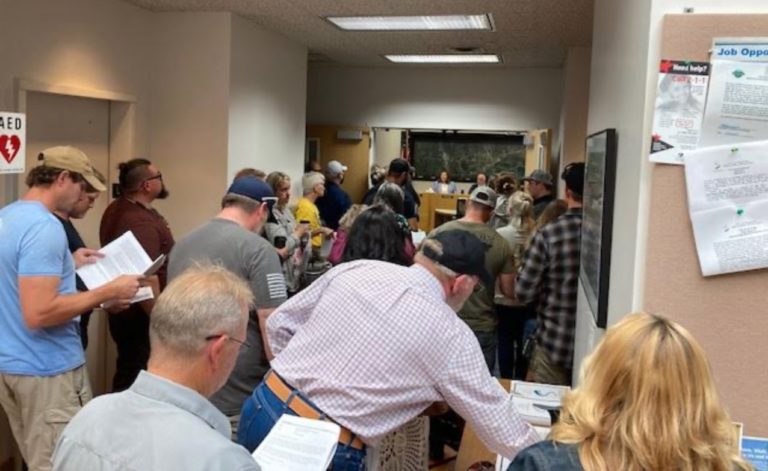
On Tuesday evening, he rose to join a group of the self-identified “LGBTQ community” to receive recognition for Pride Month, with an official resolution being read by Assemblyman Chris Constant.

Vice Chair Constant had invited the members of the LGBTQ community who had come to the meeting to step forward. Darden joined the group of rainbow-decked citizens.

Assemblywoman Meg Zaletel handed Darden a copy of the resolution and then posed with him and the group at the podium. Zaletel knows Darden, just as everyone on the dais knows Darden, and she intentionally pressed a resolution in his open hands, the video shows.

Darden dutifully held up the Pride Month resolution for photos, and then reached into his bag and took out a sub sandwich and took a bite. After putting the sandwich back, he took to the microphone to say a few words. This is where it started to go sideways.

Dustin Darden takes a bite of his subway sandwich during the Pride Month ceremony at the Anchorage Assembly.

Assembly Chairwoman Suzanne LaFrance ordered Darden away from the microphone and said he needed to leave the podium. Darden stood his ground and said he was a letter, too — “the letter D.” One of the members of the LGBTQ community shoved Darden away from the microphone.

The security team arrived and Darden was eventually force-guided to the back of the room, where an argument ensued over whether he could be kicked out for simply taking part in a ceremony in which he felt entitled to be included.

The security team called police for backup, and Darden continued his argument with the police, stating his free speech rights, as he was hauled away in handcuffs, with members of the public shouting at the police, “Shame, shame, shame!!”

All the while, LaFrance and the LGBTQ members at the podium continued their ceremony.

Watch Darden get hauled away on the Must Read Alaska Facebook feed.

Chairwoman LaFrance then called for a break as pandemonium was breaking out in the Assembly Chambers over the incident.

The police searched Darden and dropped him off without his keys, without a jacket, and without his wallet. Must Read Alaska found him sitting on a curb nearby, his arms tucked into the body of his shirt as he tried to stay warm in the 57 degree, breezy evening.

From Darden’s perspective, when Zaletel gave him the officially signed resolution to hold during the photo opportunity, she had used her power as an official of the city to include him. Must Read Alaska asked him what he planned to do next, and he was mulling his options as he sat on a curb, waiting for a friend to bring him another set of car keys so he could go home.

Watch the Pride Month recognition ceremony at this link:

Only in Alaska: Plane makes water landing, and two swim to shore, aided by floatplane passing by area

A Bellanca Scout plane, which is a two-seater with wheels, made a water landing near Middle Point off of Douglas Island today near Juneau. The two onboard were able to swim to shore, less than 100 yards away, according to accounts. By chance, a passenger in a passing floatplane owned by Alaska Seaplanes spotted the splash in the water and the pilot circled around and landed to give aid to the two, who were a bit bloody, soaking wet, but otherwise ok.

The U.S. Coast Guard arrived on the scene shortly after on Tuesday afternoon. The news of the crash was reported by KINY radio and photos were posted on Facebook by the family of the man who spotted the crash as it happened, seen above.

(Photos posted by Pauline Jim on Facebook)

Swamp report: Assemblywoman Meg Zaletel can’t vote on homelessness issues due to a conflict of interest; but she gave Chris Constant’s congressional campaign $5,600

Anchorage Assemblywoman Meg Zaletel was forced by ethics laws to recuse herself from a whole host of activities the midtown representative would normally involve herself in. Her recusal is because in November she was named the executive director of the Anchorage Coalition to End Homelessness, a job for which she is paid well over six figures. The previous executive director Jasmine Boyle, received $116,000 a year for salary, plus benefits. Zaletel’s salary, which Must Read Alaska could not determine, is said by municipal insiders to be substantially more.

The ACEH, underwritten by millions in federal HUD funds, is the beneficiary of over $1.2 million in Anchorage grants, both direct and indirect, that are awarded through Assembly appropriations. Zaletel also coordinates grants for other organizations, such as the United Way. Thus, she is has become the gorilla of the Anchorage homeless industrial complex.

Zaletel’s conflict of interest also means she cannot serve on the Assembly’s Committee on Homelessness. The committee is comprised of Chairman Felix Rivera and Vice Chairman Chris Constant, along with members Jamie Allard, Kevin Cross, Kameron Perez-Verdia, Austin Quinn-Davidson, and Randy Sulte.

But Zaletel pedals her influence in other ways. She has found a solid voting surrogate in Assemblyman Chris Constant, who is running for Congress.

In the Federal Election Commissions campaign finance reports for donations made to congressional candidates, Zaletel is credited with making two large donations in April to Constant’s campaign war chest for his congressional bid: $2,700 and $2,900. That’s within a hair of the maximum allowed by law.

In fact, Zaletel is one of Constant’s biggest donors, giving him $1 out of every $27 he has received, as of the most recent report.

That means Zaletel is funding the political career of Constant, who not only votes on appropriations, but holds tremendous power on the Assembly, steering the meetings through his control of Assembly Chairwoman Suzanne LaFrance, and in his role as vice chair of the homelessness committee. The favor will surely not be forgotten by Constant, whether he stays on the Assembly or goes to Congress.

On the Constant for Congress FEC report, Zaletel refers to her employer as “self employed,” even though she has worked as the CEO of ACEH since November. The FEC report can be viewed at this link.

Constant makes $79,000 a year working for the government-funded drug addiction treatment center Akeela, and another $56,000 a year as a member of the Assembly. He has a real estate gig on the side that provided him $13,000 in business last year. That means nearly all of Constant’s income comes from government directly or indirectly.

Campaigning for Congress, Assemblyman Chris Constant announces press conference about alleged threats made against him

Assemblyman Chris Constant believes someone has threatened him, and he is having a press conference on Tuesday before the regular Assembly meeting to talk about his situation.

The member will give a brief overview and take questions from the media.

The Anchorage police chief has already investigated the complaint and found it to be not credible. But it’s Pride Month, and Constant is a candidate running on a very LGBTQ platform for Congress. In a field of 48 candidates, he is struggling to get noticed and although he has raised over $100,000, he has chosen not to spend his money on ads, but instead is finding ways to get free media attention.

Notes from the trail: 110,000 ballots, 21.65% turnout, with five days to go in congressional race

The Division of Elections has received over 110,000 ballots as of Monday morning, votes cast in the special primary election for Alaska’s congressional seat, now vacant since Congressman Don Young’s death on March 18.

How it breaks down: Of those ballots received, 108,480 were mailed in. The Division of Elections has also received ballots that were undeliverable and the division now counts 508,043 ballots as actually deliverable to voters, rather than the earlier number of 563,000 that had been mailed to voters on April 27.

Our math puts the turnout so far at 21.65%. Alaska voters have until Saturday to get a postmark on that ballot and send it in. Don’t forget the witness signature.

What happens on Saturday: Tabulating votes begins at 8 pm on June 11, Election Night. The absentee review boards have been reviewing ballot envelopes for eligibility since May 27, thus the painstaking work of determining eligibility and no duplicate ballots will be mostly done by 8 pm that night. The first tranche of ballots will be counted and reported by about 8:30-9 pm Saturday; check back here later this week for more details on how many ballots the Division of Elections believes it can count Saturday.

The Division of Elections is unsure if there will be additional updates on the night of June 11 after the first reported count.

The Division’s website will be updated with the initial vote count on June 11, then again for the next count on June 15, June 17, and June 21. The certification of the election is scheduled for June 25.

The first sign-waving of the season? Begich for Congress was out on a sunny Monday afternoon for drive time.

Begich spotted in sign waving crew: Nick Begich for Congress was the congressional crew first out with a sign-waving effort on the traditional corner of Northern Lights Blvd. and Seward Highway on Monday. On Tuesday, he’ll be in Spenard at the food truck festival.

Sweeney traveling: Tara Sweeney for Congress is on the road system this week between Seward and Fairbanks, where the majority of the votes are found.

Peltola, Gross in Southeast: Both Mary Peltola and Al Gross are fighting for that important Southeast Alaska blue vote. Peltola is turning out to be a real favorite among the Bernie Sanders Democrats across Southeast. This area is a stronghold for Gross as well. They’ll both be in Sitka for the North Pacific Fishery Management Council meeting.

Sarah Palin and friends at the tele-rally with Trump.

Palin event with Trump: Last week’s tele-rally with former President Donald Trump attracted about 60 people for Sarah Palin, who was dressed to the nines and did selfies and autographs with the group.

Constant complaint: Chris Constant, a Democrat for Congress, will have a press conference today about a hateful voicemail left on his answering machine. The police chief says no, it was not a death threat, just a rude guy. The stories about it are here:

Endorsements: Sarah Palin keeps hauling in national endorsements day after day, including Sheriff David Clarke. Candidate John Coghill has the endorsement of former Sen. and Lt. Gov. Loren Leman. Kim Swanson of Wasilla endorsed Nick Begich.

Media coverage: The Washington Post will have a story out on Wednesday about the congressional race in its online edition, Must Read Alaska is told. The author is WaPo’s Dan Zak, who was throughout Alaska for a week or so last month learning about the race of 48 in the 49th state.

Disappearing act: Josh Revak has not posted anything on Facebook from his campaign for over three weeks.