The House Oversight Committee will hold a hearing next week to dig into the Department of Energy’s proposed gas stove regulations, a controversial regulatory effort that has sparked backlash and bipartisan opposition.
House Oversight Subcommittee on Economic Growth, Energy Policy, and Regulatory Affairs Chairman Pat Fallon, R-Texas, announced the hearing, which is scheduled for July 18 and is called “Cancelling Consumer Choice: Examining the Biden Administration’s Regulatory Assault on Americans’ Home Appliances.”
“The Department of Energy’s wave of new standards on everyday appliances from stoves to dishwashers to lightbulbs embodies the Biden Administration’s whole-of-government approach to over-regulate Americans’ day-to-day lives,” Fallon said in a statement.
As The Center Square previously reported, House lawmakers passed the “Gas Stove Protection and Freedom Act” with bipartisan support earlier this year. The legislation would prevent the Consumer Products Safety Commission from using taxpayer dollars to regulate gas stoves as a “banned hazardous product” or implement any regulations that would practically prohibit gas stoves by making them too expensive.
“The Biden administration is intent on weaponizing every aspect of the federal government to achieve its ideological goals,” U.S. Rep. Kelly Armstrong, R-N.D., who sponsored the bill, said in a statement. “Consumer protection should be about safety, not used as a veiled push to eliminate fossil fuels and the millions of jobs they support. Americans should decide if gas stoves are right for their families, not the Federal Government.”
The hearing is the latest step by lawmakers to build momentum against the regulatory effort, which polling has shown is largely unpopular. A Harvard CAPS Harris poll from June found that 69% of those surveyed opposed a gas stove ban.
Environmental activists have defended the policy, raising concerns about the environmental impact of the methane released from gas stoves as well as research suggesting gas stoves could cause conditions like asthma.
Fallon argues the proposed policy will put a financial hardship on Americans.
“The Biden Administration is doubling down on policies that will only make American families’ lives more expensive, after already ignoring the skyrocketing inflation it inflicted,” he said. “The American people deserve to further understand these bizarre, targeted efforts to regulate their appliances out of existence.”
A previously-reported Pentagon accounting error has more than doubled, as new reports show what was thought to be a $3 billion error in aid to Ukraine now totals $6.2 billion, according to Reuters.
The error resulted from overvaluing some of the equipment the Department of Defense sent to Ukraine, valuing older equipment as if it were brand new. This column previously quoted a Pentagon spokesperson, who explained, “In some cases, ‘replacement cost’ rather than ‘net book value’ was used, therefore overestimating the value of the equipment drawn down from U.S. stocks.”
This time, a Pentagon spokesperson said the additional funding was uncovered as Pentagon officials researched the situation more thoroughly and clarified protocols for valuing equipment based on Financial Management Regulation and Department of Defense policy.
The error amounts to a $2.6 billion overvaluation in 2022 and a $3.6 billion overvaluation in 2023, meaning the DoD has another $6.2 billion in military aid that it can send to Ukraine.
This helps the Biden administration continue to send more money to Ukraine despite Congressional resistance to further funding.
The Pentagon is notorious for its poor financial controls. It has yet to receive a clean audit opinion, and the Government Accountability Office often cites Pentagon processes and controls as “high risk areas” for waste, fraud, and abuse. Just a few months ago, this column reported it lost track of $220 billion in equipment.
With a budget of $842 billion, and a total of $75 billion sent to support Ukraine, taxpayers can only brace themselves for additional errors that are coming.
The #WasteOfTheDay is brought to you by the forensic auditors at OpenTheBooks.com
This article was originally published by RealClearInvestigations and made available via RealClearWire.
The Washington Free Beacon has published a blistering report about the liberal consulting company Arabella Advisors, revealing how the dark money group directly controls numerous “grassroots” pop-up organizations through sub-entities such as New Venture Fund. Some of these funded groups are in Alaska.
The Alaska Center and the relative newcomer Alaska Venture Fund are two Alaska groups funded through this Arabella dark-money network.
Although it’s unclear where funding from the new 907 Initiative comes from, it has all the same markings as the others funded by Arabella/New Venture Fund and appears to be running campaign ads while not disclosing its top three donors in the Anchorage mayoral election. It asks for no donations on its website, because all of its money is coming from Outside entities. It’s also skating close to the edge of the ice on legal activities.
Another Alaska group funded by the New Venture Fund is Alaskans for Posterity, a low-performing shadow group meant to trick voters with a name similar to the conservative Americans for Prosperity Alaska. Although Must Read Alaska has reported on this group in the past, the tie to the New Venture Fund was made by the Free Beacon reporters.
The 907 Initiative is this week carpet bombing Anchorage residents with negative ads about Mayor Dave Bronson on Anchorage in the same way that Alaskans for Posterity bombarded the airwaves against Gov. Mike Dunleavy in 2021.
The 907 Initiative, just like Alaskans for Posterity, came out of nowhere and is using Gonzalez Marketing in Anchorage to place its advertising. Gonzalez has placed a two-week ad buy for $8,500 on iHeart radio. Gonzalez Marketing has a close relationship with Lottsfelt Strategies. The two companies used to share the same address on Northern Lights Blvd. in Anchorage.
Many of the groups funded by the New Venture Fund are controlled from the top down. All of the pop-up groups are prohibited from discussing their ties to the broader network, according to the fund’s employee handbook, which, according to the document’s metadata, was prepared in April 2019 by Arabella senior director Gideon Steinberg, the Free Beacon writes.
Arabella Advisors also administers the nonprofit Sixteen Thirty Fund, and numerous other progressive groups, which Arabella uses as guerrilla political teams around the country to attack on specific issues, such as environment and political campaigns.
Arabella’s The Sixteen Thirty Fund and the New Venture Fund both support The Alaska Center, and the Sixteen Thirty Fund provided support for the failed mayoral campaign of Forrest Dunbar.
“A single, cryptically named entity that has served as a clearinghouse of undisclosed cash for the left, the Sixteen Thirty Fund, received mystery donations as large as $50 million and disseminated grants to more than 200 groups, while spending a total of $410 million in 2020 — more than the Democratic National Committee itself,” The New York Times reported about the dark money network in January.
“They are effectively departments of the New Venture Fund [controlled by Arabella] and each of their employees are on the fund’s payroll. That means a group like the Student Experience Research Network or the Institute for Responsive Government doesn’t have its own employees, but rather, New Venture Fund employees under the guise of the Institute for Responsive Government. The same goes for the Compassion Project, the Alaska Venture Fund, the Healthy Voting Project, and countless other New Venture Fund “pop-up” groups,” the Beacon reports.
“The benefits of Arabella’s centralized control over the network are made clear to New Venture Fund employees. With Arabella in control, it can “coordinate collaborative initiatives between donors” and gain access to “expert philanthropic strategy development, execution, and evaluation support services,” the Free Beacon reports.
Arabella last year contributed $600,000 to Alaskans for Bristol Bay Action, which was every penny that the pop-up organization got. The group spent its money pushing Rep. Mary Peltola and attacking Sarah Palin in the race for Alaska’s only congressional seat.
The anti-Pebble group SalmonState is another front organization for Arabella’s New Venture Fund.
Alaska’s newest news group called the Alaska Beacon is part of this politically driven network, funded in part by the Hopewell Fund, another Arabella Advisors spinoff. Although Must Read Alaska does not carry the Alaska Beacon stories, all of the other major media outlets in the state are now using the company to fill their pages, helping their news companies stay alive without paying for their own reporters, but instead using a dark-money group to provide their content.
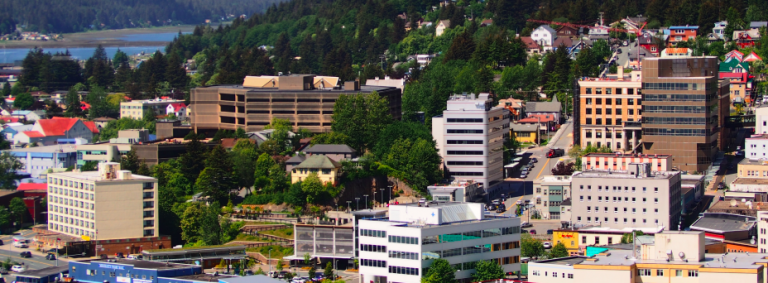
Short-term rental unit owners in Juneau are now having to share landlord duties with the tax man.
Despite criticism from residents and small business owners, the City and Borough of Juneau Assembly passed an ordinance Monday requiring short-term rental operators to register their rentals with the city. The ordinance was approved unanimously and will take effect in October. There are penalties for those who don’t comply.
It’s the first step toward what is likely to be more regulations limiting the number of short-term rentals such as Airbnbs or VRBOs allowed in Juneau, and it may ultimately impact those those who have rentals for seasonal workers.
Bankrate.com says that short-term rentals are great ways for retirees to stay active and make a side income to supplement their Social Security and retirement savings.
“Hosting an Airbnb can be a great way for retirees to generate income after they stop working. According to an Airbnb survey, the typical host in the U.S. earned over $13,800 in 2021,” the website says.
Assemblywoman Michelle Bonnet Hale said that the Assembly can’t regulate the short-term rentals until it knows how many there are.
Concerns have been raised about potential government overreach and the impact on small businesses.
The ordinance has been opposed by many in the community, which led to a temporary delay of the decision last month.
Under the new law, operators of short-term rentals must provide the city with a description of their rental units, including address, type of property, number of bedrooms and baths.They also must show proof of having a business license. Those who don’t are mow subject to a fine of $25 per violation.
The Assembly’s solution for creating more affordable housing in Juneau is to try to crack down on one type of housing — short term rentals, which are mom-and-pop businesses often run by retirees — rather than to open up more land for residential.
Juneau has a population of 31,685 according to the U.S. Census. In 1973, the population was 16,000, and by 2000, the population was 30,668.
However, since 2020, Juneau has lost 1.8% of its population, the Census Bureau says.
While the population is not growing, it’s changing. Just 6,654 Juneau residents are under the age of 18. Three years ago, the Juneau School District had 4,600 students, but in 2022 the district saw only 4,355 students in its 15 schools.
Older Juneauites now make up a larger percentage of the population. In 2014, there were 3,398 people living in Juneau who were 65 years or older. Today, there are 4,435 seniors over the age of 65. Many of the people who operate short-term rentals in Juneau are retirees or stay-home parents who are trying to make a living in the expensive capital city.
The Justice Department asked a federal judge to lift his temporary injunction, announced last week, banning the federal government from trying to suppress fee speech in social media.
But the judge wouldn’t budge on Monday.
The White House and the executive agencies under its control have coordinated with social media platforms for three years to eliminate social media posts and accounts that dispute the official government narrative.
Last week’s injunction came with a warning from Louisiana U.S. District Court Judge Terry Doughty, who said that the plaintiffs — the attorneys general of Louisiana and Missouri — have a strong case and are likely to win at trial.
Doughty said that the states have standing to sue the federal government, and he highlighted specific cases of federal censorship that appear particularly egregious, such as when the White House pressured Facebook and Twitter to remove an “anti-COVID-19 vaccine tweet” by Robert F. Kennedy Jr. and an instance where Fox News host Tucker Carlson questioned the science behind Covid vaccines.
According to Doughty, the CDC was regularly sending Facebook lists of Covid misinformation for removal. The topics removed included any “medically debatable topics” about the survival rate of for those contracting Covid and the efficacy and side effects of vaccines.
Doughty also pointed out how the story about Hunter Biden’s laptop was suppressed on social media in the days leading up to the 2020 election. The Democrats, who were not yet in control of the White House, labeled it “Russian disinformation.” As it turns out, Hunter Biden has now started cutting deals with the Department of Justice.
The labor union representing operating personnel for the White Pass & Yukon Route in Skagway authorized a strike after nearly six years of unsuccessful negotiations with the railroad.
SMART Transportation Division Local 1626 says the dispute involves wages, healthcare, workforce reduction, and safety.
The strike, if carried out, could have an impact on the early fall travel period in Alaska. But the union must first go through mediation with the railroad, and if that doesn’t work, it must still wait for a 30-day cooling-off period before it can go on strike. That would mean the earliest the strike would be may land at the end of August, but it could still disrupt the plans of cruise ship operators and tourists who are booked on the train.
The railroad is in its 125th year. Built during the Klondike Gold Rush with construction starting in 1898, White Pass is a narrow gauge railroad that is an “International Historic Civil Engineering Landmark,” traveling between Skagway and Whitehorse, Yukon. It also stops at Lake Bennett and Carcross.
The Fraser Meadows Steam Excursion trip is on a steam-powered train that chugs to the summit and back.
During the Covid pandemic, the train was only able to go to the border, since Canada was closed to visitors. This year is one of the biggest years for tourism that Skagway has ever seen.
The union is interested in higher wages that reflect the cost-of-living increases observed over the past six years, since its last labor agreement was signed in 2017. The union says that stagnant wages make it hard for workers to cover their living expenses.
In addition, the union says the railroad is going to shift some healthcare costs back to workers.
Also, the union says that White Pass may eliminate brakemen positions on the trains, something the union opposes because it would add more work to conductors. The union says that brakemen are needed as a safety concern.
Over the Independence Day weekend, a mediation session took place but was unsuccessful and no future dates for mediation meetings were set.ate for future meetings following the conclusion of the recent discussions.
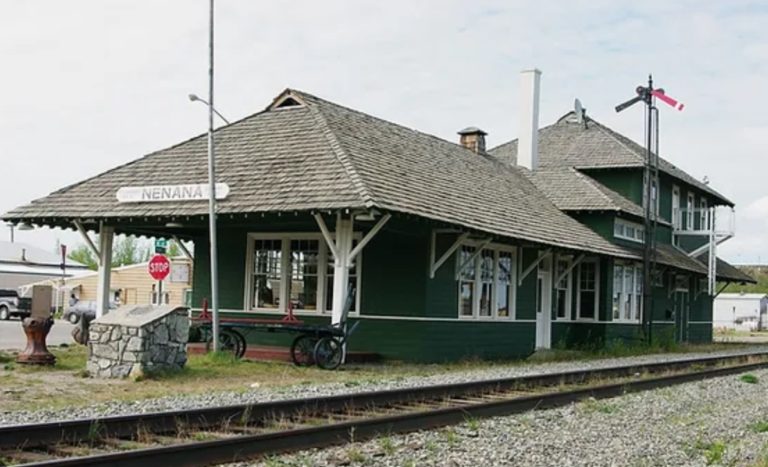
The City of Nenana is abuzz with excitement as it prepares to commemorate the centennial anniversary of the completion of the Interior Alaska Railroad.
President Warren G. Harding drove the golden spike into the ground on July 15, 1923, to mark the completion of the railroad in Nenana.
Now, 100 years later, the city is gearing up for a grand celebration, including the grand opening of a new gazebo in town, purchased by the Alaska Railroad and donated to the City of Nenana for the occasion.
The celebration on Saturday will take place throughout the day in Nenana, with a block party, entertainment, food, and a reenactment of the driving of the golden spike.
The schedule for the festivities:
9 am – Opening of time capsule at Railroad Depot 10 am – Commemoration of first flight, whistle stop train arrives in Nenana 10:30 am – Unveiling of Mears bridge monument and Ralph Modjeski plaque 11 am – Lunch opens 11:15 am – Buses and special train arrive 12 noon – Ribbon cutting at gazebo
Ceremony 1:15 pm – Native drummers 1:20. pm – Greetings from Tribal Leadership 1:25 pm – National anthem 1:30 pm – ARRC Chair Shively welcomes guests 1:35 pm – Greetings from Mayor Verhagen, presenting miniature replica bridge gifted to President Harding 1:40 pm – Greetings from ARRC President Bill O’Leary 1:45 pm – Reading ARRC 100th plaque and reference to time capsule 1:47 pm – ARRC’s Mears bridge plaque reading 1:50 pm – ARRC Chair intro guest speakers 1:55 pm – Federal Delegation 2 pm – Gov. Mike Dunleavy 2:10 pm – Chair closing words 2:15 pm – AK state song 2:20 pm – Driving of golden spike reenactment
2:45 pm – Eielson fly over
3 pm – Board special train and buses
6:26 pm – whistle stop train leaves for Fairbanks
Worth noting, there will also be an Eielson Air Force Base flyover in the afternoon to commemorate the July 4, 1923 first flight in Alaska, accomplished by aviator Carl Ben Eielson, who flew in his airplane from Fairbanks to Nenana as a Fourth of July demonstration flight. His plane, “Jenny,” still hangs from the ceiling at Fairbanks International Airport.
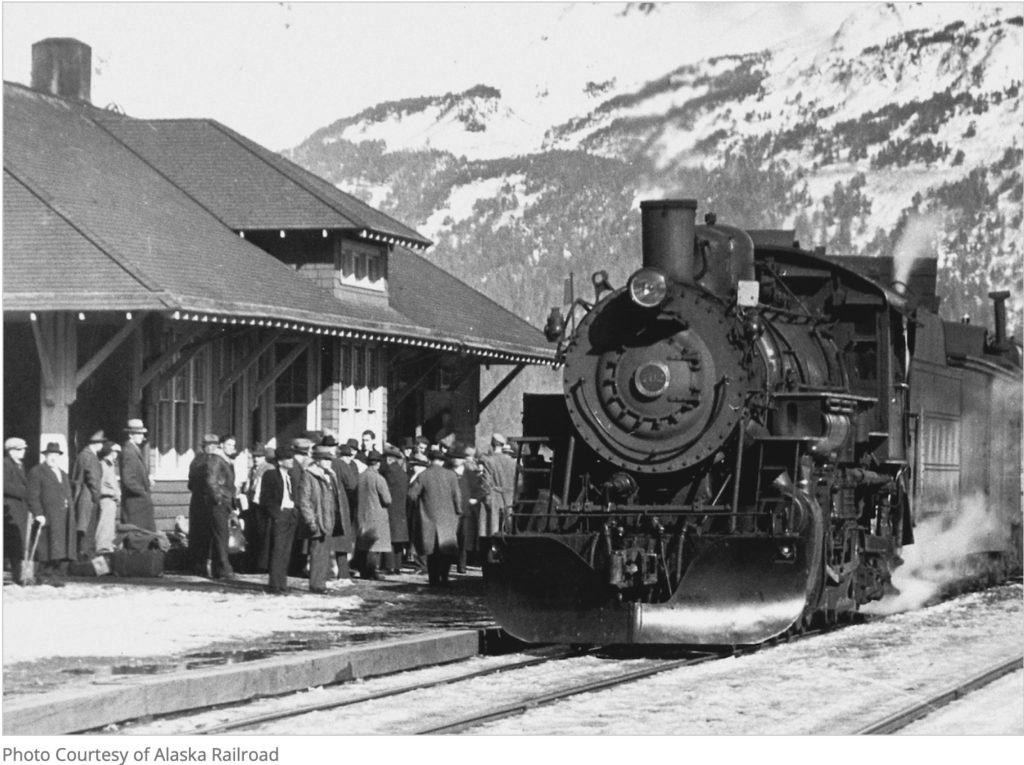
The Alaska Railroad is one of the oldest institutions in the state, predating statehood by 36 years. The railroad has played a crucial role in the development of Alaska, connecting communities and towns and moving passengers and goods between Seward and Fairbanks in what has become known as “The Railbelt.”
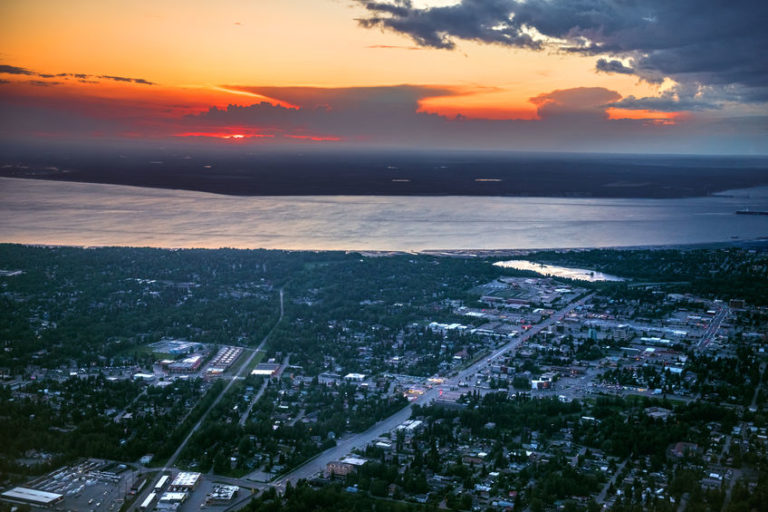
One part of the community tells a side of the story about housing in Anchorage, but the data is not clear that there is an actual housing “crisis” in Anchorage, as some call it. If there is a housing crisis, it has been around for a long time.
People in Eagle River told their Assemblyman Kevin Cross last week that Anchorage people are moving to the Mat-Su Valley and a lot of them are also working in the valley. They are not moving for the reasons Cross was saying, which is that there is not enough affordable housing in Chugiak, Eagle River, or the rest of Anchorage.
Opponents of the Kevin Cross “fix” for affordable housing argue that people are moving to find a better political climate; Anchorage has become more liberal in the past decade and the quality of life has deteriorated, and schools have become unsavory due to unwholesome agendas being forced on students and their families.
Cross, who develops real estate for a living, had called the community meeting to discuss his massive rezoning plan, a rewrite of the Title 21 ordinance. His changes, in an ordinance he advanced in the Anchorage Assembly after taking office. The goal is to build more apartments and condos across every part of the municipality, including Chugiak and Eagle River, and Girdwood, which have their own zoning carve-outs from Title 21.
The ordinance was given a poor reception, however. Residents worry about multi-story apartments being built next to their single-family homes, and are also concerned about the deterioration of their family neighborhoods.
A look at the data shows a population in decline in Anchorage, even as more housing has been built over the past few years.
According to the Alaska Housing Finance Corporation, the population of Anchorage was 298,908 people in 2015. Today, the population is down 288,000.
That’s a loss of about 11,000 people in Anchorage in less than a decade.
According to AFHC, in 2017, the municipality had 115,000 housing units, with 105,164 of them occupied, leaving an unoccupied inventory of nearly 10,000 units.
If those housing units were stable over the past six years, and with a falling population due to move-outs and low birth rates, there are still more than four housing units for every 10 people in the city, including adults and children.
When the pandemic hit in 2020, it threw a monkey wrench into many sectors of the economy, including apartment and home building. People in 2020 and 2021 approached housing in different ways — some rational ways, others not so much.
The supply chain dried up in 2020 and lumber costs skyrocketed, as did all other materials. Labor was in short supply starting in 2020 and continuing to today. These were impacts felt in every community across the country and Anchorage was no different.
At the same time, some people started working from home more, and their needs for space changed.
In November of 2020, the number of housing units approved by permits was about 415 in Anchorage, but vastly more homes were being built in the Mat-Su, which is lightly regulated.
Now, with mortgage interest rates near 7%, there’s yet another monkey wrench in the system.
According to AHFC, the rental vacancy rate was 5.7% in 2020 and slid to 4.3 in 2021. Typically, a 5-7% vacancy rate is considered a healthy balance, which puts Anchorage’s rental market a little on the tight side.
“As vacancy rates are going down, median rents have steadily gone up across the state from 2016 to 2022, with an average increase of 10.64%,” AHFC reported at the end of last year. The state reports that the average Anchorage rental is $1,400.
At the same time, none of this explains how the population loss of 11,000 in Anchorage would make the housing market tighter. The numbers from one agency to another don’t always tell the full story. After all, this is a city that is talking about the need to close a few schools due to declining enrollments; Anchorage has lost over 5,800 students since 2016.
What about the Anchorage street people? The unsheltered population in Anchorage, according to the Alaska Homeless Management Information System, is 3,198 individuals who are living in emergency shelters, couch surfing, or living on the streets or in tents in various greenbelt encampments.
Many of the unsheltered population suffer from behavioral issues that make them unsuitable candidates for a rental unit at any cost — they are drug addicts or people with serious mental illness. Some of them are repeat criminals looking for their next mark. A change in zoning to make more housing available at the bottom end of the market for this particular population is not going to be without controversy because they don’t make good neighbors.
For others in Anchorage, it’s actually far cheaper to live in Alaska’s largest city, where over 40% of the state’s population calls home, than in Seattle, the metropolis to the south. In fact, if you live on $53,000 a year in Anchorage, you’d need $60,000 a year in Seattle to maintain the same standard of living, according to Salary.com.
In fact, Anchorage doesn’t even make the top 10 list of cities with the biggest housing shortages according to multifamily.loansor Angi’s List.
Anchorage builders are frustrated, as they watch their contemporaries in the Mat-Su Valley build and sell hundreds of home.
Title 21 has, no doubt, raised the cost of building in Anchorage and made it more complicated. But Title 21 took years to write, and a quick overhaul may have unintended consequences.
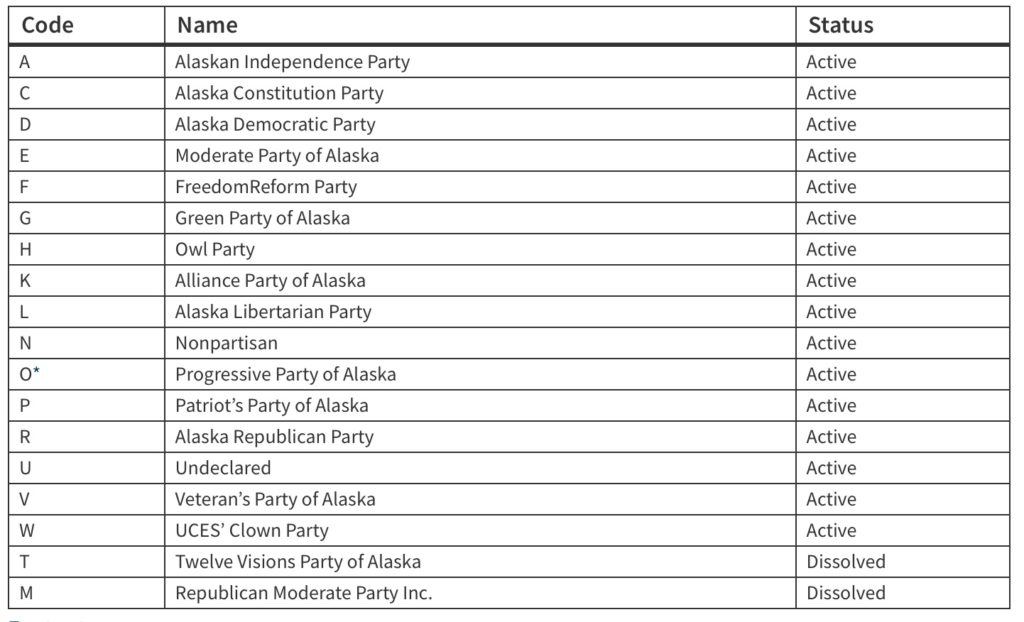
The UCES Clown Party has left the circus in Alaska. The political party has no current registered voters in the 49th this month, although it’s still on the Division of Elections’ list of 16 official political groups.
Started in California as a pro-marijuana and progressive political movement in about 2014, the “Useless Clown Party” had 102 members registered in Alaska just three years ago in July’s voter roll update.
Not all that are called political parties are actually recognized as parties in Alaska. A group has to have 5,000 registrants in order to be considered an official political party, while those with fewer than that are called political groups by the state. More about the different categories of parties and groups at this link.
The Division of Elections publishes an update of voter rolls every month, and does a voter roll purge in early March of every year.
Must Read Alaska periodically reviews these voter trends, typically in March and at other times during the year to get a snapshot of the dynamics. The following are some that are noteworthy, particularly now that Alaska has just one primary election with all party candidates on the same ballot, while before 2020’s Ballot Measure 2, Republicans had a separate ballot that could only be voted by those registered with the party or not registered with another official party.
In the July, 2023 voter roll update, the Alaska Republican Party has increased by 1,702 members since July of 2020, and still stands out as the largest single party in Alaska, with 141,522 members. Republicans are down 2% in three years.
The Alaska Democratic Party has lost members, but is still the state’s second-largest political party. But since July of 2020 when they had 76,779 voters, the Democrats have shed 2,113 registered voters and are now at 74,666, a 2.75% drop in three years.
The Alaska Independence Party has gained members, going from 17,111 in 2020 to 18,865 this month. The party is unique to Alaska, and in its formation was created as a secessionist party 39 years ago by the late Joe Vogler, although it is now a conservative party not focused on secession.
Looking farther back at a 2016’s snapshot, the state had 144,445 registered Republicans and 78,713 registered Democrats in that year, when President Donald Trump won the Alaska vote with 51.3% of the vote.
The overall voter base has increased since 2016, from 530,653 to 596,637, a 12.4% increase.
Alaska’s population in 2016 was 742,575. By the 2021 U.S. Census was 732,673, a 1.3% decrease.
Some of the other party and no-party affiliations:
The Undeclared voters still rule the roost, with 266,874 registered voters, a gain of 5,255 voters in the past three years. The increase may be attributed not so much to people leaving parties but rather are probably newcomers to Alaska applying for the Alaska Permanent Fund dividends and drivers’ licenses, and thus being automatically registered to vote and assigned the “Undeclared” status.
Nonpartisan voters now number 83,090, a gain of 835 voters, or about 1% since 2020. Nonpartisans, unlike Undeclareds, do not gain in numbers by simply showing up at the Division of Motor Vehicles. These are people who register to vote intentionally; typically they are government workers.
The Libertarian Party has seen shrinkage, starting with 7,082 in July of 2020 and now down to 6,800 registered voters, a 4% decrease in three years.
The Green Party has lost about 70 registered voters in Alaska in three years, and is now down to 1,511 members.
Overall, the official Alaska voter rolls have 1.3% more voters this month than they did three years ago. Today, there are 596,637 registered Alaska voters. The number of overall voters changes as voter rolls are purged each March, and then fluctuates throughout the year.
As for the Clown Party, it will probably be dropped off the Division of Elections list of official political groups, since no one is registered with the party in Alaska. (We don’t know where the clowns went, but readers may have some ideas.)