Home Blog Page 525

Mayor to reveal details of new library downtown

25

A new municpality-run library will be soon added to the list of Anchorage libraries. This one will be located in the old City Hall building in downtown Anchorage and will be the sixth general-purpose public library in Anchorage. It won’t take up the whole building, and the library isn’t envisioned as a large one, like the Loussac Library in Midtown.

It is a project years in the making, most recently getting a boost from former Anchorage library director Judy Eledge, who made it a priority before she left the library in 2023, after being hounded by reporting on her by the Anchorage Daily News. The money came from an endowment that has been sitting in the accounts of the Anchorage Library Foundation, originally made by Janet and John Goetz, longtime downtown residents who died many years ago and bequeathed their estate to the foundation with instructions that it would be used to recreate a downtown library. The original gift of over a half million dollars has grown over the years and is now said to be in the millions of dollars.

But none of the administrations before Bronson were able to get the project done for various reasons.

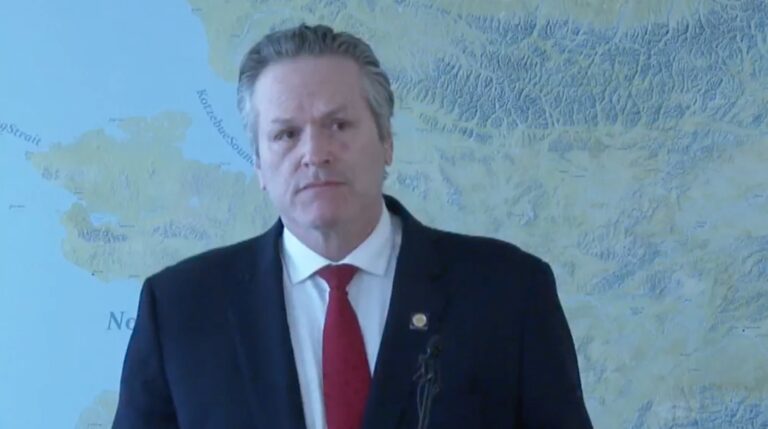
On Thursday, Mayor Dave Bronson will announce the plans to move forward, which involve using some portion of the historic building at 524 W. 4th Ave., not far from where the old downtown library was located before it was torn down to make way for the Egan Convention Center.

According to the foundation’s planning documents for the library, it will not be a location rich in actual books, but it will be a flexible space that has some books and newspapers, and lots of flexible room for other activities.

“While a small collection of popular books and DVDs will be available for check-out and magazines and newspapers will be available for browsing, staff will be much more focused on creating and curating experiences and offering services to customers. Staff will also go into the community to develop partnerships with local businesses and service providers to bring timely and relevant programs into the library. For instance, the Library might partner with a legal services or tax preparation group to offer classes in those areas, or host a Dena’ina beading workshop or a foreign film night. Some library events might not even happen at the library—staff will take advantage of the surrounding museums, restaurants, theaters and galleries to expand the size and type of programs the library is able to offer,” the planning document says.

Libraries have become de facto daytime warming shelters for Anchorage homeless and during previous mayoral administrations were venues for controversial events such as Drag Queen Story Hour for children. Parents are concerned about the books that culture-warrior librarians seem to be pushing on children, with literature that emphasizes gender identity matters that many feel are not appropriate for children. Libraries have, in fact, become a front of the culture war being waged by leftists.

These are challenges that are not exclusive to Anchorage but seen in cities around the country, where not everyone feels that the library is a safe and welcoming place. During the Bronson administration, there has been some effort to restore the use of libraries to their intended use, although the current Loussac Library has once again become a magnet for drug users and other miscreants who use the facilities for various illegal activities.

Two years ago, a woman returning books at the Loussac Library suffered permanent injuries after being attacked by a knife-wielding stranger, adding to the concern that libraries are changing in America.

Read more about the foundation’s concept for the downtown library.

Crowd shouts ‘Cowards!’ but Anchorage Assembly takes pass on Gaza cease fire resolution

Anchorage Assembly members decided to take a pass on a resolution calling for Alaska’s congressional delegation to call for a cease fire in Gaza. About 30 people at the regular Assembly meeting on Tuesday evening held signs in front of them expressing their views on the war between Hamas and Israel, which Hamas appears to be losing badly, even with the help of Iran.

The resolution had been brought to the agenda by Karen Bronga, George Martinez, and Felix Rivera. It was member Meg Zaletel who made the motion to postpone, seconded by member Daniel Volland.

As the Assembly voted 8-4 to postpone the item, the activists in the audience jeered and could be heard yelling, “Cowards!”

Michael Patterson, a communist and member of the Party for Socialism and Liberation, stood up and yelled, “Garbage! Absolute garbage! Cowards, absolute cowards!”

Assembly Chairman Chris Constant called for security to remove Patterson, and then paused the meeting for the Assembly’s dinner break, while the crowd continued to shout its disapproval.

Senate Minority Leader Mitch McConnell to step aside

In a speech on the U.S. Senate floor on Wednesday, Republican Minority Leader Mitch McConnell said he will step down from the role of leading the Senate Republicans in November. He has the record of the longest serving Senate party leader. McConnell gave a copy of his prepared remarks to AP, which first reported the news.

“One of life’s most underappreciated talents is to know when it’s time to move on to life’s next chapter,” McConnell said. “So I stand before you today … to say that this will be my last term as Republican leader of the Senate.

“If you would have told me 40 years later that I would stand before you as the longest serving Senate leader in American history, frankly, I would have thought you’d lost your mind,” he said.

“I turned 82 last week and the end of my contributions are closer than I’d prefer,” he said.

McConnell will remain in office, he said, until his term ends in January of 2027.

McConnell has had a number of health challenges this past year, including small-but-visible seizures of some sort, while speaking to the media.

Borrowed money for clean energy: $125 million in federal funding pegged for 1,000 rural Alaskans

33

The Department of Energy will spend $125.1 million for five energy development projects in rural Alaska. DOE awarded the funds under its Energy Improvement in Rural or Remote Areas program, authored in large part by Sen. Lisa Murkowski as part of the Infrastructure Investment and Jobs Act of 2021.

The math is breathtaking: For the 1,000 Alaskans served by these hydro, solar, and battery projects, the federal government is spending $125,000 per rural resident.

The program is aimed at improving “resilience, reliability, and affordability of energy systems in communities across the country with 10,000 or fewer people.”

The Alaska projects selected for funding include:

  • Chignik Hydroelectric Dam and Water Source Project led by the Lake and Peninsula Borough (Chignik Bay)—up to $7.3 million. The project will replace 100% of the community’s diesel consumption with renewable energy, and reduce energy burden.
  • Clean Energy in the Northwest Arctic led by the Northwest Arctic Borough—up to $54.8 million. This project aims to install over 4 MW of solar PV, over 7.1 MWh of battery storage systems, and approximately 850 heat pumps across the Northwest Arctic region. This project seeks to replace a 10-mile, overhead, distribution tie-line between the villages of Kobuk and Shungnak, allowing for greater interconnection in this remote region. Each of the 10 solar and battery storage projects will be owned and maintained by 11 federally recognized Alaska Native Villages, who will act as Independent Power Producers (IPP). 
  • Alaskan Tribal Energy Sovereignty led by the Tanana Chiefs Conference (Nulato, Huslia, Minto, Kaltag, Grayling, Anvik, Shageluk, Holy Cross)—up to $26.1 million. The project will strive to offset the region’s diesel consumption by 40%, which will lower energy costs and reduce greenhouse gas emissions by more than 1,550 metric tons per year over the project’s 25-year lifespan, the Department of Energy says.
  • Old Harbor Hydroelectric Project led by the Alutiiq Tribe of Old Harbor (Old Harbor)—up to $10 million. This project plans to construct a run-of-the-river hydroelectric facility with a diversion structure, pipeline, powerhouse, and electric transmission line in Old Harbor on Kodiak Island. It is anticipated that the project will be capable of generating about 3,470 MWh of energy annually and offset diesel fuel use at the local power plant by 95%, enabling a year-round reliable energy source. 
  • Thayer Creek Hydroelectric Project led by Kootznoowoo, Inc. (Angoon)—up to $26.9 million. This project encompasses an 850-kilowatt, run-of-the-river hydroelectric project that has the potential to supply three times the community’s current electricity needs, providing additional power for heating, fish processing, electric vehicle charging, and tourism. Kootznoowoo, Incorporated (KI) is the Alaska Native Village Corporation for the community of Angoon, population 357 residents. The cost per resident is $75,630.

These projects will facilitate the development of more of Alaska’s abundant hydropower resources, solar energy, battery storage systems, heat pumps, electric interconnection, and more, the Department of Energy says. More information about the awards is available on DOE’s website.

While rural Alaska is getting hydropower, the Anchorage Assembly is trying to rip out the existing Eklutna hydropower project.

Rick Whitbeck, Alaska state director of Power The Future, noted the inconsistency, saying, “Hydro that replaces higher-cost energy in rural Alaska is wonderful but the lowest cost electricity in Southcentral is somehow evil? You’d think the eco-Left could be more consistent, but logic is not their strong suit.”

To date, roughly $7.4 billion from the bipartisan infrastructure law has been announced for Alaska, with over 1,600 projects identified for funding and investment around the state. That’s $10,100 of federal funding — and much of that is federal debt — for every Alaskan. Similar results can be found across the country.

Statista, a business data website, shows that in 2023, Alaska, even with its small population of about 733,000, did better than states with far larger populations in terms of obtaining these federal infrastructure dollars:

Statistic: Funding under the Bipartisan Infrastructure Law in the United States in the fiscal year of 2023, by state (in billion U.S. dollars) | Statista
Find more statistics at Statista

Breaking: Trump wins Michigan in landslide

Another primary and another landslide for Donald Trump.

Tuesday’s Michigan primary gave him yet another decisive win against Nikki Haley. With 18% of the precincts reporting, Trump is at 65.6% and Haley is at 30% The results will change as the vote continues, but AP has called the race for Trump.

Michigan Republicans have 55 delegates to the national convention. Some will be awarded through Tuesday’s primary, while others will be at the party convention, which is Saturday.

In the Democrat primary, with 15% reporting, Biden won with 116,778 votes, or 79.5%. Some Democrats didn’t vote for Biden because Michigan is a state with many Muslims, most of whom do not support the U.S. policy for Israel. There was a Muslim movement to vote for “Uncommitted.” They account for more than 15% of Democrat primary voters in Michigan.

Striking is that Trump, even though he had competitors on the ticket, appears to have received more votes than Biden, who was only running against “Uncommitted,” Marianne Williamson (withdrawn), and Dean Phillips.

In the Republican primary with 18% reporting:

Trump: 128,700 votes

Haley: 59,012 votes

Uncommitted: 4,208 votes

Other Republican candidates received a smattering of votes, even though they had dropped out. For instance, Ron DeSantis received 2,103 votes.

In the Democrat primary, with 16% reporting:

Biden: 116,778 votes

Uncommitted: 22,177 votes

These numbers will be updated as results continue to come in.

Republican primary update: With 99% reporting, Trump has 68.2% and Haley has 26.5%.

Democrat update: Biden has 81.1% and Uncommitted has 13.3%. Marianne Williamson has 3%, Dean Phillips 2.7%.


Breaking: Repeal of ranked-choice voting petition makes ballot

With thousands of names to spare, Alaskans for Honest Elections has won the right to have its repeal of ranked-choice voting on the ballot this year.

The Division of Elections has certified 36,841 signatures, and those came from every House district but six, easily making the needed threshold for statewide support. The group needed to have 26,705 registered voters to sign the petition, which was handed into the Division of Elections in January.

With dark money from outside the state, ranked-choice voting was presented to Alaska as a way to clean up elections. Instead, it has only made them more muddy and less trusted, critics say.

Proponents of ranked-choice voting kept their organization alive to fight any attempts to repeal it. Alaskans for Better Elections will have massive amounts of dark money at their disposal to persuade voters to keep the system, in which there are no separate party primaries, and where general elections are done by ranking who voters prefer, followed by their second choice and third choice.

Whether the question goes on the August primary or the November general election is determined by when the Legislature adjourns.

Dunleavy sends education mega-spending bill back to legislative drawing board

In Alaska’s legislative budgeting cycle, nothing is final until the last gavel slams down, and the bill goes into law — or not.

The controversial Senate Bill 140, passed by the House and concurred with by the Senate, was rejected by Gov. Mike Dunleavy on Tuesday, and that means the Alaska Legislature must either come up with a better bill, or the governor will veto SB 140. The Legislature has 14 days to send him a new, improved bill — one that has at least some of his priorities — or he said he will veto this one.

He wasn’t bluffing. A headcount shows that he has the votes to sustain a veto. The Legislature would need 40 votes, and is short at least three to override his promised veto.

There are other bills can serve as vehicles for some of the good measures that were in SB 140, Dunleavy said today.

Speaking of slamming, Dunleavy lit into the NEA teachers’ union for killing the teacher incentive bonuses he had wanted in the bill. He criticized the educational establishment for not supporting the great outcomes now being proven in charter schools, another aspect that was axed by the final bill version.

Dunleavy said the section of the bill that was to help improve reading was wholly inadequate, since reading scores in Alaska schools are at crisis levels. Alaska ranks 49th in education, and Dunleavy was hoping for major education reforms in the bill that went sideways before it got to his desk.

Dunleavy spent much time at the podium reading parts of an Anchorage Daily News editorial that supports his approach to education funding and reform.

After holding forth for nearly an hour in his Anchorage conference room, Dunleavy said that he appreciated the House and Senate for working on education so early, but that they send hm a three-legged horse that is “not going to run very far.”

While the governor did not actually put the veto pen to the bill on Tuesday, he made it clear he will do so, rather than let it go into law. If the education establishement wants an increase to the basic funding formula, he said, they are going to have to “help get these items across the finish line.”

He thanked the House for putting together the omnibus bill.

“I understand why the House voted to pass this bill out, because many believed it was the best thing they could get. I get that,” he said.

The final bill version voted on had been negotiated by Rep. Jesse Sumner of Wasilla in secret meetings with the Senate and Democrats, and sprung on the unsuspecting House majority.

Alaska Democratic Party took credit for the bill passing with a large increase to the Base Student Allocation. Posting on X/Twitter, the party wrote: “This major victory would not have been possible without the unwavering and unequivocal support of Democratic elected officials. Republicans in the Alaska State House fought us every step of the way until they saw it as a political win – but we never stopped fighting.” They didn’t mention Rep. Sumner’s work or give him credit.

However, it was the Republicans in the House that voted for the BSA increase of $680 per student, with the exception of two legislators, who balked at the flawed bill — Rep. David Eastman and Rep. Mike Prax.

Dunleavy said, “The bill is incomplete. Why not fix it? I think there were a number of legislators who thought this was the best they were going to get. I don’t think so.” He suggested his office and legislators work together and get a much better bill, and that there are two weeks to do so.

During questions from reporters, Dunleavy said, “There’s going to be a substantial BSA, there just is,” signaling that he is willing to add to the basic formula for spending, but he also is demanding the support for reading programs, charter school options, and teacher incentive pay.

Adam Trombley signs with Team Sullivan as state director for Alaska’s U.S. senator

3

Adam Trombley, who served on the Anchorage Assembly and also as a chief of staff in the Anchorage mayor’s office, has been named the incoming state director for Sen. Dan Sullivan. He will take over for Chad Padgett, who announced his departure last month.

Trombley served as an Anchorage assemblyman from 2011 to 2014 for East Anchorage. He moved to the Sand Lake neighborhood and later ran again for Assembly, but this time didn’t win. Later, he served as director of economic development, real estate director, and building official in the Bronson Administration, and then as chief of staff, before returning to the private sector in April, 2023.

Until just recently, he has worked as a senior network planner for Alaska Communications Systems. A 1998 graduate of East Anchorage High School, he graduated from Lewis and Clark State College in Lewiston, Idaho.

Starting March 11, Trombley will be Sullivan’s point person in Alaska. He will coordinate the senator’s in-state schedule, and travel with the senator across the state. He will keep the D.C. office apprised of significant occurrences in Alaska and will be the first person many Alaskans will reach out to. A state director has several key roles, according to the description at the U.S. Senate, including:

  • Representing the senator in all areas of the state, including meeting and maintaining professional relationships with federal, state, and local elected officials and agencies; staff from congressional delegation offices; community business leaders; and constituents.
  • Directing state office staff including supervision, assignments, and workflow; implementing office policies and procedures for state office operations; including recruiting, hiring, and training new employees; scheduling and chairing state office staff meetings.
  • Accompanying the senator on visits throughout the state; occasionally giving speeches, remarks, or awards at events in-state when the senator cannot be present.
  • Performing other special projects assigned by Sen. Sullivan.

Padgett, who has served as state director for three years, is moving to a job at Arctic Slope Regional Corporation, an Alaska Native corporation.

Sen. Dan Sullivan is now in his 10th year serving Alaska in Washington, D.C. Before running for office in 2014, he was the Commissioner of the Alaska Department of Natural Resources and also had served as Attorney General for Alaska.

Last month, the state director for Sen. Lisa Murkowski also announced he was leaving. Steve Wackowski is headed for a job at Santos, Ltd., an Australian-based oil company doing business in Alaska.

Kelly Tshibaka: On the STAND podcast, basketball, civil rights, and the transformation of a league, a told by Pete Babcock, who was part of its history

By KELLY TSHIBAKA

As we close out Black History Month, I was reflecting on how America’s black history is present in many aspects of our lives, even in areas we don’t typically associate with it. One such place is in the National Basketball Association. 

On a recent episode of STAND with Kelly & Niki Tshibaka, Pete Babcock, the former general manager for the NBA’s Denver Nuggets, Atlanta Hawks, and San Diego Clippers, explained how the history of the NBA is extremely important to the league.

“I was always interested in…how the league went from being an all-white league to now a predominant African-American league,” Babcock said, “…and how the civil rights movement benefited from the National Basketball Association, and the game of basketball benefited from the civil rights movement. There’s so much overlap between the two.” 

Although the civil rights movement is likely the furthest thing from one’s mind when watching NBA basketball games, the two are inextricably linked together. Each impacted the other in critical ways, and the lasting mutual effect the civil rights movement and the NBA have had can still be observed in the league today.

Babcock managed NBA teams during the NBA’s process of desegregation and retold the story of the NBA’s sometimes-painful journey on the show. In fact, Babcock pointed out that the desegregation of the NBA has had lasting positive effects on the players. 

A critical aspect of the civil rights movement was breaking the false image of the “uneducated vagabond” that was so strongly perpetuated against the black community. With the emergence of leaders like Martin Luther King Jr., Malcolm X, and Booker T. Washington, this stereotype was shattered. It is here we can see one of the subtler parallels between the NBA and the civil rights movement.

Babcock explained that the NBA works to not only train the players physically, but also to improve them as people as well, stating, “the total human being is more important than just the plain skill of the player.”

Thus, the emphasis on character that was encouraged by leaders of the civil rights movement has lasted past the civil rights movement and is still seen in the attitude of NBA players, managers, and coaches today.

Perhaps just as important as his emphasis on the civil rights movement, Babcock also discussed how an accurate history is critical to the foundation of the NBA. He spoke at length about Black History 365 (BH365), a comprehensive history curriculum that he contributed to with Dr. Joel Freeman. 

Founded and created by Drs. Joel Freeman and Walter Miltion Jr., BH365 was created with collaboration and input from a diverse and broad spectrum of voices, including Dr. Alveda King, Andrew Young, Smokey Robinson, NBA leaders, and many more. BH365 is a curriculum that teaches black history in full.

Unlike other curriculums that push critical race theory and encourage African Americans to embrace a victim mentality, BH365 is a truth-centric and inclusive account of black history. 

Dr. Freeman discussed the importance of emphasizing the creativity and genius of Ancient Africa before diving into the darker side of black history. “We talk about the slave rebellions, because we wanted to show that hardly anyone was docile. There were a lot of passive aggressive ways of fighting against this [slavery].” 

This Black History Month is a time to reflect on the lasting impact the civil rights movement has had on hearts, minds, and character. This impact has notably given us the strong players we can see in the NBA today. It’s also a time to underscore the importance of having a comprehensive view of history, for if we forget what we have learned, we are surely doomed to repeat it.

If you’d like to hear more about how the civil rights movement has given us the NBA we know today, or learn more about BH365, you won’t want to miss Pete Babcock and Dr. Joel Freeman’s interview on STAND. You can also view the episode on YouTube, Rumble, and your podcast streaming platform.

Kelly Tshibaka is the host of the podcast, TV, and radio show STAND, and the 2022 Alaska Republican candidate for U.S. Senate. She co-hosts the show with her husband, Niki Tshibaka.