
Home Blog Page 524

Wall Street Journal singles out Sen. Cathy Giessel for rebuke over push to restore costly state pensions

27

The Wall Street Journal‘s editorial board says that while other states are being crushed by unfunded pensions for public workers, smart states like Florida are de-risking by moving to defined-contribution plans. Alaska is going the other direction, however, in large part due to the efforts of Sen. Cathy Giessel.

“That makes it all the more strange that Alaska may risk its future by returning to defined-benefit pensions,” the board wrote in an editorial on Thursday, weighing in on Senate Bill 88, which would return the state to a pension system for state employees and teachers.

Instead of an individual retirement account, the idea is to return to the pension system, in which the state becomes obligated to pay retirees a fixed amount annually. The pension checks would be inflation-proofed, which means they’d continue to go up each year. Retirees with 30 years of service would be paid about 63% of their final three years of salary, for the rest of their lives.

The editorial board singled out Alaska state Sen. Giessel of Anchorage, saying, “Why go back to this dismal future? Supporters hope the lure of an old-style pension will attract more public workers, especially teachers who are in short supply in the state. Fixed pensions would ‘put efficiency back into state government’ by ‘reducing the constant churn of employees,’ says state Sen. Cathy Giessel.”

Giessel, who was once thought to be a conservative, has embraced most, if not all, of the Democrats’ platform, including the return to the pension plan, as desired by union officials who have great influence over her.

“Give credit to Ms. Giessel for daring to use efficiency and government in the same sentence with a straight face. But if she wants to attract and retain more teachers, the better and more transparent way is to raise their salary. At least politicians and taxpayers would be able to see how much this costs today rather than disguising the fiscal burden in the form of future liabilities,” the editorial board argued.

In 2006, the Alaska Legislature ended the pension program because the costs were outstripping the fund balance, and the actuary tables showed that Alaska could default on the pension payments. Even after 18 years, the fund today is $3 billion short of being able to meet its obligations to those who retired years ago, even without new members, the editorial board pointed out. Newer state employees have 401(k)-type retirement plans that are very generous.

Regarding that $3 billion shortfall, the newspaper reminded readers that the Reason Foundation studied the Alaska pension system and discovered it would add $200 million in unfunded liabilities in 2022, “as potential returns were smothered by a stock-market downturn. The same study projects a $9 billion liability over the long run.”

Alaska already has a historically poor pension-funding gap, and restoring the old plan could move it below even union havens like New Jersey and Connecticut, the newspaper said.

Giving credit where credit is due, the Wall Street Journal noted that the Alaska branch of the National Education Association is one of the big drivers for Giessel’s efforts to restore defined benefits.

“After Juneau reformed its pension plan, the union chose not to join a program that supplements the new 401(k)s with payroll-tax funding. The state teachers union held out instead for fully restored pension benefits, betting its persistent political pressure would eventually prevail. Ms. Giessel’s bill would reward that union bet at great taxpayer expense,” the editorial board wrote.

In Alaska, that tax is in the way of the Legislature stripping out most of Alaskans’ statutory Permanent Fund dividends in order to pay for services the Legislature to which appropriates money.

“The state Senate approved the defined-benefit plans last month, but the House is more skeptical and Republican Gov. Mike Dunleavy hasn’t taken a definite position. It should be an easy choice. Public-worker pensions create incentives for ever-higher taxes as current politicians seek near-term political support by adding to taxpayer liabilities that have to be paid on some future Governor’s watch. Down that road lies New Jersey or Illinois,” the editorial concluded.

David Boyle: Anchorage School District says it can make do with $110 Base Student Allocation increase

By DAVID BOYLE

The Anchorage School Board admitted this week that it can get through the next school year with a very small increase in the Base Student Allocation, also known as the BSA. 

This runs counter to the education industry’s cries to the Alaska Legislature that it needs a BSA increase of $1,413 just to keep its doors open.

The board figured out how much it would cost to keep all the previous programs it was going to do away with to balance the budget.  

This discussion was neither on the record in the board meeting nor in the budget documents.  

The amount the board arrived at was a minimal $110 BSA increase from the Legislature.  

The board then discussed adding programs and teachers back into the previous budget.  

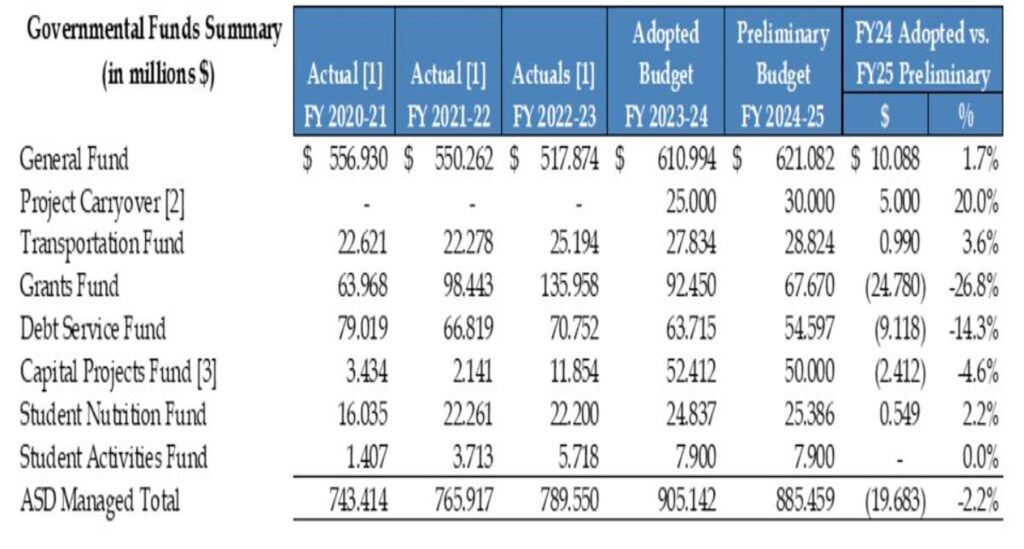
During the discussion, Board Vice Chairman Carl Jacobs offered an amendment to next school year’s budget that added $8,781,000 for a total of $894,240,584. This would be a net decrease of $10,901,416 from last year’s budget.

Even though this is a decrease of about 1.2%, the district has lost 894 students since last school year — a more than 2% loss in students.

The vote was 7-0 in favor of the amendment to increase spending.

Here are the details for the increased spending:

• Reverse the proposed elimination of 10 holdback teacher full-time equivalent (FTE) at a cost of $1,237,737;
• Reverse the proposed elimination of 36.30 teacher FTE across the district at a cost of $4,548,839;
• Reverse the proposed elimination of 5 language immersion FTE, at a cost of $604,399; 
• Reverse the proposed elimination of 18 IGNITE FTE, at a cost of $2,204,016; 
• Ensure that the Pupil: Counselor metric is 300:1 or less at all eight comprehensive high schools by allocating an additional 1.5 net Counselor FTE across Chugiak, Service and South high schools, so that each would receive an additional 0.5 Counselor FTE, at a cost of $186,000.

Community members showed up in force to complain about the elimination of the gifted-student IGNITE program’s teachers.  Their shouts were heard, and the program was restored in the budget.

Sixty-nine teacher FTEs were not eliminated. These positions were budgeted at a total of $8,594,991. Note that these may be vacant, funded teacher positions that are never actually filled.

Only member Dave Donley offered to cut extraneous expenses that add nothing to classroom instruction. His amendments would have reduced the budget by about $10 million but the board would have nothing to do with that.

Donley offered an amendment that would decrease the funding of the Coalition for Education Equity, a nonprofit that lobbies for more money for rural schools.  The Anchorage taxpayer pays $30,000 per year to this nonprofit.  According to Donley, “The CEE does not support the best interests of the Anchorage taxpayer.”  Anchorage is the only one of the Big 5 school districts that funds the CEE.

The CEE opposes the formation of local governments in rural Alaska that would be required to levy local taxes to support their schools, opposes the number of students needed to qualify for a school, opposes the need for parental consent for getting personal information of students, and opposes ASD’s efforts to get a new district cost study that would benefit the ASD.  Donley’s motion got no second, so it died.

Donley also offered an amendment to cut the $44,000 that the district pays to the Council of Great City Schools. That group represents very large urban school districts whose values do not represent our school district. Member Pat Higgins seconded the motion. It failed 5-2.

Member Donley offered an amendment to reduce non-classroom administrative costs by $2.245 million. Member Kelly Lessens seconded the motion for discussion. The board refused to reduce these expenses by a vote of 6-1.

Donley also moved to defund the Alaska Association of School Boards because Anchorage is severely underrepresented. The AASB opposes the formation of local governments so they can tax and fund their schools. Board president Margo Bellamy is on the AASB board. This amendment also failed, due to no second.

Member Donley moved to cut the Office of Equity and Compliance, now called the Office of Community Engagement but there was no second to his motion, so it died.

So, the board says it is heading to a fiscal cliff while adding nearly $9 million of non-classroom spending to next year’s budget.

To balance the budget, the district is using $71.2 million from its piggy bank savings account.

The budget reveals that the district only needs a very minimal increase in the BSA so that it doesn’t have to cut its dues and fees to marginally helpful organizations. This is interesting because Anchorage has about 33% of the state’s student population.

The board will present its budget to the Anchorage Assembly, but it is, for now, an unbalanced budget.

It is betting on a “wing and a prayer” that the Legislature will at least increase the BSA by a minimum of $110, thus balancing its budget.

The final vote on the amended budget for next school year was 6-1, with Dave Donley voting “no.”

See a list of all the amendments here.

Wade through the ASD budget for next school year at this link.

David Boyle is the education writer for Must Read Alaska. 

Republicans head into district convention and presidential preference season starting March 2

4

Alaska Republicans are going into their local convention season, with the “organized” House district subdivisions of the party holding meetings to choose delegates to the Republican state convention. Some of the House districts are so heavily democrat-dominated or so spread out that they don’t have local Republican committees or officers (Districts 37-40).

The district convention is the process politically active Alaskans go through in order to be considered delegates to the Republican National Nominating Convention, which will be held in Milwaukee, Wisconsin from July 15-18.

It’s grassroots in action: The district conventions elect delegates to the state convention, which is April 19-21 in Anchorage. That’s where the party members vote on who will be among the 26 of 29 delegates to Wisconsin. Three of the other delegate positions are reserved for the party chair, national committeewoman, and national committeeman, for a total of 29.

All delegates (and alternates) chosen go to Milwaukee must pay their own way to convention and cover all of their own hotel and most of their transportation, food, and other associated costs. Therefore, those who want to be delegates to the state convention need to be prepared to pay their own way, should they be chosen by their peers to go to the national convention.

Homer is the first to hold a district convention, on March 2. Not only will locals attend, but other Republicans may drop in — they just can’t vote unless they are in the district. Homer can expect to see Carmela Warfield in attendance; she is running for party chair and is heading to Homer for the district meeting.

After Homer comes Eagle River on March 4. The entire list is below:

Meanwhile, for all Republicans, even those not engaged in district grassroots meetings, the Republican Presidential Preference Poll is on March 5. Again, in those districts that have enough volunteers to run a caucus-by-ballot event, the day gives Alaska Republicans the opportunity to tell the party who they prefer for president among the three that are on the caucus ballot (having paid a fee to the party and being a registered federal candidate): Donald Trump, Nikki Haley, and Vivek Ramaswamy (who has dropped and endorsed Trump).

More about the Presidential Preference Poll and how to take part in these stories:

When is a baby a person? Alaska House Bill 107 seeks to define legal status of the unborn

In the logic of some, a developing infant in the womb is only a baby if the mom wants it to be. Otherwise, it’s extraneous tissue.

The debate over when a living organism in the womb actually has any rights at all has been debated for decades in America. A bill by Alaska House Rep. Kevin McCabe of Big Lake is proposing to give greater clarity to the definition, and that has abortion-promoters up in arms, fearing that it will lead to a limit on abortions in Alaska.

House Bill 107 has been discussed and debated in House Judiciary Committee this week, where Democrats argue that a fetus having personhood has too many ramifications for abortion.

But McCabe says Alaska has better laws defining death than defining life, and it’s fair to give the Alaska Supreme Court some direction.

The bill was filed over a year ago but has been sitting in the queue in House Judiciary. This week, the debate started, although it’s unclear that the bill would ever pass the liberal majority running the Senate.

“Person” means a natural person or entity that has the moral right of self-determination, McCabe said.

“Life” is defined as the property or quality that distinguishes a living organism from a dead organism or inanimate matter and that is manifested in the function of a metabolism, growth, reproduction, a response to stimuli, or adaption to the environment, each of which originates within the organism, he said.

The Alaska Constitution, in Article I, Section 1, grants all humans the natural right to life.

“Thus, every person’s right to life must be protected by the State. Article 1, section 3, further states that no person is to be denied the enjoyment of any civil or political right because of race, color, creed, sex, or national origin. This is true regardless of age, level of dependency, citizenship, or viability. And this protection must not be denied to any human — even the pre-born. Further, a viability test to determine whether a person’s life is worthy of protection would also be unlawful,” McCabe said in his sponsor statement.

In fact, if a pregnant woman is intentionally injured and loses her child as a result of that injury, the State of Alaska considers that a murder — at any stage of the unborn child’s life. If the mother and unborn child both die, it’s double-homicide, at any stage of the child’s development.

McCabe cites court cases that concur with the establishment of a fetus as a distinct person:

In Gonzales v. Carhart, the Supreme Court wrote that the unborn child is a living individual, separate and distinct from the mother. In this 2007 decision, the Court did not consider the preborn child as merely a part of the mother’s body.

In Bonbrest v. Kotz, Justice McGuire stated: “From the viewpoint of the civil law and the law of property, a child en ventre sa mere is not only regarded as human being, but as such from the moment of conception—which it is in fact.

In Marbury vs. Madison, the court wrote: “The very essence of civil liberty certainly consists in the right of every individual to claim the protection of the laws, whenever he receives an injury… The government of the United States has been emphatically termed a government of laws, and not of men. It will certainly cease to deserve this high appellation, if the laws furnish no remedy for the violation of a vested legal right.” That decision cemented the individuality of the pre-born child and guarantees him or her a civil right to claim protection under the law; this includes the right to privacy found in the Alaska Constitution, McCabe argues.

He also cited work by Dr. Horatio R. Storer, who, in the 1800’s wrote:

“Allowing, then, as must be done, that the ovum does not originate in the uterus; that for a time, however slight, during its passage through the Fallopian tube, its connection with the mother is wholly broken; that its subsequent history after impregnation is one merely of development, its attachment merely for nutrition and shelter – it is not rational to suppose that its total independence, thus once established, becomes again merged into total identity, however temporary.” 

Storer led the Physicians’ Crusade Against Abortion, and his scientific approach has still not been refuted: The life of the unborn human begins independent of the mother’s body.

“Following the science then, it is illogical to conclude that the life of the pre-born human being (which was previously independent of the mother) ceases to exist during the time that he/she is in the womb. In other words, the egg, and the sperm, which are now subdividing are an independent life and do not terminate just because they have attached to the mother for nurturing and support. When a male sperm meets a female egg, both cease to exist independently, replaced by a living human in the earliest stage of development: conception. This life has separate DNA and is separate from the mother. Every major medical textbook on the subject teaches this,” McCabe writes.

It’s time Alaska defines “person” and “life” for the purpose of the Alaska Constitution, McCabe says: “It’s time to follow science, open our eyes and ears and recognize the personhood of the pre-born. It’s time to fix our Constitution and statutes, and this bill does that.”

Other states have laws that define fetuses as humans, notably Alabama, South Carolina, and Georgia.

McCabe has an uphill battle in Alaska, where much of the population is pro-choice. In a 2014 small survey by Pew Research Center, over 60% said abortion should be legal in all cases.

According to the Guttmacher Institute, which promotes abortion, in Alaska, 15,700 of the 146,228 women of reproductive age became pregnant in 2011. 73% of these pregnancies resulted in live births and 12% in induced abortions.

During the Judiciary Committee hearing, Anchorage Democrat Rep. Cliff Groh, D-Anchorage asked McCabe if the law would lead to abortionists being prosecuted for homicide. McCabe said that it was not the intent of HB 107, and Alaska Supreme Court has ruled abortion to be covered by the privacy clause of the Alaska Constitution.

“It’s not the intent of this bill to send the stormtroopers into an abortionist’s office or a doctor that had to perform an abortion for one reason or another,” McCabe said.

Read Alaska’s 2022 abortion report at this State of Alaska Department of Health link. Since 2003, the number of abortions being performed in Alaska has been steadily declining, according to the report. In 2003, there were 1,787 abortions, but by 2022, the number had dropped to 1,238. There is no credible polling that shows if this is because of attitudinal changes toward the procedure or if there are other factors, such as women of child-bearing age moving away; Alaska has been seeing outmigration from the child-bearing age demographic.

Planned Parenthood of Alaska has sent a call for action out to oppose the bill, calling HB 107 “an extremist bill that attempts to assert personhood and legal rights beginning at conception — which could have staggering impacts on the right to abortion, IVF, and some forms of contraception.” In other words, it would cut into the group’s profit margin.

Read legal and scientific arguments about fetal personhood at the National Institutes of Health at this link.

Washington Free Beacon: Why is Renewable Energy Alaska Project demanding Chugach Electric fork over all of its customers’ data?

66

By MEGHAN BLONDER | WASHINGTON FREE BEACON

A green energy advocacy group in Alaska is demanding a local utility provider fork over its consumers’ private energy consumption data. The group wants to use that data to craft a new pricing plan that could penalize those who exceed a certain level of energy consumption, says a report from the Washington Free Beacon.

Renewable Energy Alaska Project (REAP), an Anchorage-based nonprofit that works to secure “Alaska’s clean energy future,” petitioned state regulators last month in an attempt to compel the Chugach Electric Association to provide each of its customers’ monthly energy consumption data.

REAP says it needs that data to design a rate structure that would compel customers to use less natural gas—by charging them more once they surpass certain energy consumption thresholds, the Free Beacon reports.

Chugach, Alaska’s largest electric utility, is refusing to hand over the data, citing privacy concerns. But if REAP convinces Alaska’s regulatory commission to rule in its favor, the company won’t have a say. Such a decision would effectively force Chugach to give the green energy group the actual electricity consumption habits of virtually every resident and business in Anchorage.

REAP Executive Director Chris Rose told the publication, “We don’t want the data to leak out. We respect the privacy concerns of individual customers. “But we need that data in order to develop rate design.”

REAP submitted a motion to Alaska’s regulatory commission that called the utility company’s privacy concerns “exaggerated.”

Read more of this news report at the Washington Free Beacon.

Dan Sullivan: National security bill strengthens our country’s withered defense base

28

By U.S. SEN. DAN SULLIVAN

This weekend, I traveled home to give my annual address to the Legislature on key issues we’re facing in D.C. that impact our great state. I talked about how the Biden administration continues the attack on Alaska’s economy and access to our lands, with 56 executive orders and actions levied against our state. I’m fighting this war on our state every day.

I also talked about the weakness shown by this administration on national security. Each year since taking office, President Biden’s proposes military budget cuts that shrink the Army, the Navy, and the Marine Corps. In next year’s budget, President Biden will bring the United States below 3% of GDP on military spending, which has only happened a handful of times in the past 80 years. Our military has also never faced such a serious recruiting crisis in its history, and yet, many Biden administration Department of Defense officials focus on woke and social issues that have nothing to do with military readiness and lethality.

This administration’s unserious approach to national security has wide-ranging consequences, including America’s withered defense industrial base—our ability to produce weapons and defend our nation. This vital capacity is a shadow of its former self. This weakness and atrophied defense base couldn’t come at a worse time. We are in the midst of one of the most dangerous times since World War II—a new era of authoritarian aggression. Dictators in China, Russia, Iran and North Korea are on the march, threatening their democratic neighbors, and increasingly working together across the globe to undermine America’s national security and that of our allies. Just this week, we saw reports that the North Korean dictator has shipped 3 million artillery shells to the Putin regime to help him in his brutal invasion of Ukraine.

In recognition of the threats our country faces, I voted earlier this month to advance national security legislation that, first and foremost, strengthens our country’s industrial base. We cannot wait until the bullets start flying to start building up our industrial base. We have to be proactive.

I’ll give you one example: America’s nuclear-powered submarine fleet is one of our greatest asymmetric advantages over China. One of the things that keeps the dictator Xi Jinping up at night is America’s submarine capacity. Yet, 37% of our attack submarine fleet—about 18 subs—is currently in maintenance, or idle and awaiting maintenance. They’re just sitting there because we don’t have the industrial capacity to maintain our submarine base. 

The Senate national security supplemental bill provides $3 billion to build up our submarine capacity. Once this is enacted, it will unlock another $3 billion paid for by our ally, Australia. That is over $6 billion invested in our industrial base for submarines.

But that’s not all. This bill also provides billions of dollars to produce 155-millimeter artillery shells, counter-UAS systems, Patriots, GMLRS, Javelins, Harpoons, Tomahawks, HARMs, TOW missiles—all built by Americans for America’s defense. 

Sixty percent of this bill—over $50 billion—goes directly to manufacturing lines and our own industrial capacity manned by hard-working Americans who are producing weapons and ammunition stocks for the U.S. military and, yes, for our allies—Israel, Taiwan, and Ukraine—to purchase, all of whom are facing existential threats.

The United States has never been forced into a war because we were too prepared or too strong. On the other hand, when we’ve been unprepared, there have severe consequences, including the unnecessary loss of tens of thousands of American service members. We would be wise to learn from these difficult lessons in our country’s history, and act to prepare for a conflict before one breaks out.

But our national security goes beyond just weapons manufacturing. We also need to address the catastrophe that has engulfed our southern border as a result of the Biden administration’s willful open border policies. I hammer this issue every chance I get, including in my speech to the Legislature last week. It is an unprecedented disaster.

Fentanyl is pouring in and making its way up to our state over four thousand miles away. President Biden is on track to hit over 10 million illegals entering our country during his tenure. Alaskans and Americans are dying because of President Biden’s dereliction of duty.

My colleague, Republican Senator James Lankford of Oklahoma, worked on a bill to address border security. However, because he was negotiating against a Democratic Senate Majority and a Democratic White House, the bill just did not go far enough, and I opposed it. How can you trust the same administration that, from day one, deliberately opened the southern border to suddenly enforce new immigration laws? Make no mistake: President Biden could act on our wide-open border at any time. He chooses not to.

I am convinced it will take a new president to seriously address the border crisis, which is one of many crucial reasons why I endorsed Donald Trump.

President Trump, working with a Republican Senate, demonstrated during his term that a great country like the United States is fully capable of doing two very important things at once: securing our border and reinvigorating our defense industrial base. The world was a safer place when America was strong and equipped.

The national security supplemental bill is now being reworked in the House. I believe this bill could be better. I had an amendment in the Senate version to remove direct budget support for Ukraine, which I strongly believe should be the responsibility of our European allies.

Unfortunately, it never got a vote in the Senate. I have encouraged House Republicans to improve the bill with these kinds of provisions, and advance this overdue investment in our own military industrial base.

Alaskans have a unique appreciation of the importance of investing in our military and national security. Our state is on the frontline of defense for the entire country. More than any other state in the Union, Alaska has a critical role to play during these dangerous times. Our lethal military assets are a huge source of American power. These assets must be ready to defend our country and our allies.

Authoritarian dictators in Tehran, Beijing, and Moscow are watching us. Deterrence is not divisible. You can’t show weakness in one part of the world, and strength in another, without jeopardizing America’s security and that of our allies. President Biden’s botched withdrawal from Afghanistan demonstrated this fact.

The world—and the American people—are not safer when our president shows weakness or when America retreats from its leadership role in the world. 

Throughout my time in the Senate, I have been guided by President Ronald Reagan’s time-tested principle, “peace through strength.” I believe that nothing would do more to chill the tyrannical aims of Putin and Xi than for Republicans and Democrats to come together on a robust, serious investment in our capacity to produce weapons—everything from nuclear-powered submarines to 155mm howitzer rounds—defend our country, and help our allies.

Now is the time act.

Sen. Dan Sullivan, a Republican, has represented Alaska in the U.S. Senate since he was first elected in 2014. He sits on the Senate Armed Services Committee. He recently retired from the Marine Corps Reserve after 30 years of service.

Will Murkowski leave the Republican Party? She hints that it’s an option

Sen. Lisa Murkowski, asked by a CNN reporter if she would consider changing her party affiliation to “independent,” said that possibility it is not off the table. It just depends on what direction the Republican Party takes.

Murkowski was being interviewed about the news of Sen. Mitch McConnell stepping down as Senate Minority Leader in November.

“It has Republicans reflecting on what happens to the party in the months ahead and has some weighing whether they can fit into a GOP that is more modeled after Trump than the Reagan-Republicanism McConnell embodies,” the Fox News story says.

“I wonder that every day,” Murkowski said to CNN.

Asked if she’d be open to becoming an independent, Murkowski said, “That’s not something I am prepared to discuss in terms of where I am, but I am watching very carefully what we are seeing with the party and the party’s choices and with where Republicans are leaning. And, I am clearly not one who is following the Trump path at all. So again, it is not about Lisa Murkowski. It is like what is our party right now?”

The direction the Republican Party seems to be taking in Alaska is in favor of Trump for president, according to numerous polls. In 2020, Trump won Alaska with 53% of the general election vote; Biden received 43%. This year, the pattern appears to be repeating, and Murkowski is not only vocal in her disapproval of Trump, she voted to impeach Trump in 2021.

That means that Murkowski, even with her 22 years of seniority, likely won’t be in line to become the Senate Minority Leader, because whoever is chosen by the members may need to have a good relationship with Donald Trump, should he be elected in November. McConnell, the longest-serving Senate leader in U.S. history, has refused to endorse Trump for president, and has not spoken to the former president since Jan. 6, 2021, the day the Capitol was overrun with protesters.

Murkowski is fifth in seniority among Republicans in the Senate, not counting McConnell. She comes after Sen. Chuck Grassley of Iowa, Sen. Susan Collins of Maine, Michael Crapo of Idaho, and John Cornyn of Texas. But neither Collins or Murkowski would be contenders for Minority Leader due to their liberal records. Chuck Grassley is also out because he is 90 years old and will be nearly 91 in November.

Although Sen. Rand Paul is mentioned by some as a good option, he comes from Kentucky, as does McConnell, which may make some senators balk at giving Kentucky so much power. Others mentioned include John Barrasso of Wyoming, John Cornyn of Texas, John Thune of South Dakota and Rick Scott of Florida.

Rick Whitbeck: Energy was front and center at CPAC

By RICK WHITBECK | POWER THE FUTURE

Last week, I traveled to Washington D.C. to attend the annual CPAC (Conservative Political Action Conference) event. Founded in 1974, this gathering of thousands of like-minded people celebrated its 50th anniversary with lots of red, white and blue, a solid group of speakers, hundreds of media members and seemingly as many social media influencers. 

My main role at CPAC was to help launch a four-part set of videos from my organization, Power The Future. Each one highlighted the importance of energy in the 2024 political campaigns. In addition, I hosted the Power The Future booth in the massive exhibit hall at the Gaylord National Resort and Convention Center.  In-between meeting with conference-goers and listening to speakers, I visited “Radio Row” multiple times daily, where media personalities jockeyed for guests throughout the event.  

The mood at CPAC was one of unwavering patriotism, with attendees coming from every corner of America and around the globe.  I talked with people from Hungary, Australia, the UK, Egypt, Argentina, El Salvador, New Zealand, Canada and Mexico.  Each of them there to help further conservative principles of limited government and individual responsibility, while pushing back on a globalist agenda designed to limit freedoms.  In fact, that was CPAC 2024’s theme, “Where Globalism Goes to Die.”

The other underlying theme was energy, which was fantastic to see as an everyday advocate for America’s energy potential. From the opening speaker of the event, Rep. Byron Donalds of Florida, declaring “America’s best energy days are ahead of us”, to President Trump’s declaration that “Biden’s energy assault will end on January 20th, 2025”, speaker after speaker noted the need to reverse the weakening of American energy on the international stage that we’ve seen under this administration.

Energy underpins every facet of daily life, from agriculture to transportation, from our utilities and the gas we put in our vehicles to the costs we incur at shops around Alaska to the price we pay for service providers around the world. As America has seen Joe Biden weaken our domestic energy status and output, we’ve seen massive inflation and our dollar shrinking like we haven’t witnessed in decades.

Now that I’m home, I’ll bring the energy and patriotism found at CPAC back to Alaska, fighting like never before for Alaskans to have our best resource development days ahead of us. From the North Slope to Prince of Wales Island, projects and opportunities to advance a domestic energy supply chain lie under our feet and beneath the Earth’s crust. 

It is our job to fight together to demand an opportunity to safely and responsibly extract those riches. Together, we can build a better Alaska, fight back against the narrative that traditional energy is evil, or that somehow we should live without oil, gas, coal and sacrifice the tens of thousands of jobs in our state dependent on their development.

Our future will be determined by being active and vocal, pushing back against the agenda of well-funded, wrong-on-so-many-levels activists and ideologues who want to lay waste to America. Don’t let them win.

Energy is definitely on the ballot in 2024. You can watch our videos here, and join us in the fight for Alaska, America and families across the nation.

Rick Whitbeck is the Alaska State Director for Power The Future, a national nonprofit organization that advocates for American energy jobs and fights back against economy-killing and family-destroying environmental extremism. Contact him at [email protected] and follow him on X (formerly Twitter) @PTFAlaska.

Birds of a feather: Rep. Swalwell campaigned for Peltola in Alaska; now he’s in trouble over using campaign cash to attend Super Bowl

In September, California Rep. Eric Swalwell, a foe of Alaska’s energy economy, came north to Alaska to be a special guest at Rep. Mary Peltola’s fundraiser in Juneau. That was after he had been investigated by the House Ethics Committee for his liaison with Fang-Fang, a suspected Chinese spy.

Now, Swalwell is in trouble again, for running up a tab at the Super Bowl with his campaign account.

Swalwell is known for using his campaign war chest as a “personal piggy bank,” says the American Accountability Foundation, a watchdog group. Swalwell spent campaign funds at the Super Bowl and paid $50,000 to NFL teams for “event tickets,” according to a report from the Washington Free Beacon.

“Swalwell’s attendance raises questions about how a congressman known for facing financial struggles was able to afford tickets that cost at least $10,000 apiece. It could also fuel complaints that Swalwell has used campaign money to fund an elaborate lifestyle. In 2021, a conservative watchdog group accused Swalwell of illegally using campaign funds for personal expenses, citing $20,000 in payments for luxury hotel stays. In December, Swalwell’s campaign paid $1,700 for his stay at the Burj al Arab, a five-star hotel in Dubai,” the Free Beacon reported.

Swalwell donated $3,000 to Peltola’s campaign in the fall of 2023, through his leadership political action committee, Remedy PAC, which has also donated to Rep. Adam Schiff’s run for Senate. Schiff is best known for being head of the impeachment of former President Donald Trump.

In the past, Swalwell has been hit with complaints for converting campaign money into gift cards. In 2021, his Federal Elections Commission report showed “anomalies in campaign expenditures that raise troubling questions as to whether campaign disbursements went towards personal use or to the direct benefit of family members,” the watchdog group said in its complaint.

“These anomalies include what appears to be preloading of campaign dollars to a Starbucks account and/or gift cards, paying a family member over $17,000 for ‘childcare’, attending the musical Beach Blanket Babylon, and personal medical testing for COVID-19, among others,” the complaint said.

Read the report at the Washington Free Beacon.

Swalwell says his trip to the Super Bowl was a fundraiser for other Democrats, which is why he bought so many tickets.