While we are loathe to tell you how to vote as the mayoral runoff election wraps up Tuesday, we are not bashful at all about sharing who we plan to vote for.
Our vote goes to Dave Bronson.
His opponent, Forrest Dunbar, a sitting assemblyman, has contributed to the year-long lockdown of Anchorage. He voted eight times to keep the mayoral lockdown in place.
He voted April 12 with five other Assembly members to extend the lockdown for the eighth consecutive time. Only days later, on April 27, Dunbar co-sponsored an ordinance that lifted the restrictions at midnight May 3, just before the election and our liberal-leaning Assembly opted to go along to boost Dunbar’s runoff chances.
Add that to his being a liberal’s liberal and a guy who espouses some of the most leftist drivel we have heard from a politician in years – not to mention his spend, spend, spend view of government – and his election would be a disaster for Anchorage.
Bronson promises to lead the city in a new direction. It truly needs one.
The Anchorage Election Commission will take a second look at ballots that have been initially rejected by election officials after polls close on May 11 in Anchorage. The process is sometimes called the “election canvass.”
Anchorage residents have until 8 pm to get their ballots into a drop box or to vote in person on Tuesday. If they mail their ballots later than Sunday, they’ll want to get a hand cancellation done at the Post Office to ensure the ballot has been received in time.
Unofficial results are usually available by 9:30 pm on election night. To receive a text alert when the Results webpage at www.muni.org is updated, text “start” to 1-907-312-1012.
The Election Commission’s canvass will on occur either on Friday, May 16 or as late as Friday, May 21. The election is certified by the Assembly on Tuesday, May 25. A new mayor is sworn in on July 1, with the month of June designated by the Municipal Charter as a transition period.
Voters whose ballot have been challenged have received cure letters and must return the requested information before the canvass for their ballot to be counted. The cure-letter response must be mailed or taken in person to the election center at Ship Creek.
As the Election Commission members are appointed by the mayor, the current members were all appointed by former Mayor Ethan Berkowitz. They include:
Joyce Anderson, nonpartisan. President, Anchorage League of Women Voters. Appointed October, 2018, expires October, 2021.
Glennis Ireland, nonpartisan, appointed October, 2020, expires October 2023.
Cynthia Hawkins, nonpartisan, appointed October, 2018, expires October 2021.
Patricia Abney, Democrat, Candidate, Alaska State House of Representatives, District 32, 2002, 2006, Assembly Person, Municipality of Anchorage, 1991-2001. Appointed October, 2018, expires October, 2021.
Elaine Nelson, nonpartisan, appointed July, 2020, expires October 2022.
There are numerous boards and commissions that are opportunities for Anchorage residents to shape their city’s future.Apply at this link.
If the election for Anchorage mayor is close, within one-half percent, an automatic recount will be conducted at no cost to the candidates.
Over 20 Anchorage moms will be going door to door for Dave Bronson for Mayor on Sunday afternoon, Mothers Day. They’ll have flyers and lists and after meeting at campaign headquarters at 1 pm, will be mainly walking in South Anchorage neighborhoods for two to four hours.
The moms will be led by Deb Bronson, the wife of Dave Bronson, who is one of two candidates on the May 11 ballot.
This is not the same “Wall of Moms” that mayoral candidate Forrest Dunbar’s sister and cousin participated in last summer in Portland, Ore., when a group of women and others locked arms to prevent police from stopping rioting Antifa members from vandalizing and burning down buildings. Dunbar proudly noted then that the women in his family were in full support of the Portland riot.
These Bronson for Mayor moms will be more like Iscah Miles, pictured below, who was honored by Bronson last week as the volunteer who made the 50,000th voter connect from the Bronson campaign while going door-to-door on Saturday. Miles and Bronson served together in the National Guard.
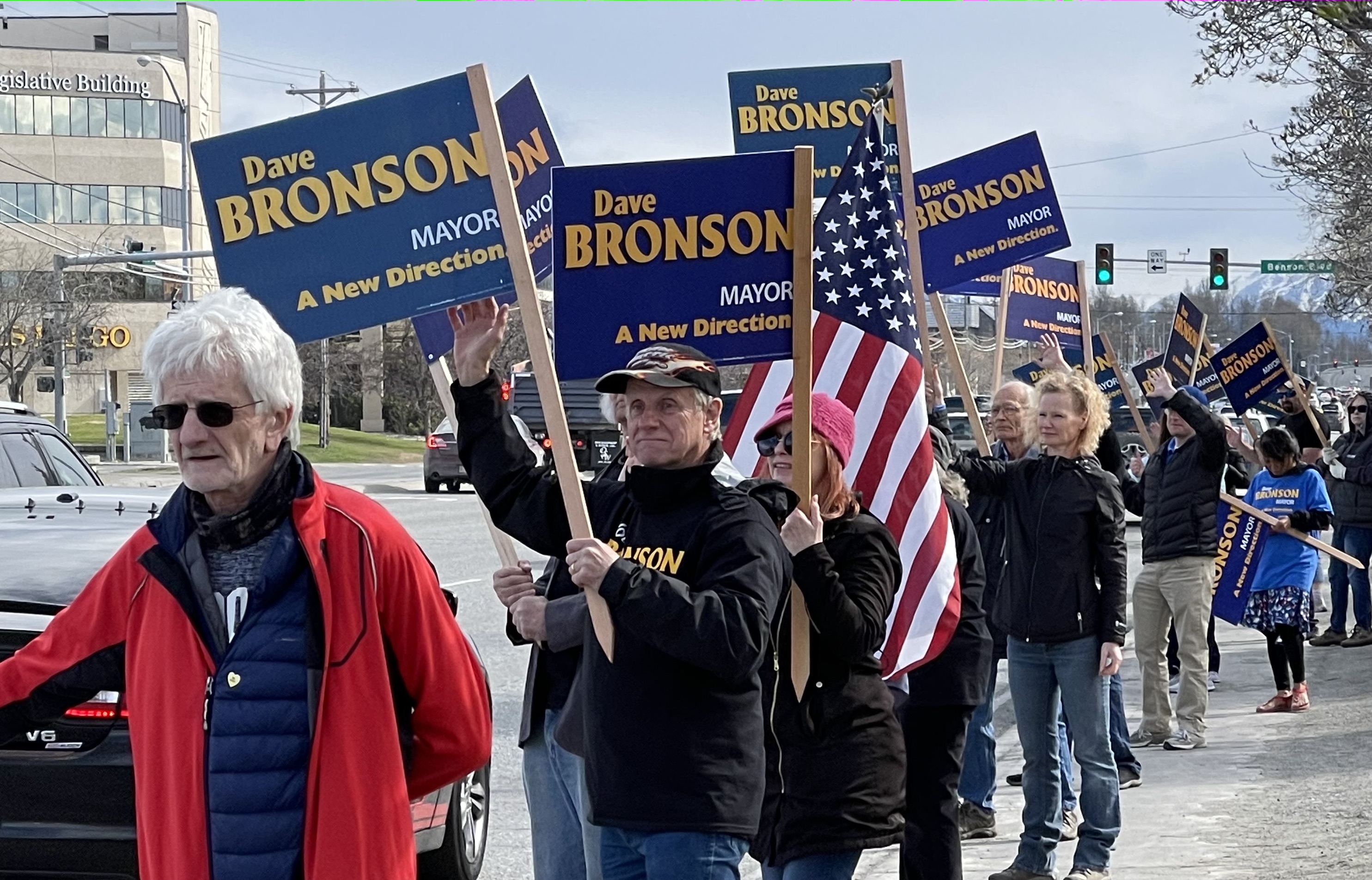
Every week, dozens of volunteers have turned out for Bronson walking and talking events with a passion for change not seen in Anchorage for many years.
Missouri Democrat Rep. Cori Bush repeated the progressive waterboarding of language and culture on Thursday when she referred to women as “birthing people” during a hearing about the health of black children, which a Democrat Oversight Committee calls a crisis. The term “birthing people” came so naturally to Bush that she didn’t understand what the fuss was all about.
She’s not the only one doing it. The thought leaders of the Left and policymakers at the highest level of government are erasing women and girls.
The CDC now refers in its literature to “People who are pregnant” and “People who are breastfeeding,” rather than women or females.
For inexplicable reasons, the agency that is tasked with interpreting science into policy now writes over women’s very chromosomes by reporting, “Pregnant people with COVID-19 are at an increased risk for severe illness from COVID-19.”
Where did this accepted of gender denial science come from? Feminist lawyers.
The gestation of a child, the morning sickness, the physical demands of advanced pregnancy, the labor of giving birth, and postpartum up-and-down experiences, and nursing a baby have made being a woman inconvenient in the field of employment law. Attorneys and feminists are positing that it is time to “de-gender pregnancy,” to reduce the frequency of workplace discrimination.
If everyone is a “people,” then pregnancy is something that might happen to any of them, the attorneys would have us believe.
We arrive at the culture wars of Mothers Day, 2021 and find motherhood itself is beingcancelled by legal scholars trying to protect women for their own good. You are a menstruating person, not a woman. You are a birthing person, not a mother. There is nothing unique about your anatomy.
These are the same great thinkers who have led the fight to cancel fathers and make fatherhood dispensable in the lives of children, a trend that began with Lyndon Johnson’s Great Society in the 1960s. We see how that’s working out.
These are the same great thinkers who cancelled Mr. Potato Head this year, because “Mister” is a classification too far. Banishing Barbie is already underway with the de-gendering of the iconic doll.
In 1865, poet William Ross Wallace wrote a poem that describes motherhood in terms that seem so politically incorrect today that the poem may be someday subjected to a “trigger warning.”
The Hand That Rocks the Cradle’s third stanza is powerful:
“Woman, how divine your mission, Here upon our natal sod; Keep – oh, keep the young heart open Always to the breath of God! All true trophies of the ages Are from mother-love impearled, For the hand that rocks the cradle Is the hand that rules the world.”
The rush to de-gender pregnancy is robbing women of what is a transformational and fleeting season in their lives, the creation and nurturing of life itself.
In January, House Speaker Nancy Pelosi’s Democratic majority erased the words “father, mother, son, daughter, brother, sister” and other terms that were not considered sufficiently “gender-inclusive” from the House rules. Those terms have been replaced with “parent, child, sibling, parent’s sibling.” That’s right: There’s no more sister and brother or aunt and uncle. No more mom or dad.
To all mothers, happy Mothers Day from Must Read America. You are so very special and treasured. You are the hand that rocks the cradle, with unique abilities that shall not be denied. It’s time to start fighting back and reclaim your rightful place as mothers. Don’t let the Left take away what is amazing, important, and God-given.
Suzanne Downing writes for Must Read Alaska, Must Read America, and NewsMax.
A comic-book image that portrays mayoral candidate Forrest Dunbar as Captain America and his competitor Dave Bronson as Hitler has been approved and adopted by Scott Kendall, former Gov. Bill Walker’s chief of staff.
The mayoral election taking place in Anchorage may be evidence of Godwin’s law or “Godwin’s Law (or rule) of Nazi Analogies,” an Internet term that asserts that as an online discussion grows longer, the probability of a comparison involving Nazis or Hitler becomes more likely. Now it evidently applies to political campaigns.
Kendall, the architect of ranked-choice voting and jungle primary elections with Ballot Measure 2, is using the image of Hitler being punched in the jaw on his personal Facebook profile. Kendall is also the architect of the Recall Dunleavy campaign, which may foreshadow campaign strategies to come if the recall election ever makes it to the ballot.
Far-left Anchorage Assemblyman Chris Constant, and Alaskans for Better Elections (Ballot Measure 2) Director Jason Grenn and Shea Siegert, also of the Dunbar campaign, all indicated their approval of the new profile photo Kendall chose by hitting the “like” option on Facebook.
Bronson supporter Dave Stieren raised an eyebrow over the “Bronson and his supporters are literally Nazis” tactic. The election ends at 8 pm on May 11.
Former Mayor Ethan Berkowitz, who resigned in shame in October after a nude photo of what looked like him in his office bathroom surfaced on Facebook, is a looming problem for Forrest Dunbar, who was one of his strongest allies and who is now running to replace him.
Voters want anything but a Berkowitz this year, if early returns are an indication. Some 57,378 ballots had been received by the Anchorage Election Office by Thursday night, and they are trending away from Dunbar and toward Dave Bronson, according to a Must Read Alaska analysis.
Residents in Anchorage remember when former news anchor Maria Athens splashed a backside selfie of Berkowitz on Facebook and accused him of all kinds of heinous acts. It became an international story.
The selfie that took down a mayor.
Dunbar, running for mayor now to replace Berkowitz, rushed to Berkowitz’ defense right away. Without evidence, he said Berkowitz could never have done such a thing. By Oct. 11, Dunbar had circled the wagons and declared Athens “unwell.”
By Oct. 23, it was all over but the shouting. Berkowitz resigned and Dunbar clammed up about his friend.
Berkowitz and Dunbar became fast friends when Dunbar volunteered on both the 2008 and 2010 Berkowitz campaigns.
Berkowitz was a man who had endorsed Dunbar in 2014, when Berkowitz said, “I’ve known Forrest for years and value his friendship because he is energetic, smart and compassionate. You can count on him to do the right job and do it well. He is an Alaskan who will make us all proud.”
“I’m deeply honored to have Ethan’s endorsement,” said Dunbar in 2014 during his run against Congressman Don Young. “It’s crucial that we have support and advice from established Alaskan policy leaders like Ethan.”
Dunbar and Berkowitz worked together to pass the controversial bag ban in 2018. That was one of their most infamous policy-leader outcomes.
Although he may have wanted a Berkowitz endorsement before, now it’s the kiss of death. Between the unpopular bag ban and the butt shots, Berkowitz may be an anvil, rather than an albatross, around Dunbar’s neck this year.
Dunbar is now playing an 11th-hour game of catch up, including in his role as assemblyman, voting last week 180-degrees differently than he had just two weeks before on the mayor’s emergency orders. Dunbar all but heralded that the pandemic as essentially over and said restrictions on gatherings must be lifted immediately.
The election ends on May 11. The Election office is open today and processing ballot thousands of envelopes. The election workers will log ballots and begin to adjudicate them, but will not count them until polls close on Tuesday.
Although the news media largely has ignored it, President Joe Biden took it on the chin in his drive to sink gun-makers’ congressionally approved immunity from anti-gun activists’ lawsuits.
An Arizona federal judge has ruled in favor of Glock, the No. 1 firearms manufacturer in U.S. sales, and dismissed a Brady Campaign to Prevent Gun Violence lawsuit on behalf of a man who was accidentally shot and paralyzed.
U.S. District Court Judge Susan Brnovich in mid-March upheld liability immunity granted in the Protection of Lawful Commerce in Arms Act passed in 2005 to block gun-makers from a potential wave of industry-killing lawsuits.
Brnovich, nominated by former President Donald Trump and the wife of Arizona Attorney General Mark Brnovich, dismissed multiple claims in the suit that the act’s protections were illegal.
“The statute is constitutional,” she wrote.
Of course it is. Lawsuits blaming the firearms industry for others’ criminal acts or negligence defy even common sense.
“These attempts to hold manufacturers responsible for the criminal and negligent misuse of firearms are misguided and are attempts at legislation through litigation,” says Mark Oliva, the spokesman for the National Shooting Sports Foundation, an industry trade group.
“The PLCAA law was passed with a bipartisan majority in both chambers of Congress to keep activists from attempting to bankrupt firearm manufacturers by tying them up in court with unfounded claims. This demonstrates why protecting this legislation against attacks by President Biden and gun control factions in Congress is critical.”
Biden, pushing for more gun control and repeal of the PLCCA, falsely has claimed the firearms industry is “the only industry in America” that can’t be sued. That is untrue.
Others are protected, as well. TSA screeners cannot be sued for disputes at airport checkpoints. Pfizer and Moderna have total immunity from liability if something unintentionally goes wrong with their vaccines. Almost 30 states have granted legal immunity to nursing homes to shield them from COVID-19 lawsuits. The list goes on, and the PLCAA does not grant immunity in all instances.
“The structure of world peace cannot be the work of one man, or one party, or one nation … It must be a peace which rests on the cooperative effort of the whole world.” – Franklin Delano Roosevelt.
May 8, the World War II Victory Day in Europe, is a reminder to Alaskans and all of mankind of a remarkable chapter in the world’s history, when peace-seeking nations united against evil.
One of the decisive factors leading to the victory of the world’s peace-seeking nations in the Second World War was the effective cooperation of the countries of the anti-Hitler coalition.
Today, after the passage of 76 years, it is vital once again to recall this unique episode, when the Allied countries, despite sharply divergent governing structures and ideologies, managed to reach agreement on a shared global imperative―to present a unified front against the powers that promulgated fascism and militarism.
Alexander Dolitsky
In the “worst of times” between 1939 and 1945, some 55 million people died violent deaths―the majority of them not as soldiers-in-arms but as defenseless civilians, including the millions of victims of the Holocaust. Yet, in one way, this period was also the “best of times,” when many countries of the world rallied against the ultimate rogue states of Germany and Japan to achieve the total defeat of German Nazism and Japanese militarism.
The United States’ Lend–Lease program contributed greatly to the victory in World War II, and the Great Patriotic War of the Soviet Union in particular.
The volume of materiel transferred from the United States to the Soviet Union between 1941 and 1945 was indeed staggering: nearly 15,000 airplanes, 7,000 tanks, 51,000 jeeps, 376,000 trucks, 132,000 machine guns, 4.5 million tons of food, 107 million tons of cotton, and more than 15 million pairs of army boots, among other items. At its peak in 1944, American help amounted to 12 percent of the Soviet gross national product.
Ladd Army Airfield (now Fort Wainwright) in Fairbanks, Alaska, served as a key transfer point for nearly 8,000 American-built combat aircraft from the United States to the Russian battlefronts on the Alaska–Siberia Air Route. In the three years of the route’s existence, thousands of Americans worked with Soviet personnel on the cooperative program. From 1942 to 1945, the Alaska–Siberia Lend–Lease operations demonstrated that two nations could set aside differing views, cultural values, and ideologies to achieve a common, mutually beneficial goal: to defeat Nazi Germany and its Axis partners.
Soviet and American pilots flew the Alaska–Siberia Air Route to deliver combat planes half way around the world, traversing more than 12 time zones, from Great Falls, Montana, to the Russian warfronts. Much of the route lay over remote and roadless wilderness where pilots made their way in stages from the safety of one hastily built airfield to the next.
Alaska served as the exchange location for transferring the planes to the Soviet Union. United States Army Air Corps pilots from the 7th Ferrying Group and Women Airforce Service Pilots (WASPs) flew combat planes from their points of manufacture in the U.S. to Great Falls, Montana, where male pilots of the 7th Ferrying Group flew them across Canada to Ladd Army Airfield, now Fort Wainwright, near Fairbanks, Alaska. From there, pilots of the USSR’s Air Force flew the planes over western Alaska and across Siberia to the warfronts.
Due to severe weather conditions, mechanical problems, and other adverse circumstances, 133 of these airplanes crashed in North America and 44 went down in Siberia along the Alaska–Siberia Air Route. During their time of service, 38 WASPs died and many more were wounded in the line of duty in the United States while delivering planes to Great Falls.
In the process of transferring aircraft in Alaska, Soviets and Americans get acquainted, and many became sincere friends, carrying on in friendship for the rest of their lives what had begun as a purely strategic alliance. The friendship and cooperation between the two nations during this period of history is now little remembered in the wake of 45 years of ill will fostered during the Cold War (1946 to 1991), and recent resurging tensions between Russia and the United States. Yet, in many ways, our two countries continue to rediscover the benefits of mutual cooperation, as the rebuilding of economic and social bridges continues.
Today, therefore, it is important to remind Alaskans and other peace-seeking citizens of the U.S. Lend–Lease Program and Soviet–American war cooperation of the 1940s.
Beyond the achievement of victory in World War II, the Alaska–Siberia Lend-Lease Program established a tradition of cooperation across the Bering Strait that continues to this day in the form of various intergovernmental agreements, including the Shared Beringian Heritage Program of the U.S. National Park Service, and numerous ongoing people-to-people cultural and economic exchanges.
Master of Ceremony John Binkley (right) and Program Manager Alexander Dolitsky (left) acknowledge distinguished guests at the WWII Alaska-Siberia Lend-Lease Memorial dedication, Fairbanks, Alaska, August 27th, 2006. Defense Dept. photo by U.S. Air Force Staff Sgt. D. Myles Cullen.
The heroism and dedication of the Soviet and American participants of the Alaska–Siberia Airway will not be forgotten. It is our civic duty to express our deep respect to those whose efforts led to the program’s success and, in the process, brought the war to a close. This is our history. Future generations should be brought up with a respectful spirit of patriotism to understand this history of cooperation between our countries.
Alexander B. Dolitsky was born and raised in Kiev in the former Soviet Union. He received an M.A. in history from Kiev Pedagogical Institute, Ukraine, in 1977; an M.A. in anthropology and archaeology from Brown University in 1983; and was enroled in the Ph.D. program in Anthropology at Bryn Mawr College from 1983 to 1985, where he was also a lecturer in the Russian Center. In the U.S.S.R., he was a social studies teacher for three years, and an archaeologist for five years for the Ukranian Academy of Sciences. In 1978, he settled in the United States. Dolitsky visited Alaska for the first time in 1981, while conducting field research for graduate school at Brown. He lived first in Sitka in 1985 and then settled in Juneau in 1986. From 1985 to 1987, he was a U.S. Forest Service archaeologist and social scientist. He was an Adjunct Assistant Professor of Russian Studies at the University of Alaska Southeast from 1985 to 1999; Social Studies Instructor at the Alyeska Central School, Alaska Department of Education from 1988 to 2006; and has been the Director of the Alaska-Siberia Research Center (see www.aksrc.homestead.com) from 1990 to present. He has conducted about 30 field studies in various areas of the former Soviet Union (including Siberia), Central Asia, South America, Eastern Europe and the United States (including Alaska). Dolitsky has been a lecturer on the World Discoverer, Spirit of Oceanus, andClipper Odyssey vessels in the Arctic and sub-Arctic regions. He was the Project Manager for the WWII Alaska-Siberia Lend Lease Memorial, which was erected in Fairbanks in 2006. He has published extensively in the fields of anthropology, history, archaeology, and ethnography. His more recent publications include Fairy Tales and Myths of the Bering Strait Chukchi, Ancient Tales of Kamchatka; Tales and Legends of the Yupik Eskimos of Siberia; Old Russia in Modern America: Russian Old Believers in Alaska; Allies in Wartime: The Alaska-Siberia Airway During WWII; Spirit of the Siberian Tiger: Folktales of the Russian Far East; Living Wisdom of the Far North: Tales and Legends from Chukotka and Alaska; Pipeline to Russia; The Alaska-Siberia Air Route in WWII; and Old Russia in Modern America: Living Traditions of the Russian Old Believers; Ancient Tales of Chukotka, and Ancient Tales of Kamchatka.
Robin Brena, the architect and funder behind the failed oil-tax hike in 2020 known as Ballot Measure 1, poured $4,000 into the Alaska Democratic Party in the final days of the Anchorage mayoral runoff.
The funds will be used to “get out the vote” in in the election that will decide if Forrest Dunbar, a Democrat, or Dave Bronson, a Republican, will become mayor of Anchorage.
Brena, a business partner and transition team oil-tax adviser to former Gov. Bill Walker, put over $400,000 into Ballot Measure One, in addition to paying signature gatherers to get people to sign the ballot initiative. It failed with voters 58-42 in November.
A regular Democrat supporter, Brena had already given the maximum allowed by law to the Dunbar campaign in early January. Must Read Alaska has learned the $4,000 to the Alaska Democrats will be used for text messages to Democrats in Anchorage who haven’t yet voted.
The Anchorage Municipality has also announced free bus service on People Mover on Election Day, ostensibly to help the Democrat vote.
The Alaska Republican Party appears to be working on its own get-out-the-vote strategy, and has reported $21,535 in its seven-day report to be used for the municipal election. This, too, appears to be focused on getting voters to find their ballots in their stack of mail and to vote them. The Republican Party typically stays out of local races as a policy but will work on getting out the vote in some races.
A private group, Conservatives for Bronson, has dump trucks adorned with Bronson signs focused on the Eagle River area, where conservatives have been reported to be hanging onto their ballots. A number of conservatives express continued mistrust of the municipality’s vote-by-mail security and the Bronson campaign has put a focus on that area, including a massive rally on Thursday.
The amount logged in as a contribution to the Conservatives for Bronson account is over $91,000, most of it coming from McKenna Bros. as a non-monetary contribution of the trucks and their drivers.
Secure drop boxes for ballots are located at:
Anchorage School District Education Center – 5530 East Northern Lights Boulevard: Location Picture
South Anchorage High School – 13400 Elmore Road: Location Picture
Spenard Community Recreation Center – 2020 West 48th Avenue: Location Picture
UAA Alaska Airlines Center – 3550 Providence Drive: Location Picture
West Anchorage High School – 1700 Hillcrest Drive: Location Picture
For those needing to vote in person for any reason, you can vote at If you need assistance voting, or if you need to replace a lost or damaged ballot, or if you didn’t receive a ballot, please protect our community in the public health crisis and call 243-VOTE (8683).
If the April 6 election is any indication, lines could be long at the three in-person voting centers on Tuesday.
Locations:
City Hall 632 West 6th Avenue, Room #155 Weekdays, May 5 – 10, 9 a.m. – 6 p.m. Saturday, May 8, 10 a.m. – 4 p.m. Sunday, May 9, noon – 5 p.m.Election Day, May 11, 7 a.m. – 8 p.m.
Eagle River Town Center 12001 Business Boulevard, Community Room #170 (same building as the library) Weekdays, May 5 – 10, 9 a.m. – 6 p.m. Saturday, May 8, 10 a.m. – 4 p.m. Sunday, May 9, noon – 5 p.m. Election Day, May 11, 7 a.m. – 8 p.m. Only Chugiak-Eagle River ballots will be available at this location.
Loussac Library3600 Denali Street, First Floor, Assembly Chambers Weekdays, May 5 – 10, 9 a.m. – 6 p.m. Saturday, May 8, 10 a.m. – 4 p.m. Sunday, May 9, noon – 5 p.m. Election Day, May 11, 7 a.m. – 8 p.m.
At Anchorage Vote Centers services: Voters can vote in person, return a mailed ballot, replace a lost or damaged ballot, receive a ballot package if they didn’t receive one in the mail, receive voting assistance, or get help with other voter questions. Voters who are voting in-person or requesting a replacement ballot will be required to show identification.
For voters who wish to vote at home and didn’t received a mailed ballot, please call the Voter Hotline at (907) 243-VOTE (8683) for a replacement ballot. Replacement ballot requests must be received no later than 5:00 p.m. on Tuesday, May 4, 2021, to allow sufficient time for mailing.
Voted ballots being returned by U.S. Postal Service mail must be postmarked no later than Election Day, May 11, 2021, and received by noon May 21, 2021. If mailing during the last 48 hours of the election, ask a postal official to hand-cancel/ hand-stamp the envelope with a postmark.