Wednesday, June 17, 2026
Home Blog Page 981

Trump endorses Dunleavy, but with a caveat: Dunleavy can’t support Lisa Murkowski

In a statement today, former President Donald Trump says he is supporting Gov. Mike Dunleavy in 2022, unless Dunleavy decides to back Sen. Lisa Murkowski in her reelection. If Dunleavy does that, the endorsement is off.

“Mike Dunleavy has been a strong and consistent Conservative since his time in the Alaska State Senate. I was proud to endorse his first run for Governor, and I am proud to support his reelection, too. From his handling of the virus, support of the Constitution, including the Second and Tenth Amendments — taking advantage of all the opportunities Alaska has to offer, and his strong pushback abasing the Liberal Biden Administration’s attempt to hurt our great Country. Alaska needs Mike Dunleavy as Governor now more than ever. He has my Complete and Total Endorsement but, this endorsement is subject to his non-endorsement of Senator Lisa Murkowski who has been very bad for Alaska, including losing ANWAR, perhaps the most important drilling site in the world, and much else. In other words, if Mike endorsees her, which is his prerogative, my endorsement of him is null and void, and of no further force or effect!” Trump wrote in an official statement.

Dunleavy was elected in 2018 and is running for reelection in 2022. He won 51.4 percent of the vote. In 2020, Trump won Alaska for the second time, with over 53 percent of the vote.

“We certainly don’t believe Lisa Murkowski deserves anyone’s endorsement,” quipped Tim Murtaugh, spokesman for the Kelly Tshibaka campaign for Senate.

Dunleavy has not said who he prefers — Murkowski or Tshibaka — for U.S. Senate. Murkowski has held the seat since being appointed to it by her father, Gov. Frank Murkowski, in 2002. She has fought off challengers, even winning a write-in election in 2010, becoming the first U.S. senator in more than 50 years to win an election with a write-in campaign, when she beat Joe Miller after he won the Republican primary, and also defeated Democrat Scott McAdams. She easily won re-election in 2016.

Tshibaka is the former commissioner of Administration for the Dunleavy Administration and is endorsed by Trump for Senate.

Cheryl Frasca named Bronson’s director of Office of Management, Budget

Today, Anchorage Mayor Dave Bronson selected Cheryl Frasca as the director of the Office of Management and Budget. 

Through her 47-year career working for U.S. Congress, governors, mayors, and state legislators of different parties, Frasca has honed extensive skills dealing with state and city budgets and public administration. 

Frasca was previously the OMB director for the Municipality of Anchorage from 2000 to 2002, and 2009 to 2012, and served in the same role for the State of Alaska from 2002 to 2006. She has also worked in the private sector dealing with government relations, fiscal policies, and policy analysis issues.

“Cheryl is one of the top financial minds in the entire state of Alaska,” said Mayor Dave Bronson. “I am elated that she has agreed to once again serve the people of Anchorage as we work together to help our great city prosper.”

Frasca has a bachelor of political science from California State University Hayward and a Master of Public Administration from the University of Alaska Southeast. 

Lt. Gov. Kevin Meyer will not run again in ’22

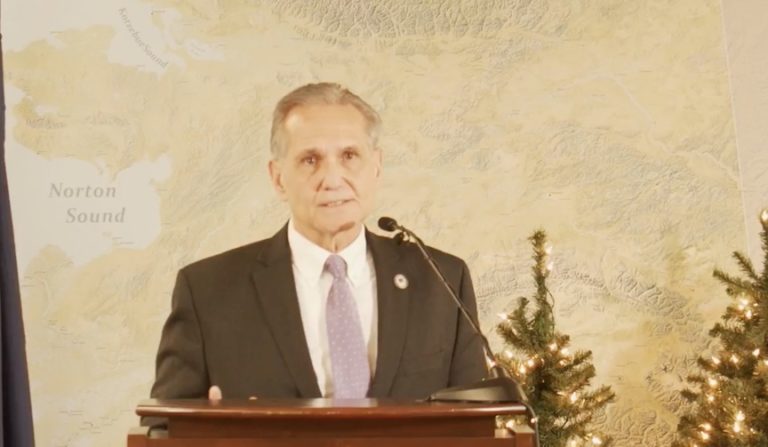
During a press conference on Tuesday, Alaska Lt. Gov Kevin Meyer said he will not run for reelection. He made the announcement at the end of a press conference about a bill he and Gov. Mike Dunleavy are presenting in 2022 to beef up voting integrity.

Meyer said he wants to devote his entire focus in 2022 to ensuring a fair election. The election will be conducted for the first time in the brand new “jungle primary” and “ranked choice voting” for the general election, a system that was ushered in with Ballot Measure 2, passed by voters last November.

“I think this is going to be an election unlike any other,” Meyer said, and emphasized that he needs to be impartial, without appearance of bias or conflict. “That is extremely important as far as voter trust and confidence in our election process.”

After 30 years of elected service, he said he has been in 19 elections, and “I kind of look forward to sitting this one out, and focusing on having the best election process in 2022.”

His announcement gives Gov. Dunleavy the opportunity to choose a new running mate for his reelection campaign. In the past, lieutenant governor candidates ran separate from gubernatorial candidates, but with the new voting scheme, the governor and lieutenant governor candidates must run as a pair.

Dunleavy and Meyer have an election integrity bill for legislative session

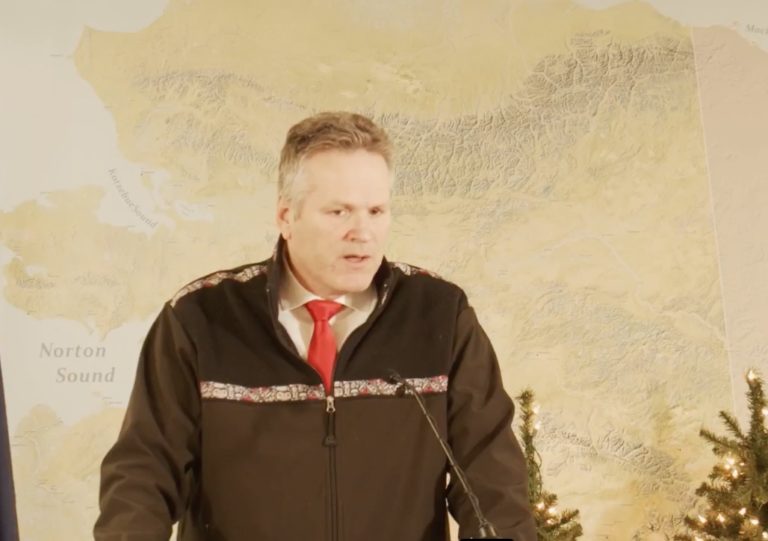
Alaska Lt. Gov. Kevin Meyer and Gov. Mike Dunleavy today announced the Election Integrity Bill, intended to improve the way the Division of Elections maintains voter rolls while providing additional tools to ensure a more secure system.

“After the 2020 nationwide election, we saw that election integrity was a concern for many Americans,” said Meyer. “Alaskans deserve to feel confident that the election process is conducted fairly and with integrity. At the end of the day, The Election Integrity bill will help place trust back into the election process.”

In the Election Integrity Bill, there are changes to the Permanent Fund Dividend – Automatic Voter Registration process, giving the option to request voter registration. These changes will allow for more secure data to come from the Department of Revenue to the Division of Elections to clean up the voter lists.

The bill includes amendments and provisions that would require the Division of Elections to maintain the master voter file differently and issue a required report every other year to the legislature. There will also be increases in the transparency of the election process, an improved ballot-counting process, and a toll-free election offense hotline. 

The bill will provide additional ways to verify that the person voting an absentee ballot is the voter whose name is on it, such as using signature verification equipment. There will be a more thorough definition of crimes around election fraud and election interference.

In addition, the bill sets up future training for police officers on election offenses, so if they are called upon to investigate these new crimes, they have the training to complete the investigation appropriately.

The proposed bill will make Alaska’s elections more secure and efficient while increasing confidence and integrity in election processes and results. The Election Integrity Bill will be introduced in the next few weeks.

“This Election Integrity Bill will ensure confidence with Alaskans and help rebuild trust in the election process,” Dunleavy said. “We are making the current system more secure through improvements. By consolidating ideas from past bills introduced in the Legislature and incorporating practices from other states, we hope to establish a more trustworthy elections system.”

Highlights from the proposed bill:

  • The changes to the Permanent Fund Dividend – Automatic Voter Registration come after more than 5 years of experience with the process. PFD applicants will have to request voter registration. These changes will allow for more secure data to come from the Department of Revenue to the Division of Elections to clean up our voter lists.
  • New statutory changes amend the list maintenance language statute to require the Division of Elections to review certain records, such as deceased voters, voters registered in other states, certain felony convictions, among others. The Division of Elections will be required to consult a subject-matter expert to audit the list of registered voters and issue a report every other year. 
  • Within the bill, there will be increases in the transparency of the election process for election observers and an improved ballot-counting process to ensure accuracy. The bill includes the creation of a toll-free election offense hotline for voters to use if they see questionable activity at the polls.
  • The bill reinforces the belief that absentee ballot signatures should be witnessed and it pays the postage costs for the return envelopes. This legislation requires free online bill tracking to be set up. The bill will provide additional ways to verify that the person voting an absentee ballot is the voter whose name is on it, such as using signature verification equipment. Absentee voting integrity will be improved through the future acquisition of new signature verification equipment.
  • The bill gives voters the option to request an absentee ballot for a 4-year window application, instead of a permanent absentee option.
  • The bill provides voters the option to fix any minor errors to their ballot by establishing ballot curing. Ballot curing is a popular way for voters to fix any problems with an absentee or mail ballot to ensure their vote is counted.
  • Working in conjunction with smaller communities and villages, this bill gives the Division of Elections the ability to mail ballots should it be required to give some Alaskans the chance to vote, even during a pandemic.
  • The bill will require new regulations for routine forensic examinations and chain of custody protocols for tabulators to be created and followed. When questions arise, there will be tools set forth to ensure an accurate accounting of election results.
  • The bill introduces a more thorough definition of crimes around election fraud and election interference that will provide clarity in the case of unlawful interference with voting.
  • The bill also sets up future training for police officers on election offenses, so if they are called upon to investigate these new crimes, they have the training to complete the investigation appropriately.

The bill will be introduced early in the next legislative session.

Legislative committee asks Permanent Fund chairman for answers on CEO’s firing

Sen. Natasha von Imhof, chairwoman of the Legislative Budget and Audit Committee, wants answers from Permanent Fund Chairman Craig Richards about why the Board of Trustees suddenly fired CEO Angela Rodell.

“The dismissal was abrupt and the APFC has not provided any explanation for its actions or a clear plan for a professional and timely leadership transition. The Board’s actions threaten to send a message of management instability at the APFC during a time of global uncertainty,” she wrote.

Rodell was dismissed by the board on a vote of 5-1 during the Dec. 9 quarterly meeting of the board of trustees. The board has stated that it is a personnel matter and is confidential.

Alaska’s Permanent Fund, with $83 billion in assets, is owned by the State of Alaska; its oversight board of trustees is appointed by the governor according to a schedule set by law. The board Chairman Craig Richards was initially placed on the board by former Gov. Bill Walker and was retained by Gov. Mike Dunleavy. Others on the board includes designated seats for the Commissioner of Revenue and Commissioner of Natural Resources; all but one of the members, Bill Moran, were appointed by Dunleavy.

Von Imhof said in her letter that because the Permanent Fund now provides more than 65 percent of the state’s annual revenue and is now without a CEO, the public and policymakers need to know what transpired.

“Hiding behind employee confidentiality by refusing to provide any information or transparency regarding the process followed by the Board, or its goals and intent, contradicts the Board’s giving principles stated on your website,” she wrote.

Von Imhof said the Legislative Budget and Audit Committee has the responsibility to see that the Permanent Fund exists in perpetuity and is not politicized.

She is asking Richards to produce for the committee:

  • Any and all communications from 2019-present between the Trustees and the executive branch of the State of Alaska relating to the performance of Rodell.
  • Any and all communications from 2019-present between the Trustees and the executive branch relating to the decision to fire Rodell.
  • Any and all communications from 2019-present between employees of the Alaska Permanent Fund Corporation and the executive branch relating to the performance of and the decision to fire Rodell as CEO.
  • Copies of employee surveys from 2019-present that APFC conducted or received from any source.
  • Copies of Rodell’s employment contract.
  • Copies of all policies and procedures regarding employee termination, discipline, and counseling of employees.
  • Copies of all reports and documents considered by the board at the meeting at which the board terminated Rodell.
  • Copies of any benchmark reports used by the board in its evaluation of Rodell in 2021.
  • Any communications from 2019-present from any fund managers investment banksers or third parties to the board that either raised concerns with or praised Rodell’s performance.

Read the Von Imhof letter here:

Von Imhof is also asking that Richards destroy no documents relating to the material she wants to see. That request came in a separate letter:

Art Chance: Change comes at a price

By ART CHANCE

I’ve never really understood the antipathy towards Alaska’s Legislature. I’ve been around long enough to remember when everything that didn’t go the way the Editorial Board of The Anchorage Times wanted, it was because the capital was in Juneau and the Legislature met there. 

The voters of Anchorage and the Mat-Su embraced moving the capital from Juneau; the rest of the State not so much, but the ballot initiative did pass.  

Paying for the move was another matter, and the anti-move forces proved to be far better propagandists than were the capital movers. Alaska was full of big ideas in those days and the “Buy the NFL” campaign was masterful. Both live football and a nearby team, the Seahawks, were still new, and Alaska was more than a little football crazy. The central notion was that Alaska could buy every club in the NFL for less than it would cost to move the Capital from Juneau. Every town in Alaska could have its own football team. Or they could move the capital.

It was utter fiction but the pro-movers couldn’t effectively rebut it and it left a mark. Then, as now, the Juneau denizens knew more about running and keeping the government than the capital movers knew about taking it.

Moving the capital has long been a Republican thing, and keeping it in Juneau has been a Democrat thing. It bears remembering that Alaska was so deeply Democratic that it was only admitted to the Union concurrently with equally deeply Republican Hawaii, and Alaska remained firmly Democrat until the 1980 election gave the Republicans control of the State Senate (The 1964 House was 20-20, but the Speaker was Bruce Kendall, then still a Democrat.)   

I read with interest the comments to Gov. Dunleavy’s piece here on Must Read Alaska about his public safety initiatives in which various self-styled true conservatives are screaming at him for not exercising dictatorial powers; Alaska’s governor has great authority over running the Executive Branch of State government, but actually has very little authority over running the rest of the state.   

The Legislature runs the state and the governor just follows orders. The governor can issue administrative orders regarding the processes of the Executive Branch with pretty much untrammeled authority, so long as the order is constitutional.  The governor can also issue executive orders on other matters, but they are subject to review and potential reversal by either the courts or the Legislature. In terms of promulgating statutory authority, Alaska is a very democratic state. Alaska’s founders took that business about all power coming from the people seriously and the Legislature is the instrument of that power.

My friend Mike Tavoliero has a piece up on Must Read Alaska about moving the legislative session to Southcentral.   I’m not opposed to it but, I don’t share Mike’s enthusiasm for it.   

If you moved the session to downtown Anchorage, the only thing that would change would be there would be more school kids in the gallery and more frustrated teachers trying to get them to take their ear buds out and stop texting. Everybody who knows enough about issues and politics to talk coherently with a legislator already knows how to contact a legislator. Sadly, lots who don’t know how to talk coherently also know how to contact a legislator.   

If the communist dimwits that have controlled the Anchorage Assembly in recent years could get interested in anything other than feathering their and their friends’ in the homeless industrial complex’s nest, they’d have long ago gifted the unused Egan Center to the Legislature and maybe put up a little seed money for necessary remodeling.   

Of course these are the same left wing nuts who trashed a Legislative Information Office near the downtown government complex just because some Republicans might have gotten nice offices. Later, the police that the Lefties hate got a nice office from that debacle for a few dimes on the dollar.

Back to Mike’s point, you really haven’t lived until you’ve been a Republican elected or appointed official in the beautiful, friendly People’s Republic of Juneau. By the later years of my career there, Juneau was as segregated as the small southern town where I grew up in the 1950s and 1960s; Republicans went to Republican places and did Republican things, while Democrats went to Democrat places and did Democrat things.  

To this day I don’t share the same room with a Democrat unless it is a public accommodation or I’m being paid to be there. My union “friends” gave me my own shrine in the front window of the Teamster’s Hall across from the Willoughby Street entrance to the Juneau State Office Building, the SOB; the most aptly named building in America. 

Juneau isn’t all bad or all lefty.  I had a prominent local lefty do a Mad Maxine Waters on me and confront me in “The Hangar,” a popular watering hole, one evening.  I had reached the “I don’t care” stage of my career and got right in his face and insulted and threatened him out of the joint. I couldn’t buy a drink for the rest of the evening.

For the Executive Branch, the capital has largely moved; most of the commissioners and directors are based in Anchorage and are only in Juneau for session. Other than the infrastructure divisions, those that are the ministers of the internal government, Juneau is basically a regional center for the government; much like Fairbanks.   

The legislative session gives a welcome boost to the Juneau economy in the winter and keeps it from becoming Sitka, Ketchikan, or Skagway, which are ghost towns when the cruise ships leave. But then, so is Anchorage. If you haven’t noticed — and it is easy not to notice because there is no reason to go there — Downtown Anchorage is a wasteland.

I disagree with most of the fundamental principles of the opponents of Juneau as the capital. You can’t hide in Juneau.  If you want to hide, you go to Anchorage, or basically any place other than Juneau. There are a helluva lot more discrete, comfortable watering holes in Anchorage than in Juneau.   

It is a valid argument that Juneau is too remote and too expensive to travel to or subsist in. The only argument that makes any sense to rational people is a purely economic argument. Had I moved my division to Anchorage, it would have been a 25% or so raise for me and my staff, and would have saved the State several hundred thousand dollars a year in travel costs.

I think it is inevitable; the capitol has always been in the political and economic center of the State. Kodiak was the center of Russian government, then Sitka. Sitka remained the Capital until Juneau exploded with gold wealth in the early years of the 20th Century.   

For much of the first half of the 20th Century Juneau was the richest town in America and maybe The World and was the seat of Territorial Government and then the State.   

The economic center of Alaska today is Anchorage, for better or worse. Just remember that all those leftist interest groups that haven’t already moved their offices to Anchorage will follow the capital here. They make for interesting neighbors.

Art Chance is a retired Director of Labor Relations for the State of Alaska, formerly of Juneau and now living in Anchorage. He is the author of the book, “Red on Blue, Establishing a Republican Governance,” available at Amazon. 

Criminal complaint: Doctors who signed complaint against fellow physicians now complain they got unwanted chocolate and information in gift bags

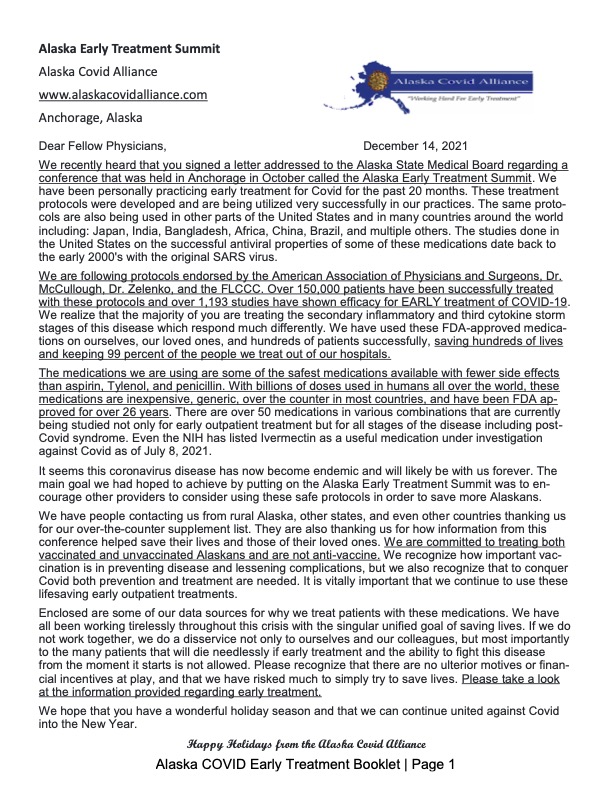
Alaska doctors who complained to the State Medical Board about a group of fellow physicians using non-FDA-approved treatments for Covid-19 illness received gifts of chocolates and information packets over the holidays from the Alaska Covid Alliance, a small group of allies of the alternative treatments.

The letter accompanying the chocolates and information pamphlet explained to the complaining doctors that the Alaska Covid Alliance-associated physicians had been using a series of treatment protocols for 20 months, and that the attached information was meant to better explain what some of those practices are and where they are being used successfully in the world.

Read: From A to Z, doctors who signed complaint letter

The complaining doctors didn’t universally appreciate the gesture. Some felt intimidated, they said. Many of the signers of the original complaint are women doctors who are part of a closed Facebook page, where they aired their extensive grievances about having received the chocolate and educational resources.

“Some felt threatened, unsafe, intimidated by this letter and the chocolates that came with it in a nice holiday gift bag,” said one of the Covid Alliance supporters, who was mystified at the reaction. “Their Facebook page kind of blew up about it.”

Read: Public turns against group of doctors trying to stop early Covid treatment

The accompanying letter from the Alaska Covid Alliance discussed medications such as ivermectin or hydroxychloroquine, which are believed to be safer than many common drugs used to treat various illnesses.

In response to the complaints about intimidation, Providence Medical Center management sent the following letter to its medical staff, saying that the matter was elevated to the Alaska State Medical Board:

“Hello Members of the Medical Staff,

“It has come to our attention that ​multiple members of our Medical Staff have received deliveries to their home over the past couple of days. The deliveries include a letter from Alaska Covid Alliance along with unwanted gifts. Although the message states that it is intended to be informational, some recipients are perceiving it as a form of intimidation. We believe these deliveries are targeting those who signed the ASMB letter. Through partnerships, we have informed ASHNHA and the Alaska State Medical Board about these activities. Please report to the Medical Staff Office ([email protected]) if you have received these unwanted gifts or visits so we may sense the scope of this activity.”

The gift bags were intended to be an olive branch to the complaining doctors, who were trying to get the Covid Alliance physicians’ license revoked by the state medical board. The medical board has refused to take action against the pioneering doctors.

As for the olive branch, it was stalking, Dr. Merijeanne Moore said to the Anchorage Daily News. She was one of the first to author the complaint to the Alaska State Medical Board about the medical participants in the Early Treatment Summit, organized by the Alaska Covid Alliance. Moore, who is a psychiatrist, filed a police report, and an Anchorage detective was assigned to the case.

“We wanted to start a dialogue,” said one member of the Alaska Covid Alliance. Let’s come to the table. It’s 28 pages, a synopsis of all the early treatment research that has been done.”

One of the Covid Alliance volunteers said the deliveries were made to home addresses after Providence prohibited them from being delivered on its campus. Other volunteers mailed the gifts after being unable to deliver them in person. One recipient of the holiday bag threw it down on the driveway when he realized what it was, a volunteer reported.

One of the Covid Alliance volunteers said she was interviewed by APD Detective Jason Deville, and that the case number is 21-507288. She said the detective wanted to know if the candy had been tampered with.

Two-time failed congressional candidate Alyse Galvin will run for Legislature

Alyse Galvin, a Rogers Park-College Village resident of Anchorage, is one of the latest to throw her hat in the ring for legislative office in 2022.

She failed to win as a congressional candidate in 2018 and 2020, running against Congressman Don Young.

This time, she has not indicated if she’ll run for House or for Senate.

Galvin has strong name recognition statewide due to her two congressional runs, which involved millions of dollars in name-building advertising.

She is in a House district with no incumbents, due to the newly drawn political boundaries that came out of the Alaska Redistricting Board final maps. Galvin is located in an area that was represented by Rep. Harriet Drummond, who is now representing the same district as Rep. Zack Fields.

A hard leftist, if Galvin chooses to run for Senate, it will almost certainly be because the incumbent, Sen. Elvi Gray-Jackson, has been persuaded by the Alaska Democratic Party to run for U.S. Senate against Sen. Lisa Murkowski. The effort to line up appropriate candidates is often coordinated by the Alaska Democratic Party.

Galvin is a nonpartisan but has run with the blessing, endorsement, and funds of the Alaska Democratic Party in the past, as the party continues to shape-shift in order to deceive voters into thinking its candidates are independents.

Bill Walker has amnesia, and the Anchorage Daily News hopes you do, too

By SUZANNE DOWNING

Former Alaska Gov. Bill Walker is pulling out all the stops to convince voters that his decades of haunting their ballots is worth their time once again.

Even though equally liberal Les Gara is making a case to the Democrat voter base for next year’s gubernatorial race, it is the Walker camp that is benefitting from that most valuable proxy for the Left in Alaska: The Anchorage Daily News, known during his last campaign as the Alaska Dispatch News.

In a Sunday guest column, the ADN gave the perpetual candidate and failed governor its top billing to attack Gov. Mike Dunleavy.

Let’s face it: Opinion pieces from candidates are essentially placed advertisements from the campaign. It’s the same everywhere in the news business, but was a campaign technique elevated by the Anchorage Daily News years ago.

By pushing wind into the sails of a man in his seventies who was beaten twice for public office and forced to end his campaign under the scandal of his running mate’s sordid behavior, the ADN is acknowledging that Walker is the Left’s best chance of regaining the Governor’s mansion.

Oh, how the Juneau elite long for those days, when the Walker-era Governor’s Mansion was the spot for lavish parties and when the booze flowed freely, all billed to the Alaska treasury and taxpayers (yes, you do pay a tax to the state treasury — it’s your garnished Permanent Fund dividend, a tradition begun by Walker and continued by the Alaska Legislature.)

It will take a lot of ink on the printing press to blot out the memory of the Walker years, both for Democrat-leaning voters and even the “Murkowski Republicans” who won’t vote for someone like Gara, but who balk at Dunleavy. 

But the reasoning for the furious pace of attacks makes sense right now, especially to clear the decks of anyone who might present themselves as an actual challenger of substance and means.

Dunleavy is currently ranked one of the most popular governors in America, with support from former President Donald Trump, among others. His management of Covid-19, which resisted the Left’s demands for statewide mask and vaccination mandates, while protecting the elderly and vulnerable populations, has Alaska remaining one of the safest places in America for handling the health challenges brought from the virus. 

Walker knows that his attacks on “pandemic management” will not play with a public that is exhausted by whipsawing calls from Dr. Anthony Fauci and the CDC to “follow the (ever changing) science.”

He also knows that he cannot attack Dunleavy on the issue of public safety, after he devastated the Alaska State Troopers with cuts under his administration, and at the same time championed SB 91 into law, over the objections of rank and file police and prosecutors. His support for SB 91 is why he lost the support of law enforcement unions during the last election. They went over to law-respecting Mike Dunleavy.

Walker is leaving the ADN-designated hatchet man (and vacationing family friend) Kyle Hopkins and his editor Dave Hulen to do the work of making Dunleavy look weak on public safety.

Walker also knows that the Permanent Fund dividend is a topic he has no credibility to talk to voters about. After pledging to never touch the PFD, he unilaterally vetoed the amount of the dividend in 2016, and never looked back in his pursuit to accomplish what AFL-CIO president Vince Beltrami and other special interests were demanding in Juneau: to hook up government spending to a guaranteed funding source, and leave the PFD behind.

It would be a monumental success if the Walker campaign can convince people he can save their PFDs: Who better to put out a fire than an arsonist?

Now, the ADN, which obstructs every conservative columnist by fact-checking them into extended frustration, has allowed the very man who fired Angela Rodell as Department of Revenue Commissioner to imply, inaccurately, that Gov. Dunleavy had something to do with her recent firing as the head of the Permanent Fund. Yes, Walker is the governor who didn’t have the courage to call her on the phone to fire her, but allowed her to read about her firing in the ADN. Now he says she was the savior of the Permanent Fund, but he didn’t respect her enough to inform her in 2014 that she was history?

This week’s developments leave little doubt about the coming volume and tone of the coverage from the state’s largest newspaper. The playbook is not new: It is the same one used by former owner Alice Rogoff to manufacture outrage over scandals in the National Guard against then Gov. Sean Parnell. They only have to dust it off.

Above the fold for months, the National Guard recruiting story, like the mainstream media’s attempt to link President Donald Trump to Russian interference in elections, gave the ADN the reputation as Alaska kingmaker, more than news outlet.

And, like the bogus Russia scandal, it just faded away the day after Bill Walker won in 2014.

That sorry episode in Alaska journalism, which has the lowest standards in the nation, gave birth to Must Read Alaska. During the year after the 2014 election, the editorial page of the ADN refused to print letters or op-eds from conservatives. And in the spring of 2015, Must Read Alaska started — one small voice against the liberal-dominated media. First, it launched as a newsletter, and a year later it became a website and newsletter.

It is time for conservatives to buckle up and be ready for what Hulen’s crew is cooking. The last four years of the Dunleavy administration has been a traumatic event to liberals hoping to reshape Alaska. Will conservatives forget the ADN’s crime against journalistic integrity?

It appears the ADN will do everything it can to put Walker back into office. Get ready for the sales pitch, now being funded by liberal nonprofit entities from out of state that will allow so-called journalists to run roughshod over neutrality.

Must Read Alaska will continue to call out the mainstream media bias in 2022. It looks like it will be a full-time job.

Suzanne Downing is publisher of Must Read Alaska.