A Superior Court judge has ruled the State of Alaska cannot certify the current mail-in election because the Division of Elections did not provide an adequate way for blind people to vote privately in all areas of the state. The election ends at 8 pm Saturday.
The State Department of Law is asking the Alaska Supreme Court to reverse the injunction, which was written by Superior Court Judge Una Gahdbhir.
The ruling throws a monkey wrench into the hurry-up election put together by the Elections Division to get the special primary election completed in the legal timeframe. When Congressman Don Young died on March 18, the Elections Division Director Gail Fenumiai and Lt. Gov. Kevin Meyer decided to do the state’s first all-mail-in election. Ballots went out in the mail on April 27, and must be postmarked by June 11. Over 121,000 ballots have been cast in this election, as of Wednesday.
Certification was set for June 25 by the Division of Elections.
The judge did not provide a remedy for getting private voting options for visually impaired people. The Alaska Human Rights Commission sued on Wednesday, giving the State little time to remedy the problem of ensuring that blind people could cast a ballot in secret, as seeing people are able to do with the paper ballots.
The Elections Division will be able to count votes on Saturday night, but if the delay continues, it could impact when the State holds the special general.
Yet, if the election results are made public, and there is a very close race, those public results could theoretically end up swaying the final tally, if there are enough blind voters who decide to vote.
Right now the primary election for the regular election is Aug. 16, and if the special primary election certification is delayed, the special general could be delayed by a few weeks. Will the Division of Election also conduct that one by mail only?
One thing is certain, the ruling derails the ability of the Election Division to meet the statutory timeframe for the special general election to be on the same day as the regular primary election.
More than 121,000 votes were logged in as of yesterday at the Division of Elections for the special primary election for Alaska’s congressional seat. We’re now on the 24+-hour watch, with Division of Elections reporting out the majority (we presume, but they won’t say) of the votes by 9 pm on Saturday. Must Read Alaska will be reporting from Soldotna on Saturday.
Colony Day Parade: Look for lots of candidates to have entries in the parade in Palmer Saturday, including Rep. DeLena Johnson and Sen. Shelley Hughes. Nick Begich for Congress will have a truck, but we’re not expecting candidates Tara Sweeney or Mary Peltola to look for last-minute Valley votes. All of the candidates are going where the crowds are most receptive on Saturday.
Media gaffe:Bloomberg’s report, above, shows why congressional candidate Nick Begich has the highest hill to climb in this election. The report said “Mark Begich,” the name that is kryptonite for Nick, the conservative in the family who is always having to battle the old leftist uncles…who have endorsed rival Chris Constant for Congress. That is a groaner for the Nick campaign, which is now referring to him as NBIII, understandably.
On the other hand, at least the national news group mentioned Must Read Alaska, even if it was an old poll from April:
More media:New York Times has a roundup of the Alaska raceat this link.
FiveThirtyEight, the Nate Silver polling and survey site, has a story here.
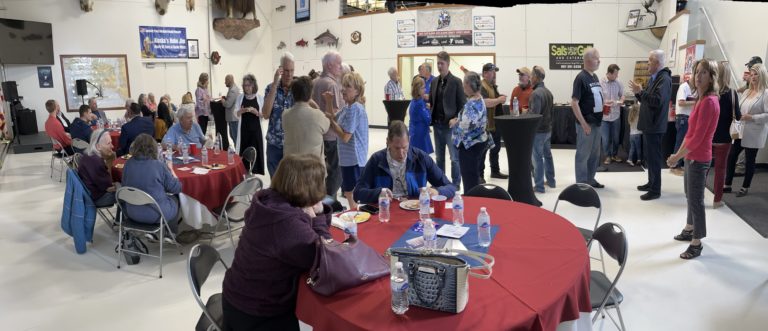
Running through the tape: About 80 people attended the Nick Begich for Congress fundraiser at the Keith Manternach hangar in Anchorage on Thursday, and there were a lot of new faces. Photo at top of page captures some of the vibe, which was upbeat and casual.
Kelly Tshibaka and the bikers: Tshibaka, running for U.S. Senate, is on the Kenai with Chris Cox, founder of Bikers for Trump, and a lot of Trump and Tshibaka fans. They’re doing door-to-door campaigning.
Freedom of speech: Is there any right more paramount to a free society? Without freedom of speech, there is no freedom of thought. And without freedom of thought, there is no wisdom. And without wisdom, a government will crumble. For to govern with wisdom, you must set the ideas free and the good ones will rise to the top. Just as truth will always find the light of day, so too will the good ideas rise above the scrutiny of public discourse. The restriction of speech is a red flag of tyranny.
“Freedom of speech is a principal pillar of a free government; when this support is taken away, the constitution of a free society is dissolved, and tyranny is erected on its ruins.” – Benjamin Franklin
If a bad idea cannot be challenged, nor a good idea tested, then we are left with a vacuum filled by power hungry politicians, who espouse their own agendas and would silence those who dare to disagree. Leaders who resort to censorship are threatened by free speech, because the power of the people would shut down their self-interests and politically biased decisions.
On several occasions, and lately becoming more the norm, I have been censored in public meetings. I have had my microphone muted, I have been ignored, deemed “out of order,” when it was within my right to call a point of order, and told to stop talking.
As an elected representative, when they silence me, they silence you. The question is why? What are they so afraid of? Are my words really so scary? Does listening to my point of view pose such a threat? If they can’t hear what I have to say, they certainly don’t care what you have to say.
My colleagues on the Anchorage Assembly have been allowed to ask questions, interrupt, imply motive, make comments out of debate, debate testifiers during public comment periods, and generally not been held to the same standards and rules of decorum as I have been held.
Now, I am not suggesting we throw rules to the wind and let chaos control an Assembly meeting. I am suggesting that silencing someone when it is their turn to speak because you do not like what they have to say is just plain wrong. Less than the glaringly obvious political bias, what concerns me most is this the naked censorship. We may not agree on how to govern this city, but we should agree on the fundamental principles which we have pledged an oath to uphold.
The line between a free society and the Gulag is as narrow as the stroke of a pen. For one act of censorship requires another and another until all speech is regulated to conform to an ideology. Free speech has fueled every great advancement the human race has ever achieved. But censorship is the slippery slope to all tyrannies perpetuated on people since time immemorial. We must do better. Do I like to sit and endure the name calling and accusations that sometimes come from the public? Of course not. But I will defend to the death their right to say it.
If we cannot preserve the fundamental freedoms of this nation, we have failed in our duty as public servants.
Jamie Allard is an Anchorage Assembly member representing Chugiak and Eagle River.
Officials with the Alaska Law Department say they have “serious concerns” about the timing of a lawsuit challenging Saturday’s special congressional election.
The Alaska State Commission on Human Rights is suing Lt. Gov. Kevin Meyer and the Alaska Division of Elections over the mail-only election on behalf of a visually-impaired voter identified as “B.L.”
“B.L. filed a complaint with ASCHR on May 15, 2022, alleging that the ballot is not accessible to a visually impaired individual and that the DOE is engaging in discrimination on the basis of a disability based on its failure to provide accessible ballots or voting machines throughout the state, denying B.L and similarly-situated voters equal access to its services,” the lawsuit states. “Despite several meetings with ASCHR before and after the filing of B.L.’s ASCHR complaint over the lack of reasonable accommodations for visually impaired voters over the course of the last several weeks, the DOE does not plan to place touch screen voting machines at more than five locations throughout the State.”
The plaintiffs are asking elections officials not to certify the election “until such time as visually impaired Alaska voters are given a full and fair opportunity to participate in such election.”
A spokeswoman with the Department of Law said the office is still reviewing the lawsuit.
“The Division of Elections has serious concerns about the timing of this lawsuit and will ask that the court not upset the constitutionally and statutorily required special election, for which ballots were sent out over a month ago,” said Patty Sullivan, a spokeswoman for the Department of Law in an emailed statement. “These issues could have been raised much earlier, and the Division has not done anything differently than what it has done in the past for absentee voting. We are hopeful the court will agree.”
The Division of Elections “has systems in place to help all voters exercise their right to vote, even in a mail-in election.” Sullivan said
“A voter can get the assistance of a trusted person to complete the ballot received in the mail in the comfort of their own home,” Sullivan said. “Election workers can help voters with their ballots at any absentee-in-person location or division office. Or voters can fill out a ballot privately online using their own computer or tablet set to their own specifications. And, at division regional offices, tablets are available to fill out the ballot digitally for those who need it.”
Forty-eight candidates are vying to serve the remaining four months of the late U.S. Rep. Don Young’s term. Ballots must be postmarked by Saturday. More than 121,000 ballots had been received back at the Division of Elections as of Thursday.
The top four vote-getters will advance to a runoff held during the Aug. 16 primary.
The price of food, gas and other consumer goods spiked again in May, as inflation is forcing Americans to make tough decisions about how to spend their money.
According to the U.S. Department of Labor, consumer prices climbed 8.6% in May over the same period last year, the largest increase since 1981. From April to May, costs jumped 1%, a sharp increase over the 0.3% spike from March to April.
The cost of gasoline is driving the 40-year-high inflation, as gas prices rose for the 12th consecutive day overnight. The average cost of a gallon of regular gasoline is now $4.99, according to AAA, a penny from the $5 threshold that motorists in more than 20 states already are paying.
The food index rose 10.1% over 12 months and 1.2% from April to May. The cost of housing, rent, home energy and airline tickets also saw significant increases. Core prices, which exclude food and energy, rose 6% over the year.
Stock futures dropped after Friday’s inflation report was released.
Lower income Americans are being hit the hardest by rising prices because they have less discretionary money to spend.
“What’s both remarkable and troubling is the lack of discussion over the price level, which is the new ‘floor’ for prices in the economy,” Erik Randolph, director of research at the Georgia Center for Opportunity, said. “The only discussion is about bringing the inflation rate back down. This means that the federal policymakers are willing to leave the price level elevated. Leaving the price level elevated means we are leaving the economically disadvantaged further behind, exacerbating the economic divide in our nation.”
A new poll from the Trafalgar group shows that a majority of Americans think President Joe Biden “is intentionally letting gas prices rise to make Americans use less fossil fuels.” According to the poll, 53% of Americans believe so, 39.6% don’t think the president is intentionally letting gas prices rise, while 7.4% are unsure.
“Surging gas prices are creating immense hardships both for everyday Americans and for our economy at large,” Mark Meckler, president of Convention of States Action, said in a statement accompanying the poll. “This stunning data reveals that a majority of voters believe our gas crisis is by design. Specifically, that President Biden is intentionally allowing gas prices to continue to rise in order to advance the political agenda of Washington, DC special interests.”
Dan McCaleb is the executive editor of The Center Square. He welcomes your comments. Contact Dan at [email protected].
This week, over the strident protests of some trail users, the Parks and Recreation Advisory Committee wisely approved a temporary pitch-and-putt 9-hole disc golf course at the Treadwell Mine Historic Site in Douglas. This approval would add another much-needed outdoor recreation venue for local residents.
Disc golf is a sport in which players throw a disc (similar to a Frisbee) at a target, or basket, using rules similar to golf. Most disc golf courses are built in more natural and less manicured environments than a regular golf course and require minimal maintenance while incorporating safety in their design.
The project would be located near existing walking trails, so it initially generated some concern among trail users worried about hiker safety. However, the Juneau Disc Golf Club, the project sponsors, have been responsive in addressing concerns through re-design and re-locating holes.
Two of Juneau’s most enduring qualities are its access to outdoor recreational opportunities and its commitment to shared, mix use of its public resources. The City and Borough of Juneau Assembly, city staff, school district, and a whole host of non-profits and volunteers deserve credit for championing and developing diverse recreational activities. They all play a vital role in the health and well-being of our youth and families.
A recent City Journal article citing an Aspen Institute survey on youth sports revealed that 45 percent of American parents saw a reduction in local community programs and sports teams during the pandemic. Significantly, 28 percent indicated their kids had lost interest in organized sports.
This has resulted in rising obesity rates and levels of depression. During the pandemic, Juneau, in particular, saw an unprecedented number of young people experiencing high levels of stress, thoughts of self-harm and suicide attempts. It’s a simple fact that activities that get kids off their couches, screens and phones is good for physical and mental health.
Juneau officials have recognized this and have included “diverse recreational assets and opportunities” as a goal in Juneau’s economic plan.
Recently, the Assembly approved an expansion of the municipally-owned ski area summer operation that will open up a whole host of new activities for visitors and residents (while allowing the ski area to be financially self-sufficient). The selection of a site at 35-Mile for ATV enthusiasts is another illustration that widens the diversity of recreational options available to residents.
Disc golf shares the benefits of the above examples and it’s now one of the most rapidly growing sports in the country. Idaho, for instance, has 143 courses, and Alaska has close to 50 throughout the state. The sport has been fully embraced in Juneau through a variety of programs sponsored by disc golf club. According to club officials, professional coaches taught around 1,000 students how to play disc golf in the 2021-2022 school year, at local schools at the elementary, middle, and high school level. Similar classes were taught in Skagway and Haines.
Discs and baskets were left at the schools so teachers could use them during gym class. Reportedly, participation percentages were remarkably high, engaging many students that previously didn’t enjoy gym class.
JDGC has five different leagues and sponsors tournaments throughout the year. The club also has a development league every Sunday and holds clinics to improve skill levels.
Juneau’s one existing 18-hole disc golf course near Lena Point is used by more experienced players. There is a need for an easier more compact 9-hole course for beginners to practice and learn on. The temporary Treadwell course is intentionally designed to accommodate beginners by limiting play to putting and pitching discs that are thrown shorter distances and at slower speeds (picture an executive par 3 golf course).
Unfortunately, before all the facts were known, opponents of the project mounted an anti-course petition drive, citing a few rare injuries that occurred in other states involving large, poorly designed disc golf courses located in heavily trafficked public parks. Their testimony at the hearing when the proposal was being considered offered no compromise.
The Treadwell course layout will locate holes so discs will not fly adjacent to or across published trails. In addition, disc golf club is only applying for a temporary permit on a first-year trial basis which will allow for further public comment.
Expansion of recreational venues throughout the borough is a top priority of the Assembly and enhances the quality of life for all residents, but especially our youth.
This Juneau Disc Golf Club project deserves a chance to succeed. Thanks to Juneau’s Parks and Recreation Advisory Committee for giving them that opportunity.
After retiring as the senior vice president in charge of business banking for Key Bank in Alaska, Win Gruening became a regular opinion page columnist for the Juneau Empire. He was born and raised in Juneau and graduated from the U.S. Air Force Academy in 1970. He is involved in various local and statewide organizations.
The state’s Human Rights Commission has filed a lawsuit against the Division of Elections, its Director Gail Fenumiai, and Lt. Gov. Kevin Meyer, alleging that Alaska’s special mail-in election for the vacant congressional seat robs voters who are blind, because they have no good way to vote privately or independently, as they do in regular elections.
The lawsuit was filed Tuesday on behalf of a plaintiff referred to only as “B.L.,” asking the court to stop the certification of the results of the June 11 special primary election until blind voters have “a full and fair opportunity to participate.”
There are options for voters, including using custom computer technology to vote, and most visually impaired adults have access to such technologies. But perhaps B.L., who lives in Anchorage, does not have access to a computer, the Internet, and the adaptive software.
“A visually impaired voter may identify, and vote for, a candidate using this electronic option privately only by using screen reading technology which reads the text aloud. However, this option is only available to those visually impaired voters who have access to a private computer with internet access. Additionally, to ensure privacy, this option requires a visually impaired voter to access and fold their ballot in absence of any instructions regarding the same; any requirement of dependence on another individual to facilitate this process precludes the voter’s privacy,” the lawsuit states.
The Division has published June 25 as the target date for the certification of the election. As of now, the votes will be counted and announced starting Saturday night, unless a judge blocks the state from being able to proceed.
If the judge agrees and stops the election, the very results of the election may come into question, and be subject to lawsuits, as ballots sit uncounted for an unspecified period of time. The Law Department says the fact that the lawsuit was filed just three days before the end of the election poses serious challenges and that the Division of Elections is not doing anything differently than it has in the past.
The June 11 special primary election will determine which four names will go on the special general election ballot, which must be printed and mailed to overseas voters along with the regular primary ballots that are voted at the same time. Candidates will not know how they performed and won’t have the information to decide whether to continue as a candidate during the regular election cycle for the congressional seat. The deadline for withdrawing is June 26.
The Division of Elections must then print the general-and-primary combo ballot and has until July 1 to mail the ballot to overseas voters. Any delay in the process could upend the entire election, which is on a tight schedule due to the untimely death of Congressman Don Young on March 18.
The request was a few months too late. The Meet the Press Show on NBC reached out to Congressman Don Young’s press office to see if the congressman could be on the show on Friday, June 10.
“We would love to have him on the program if his schedule allows,” the request read. It may have been an intern who made the ask for the show that is the longest-running television show in history. If so, oops.
The communication director for Alaska congressional office for Alaska’s at-large seat took to Twitter to give his deadpanned answer:
“Unfortunately, @chucktodd, I don’t think Congressman Young’s schedule will allow him to be on Meet the Press with you tomorrow but I’ll circle back if that changes. Thanks for reaching out.”
Congressman Young’s 89th birthday would have been today, but he died on March 18.
Zack Brown, the communication director, also wrote on Twitter: “The best part to me is if DY saw this he would cackle about it for 5 minutes before asking me to print it and laminate it so he could show all his friends on the House Floor during votes.”
Corey Ahkivgak, who has attacked three people in Anchorage in the past six months, including a woman who he stabbed in the back at the Loussac Library, was let go by an Anchorage judge. By Monday, Ahkivgak will be walking the streets of Anchorage, free to attack again.
Angela Harris was stabbed while returning borrowed items at the Loussac Library on Sunday afternoon, Feb 13, 2022. Ahkivgak came up to her from behind in the lobby of the library as she approached the return chute. Her injuries were additionally severe because the man’s knife hit her spinal cord, causing paralysis. He had attacked two other women in months leading up to his attack on Harris, and had been released on those attacks, too.
“My family and I have lived in Alaska since 2005 and I am a mother to four children, all of whom I have regularly taken to the library since they were young. I am serving on active duty in the United States Coast Guard,” she said. “Corey Leif Ahkivgak drove a dirty Leatherman knife into my spine between L2 and L3, penetrating my spinal cord.”
But Judge Josie Garton of Anchorage Superior Court dismissed the charges, saying that Ahkivgak was never going to be competent enough to stand trial or understand the criminal Justice system.
Unless prosecutors can find a way to civilly commit him, the ruling means Ahkivgak can go wherever he wants, including any homeless shelter, park, grocery store, or back to the scene of his latest crime — the Loussac Library.
On Facebook, Harris wrote:
“When I arrived at St. Elias, “Momisol” (Ms. Marisol) said, ‘He broke your skin but he did not break your spirit’. Yesterday my heart broke. Today I am reminded of her words as I get myself up again refusing to allow the law to break my spirit. I will not deny that this ruling, the dismissal of his charges and ability to be released again, feels like a bigger blow than when Corey Ahkivgak drove a dirty leatherman knife through my spine.
“It was just another day at work on January 6th when Judge Garton followed the rules of the law releasing Mr. Ahkivgak from custody 28 days after publicly attacking two women on two separate occasions in December. He attacked me 38 days later. Yesterday was the second time that I listened to public competency hearings (for a mind blowing time, call the courts and get the information to listen to a block of those hearings).
“For almost two hours I listened to Municipal and State criminal charges being dismissed and cases dropped due to incompetence rulings. Multiple offenders. Violent offenders. Minor offenders. It was an assembly line of cases. There were victims, like myself, who pleaded with the court to help make sense of how someone could have murdered another human being and still be released with no record based on incompetence.
“Listening to Judge Garton as she justifiably carried out her lawful duties on another routine day in the office was one of the biggest hits I’ve ever taken. It was heavy for me because the people in positions of power have known this injustice has existed for a long time. They knew Alaska Laws were not yet written to protect the public. They knew people were being sent out to the streets daily with clean records. They’ve known there was a loophole, a gap putting Alaskans at risk, yet no one before now has looked into what can be done to fix it.
“Repeatedly, I am being told that, in addition to daily physical and occupational therapy, counseling, learning to walk, etc., it’s also now become up to me, as the victim, to fight for legislative changes. Knowing the courts have watched this injustice happen every day and no one has gotten in front of it because it hasn’t yet effected them or their family was one of the hardest hits. Rulings like this mean those released based on mental incompetency can still work in public schools, purchase firearms, anything they please because there is literally no record of their criminal activity nor their mental incompetence.
“Unless we continue to fight, Mr. Ahkivgak would be released to the public on Monday. My support team and I continue to show up in offices pushing for longer detainment. I am 100% confident that the DA prosecuting on behalf of the State is filing for a Civil Commitment (another soapbox for later, but I have no representation or say. This is a State matter and they do not work on behalf of the victim. The DA for this case has just been very kind at answering my calls and helping me make sense of it). I’ve also learned that if there is no bed space or if the Judge chooses, this request can be denied. API has 80 beds available to serve our state. 10 of those are designated to criminal rehabilitation.
“The Commissioner told the Governor during our meeting that these are adequate numbers and there isn’t a waitlist issue. It makes sense after listening to the court hearings because they release the criminals if they know they will not be able to get into a facility within the time the law allows for them to be detained (yes, I understand criminals are people and have rights too; I do not agree with it being acceptable to conclude 10 beds for rehabilitation is acceptable because we’ve already released a ton back to the streets because 10 beds are all we have).
“I have no legal background; my understanding is a Civil Commitment will detain him for 30 more days. We will continue to have to push for 60, 90 and then 180 days. My understanding is that is as long as he can be held accordingly to law. Judge Garton said he can be held for longer if he’s a danger, but I’ve not found supporting documentation to give me faith in this. After hearing other cases, I also understand that there is a strong lean on releasing criminals because they’ve been detained too long with no resolve. Evidently, keeping our community safe by keeping offenders detained is less favorable as so many pleaded with the judge for “immediate release” because their client has the right to be released since they are incompetent and has already been in jail for weeks or a couple of months. I am abundantly blessed to have Jesus as my stronghold and my family and friends as my support. Even with the love, support and encouragement of an army, there are moments that I crumble. I appreciate all of your love and support. Many of you wrote letters and have reached out to people in positions who can help; thank you for making enough noise to get their attention. Unfortunately, the squeaky wheel gets the grease. Please do not stop pressing in until laws are written AND passed. It is going to take community involvement to keep the needle moving. I cannot imagine the emotional, spiritual, mental and financial ruins that other victims before me have faced. Hearing the volume of cases in two days makes me wonder how many victims are out there. Alaska is so big yet so small. Do I know someone who was victimized? Do you? Do they have support?
“The resources that Alaska has is sometimes difficult to find. Even when found, Alaska’s Victims’ Compensation Board has a $40k cap. I would have blown through that a few hours after my attack. I haven’t found that Alaska has a support group for victims in my situation. Homicide, yes, but why does it have to come to that? What exactly are our rights, resources and options as victims? Another huge blessing, I am active duty and Tricare has helped but even then I’ve had to spend double digit hours of emotional stress fighting for outpatient services (again, thanks to Gaylin Swibold and Karen Hewes leaning in with our HS, I now have an incredible patient advocate and no longer have to fight this battle). What about victims who were already struggling to keep their head afloat? If you know a victim, I implore you to reach out to them. For me, I was in our public library on a Sunday afternoon. Through counseling, I’m learning that this has had a profoundly deeper traumatic effect because I was in a seemingly safe place full of fantastic memories. I’ve taken our kiddos to the library since they were young and have had a ton of fun experiences there. For others, who knows their experience? Are they fortunate enough to even have the time, funding and transportation for a counselor to help them process their experience? Where are they and how can they get the assistance that they need?
“I cannot imagine my life without my parents, Walter Burns and Robin Burns being retired and able to come here to take care of the two “littles” (spoiler, they are no longer little) in our home (we are blessed that Miss Kitty likes Mike Trepagnier and April Trepagnier so they can care for her while mom and dad are here). I cannot imagine how I would have been released from inpatient care without Dr. Todd Curzie opening his home to Aaron D and I. I cannot imagine how I would have made it through meetings with government officials without Captain Leanne Lusk picking up dialogue when my shaking voice fades. I cannot imagine how I would untangle my thoughts without the ability to word dump to Christine Moaga and have her help sort it all out.
“I am abundantly blessed. I still struggle daily. We keep fighting because there are victims out there with little to nothing. Criminals are not kept detained and are released creating more victims. We MUST protect and support our community. I honestly do not know how I could fill the gap but I would love to know other victims and hear their stories. I would love to know if there are things that we as a community could do to support them. Victims For Justice is a great resource and my advocate, Golda, is the kindest woman. It seems as if that system could use a little tweaking too (another soapbox for later), but for those victims who still have a gap in their needs, I wonder how our community could offer assistance. Jesus didn’t make a mistake. I am here because there is work to be done. My life is forever changed. We must close the loophole. We must bridge the gap. We must make our public places safer. We have a mental health crisis in our community with inadequate facilities and resources.
“We have a robust Mental Health Trust; how is Alaska utilizing it if not within API? Before anyone barks back, I understand this is happening globally. I understand there are more issues. I am trying to heal and fight with what I have been dealt. My tragedy will not be in vain. It’s already a victory because I still have my life and ability to love on my family and watch my kiddos continue to grow into extraordinary adults. This experience gives us a chance to save someone else from facing a similar attack or a family loosing a beloved. Prayerfully, that positive footprint would encourage someone else to leave a positive footprint. More than a decade ago Mr. Gillam, Diane and JL showed me and my family love and kindness in a way that I can never repay. The only thing any of them would ever say was, “whenever you see an opportunity, pay it forward”. I know Jesus has been with me every step of the way. I’m doing the best I can to press forward, still seek out the best in people and help whoever I can along the way without completely depleting myself. Even after reading this, if the only thing you do is show one other person kindness today, it’s a win.”
Original police report:
Initial indications are that 32-year-old Corey L. Ahkivgak was sitting at a table in the lobby of the library when he abruptly stood up and ran towards a male and female who were near some bookshelves by the windows. Ahkivgak stabbed the adult female in the upper body and then fled from the building on foot. The adult female was transported to the hospital by medics for treatment of her injuries. She is expected to survive.
A description of Ahkivgak was aired over the radio; multiple officers arrived and formed a perimeter. A K9 track was conducted but was ultimately unsuccessful. Just before 5PM a swing shift officer saw a male, matching the suspect’s description, walking near E 36th Avenue and Cottonwood Street. The officer gave the man commands and took him into custody at 4:58PM once backup units arrived. Ahkivgak was positively identified as the suspect.
While Ahkivgak was being transported to the Anchorage Police Department for questioning, he slipped his handcuffs from the back of his body to the front. The officer pulled over, removed Ahkivgak from his patrol vehicle, re-cuffed Ahkivgak’s hands behind him, and then placed hobbles onto Ahkivgak’s legs to keep him from slipping the cuffs again. While Ahkivgak was sitting in the interview room at APD HQ, he flipped over the table causing it to break. At the conclusion of the interview, Ahkivgak was remanded at the Anchorage Jail on the charges of Assault III, Violate Conditions of Release, Criminal Mischief IV (for the damage to the interview room), and Assault I.
There is no indication that Ahkivgak and the victim knew one another. The motive for the attack is still under investigation.