An analysis of the ballots being returned by voters in the congressional race shows that by mid-May, most of the expected ballots had already been received by the Division of Elections. The current push for “get out the vote” is for a smaller and smaller universe of expected ballots.
The number of ballots the Division of Election has in hand now stands at 119,279, with another data release expected late Thursday by the division.
About 3,000-4,000 mail-in ballots are expected by election analysts to be received per day Thursday through Saturday, with a total vote count looking to be about 135,000.
Saturday is the final day when ballots can be postmarked for the election that will decide which four candidates will compete to fill the temporary congressional seat for Alaska.
The Division of Elections has received more than 60,000 undeliverable ballot envelopes from the post office and voters. That is more than 13% of the entire voter roll, and the returned mail will assist the Division of Elections in future purges of the voter roll.
The large population boroughs mailed in 1.7% (Anchorage) to 3.0% (Kenai) more ballots during the past three days.
The Kenai (22.9%) and Mat-Su (19.4%) Boroughs continue lead in total ballot turnouts.
Smaller hubs had ballot surges approaching 4%: Copper River, Petersburg and Denali.
Western Alaskan ballot flow is weakening: North Slope Borough (0.4%) and Bethel (0.3%).
The most recent ballots trended from conservative areas, and the net Republican advantage is rose from 8.4% to 13.8% for the period.
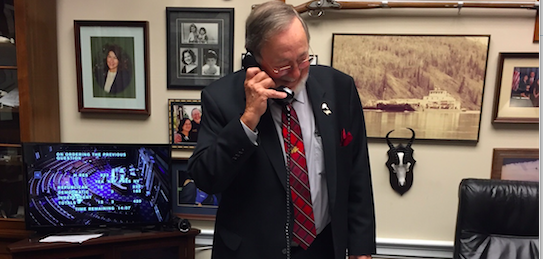
With two days left in the special congressional primary of 2022, today is the late Congressman Don Young’s birthday. He would be 89.
At a birthday celebration for Congressman Don Young in 1994, (courtesy of Curtis Thayer).
Media notes: The Washington Post published its long-form story on the congressional race in Alaska, and it’s mostly accurate and expansively reported. And Bloomberg has a story out as well about the Alaska race. National Journal is prowling around the campaigns looking for quotes for a story as well.
Newsweek, which has become very left-leaning, has as story up now as well. That story is here.
The Washington Examiner story features mainly Santa Claus and Palin, at this link.
Meanwhile, the local Alaska media decided to gin up a story that any candidate who lends money to his own campaign is committing something akin to “legalized bribery.” In other words, it is legal to loan money to your own campaign and it is done all the time.
You cannot make this stuff up:
Native News Online has an interview with Tara Sweeney, linked here.
Spotted at baseball night: Nick Begich was spotted at the Chinooks and Mat-Su Miners opening game on Wednesday.
Ad buys: Mary Peltola bought new broadcast flight for $6,000 in Anchorage. Sarah Palin’s new radio ad flight cost her $11,000 for Southcentral Alaska stations. Al Gross bought last-minute broadcast for $24,000 in Fairbanks, Anchorage, and Juneau.
Endorsements: The Teamsters Union Local 959 has endorsedTara Sweeney.
Alaska House Republican Caucus Leader Cathy Tilton has endorsed Nick Begich.
Rep. Andy Josephson endorsed Adam Wool in a letter to the editor, which states, in part, “At the same time, Adam has been unafraid to take tough votes in defense of climate reduction and mitigation measures, gun safety, and a responsible Permanent Fund dividend, to name a few. He has also been principled, while simultaneously working well with both sides of the aisle. Rep. Wool has been collaborative, not divisive. Adam is also an exceptional listener.”
(Key phrase: The Democrats call it “gun safety.”)
Colony Days Saturday: Which candidates will show up for Colony Day parade in Palmer on Saturday? The weather is expected to be cloudy and in the mid-60s. Must Read Alaska will be there for the festivities.
Mary Peltola and daughter at Celebration in Juneau.
Celebration in Juneau: Celebration, a big Tlingit-Haida-Tsimshian event in Juneau, brought in candidate Mary Peltola for the festivities and parade. Celebration is one of the largest gatherings of Southeast Alaska Native peoples, drawing thousands of people, including more than 2,000 dancers, according to sponsoring organization, Sealaska Heritage Foundation.
Fundraisers: Nick Begich is holding a fundraiser at the Keith Manternach hangar on June 9 at 5:30 pm. The campaign said the first 15 people get a free NBIII t-shirt, and yes — full disclosure — MRAK publisher Suzanne Downing is a co-host and will attend.
I go to see a movie at the theater every couple of years; they’re overpriced, the service sucks, and the audience is usually a bunch of punks who can’t get off their phones. But nostalgia demanded that I go see “Top Gun – Maverick.” I saw the original when it came out at the 20th Century Theatre in downtown Juneau; surround sound was a new and neat thing in 1986.
That movie is responsible for the fact that you could trace the evolution of surround sound in the dead cables in my Juneau crawl space; if that chain slicing across the deck as the F14 catapults doesn’t addict you to surround sound, you’re immune – or something. In my experience, the original “Top Gun” was the first movie with truly good sound.
The new movie is just a modernized version of the old movie, but 1986 was an eon ago and it is time for a new audience that will think it is new. While the movie is a resounding box office success, I have to wonder if it is reaching that new audience. Admittedly, anecdote isn’t data, but my observation is that the audience was made up of people who saw it the first one. The only young people were the kids they brought with them. I don’t think this movie has much attraction to the man-bun and pink pussy-hat set. You can’t say it has “woke” conformity, but they’re careful to skirt any subjects or situations that might set the woke crowd off. To their credit, the producers kept the Nationalist Chinese flag on Maverick’s jacket despite the opposition of the Communist Chinese, who provided financing for the movie. Chinese financing of US movies is something we should address.
The protagonist, Pete Mitchell, call-sign “Maverick,” played by Tom Cruise, is a character many of us who have worked in government and corporations are very familiar with; he is very, very good at what he does and almost everyone above him or around him in the organization hates him. I think I know that guy. Maverick is the kind of guy who gets the assignments that can get you killed or your reputation ruined, and the people who gave you that assignment can claim they don’t know you. I’ve been there, done that.
In the original Maverick was a hair on fire “naval aviator” and the only things he chased more aggressively than enemy aircraft were pretty women. Orders and procedures were suggestions, often laughable suggestions from inferior men. Maverick becomes something of a hero by acting against orders and thwarts those who would like to destroy him. He receives a plum assignment and that is where we leave it in 1986.
In 2022, Maverick is still a captain and promotion has been impossible. One of his antagonists from almost 40 years before, “Iceman,” has become an ally, has also become an admiral, and is something of a protector. The Admiral, “Iceman,” steps in to rescue the still “dangerous” Maverick from yet another contretemps with the pencil-necked weenies and gets him assigned back at “Top Gun” to instruct a group of pilots for a very demanding and secret mission, an only thinly disguised covert raid on an Iranian nuclear site. Needless to say, many of the pencil-necked weenies in command don’t like the new addition to their mission.
The new one is essentially the same plot line as the original and the same characterizations, but with a couple of ironic twists. There are plenty of nostalgic cues to bring back memories for those of us familiar with the original. Maverick may have been a hero in the first one, but he wasn’t and isn’t a hero to the Navy bureaucrats above him so he remains a captain after all these years and everyone outranks him in every way except in reputation.
The original movie was unkind to the Navy brass. The new one is even less kind and is very much reflective of these times. The three-star in charge of the mission that is the focus of the story steps into the training that Maverick is conducting. The mission profile is very demanding and the team is having difficulty accomplishing the mission in simulation. The three-star changes the mission profile to make it less demanding so that the team can meet the metrics in the training for the mission. That means that the team is prepared for the mission but also all but guarantees that some or all of them will not survive it and the mission might not succeed.
That is unfortunately typical of today’s public management. The manager’s metric is to plan and train up a mission, so if he meets his metrics he is a success. If the team fails to carry out the mission successfully, the failure is on them. In less business school-like terms, he’s willing to sacrifice their lives to move any responsibility for failure away from himself.
Since you know the genre, I won’t be a spoiler if I tell you that Maverick and his team accomplish the mission, make an heroic, if unlikely though nostalgic, getaway, and Maverick rides off into the sunset with the pretty woman, and does so in a vintage WW II P-51, which may in fact be his. Tom Cruise does own and fly one.
It’s a good movie worth seeing and one that might do some good for our indoctrinated youth to see, so if you can tear your kids away from Tik-Tok take them to it. Without regard to the story, the graphics are stunning. No CGI or animation was used and all the flying was done by real Navy pilots flying real Navy aircraft although the websites are abuzz about whether the SU-57s depicted were real or whether they were US F-22s made to cosmetically resemble the SU-57. Of course, that is the sort of controversy that makes we who argue about stuff like that sometimes unpleasant to go to movies with.
Art Chance is a retired Director of Labor Relations for the State of Alaska, formerly of Juneau and now living in Anchorage. He is the author of the book, “Red on Blue, Establishing a Republican Governance,” available at Amazon.
Alaska Gov. Mike Dunleavy today expressed his gratitude and appreciation to Commissioner Dr. Michael Johnson, who is departing from his role as commissioner of the Alaska Department of Education and Early Development. Commissioner Johnson publicly announced his departure during the Alaska State Board of Education and Early Development quarterly meeting this afternoon. His official last day is June 30, 2022.
Sources say he has taken a job at a college out of state. Dunleavy and Johnson have for many years been friends and fellow educators in rural communities and the move is not seen as a rift, but an opportunity for Johnson to get back to the roots of education. Helping to pass the Alaska Reads Act has been one of his achievements in the Dunleavy Administration.
“From the moment he stepped into a classroom, Commissioner Johnson has been a true asset to Alaska’s public education system. His accomplished background in a rural Alaska school district gave him a unique perspective to be a successful and thoughtful leader,” said Dunleavy. “Michael has been a friend to many and I have valued his insight and commitment to our future generations. I wish him well in his future endeavors and thank him for his many years of dedication to Alaska’s students, educators, and administrators. It is only fitting that we cap off Michael’s years of service to the state with the historic passage of the Alaska Reads Act which earned bipartisan support and will greatly improve the trajectory for Alaska’s students – a feat that could not have been achieved without him.”
Commissioner Johnson began his service as Commissioner on July 1, 2016. He previously served in the Copper River School District as superintendent, school principal, district curriculum and staff development director, elementary teacher, and special education program assistant. During his tenure as its principal, Glennallen Elementary School was named a Blue Ribbon School by the U.S. Department of Education. Commissioner Johnson also is a recipient of the prestigious Milken Educator Award.
“It has been an honor to work with Governor Dunleavy and the State Board to improve student outcomes in Alaska. He has always made time to support the work necessary to support Alaska’s students,” said Commissioner Johnson. “There are far too many friends, colleagues, and fellow Alaskans to thank individually. I’ll look back on my time as Commissioner with enormous gratitude. I will continue to support Governor Dunleavy and an effective public education system in Alaska.”
Commissioner Johnson holds certification in Alaska as a teacher and administrator. He holds a BA and a MA in teaching degree in elementary education from Columbia International University, and a doctorate of philosophy in education and intercultural studies from the University of Alaska Fairbanks
After over a decade of serving a south-central portion of Anchorage in the Legislature, Rep. Chris Tuck is leaving office.
Redistricting put him into the same district as Rep. Andy Josephson. Both are Democrats, but Tuck was the House Majority leader during the past two years and is seen as a moderate Democrat, while Josephson is considered hardline left.
That leaves Josephson to run against Republican Kathy Henslee and Alaskan Independence Party candidate Timothy Huit.
Tuck, who has served in the Legislature since winning a House seat in 2008, is said to have a lot of work in the private sector right now. He is a business representative with the International Brotherhood of Electrical Workers Local 1547 and works as an electrician.
Henslee, a realtor, ran for Assembly and lost to Meg Zaletel earlier this year but is now a well-known name in the district. Josephson is also a well-known name, as he is pro-tax, pro-abortion, and considered a foe of a full Permanent Fund dividend.
It’s not enough to pass an ordinance — AO 2022-60 — that will give the Assembly a path to impeach a duly elected mayor. That controversial ordinance will be revisited by the Assembly on July 12 after much hue and cry from the public and a strategic decision on Tuesday by the Assembly to wait until they can seat another liberal member on the body for downtown Anchorage.
Now, the Assembly leadership has an ordinance that will give it the power to appoint the Youth Advisory Commission, taking that power away from the youth commission, who last year changed their procedures to vote as a body to appoint their representative to the Assembly.
The current youth member of the Assembly is conservative and outspoken. Sarah Price, who was voted by the commission in January, but not seated by the Assembly until May, has only been to three meetings. But she has challenged Assembly Chairwoman Suzanne LaFrance on her and the majority’s attempt to create an impeachment process for the mayor, and sided with the conservative adult members of the Assembly.
Thus, on Tuesday night, AO No. 2022-69, was offered by LaFrance, proposing to seize the power of the Youth Advisory Commission to appoint their representative and award that power to LaFrance, who would appoint someone who agrees with her.
Price excoriated LaFrance during the meeting on Tuesday during a traditional “moment of personal privilege.” Price pointed out that it had taken the Assembly five months to seat her as the youth representative after she had been elected by her peers, and that the ordinance to remove the power and voice of the youth commission had not even been shown to the members of the YAC before it was introduced as a last-minute agenda item on Tuesday.
Price called the move “devious,” and said that the role for the youth representative on the Assembly is not meant to be just a token seat-filler who would be both nominated and approved by the Assembly.
Later, LaFrance prevented Price from being able to speak on the topic, since she had already spoken.
Several young people who attended the meeting also objected to the takeover of the Youth Advisory Council by the Assembly and said so on the record during the public comment period.
The Youth Advisory Commission has a unique ability in code to nominate two youth commissioners to the Assembly — one regular, and one alternate. In the past, during the administration of liberal Mayor Ethan Berkowitz, the member was chosen by the mayor and was a leftist, who resigned from the youth commission when Dave Bronson became mayor, declaring the administration “homophobic.”
Since the group has been meeting, it established a new method for picking its ambassador to the Assembly, something that could come to an end with AO 2022-69.
As Price was using her time at the end of the meeting to ask the Assembly to not overrule the will of the Youth Advisory Commission, her microphone was cut off, something that has happened before with conservative speakers.
The crowd jeered and pointed out that other microphones were live still, as LaFrance attempted to blame the cut mic on a technical issue.
Seventeen Republican attorneys general, including Alaska Attorney General Treg Taylor, have filed an amicus brief with the 11th Circuit Court of Appeals in support of a Florida law that bans sanctuary cities.
The brief was filed by the attorneys general of Alabama and Georgia, Steve Marshall and Christopher Carr. Joining them were the attorneys general of Alaska, Arizona, Arkansas, Indiana, Kansas, Kentucky, Mississippi, Missouri, Montana, Nebraska, Oklahoma, South Carolina, Texas, Utah, and West Virginia.
In 2019, the Florida legislature passed a bill signed into law by Gov. Ron DeSantis requiring state and local government officials and employees to comply with federal immigration enforcement.
DeSantis said he was proud to sign the bill “to uphold the rule of law and ensure that our communities are safe.” He thanked state legislators “and the Angel Parents for their commitment to seeing this bill across the finish line. Their leadership has made Florida safer.”
Shortly thereafter, the city of South Miami sued, and later several other groups, claiming the law discriminated against foreign nationals living in Florida illegally. U.S. District Court Judge Beth Bloom granted the city’s request for an injunction, halting the law from going into effect. Florida then appealed.
The Florida case is currently on appeal from the U.S. District Court for the Southern District of Florida, Miami Division. The attorneys general argue Bloom legislated from the bench and exceeded her constitutional authority.
“The amici States must constantly defend against legal challenges to state statutes brought by those who oppose the results of the legislative process,” they argue in the brief. “These litigants invite federal courts to substitute their own judgment for that of the legislature. Too often, courts accept the invitation to usurp the legislative role by ascribing invidious intent to legislative enactments based on sheer policy disagreement, dressed up as supposed discrimination.
“The Constitution forbids that, and for good reason. … Federal courts are poorly positioned to weigh the many interests at stake. Their decisions are rendered without public debate. And, because they are not elected, they cannot be held accountable by the people.”
They argue Bloom “fell prey to exactly this temptation.”
“A legislative judgment that the country’s existing laws should be enforced is not an extreme or suspect position,” they argue. “Yet the district court held the law facially invalid, because it was supposedly enacted with discriminatory intent, even though the law specifically prohibits racial discrimination. The Court did not point to any discrimination apparent in the text of the law (there is none).”
AG Marshall said, “An unelected federal judge apparently disagrees with Florida’s political judgment about whether immigration laws should be enforced, but that should not be relevant,” adding that he hopes the court undoes Bloom’s “troubling ruling and puts an end to this practice of legislation by judicial fiat.”
In Florida AG Ashley Moody’s brief filed with the 11th Circuit, she argued Judge Bloom “committed numerous errors to arrive at the remarkable conclusion that the Florida Legislature had secret racist motivations in enacting SB 168.”
“The law promotes public safety in facilitating federal immigration enforcement against criminal aliens, while expressly prohibiting racial discrimination in its implementation,” the brief states. “The district court found a hidden racist motive only by ignoring key provisions of the statute, failing to afford the Legislature a presumption of good faith and placing great weight on the thinnest of evidence.”
There are currently more than 300 so-called sanctuary cities in the U.S. whose officials won’t cooperate with federal immigration enforcement, the Federation for American Immigration Reform (FAIR) estimates.
“Many sanctuary policies restrict law enforcement agencies from cooperating with federal immigration officials, including prohibiting their compliance with immigration detainers,” it states.
According to U.S. Immigration and Customs Enforcement estimates, more than 2.1 million illegal immigrants are living in the U.S., with more than 1.9 million of them having deportation orders from a judge.
In a recent letter to Department of Homeland Security Secretary Alejandro Mayorkas, Florida Congressman Matt Gaetz estimates that it would take 14.5 years to deport “just the aliens DHS has released under the Biden Administration,” into the interior of the U.S., including Florida. This is in addition to the 1.9 million with deportation orders who haven’t been deported.
He also recently cited DHS data indicating that the Biden administration has the lowest deportation rate in the history of the agency. According to DHS data, 48% fewer criminal illegal immigrants have been arrested and 63% fewer convicted criminals have been deported under the administration, he said.
As is often the case, there was no shortage of bills introduced to the 32nd Legislature (which comprises 2021 and 2022). Not counting resolutions, legislators introduced 690. Those that did not pass both bodies by the end of the 4thSpecial Session in 2021 were still in play in 2022, and when all was said and done, 74 completed the process.
More important than a list of what bills crossed the legislative finish line in 2022 is the question of what good and bad policy reforms the legislature enacted. This analysis is not comprehensive because keeping up with Juneau antics is a daunting task, but what follows are some highlights. Readers who take an interest in any of the policies should remember that nothing is final until signed by the governor, who maintains veto authority.
For context, Alaska Policy Forum is all about freedom. Bills are good when they bring more freedom to people. Our vision is an Alaska that continuously maximizes individual opportunities and freedom on a path toward prosperity. More specifically, we operate under seven principles of sound public policy, which provide the lens through which we evaluate the following outcomes of 2022 legislative activity.
Because literacy is a foundation for understanding freedom, the best policy reform to make its way through the legislature in 2022 was the Alaska Reads Act. This nonpartisan reform passed the Senate unanimously (twice!) and squeezed out of the House by a single vote. It creates a comprehensive statewide K–12 reading policyto improve Alaska’s dismal outcomes. We certainly do not like everything in the bill, but we fully support reforms that ensure education dollars are spent in ways that develop reading proficiency for students.
Another very good outcome of this legislature was not creating a new defined benefits pension tier for state employees. More than one bill was introduced to do so, and advocates deployed many tactics to propel the dangerous change. Thankfully, all attempts failed, and at least for now, Alaska has steered clear of proposals that would bring great fiscal risk to the state and threaten retirement benefits already promised to retirees.
A surprising bright spot: Inaction on a billthat would have capped political contributions. A 2021 ruling by the Ninth Circuit Court struck down Alaska’s previous campaign donation limits. We agree with those who contend that laws to “regulate political spending and contributions . . . violate the right to free speech and ultimately diminish citizens’ power.”
Additionally, legislators made a small step toward cutting back on bureaucratic excess with a bill that attempts to eliminate “outdated, duplicative, or excessive” government publications. Allowing some documents to be delivered electronically saves state funds.
Progress was also made toward improved transparency of state spending by way of the Alaska Online Checkbook Act, which passed without a single legislator voting against it. That’s quite an accomplishment! APF fully supports the intent of this policy reform but would be remiss if we did not point out a glaring omission: The largest chunk of dollars the state spends goes directly to the 53 school districts; most other spending looks miniscule by comparison. Contrary to the principle of open government, those school districts’ appropriations are a closed book, providing no clear picture of how the funds are spent.
Some bills survived the legislative session with both good and bad elements.
One proposalgives the state Board of Pharmacy authority to continue practices started during the COVID pandemic — notably, allowing pharmacists to prescribe vaccines and emergency medications. Giving health care professionals tools to meet the needs of the market is indeed a welcome step. However, in doing so, the legislature also took the opportunity to widen the scope and authority of a government regulatory board, once again showing that most of our elected officials do not trust the power of the free market.
Another bill passed with the intention of alleviating Alaska’s teacher shortage. That lawmakers have identified this problem is good news, and the bill took some steps in the right direction. Even the name sounds great: “Out of state teacher reciprocity.” But once again, policymakers showed their fear of the market’s ability to self-correct. Rather than simply recognizing licenses in good standing from other states, the bill gives such teachers a two-year pass while they teach in Alaska. It still requires them to complete Alaska’s more-onerous requirements to maintain licensure. The education special interest groups win again.
While over 60 bills were introduced dealing with Alaska’s elections, not one of consequence passed. At a time when a majority of voters in our statesupport election audits, requiring a photo ID to vote in person, and signature verification of ballots, the legislature could not manage to pass even one small improvement to address their concerns.
Lastly, fiscal restraint took a back seat in 2022. The budget that passed for 2023 was massive: 65% more than APF’s Responsible Alaska Budget amount and a 37% increase over last year’s budget. We’ll weigh in on the final budget after the governor has had a chance to issue vetoes, but in the meantime, we were disappointed that legislators took no statutory action on an appropriation limit of any sort.
While many elected officials campaigned on this very issue and the Alaska Chamber has made a “meaningful spending cap on operating budget expenditures” a policy priority year after year, another session has passed with no progress. Until Alaska gets its fiscal house in order, our economy will continue to be disadvantaged and the handful of good bills that manage to make their way into law will not be enough to fill the civic hole.
Bethany Marcum is chief executive officer of Alaska Policy Forum.
The first teacher to be an Alaska governor was right at home: Gov. Mike Dunleavy, in the the library in Turnagain Elementary School in West Anchorage, rose to speak while the children and adults in summer school classes settled down for a monumental announcement from the state’s top elected official. Students sat crisscrossed on the floor in front, and flanked by nearly one third of the Alaska Legislature, Dunleavy announced the success of the Alaska Reads Act, a key initiative of his administration, which he would sign in a few days.
“Today’s news is about you,” said Dunleavy to the students who ranged in age from 6 to 10, “Because the foundation of everything that matters to being a good student, to being a good student, starts with you being able to open a book up, and know what the words in it mean.”
Though the scene at Tuesday’s ceremony was upbeat, the path to it in the Legislature was anything but.
Alaska by many metrics ranks either last or near last in the United States for reading competency by the third grade. Dunleavy’s administration, and in particular his Commissioner of Education Michael Johnson, made reading reform a major state policy initiative.
The elements of the plan which became the core of the Alaska Reads Act were accountability combined with support. Each component was a major plank for either conservative or liberal groups. Each component was also a major sticking point for organizations on both sides of the political spectrum.
An aggressive goal that is unconventional made even more uncommon allies. Dunleavy gained the support of Alaska State Sen. Tom Begich, the leader of the Democratic Caucus in the Senate, who is retiring from politics. (Begich’s conservative nephew, Nick Begich III, is the Republican candidate for the United States Congress).
The governor also enlisted the help of Sens. Shelley Hughes and Roger Holland. Hughes, the Republican Senate Majority Leader, is known for her uncompromising conservative views that resulted in her being removed from previous Senate majority organization.
Holland is a freshman who unseated former Alaska Senate President Cathy Giessel for not being conservative enough in the Republican primary of 2020.
All were in attendance to celebrate a major milestone in education, as were a substantial contingent of the Alaska House of Representatives. Though the bill passed the Senate unanimously, the Alaska Reads Act became ensared in naked gubernatorial election politics as members of the Bill Walker Caucus in the House repeatedly killed the education reform measure.
In particular, former Speaker Bryce Edgmon of Dillingham and Bethel Rep. Tiffany Zulkosky (appointed by former governor and current candidate Bill Walker) waged a savage, multi-month campaign both in the Capitol and in the press against the reading bill. Charging the sponsors of the initiative of being both anti-rural and anti-student, Edgmon and Zulkosky nearly ensured the original bill had no chance of passing.
It took a last ditch maneuver, which also gained unanimous Senate approval, to send a reading bill straight to the House on the last day of the legislative session, and by doing so, avoid the roadblocks Edgmon and Zulkosky erected in the House committee process. In a debate that was only overshadowed by the fight over the annual Permanent Fund Dividend, members of the Walker Caucus successfully enlisted near unanimous House Democratic support.
Rep. Mike Cronk of Tok, the rural conservative freshman and former teacher, teamed up with pro-life Democrat and House Majority Leader Chris Tuck to get the largest educational overhaul in a generation over the finish line.
Cronk and Tuck were successful — by a single vote. Joining virtually the entire House Republican Caucus in supporting the Alaska Reads Act were Rep. Neal Foster of Nome and Josiah Patkotak of the North Slope, both members of the Bush Caucus who broke from Edgmon and Zulkosky.
Along with Tuck came East Anchorage Rep. Geran Tarr, representing the poorest district in urban Alaska. House Speaker Louise Stutes cast the deciding vote, cementing the longstanding rivalry between her and Edgmon, her predecessor.
But none of the tension from Juneau could be felt or seen on Tuesday. Smiles on newly tanned faces from the state’s recent stretch of sun graced the audience as lawmaker after lawmaker spent time sharing with the students what it means to have done something on their behalf.
After a moving testimony about reading intervention did for his young daughter, Sen. President Peter Micciche, the retiring Soldotna Republican, yielded the microphone to Sens. Hughes and Shower, but not before acknowledging the importance of the work done. “There are a lot of experts in education in this room. But I’m telling you, when the going got tough, none of us thought of you. We thought of them,” said Micciche, motioning to the kids seated in front.
House Republican leader Cathy Tilton speaks to the children gathered for the bill signing.
Rep. Cathy Tilton, the House Republican Leader, outlined how finally Alaska was on track to make monumental improvements in the quality of outcomes in Alaska’s students. Tilton was joined by Reps. DeLena Johnson of Palmer, Kevin McCabe of Big Lake, James Kaufman and Laddie Shaw of Anchorage, and Ken McCarty of Eagle River. Rep. Ron Gilham of Soldotna, a lifelong working man proud of his blue collar roots, shared the importance in reading to preserve the opportunities he got as a young man.
The celebration concluded with an unusual twist. While the final version of the Alaska Reads Act will be officially signed in the coming days, according to Dunleavy’s office, the pens that were brandished were signed on books. Specifically, the students and children in attendance got their favorite booked autographed by the governor which can be kept as a piece of Alaskan history. Among the recipients of a signed book was the family of Rep. Tuck, whose mother and child were in attendance.
As the children made their way out of the library and the press clapped up their recording devices, the legislators of both parties, at the far ends of the political spectrum, shook hands on a rare accomplishment of bipartisanship that defied petty politics, while Dunleavy stayed at a table, now signing books for the children of the teachers and librarians who came for the announcement.