Sunday, May 10, 2026
Home Blog Page 908

Ballot roulette: What will your special election ballot look like for the congressional race?

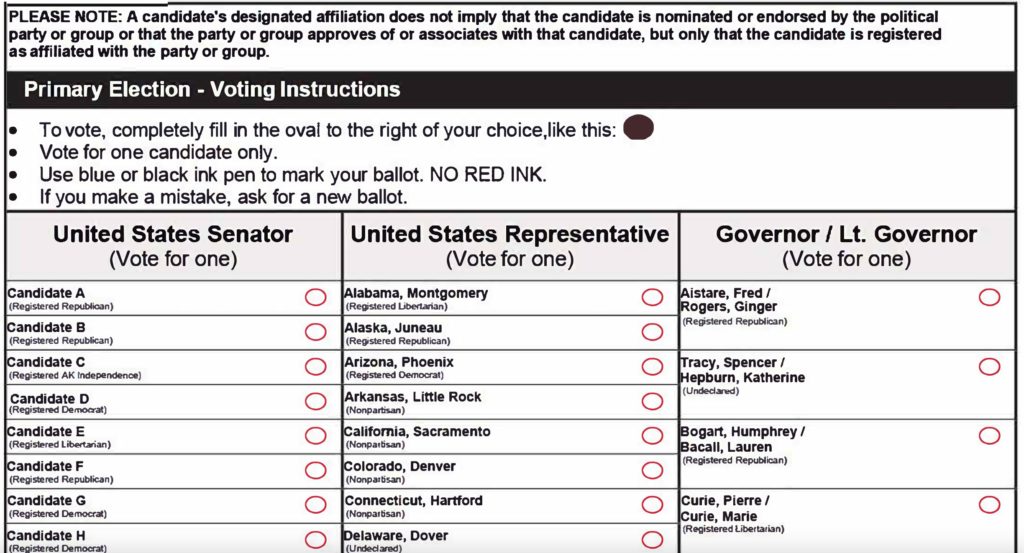
For the special primary election to choose a new congressional representative for Alaska, 48 names will be on the June 11 ballot. How will you find your favorite candidate among the 48?

Alaska voters will be tasked with choosing just one name among the sea of choices.

Where that candidate is on the ballot depends on what district you live in.

The Division of Elections will print a different ballot for each state House district. The candidates will be rotated because that is what statute requires.

Candidates for the vacant U.S. House seat are listed alphabetically in House District 1, which, using the old district maps, is Fairbanks. Then the candidate at the top of the list drops to the bottom of the list in House District 2. The process repeats through House District 40.

See all the ballots at this link.

Ballots will be mailed to registered Alaska voters on April 27. This is a mail-in election with few options for in-person voting. Not planning to be home? To change the address where your ballot is mailed, visit this page.

With 64 days to special primary to replace Don Young, congressional candidates are on the move around Alaska

In Fairbanks, a crowd of 200 people gathered at Bobby’s in Downtown, shown in the photo above, to welcome candidate for Congress Nick Begich to their fundraiser for him in the Golden Heart City. He picked up endorsements from well-known Fairbanksians Dick Randolph and Ralph Seekins, and another from incoming Anchorage Assemblyman Randy Sulte. On Friday, he was speaking to a crowd of 100 at the Fairbanks Alaska Outdoor Council.

Josh Revak was also campaigning all week. In a meeting with Eagle River Republican leaders, the state senator on Wednesday explained that he voted against the Permanent Fund dividend because he’s in a purple district in South Anchorage. He spent most of his time talking about his military record before being ushered away by his legislative aide as the questions got spicy. District 22 has already endorsed Nick Begich. Revak heads to Ketchikan on Saturday to campaign at the Friends of the NRA banquet.

Republican Tara Sweeney, who has support from several business leaders, prepared for a Saturday fundraiser in midtown Anchorage, with hosts such as Mead Treadwell, Kara Moriarty, and Jeanine St. John. Sweeney and Revak were co-chairs of Congressman Don Young’s campaign before he died on March 18.

Democrat candidate Chris Constant has gone dead quiet since 47 other candidates jumped in the race. The downtown Anchorage Assemblyman, usually a Twitter warrior, has barely been seen on the platform and has been silent on Facebook since April 1, the deadline for filing, when the field of candidates exploded.

Constant has been overshadowed on his Left by Al Gross, who has endorsements from major Democrats. Gross hasn’t been seen locally much. Instead, he’s raising money from Democrats nationally on Twitter with an ad that says he is neck-and-neck with Sarah Palin in Alaska.

Gross, who lost hid bid for the hospital board in Petersburg after losing for U.S. Senate, says his poll shows that it’s between just the two of them with 18 percent undecided.

These kinds of fundraising pitches may or may not be legitimate in terms of the polling information. To ground-truth these claims, Must Read Alaska has a poll in the field with a reputable national firm and will be reporting on the results.

As for Palin, she is raising money nationally by using her massive social media reach. Palin was to meet with a group of Republicans who support the party with major donations, but the event was canceled because not enough of them said they could show up.

And she’s giving the mainstream media a much-needed lift; since Donald Trump left office, the media has tanked in readership.

The Los Angeles Times wrote about Palin here.

The Anchorage Daily News wrote about Palin here.

The Washington Post chimed in on her here.

NewsMax wrote about Palin here.

Did a plane crash into Lazy Mountain? A meteor? Troopers say no, it’s a contrail

According to the Department of Public Safety, the spectacle in the sky on Thursday morning over Lazy Mountain was a unique combination of contrails from a passing jet, atmospheric conditions, and the rising sun. Photos circulated on social media, as people in the Mat-Su Valley wondered about what appeared to be a strange trail of smoke with dark portions that appeared to be debris from something.

“The Alaska State Troopers and our partners at the Alaska Rescue Coordination Center investigated the Lazy Mountain photos and video that were reported to the Alaska State Troopers and have also been circulating across social media this morning. There have been no reports of overdue aircraft or ELT activations indicating an aircraft crash. A rescue team on a helicopter flew a mission around the Lazy Mountain area this morning and located nothing suspicious and there were no signs of crashed aircraft.”

There have been no reports of any audible impact, either, but plenty of speculation on social media, along with some political jokes on the Must Read Alaska Facebook page, including one that said “It’s Biden’s winter of death coming for us.”

“Further investigation revealed that a large commercial jet was flying in that area around the time that the photos and video were taken. The aircraft was contacted and reported normal flight operations on its way to JFK airport in New York. Troopers believe that the photos and videos showed a contrail from the commercial jet combined with the rising sun which together caused the unique atmospheric sight,” Troopers wrote. “We greatly appreciate the numerous Alaskans that reported the suspicious sight this morning to law enforcement.”

A contrail is a trail of condensed water from an aircraft or rocket at high altitude, usually seen as a white streak across the sky.

Photo credit: Sarah Langguth

Election results: Thursday update as Sulte solidifies support in South Anchorage Assembly race

Thursday results from the Anchorage Election Office, as of 5:30 pm. A total of 54,787 ballots have been counted of the 235,882 sent to voters. This is 23.23 percent turnout, but more ballots will be counted tomorrow as they arrive by mail.

Anchorage Assembly race for District 6 is seeing Randy Sulte upsetting incumbent John Weddleton. There are 3,000 to 4,000 more votes still outstanding in the race between Kathy Henslee and Meg Zaletel. It appears that Stephanie Taylor in East Anchorage has lost to incumbent Forrest Dunbar. Kevin Cross has won handily in Eagle River. The school board incumbents appear to have won reelection.

No more results are expected for 24 hours:

Anchorage Assembly

Eagle River: District 2 Seat A

  • Kevin Cross – 4,825
  • Gretchen Wehmhof – 2,778
  • Vanessa Stephens – 402

West Anchorage: District 3 Seat D

  • Liz Vazquez – 4,034
  • Kameron Perez-Verdia – 5,216
  • Nial Sherwood Williams – 486

Midtown Anchorage: District 4 Seat F

  • Kathy Henslee – 4,214
  • Meg Zaletel – 4,727

East Anchorage: District 5 Seat H

  • Stephanie Taylor – 3,944
  • Forrest Dunbar – 5,268
  • Christopher Hall -252

South Anchorage: District 6 Seat J

  • Randy Sulte – 7,405
  • John Weddleton – 6,828
  • Darin Colbry -238

School Board Open Seats

Seat A:

  • Mark Anthony Cox – 20,224
  • Margo Bellamy – 25,066
  • Dan Loring – 1,630
  • Cliff Murray – 3,831

Seat B:

  • Rachel Ries – 21,096
  • Kelly Lessens – 25,699
  • Benjamin R. Baldwin – 1,736
  • Dustin Darden – 2,411

Prop. 1 – ASD capital improvements bonds

Yes – 26,668

No – 27,499

Prop. 2 – Facilities capital improvement project bonds

Yes – 26,628

No – 27,488

Prop. 3 – Public safety and transit bonds

Yes – 29,731

No – 24,077

Prop. 4 – Road and storm drainage bonds

Yes – 32,896

No – 21,269

Proposition 5 – Parks and Recreation bonds

Yes – 29,590

No – 24,257

Prop. 6 – Fire protection bonds

Yes – 33,452

No – 20,487

Stateswoman passes: Arliss Sturgulewski, 1927-2022

Arliss Sturgulewski, a former Alaska state legislator and at one point the Republican nominee for Alaska governor, has passed. She was 94.

She was a member of the Alaska State Senate from 1978-1993, and ran for governor in 1986 and 1990. She lost to Democrat Steve Cowper in 1986 for governor.

In 1990, she was beat by Wally Hickel for governor. After she and lieutenant governor candidate Jack Coghill had won their respective races and formed a ticket, Coghill and others in the conservative wing of the party met with Sturgulewski in both Juneau and in Anchorage, and asked if she would support some of their conservative causes, such as development and limits on abortion.

She said she would not and that she would stick to her platform, not the Republican platform. Coghill then called Hickel and they formed up a third-party ticket at the last minute. That left Sturgulewski out in the cold, looking for a new running mate in the third week of September. She signed up Jim Campbell, an Anchorage business leader, who was president of Spenard Builders Supply. Hickel and Coghill ended up winning in November as members of the Alaskan Independence Party.

Sturgulewski was considered a liberal Republican who thought the Democratic Party was corrupt. She supported abortion rights, and was an ardent environmentalist.

When Democrat operatives tried to recall Gov. Mike Dunleavy in 2017, Sturgulewski was one of their first big sponsors of the recall petition. She left the Republican Party.

Sturgulewski was born on Sept. 27, 1927 in Blaine, Washington. She received her bachelor’s degree from University Washington, Seattle, 1949 and doctor of laws (honorary), from the University Alaska, Anchorage, 1993.

Friends celebrated her 90th birthday with her in 2017. Sturgulewski was active in politics until the past two years. Although she had lived in College Village in Anchorage for many years, she had been living in the Alaska Pioneers Home recently.

She was vice chairman New Capital Site Planning Commission in the 1970s, and was a member of member of the Anchorage Area Planning and Zoning Commission.

Sturgulewski is related to the family of Sen. Lisa Murkowski through marriage. Bernard Sturgulewski, her husband, died in a plane crash in 1968. Their son, Roe is married to Carol Murkowski, one of the six children of Nancy and former Gov. Frank Murkowski.

As a former lawmaker, Sturgulewski will be honored with flags flown at half staff in Alaska.

“My family sends our condolences to the family of former Senator Sturgulewski,” said Gov. Mike Dunleavy. “Arliss lived a long life and served this state and its largest city at important historical junctures. Her commitment to building a civic-minded Alaska will be remembered.”

Sturgulewski was recognized for her efforts in Alaska, including receiving the Anchorage YWCA Woman of Achievement award, the ATHENA Award, and Congregation Beth Sholom’s Shining Lights Award, the governor said.

Skagway challenge denied: Redistricting map will stand

The Skagway Borough spent nearly $300,000 fighting a redistricting plan that joins it into a House district with north Juneau, rather than downtown Juneau, where city leaders in Skagway feel more at home.

$292,375 and change is the bill so far. That’s what the Skagway Borough spent fighting in court the redistricting plan that the Alaska Redistricting Board approved for the Juneau-Skagway political boundaries.

The money went to Anchorage lawyer Robin Brena in three checks. And there may be more bills on the way for Skagway residents to pay. The borough, after being defeated in court, asked the Alaska Supreme Court it to reconsider its decision. That request has now been denied, as of April 7th.

Brena is the law partner of former Gov. Bill Walker, who is running for governor once again, after having lost a humiliating bid for reelection in 2018. He is one of the advocates for higher oil taxes, costing the state tens of millions of dollars as he has mounted campaign after campaign to jack up taxes on oil production in Alaska.

His bill for Skagway pencils out to about $300 per resident for the unsuccessful effort to overturn the redistricting map.

Newest Supreme Court justice approved with one ‘yea’ vote from Murkowski, one ‘nay’ vote from Sullivan

Sen. Dan Sullivan said no to the appointment of incoming U.S. Supreme Court Justice Ketanji Brown Jackson. Sen. Lisa Murkowski was a yes vote.

Jackson was confirmed by a vote of 53 yeas and 47 nays. Three Republicans voted for her: Sens. Mitt Romney of Utah, Susan Collins of Maine and Murkowski.

The confirmation fulfills one of President Joe Biden’s promises, which was to appoint a black woman to the Supreme Court. Jackson will be sworn in later this year, when Justice Stephen Breyer retires.

Today’s historic vote will usher in one the most radical justices in Supreme Court history, in the same cut of cloth as Justices Elena Kagan and Sonia Sotomayor. Jackson has a history of letting criminals off easy. She can’t say what a woman is because she is “not a biologist.” She can’t say she supports the natural rights declared in the Declaration of Independence. She has let child pornography traffickers walk. She has claimed to have no judicial philosophy.

Murkowski said, in a statement: “In addition to reviewing her record, I had the opportunity to speak with Judge Jackson on two occasions, to learn more about her background, jurisprudence, and discuss issues important to Alaskans. Her qualifications and her record demonstrate her knowledge and respect for the Constitution. I congratulate her on this achievement and celebrate her historic confirmation with Americans.

Murkowski excused Jackson’s record on child abuse and pornography: “One thing that Judge Jackson’s confirmation hearings made clear is that Congress needs to revisit the PROTECT Act to address the heinous crimes of child abuse, including child pornography. It is the responsibility of Congress to provide updated direction to the U.S. Sentencing Commission and that review is underway.”

Sen. Dan Sullivan gave a fulsome explanation for why he voted no:

“As with all U.S. Supreme Court nominees, I thoroughly examine the individual’s record, prior decisions, confirmation hearing transcripts, judicial philosophy, and take the opportunity to discuss in detail federal laws and U.S. Supreme Court decisions that directly impact Alaska, including Venetie, Sturgeon I & II, and Chehalis. I respectfully ask nominees with whom I meet to read these cases prior to meeting with me so we can go into detail about the uniqueness of Alaska on so many important federal issues.

“The most important quality I look for in an individual who is privileged to be confirmed for life tenure as a Supreme Court justice or federal court of appeals judge is a record and judicial philosophy that understands and emphasizes limits on federal judiciary and federal agency powers. This is critical to the proper functioning of our constitutional system of government and of fundamental importance to the State of Alaska.

“For 25 years—as a law clerk to federal courts of appeals and to the Alaska Supreme Court, as Alaska’s Attorney General and Commissioner of the Department of Natural Resources, and as a U.S. Senator—I have witnessed firsthand how federal agencies and federal courts, particularly the D.C. and 9th Circuit Courts of Appeals, have made decisions and taken actions well beyond their statutory mandates as prescribed by Congress. Such overreaching federal judiciary and agency actions have limited our state’s full potential and have negatively impacted the lives of countless Alaskans.

“With the recent confirmation of new justices to the Supreme Court, we have made progress in reversing overreaching federal courts of appeals’ decisions that have ignored the will of Congress as it relates to critically-important Alaska issues in the Sturgeon I & II cases, as well as in the Chehalis decision.

“However, in my view, an overreaching federal judiciary by life-tenured judges remains one of the biggest factors limiting Alaska’s future potential. Our federal district court in Alaska, with no discernable judicial philosophy recognizing its own limited powers or those of federal agencies, frequently decides cases in favor of Lower 48 environmental plaintiffs. Such decisions by life-tenured judges are having devastating, real-life consequences for Alaskans.

“This is the perspective and area of focus from which I have examined the qualifications of all of the Supreme Court nominees I have considered, including Judge Jackson. And on these critical issues, I found her views and record to be very concerning.

“First, despite attempts in my personal meeting with her and during her confirmation hearing, Judge Jackson repeatedly stated that she had no judicial philosophy that grounded her approach to the law. She testified that her role as a district judge did not provide her with opportunities to think about constitutional interpretation, which I found puzzling to say the least. And while she demonstrated that she understood approaches to the law that emphasize systemic limitations on a federal judge’s power—such as originalism or textualism—she refused to embrace any judicial philosophy that places limits on the role of the judiciary in our constitutional system.

“Much more troubling than this lack of a coherent approach to constitutional and statutory interpretation is Judge Jackson’s actual record on the few cases on which she ruled as a district court judge that involved these important issues.

“In Make the Road N.Y. v. McAleenan and in American Federation of Government Employees v. Trump, Judge Jackson ignored clear congressional restraints on her powers as a district judge to make decisions with broad, nationwide consequences in high-profile, politically-charged cases.

“Judge Jackson described these opinions as two of her most important decisions, which is both curious and troubling, because both were reversed by the left-leaning D.C. Circuit Court of Appeals. The D.C. Circuit unanimously held, in both cases, that Judge Jackson had significantly exceeded the powers granted to her by Congress to review actions taken by other branches of the federal government. These are exactly the kinds of judicial activist decisions that I believe judges must refrain from making in our constitutional system of government.

“Similarly, in Committee on the Judiciary v. McGhan, a case that involved a novel constitutional question impacting the separation of powers, Judge Jackson found an implied constitutional right to sue based on the vague notion of ‘constitutional values.’ The D.C. Circuit reversed, then later reinstated this decision, which ultimately ended up being mooted by subsequent federal government actions. Nevertheless, this decision by Judge Jackson stands out for analysis that is unanchored from a rigorous reading of the text of the U.S. Constitution—which is a core function of a federal judge. 

“In my meeting with Judge Jackson, I found her to be engaging and extremely intelligent. Her personal and professional accomplishments are very impressive and inspiring, and the historic nature of her nomination and confirmation is important to our nation. While I voted against her confirmation for the reasons stated above, I congratulate Judge Jackson on this achievement.”

So far, more than one of every 100 Anchorage ballots rejected, mainly due to signature issues

The “ballot curing” process is under way, as 601 ballots have been rejected so far in the Anchorage Municipal Election that ended Tuesday, most of them due to failing the signature test at the Anchorage Municipal Election Office.

The rejected ballots are from every part of the municipality, including several from Joint Base Elmendorf Richardson. They do not seem to come from one specific area.

One of those rejected ballots was cast by Hunter Sulte, the son of Assembly District 6 candidate Randy Sulte who, at this point, is winning in his challenge to Assemblyman John Weddleton. Hunter Sulte is a goalie for the Portland Timber soccer team and is on tour in the midst of the team’s season. He’s unable to get back in time Anchorage to fix his ballot to the Clerk’s satisfaction. At at this point, count him among those who were disenfranchised of his vote.

Under the old absentee ballot process, Hunter could have requested an absentee ballot, and would have voted and mailed it in; that process would have ensured the ballot came from the proper voter.

As for the other 600 who were disenfranchised, they are supposed to get letters from the Clerk, who runs the Election Office, but if they are not home, they won’t know their ballot didn’t count. Those with shifts on the North Slope or who are traveling out of state might not even know their ballot was rejected.

Anchorage moved to an all-mail election system in 2017 and since then does not conduct regular polls, where people can show their driver’s license, sign a roster, and get a ballot from a human being. Now, ballots are mailed, and the voters must return them by mail or drop them in drop boxes around Anchorage. The process is cumbersome and the election stretches out for many weeks as a result.

During the election for Anchorage mayor last year, more than 400 ballots didn’t pass the signature test and the Bronson campaign team went about tracking down those voters to make sure they knew how to fix their ballots and resubmit them. Even then, some people’s ballots were rejected a second time.

Must Read Alaska wrote about problems with signature “curing” and voter disenfranchisement in this story last year:

The campaigns for several of the Assembly challengers are working through the list to make sure their voters are getting the message that they have to fix their ballot, and how to do so most efficiently.

It may seem like a small number, but with 46,000 votes in so far, it’s more than one out of every 100 voters who are not getting their ballots counted because their signatures don’t match with the one the election office has on file. More ballots are expected to arrive in coming days, and the number of rejected signatures will probably rise.

If you are wondering if your name is on the list of rejected ballots, Must Read Alaska has compiled a Google document — embedded below — with the first name and last initial, along with the zip code, for many of the ones we found were rejected. If you think you might be on that list, you can contact the author at [email protected] and I will check the full-name list.

Breaking: Groups file lawsuit against Ballot Measure 2, based on free speech and privacy violations

Two citizen advocacy groups and three Alaskans filed a federal lawsuit to stop the most anti-privacy election laws in the country. The provisions adopted by a slim margin in Ballot Measure 2 in Nov. 2020 violate the free speech and privacy rights of individuals who make certain political contributions and discourage participation in Alaska’s political process, the plaintiffs say. The on-air donor disclaimer requirement, the disclosure of donor layers, and the requirement that donors double-report contributions all violate the First Amendment’s protections of political speech and association.

The lawsuit was filed by Doug Smith, an Anchorage resident, two other individual Alaska-based donors, and two citizen advocacy organizations, the Alaska Free Market Coalition and Families for the Last Frontier. With the help of attorneys from the national, nonprofit law firm, the Liberty Justice Center, they are suing state officials from the Alaska Public Offices Commission.

The Liberty Justice Center fights for Americans’ fundamental constitutional rights and has previously challenged donor disclosure requirements in Montana, New Jersey, New Mexico, and Rhode Island.

“Americans have the right to support causes they believe in without overly intrusive and burdensome requirements from the government,” said Daniel Suhr, managing attorney at the Liberty Justice Center. “Alaska’s new reporting requirements present Americans with an unconstitutional choice: sacrifice privacy to support causes and candidates or sit out of critical debates facing Alaska. We will not stand by as Alaskans’ free-speech rights are squelched by bureaucrats enforcing this unconstitutional law.”

The law requires that donors redundantly report donations or face thousands of dollars in fines. It demands that speakers fill their ads with extensive disclaimers for the entirety of an ad’s run time, converting ads from communications about issues or candidates into an advertisement of a speaker’s contributors.

It further requires the disclosure of not only donors but the donors of donors—who gave money to someone who in turn gave money to a speaker—demanding comprehensive genealogies of contributions that run far afield from any state interest in protecting the integrity of elections or curtailing corruption.

As Alaska prepares for upcoming elections, the state’s onerous new regulations and requirements on donors will potentially discourage certain donors from supporting causes and candidates important to them.

“These overly intrusive requirements will shut down speech in Alaska,” said Doug Smith, Alaskan and lead plaintiff in the lawsuit. “We should welcome and encourage debate over important issues in Alaska, rather than impose laws and requirements that deter people from supporting causes they believe in and open them up to political intimidation.”

This lawsuit, filed Thursday, is the first challenge to Ballot Measure 2 filed in federal court. A separate challenge was brought on state constitutional grounds. The lawsuit, Smith v. Helzer, was filed April 7, 2022, in the U.S. District Court for the District of Alaska. Case filings are available here: https://libertyjusticecenter.org/media/alaska-ballot-measure-2.