I’ve had a nodding acquaintance with Sarah Palin since her days as mayor of Wasilla. I worked in the Frank Murkowski Administration with her and she was usually at Monday morning staff meetings with the commissioner of Administration, as was I.
I was peripherally involved in the events leading up to her leaving the Murkowski Administration to become every Democrat’s favorite Republican. Unlike most who aren’t Palin fans, I know why I’m not one. Facing the prospect of either working for her or for Gov. Tony Knowles again after the 2006 election was my principal reason for deciding my State career was over on July 1, 2006.
I’ve never met Kari Lake, Republican candidate for governor of Arizona, but I saw a lot of her while I was in Tucson for the last couple of months. The Democrats haven’t dragged out or made up any old love affairs or corrupt bargains so they’re left with their “extremism” stock in trade. I’m surprised they haven’t dragged out some pencil-necked boy who has worked with her to tell the snowflakes how mean and heartless she is. She strikes me as a very driven and organized woman. I watched several hours of her campaign and interview appearances over the last couple of months and there is never a misstep, gaffe, or flubbed line.
Lake is an interesting contrast to Palin.
Republicans have long had women running for and winning political office. Jeanette Rankin of Montana was the first woman elected Congress and took office even before women could vote. After Rankin, there were always a smattering of women in the Congress; more Democrats than Republicans, but then the Democrats had hegemony over the Congress from 1932 until 1994 except for one House session in the 1940s.
The women elected to Congress were uniformly matronly. Into the 1960s and beyond, they were very much 50-ish, and of the hat and gloves style of dress. Into the 1980s, Margaret Thatcher, the most powerful woman the modern world had yet seen, was firmly set in the matron image, as was Sandra Day O’Connor the first female U.S. Supreme Court Justice, although she had a bit of a cowgirl ambiance.
The Democrats began, though tentatively, the paradigm change with their vice presidential nominee Geraldine Ferraro. She was a younger, and less the dowdy matron, though still conservative in dress and mannerisms. Fast forward to Hillary Clinton; despite her master’s thesis on Saul Alinsky and some vestigial “we want the world and we want it now” 1960s karma, her image was still that of a “stand by your man” wife and mother; she was downright frumpy at times. Somewhere in the 1990s, the modern Democrat woman image began to coalesce; the granola girl was a part of it, but the screeching harpie became the face of the Democrats; think pussy hats and “I am an angry woman.”
The Republicans went another way; the dowdy matron was gone. A new woman emerged; she was a young-looking 40-something, attractive, fashionably but not ostentatiously dressed, but more importantly she was smart, vivacious, and had a sharp tongue. Michele Bachman is the first that comes to my mind but others followed, including Sarah Palin.
Sarah flew closer to the sun with her run for the vice presidency. Those of us familiar with her cringed whenever she stepped before a microphone; a word salad was the usual result. But she became quite good at the off the cuff quip and the 15-second sound bite. I’ll give her credit for being one of the all-time best at the sound bite that sums up an issue and delivers a bite to the opposition.
I won’t give her any credit for having a clue about developing and implementing coherent policy. She flew with the winds; a Republican governor gave the Democrats their fondest dream with ACES oil taxes, and she probably still doesn’t know what a foolish thing she did. Nobody knows what happened to a half a billion dollars she gave to TransCanada for a vaporware gas line. You can lay most every bad thing in Alaska politics in the last dozen years or so at her feet: She called for Sen. Ted Stevens’ resignation and defeat. She endorsed Bill Walker. She propped up Joe Miller. Now she’s dropped in and helped elect a Democrat to Alaska’s only House seat for the first time in 50 years. But she’s still pretty, perky Sarah and those who only know her from TV just love her.
Kari Lake is the latest iteration of the modern Republican paradigm; attractive, fashionable but not ostentatiously so, and has a rapier wit and equally sharp tongue. She’s a former reporter and news anchor who can chew up and spit out snarky young lefty reporters with alacrity. She’s who we needed when Sarah was getting chewed up by that dimwit Katie Couric or being danced a merry reel by the lefties with information requests.
I write this on Election Day. Kari Lake has a pretty good shot at being governor of Arizona tomorrow, or within a few days anyway.
Sarah has a pretty good shot at being back in New York with her hockey player boyfriend.
Art Chance is a retired Director of Labor Relations for the State of Alaska, formerly of Juneau and now living in Anchorage. He is the author of the book, “Red on Blue, Establishing a Republican Governance,” available at Amazon.
Alaska Gov. Mike Dunleavy announced appointees to the Governor’s Marijuana Task Force. The governor created the task force to review the current marijuana tax and fee structures and regulations applicable to marijuana operators and provide recommendations for improvement to the Office of the Governor.
In addition to the Alaska Department of Revenue commissioner, the Alaska Department of Commerce, Community and Economic Development commissioner, and the director of the Department of Natural Resources, Division of Agriculture, Dunleavy appointed the following:
Aaron Staissney (licensed marijuana operator)
Sam Hachey (licensed marijuana operator)
Gary Evans (licensed marijuana operator)
Brandon Emmett (licensed marijuana/concentrate)
Ryan Tunseth (licensed marijuana retailer)
Frank Malone (limited licensed marijuana cultivator)
Leif Abel (standard licensed marijuana cultivator)
Nick Miller (member on the AK marijuana control board)
Jana Weltzin (public member)
David Pruhs (representative for city, borough, or municipality)
The Task Force will meet monthly and submit a report of findings and recommendations by Jan. 13, 2023.
Gov. Mike Dunleavy has appointed Brian Fechter to replace Deven Mitchell as acting commissioner for the Alaska Department of Revenue. Mitchell is leaving the department to become executive director at the Alaska Permanent Fund Corporation.
Fechter has been with the state since 2013, serving in various capacities at the Office of Management and Budget, Department of Health and Social Services, and most recently as the Deputy Commissioner for the Department of Revenue.
He holds a Masters Degree in Financial Services from St. Joseph’s University in Philadelphia. He became an Alaskan in 2012 after working for the Disney Company in Orlando and PNC Bank in Pittsburgh.
He also serves the state on the State Bond Committee, Alaska Municipal Bond Bank Board and the Governor’s Advisory Council on Opioid Remediation.
Fechter starts his new role overseeing Alaska’s state revenues on Tuesday, Nov. 8, and will be subject to confirmation hearings in the Alaska Legislature this winter.
Across the country, voting has begun for the 2022 midterm election. In Alaska, polls opened at 7 am, and will close at 8 pm. If you are mailing in your ballot, make sure you get a hand-cancel on your envelope at a post office.
In most areas of the state, the weather looks stable for Election Day. It’s a balmy 26 degrees in Barrow, 23 degrees in Fairbanks, 34 degrees in Anchorage, 39 degrees in Homer, 10 degrees in Juneau, and 16 degrees in Ketchikan.
Polling places can be foundat this link. The map is slow to load, so be patient.
If you have weaker internet, a list of polling places, without mapping,is at this link.
District numbers and polling places have changed for many due to redistricting, which happens every 10 years. You can vote at any voting location, but it will be a questioned ballot and will require review before it’s counted. The regional voting offices have the ability to provide ballots for all House districts. Be sure to bring identification with you to the polls and dress warmly, as lines may stretch out of the building.
Must Read Alaska is interested in hearing from voters who encounter good or bad behavior from poll workers or others in the voting process on Election Day. You may relay your experiences — good or bad — in the comment section below.
Scott Kendall, the lawyer and architect of the ranked choice voting method (Ballot Measure 2) Alaska now uses in its elections, is a well known supporter of Sen. Lisa Murkowski, Rep. Mary Peltola, and Kendall’s former boss, Bill Walker, the failed governor who left office in disgrace in 2018. Kendall represents all-things-Democratic Party. He supports all the Democrats on the ballot and actively works for their elections.
But Kendall didn’t do any of his candidates a favor by bullying a working-class Anchorage man who was simply participating in democracy and waving signs as a volunteer after work for the man’s preferred candidate, Nick Begich for Congress.
A member of the Young Republicans Club, the young man is 22 years old and works four jobs to help his family out, especially since his mother’s house burned down. He went straight from work with his warm “security” jacket on and waved signs for Begich at the corner of Northern Lights Blvd. and New Seward Highway with about a dozen other citizens.
The working man who was picked on by Scott Kendall for having a job.
Kendall commented on Twitter, “Good thing @NBegich has a security detail for his sign waving! Shades of Joe Miller…?” referring to former Senate candidate Joe Miller and his famous entourage of Drop Zone security personnel.
Ryan McKee, president of the Young Republicans, noted that the young man took it in stride, and after finding that he was attacked by Kendall, decided to go make get-out-the-vote phone calls all evening for Gov. Mike Dunleavy. The working man with four jobs said that with “the little time I have, I do what I want.”
“But Bill Walker it would be great if you kept your staff under control and refrain from these petty attacks on really great people,” McKee commented on social media.
In Alaska, Kendall represents the “elitist cabal” that former Democrat U.S. Rep. Tulsi Gabbard was referring to when she quit the Democrat party last month. Disdainful of working people who hold jobs and try to support themselves and their families, Kendall typifies the divide between the snarky, Twitter-obsessed lawyer class and the workers of America.
Kendall is behind a group that has been harassing the campaign of Gov. Mike Dunleavy with “law fare” legal complaints to try to tie up Dunleavy’s campaign in court and prevent them from being effective against Kendall’s favorite candidate, Walker.
As a legislator, I am frequently asked whether or not Alaskans should vote this week to hold a state constitutional convention here in Alaska. As with most questions that end up on the ballot at election time, there are strong proponents of the idea, and strong opponents as well. Owing to the great interest in the question from many of those I represent in the legislature, and primarily for their sake, I will do my best to explain how I see it.
I should note that what I am about to share is unlikely to be picked up and broadcast by either the “Convention YES” or the “NO on 1” camps because my purpose in writing is not to direct voters into either camp. In 2012, the last time the question was on the ballot, Alaskans voted 2 to 1 against calling a constitutional convention. In my district, the vote was even more lopsided at 2.5 to 1. Owing to the Convention YES campaign, I expect the Yes votes in my district to be higher this year, but there remains a great deal of confusion over what exactly it is that those who vote Yes are voting for.
On March 19th 1955, the Alaska Territorial Legislature issued a call for a constitutional convention to be held that same year. Elections were held, and 55 delegates were chosen. The convention was in session for 76 days and held public hearings over a 15-day period. After 220 hours of plenary sessions, 54 of the delegates voted in favor. One delegate, Ralph Robertson, refused to sign. On April 24th 1956, Alaskans voted overwhelmingly to ratify the Alaska Constitution.
It has continued, largely intact, since that time.
The desire for statehood was a driving force in the legislature’s decision to call a constitutional convention in 1955. I believe the best argument for a convention today, which I hear very few people actually making, are the many profound changes that Alaska has undergone over the last 67 years.
The constitutional convention in 1955 was hardly a partisan affair. It didn’t need to be. Alaska was a Democrat stronghold. When the Alaska State Legislature held its first meeting in 1959, there were 18 Democrats and two Republicans in the state senate. The Alaska Constitution largely reflected the thinking of Democrat voters at the time.
Fast-forward to 2022; the last time Alaskans elected a Democrat majority in the state house was three decades ago. The last time they elected a Democrat majority in the state senate was nearly 50 years ago. Today, Republican voters outnumber Democrat voters by nearly 2 to 1, Nonpartisans outnumber Democrats, and most Alaskans choose not to declare an affiliation with any of the parties.
A lot has changed in 67 years.
One thing that hasn’t changed is Democrat control of the Alaska Judiciary. Article IV, Section 8, of the Alaska Constitution guarantees that members of the Alaska Bar Association will always have a monopoly on who is eligible to serve as a superior court judge or a member of the Alaska Supreme Court. There are 12 members of the Alaska Bar Associations Board of Governors. Three members are non-attorneys appointed by the governor and confirmed by the legislature. These are the only three Republicans on the 12-member board.
Even if Alaska were to one day be the most Republican state in the country, absent a change to the Alaska Constitution, Republicans would never be in a position to choose new judges or who sits on the Alaska Supreme Court. Democrats put a lock on that in 1956.
Likewise, that same supreme court has also sought to put a lock on the constitutional amendment process through the legislature. The Alaska Constitution provides in Article XIII, Section 1, that the legislature may amend the constitution by a two-thirds vote of each house at any time. What this means is that at least 41 out of 60 legislators must vote to send a constitutional amendment to the people for ratification. Needless to say, it doesn’t happen very often. In the case Bess v. Ulmer, the Alaska Supreme Court opined that this hurdle was not high enough, and sought to establish a higher one.
In response to the legislature passing a constitutional amendment to limit the power of the court, the court discovered a new definition of the word “amendment” that would limit the legislature to passing only those amendments that the Court itself approved of. Henceforth, the Alaska Supreme Court opined that it could veto any amendments passed by the legislature that the court found to be either “quantitatively” or “qualitatively” (or a combination of both) a “revision”, and therefore no longer an “amendment”. In doing so, it struck down an amendment that would have added less than 65 words to the Constitution.
To this day, whenever a legislator proposes a constitutional amendment, on whatever topic, the legislature’s attorneys dutifully provide a warning label that the court may, for reasons unknown, deem that amendment to the constitution to be “unconstitutional”.
Even a cursory review of the constitutional convention debates shows that delegates understood that the legislature had the power to pass an amendment that would eliminate the judiciary branch in its entirety! (See the remarks of Delegate McLaughlin, Chairman of the Committee on the Judicial Branch appearing on page 3,425), and that the legislature would need the authority to determine how quickly such a wide sweeping amendment would go into effect.
Effectively, the supreme court has now assumed responsibility for passing amendments to the constitution unilaterally through court decisions. If the legislature desires to pass an amendment without obtaining the consent of the court, the court points to a constitutional convention as the only avenue still available to the people and the other branches of government. Meanwhile, the court has declared that it alone is “under a duty to develop additional constitutional rights and privileges under our Alaska Constitution…” (Valley Hosp. Ass’n v. Mat-Su Coalition).
As Alaska has moved further and further away from the Democrat stronghold it was in the 1950s, the court has responded by stripping more and more power from the other branches of government and from the people, turning on its head what convention delegates approved and the people ratified in 1956.
Some will say “now isn’t this exactly the sort of situation that calls for a constitutional convention.” Perhaps. But there’s a bit more to it. Many, perhaps even most of those advocating for a convention, point to some way or other one of the branches of government isn’t following the constitution; the courts are reinterpreting (rewriting) the constitution, the governor is misappropriating the PFD, legislators aren’t following state law dealing with limiting sessions to 90 days, etc.
Let us assume for a moment that these charges (or others like them) are true, and that violations of the constitution are taking place. If the constitution is being stretched or broken, how will rewriting the constitution at a convention solve for that? What will stop these same parties from stretching and breaking whatever changes are approved at the convention?
Somewhere along the way, many Alaskans came to find misplaced comfort in the myth that the constitution is a self-executing document; able to defend itself against those who would violate it. America’s founders were under no such illusion. The father of the Constitution, James Madison, was certainly not of that opinion. He referred to the Constitution as a parchment barrier. Unless the people are committed to its defense, its ability to stop government overreach is paper-thin.
The people can take steps to defend their Constitution at any time, but there is no certainty that they in fact will. In fact, so many of the proposals for how to fix government today; voting the bums out, supporting a particular political party, filing lawsuits, and yes, even the calling of constitutional conventions, all distract from the much more difficult work that must precede each of these things if they are to be effective.
To paraphrase Michael Boldin, founder of the Tenth Amendment Center, when individuals in government exceed their constitutional authority you aren’t supposed to wait some number of years to be able to elect someone else who will hopefully do better. You aren’t supposed to wait years until a friendly judge or justice finally agrees that they were out of line and its ok for you to be free again. Those are all passive approaches to government overreach, and passivity only invites more and further overreach. In a constitutional republic, all public officers and all naturalized citizens take an individual oath to support and defend the Constitution because they all have an active role to play in its defense.
It could be that the spirit that currently animates the Convention YES camp will develop into that type of resolve. I believe that is what many of us are hoping for, but it won’t simply happen by itself, even if Alaskans approve a convention on Tuesday. Here are some of the obstacles that Alaskans will need to be able to navigate if a convention is to be successful.
The first and most obvious challenge will be the election of delegates. Some today, rightly blame legislators for the current mess and hope to exclude them from participating in a convention. This is a historical and a practical non-starter. In 1955, 10 legislators were elected as delegates, several more ran and lost, and eight recent former legislators were also elected as delegates. The irony is that federal law at the time expressly prohibited current and many former legislators from being elected as delegates. Congress had to pass a law specifically exempting Alaska legislators from the prohibition, and it did.
The Alaska Constitution also now specifically exempts legislators from such prohibitions. In short, if they want to run, they can. But the idea of excluding legislators is also a non-starter for an entirely different reason. The people are the ones who elect legislators, and the people are the ones who elect delegates. If you are trying to devise a system that prevents the people from being able to elect the representatives and delegates they want, you aren’t just excluding legislators, you are actually excluding the people themselves from the process, and that’s a recipe that quickly departs from the notion of having a constitutional republic in the first place. For better and for worse, the people stay a part of the convention process, and so do at least some of the legislators.
I’ve heard some conservatives propose simply not voting to elect any legislators that run for delegate. That’s one approach. Just realize that if Democrat legislators run and no Republican legislators run, the only legislators elected to be delegates will be Democrats.
Legislators will also be involved in passing the law(s) that will determine how a convention will take place. Someone needs to decide how many delegates there will be. Someone needs to decide how those delegates will get elected and which parts of the state they will represent. In 1955, the delegate elected with the fewest votes was Michael Walsh, who was elected as a write-in candidate with only three votes following the death of another delegate. Someone will need to sort out what happens when delegates die and so forth, and the Alaska Constitution entrusts those decisions to the people’s elected representatives in the legislature.
Because of the First Amendment (see Citizens United), money will also be part of the process. The value of the Alaska Permanent Fund currently sits at more than $70 billion. The constitution is what determines how and when that money can be spent. I don’t know, but Chuck Schumer or George Soros or any number of other political figures in Washington may have some ideas on how they would like to see that money invested and spent. If so, they might be willing to spend a few million to try and help delegates get elected that align with their ideas.
Some have suggested that a novel approach to electing delegates can be chosen which will limit the influence of outside money and current political figures. Perhaps such an approach could be devised, but it would require convincing a majority of legislators to pass such an approach into law, and few politicians are keen on passing laws that limit their own power and influence.
And there’s the rub. Nothing about the project of curbing corruption in government is easy. There’s no silver bullet that will stop corruption in its tracks or halt government overreach, much less turn it back. Holding individuals in government accountable for their actions is the only way. It’s the path forward until there’s a convention, it’s the path forward during the convention process, and it’s the path forward after a convention has done its business.
But it’s also the least attractive option for those in Juneau and also many in the public who see pushing back against government dysfunction as a colossal waste of time. So the dysfunction worsens and the calls for relief grow ever louder. One day, Alaskans will pull the trigger on a convention. If I were a betting man, I would put my money on Alaskans calling a convention through their legislators. Something that neither camp talks about is that the constitution gives legislators the ability to call a constitutional convention at any time.
Of course, its easier for some legislators to downplay that option, blame their troubles on the constitution itself, and tell the public that the only path forward is for the people to solve their problem by voting for a constitutional convention. Of course, if the vote on Tuesday is NO, it would not surprise me at all if some of these same politicians spend the next 10 years talking about how “the people have spoken” and that they couldn’t possibly go against the will of the people and trigger a convention through the legislature.
Will these politicians be held accountable by the people? Only the people can decide that question, and don’t look for help from those connected to Juneau. Politicians, legislative employees and their family members have a vested stake in the status quo (even those of us who are fighting against it every day).
The legislature could be putting the breaks on things like judicial overreach through laws limiting the jurisdiction of the courts, cutting their budgets, and beginning impeachment proceedings against the worst offenders. Instead, legislators routinely ratify such abuses by voting to approve the money that permits them to continue. Some may try to blame the constitution for that, but it’s not the constitution’s job to make politicians follow it. It’s the politician’s job to keep their oath, and it is the responsibility of every Alaskan to call them to task when they do not.
David Eastman is a state representative for Wasilla, District 10.
There were things that were a lot more important than campaigning this fall for Alaska Gov. Mike Dunleavy.
In mid-September, Dunleavy made a decision, because there was only one right decision for him: The people of Western Alaska needed him to be focused on their major 100-year disaster. He needed to have a steady hand on the wheel, not going to meet-and-greets and fundraisers.
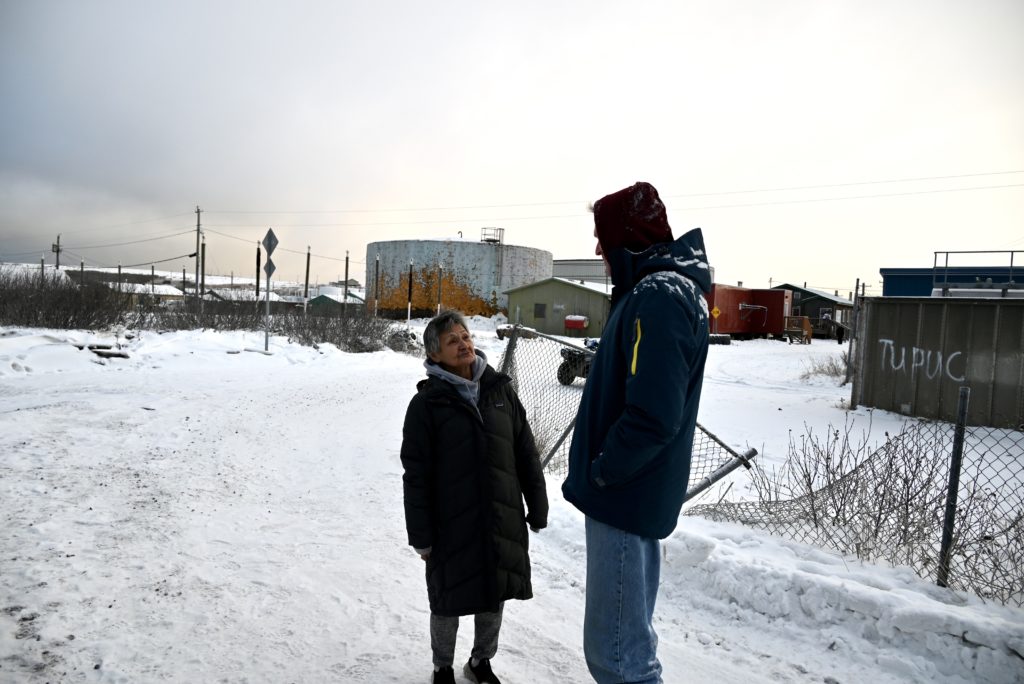
The storm that hit villages on the coast of Alaska on Sept. 17 knocked homes from foundations and peeled apart the breakwaters that protected tiny traditional communities. Typhoon Merbok, with its 50-foot waves in the Bering Sea, put communities like Nome, Stebbins, Hooper Bay, and Koyuk at extreme risk, coming just weeks before winter set in.
Dunleavy, running for his second term, set aside campaigning on the road system, where there are lots of voters to talk to, and during three different trips over more than a month, traveled to the remote western villages of a few hundred people, just to make sure repairs were being coordinated, completed, and that the people were going to be safe this winter.
In many ways, rural Alaska is where Dunleavy is most at home, and for him, it was a travel back through his long life in places that most Alaskans have never seen.
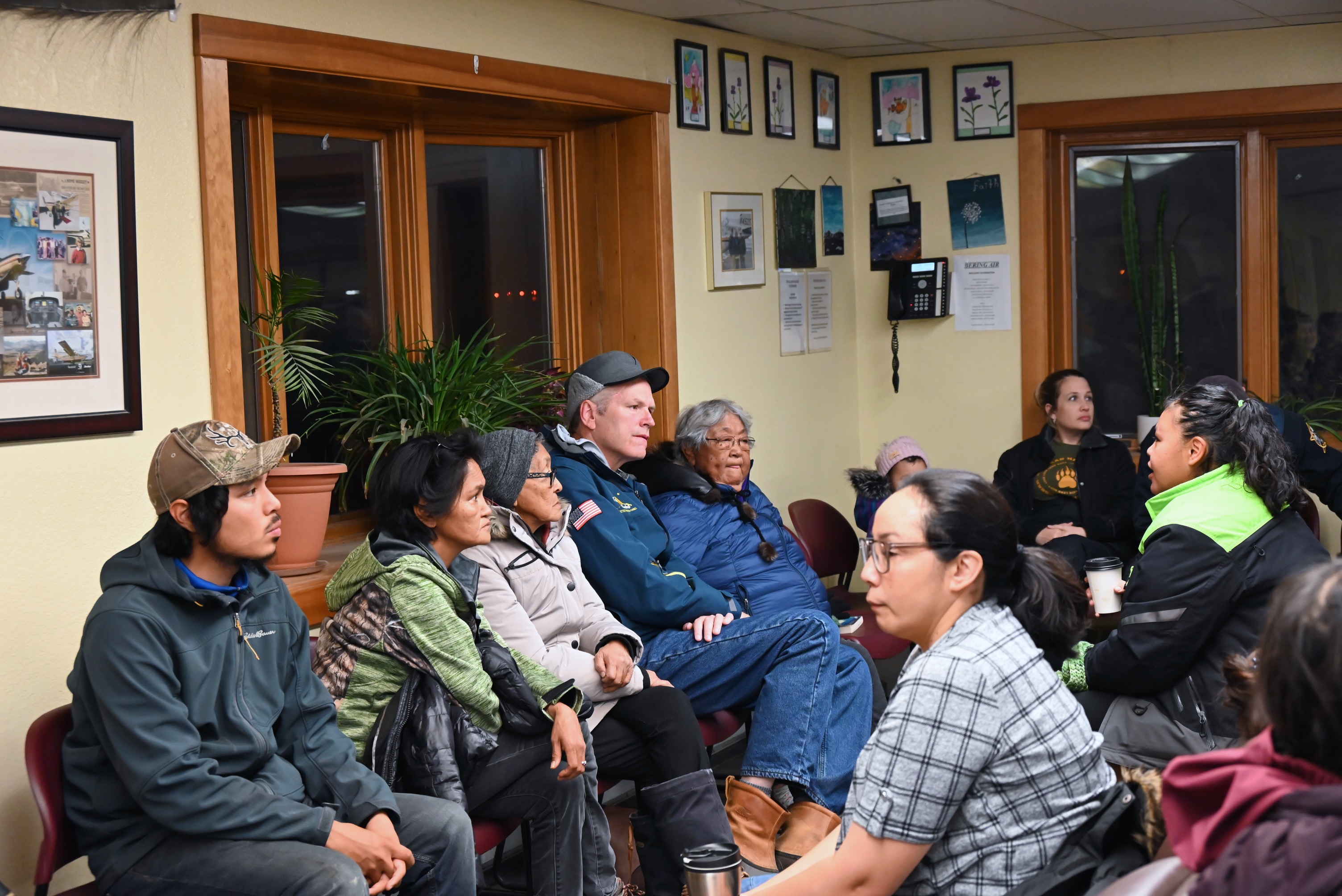
Dunleavy sat down with Must Read Alaska to talk about the way the campaign was changed by the disaster. He first pointed out that today, Nov. 7, is the 35th anniversary of his marriage to Rose, the young woman he met in Noorvik decades ago.
The two married in Nome and raised their family in the Arctic. Rural Alaska runs through his veins and during his first swearing in ceremony, he went to Noorvik and Kotzebue for the historic occasion.
In his trips to the coastal villages this fall, Dunleavy reconnected with many people he knows from the far-flung region — people he taught in school, people who now have children of their own. He got caught up on elders who had passed, and people who have married and settled down. Most of all, he reconnected with the abiding optimism of the people of Alaska, where no matter how full the glass is, “it’s always at least half full,” he said, explaining the hope and sense of community present in the villages that dot the big expanse of Alaska.
As the weather in Western Alaska hovers in the 30s, the rebuild continues. As of last week, FEMA had dispersed over $4.6 million in individual assistance to survivors of the storm, $3.1 million in other needs assistance, which is for essential personal property loss and subsistence gear, and $1.4 million in housing repair funding.
The state Division of Emergency Management continues to purchase building materials and transport them to communities throughout the region, as weather allows air cargo flights to land. Partners are assisting with home repairs, including Native nonprofits like the Association of Village Council Presidents, Kawerak, private contractors through DOT, and the communities. The faith-based and volunteer organizations such as Samaritan’s Purse have all brought in volunteer skilled labor to assist.
Most of the roads that were damaged by the typhoon have been cleaned up, and have temporary or permanent repairs. The same holds true for public buildings that were damaged. Most are usable.
At this point, it appears about $40 million in damage was done to infrastructure throughout the region and some repairs will take years to complete. But community protection structures such as seawalls and berms are either completed or under way, in the event that other storms hit, until the sea and river ice is fastened to the shore.
In addition, approximately 120,425 pounds of food and 220,900 pounds of water have been donated and delivered throughout the area by the State of Alaska, volunteer agencies, regional Native corporations, nonprofits, and health corporations.
All of this is what Dunleavy has been spending his energy and focus on during what has been an anything-but-normal the campaign season, popping back to events on the road system when he is able.
When asked what was one of the most memorable things for him during his trip, he said that landing in Koyuk and being able to hold a grandchild of one of his former students stands out as particularly moving.
“This is the next generation for Koyuk, and the next generation for Alaska,” Dunleavy said. He also remembered meeting with the mayors of the villages, and said that for so many of them, they expressed how resourceful their local people are, and how resilient they are, but how grateful they are for the State of Alaska’s assistance.
“If people have never lived in rural Alaska, it’s hard to describe it. It’s the heart of Alaska, it’s what makes us so different. Without rural Alaska, we’d still be a different kind of place, but it’s rural Alaska that makes us truly unique,” he said.
Maybe it’s grade inflation with the Democrats: The gap between how Democrats see the U.S. economy and how Republicans and independents grade may be one of the best clues to how Americans will vote on Tuesday.
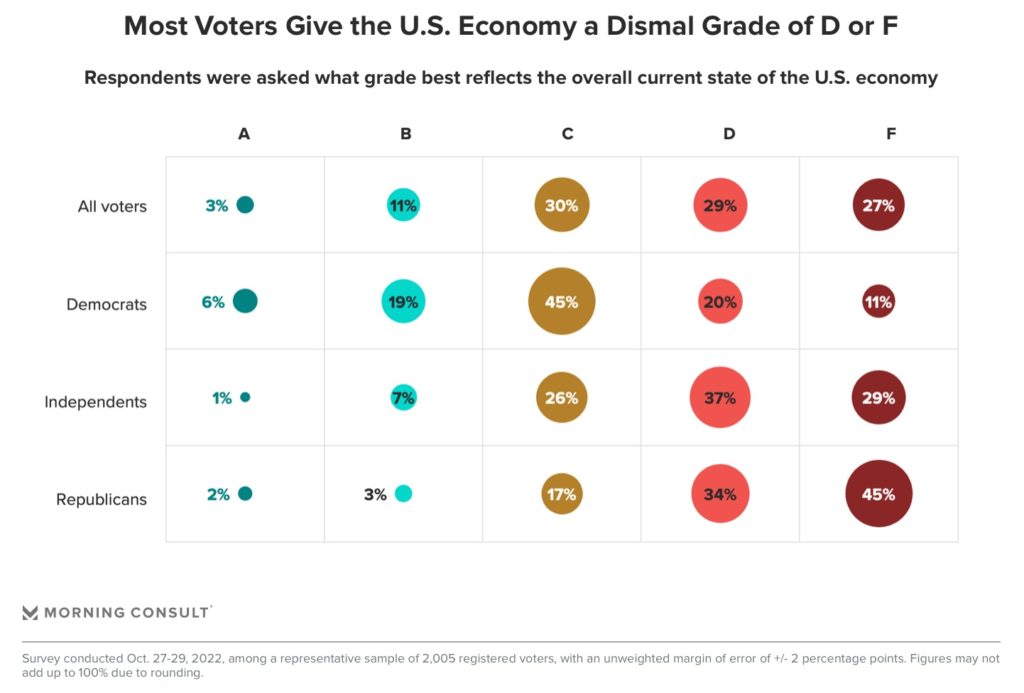
According to Morning Consult polling, 70% of Democrats polled give the current U.S. economy an A, B, or C grade. Some 45% of Democrats award the economy a C grade, and only 11% of Democrats give it an F.
That compares to the grade that other voters give the economy — only 22% of Republicans give it a C or better, and only 34% of independents do. 45% of Republicans say the economy gets an F grade right now and another 34% give it a D.
Calculated as a whole, 56% of all voters give the economy a D or F grade.
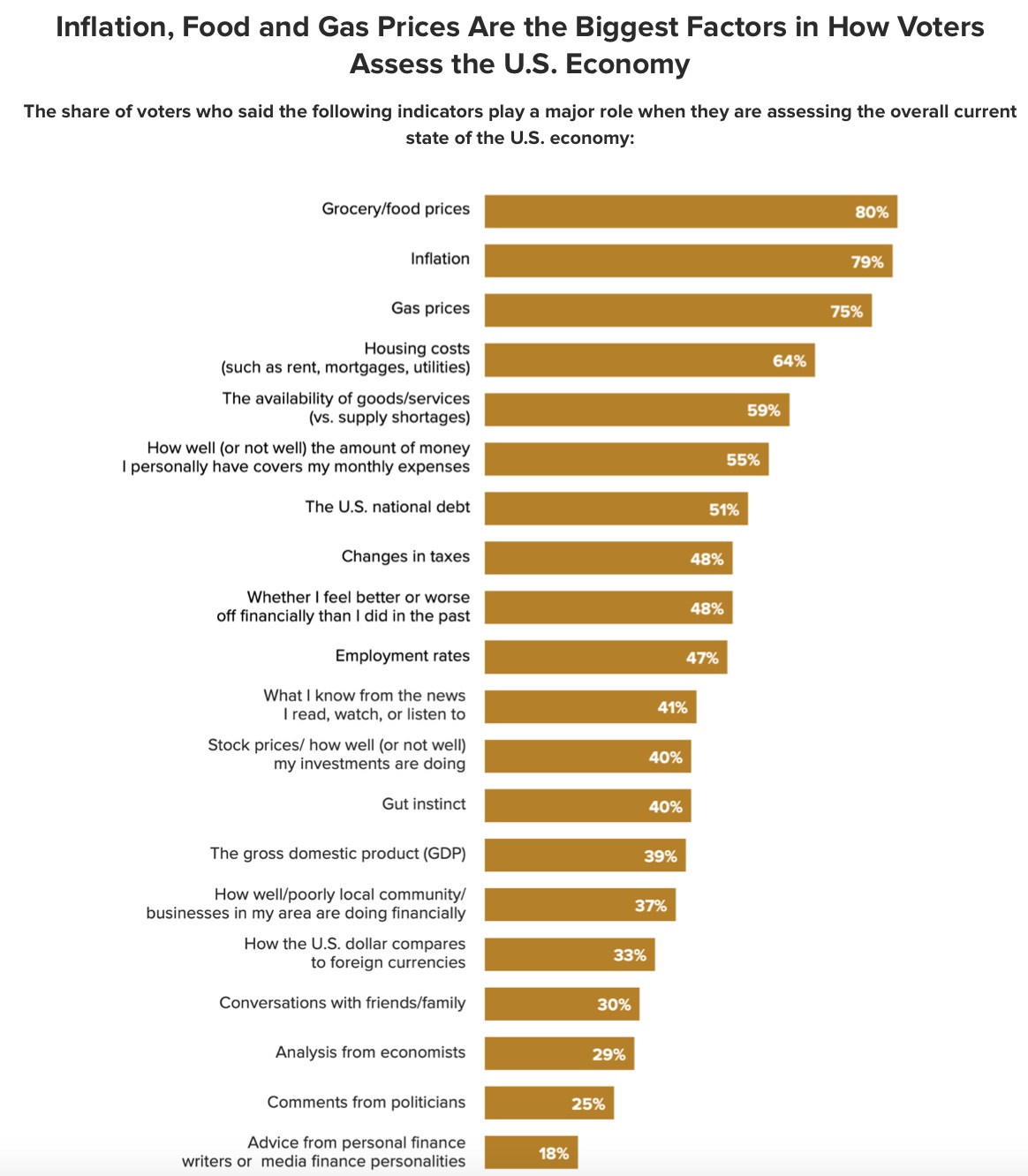
When asked what influenced the grade, some 80% told the polling company that food prices were a major driving factor for their grade, followed by inflation (79%) and gas prices (75).
Morning Consult’s Consumer Confidence Index shows that consumer worries are up and sentiment down — even lower than it was during the Covid-19 lockdown policies of 2020, when the economy went into a tailspin with high unemployment, and an actual recession.
“In a survey conducted in the week leading up to the midterm elections, voters were most likely to give the current economy a bad grade, with 56% assigning a D or F, including about 4 in 5 Republicans, 2 in 3 independents and 3 in 10 Democrats,” Morning Consult reports.
“Though Democrats were the most generous group when it came to grading the economy, only 6% of Democrats awarded the economy an A, and those voters have expressed an increasingly dismal outlook in the past year,” Morning Consult reports.
On his campaign swing to help Democrats, President Joe Biden has said he will close down coal plants and that he has already put an end to drilling for oil on American land.
“No one is building new coal plants, because they can’t rely on it, even if they have all the coal guaranteed for the rest of their existence of the plant,” Biden said in a speech in California. “So it’s going to become a wind generation. We’re going to be shutting these plants down all across America and having wind and solar.”
On Saturday, White House Press Secretary Karine Jean-Pierre tried to walk the remarks back: “The president’s remarks yesterday have been twisted to suggest a meaning that was not intended; he regrets it if anyone hearing these remarks took offense.”
But that wasn’t the end of it. In New York, as he was stumping for Democrat Gov. Kathy Hochul, he made an impromptu comment to a climate protester at Sarah Lawrence College, when the president said he had ended drilling for oil.
“No more drilling,” he said. When the protestor persisted, he shot back, “There is no more drilling. I haven’t formed any new drilling.” And when the protester raised off-shore drilling in the Gulf of Mexico, he doubled down on shutting down off-shore fields: “That was before I was president. We’re trying to work on that to get that done.”
When Biden became president, the average price of gas was $2.37 per gallon, a price that has jumped to over $5 a gallon and is now down to $3.80 a gallon on average in the Lower 48. That lower price is due to the draining of the Strategic Petroleum Reserve by Biden over the past year. Biden has blamed the rise of gas on oil company greed, and Russia’s invasion of Ukraine. Last week he threatened to tax oil companies with a windfall profits tax if they don’t lower their prices. Oil is a commodity, the price of which is set by world markets in a free-market and highly volatile, highly regulated environment.
The Biden Administration has leased fewer acres for oil and gas drilling than at any time since World War II. Since he took office, Biden has also drained the National Petroleum Reserve, bringing it from 638 million barrels to 400 million barrels, a 37% decline and the lowest level since 1984.
Inventories of diesel are now below the accepted emergency levels, and the United States had just a 25 day supply of diesel three weeks ago, according to the Energy Information Agency, as reported by Business Insider. This is the lowest level of diesel supply since 2008, and the fuel is expected to be in short supply until at least summer, which may continue to put pressure on family budgets, as the cost of food and other goods will reflect higher shipping costs.