Thursday, May 14, 2026
Home Blog Page 826

Valley KGB road project, halted under Gov. Bill Walker, gets new life under Dunleavy, and hopes rise that it will prevent deaths on dangerous stretch

The people living and working along Knik-Goose Bay (KGB) Road will see significant safety upgrades along the highway with the official start of Phase One of the Knik-Goose Bay Road Reconstruction project.

The project will reconstruct KGB into a four-lane separated roadway with wider shoulders, bike path, turn lanes, signalized intersections, and continuous lighting.

“This project is critical to the safety of the Alaskans who drive this roadway every day,” said Gov. Mike Dunleavy. “These roadway improvements will drive down the serious crashes that have plagued this community for decades. I look forward to the day in which we don’t have any highway safety corridors.”

KGB Road was designated by the State of Alaska as a Safety Corridor in 2009 due to numerous fatalities and major crashes on the road. KGB has a fatal crash rate that is nearly four times the national average.

The reconstruction project was paused in 2016 by Gov. Bill Walker. The money was in place, and it was fully funded through mainly federal funds and pre-authorized state funds, but Walker used money as an excuse for putting it on hold.

\More than a dozen people have lost their lives on the road since then. Some say Walker was using it as a political battering ram against the Valley delegation, which opposed his policies on several fronts, including his vetoing of the Permanent Fund dividend.

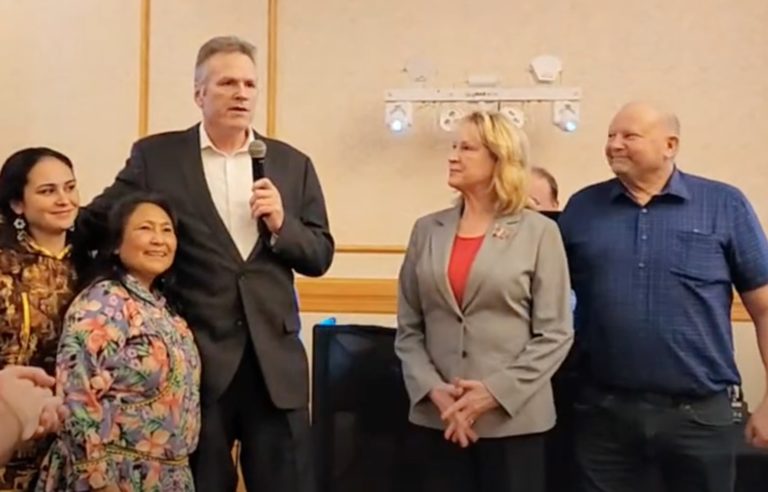
Gov. Dunleavy made a commitment to Mat-Su Valley residents to get the road project restarted as soon as possible. Saturday was the groundbreaking.

KGB Road is a two-lane highway with average daily traffic of over 19,000 vehicles near the Palmer-Wasilla Highway. KGB was constructed on its current alignment in 1966.

Phase One of the reconstruction will upgrade four miles of KGB from Centaur Avenue to Fairview Loop. The project will expand the corridor to a four-lane divided roadway with a separated multi-use pathway on the north side. The roadway will have wider shoulders, street lighting, and median breaks approximately every half mile or mile. The project will construct several signalized intersections, including a new signalized intersection at Endeavor Street, significantly improving access to the Smith Ball Fields.

“It is imperative to make our transportation network safer, for our families and our communities,” said Commissioner Ryan Anderson. “The department is committed to doing the work that will ultimately allow us to decommission the Highway Safety Corridors. We’re nearly there on the Parks Highway, starting work on KGB, and we have our sights set on making the necessary improvements to the Seward and Sterling Highways.”

“Addressing the life/safety issues on this main arterial in this incredibly high growth area has been a top priority of mine along with the entire Mat-Su Delegation,” said Senate Majority Leader, Senator Shelley Hughes. “Along with working with Governor Dunleavy to restore the dollars removed by the prior administration, it’s been a community effort as we’ve heard from countless individuals and families who daily drive on KGB as well as from those who’ve tragically lost loved ones on this key route. Together we have pushed for safety improvements and a timely schedule to move the project forward. While construction is underway, it will take patience and cautious driving on all our parts, but I know we are thankful for DOT and private sector workers for their planning and preparation as well as will be for their boots on the groundwork all the way to project completion.”

Sen. Mike Shower gives his ceremonial shovel to a widow who had lost her husband on the dangerous Knik-Goose Bay Road.

“I want to thank the legislators who pushed hard to get the KGB improvements funded and the administration for making it a priority. My daughter and grandkids lived down KGB and I know personally how important this safety upgrade is for the people who live and work down the KGB corridor, including many who go into Big Lake. As one of the fastest growing areas of the state, and one of the more dangerous roads, this couldn’t happen soon enough,” said Senator Mike Shower, who spontaneously gave his ceremonial shovel to a woman who had lost her husband to a car wreck on the road.

“I would like to thank Governor Dunleavy and the DOT for executing Phase 1 of the KGB Reconstruction project. I also extend my appreciation to all those in the community who actively engaged to make this project happen,” said Senator David Wilson. “The four-lane divided roadway improves mobility for people and freight, adds capacity, and corrects problems created by unconstrained access. Many years in the making, this top priority project will improve safety, reduce congestion, and save precious lives, now and in the future.”

“It is unfortunate that this lifesaving project was stalled by the shortsighted and punitive actions of the previous administration. This incredibly necessary project has been a long time coming to fruition. It has also been a team effort of Mat-Su legislators, both current and former, to get us to this point. I am proud to join with my colleagues and Governor Dunleavy in getting this project underway,” said Representative Cathy Tilton.

“I would like to thank the tireless work of four current and past legislators, Sen Wilson, Rep Tilton, Rep Neuman and Rep Sullivan-Leonard on KGB Road and the citizens of the Mat Su,” said Representative Kevin McCabe. “Without their grit and teamwork, we would not be here today. Thank you, Governor Dunleavy for looking out for all Alaskans. I’m proud to help bring this project home.”

“Mat-Su Valley residents are excited to see construction crews at work rebuilding KGB road,” said Wasilla Mayor Glenda Ledford. “Once the road is completed it will be a safe and effective transportation corridor for drivers, pedestrians, and bikers. I want to thank the Mat-Su Valley legislators, DOT Commissioner Anderson, his staff and Governor Dunleavy for recognizing and making KGB Road a public safety priority.”

Phase One is expected to be substantially complete in the fall of 2024. Phase Two is scheduled to start in 2025.

DOT has created this fact sheet for Phase 1 of the KGB Road reconstruction project.

How it started, how it’s going: Army Covid vaccination mandate chart shows no National Guard discharges so far

More than 1,500 members of the U.S. Army have been separated from service because they refused to take the Covid-19 vaccination and the routine booster shots that are administered every six months.

The Army reports, however, that although 9,826 members of the U.S. Army National Guard and 5,241 members of the U.S. Army Reserve have refused the shots, none has been separated from service over the refusal. Others say the number of refusals is as high as 40,000.

A Department of Defense order went into effect July 1 that appears to be out of step with a pending lawsuit from Alaska, Texas, and other state governors

The Army and the other branches of the military have faced a relatively small number of outright refusals from National Guard members, and lawsuits from service members of the Army, Navy, Air Force, and other branches have ensued, creating uncertainty about whether people can be separated from the National Guard if they refuse a Covid vaccination.

“The resulting uncertainty surrounding whether thousands of service members are about to be booted from the military comes as the branches struggle with what some are calling the hardest recruiting environment in a generation. Leaders have been busy lowering expectations for how many Americans will fill the ranks in the near future,” according to Military.com.

“And many service members who have declined to get vaccinated, particularly in the Department of the Navy and Department of the Air Force, are being protected under pending lawsuits for religious exemptions. In response, those services are trying to offer alternative vaccines such as Novavax, which throws cold water on one of the main arguments given by deniers seeking religious exemptions.”

According to the military-focused news website, although National Guard soldiers were ordered to be vaccinated by July 1, far later than most other services, “roughly 40,000 of them blew off the Pentagon’s directive. Troops in all branches have been required to be immunized against at least a dozen ailments including the flu and hepatitis for years, with the coronavirus vaccine a rare instance where vaccination has become a political hot potato.”

Beginning July 1, members of the Army National Guard and U.S. Army Reserve who have refused the Covid-19 vaccination orders by the Department of Defense, and who do not have a temporary or permanent exemption are prohibited from taking part in federally funded drills, training, and other duty, and they will not receive payment or retirement credit.

However, unit commanders have the option to place unvaccinated reserve component soldiers in an “appropriate duty status” for limited administrative purposes, such as receiving the vaccine, processing their exemption requests, or conducting separation procedures. Soldiers could receive compensation and retirement credit for these service days.

At the same time, a federal judge in Ohio ordered a preliminary injunction on July 29, preventing the U.S. Air Force from enforcing its identical Covid vaccine mandate on those who had submitted a religious exemption request. That injunction remains in effect until a full trial has resolved the matter. In addition, a judge ordered a temporary restraining order in a class action lawsuit among Air Force plaintiffs, preventing airmen, active reserve, National Guard, Air Force Academy cadets, the Air Force Reserve Command, and Space Force members from being forcibly vaccinated for Covid.

But the Army is continuing to publish requirements that include stark terms of separation for those guardsmen who refuse the vaccine.

Army policy allows soldiers to submit requests for temporary (up to 365 days) or permanent medical exemptions through medical channels. Soldiers may request an administrative (religious) exemption from the vaccine requirement. These requests are generally not being honored.

According to the Department of Defense, Army officials review each request individually to determine whether an exemption is appropriate. Medical requests are reviewed primarily by healthcare providers, and religious accommodation requests include interviews with the soldier’s chaplain, recommendations from the chain of command, as well as a public health and a legal review.

All soldiers, including National Guardsmen, who refuse the order to be vaccinated without an approved or pending exemption request are subject to certain adverse administrative actions, including flags, bars to continued service, and official reprimands, the Army wrote on its website. Those who continue to refuse the vaccination order without an approved or pending exemption “may also be subject to additional adverse administrative action, including separation.”

Gov. Mike Dunleavy in January joined Texas Gov. Greg Abbott in federal court to stop the federal government from requiring National Guard members to obtain Covid-19 vaccines as a condition of their service to the state of the Alaska and its people. The U.S. Army National Guard operates under the chain of command of each state’s governor.

Dunleavy contends the unconstitutional vaccine mandate usurps state sovereignty and illegally undermines governors’ authorities as commanders of state National Guards.

“Protecting the freedom and liberty of National Guard members has fallen on responsible governors. The federal government has no authority to make health decisions for National Guard members who are at work under state authority. I pledge to protect that medical freedom and to challenge the trampling of our state’s rights under the 10th Amendment,” Dunleavy said earlier this year.

“The staggering number of unvaccinated Guardsmen sets up an unprecedented situation in which the Pentagon has drawn a line in the sand, but Army officials and Guard leaders interviewed by Military.com all agreed that so many troops being forced out would undermine the force,” Military.com wrote.

“Some are concerned whether unvaccinated troops pose any significant health risk worth a radical reduction in the size of the force. Many troops were vaccinated in January 2021, when the vaccine became available, but the small percentage of holdouts after the deadlines remains stubbornly steady.”

Alaska Highway reopens to light traffic north of Fort St. John after fire closes bridge

One person is said to have died after a commercial tanker truck carrying flammable liquids crashed on the Sikani Chief River Bridge about 124 miles north of Fort St. John. The highway is open again to small trucks and cars, but not yet open to larger commercial traffic.

Photos posted on Facebook showed billows of black smoke and portions of the wooded area on both sides of the highway burning. RCMP said the accident took place at about 8:30 pm on Thursday when the truck hit a barrier on the bridge. The driver is presumed dead.

The Alaska Highway is the main route from the Lower 48 and Canada to Alaska. Those traveling with big rigs or recreational vehicles may be delayed for several more days. (Photo credit: Unknown, social media)

Photographer unknown: Brush along the sides of the Sikani River Bridge continues to smolder.

Peltola widens lead some more over Palin

A nearly 9 point difference has opened up between candidates Mary Peltola and Sarah Palin for the temporary seat for Congress. The Bethel Native has nearly 40% of the votes in the Aug. 16 special general election to finish the term of Congressman Don Young.

Of 187,919 votes counted in this race thus far, Pelota now has 39.64%, Palin has 30.94%, and Nick Begich has 27.84%. Begich is staying 3 points behind Palin as the counting has continued and more absentee mail-in ballots are processed by the Division of Elections.

Peltola’s margin has increased over yesterday, when she had 39.25% out of the 180,194 ballots that had been counted.

Any valid ballots that were postmarked before midnight on Aug. 16 that arrive by Aug. 31 will be counted, with only a few more expected to trickle in over the weekend. The Division of Elections will then run the calculation for where the voters for Nick Begich wanted their second choice to go — Pelota, Palin, or nobody. To win, Palin has to get two votes for every one that Peltola gets from the Begich ballots.

Alaska voters approved this ranked choice ballot system in 2020 and this election is the first time it has been used. It is being widely criticized for being difficult to understand and for delaying the process for knowing who the winner is, since the ranked choice process will not take place until Aug. 31.

District 9, which is the South Anchorage hillside formerly made up of old District 28, had an over 50.9% voter turnout. Peltola received 45% of the vote from the South Anchorage hillside, with Begich getting 32% and Palin coming in at 20%.

McConnell-run super PAC cancels ad buys in Alaska for Murkowski; prospects viewed positively for November

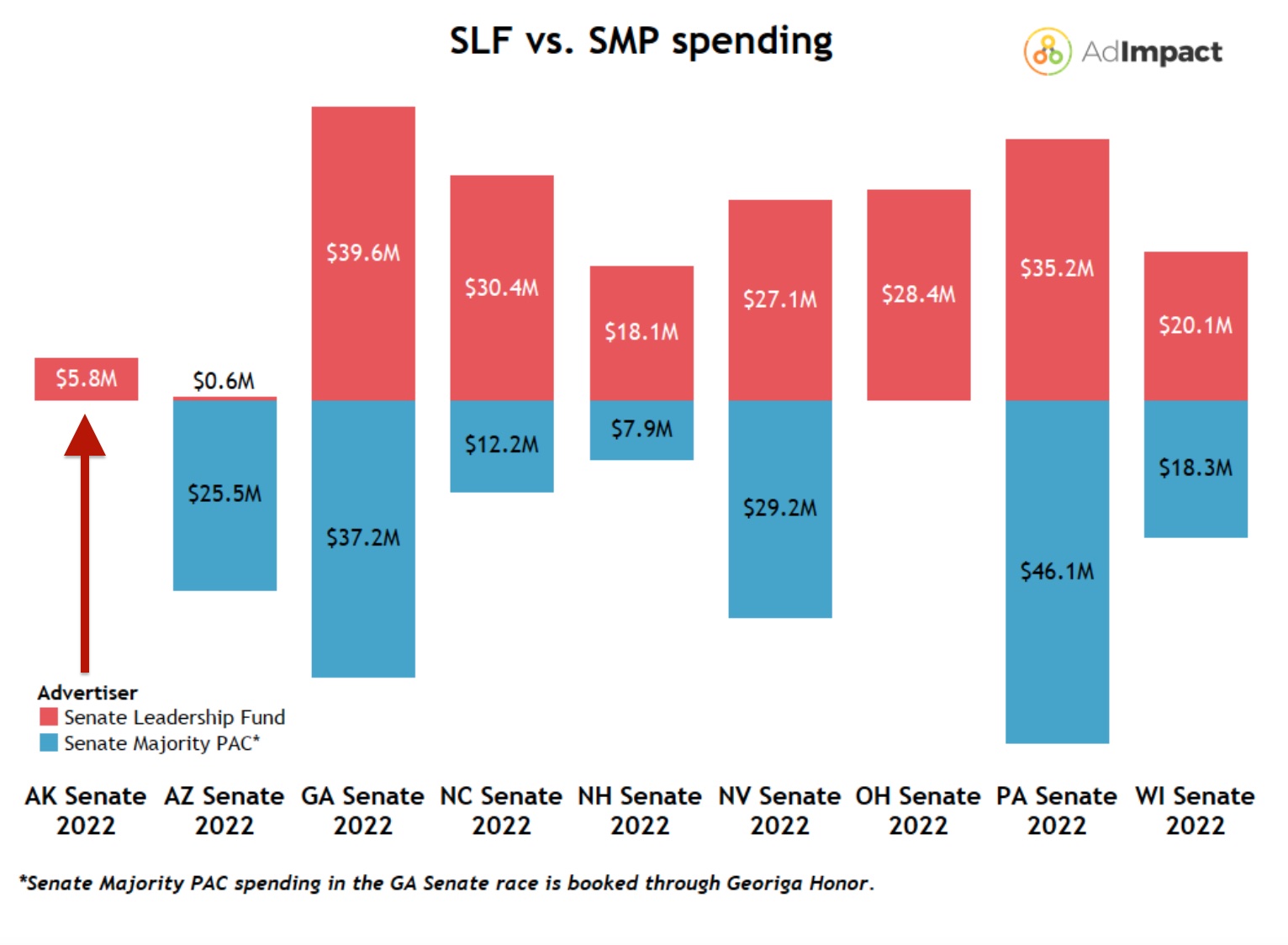
The U.S. Senate Republican super political action committee is canceling nearly $10 million, mostly in Arizona but also Alaska ad reservations, according to reporting from Politico. The ads had been reserved by the Senate Leadership Fund to support the candidacies of Blake Masters in Arizona and Sen. Lisa Murkowski in Alaska.

While the change in Arizona might raise questions about Republicans’ view of Masters’s chances against Democrat Sen. Mark Kelly the super PAC said the decision to cut two weeks — or about $1.7 million in advertising — off of ads for Sen. Lisa Murkowski is a vote of confidence in her, the news organization reports.

Murkowski advanced to the top-four general election with about 45 percent of the vote compared with 39 percent for Trump-backed Kelly Tshibaka, according to Politico. The actual results are 44% for Murkowski and 40% for Tshibaka; Politico appears to be slanting the reporting in favor of Murkowski.

Ads from the Senate Leadership Fund in support of Murkowski will now begin Sept. 20, leaving the super PAC the ability to reallocate those resources to races that it needs to win against actual Democrats.

“We are all-in for Senator Murkowski. Senator Murkowski is in a very strong position and based on that decided to push back our start date,” the PAC said.

Americans are suspicious of FBI raid on Mar A Lago

By CASEY HARPER | THE CENTER SQUARE

The Federal Bureau of Investigation raid on former President Donald Trump’s Florida residence has led to a drop in trust for the law enforcement agency, a new poll shows.

Convention of States Action, along with the Trafalgar group, released the poll Thursday, which showed a large segment of Americans say the raid has lessened their confidence in federal law enforcement and that they question the motives for the raid.

The poll found that “46.2 percent of American voters say the Department of Justice and the FBI are too political, corrupt, and not to be trusted” while about the same percentage of those surveyed say the opposite.

Republicans are much less trusting of the agencies. Notably, though, many independent voters have lost confidence in the federal agencies.

The poll found “47.9 percent of Independent voters say the Department of Justice and the FBI are too political, corrupt, and not to be trusted” while “43.7 percent say they are to be respected for their pursuit of justice and law and order, and 8.4 percent are not sure.”

The survey also reports that “48.7 percent of American voters believe the FBI and Department of Justice are not telling the truth about their reasons for conducting the raid on President Donald Trump’s home.”

Again, half of independents are skeptical, with 50% saying the DOJ investigation into Trump “is only intended to prevent him from running for office in 2024.”

The pollsters surveyed more than 1,000 likely midterm election voters from August 19th through Aug. 23.

Casey Harper is a Senior Reporter for the Washington, D.C. Bureau. He previously worked for The Daily Caller, The Hill, and Sinclair Broadcast Group. A graduate of Hillsdale College, Casey’s work has also appeared in Fox News, Fox Business, and USA Today.
Leigh Sloan: The rise of choice schoolers

By LEIGH SLOAN

Post Covid-19, the the way people view education has changed significantly. Many parents faced schooling their kids at home for the first time ever. Some decided that homeschooling wasn’t as intimidating as they thought and they never looked back. Here in Alaska, homeschooling has risen to almost 40 percent.  

Back when homeschooling was more of a fringe phenomenon, it evoked images of long-skirted women, minivans, and swarms of kids with little to no social awareness. There were three choices: 1. Public school 2. Private school 3. Homeschool. Because it was the easiest and most economical for busy working families, most people chose public school. 

These days schooling is being reimagined and re-engineered by people who know the students best: their parents. Parents (and even grandparents) with degrees and skills are stepping up to the plate to solve the educational crisis. They are looking beyond their own families and serving the needs of the community. One semester before Covid I decided that my kids did better with a “classroom” of more than just immediate family, so I opened up my home for a “micro-school.” Only I didn’t call it that at the time. I just called it helping teach other homeschooled kids two days a week.

Little did I know what a lifeline that little gathering would be to our kids and the kids who came. It was a small enough group that through Covid, we stayed healthy and they never missed a beat either in their studies or in their social lives. The world seemed to be crashing down, but our little micro school provided a safe place for these kids to learn and grow. 

This year, my kids’ needs are changing. I have crossed the threshold into being a Mom of Middle/High Schoolers. Now they need a bit wider space to grow and spread their wings and new social experiences. I imagined what I would want in a resource for me and my family and I created it for others. Calling it “The Green Room,” I gathered four other teachers who are passionate about their disciplines and equipped to teach. We found a space to meet and together we are looking forward to cultivating a community where parents are in charge and teachers are there to serve. 

As I’ve been in connection with other homeschool parents, I have found that there is a plethora of ways that people provide education. On one end of the continuum you have full time public school and at the other end you have full time independent homeschool. In between you have co-ops, hybrid schooling and more. Even in different seasons of life, parents and students have different needs. It is a new frontier of education as I have watched as many of my friends have stepped up to use their talents in creative ways to find workable solutions. 

We may not all be doing it the same way. We are not always homeschoolers, public schoolers or private schoolers. We need a new term for those of us out exploring on the educational frontier: we are Choice Schoolers. Choice Schooling is a philosophy of education that understands there are many right ways to educate a child. Choice Schooling is the belief that parents should make the ultimate decisions on how they want to educate their children —  and not anyone else. 

It’s understandable to be frustrated with the system as it is. As both a parent and former public school teacher, I know very well that the system is flawed. That is why I left the traditional system so early in my career. You may choose to leave the system, and that can be a good choice. You may be a teacher, student, or parent who chooses to stay, and that can be a good choice too. Choice Schoolers do not presume to act as judge and jury for the decisions parents make. Instead they support them along the way. 

We are all doing the best that we can. For better or for worse, these are all our community public and private schools. Since the advent of public education or “government run schools” as some prefer to say, the mantra has been that public education is to remain both “free and appropriate.” The dilemma is this: who gets to decide what is free and what is appropriate? 

The answer for Choice Schoolers? The parents.  We fight for every parent’s option to choose. Whether the choice be at the micro level, like parents who want to opt out of a public school class they deem “inappropriate.” Choice can also be at the macro level: when their child’s needs can’t be met in the traditional environment and they need an entirely different schooling experience.

As school choice becomes more and more of a reality in other US states, it has caused some fear to arise from both left and right. The fear coming from the right is that anything the government funds it will control. That fear is founded. As we know, anything unchecked in government hands can become a problem. If we are not vigilant enough to keep our eyes wide open and our fingers steadily on the pulse of what is going on with our kids, that fear could manifest as reality. 

But fear should not be a driving force in all our decisions moving forward. Rarely do we make our most forward thinking decisions from a place of fear. Maybe the Department of Education does need to be entirely demolished and reconstructed. If that’s what it takes to bring reform, so be it. But in the meantime, let’s not condemn families who choose to participate in public education, or who make different decisions for their families. Let’s advocate for more freedom for them and for everyone, not less. You may not feel comfortable with taking funds for your child’s education because of your concerns about government control, but will you fight for the freedom of those who do? 

All over Alaska, parents have been accessing educational resources and using them where they can. And those resources are doing a whole lot of good. So far, no one is controlling the way that I educate my children, and I refuse to let them. When we talk about government control gone awry, we need to realize that government only has as much control as “we the people” allow it. Will the entrenched “system” try to wrestle control from parents as they become empowered? Probably so. But will they be successful? That is up to you and me.

These are your schools every bit as much as they belong to your political opponents. You may fiercely distance yourself from the philosophy and objectives of the local public school, but it is still your local school. The laws around education came from your elected officials. It’s shortsighted to believe that this is only about you and your family. It’s about us and our communities, our state and nation. Distancing won’t make it go away, but engaging can make a difference. When it comes to education, stay engaged, fight for educational liberty, and be part of the solution. 

Saturday is unofficial gay day at the Alaska State Fair

A national group called “Out at the Fair” has targeted the Alaska State Fair for one of its nine state fairs around the country for gays, lesbians, bisexual, transgender, and queer-identifying people to converge on en masse.

The Out at the Fair day is Saturday at the fairgrounds in Palmer, with LGBTQ+ people coming from all over the country to participate. The group targets between 8 and 10 fairs around the country every year for these events, with the Alaska State Fair on the list for the first time.

Alaskans attending the fair on Saturday can expect to see drag queens and lots of rainbow garb among the crowds. Many of the participants will be attending the LeAnn Rimes concert Saturday night. But first, the photo shoot for the group takes place.

“Our first festival always starts as a group photo because visibility as a community is very important. Join us Saturday, August 27, 2022, at the Alaska State Fair in Palmer, Alaska. Join us at 4:00pm (SHARP) at the ‘I in Fair’ sign for our 1st group photo!” the organization’s website says.

One of the sponsors of the event is Identity Inc., which wrote that it is family friendly, and “Show us your PRIDE Alaska by wearing something rainbow or ordering your ‘OATF Merch’ today and with your help, we will return to the Alaska State Fair in 2023.”

The fair runs through Sept. 5.

Tshibaka proposes five debates with Murkowski

Alaska Republican U.S. Senate candidate Kelly Tshibaka on Friday called on Sen. Lisa Murkowski to agree to five debates before the Nov. 8, 2022 general election.

Tshibaka proposes that the debates could be hosted by media outlets or public interest groups in different regions of the state, or separated into debates about specific topics, like energy policy or standing up to the harmful Biden administration. The Tshibaka campaign also encouraged news organizations and civic groups to formulate plans for debates and invite the candidates.

Tshibaka issued the following statement:

“Alaskans deserve to know if their senator is going to stand up to the disastrous Biden administration, and they deserve to see the candidates standing shoulder to shoulder, explaining their records and positions. There are 74 days between now and Election Day, surely Senator Murkowski can find time on her schedule for these five debates for the voters of Alaska. After 21 years in the Senate, Lisa Murkowski has become much more liberal and voters deserve the chance to evaluate that for themselves. Energy jobs, gas prices, and inflation are tops in voters’ minds, and they want to know why Murkowski has enabled the Biden administration every step along the way. This campaign is a job interview with the people of Alaska, and it’s the responsibility of all candidates to show up. I look forward to agreeing to a full schedule of debates very soon.”