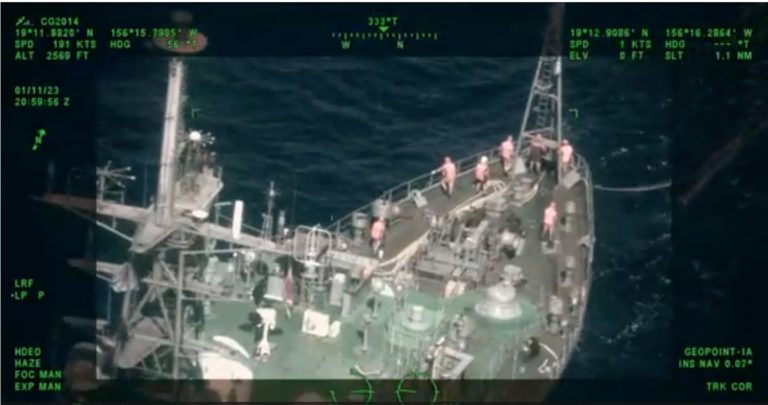
The U.S. Coast Guard has been monitoring a Russian vessel, believed to be engaged in intelligence gathering, off the coast of the Hawaiian Islands. The Coast Guard is coordinating with Department of Defense partners, providing updates to foreign vessel movements and activities and to “appropriately meet presence with presence to encourage international maritime norms.”
Although foreign ships in the U.S. exclusive economic zone is not unusual, tensions between the United States and Russia make the ship’s movements interesting to the Pentagon. Defense officials say the ship is operating in international waters. The zone allows ship to be within 12 nautical miles from a country’s shore.
The vessel is described as a Vishnya-class intelligence ship Kareliya (535), according to a review of the Jan. 11 video released by the Coast Guard. Satellite photos from Jan. 10 show the Russian vessel coming as close to 40 kilometers, or approximately 25 miles, within the Hawaiian shores, according to US Naval Institute News. The Coast Guard tracked the Kareliya in May 2021 in the same general area.
In mid-September, the Coast Guard Cutter Kimball crew, on a routine patrol in the Bering Sea, encountered Chinese naval vessels and four Russian naval vessels, including a Russian Federation Navy destroyer, all in a single formation.
Alaska USA Federal Credit Union will change its name to Global Federal Credit Union on April 3. The name change, the fourth name change in the company’s history, “marks a significant milestone in our credit union’s journey, providing an opportunity to reflect on everything that Alaska USA has stood for and everything that we aspire to become as we move forward into an exciting future,” the cooperative credit union said.
The credit union’s membership is distributed worldwide and the services can be accessed anywhere.
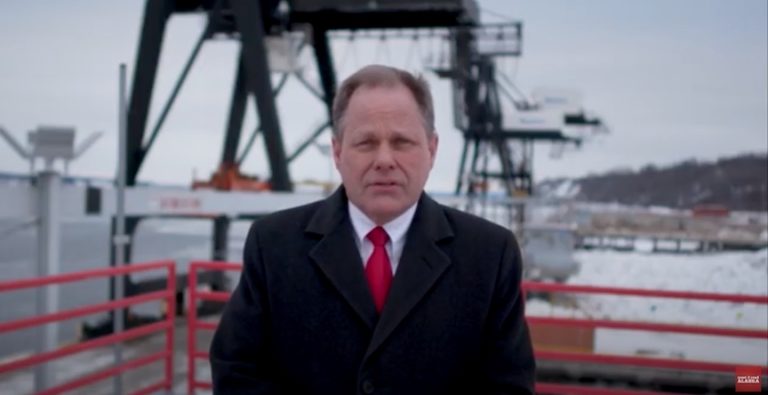
“We recognize that many of our members, like me, were born and raised in Alaska and have had accounts at Alaska USA for a long time. I want to assure you that the credit union is still Alaskan to our core; Alaska is in our DNA. When you walk into a branch you’ll be greeted by the same employees, use the same accounts, and experience the same commitment to the financial wellbeing of our communities that you’ve come to expect from us. Global is simply a new name with the same Alaskan spirit and values that have always guided us,” President and CEO Geoff Lundfelt wrote to account holders on Thursday. In other words, members’ passwords and log-ins won’t change.
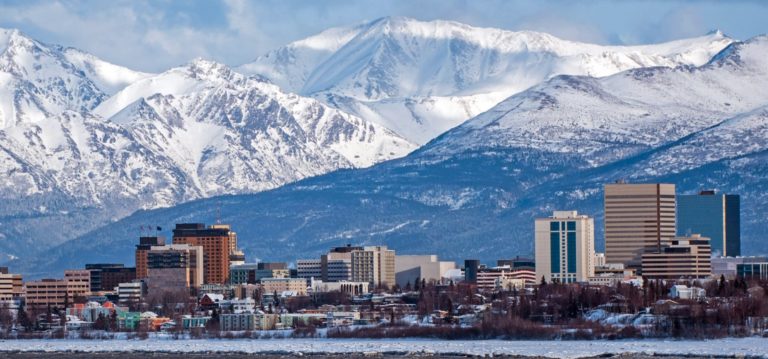
The credit union’s subsidiary companies are also adopting the Global name. Alaska USA Insurance Brokers will be known as Global Credit Union Insurance Brokers, and Alaska USA Mortgage Company will be known as Global Credit Union Home Loans. The company has more than 1,100 employees and is headquartered in Anchorage.
“Since we were founded in 1948 as Alaskan Air Depot Federal Credit Union, our organization has expanded far beyond the confines of the Air Depot and the borders of Alaska. As your families grew, we grew. We now have members in all 50 states and all over the world. We have branches in Alaska, Arizona, California, Idaho, Washington, and even on military bases in Italy. We’ve grown to become what Alaska always has been—larger than life. Global,” he said.
On Thursday, the Anchorage Assembly consulted with its legal counsel in executive session on the scope of its power to respond to allegations made by former Municipal Manager Amy Demboski in her wrongful termination claim against Mayor Dave Bronson. During a Friday meeting, the Assembly will vote on what actions it may take against the mayor.
Later in the meeting the Assembly introduced three items for consideration at the Friday special meeting, which is scheduled for 3-5 pm at City Hall, Suite 155. The text of those ordinances is at this link.
– The Emergency ordinance on Boards and Commissions addresses the inability of some boards and commissions to meet quorum by extending the membership for those members whose term expired October 14, 2022 and have not yet been replaced by an additional 60 days to April 12, 2023 or until a new appointment is confirmed to a member’s designated seat, whichever occurs first.
– The emergency ordinance regarding the Office of the Ombudsman proposes to clarify the authority of the office to investigate personnel matters within the Municipality.
– The emergency ordinance regarding contract oversight and reporting requires the Assembly to approve contracts at a lower monetary threshold than is currently in ordinance. It requires more detailed reporting of contracts awarded and municipal spending.
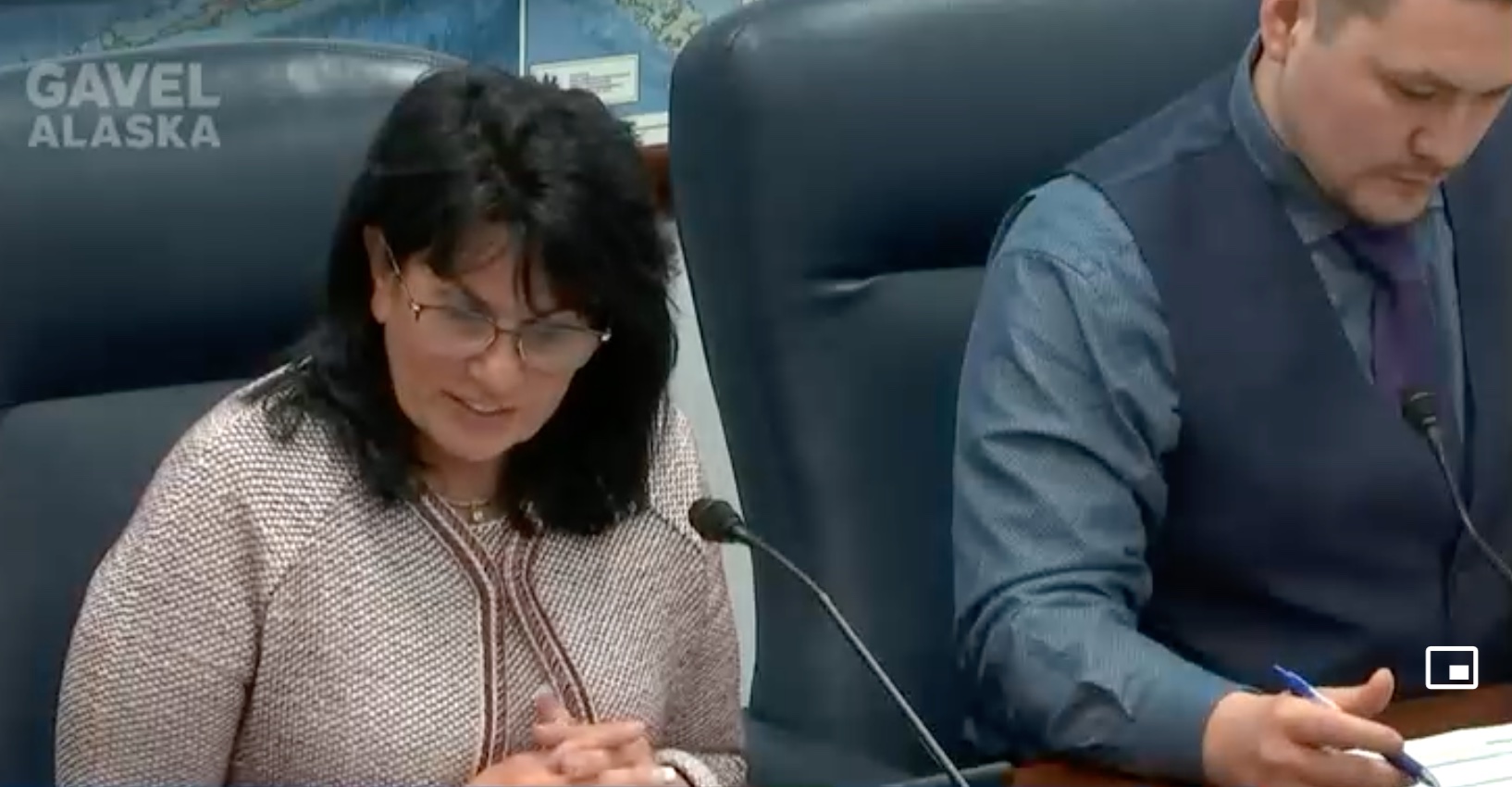
“The letter from former Municipal Manager Demboski is now in the public record,” said Assembly Chair Suzanne LaFrance. “The statement contains very serious allegations of mismanagement of municipal resources, so Assembly leadership is taking steps to protect those resources. We are focused on good governance and intend to strengthen the code.”
Emergency ordinances would be in effect for 60 days. Meanwhile, the Assembly may be considering impeachment of the mayor, as it granted itself that authority in 2022.
The House Committee on Committees met today in Juneau and assigned seats to members of the majority and minority caucuses, making it final who is in and out of the House Majority.
Minority members were assigned to committees by the new Minority Leader Cal Schrage, who is not registered with a party but who caucuses with Democrats on behalf of his Anchorage district. Speaker Tilton chairs the Committee on Committee. Tilton is the first Speaker from Wasilla in the Alaska House of Representative’s state history.
The committees are as follows with minority members in italics.
RULES
Chair: Craig Johnson Vice-Chair: Cathy Tilton Jamie Allard Jesse Sumner Laddie Shaw Zack Fields Cal Schrage
FINANCE
Co-Chair: DeLena Johnson Co-Chair: Bryce Edgmon Co-Chair: Neal Foster Julie Coloumbe Mike Cronk Will Stapp Frank Tomaszewski Alyce Galvin Sara Hannan Andy Josephson Dan Ortiz
Community, Regional Affairs TThS 8-10 Chair: CJ McCormick Vice-Chair: Kevin McCabe Tom McKay Josiah Patkotak Justin Ruffridge Rebecca Himschoot Donna Mears
EDUCATION MWF 8-10 Co-Chair: Jamie Allard Co-Chair: Justin Ruffridge Mike Prax CJ McCormick Tom McKay Rebecca Himschoot Andi Story
HEALTH & SOCIAL SERVICES TThS 3-5 Chair: Mike Prax CJ McCormick Justin Ruffridge Dan Saddler Jesse Sumner Zack Fields Genevieve Mina
JUDICIARY MWF 1-3 Chair: Sarah Vance Vice-Chair: Jamie Allard Ben Carpenter Craig Johnson David Eastman Andrew Gray Cliff Groh
LABOR & COMMERCE MWF 3:15-5:15 Chair: Jesse Sumner Mike Prax Justin Ruffridge Dan Saddler Stanley Wright Ashley Carrick Zack Fields
RESOURCES MWF 1-3 Chair: Tom McKay Kevin McCabe Josiah Patkotak George Rauscher Dan Saddler Stanley Wright Jennie Armstrong Donna Mears Maxine Dibert
STATE AFFAIRS TThS 3-5 Chair: Laddie Shaw Vice Chair: Stanley Wright Ben Carpenter Craig Johnson Jamie Allard Jennie Armstrong Andi Story
TRANSPORTATION TThS 1-3 Chair: Kevin McCabe Craig Johnson Tom McKay Sarah Vance Louise Stutes Genevieve Mina Andrew Gray
Arctic, Economic Development, Tourism TTh 11-12:30 Chair: Stanley Wright George Rauscher Laddie Shaw vacant Ashley Carrick
ENERGY TTh 10:15-12 Chair: George Rauscher Tom McKay Josiah Patkotak vacant Cal Schrage
FISHERIES TTh 10-12 Chair: Sarah Vance Kevin McCabe CJ McCormick vacant Louise Stutes
MILITARY & VETERANS’ AFFAIRS TTh 1-3 Chair: Stanley Wright Laddie Shaw Ben Carpenter vacant Cliff Groh
TRIBAL AFFAIRS TTh 8-10 Chair: CJ McCormick Ben Carpenter Sarah Vance vacant Maxine Dibert
WAYS AND MEANS TThS 11:30-1:30 Chair: Ben Carpenter Jamie Allard vacant vacant Cliff Groh
LEGISLATIVE COUNCIL Vice-Chair: Kevin McCabe Cathy Tilton Craig Johnson Dan Saddler Bryce Edgmon George Rauscher Sarah Hannan
LEGISLATIVE BUDGET & AUDIT Chair: Ben Carpenter DeLena Johnson Sarah Vance Frank Tomaszewski Andy Josephson
JOINT ARMED SERVICES Co-Chair: Laddie Shaw Mike Prax George Rauscher Stanley Wright Cliff Groh
ETHICS DeLena Johnson Sara Hannan Alternate – Mike Prax Alternate – Andy Josephson
The Anchorage Assembly interviewed and voted to name Eagle River resident Robin Dern as the temporary replacement for former Assemblywoman Jamie Allard, who is now a sitting legislator. Dern was among 10 people who applied for the seat, which will be filled by the voters on April 4 through a regular municipal election.
On the first round of voting, Dern received 5 votes and Matt Cruickshank received 2 votes. On the second round, Dern got 7 votes and Cruickshank received 4 votes. The Assembly uses ranked choice voting in its procedure to replace a vacancy.
Dern, an artist, writer, and poet, said that in addition to her other qualities, she is the only woman to have applied for the seat. Her background includes: Executive director in local nonprofits for 20 years, United Jewish Communities Alaska Board member, FEMA State Set Aside board chairwoman, Anchorage Schools Foundation co-chairwoman, Special Olympics World Winter Games volunteer coordinator, Arctic Winter Games volunteer, Anti-Defamation League Pacific Northwest Regional Board member, Anti-Defamation League trained facilitator in “No Place for Hate, Hate Crimes, Inclusive Policing & Response to Violent Extremism,” Eagle River Food Pantry volunteer, Anchorage School District volunteer and parent, FBI and Anchorage Police Department Citizen Academy participant.
Dern took her position on the dais and, through her face mask said she was grateful for the opportunity to serve Eagle River. Her first meeting, which was underway this afternoon, proceeded into executive session to consider legal action against the mayor of Anchorage or members of the mayor’s administration.
A memo from the Municipal Ombudsman to the Anchorage Assembly says that members of Mayor Dave Bronson’s administration have been downloading security videos that shows who has come and gone from the Ombudsman’s Office. The memo was included in the packet for Thursday’s special meeting of the Assembly, during which members will go into executive session to explore their options for punishing the mayor for other allegations, which came to light in recent days.
Darrel Hess, the Municipal Ombudsman, has also requested a review by municipal Law Department, as spying on employees who are whistleblowers may be considered a form of misconduct.
“Recently, multiple Municipal employees have contacted the Ombudsman’s Office alleging that an executive with the Municipality had stated that the Mayor’s Office has been downloading copies of City Hall surveillance videos to see who is accessing the Ombudsman’s Office and interacting with Assembly Members. Employees have stated that they are hesitant to visit our office because they are afraid that access to our office is being monitored. The employees perceive the alleged statements by the executive to be an attempt to intimidate them to not contact the Ombudsman’s Office,” the memo says.
“Anchorage’s Home Rule Charter states that the people of Anchorage have the right to the services of an Ombudsman. Accusations of attempting to intimidate Municipal employees to discourage them from contacting the Ombudsman’s Office are serious, chilling allegations — even if no videos have been pulled. Given the gravity of the accusations, and based on the statements of multiple Municipal employees, I reasonably believe that there may have been a breach of duty, misconduct, or illegal activity by a Municipal employee. I believe that I have an obligation under AMC 2.60.l70* -Misconduct by municipal personnel – to refer this matter to the Municipal Prosecutor’s Office for review, to determine if there have been any violations of Municipal Code or any other applicable laws,” Hess continues.
“If the Ombudsman believes there is a breach of duty or misconduct by an officer or employee of the municipality, the Ombudsman may refer the matter to the appropriate department head, to the Mayor, to the Board of Ethics, or, when appropriate, to the Municipal Prosecutor, District Attorney, or any other agency,” the memo concludes.
The mayor is already embattled because former Municipal Manager Amy Demboski has set forth several allegations relating to improper contract awards and other actionable items, which were already part of Thursday’s meeting.
On Aug. 15, 2018, during the Berkowitz administration, my company (LeMay Engineering & Consulting, Inc.) submitted a competitive bid to the Municipality of Anchorage to provide temporary support and payroll services.
In other words, we bid to provide employees who work for us to the municipality—the employees work for the municipality, but they are our employees, and we handle payroll taxes and similar matters.
This contract is no secret; it is publicly available information located transparently on the city’s website.Our contract title is: 2018B065—Provide Temporary Support and Payroll Services on an as-required basis. Our low bid won the contract.
As an aside, here’s a fun fact: The dollar amount associated with temporary support services significantly decreased after Mayor Bronson took office and removed unnecessary and duplicative positions.
There is nothing untoward about my company’s contract. So, imagine my surprise when I received an email stating that my corporation was wasting the municipal taxpayers’ money. I investigated and discovered two false and defamatory articles written by a person who is associated with a small political blog that recently went live.
The articles were entitled “An Initial Look into Joe Gerace Could Lead to a More Comprehensive Audit,” January 11, 2023, and “Tshibaka Children Score Lucrative Summer Work with the Muni,” dated October 21, 2022.
Typically, municipal departments requiring temporary support already have identified the people they need and their hourly rates. Our scope is to hire people after background checks, verify employment eligibility, and send them to report to the MOA departments that initiated the requests. Timecards are collected weekly and are signed by the employee and MOA Department Supervisors. We pay each employee based on actual hours worked, along with all payroll taxes. We then submit invoices to the MOA for reimbursement.
The blogger published fairytales, libeling my company with mistruths and misleading deceptions that illustrated her lack of understanding regarding MOA contracts and their terms. She suggested a fraudulent payment was made to the Tshibaka children and then based upon her incorrect understanding of MOA contracts, she deduced that the hours the Tshibaka children worked violated labor laws. She is wrong on both counts.
MOA contracts are awarded for a “not to exceed” amount. The not to exceed amount of the contract is not paid in full up front; it is paid piece-meal and only against the contractor’s submitted invoices charging hours at hourly rates. For example, the period worked by one of the Tshibaka children was April 8 to July 7, 2022, and the purchase order was for a not to exceed value of $10,871—later increased to $15,947.
However, the amount actually invoiced to the MOA for this employee’s hours worked was $9,166.79—the amount paid did not reach the “not to exceed” amount. For the second Tshibaka child, the purchase order was for $3,525.00. This employee’s total hours worked were 47 over a three-week period. Thus, the total invoiced amount was only $1,104.50. Once again, the “not to exceed” amount was not reached.
Also, there was nothing untoward about the Tshibaka children working for the city. MOA Code 3.30.168 – Employment of Relatives, permitted the Tsibaka children to work for the city in different departments than their father.
I contacted that writer via email, asking to set the record straight with truth. But, she did not pick up the phone and call me to discuss these matters before writing her slanderous articles. In July 2022, an Anchorage Daily News journalist called me, asking about the Tshibaka children’s work for the municipality through our company. He had similar questions as the blogger. However, unlike the blogger, the ADN journalist called me to discuss his questions first prior to publishing a fairytale. After his questions were answered, the Anchorage Daily News journalist concluded there was no story.
The website that published the falsehoods is associated with the Ship Creek Group, a political consultancy that registered the website name. One of the partners of this entity was employed by disgraced Mayor Berkowitz’s administration through our temporary employment services contract.
When opening our company 18 years ago, we wanted our name as part of our title. Our name (i.e., our reputation) means everything to us. Anchorage Taxpayers, there’s nothing to see here.
This column was written by Patrick M. LeMay, corporate president of LeMay Engineering & Consulting, Inc. and has been reviewed by one of his corporate attorneys.
After eight months of investigation, the U.S. Supreme Court still doesn’t know who on its staff leaked a draft copy of the historic Dobbs v. Jackson Women’s Health Org. decision, which untangled the nearly 50-year-old abortion law known as Roe v. Wade, and sent the abortion question back to the states, so states can make their own laws regarding the legality of abortion.
The investigation “has to date been unable to identify a person responsible by a preponderance of the evidence.” The report says investigators conducted 126 formal interviews of nearly 100 employees, and all denied leaking the opinion to the media.
The investigation also found no credible reason to believe the court’s computers were hacked.
The justices went on, in an introduction to the report, to say that the Covid-19 pandemic remote work policies led to a situation where it would have been too easy for someone to get access to a document and leak it to the media. An independent legal review of the investigation recommended the court tighten up access to hard copies of sensitive documents and to limit email distribution of them to avoid further leaks.
The May 2, 2022 leak is considered to be the worst confidentiality breach in Supreme Court history and has shaken the faith in the institution. Politico, a publication read by politicos, published the draft opinion on May 2. The following day, Chief Justice John Roberts ordered an investigation by the court’s marshal, Gail Curley.
The justice’s issued a statement on Thursday calling the leak a form of misguided protest, and “a grave assault on the judicial process.” The justices called it a “betrayal of trust.”
Curley’s report, attached below, details what actions the investigation took, and concludes that the culprit remains unknown. The justices say no further investigation is warranted:
The leak of the Dobbs decision is thought to be the reason pro-abortion advocates attacked more than 100 crisis pregnancy clinics in recent months, attacks that started right after the publication by Politico.
On Wednesday, an Alaska State Trooper and a representative from the Alaska Department of Fish and Game were able to land in Wales, Alaska to investigate the polar bear attack that left a young mother and her child dead on Tuesday, in what was described by Must Read Alaska sources as an extremely gory scene in an attack that went on for some time near the entrance to the school in that remote village.
The bear had chased other residents in the village during a blinding ground storm, and then came upon Summer Myomick, 24, and her son, Clyde Ongtowasruk, age 1, as the two were walking from the school to the clinic. Myomick was from St. Michael, 232 miles away, but split her time between the two communities.
The mauling took place near the Kingikmiut School front door. The bear had also tried to enter the school at one point and the principal slammed the door shut before the bear could get in, had all the blinds shut in the building, and kept everyone away from windows. People inside the school were not able to save the two mauling victims because the bear was an immediate threat and there were no adequate weapons inside the school.
After the mauling, the polar bear was shot and killed by a Wales resident who had a large-caliber firearm and took the bear down while it was consuming its prey, Must Read Alaska has learned.
Troopers and Alaska Department of Fish and Game were able to get to Wales after weather improved. The runway lights were out in Wales, limiting the ability of pilots to get into the village, due to the approximately five hours of actual daylight this week in that village, which is the farthest-west community on the North American continent. Wales is located on the Seward Peninsula and facing Little Diomede Island, 26.5 miles to the west.
The remains of the young mother and child were sent to the medical examiner. Fish and Game is assisting the U.S. Fish and Wildlife Service, as polar bears are federally managed as a marine mammal. Officials took samples from the bear for a necropsy, which may determine if the bear was hungry, rabid, injured, or was just an aggressive predator.
At this time of year, most polar bears are out on the sea ice hunting seals. There is no lack of sea ice off of Wales at this time of year, but many liberal news outlets are suggesting that the bear attack is a result of climate change. This attack is the first reported in Alaska for over three decades. The last attack was in Point Lay, in 1990, when a 28-year-old man was killed while walking in the village, which is 300 miles north of Wales.