Home Blog Page 606

Comer has receipts: Checks made out to Joe Biden

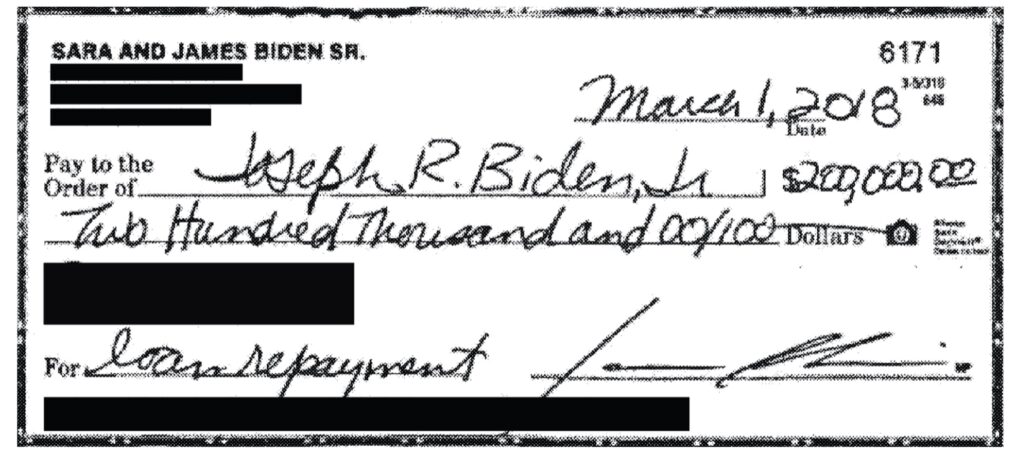
House Committee on Oversight and Accountability Chairman James Comer on Monday today announced the committee obtained bank records revealing a $200,000 direct payment from James and Sara Biden to Joe Biden in the form of a personal check. In September, Chairman Comer issued three subpoenas for Hunter and James Biden’s personal and business bank records.

In 2018, James Biden received $600,000 in loans from, Americore—a financially distressed and failing rural hospital operator. According to bankruptcy court documents, James Biden received these loans “based upon representations that his last name, ‘Biden,’ could ‘open doors’ and that he could obtain a large investment from the Middle East based on his political connections.”

On March 1, 2018, Americore wired a $200,000 loan into James and Sara Biden’s personal bank account – not their business bank account. On the same day, James Biden wrote a $200,000 check from this same personal bank account to Joe Biden. 

Chairman Comer released a video outlining this direct payment and the questions President Biden must answer.

Watch the full video here.

GOP governors lean on NCAA to keep biological men out of women’s sports

By PHILIP WEGMANN | REAL CLEAR WIRE

Republican governors are quietly leaning on one of their former colleagues while pressing the NCAA to bar biological men and women from competing against one another. It is the latest in an ongoing debate over transgender athletes in women’s sports.

Led by South Dakota Gov. Kristi Noem, nine states brought their case directly to NCAA President Charlie Baker, warning the former Republican Massachusetts governor that, without a change in rules, “truly remarkable female athletes” were at risk of being dominated by “average male athletes.”

According to sources familiar with those discussions, Baker in turn referred the governors to a body called the Committee on Competitive Safeguards and Medical Aspects of Sports.

“The NCAA has the chance to guarantee an environment where female college athletes can thrive without the concern of inequities. We trust that you also want to guarantee just such an environment,” the governors wrote that body in a letter obtained first by RealClearPolitics.

Arguments over including transgender athletes in women’s sports have divided the country in recent years, and the issue has become something of a litmus test for the candidates now running for the Republican presidential nomination.

“In Florida, girls are going to play girls sports and boys are going to play boys sports,” Gov. Ron DeSantis, said in 2021 while signing a bill mandating that policy. On the campaign trail, meanwhile, former South Carolina Gov.  Nikki Haley has called keeping biological boys out of girls spaces “the women’s issue of our time.” For his part, former President Trump has vowed to “defeat the cult of gender ideology.”

Eighteen states have passed laws banning transgender athletes from participating in female school sports, and earlier this year, a federal judge ruled that West Virginia’s ban was constitutional and could remain in place.

The Biden administration has proposed federal rules that would allow schools to place limits on transgender students competing on teams that do not match their biological sex. The proposed rules would, however, bar schools from enacting across-the-board bans on trans athletes. According to the governors, this has left the states as “the last line of defense for protecting fairness in women’s and girls’ sports.”

According to a source familiar with the drafting of the letter, Baker was “very gracious” and “highly cooperative” even as Republicans lean on the organization that he now leads to update their rules.

The letter follows a call that Noem made two years ago to build a “coalition to defend fairness in women’s sports.” That bloc is now emerging. Eight governors co-signed the letter to the NCAA: Sarah Sanders of Arkansas, Mike Parsons of Missouri, Greg Gianforte of Montana, Joe Lombardo of Nevada, Kevin Stitt of Oklahoma, Gregg Abbott of Texas, and Mark Gordon of Wyoming. Notably, Mississippi Gov. Tate Reeves, chairman of the Republican Governors Association’s policy arm, which represents the 26 states with GOP executives, also co-signed the letter to the NCAA.

The NCAA has adopted a sport-by-sport approach, which the governors oppose. Proponents note that this policy brings the NCAA in line with their counterparts on both the U.S. and international Olympic committees.

“But this policy allows the NCAA to avoid responsibility for ensuring the fairness of collegiate sports – therefore it must be changed,” the GOP governors wrote in their letter.

The governors pointed to “fundamental” differences between men and women, arguing that “biological men are generally taller, faster, stronger, and have more testosterone than biological women,” which when they compete against one another “puts women, through no fault of their own, at a disadvantage.”

Exhibit A for the Republican governors is Riley Gaines, the former Kentucky swimmer who set Southeastern Conference records before finishing in a dead heat with transgender swimmer Lia Thomas of the University of Pennsylvania in 200-yard NCAA freestyle championship in 2022.

“Traditionally, when two swimmers tie, they both stand on top of the podium – but Riley was told that the trophy was going to be given to Lia. When Riley asked why she couldn’t stand for photos with the first-place trophy that she rightfully earned, she was given a series of non-answers that boiled down to ‘we just have to give it to Lia,’” the governors wrote.

“The decade of hard work and the countless hours spent in the pool were suddenly wasted. Riley’s lifetime of achievement was ripped away from her by someone who shouldn’t have even been in the race—all for a photo op,” they continued.

During testimony before the Senate Judiciary Committee earlier this month, Baker distanced himself from the rules that allowed Lia to compete against Gaines, noting that the controversy predated his time as head of the NCAA.

“As I said before, the rules around transgender athletes generally are more restrictive today than they were in 2022,” Baker told lawmakers. “And I can state pretty clearly that no one’s going to get forced into any sort of situation that’s going to make them uncomfortable.”

That testimony has not assuaged the fears of the coalition of governors led by Noem.

“The NCAA has the opportunity to guarantee a fair environment for women’s sports. If you take this opportunity, it will expand the possibilities for so many young women for years to come,” they wrote. “But if you continue the NCAA’s misguided policies, stories like Riley Gaines’ will only become more common.”

This article was originally published by RealClearPolitics and made available via RealClearWire.

Rick Whitbeck: In Alaska, with friends like Biden, who needs enemies?

By RICK WHITBECK | POWER THE FUTURE

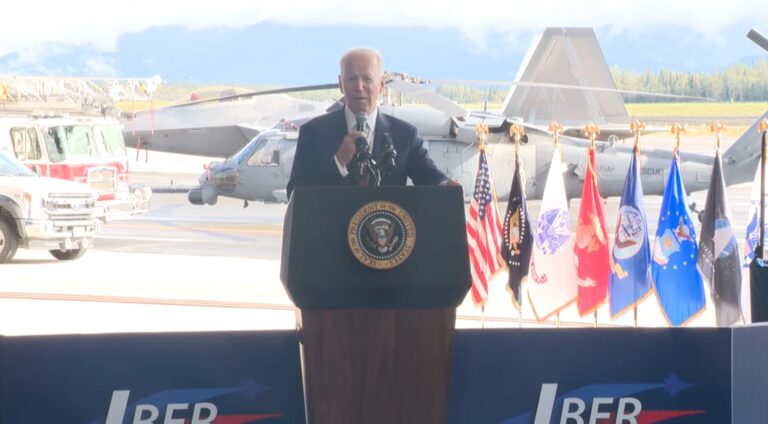
Not all attention is good attention, and when it comes to Joe Biden and Alaska, the attention we get is anything but good. The Biden administration makes so many trips to our state that perhaps it’s time we tell them we just want to be friends.

In 2023 alone, we’ve seen the president visit twice. There’s also been five department secretaries or administrators come through the state, along with at least 50 more executive branch officials. The most recent was Secretary of the Interior Deb Haaland, who spoke at the Alaska Federation of Natives convention in Anchorage last week.

This begs the obvious question: Why so much attention being shown to our state? A simple answer would be the wooing of moderate U.S. Sen. Lisa Murkowski, who has shown a willingness to work across the aisle. However, there could be another reason altogether.

There’s a theory more in line with Team Biden’s usual strategy: By showing up and pretending to care about Alaska and Alaskans, the administration can continue to make policy decisions that harm our state and nation while giving itself political cover. After a number of these official visits, we’ve seen delays and obstruction on Alaska’s development projects, with Haaland’s Interior Department the most egregious offender, but far from the only one.

Since taking office, Biden and his team have amassed a list of nearly 60 executive orders and actions targeting Alaska’s resource development industries, including more than a dozen in 2023 alone.

In January, the Environmental Protection Agency issued a preemptive veto on Alaska’s trillion-dollar Pebble mine and its world-class copper deposit; that decision was immediately challenged in court. This came after numerous EPA leadership visits throughout 2022, endangering the nation’s largest untapped source of copper, which is needed for Biden’s “green revolution.”

In March, the Department of Interior pulled back from a land exchange that would have allowed a road to be built — and lives to be saved in emergency situations — between the Native villages of King Cove and Cold Bay. This followed Haaland’s visits to both communities in April of 2022, where she voiced understanding for the communities’ full-throated support for the road, agreeing to ‘find a way to proceed.’

Also in March was the trade-off of not only a 60%-of-original, scaled-back Willow oil and gas project in the National Petroleum Reserve-Alaska, aka NPR-A, but a moratorium of development activity for 15.8 million acres of on-shore and off-shore areas in and around NPR-A. These actions — again from Haaland’s Department of Interior — directly overrode previous presidential authority for the NPR-A development and congressional authorization of guaranteed access for developers to the area.

In September, Haaland ordered a full-stop cancellation of contracted leases in the “1002 Area” of the Arctic National Wildlife Refuge, or ANWR, an area specifically authorized for development by Congress in its 2017 Tax Cuts and Jobs Act.

This month, the Interior Department struck once again, releasing a substantively different environmental impact statement for the road to the Ambler Mining District, putting the congressionally authorized and mandated-access road to an area flush with copper, strategic and critical minerals on unstable footing. Transportation Secretary Pete Buttigieg’s August 2022 visit to the state, and days spent with our fully supportive federal delegation, did little to sway his or Haaland’s dismissal of congressional authority.

Even Secretary Haaland’s appearance last week missed a golden opportunity to expand on the administration’s energy goals. In a 15-minute speech, she mentioned resource or energy policies in two sentences; this while speaking to hundreds of Alaskans who, by and large, have their living conditions better now than at any time in Alaska’s history, with regional resource development opportunities the main driver for their advancements.

For all the messaging from Biden and his team about securing domestic supplies of components and materials to electrify the grid and save the planet from the “climate crisis,” his actions in Alaska fail time and again to back up the bluster and walk the talk.

Sending high-ranking administrative officials back and forth between Washington, D.C., and Alaska only adds to the government’s carbon footprint, with little help for our country to show from their jet-setting activities.

Rick Whitbeck is Alaska state director for Power The Future, a national nonprofit organization that advocates American energy jobs.

Scott Atlas: Today’s public health emergency is restoring trust in FDA, CDC

53

By SCOTT ATLAS, MD | REAL CLEAR WIRE

The public health emergency of the SARS2-CoV pandemic ended long ago, but America faces a new emergency. Faith in health agencies has plummeted more rapidly since 2019 than any other government institution, with almost two-thirds now rating the FDA and the CDC as “only fair or poor.”

Half of America no longer has much confidence in science itself.  

The loss of trust is part of the disgraceful legacy of those who held power during the pandemic. Two presidents and dozens of governors hid behind public health bureaucrats Anthony Fauci, Deborah Birx, Robert Redfield, and Rochelle Walensky. They ignored Henderson’s classic review 15 years earlier showing lockdowns were both ineffective and extremely harmful. They rejected the alternative, targeted protection, recommended as early as March 2020 by Ioannidis, Katz, and Atlas.

Beyond a reckless disregard for foreseeable destruction from their policies, America’s leaders imposed sinful harms and long-lasting damage on our children, the totality of which may not be realized for decades. Mandatory school closings, forced isolation of teens and college students, and required injections of healthy children with experimental drugs attempting to shield adults will be a permanent black mark on America.

And the truth cannot be denied – the Birx-Fauci lockdowns failed to stop the death and the spread of infection (see Bjornskov, Bendavid, Agrawal, Herby, and Kerpen) and inflicted tremendous harms, shifting the pandemic burden to low-income families to spare the affluent.

America’s next president needs to lead with strong reforms, because the Birx-Fauci stain on public health and science jeopardizes the credibility of all future health guidance.

Here are some recommended initial executive orders:

  • Clearly define by law “public health emergency” with strict time limits (e.g., two weeks), requiring legislation to extend. Human rights were violated in the United States. Guarantees of the most fundamental freedoms upon which this country was founded – speech, religion, assembly – were suddenly reversed, without limit, by lockdowners under the guise of “the science” and “safety.” The U.S., with freedoms explicitly defined as “endowed by their Creator,” must be managed in concert with its system of laws, even during health emergencies.
  • Add term limits (e.g., six years) to all health agency positions, including top- and mid-level posts, after first cleaning house of all heads of CDC, NIH, and FDA. For instance, Anthony Fauci worked as a bureaucrat for 38 years. Such longevity accrues power and seems to inhibit dissenting voices, while setting up unhealthy relationships with outside parties, including the media.
  • Forbid all drug royalty-sharing by employees of FDA, NIH, CDC, and forbid related private jobs for five years after government service. OpenTheBooks revealed that between 2009 and 2021, approximately 54,000 royalty payments totaling $325.8 million were paid by third party entities to NIH researchers, sources redacted. We know that Dr. Francis Collins, the NIH’s former director, received 21 payments and Dr. Anthony Fauci received 37 payments between 2010 and 2021. This shocking conflict of interest, with hundreds of agency employees garnering personal profit forcibly revealed by FOIA requests, is the most urgent among many reforms.
  • Require full transparency of all FDA, CDC, and NIH discussions with immediate posting to public forums. Statements from all advisors in those meetings, such as the startling October 26, 2021, recommendation of Eric Rubin, M.D., FDA advisor for children’s COVID vaccines, that “we’re never going to learn about how safe this vaccine is [in children] unless we start giving it. That’s just the way it goes,” must be widely visible to the public.
  • Restatement with executive order that the CDC and other health agencies are strictly advisory and do not have power to set laws or mandates. Limiting health agency power is a way to begin holding elected officials accountable to the citizens, rather than allowing the pretense of hiding behind those agencies.
  • Decentralize today’s cartel of NIH funding that controls all academic science careers and university medical centers. More than 15 U.S. medical centers receive over $500 million each – per year – from the NIH, the dominant funder of all scientific research, to the tune of $45 billion per year. Leverage on individual university scientists who owe their careers to NIH funding explains the February 2020 Lancet publication concocted behind closed doors calling the lab origin of the SARS2 virus a “conspiracy theory”– perhaps to conceal NIH malfeasance overseen by Drs. Collins and Fauci, who sent more than $2 million taxpayer dollars to fund China’s dangerous gain-of-function research to circumvent our country’s restrictions. Instead, disseminating control of NIH funding across regions with block grants to states would reduce this grip on independent voices.
  • Immediately halt all binding agreements or pledges to the World Health Organization. The U.S. is the largest funding nation to WHO activities, but the WHO record is abysmal. In addition to supporting China’s stonewalling, Director Tedros backed China’s reckless human rights violations, stating “the Chinese government is to be congratulated for the extraordinary measures it has taken to contain the outbreak,” even as it used pseudoscience to essentially imprison its citizens. WHO disregarded evidence in its guidelines on mitigation, censored its own staff for acknowledging limits of asymptomatic spread, and flipped fundamental definitions like “herd immunity“ to influence behavior, rather than to dispassionately inform with data.
  • We must hope Tedros was joking when he said, “China is actually setting a new standard for outbreak response.” Blind to the obvious need for reassessment, the Biden administration’s ambassador to the WHO Pamela Hamamoto already promised “The United States is committed to the [WHO’s] Pandemic Accord” even without seeing the final version. In that Accord, the WHO will define “public health emergency” for other countries – the fundamental basis to justify restrictions on the public. What is the rationale for any sovereign nation to allow a third party to legally define and impose such a critical state?

Finally, American voters need to wake up and hold elected officials accountable. Without substantial reforms, the promised freedoms of the United States will have lost legitimacy.

Scott W. Atlas, M.D., is a senior fellow at Stanford University’s Hoover Institution; co-director of the Global Liberty Institute; former advisor to the president and member, White House Coronavirus Task Force; and author of “A Plague Upon Our House: My Fight at the Trump White House to Stop COVID From Destroying America” (Bombardier Press).

This article was originally published by RealClearPolitics and made available via RealClearWire.
National Organization for Women says ‘Trans women are women’

The largest feminist organization in the world has declared that “Trans women are women.” The National Organization for Women took to Facebook with the controversial statement, which generated hundreds of comments — and the organization started blocking any of those who disagreed with the statement.

Started by Betty Friedan, a political activist who is credited for the modern feminist movement that focused on the, NOW has a multi-faceted mission today that is almost identical to that of Planned Parenthood: “NOW is a multi-issue, multi-strategy organization that takes a holistic approach to women’s rights. Our priorities are winning economic equality and securing it with an amendment to the U.S. Constitution that will guarantee equal rights for women; championing abortion rights, reproductive freedom and other women’s health issues; opposing racism; fighting bigotry against the LGBTQIA community; and ending violence against women,” the group’s website says.

In spite of the quest for equality for women, it’s actually men who are seeking equality with women at a whole new level: They are winning international women’s beauty pageants, breaking records on women’s athletics teams, and claiming their place in women’s restrooms. Now, men who have prostates, pectorals, and possibly penises are being accepted as women by the most powerful feminist organization in politics.

Sullivan lauds the roll-out of caps on trial lawyers who were poaching pockets of sick Marines

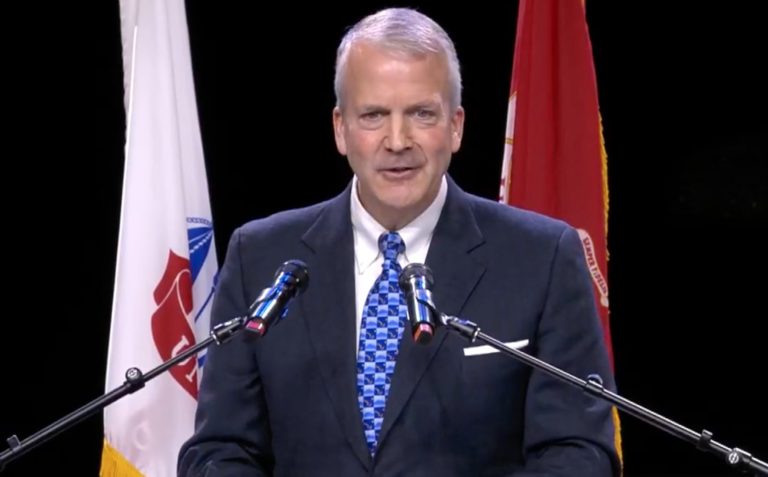
Sen. Dan Sullivan, a member of the Senate Veterans Affairs Committee, welcomed a report Monday that the Department of Justice has begun enforcing caps on the fees trial lawyers can charge in cases representing sick Marines and others impacted by water contamination at Marine Corps Base Camp Lejeune in North Carolina.

The caps, which were announced in September, came after Sen. Sullivan pressed the issue for more than a year in the Senate, and discussed the issue with U.S. Attorney General Merrick Garland two weeks prior to the announcement of caps by the DOJ.

On Monday, Bloomberg News reported that the DOJ had begun requesting attorney fee caps be enforced “following the guidelines in Federal Tort Claims Act, which limits attorney fees to 20% for administrative settlements, and 25% for claims resulting from litigation.”

The story highlight’s Sullivan’s role in working with Garland to institute the caps.

“In my eight years in the U.S. Senate, there are few issues I’ve been involved with that more desperately cry out for a just resolution. My Democratic colleagues fought hard to keep attorney’s fees caps out of the Camp Lejeune Justice Act, with the predictable result of unscrupulous trial lawyers trying to grab sixty to seventy percent of the compensation owed to sick Marines and their families, and spending hundreds of millions of dollars to lure Marines into these ultra-high contingency fee arrangements,” said Sen. Sullivan. “I’ve been fighting this injustice tooth and nail for over a year with legislation, unanimous consent requests on the Senate floor, and repeated engagement with the administration. I’m pleased to say, after several productive phone calls, the Attorney General agreed with me and the DOJ is now enforcing these caps.”

Sullivan thanked the U.S. Attorney General for “doing the right thing, and the countless Marines and Veterans Service Organizations (VSOs) who courageously spoke out and demanded Congress and the administration fix this. While this is excellent news for the thousands of Americans who suffered after serving at Camp Lejeune, I am still concerned that the new caps are too high, given the fact that Congress reduced the burden of proof for these cases, making them significantly easier to win. I’ll continue working with my colleagues to advance my Protect Camp Lejeune VETS Act to set these caps at a just and reasonable level and maximize the compensation for the individuals who actually deserve it.”

Marines and impacted individuals can seek compensation as a result of the Camp Lejeune Justice Act, which became law in August 2022 in the larger Honoring our Promise to Address Comprehensive Toxics (PACT) Act. In May 2022, the Biden Justice Department provided technical guidance on the PACT Act, recommending the legislation cap attorney’s fees.

During consideration of the PACT Act, Senate Democrats blocked votes on any amendments, including an amendment to cap legal fees. Since passage of the law, trial lawyers across the country have unleashed over a billion dollars in television ads and social media campaigns, seeking out Marines and other victims for Camp Lejeune-related cases and charging contingency fees reportedly as high as 60 percent.

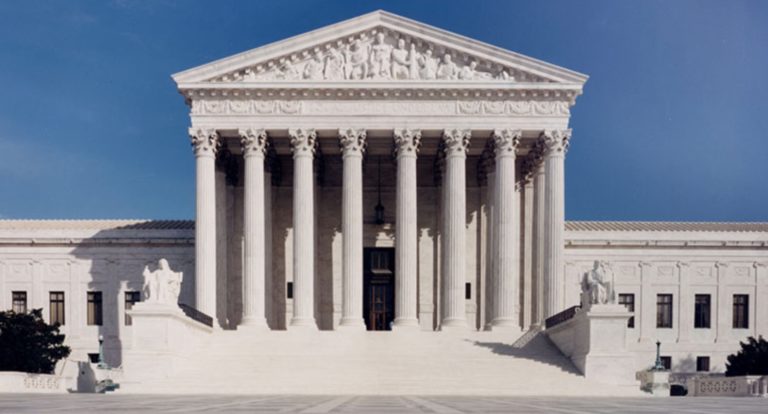
Supreme Court begins season that has First and Second Amendment cases

The U.S. Supreme Court started its winter season of discontent on Monday, with a case involving a tow truck, a borrowed car, and a stash of drugs belonging to someone.

In Culley v. Marshall, two women had cars being borrowed by someone who had drugs in them. When police pulled the drivers over and discovered the drugs, the cars were seized. It took a year for each of these women to get their cars back, and they suffered economic damage, unable to get to work and unable to pay bills. The case involves their right to due process.

In November, the justices are planning to hear a couple of First Amendment cases, and another involving the Second Amendment.

In  O’Connor-Ratcliff v. Garnier, the question is, can members of a school board block critics from seeing their personal Facebook and Twitter Accounts?

In the second case, the city manager of Port Huron, Mich. blocked a critic on his Facebook page. The critic had been writing about the manager’s poor handling of the Covid pandemic.

In another case before the court, the question is, can someone get a trademark on the “Trump Too Small” phrase?

In 2016, Sen. Marco Rubio of Florida, then a candidate for president, said Trump’s hand were small. Steve Elster attempted to register the phrase “Trump Too Small” and sell t-shirts with that printed on them to criticize the president. The U.S. Patent and Trademark Office denied his application, because it used the name of a living person who had not given permission.

The court will also hear a gun-rights case involving a Texas man who is challenging a federal ban on the possession of firearms by those who are subject to domestic violence restraining orders.

The Biden Administration appealed the case, known as United States v. Rahimi, after a federal appeals court invalidated the ban earlier this year. 

Zackey Rahimi, who had been involved in several shooting incidences, assaulted his ex-girlfriend in a Texas parking lot in 2019 and warned her that he would shoot her if she said anything about it to anyone. She did say something.

In February of 2020 a Texas state court issued a domestic violence restraining order against Rahimi, which by default prevented him from possessing firearms. He was warned by the judge that violating the order would be a federal felony.

The Rahimi is another moment when the high court may rule regarding the “history and tradition test,” that it had outlined in the earlier Bruen case in New York.

Petitions in search of signatures

What petitions are being circulated for the 2024 election cycle?

One of the most well-known would unwind the Ballot Measure 2 proposal from 2020 that brought open primaries and ranked-choice voting to Alaska, and ushered in Rep. Mary Peltola in the process.

“An Act to get rid of the Open Primary System and Ranked-Choice General Election” is the work of a conservative group called Alaskans for Honest Elections.

That petition asks voters if they want to reconsider Ballot Measure 2 and reinstate a political party primary and general election process that is easily understood. The political parties of Alaska would select their candidates through a primary process, as they did before 2022. Voters would vote for their preferred candidate, and then each preferred candidate from each registered political party would appear on the general ballot.

Alaskans for Honest Elections has until Feb. 7, 2024 to file petition booklets with the state with at least 26,705 legitimate voter signatures on them.

Alaskans for Honest Elections has been the subject of a legal complaint filed by the Alaskans for Better Elections group, which is the one that brought Ballot Measure 2 forth in 2020, and which is fighting Alaskans for Honest Elections.

More recently, Alaskans for Honest Elections has filed its own complaint against Alaskans for Better Elections, claiming election violations. The details are at this Alaskans of Honest Elections website.

Another initiative petition circulating would “increase Alaska’s minimum wage, provide workers with paid sick leave, and protect workers from practices that violate their constitutional rights.”

The minimum wage would be boosted to $13 in 2025, $14 in 2026, and $15 in 2027. The current minimum wage in Alaska is $10.85. Sponsors of the petition include Rep. Genevieve Mina, a Democrat who lives in Anchorage, and Ed Flanagan of Juneau, who is chair of Alaskans for a Fair Minimum Wage.

The petition wants employers with fewer than 15 employees to grant a week of sick leave with pay to workers. It also prohibits companies from requiring workers to attend religious or political meetings as part of their work hours. There are numerous other provisions in the initiative language that are not included in the ballot summary.

The group has until Sept. 13, 2024 to collect the 26,705 signatures it needs to put the question on the 2024 general election ballot.

“An Act restoring campaign contribution limits for campaigns for state and local office” is a new initiative petition now circulating. Its sponsors, including Rep. Calvin Schrage of Anchorage, David Monson of Alaskans for Better Elections, and former Attorney General Bruce Botelho of Juneau, are trying to reinstate campaign contribution limits. Alaska’s draconian limits were deemed unconstitutional and right now, there are no limits on how much one can give to any local or state candidate’s campaign; federal candidates fall under federal rules.

The actual limits the group suggests are spelled out in the initiative at this link. The group has until Sept. 1, 2024 to collect the needed signatures.

A recent petition application filed over the summer has been denied: “An Act preventing the expenditure of public funds for any process by which political parties select their official nominees or endorsed candidates for office” is another initiative petition circulating. This petition is a way to support the much-maligned Ballot Measure 2, which bought Alaska open primaries. It basically would prevent the state from expending any money to assist the political process in political parties. How this plays out in practical terms is unclear, since parties already pay for their own conventions and presidential preference polls. It would almost certainly create havoc with the Division of Elections if the division was not allowed to even assist political parties, for instance, if they need help understanding the process. It was an initiative in search of a problem.

Sponsors were former Attorney General Bruce Botelho, former Sen. Lesil McGuire, and Juli Lucky of Alaskans for Better Elections, along with election attorney for Alaskans for Better Elections Scott Kendall.

Exports of civilian firearms, ammunitions paused for 90 days

The United States Department of Commerce’s International Trade Administration has paused the export of certain civilian firearms and ammunition for 90 days.

The department on Friday said it will review protocols to ensure firearms are not being diverted to “entities or activities that promote regional instability, violate human rights, or fuel criminal activities.”

The agency will assess current firearm export control review policies to determine whether changes are warranted “to advance U.S. national security and foreign policy interests during the 90-day pause,” the department said in a statement Friday.

“Effective immediately, the U.S. Department of Commerce (the Department) is pausing for approximately 90 days the issuance of new export licenses involving certain firearms, related components, and ammunition under its jurisdiction and the provision of new export assistance activities for such products to all non-governmental end users worldwide, apart from those in certain destinations,” Commerce said.

During this “pause” period, the Department will “further assess current firearm export control review policies to determine whether any changes are warranted to advance U.S. national security and foreign policy interests. The review will be conducted with urgency and will enable the Department to more effectively assess and mitigate risk of firearms being diverted to entities or activities that promote regional instability, violate human rights, or fuel criminal activities.”

International Trade Administration simultaneously will review its export assistance policy to ensure that its export assistance is consistent with applicable export controls and does not undermine U.S. policy interests.

The pause applies to the Bureau of Industry and Security’s issuance of new licenses involving certain firearms, related components, and ammunition controlled on the Commerce Control List.

The pass applies to firearms and ammunition to end-users worldwide, except for Ukraine, Israel and Country Group A:1, which can be found on this government list. Countries like Argentina, Luxembourg, Canada, Belgium, Italy, and Japan are found on the A:1 list. Israel is not on the list and neither is Ukraine, although Mexico is.

The pause applies to semi-automatic and non-automatic firearms, shotguns, and receivers (frames) and ammunition.