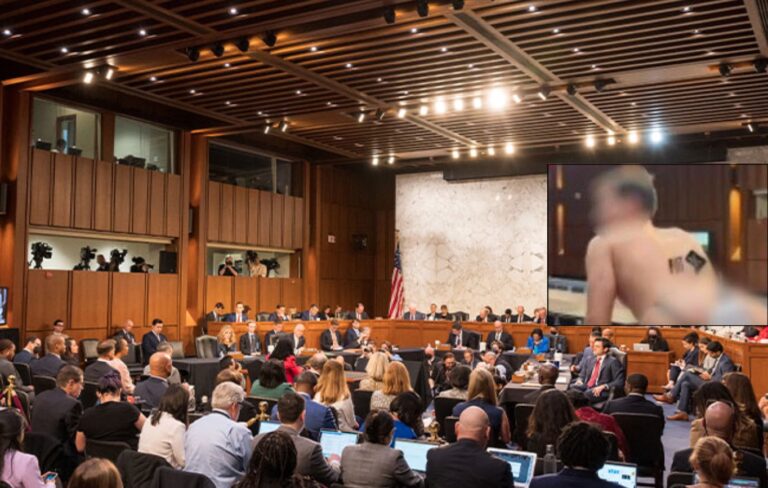
A leaked pornography video shows what appears to be a congressional staffer, who has been identified by many on the Hill, having anal sex with an unknown man in a Senate hearing room in the Hart Building. The footage was obtained and exposed by The Daily Caller.
One of the caucusing staffers can be seen in a photo, naked on all fours, looking back at the camera on the table where senators facing the audience and testifiers during hearings. He appears to be the recipient of an unprotected railing, the news outlet wrote.
A source identified the room to The Daily Caller as Hart 216. The Daily Caller blurred out the man’s face because his identity had not been confirmed, but his name is being widely shared on social media.
The news story has been picked up by other media, such as Breitbart News, which claims one of the men is a staff aide to Democrat Sen. Ben Cardin of Maryland, who recently led a group of mainly Democrat senators and Republican Sen. Lisa Murkowski on an official trip to the climate change summit COP 28 in Dubai.
The Washington Examiner and Free Beacon also wrote about it.
But The New York Times did not, and neither did The Washington Post.The New York Times, whose motto is “All the News That’s Fit to Print,” led with a story Saturday on global debt, and the Washington Post, whose motto is “Democracy Dies in Darkness,” wrote about Israel accidentally killing three hostages that had been held by Hamas since Oct. 7.
“If Republicans desecrated the halls of Congress by peacefully walking through them on January 6th. What the hell do you call it when 2 Democrat staff members are F*cking each other in the *ss in a Senate hearing room?,” wrote one person on X/Twitter, who identifies himself as a conservative.
Another man, who identifies as a liberal, posted his response, “‘Conservatives retweet gay porn’ was not on my expected list to accompany my morning coffee this AM.”
Monica Crowley, former Assistant Treasury Secretary and former Fox News contributor, wrote, “Cocaine, topless trans activists & communist dancers in the White House, Dem staffers having gay sex in a Senate hearing room, a Satanic statue in Iowa, anti-Semitic terrorist sympathizers in the streets & university corner offices… The Left is doing a bang-up job on America.”
Sen. Cardin gave the Washington Examiner in a statement, “We have seen media reports. As this is a personnel matter and under review, we will not be commenting further at this time.”
The Senate staffer who has been widely named in the activity at this point hinted that he may pursue legal action after he was named on social media.
Sen. Dick Durbin of Michigan is the chair of the Senate Judiciary Committee; Cardin does not serve on that committee.
It’s not known when the pornographic clip was made, but the most recent three hearings in the room happened earlier this week, before the Senate adjourned for the holiday break. The hearings were on:
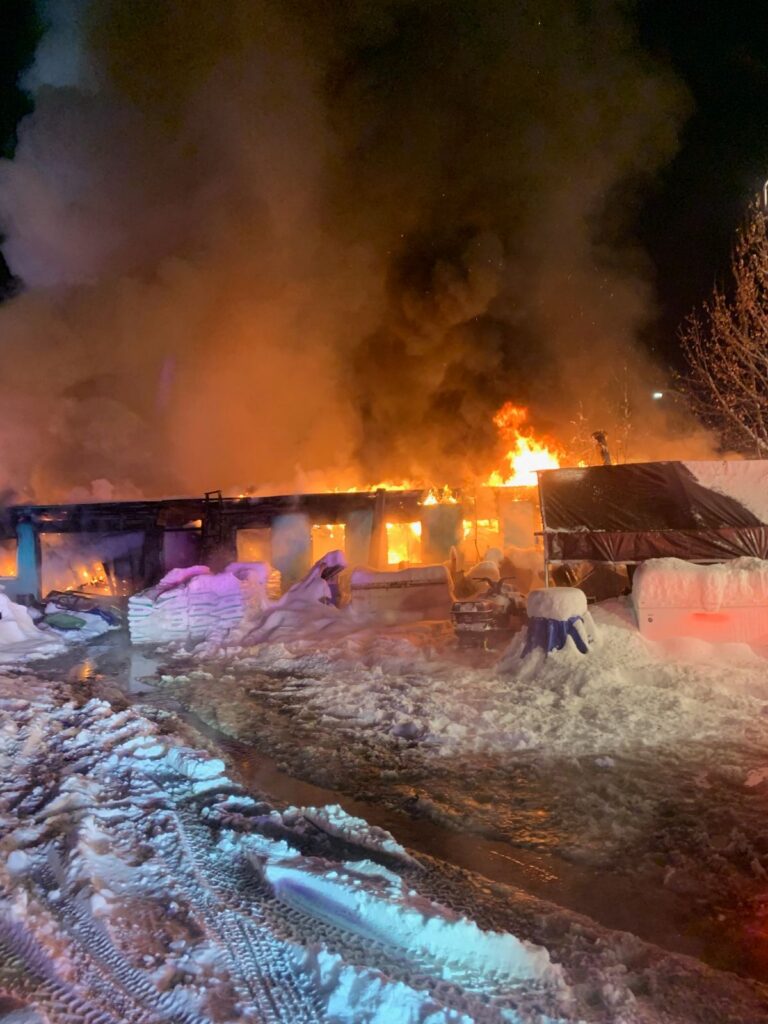
Fairbanks Fur Tannery, owned by Board of Game member Al Barrette of Fairbanks, exploded and burned on Friday night. Located on Peger Road, the inferno happened in what was once the Bachner Air Services/ Texaco hangar. The explosion and blaze was witnessed by several people from as far away as Farmers Loop.
Early reports indicate that no one was in the building at the time of the fire. Fire trucks were on the scene after 6:30 pm, and the outside temperature was around -6. Observers in the area said the explosion was just before 8 pm.
Barrette was appointed to the Board of Game by Gov. Mike Dunleavy in 2019. He is a fur dresser by trade, a Class A assistant big game guide, and a veteran of the U.S. Army. He has been involved in fish and game regulatory matters since the 1990s, and has been a member of several working groups, including the Fortymile Harvest Management Coalition, the Western Arctic Caribou Herd Working Group, the Wood Bison Restoration Advisory Group, and the Dall Sheep Working Group.
This story will be updated as more information is available.
Michael Daniel, a Republican from Homer, has filed with the Division of Elections to challenge Rep. Sarah Vance for House District 6, Homer, Seldovia, Ninilchik, and Kasilof, where Vance has been the representative since 2019, when she retired former Rep. Paul Seaton.
Daniel is a Republican, like Vance. He is the chair of the Homer Chamber of Commerce’s board of directors. He is a veteran of the U.S. Marine Corps and the Navy. After growing up in Anchorage, he served in the military for 20 years, before moving to Homer in 2018.
Because of the new open primary and ranked-choice general election, Republicans don’t have the ability to sort out their nominee in the August primary. Instead, the top four candidates for a seat proceed to the November General Election, regardless of party.
A movie that depicts a dark view of America’s future, as it splits apart into tribes of values — conservative vs. liberal — is previewed by a trailer posted on YouTube. The movie itself will be released in the spring, during what is likely to be another deeply contentious presidential election.
In the trailer, viewers learn that the premise is that 19 states have seceded from the union. Those who have seen civil war in other nations know this does not happen without bloodshed.
Director Alex Garland directs the dystopian political thriller with the tagline “All Empires Fail,” set in the near future, a time when factions from Texas and California clash for control of the White House and revolutionaries attempt to infiltrate Washington, D.C., which is a fortress of fortification.
In stark contrast to Anchorage School District policies, the Mat-Su School District has developed a way for parents to be informed and have the ability to approve of the books their children are checking out of the school libraries.
The Valley district sent notices home on Thursday to parents, explaining the new process, which is something parents can opt-into, but at their own discretion.
“We want to keep you informed about an important update to ensure you have control over your student’s library reading choices in the MSBSD,” the district wrote.
Under Board Policy 6020, the School Board described the role of parents and guardians as “key stakeholders in their children’s education—they are their children’s first and most influential teachers. Parental engagement in the education of children contributes greatly to student achievement and conduct.”
Along with other board policies, the District is providing this new option to parents so that they can be involved in their student’s reading choices.
“If you wish to require parent permission for your student to check out any book from the library, please review the process detailed below (no action needed if you’re not interested in required parent approval). This option is available in ParentVUE and instructions for requiring permission are attached to this letter. If you need support, please contact your student’s school or the IT call center (761-4357) Monday-Friday 8AM-4PM,” the district said.
I put together a 5-part series in Alaska Politics and Elections Online (APEOnline) summer 2021 exploring the ongoing war between the Alaska Railroad and property owners along its tracks. It was a fascinating journey in predatory corporate behavior and bullying aimed at its neighbors. My conclusion was that Alaska Railroad was unnecessarily ugly and really needed to tone the nastiness down.
A follow-up piece last summer explored Alaska Railroad playing footsie with the Long Trail supporters as the use of the Alaska Railroad right-of-way is only way one can construct a trail system from Fairbanks to Seward, something that is illegal under federal law today.
There was some movement between August and September in the Flying Crown Homeowners Association v AKRR case, as the Ninth Circuit Court of Appeals rendered a jaw-droppingly awful opinion that rewrote 150 years of federal law, ignored previous U.S. Supreme Court opinions, granted the railroad exclusive use rights-of-way along their tracks, something that doesn’t exist for any other railroad in the US.
Given the awfulness of Ninth Circuit opinions over the last half century, this opinion is no surprise. Happily, the process is still underway, with at least one appeal to the entire Ninth Circuit available and following that a trip to the Supreme Court is still possible.
My question is: What has the Alaska Railroad done in response to their big wins in court? Has their behavior changed? If so, how?
It took a while to get a straight answer from my sources, not because of a lack of activity from the Alaska Railroad, but rather due to teeth-numbing anger and frustration from hundreds of abused property owners living along the tracks from Anchorage to Fairbanks.
Before reviewing the action this summer, a review of railroad rights-of-way is in order.
A normal right-of-way allows the right-of-way owner access to the property of the owner. Think of a utility right-of-way in your backyard. Per U.S. law, the standard 200’ wide railroad right-of-way allows the railroad to keep tracks and immediate beds clear of all obstructions. The total width is intended to keep accidents from being deadly to bystanders. The closer you get to the tracks, the more limited your ability as a property owner is to build structures or plant trees.
The question arises: Did the Alaska congressional delegation at the time (Sen. Ted Stevens, Sen. Frank Murkowski and Rep. Don Young) legislatively commit a legislative taking, literally stealing property from the property owners along the Alaska Railroad tracks? The answer to this is clearly no, despite Alaska Railroad claiming exclusive use of the right-of-way for nearly a decade. The phrase “land thieves” comes to mind, should you want to get into the name-calling business.
What happened last summer?
The latest flash point was brush clearing along the tracks. Two summers ago, when the crews showed up from Nancy Lake to Talkeetna, they did their brush clearing working with the property owners to retain trees clearly a distance away from the tracks, but within the 200’ easement.
Last summer, that notification, negotiation ended, and the crews simply mowed everything in the easement, removing all trees and natural fences grown over the years, infuriating the property owners. They returned to properties manicured two years ago for a second round. Property owners were neither consulted nor listened to when the crews showed up. Happily, nobody got shot.
Did this matter to the Alaska Railroad? Hardly.
The railroad logic appears to be take advantage of the opening the court gifted them by cleaning up their list of outstanding work to do, and if the opinion is subsequently reversed, you can expect their response to be some variation of: “Oopsie. Our mistake. So sad. Too bad. Sucks to be you.”
There are other festering issues with the Alaska Railroad. One of the worst may be the right-of-way patent accepted in 2006 by the railroad that put a cloud on all other property titles (homestead patents, for instance) along the rail lines. That will be a topic for another piece.
The Alaska Railroad has been an intentional bad actor along the Railbelt for the last decade, acting the bully on a regular basis, bashing its neighbors and converting a lot of supporters into former supporters. Now that they think they have ownership of their rights-of-way, they are being even uglier to their neighbors. Any business, even a state-owned business that goes feral and chooses to intentionally pick fights with their neighbors and customers will not be long for the competitive world. Neither should the Alaska Railroad. Should they keep this up, we will shortly be in a discussion on the question: “Is the Alaska Railroad is simply too nasty to exist?”
Depending on the outcome of that discussion, it will be time to do something about them.
In the meantime, what are our options? With a problem like this, normally, one would get the Legislature involved. The problem with that approach is that the Alaska Railroad typically ignores the Legislature — that is, until they need more money or some legislation. Today, the best handle on their behavior is the governor, who appoints their board of directors.
With that in mind, it is long past time for the governor to conduct a thorough housecleaning of the AKRR Board and appoint members who are just as interested in their moral and legal responsibilities as they are in targeting their neighbors. Gov. Mike Dunleavy can solve this. It is long past time he do so.
Final thoughts: I have been working in the political wars for over 30 years in this state and have seen a lot of anger on both sides of the political fence. But the level of outrage, anger and frustration from property owners of all political stripe along the Alaska Railroad right-of-way is orders of magnitude beyond anything I have encountered during that time. In a lot of ways, the Alaska Railroad is acting like the Chinese Communist Party, simply stepping on people because they can and giggling about it afterwards.
Gratuitous ugliness is hardly a positive lifestyle choice or profitable business model. Just because you can do something doesn’t mean you should.
Alex Gimarc lives in Anchorage since retiring from the military in 1997. His interests include science and technology, environment, energy, economics, military affairs, fishing and disabilities policies. His weekly column “Interesting Items” is a summary of news stories with substantive Alaska-themed topics. He was a small business owner and Information Technology professional.
Elon Musk’s remark, “What I see all over the place is people who care about looking good, while doing evil,” delves into the complex reality between outward appearances and moral conduct. “Caring about looking good,” he suggests, is an empty pursuit, a mere front devoid of intrinsic value.
“What I care about is the reality of goodness, not the perception of it – and what I see all over the place is people who care about looking good while doing evil” – Elon Musk pic.twitter.com/sVvR6arCKe
However, the heart of the matter lies in the consequential descent into malevolence that often accompanies the contest for superficial righteousness.
Edmond Burkeis credited with the phrase, “The only thing necessary for the triumph of evil is for good men to do nothing.”
Burke’s wisdom is reflected in Musk’s observation, illuminating the inaction which allows injustice and immorality to endure. Burke implies that when we witness wrongdoing yet abstain from taking a stand or intervening, we become complicit in perpetuating objectionable actions. We all do it. It is part of human nature. Our silence and inaction, driven by a desire to “look good” or preserve a veneer of moral rectitude, or perhaps just to avoid trouble, set in motion a subtle cycle where personal image overrides the imperative to uphold what is right.
And what is right? Doesn’t it involve actions or interventions aligned with ethical principles, showcasing moral responsibility, and contributing to societal improvement?
Does it denote a commitment to values transcending mere appearances, prioritizing substantial, ethical behavior, even when confronted with the challenges of addressing wrongdoing or injustices?
This insidious cycle intricately links to the deceptive nature of our sins, as Burke eloquently posits. The enticing allure of vanity blinds us to the reality of our moral lapses. Cloaked in self-importance and the need to project an unsullied image, our sins deceive us into believing that our inaction or complicity is justified. Vanity becomes the smokescreen through which we rationalize moral shortcomings, perpetuating a cycle of self-deception.
Again, we all do this. However, in America, in Alaska, and in Anchorage, it has become a full-time vocation for many of our political and corporate classes.
In essence, Musk’s insight, entwined with Burke’s wisdom, cautions against the peril of prioritizing appearances over ethical responsibility. It serves as a reminder that the path to moral turpitude is often paved with the good intentions of maintaining a pristine image. To break free from this cycle, one must confront the uncomfortable truth that true virtue lies not in looking good but in actively striving to do good, even when faced with the unmasking of our own vanities.
Volunteers at the recent Financial Reality Fairin Anchorage observed that high school students in attendance could not do the simple mental math needed to decide whether a role-played financial transition would be good for them or not.
The Financial Reality Foundation has been involved in presenting these and other opportunities for students to discover the real world of personal finances since 2011. Coincidentally, the Alaska Children’s Trust, which has been around since 1997, reported on its website that 76% of Alaskan 4th graders are not proficient in reading and 77% of 8th graders are not proficient in math in 2023.
In contemplating the moral dilemma presented by these observations, a stark reality surfaces—one that transcends mere financial literacy. The dilemma lies not only in the students’ struggle with basic financial concepts but extends to the broader educational landscape and its profound implications for the future of Anchorage, Alaska, and the United States.
At the heart of this quandary is the juxtaposition of two organizations: the Financial Reality Foundation, diligently working to equip students with essential financial knowledge, and the Alaska Children’s Trust, grappling with alarming statistics about academic proficiency. The convergence of these entities highlights a disconcerting narrative that unfolds against the backdrop of education and its multifaceted challenges.
The Financial Reality Foundation, with its commendable efforts since 2011, seeks to bridge the gap between theoretical classroom learning and the practicalities of personal finance. Yet, the irony is palpable when, despite these initiatives, students find themselves unable to add or subtract simple numbers in their heads.
The students invariably reached for their phone calculator to figure the answer to 700 minus 10, or 680 plus 30.
And so arises the question of whether financial literacy programs alone can address the broader educational disparities that seem to plague Alaska’s youth.
The statistics reported by the Alaska Children’s Trust in 2023 deepen the moral quandary. A staggering 76% of 4th graders lacking proficiency in reading and 77% of 8th graders struggling with math show the systemic issues that extend beyond the scope of financial education. The very foundation of academic proficiency appears shaky, raising concerns about the overall effectiveness of the education system.
In navigating this moral labyrinth, we must confront the interconnected nature of these challenges. Financial literacy, while crucial, cannot exist in isolation. The proficiency deficits identified by the Alaska Children’s Trust suggest systemic shortcomings that demand a holistic approach to education reform. The moral imperative, therefore, extends beyond financial education to encompass a broader commitment to enhancing the overall quality of education, addressing disparities in foundational skills, and fostering a supportive environment for academic growth.
As we grapple with the moral dilemma laid bare by these educational deficiencies that have been obvious to the public for over a decade, the call to action becomes clear, yet unheard and it is a lot worse than just “looking good.” It is not merely about refining financial literacy programs but about advocating for comprehensive educational reform.
Is our state Legislature filled with “people who care about looking good while doing evil”?
Only through a concerted effort to bolster foundational skills in reading, math, and critical thinking can we pave the way for a generation capable of navigating not only financial realities but the complexities of the world they inherit.
Michael Tavoliero is a senior contributor at Must Read Alaska.
Traveling through Canada? Don’t be surprised if you find tampons available in restrooms marked for men. A new law goes into effect in Canada on Dec. 15: All restrooms, regardless of gender, must provide menstrual products. The new law specifies that this is to make sure menstruating employees can use the toilet that “best reflects their gender.”
The exact wording from the government of Canada:
Menstrual products in all toilet rooms
“The regulations specify that menstrual products must be in all toilet rooms, regardless of their marked genders. This means that every female-identified, male-identified and all gender toilet rooms will need to have menstrual products. Unrestricted access to menstrual products better protects menstruating employees and makes sure that they feel safe to use the toilet room that best reflects their gender.
“Employers must also make sure a covered container for disposal of menstrual products is provided. A disposal container must be placed in each toilet room that has one toilet. In rooms with multiple toilets, a disposal container must be in each toilet stall.”
It’s out with the old traditions, and in with the non-holy holidays as the Biden White House erased the Christ from Christmas altogether this year.
Now, Christmas is just another show. It’s a cabaret Christmas, with tap dancers in a variety of garish costumes tapping through the White House holiday displays straight out of Weimar Republic’s cabaret scene. Is history repeating itself?
A bit of magic, wonder, and joy brought to you by the talented tappers of Dorrance Dance, performing their playful interpretation of The Nutcracker Suite.
The video did not get the warmest of welcomes on X/Twitter, where it was featured by the White House, as critics noted how it debased Christmas and eliminated taste altogether.
The Biden White House featured a twerking bunny at an Easter celebration and topless transgenders on the White House lawn for Pride month.
Gritty twerking at the White House on Easter as the FBI sends its agents to spy on Catholic churches is so 2023pic.twitter.com/ajKvoijyQ0
Pride Month celebration at the White House with topless transgenders.
Critics also compared the Biden Christmas decorations video to the one produced by First Lady Melania Trump during the Trump Administration, which was criticized by liberals as cold and lifeless, but praised by others as classy and respectful:
Melania Trump’s decorations of the White House in 2019 were incredible. Christmas had class. pic.twitter.com/HvZikFFIfX