Sunday, August 16, 2026
Home Blog Page 553

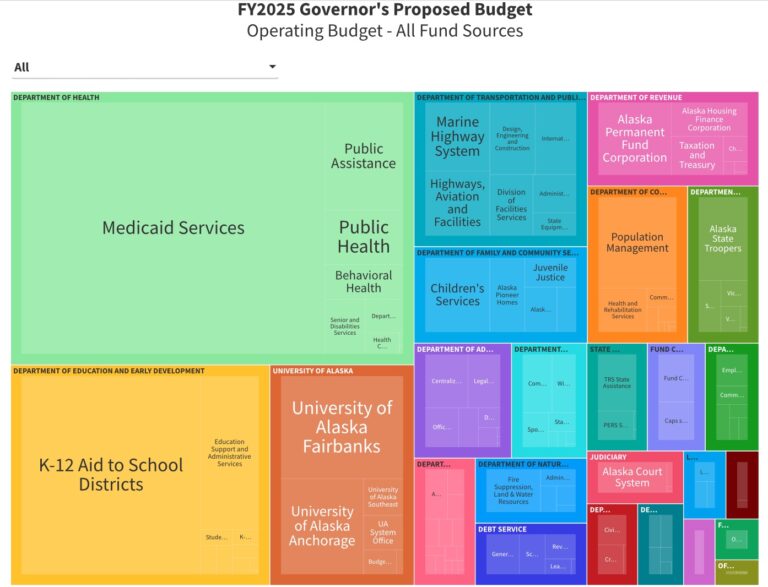
Check out the graphics: Governor proposes $13.9 billion budget for next fiscal year, $3,400 full PFD

The governor’s proposed budget is $13.9 billion for Fiscal Year 2025, which starts July 1. Based on forecasts of reduced oil prices and production, this creates a budget deficit of $987 million that will be covered by a draw from the Constitutional Budget Reserve and the Statutory Budget Reserve, he said today.

As he has every year, he proposes a full Permanent Fund dividend of about $3,400. He is proposing no new taxes, and although has not added to the school formula, has a one-time increase for education, something he has done every year.

One of the more interesting aspects for Dunleavy’s budget announcement are the interactive graphics his office prepared, so that Alaskans can go beyond the media and study the budget for themselves.

This is the first time in Alaska history the Governor’s Office has posted such exquisitely produced, easy-to-follow, and visual detail so people can delve right in without mainstream media interpreters.

Of the media interpreters, the Anchorage Daily News led by casting the budget darkly, saying that his spending plan has a $1 billion deficit and no new revenue sources, and that the governor blamed the federal government for the reduction in proceeds from resource extraction.

Anchorage School Superintendent Jharrett Bryantt posted an immediate response, expressing his deep disappointment in the education budget, which is a major portion of state spending. In addition to the statutory formula, Dunleavy added on millions for construction and maintenance, millions for reading programs, and millions for teacher recruitment, retention, career and technical education.

But as with last year’s budget, the proposed dividend is unlikely to pass the House and Senate in its current form. Since Gov. Walker cut the dividend in 2016, the Legislature has followed suit and cut it dramatically almost every year. It’s highly unlikely, therefore, that there will be a $3,400 dividend when the dust settled, presumably by the end of April or early May.

In terms of the full dividend, Dunleavy said the court ruled that the Legislature doesn’t have to follow the law, but the court didn’t say the Governor’s Office doesn’t have to follow the law, and so he is going with the statutory formula every time, using a conservative interpretation of what was decided by the Alaska Supreme Court.

Highlights from the Governor’s proposed budget include:

Public Safety 

  • – 10 additional Village Public Safety Officer positions and VPSO salary increases
  • – Three new investigators at Alaska State Troopers focused on crimes against children
  • – Four investigators at AST fully dedicated to investigating missing and murdered Indigenous persons
  • – Acquisition of a single engine turbine-powered all weather aircraft (Pilatus PC-12NG) for statewide Public Safety operations
  • – Replacement of a patrol vessel for Southeast Alaska to respond to emergencies, search and rescue operations, and enforce laws and regulations protecting coastal Alaska communities.

Education

  • – Statutory funding for school districts according to the Foundation Program, Pupil Transportation, and School Debt Reimbursement formulas in statute.
  • – $8.3 million for school construction and major maintenance.
  • – $5 million for the Alyeska Reading Academy and Institute.
  • – $1.5 million for Teacher Recruitment, Retention, Certification and Apprenticeship Development.
  • – $1.5 million for continued Career and Technical Education Initiative.

Food Security

  • – Funding for 30 permanent, full-time Eligibility Technician positions within the Department of Health to process SNAP applications.
  • – $5 million to food banks and food pantries across Alaska to increase food security.

Housing

  • – $25 million for Alaska Housing Finance Corporation Downpayment Assistance Grants primarily utilizing AHFC dividends.
  • – $62.6 million for AHFC annual housing programs.

The Governor’s FY2025 proposed budget also includes investments in infrastructure and economic development providing both immediate and long-term benefits to Alaskans.

Transportation

  • – Matching funds for Alaska Marine Highway ferry replacement grants using Federal toll credits.
  • – $2.5 million for Statewide PFAS Fleetwide Equipment Foam Replacement.
  • – $915,000 for contracted urban snow removal when unexpected snowfall exceeds existing operational capacity.

Law

  • – $1.9 million and 10 positions to expand consumer protection investigations, address child protection cases, assist with drug prosecutions and assist with grand jury investigations.
  • – $2 million to support continued statehood defense efforts across multiple agencies.

Cornel West, independent candidate, says he will be on Alaska ballot for president in 2024

Independent candidate Dr. Cornel West, backed by Alaska’s Aurora Party, says he has obtained ballot access in Alaska for the 2024 U.S. presidential election, which would make him the first Independent candidate in the state to do so.

In fact, the Aurora Party has submitted its paperwork to the Alaska Division of Elections to have West appear as a candidate, but it has not yet been processed by the office, and doesn’t appear on the division’s website.

If he does appear on the ballot for the 2024 election, he would likely peel away votes from the Democratic nominee, presumably President Joe Biden since he is considered a socialist by most standards.

“We’re fighting for a society where public welfare is prioritized over private profit, where our environment is protected, where poverty is abolished, and where every vote counts by implementing rank choice voting. As part of the Aurora Party nomination and party line ballot access, it’s a profound honor to be the first independent candidate on Alaska’s ballot for 2024. Immense gratitude to my Alaskan family for championing this cause. Alaska, you’re not just on the map, you’re leading the march for justice and truth,” West said in his press release.

One of the things that West said he would do, if elected, is to raise the Alaska Permanent dividend to $10,000 per Alaska resident, which he could only do by nationalizing the Alaska Permanent Fund Corporation.

“We’re honored to be the first state in the nation to place Dr. West on the ballot. He will be a President with the moral clarity and strength to institute a new national government with working and poor people as its priority. Alaska has a robust and independent spirit, and we will win for the Independent Dr. West in November,” the Aurora Party of Alaska said in the press release. Marc Belk of Anchorage is listed as the party’s state chair.

West also said his use of the Permanent Fund would influence a move toward a universal basic income in Alaska.

And his press release indicates he would work to crush the oil industry that created the Alaska Permanent Fund.

“Enhancing his commitment to the environment, Brother West calls for an immediate moratorium on all oil and gas leasing, with a focused effort on fully protecting the idyllic Arctic National Wildlife Refuge (ANWR), including the cultural resources deemed essential to the continuation of Alaska Native’s way of life. This approach is in line with the critical need for environmentally sustainable practices that consider an increasingly perilous climate crisis that’s already distributing adverse impacts statewide, and disproportionately on Alaska Native and other environmental justice communities. Specifically, Brother West will cancel the controversial and climate killing Willow project as well as proposed geoengineering projects,” he said.

West is known for his focus on race, gender, and class struggle in American society. He has described himself as a “non-Marxist socialist” and served as honorary chairman of the Democratic Socialists of America.

“Highlighting his commitments to indigenous communities nationwide, Brother West’s campaign focuses on obtaining Free Prior and Informed Consent from Alaska Natives before initiating any projects or initiatives on their sovereign territory. This approach will, in part, ensure that Alaska Natives play a central role in decisions affecting their territories and cultural heritage.”

“Our alignment with the Aurora party’s platform is very congruent with our own Policy Pillars, a commission to study and implement Universal Basic Income, dedication to climate action, environmental justice, and respect for Indigenous sovereignty, and overall, I am confident that both of our approaches offers a new direction for political initiatives not just in Alaska but throughout the United States, I am honored and humbled to be in partnership with them and look forward to getting to work to win the State of Alaska next November.”

The Aurora Party qualifies as a “limited political party” in Alaska. In order to have West as its candidate, it is required to have a petition to establish itself with at least 3,614 qualified voters, based on the number of ballots cast for president in the 2020 presidential election, which was 361,600.

Limited political parties are governed by Alaska Statue 15.30.025, and a copy is enclosed for your review. To establish a limited political party, a petition must be submitted to the Division of Elections at least 90 days before a Presidential General Election. That date is August 7, 2024 for the 2024 General Election. It must be signed by qualified voters of the State of Alaska equal to at least one percent of the number of voters who cast ballots for President at the last Presidential Election. The number of ballots cast for President in the 2020 Presidential Election was 361,400. Therefore, the number of qualified signatures required on the petition must be at least 3,614.”

As for his “independent” status on the ballot, the law says he may have applied a few weeks too soon:

“A person may also file as an independent candidate for President of the United States by filing a petition with the Director of Elections not earlier than January 1 of a presidential election year and not later than the 90th day before a Presidential General Election. That date is August 7, 2024 for the 2024 General Election. The petition must be signed by qualified voters of the state equal in number to at least one percent of the number of voters who cast ballots in an election under AS 15.30 for President of the United States at the last Presidential General Election. The number of ballots cast for President in the 2020 Presidential Election was 361,400. Therefore, the number of qualified signatures required on the petition must be at least 3,614. The petition must state that the signers desire the named candidate for President of the United States to appear on the ballot as an independent candidate for president at the next succeeding Presidential General Election.”

Also, according to Alaska Statute, in order to appear on the ballot, a candidate who has qualified for ballot status under AS 15.30.026(a) must certify to the Director of Elections on or before Sept. 1 of the year of the presidential general election:

  • – the names of the electors for the independent candidate for president of the United States, equal to the number of senators and representatives to which the state is entitled in Congress;
  • – the name of a candidate for vice president, selected by the independent candidate; and
  • – the name, Alaska mailing address, and signature of the candidate’s state campaign chair, who must be an Alaska resident.

State fall revenue forecast released: $6.5 billion

The Department of Revenue released of the Fall 2023 Revenue Sources Book, a report that shows where money will be coming from for the State’s budget, including Revenue’s latest forecast for oil price, oil production, and tax revenue.

Unrestricted General Fund revenue, before accounting for the operating transfer from the Permanent Fund Earnings Reserve, is forecast to be $3.0 billion for Fiscal Year 2024 and $2.7 billion for Fiscal Year 2025.

The Permanent Fund is set to transfer $3.5 billion to the General Fund for FY 2024 and $3.7 billion for FY 2025. These amounts include funds available for general government spending and annual payment of dividends to qualifying Alaska residents.

For FY 2024, the total is $6.5 billion. That number will factor into Gov. Mike Dunleavy’s proposed budget, which he is releasing on Thursday.

The Permanent Fund operating transfer remains a large source of funding to the General Fund, contributing 48% of undesignated general funds for FY 2023 and projected to contribute a range of 54% to 62% for each of the next 10 years, the report says. 

In FY 2023, the Alaska North Slope oil prices averaged $86.63 per barrel. The Fall revenue forecast incorporates the most current indicators from the financial markets and is based on an annual average ANS oil price. The ANS oil price for FY24 is projected at $82.39 per barrel and $76 for FY 2025. Oil prices are expected to decline beyond FY 2025, stabilizing at $70 per barrel by FY 2033.

In FY 2023, ANS oil production averaged 479,400 barrels per day.  ANS oil production is expected to average 470,300 barrels per day for FY 2024 and 463,800 for FY 2025, respectively, before climbing to 633,000 barrels per day by FY 2033. 

Since the department’s Spring 2023 Revenue Forecast, released in March 2023, the ANS oil price forecast has increased by $9.39 per barrel for FY 2024 and $6 per barrel for FY 2025. 

The ANS oil production forecast decreased by 26,100 barrels per day for FY 2024 and by 34,200 barrels per day for FY 2025.  Driven by the revised outlook of oil price and production, the Unrestricted General Fund revenue forecast increased by $228 million for FY 2024 and $79 million for FY 2025.  

The Revenue Sources Book is available on DOR’s website at www.tax.alaska.gov.

Kelly Tshibaka: Fighting for justice at the Justice Department

By KELLY TSHIBAKA

The trust of the nation rests in the hands of the people who compose the Department of Justice. It is a complex institution with intricate mechanisms and extensive responsibility for securing public safety across America.

Navigating these complexities requires exceptional wisdom, particularly when the Justice Department uses its power in ways that are unjust and intended to subvert the commander-in-chief elected by the people of the United States.

In a recent interview on STAND with Kelly & Niki Tshibaka, former acting attorney general of the United States, Matt Whitaker, shared his experiences, insights, and the challenges he faced during his tenure as the head of the Justice Department during the Trump Administration. 

Whitaker revealed how the bureaucratic elites within the department recklessly bent, broke, and twisted the law, undermining the U.S. Constitution, in order to subvert the rightful authority of a U.S. president they chose to despise. He detailed these experiences in his book, Above the Law.

Whitaker was not new to the Department of Justice, but came with an outsider’s perspective. During the interview, he reveals the formidable tasks he encountered as a prosecutor, particularly in his fight against child pornography and human trafficking. But despite the massive challenges he faced, his teams achieved huge victories. 

Whitaker credited those successes to following the rule of law and case law: “The path to justice is actually a well-worn path.” He also contrasted it with some of the prosecutorial decisions occurring in current cases against Trump that stretch the law “well beyond its snapping point, and there’s no case law on this because nobody’s ever done a case like this.”

Whitaker also underscored the absolute necessity of adhering to well-established laws and ethical responsibilities in the pursuit of justice. The adherence to the rule of law, regardless of the individual or situation in question, is fundamental to maintaining a fair and just society. He noted that in President Donald Trump’s cases, prosecutors and judges are not consistently following the rule of law, case law, or legal ethics.

Switching gears to the current state of affairs under the Biden Administration, Whitaker discussed the escalating crisis of human trafficking and the rise in fentanyl-related issues. He expressed concern that Biden’s open border policies were exacerbating these issues. 

On a broader scale, Whitaker highlighted the weaponization of government and the urgent need for accountability. Holding government agencies accountable for their actions is a crucial aspect of democracy. Whitaker shared his firsthand account of the actions he witnessed within the Department of Justice, discussing his book, Above the Law, which details the weaponization of law enforcement agencies. Whitaker’s insights on the abuses that occurred at the Department of Justice remind us of the importance of standing firm in our pursuit of justice and maintaining a vigilant eye on those in power.

Matt Whitaker’s interview on STAND presents a fascinating exploration of the complexities of social justice in modern society. His experiences, insights, and expert perspective offer valuable understanding of the challenges and responsibilities inherent in the pursuit of justice and equality of rights. By standing firm and strong, we can contribute to the fight for justice and freedom in America.

Kelly Tshibaka is the host of the podcast, TV, and radio show STAND, and the 2022 Alaska Republican candidate for U.S. Senate. She co-hosts the show with her husband, Niki Tshibaka.

Downing: Elon Musk’s Starlink bridges the rural digital divide, but Biden’s FCC is stuck on stupid

By SUZANNE DOWNING

Look up in the night sky this month: It’s the Geminids meteor shower putting on a show … or it just might be a Starlink satellite orbiting to provide communications connectivity to rural America.

For good or ill, America is increasingly dependent on digital connectivity. But as West and East coasts have locked in high speed broadband, vast portions of rural America were left behind, struggling with unreliable or nonexistent internet access. 

Enter Starlink, the game-changing space-based satellite broadband by SpaceX, which is revolutionizing communications across rural America, while improving internet speeds for Flyover States that President Joe Biden will never win in 2024.

Yet, in the face of innovation, progress, Elon Musk’s own private capital investment, and provable successes of Starlink’s low-orbit satellites, Biden’s Federal Communications Commission is telling Musk to take a hike. The FCC wants fiber optic cable at great cost, not Starlink at a lower cost.

It all traces back to President Biden’s vendetta against Musk, which ramped up to warp speed after Musk’s acquisition of X/Twitter in 2022, when Musk unleashed, almost overnight, the world’s most vibrant free-speech platform. 

Musk has used that platform to throw a few deserved digs at the Biden Administration for its suppression of free speech under the previous Twitter ownership. 

The billionaire entrepreneur, once he looked into the files at Twitter, produced the receipts to show that the federal government had been continuously collaborating with social media giants Twitter and Facebook to suppress the speech of conservatives.

Biden worries about public sentiment turning against him, and he’s trying to cripple Musk by proxy through federal agencies, according to Trump-appointed FCC Commissioner Brendan Carr, who is in the minority on the commission.

Biden’s statements a year ago about how Musk’s cooperation with foreign countries  were “worthy of being looked at” in “a lot of way” gave a green light for government agencies to initiate investigations into all-things Musk World.

The Department of Justice, the Federal Aviation Administration, the Federal Trade Commission, the National Labor Relations Board, the U.S. Attorney for the Southern District of New York, and even the Department of Interior’s Fish and Wildlife Service initiated investigations into Musk or his businesses, Commissioner Carr said in his letter of dissent.

This relentless hounding of Musk looks an awful lot like regulatory harassment.

The three Democrats who comprise the majority on the five-member FCC, in denying a grant for satellite launches, claim that Starlink simply failed to meet their standards. Carr says those standards couldn’t be met by anyone, ever, and are being applied solely to Starlink.

Consider Starlink’s recent track record:

When Russia disabled Ukraine’s internet, Starlink swiftly deployed low-orbit satellites, providing critical connectivity to the embattled nation. 

In the Gaza strip, Starlink offered humanitarian aid with the approval of Israel’s Prime Minister Benjamin Netanyahu last month, after Hamas had started a war with Israel and Netanyahu disabled internet in Gaza so Hamas could not use it for terrorism communications.

The Starlink service also came to the rescue of Tonga after a volcano erupted, severing communication lines in December, 2021.

Starlink stepped in to restore internet service to Alaska’s Arctic coastline after an undersea fiber optic cable was cut by moving ice in June of this year, leaving isolated communities stranded without internet access for months. 

These actions by Starlink were undertaken without government subsidies. But even Musk’s billions can only go so far. Right now, the federal government says it is trying to expand broadband in America, and it looks like it will help anyone, at any cost, so long as their name is not Elon Musk.

Starlink’s satellite megaconstellation is made up of over 5,000 operational satellites, now delivering high-speed internet to millions across the world in 40 countries and counting. This technology represents a giant leap forward in connectivity, especially for disadvantaged areas, like Alaska.

Yet in Alaska, the feds just awarded one tribal group – Tanana Chiefs Conference — a $35 million grant that costs U.S. taxpayers $365,000 for each household hooked up to fiber in three villages, Venetie (pop. 126 with 39 households), Chalkyitsik (pop. 118, with 40 households), and Circle (pop. 42, with 17 households).

Then, the taxpayers will also underwrite the maintenance and operations of these fiber optic systems to these communities of less than 100 households.

In Nuiqsut, Alaska, where there are 125 households, the cost-per-household, born by U.S. taxpayers, is $320,000. 

Alaska is a perfect place for space-based satellite internet. The fiber optic plan is nowhere near sufficient for the geography. Other parts of America, even those not at the edge of the world like Alaska, are also well-suited for this leapfrog technology.

It is time for the FCC to put aside political vendettas and embrace progress. 

Suzanne Downing is founder and managing editor of Must Read Alaska.

Blue dogs roll over: Impeachment inquiry formalized but Rep. Peltola, Democrats stay loyal to Biden

Alaska Rep. Mary Pelota voted in lockstep with her Democrat House colleagues to try to block a formal impeachment investigation into the corrupt history of President Joe Biden.

The U.S. House formalized the impeachment inquiry on a vote of 221-212, along party lines.

“We’re very pleased with the vote today. I think that’s it a message loud and clear to the White House. We expect you to comply,” House Oversight Committee Chair James Comer said. He is leading one of the more interesting investigations.

“We are now at a pivotal moment in our investigation. We will soon depose and interview several members of the Biden family and their associates about these influence-peddling schemes. But we are facing obstruction from the White House,” Comer said. “The White House is seeking to block key testimony from current and former White House staff. It is also withholding thousands of records from Joe Biden’s time as vice president. President Biden must be held accountable for his lies, corruption, and obstruction. We have a duty to provide the accountability and transparency that Americans demand and deserve.”

Although an inquiry has been going on for several months, and there have been several committees investigating the president, this was the first official vote, taken in response to the White House, which has said that any requests for documents were invalid since there had been no floor vote.

Some of the documents wanted by committee members may relate to President Biden acting on Ukrainian matters with the goal of benefiting his son Hunter Biden, who was on the board of Burisma, a major Ukraine energy company.

Also on Wednesday, the president’s son, Hunter Biden, defied a subpoena to appear before the House for a deposition. Hunter Biden is also currently under indictment for tax fraud and firearm-and-drug-related charges.

On the House floor, Comer implored members to vote for the impeachment proceedings. He said that President Biden has repeatedly lied to the American people about his family’s corrupt influence-peddling schemes.

Biden lied when he told Americans he had never spoken to his son about his family’s business dealings, and claimed there was an “absolute wall” between his official government duties as the vice president and his family, Comer said.

“He said his family never made money from China. All of these are blatant lies. Our investigation has revealed how Joe Biden knew of, participated in, and benefited from his family cashing in on the Biden name around the world. Since January, we have learned some of the following: The Bidens created 20 shell companies – most of which were created when Joe Biden was Vice President. The Bidens and their associates then raked in over $24 million through these shell companies from China, Russia, Ukraine, Kazakhstan, and Romania between 2014-2019. At least ten members of the Biden family benefited or participated in these schemes. The Bidens layered these payments through their bank accounts to hide the sources of the money. The banks even flagged many of these transactions in more than 150 suspicious activity reports to the Treasury Department,” Comer said.

“One bank investigator was so concerned about Hunter Biden’s financial transactions with the Chinese company that he wanted to re-evaluate the bank’s relationship with him.  He noted that his transactions served ‘no current business purpose.’ According to Devon Archer, a Biden family associate, Joe Biden was THE BRAND of the business. The BRAND showed up. Joe Biden spoke to his son’s associates by speakerphone over 20 times, dined with foreign oligarchs and a Burisma executive, and had coffee with his son’s Chinese associate – all when he was Vice President,” Comer said.

“Weeks after Joe Biden left the vice presidency, money from this CCP-linked entity began to make its way to the bank accounts of several Biden family members. Based on one Biden associate’s interview with the FBI, these payments were sent to the Bidens as a ‘thank you.’ Ask any Justice Department public corruption investigator about the importance of payments received after one leaves public office. It’s a hallmark of corruption,” Comer said.

AIDEA gives state budget $11 million dividend

7

The Alaska Industrial Development and Export Authority’s Board of Directors approved a dividend of $11 million from AIDEA for the State of Alaska Unrestricted General Fund for Fiscal Year 2025.

Under statute, the dividends are to be not less than 25% and no more than 50% of the agency’s current fiscal year calculated statutory net income. The board of directors chose to declare a dividend amount of 42% of statutory net income to the State of Alaska.

“Financial returns from AIDEA’s investments go to two places—back into AIDEA’s pool of funds to be reinvested for job creation and as dividends issued to the State of Alaska’s Unrestricted General Fund. This dividend announcement brings AIDEA’s total dividends to more than $468 million since the public corporation issued its first dividend in 1997,” said AIDEA Board Chairman, Dana Pruhs.

AIDEA is an independently governed, public corporation of the State of Alaska whose mission is to promote economic development and jobs throughout Alaska. AIDEA fulfills this mission by making investments and offering financing tools to communities and businesses.

“AIDEA is financially self-sustaining and the dividend we pay out annually goes into the State’s Unrestricted General Fund for the State of Alaska to use. AIDEA is a successful entity of the State of Alaska as evidenced by the $11 million dividend declared today,” said AIDEA Executive Director, Randy Ruaro.

The dividend varies year to year. Last year’s AIDEA contribution to the state budget was $17 million. It was $14.5 million in 2021.

Michael Brown: To accuse Israel of genocide is scandalous

By MICHAEL BROWN

You may believe that Israel’s response to Oct. 7 is disproportionate. You may even believe that, on some level, the Israel Defense Forces (IDF) are guilty of war crimes.

But to accuse Israel of committing genocide is as preposterous as it is scandalous. Yet the word “genocide” is virtually ubiquitous these days, the most common description of Israel’s allegedly abdominal acts.

According to the Britannica website, genocide is “the deliberate and systematic destruction of a group of people because of their ethnicity, nationality, religion, or race.”

The worst genocide in history was the Holocaust, where Hitler slaughtered 6 million out of 9 million European Jews in his attempt to wipe them off the map. This included the extermination of 3 million out of 3.3 million Polish Jews — more than 9 out of every 10.

In Cambodia, Pol Pot exterminated almost a quarter of his country, targeting specific parts of the population deemed unworthy to live.

How, then, can Israel be charged with practicing genocide against the Palestinians, specifically against the Palestinians of Gaza?

The population of Gaza is roughly 2.1 million, and if the figures released by Hamas are to be taken at face value, then roughly 17,000 Gazans have been killed by the IDF since Israel began its military operations in the aftermath of the October 7 massacre. That amounts to less than 1% of the total population.

Even if all those killed were civilians and none of them combatants, that would not constitute anything remotely near to “genocide.” Not in the slightest. To the contrary, these numbers would be typical of civilian casualties in war — tragic, agonizing, heartbreaking — but nothing comparable to genocide in the slightest.

To be sure, these are human lives, each of inestimable value, and we should mourn the loss of every one of them. I am not minimizing these deaths in the slightest, especially those of women and children. But to call such losses “genocide” is to mock the very meaning of the word and the suffering it represents.

When you add in the fact that the IDF goes to unusual lengths to avoid civilian casualties, including dropping hundreds of thousands of leaflets warning civilians to flee, along with tens of thousands of automated texts and calls, the cry of “genocide” becomes all the more preposterous.

The reality is that, if the IDF wanted to slaughter most of the population of Gaza, it could do so in a matter of days, if not hours, with virtually no Israeli losses. This alone should serve as a stark rebuke to those who dare use the “genocide” word.

As for the broader charge of Israel’s alleged genocide (or ethnic cleansing) of the Palestinians, consider the numerical growth of the Arab (= Palestinian) population within Israel proper, along with in the West Bank and Gaza.

The number of Arabs who remained in Israel after the War of Independence has grown from 200,000 in 1948 to more than 2 million today, representing an increase of more than 1,000%. This is “genocide”? Seriously?

You might say, “We’re not talking about all Palestinians. We’re talking about the Palestinians living in Gaza and the West Bank. That’s where the genocide is taking place.”

Let’s look at those numbers too.

Using the most common estimates, the Palestinian population of the West Bank in 1967, when Israel occupied it after the Six Day War, was slightly under 600,000. Today, the Palestinian population of the West Bank is roughly 2.5 million, representing an increase of better than 400%.

As for Gaza, the Palestinian population when Israel unilaterally withdrew from the region in 2005 was roughly 1.3 million. Today, as noted earlier, it has grown to 2.1 million, representing an increase of a little about 60% in less than 20 years.

So, the Arab (Palestinian) Israeli population has grown by more than 1,000% since 1948, the Palestinian population of the West Bank has grown by more than more than 400% since 1967, and the Palestinian population of Gaza has grown by better than 60% since 2005.

This is supposed to be “genocide”? This is what “ethnic cleansing” looks like? The dramatic growth of a people equals their “genocide”?

In a previous article, I mentioned the interaction between a mother and her 15-year-old daughter after her daughter said that they should not eat at McDonald’s because of the company’s alleged support of Israel.

The mother said, “Tell me what Israel is doing wrong without using the word genocide.”

“But it is genocide,” her daughter replied.

The same charge was raised when I recently interacted with university students from Gaza while in India. And that same charge is repeated day and night, unthinkingly and incessantly, raised against the very people who suffered the worst genocide in human history, while university presidents cannot state that the call for the genocide of the Jews constitutes bullying and harassment.

This is a scandal.

Dr. Michael Brown (www.askdrbrown.org) is the host of the nationally syndicated Line of Fire radio program. His latest book is Why So Many Christians Have Left the Faith. Connect with him on FacebookTwitter, or YouTube. His column first appeared at The Christian Post.

United Nations agreement: World to move away from fossil fuels by 2050

Nearly 200 member nations agreed on Wednesday to move away from fossil fuels. The vote was the first time in the 28 years of the United Nations Climate Change Conference that countries have made a pledge of this nature.

The agreement does not call for an outright phasing out of oil, gas, or and coal, and it doesn’t prescribe exactly how each country will “transition” from these fuels.

“Humanity has finally done what is long, long, long overdue,” said Wopke Hoekstra, European Union commissioner for climate action. “Thirty years, 30 years! … we spent to arrive at the beginning of the end of fossil fuels.”

The deal resulted from two weeks of negotiations at the conference known as COP 28. The transition will be done in “a just, orderly and equitable manner” but should accelerate this decade and achieve net-zero greenhouse gas emissions in 26 years — by 2050. The agreement is not legally binding, but it is likely to have the effect of giving the eco-industry more political power.

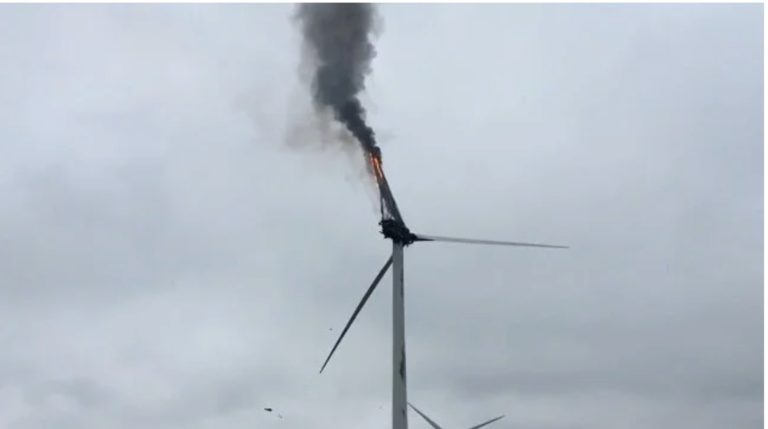
The agreement was announced as major wind projects are failing in the United States and electric vehicle manufacturers are cutting back production due to lagging sales, said Daniel Turner founder and director of Power the Future.

“This joke of an agreement really only has two goals: allow Joe Biden to continue his war on American energy and ensure these elitists have something to do before next year’s COP29 exclusive junket,” Turner said. “These unelected bureaucrats can smile as they board their carbon-spewing private jets knowing feckless leaders like Joe Biden will continue to do their bidding in pursuit of a fanciful and misguided agenda.”

Alaska is dependent on oil, with as much as 85% of the state’s unrestricted general fund revenue coming from oil production, according to state estimates.

In an announcement from the State Department last week, nuclear power is going to get a lot more attention.

The United States, Canada, Japan, France, and the United Kingdom, known as the “Sapporo 5,” announced their support for increased deployment of zero-carbon, peaceful nuclear energy by “expanding nuclear fuel production capacity across trusted, high-quality suppliers free from manipulation and influence.” 

The Sapporo 5 will work to mobilize at least $4.2 billion in government-led and private investment in the five nations’ collective enrichment and conversion capacity over the next three years, with a view to further additional private sector finance, and the five invited all like-minded nations “to join in securing the global uranium supply chain.”

The State Department wrote, “The United States is committed to supporting the use of all clean energy technologies, including nuclear, to power global decarbonization efforts and provide energy security and independence to partners around the world.”