Rep. Mary Peltola voted against a bill on Tuesday that requires the actual heads of agencies to personally sign off on most new regulations their agencies promulgate. H.R. 357, passed by a vote of to 218-203, with Peltola and all but three Democrats trying to block it.
Peltola’s two other co-chairs of the Blue Dog Democrat Coalition, a “moderate Democrat” coalition, voted in favor of the bill — Rep. Jared Golden of Maine and Rep. Marie Glusenkamp Perez of Washington. But Blue Dog co-chair Peltola voted “no” to the government accountability measure.
The bill requires, subject to a limited exception, “that any agency rule promulgated under notice and comment procedures must be issued and signed by an individual who was appointed by the President and confirmed by the Senate.”
According to a 2019 study by the Pacific Legal Foundation, 98% of all rules that came out of the Food and Drug Administration between 2001 and 2017 were issued “illegally” by non-Senate confirmed officials. Other agencies had similar issues.
The study found that 25 of those rules had an economic impact of more than $100 million and that the FDA’s high incidence of rules issued by minor officials meant that more than 70% of all Health and Human Services Department rules were “unconstitutional.”
In 2021, Congress passed 143 laws, yet federal agencies issued 3,257 rules, which have an estimated cost of $1.927 trillion annually, or more than $14,684 per U.S. household annually.
Rep. Ben Cline’s, a Republican from Virginia, and Rep. Golden, a Maine Democrat, co-sponsored the Ensuring Accountability in Agency Rulemaking Act to provide greater accountability to taxpayers.
“For too long, costly regulatory burdens have been imposed by unelected career bureaucrats, rather than an individual confirmed by the Senate. That is unacceptable. Passage of this legislation on the House Floor is a step in the right direction to help rein in Washington bureaucrats’ overreach of power and ensure a government that is accountable to the American people,” Cline said.
The vast number of regulations and federal mandates cost 10% of America’s gross domestic product each year, Cline said.
“It’s simple: federal regulations should be made by officials who are accountable to the American people. House passage of this common-sense, bipartisan bill brings us one step closer to a more responsible and responsive government,” Rep. Golden said.
The bill will now head to the Senate, which is controlled by Democrats.
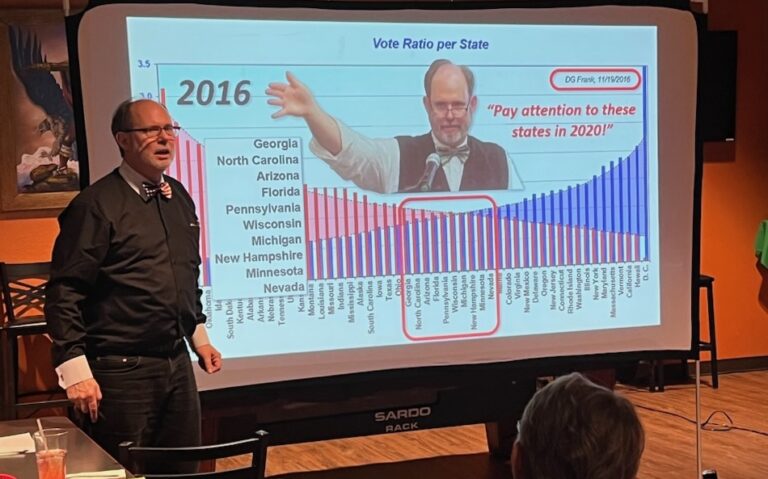
Election integrity expert Douglas Frank is touring Alaska, where he made recent stops in Fairbanks, Kenai, and Homer. Frank toured Alaska at the invitation of a local group, Cause of America-Alaska, which has the goal of restoring trust in local elections. Frank has given dozens of these presentations around the country and has gained much notoriety.
I was able to attend both of the presentations Frank made on the Kenai Peninsula. It was a whirlwind of election integrity information from around the country and in Alaska. The vast amount of information he presented was quite persuasive.
Frank said voter fraud exists in Alaska, and verified this claim with supporting information. Alaska has the dirtiest voter rolls in the country, he said, which should be an eye-opener for all of us. Fortunately, Frank also gave some suggestions on what can be done to restore the integrity of our elections.
Frank did not start his career studying election integrity. He has a doctorate in surface analytical chemistry and spent most of his working career as a mathematician and scientist. Because of his reputation in mathematics, he was asked by the Pennsylvania Legislature to study the 2020 election to determine if there was election fraud. Frank made many important findings including:
– There were many phantom voters on the voter rolls in each county.
– These phantom voters were used to influence the election.
– The number of ballots from phantom voters appears to be manipulated by machine algorithms.
– These behaviors can be observed in other states.
– The vote counts were influenced at the county level to achieve a target outcome at the state level.
Needless to say, these conclusions were controversial and brought him much adverse attention from mainstream media who were critical of anybody casting doubt on the 2020 election of Joe Biden. While many hurried to debunk his findings, one person who listened was Mike Lindell. Lindell is a Donald Trump supporter and has long claimed that there was fraud in the 2020 election.
After his work in Pennsylvania was completed, Frank joined with Lindell to participate in the election integrity investigations that Lindell had been funding. Frank put it this way in his introduction: Although he never served in the military, he has been called to serve his country fighting for election integrity in small county-level battlefields around the country.
Frank has visited 47 states and made presentations in over 800 counties. In every state he has visited, he said that if he is granted access to the voter rolls by the governing authority like the secretary of state or lieutenant governor, he can demonstrate examples of voter fraud. This fraud is directly tied to the number of excess voters on the voter rolls.
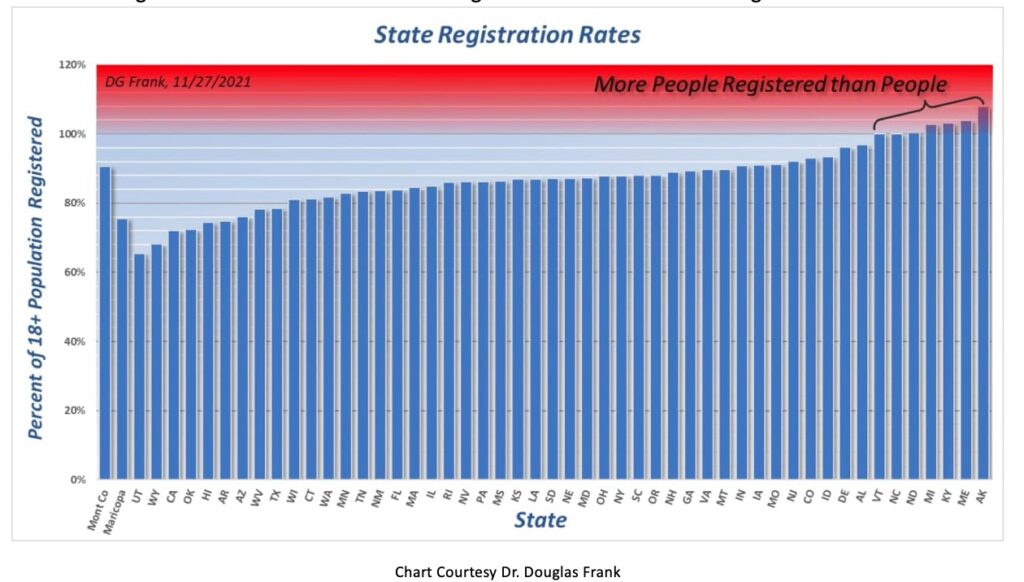
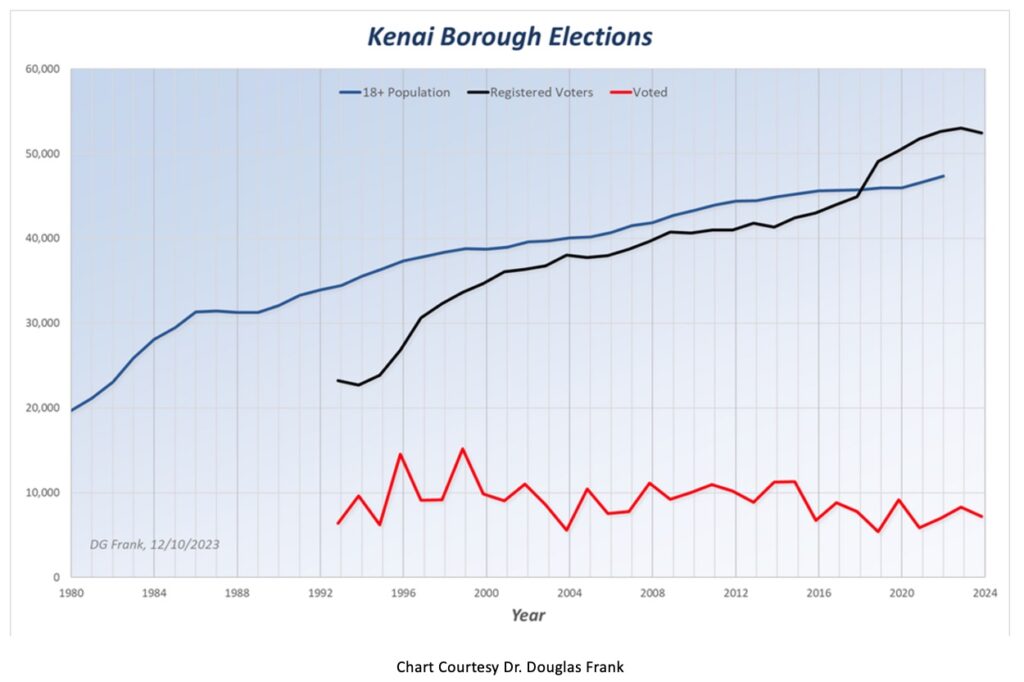
Alaska is no different, and it has the distinction of having the dirtiest voter rolls in the country. Frank makes this claim after examining the population data vs. the number of registered voters. Alaska has more registered voters than adults eligible to vote.
This is not an issue unique to Alaska, six other states also fall into that same category. Dirty voter rolls are a well-known problem, and every state has them to some extent. Alaska attempts to clean our voter rolls by using a nationwide system called the Electronic Registration Information Center, ERIC for short.
When an individual dies or moves out of Alaska, the ERIC system is supposed to notify the state so the voter rolls can be cleaned of these ineligible voters. With a voter roll population 108% greater than the number of adult residents of Alaska, it is clear that the ERIC system has not worked in Alaska.
Frank points out that dirty voter rolls alone are not a problem. The issue is voter fraud that can arise if an unscrupulous individual takes advantage of the excess voters on a dirty voter roll and submits votes for them. The wide use of absentee ballots in the 2020 election, which was justified by the Covid-19 pandemic, made this type of voter fraud much easier than it had been in the past.
Frank related a story about his first stop in Juneau where he was able to obtain a copy of the Alaska voter rolls. He examined it for the Douglas precinct and sorted it by voter addresses. He showed many examples of what he alleges could be a sign of voter fraud.
For several voter addresses, there were multiple people registered to vote there, but they all had different last names. This might have a legitimate explanation, but Franks indicated that this can also be a sign that someone obtained several absentee ballots for ineligible individuals, and then submitted those ballots in the election.
This might seem implausible, but a Rasmussen Report recently revealed that 20% of the people surveyed who voted by mail said they cast a fraudulent ballot in the 2020 election.
Another problem Frank highlighted was a problem with the security of election counting machines. He related a story about a conversation he had with the secretary of state in another state. The individual indicated that the state had the most secure election system in the country, with an alarm system that would ring on the secretary of state’s phone if anyone tried to hack into the system.
Frank was given permission to try to hack into the system and within one minute had access to the state’s election database and was able to discover the secretary of state’s official log-in ID and password. Frank then used that information to log on to over 30 Dominion machines around the state and demonstrate how he could manipulate the voter data contained within them. The entire time this demonstration was happening, the secretary of state’s alarm system on his phone never indicated a violation.
These were the same type of Dominion vote-counting machines we use here in Alaska. Frank made a very clear point that electronic vote-counting machines cannot be trusted.
While the inability to have accurate voter rolls might seem discouraging, Frank gave us the solution. He said to restore integrity to our elections we need to do several things:
– Minimize absentee voting. Only the military and very few other individuals should be allowed to vote this way. The goal should be less than 1% of the vote be taken by absentee ballots.
– Vote on paper ballots. (Alaska is a paper-based ballot system.)
– Eliminate the use of machines to count ballots. Ballots should be hand-counted at the precinct level.
The most important part of his presentation was how to achieve his recommendations. Frank says that there is so much partisanship in all state legislatures that there will never be meaningful reform coming from them. He has talked to many energized state representatives and senators, but they have all been stymied by partisan politics.
This is a David v. Goliath battle that will need to take place at the grassroots level, Frank said. Local groups must use the tools he provides to document the voter fraud that exists in our local communities. After that is established, we need to present this information at the local borough level to convince local politicians that this is a real issue. This must be done on the record at a borough assembly meeting so that there is official documentation of the fraud. Then we need to use this documented fraud to pressure our borough to implement the changes to our election procedures he recommends.
Greg Sarber is a lifelong Alaskan and a retired petroleum engineer.
More than 20% of voters who used mail-in ballots in 2020 admit they participated in at least one form of election fraud, according to a new poll whose results were released Tuesday by Rasmussen Reports and the Heartland Institute.
The telephone and online survey found that 21% of likely U.S. voters who voted by absentee or mail-in ballot in the 2020 election say they filled out a ballot, in part or in full, on behalf of a friend or family member, such as a spouse or child, while 78% say they didn’t. (To see survey question wording, click here.)
Thirty percent of those surveyed said they voted by absentee or mail-in ballot in the 2020 election. Nineteen percent of those who cast mail-in votes say a friend or family member filled out their ballot, in part or in full, on their behalf. Seventeen percent of the mail-in voters reported that in the 2020 election, they cast a ballot in a state where they were no longer a permanent resident. All of these practices are illegal, the Heartland Institutenoted.
According to the Associated Press, more than 43 percent of 2020 voters cast ballots by mail, the highest percentage in history.
The poll reveals that 10% of all respondents — not just those who said they voted by mail — know “a friend, family member, co-worker, or other acquaintance who has admitted … that he or she cast a mail-in ballot in 2020 in a state other than his or her state of permanent residence.”
Eight percent of all who responded said “a friend, family member, or organization, such as a political party” offered to “pay” or give them a “reward” for agreeing to vote in the 2020 election.
“The results of this survey are nothing short of stunning,” said Justin Haskins, director of the Socialism Research Center at the Heartland Institute. “For the past three years, Americans have repeatedly been told that the 2020 election was the most secure in history. But if this poll’s findings are reflective of reality, the exact opposite is true. This conclusion isn’t based on conspiracy theories or suspect evidence, but rather from the responses made directly by the voters themselves.”
A democratic republic cannot survive if election laws allow voters to commit fraud easily, Haskins said, adding “that’s exactly what occurred during the 2020 election. Although some progress has been made in more than a dozen states since the conclusion of the 2020 election, much more work is needed in most regions of the United States. If America’s election laws do not improve soon, voters and politicians will continue to question the truthfulness and fairness of all future elections.”
The Anchorage public hearing on the Ambler Road, needed infrastructure to reach the state’s Ambler Mining District, is set for Wednesday, Dec. 13, in the Wilda Marston Theater on the ground floor of the Loussac Library. Many are expecting a large group of environmental activists to dominate the hearing.
The Bureau of Land Management has set the rules: Everyone who wants to testify has two minutes.
Except for elders.
Elders get to speak first and will not be time limited. After they run out the clock, other speakers will be selected “at random” until the meeting ends. The notice doesn’t say when the meeting will end but it starts at 5 pm and the library building closes at 8 pm.
It’s unclear what federal law allows some citizens to have priority and also unlimited time at the microphone during a public hearing, but the Biden Administration is signaling that it wants elders — code for “Native elders” — to dominate the public testimony.
But because of the wording, in fact, other elders could qualify. Anchorage Republican Women’s Club President Judy Eledge could declare herself an elder and tie up the microphone by reading graphic LGBTQ books that the Loussac Library allows in the kids section. So could Democrat activists of any age, so long as they “self identify” as an elder.
The term “elder” is ambiguous at best and discriminatory at least. AARP says anyone over 50 qualifies for membership as a senior citizen, another word for elder. In tribal culture, elder status does not mean old age, but recognition as an elder. It has, for some tribes, a spiritual or religious meaning, which adds another layer of lawsuit bait for the BLM. Some tribal elders are in their 30s.
This meeting appears to be, at the very least, a Civil Rights Act violation, and may also violate the Administrative Procedures Act. It may violate other laws and regulations, as well as the laws of common decency.
There have already been similar hearings on the new Ambler Road draft supplemental environmental impact statement in several Alaska Native communities, including Ambler, Shungnak, Kobuk, Allakaket, and a half dozen more.
Natives in Alaska already are granted government-to-government consultation status, and cooperating agency status. Now, the BLM is giving them a race-age card to play in Anchorage to take precedence at a public meeting over other citizens.
One woman with a newborn baby plans to attend on Wednesday and wondered if because she would be given the same courtesy as “elders” since her baby is so young and must be with her.
U.S. Sen. Dan Sullivan, Sen. Lisa Murkowski and 29 of their Senate colleagues have sent a bipartisan letterto United Nations Secretary-General Antonio Guterres, condemning the inaction of the U.N. regarding Hamas’s widespread sexual violence, including mass rape and mutilation, against women in Israel on Oct. 7.
The senators urged Guterres to open an independent investigation into Hamas’s acts of sexual violence and to hold the U.N. Entity for Gender Equality and the Empowerment of Women—the organization dedicated to ending gender-based violence—accountable for its failure to immediately and unequivocally condemn Hamas’s atrocities against women.
Joining Senator Sullivan were Senators Jim Risch (R-Idaho), Mike Crapo (R-Idaho), Jacky Rosen (D-N.M.), Joni Ernst (R-Iowa), Kirsten Gillibrand (D-N.Y.), Susan Collins (R-Maine), Ben Cardin (D-M.D.), Shelley Moore Capito (R-W.Va.), Kyrsten Sinema (I-Ariz.), Katie Britt (R-Ala.), Tammy Duckworth (D-Ill.), Richard Blumenthal (D-Conn.), Lisa Murkowski (R-Alaska), Cory Booker (D-N.J.), Deb Fischer (R-Neb.), Bob Casey (D-Pa.), John Fetterman (D-Pa.), Chuck Grassley (R-Iowa), Bill Cassidy (R-La.), Joe Manchin (D-W.Va.), James Lankford (R-Okla.), Ron Wyden (D-Ore.), Rick Scott (R-Fla.), Lindsey Graham (R-S.C.), Marco Rubio (R-Fla.), Tim Scott (R-S.C.), Jerry Moran (R-Kan.), Bill Hagerty (R-Tenn.), and Roger Wicker (R-Miss.), and Marsha Blackburn (R-Tenn.).
“We write to express our profound disappointment with the United Nations’ (UN) response to Hamas’s widespread sexual violence, including rape and mutilation, as a weapon of war against women in Israel on October 7, 2023,” wrote the senators. “A growing body of evidence including the testimonies of survivors, witnesses, and first responders makes clear that as part of Hamas’s terrorist attack that killed 1,200 men, women, and children on October 7, the terrorist organization intentionally used rape and sexual assault as weapons of war.”
“Sexual violence, particularly on this scale and of this level of brutality, must be condemned unequivocally and without qualification, which is why we were shocked that it took UN Women nearly two months to speak out against these atrocities,” the senators’ letter said. “… we urge you to move swiftly to seek the establishment of an independent fact-finding effort through a separate mechanism, tasked with collecting testimonies from survivors and witnesses of Hamas’s sexual violence. An independent investigation is a necessary step to hold perpetrators accountable, support survivors, and provide justice for victims.”
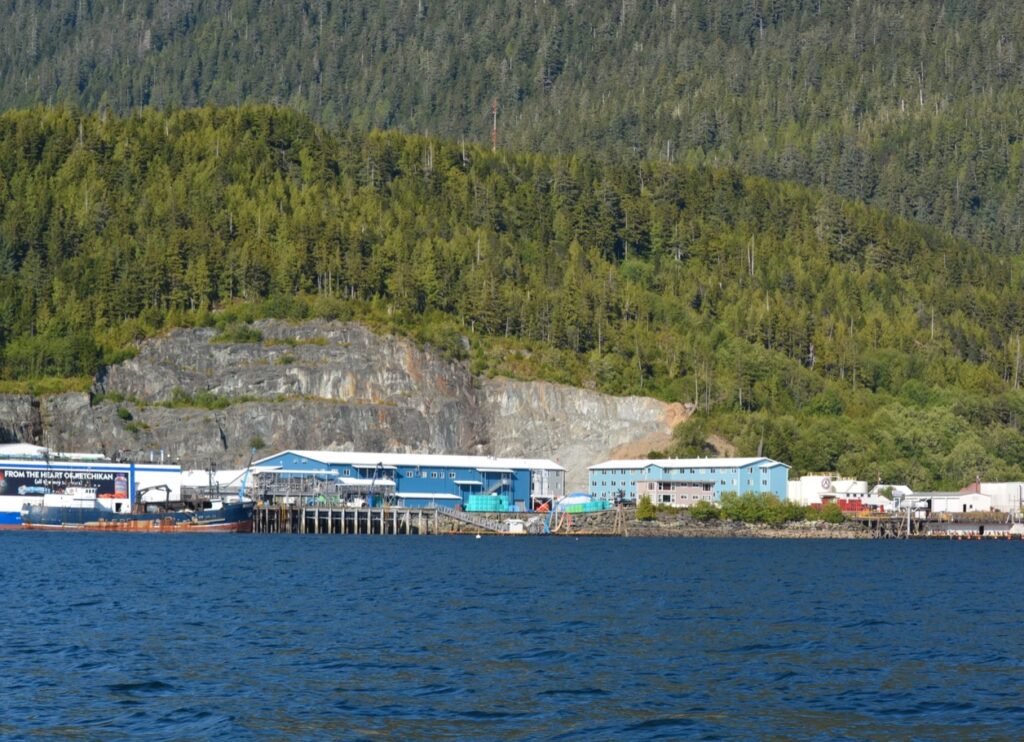
In a sweeping company overhaul, Trident Seafoods is divesting four out of its 12 processing plants located in Alaska. This move will also result in employee layoffs across the company.
The four plants slated for sale are situated in Kodiak, Ketchikan, Petersburg, and False Pass.
Trident Seafoods’ CEO, Joe Bundrant, emphasized the need for decisive action, stating that the steps today to restructure are essential to ensure equitable returns for the fishing fleet, communities, and stakeholders.
While actively seeking potential buyers for the four plants, Trident Seafoods is planning to continue to operate its Kodiak facility on a considerably reduced scale during the upcoming winter season. This restructuring aims to secure the company’s future while adapting to evolving industry dynamics.
Trident’s Ketchikan plant. Photo credit: Trident.
“Our Kodiak operations are integral to the Gulf of Alaska fisheries,” said Jeff Welbourn, Senior Vice President of Alaska Operations at Trident Seafoods. “They are highly efficient, multispecies plants, and we are working diligently to find a new owner to support the fleet and the Kodiak community.”
Trident also announced that its regional salmon strategy would refocus operations in Southeast Alaska and Area M.
As the company seeks buyers for its seasonal plants in Ketchikan, Petersburg, and False Pass, it said in a statement, “These are all well-maintained operations that align better with other operators’ strategies. We are optimistic the combination of new ownership and our continued service to the fleet through our other locations will mean little to no disruption for regional salmon fleets.”
To round out the Alaska operations strategy, Trident is retiring or seeking buyers for other assets, such as the historic South Naknek Diamond NN cannery facility and the support facilities in Chignik. The company is also assessing its overall company-owned vessel strategy.
The restructuring effort is not confined to Alaska alone. Trident is also streamlining its head office support functions, resulting in a 10% reduction in workers.
The restructuring effort enables Trident to execute its strategic drive to modernize its processing plants throughout Alaska. In August, the company announced a delay to the three-year plan to build a new, state-of-the-art processing plant in Unalaska’s Dutch Harbor to replace an aging plant in Akutan, Alaska. Construction is likely to resume once the restructuring activities are complete.
“We are modernizing and re-tooling the remaining Alaska plants to be more efficient, effective, and sustainable operations,” the company said. “This will allow us to continue supporting as many fleets and communities as possible across Alaska for the long term.”
The company is also looking at whether it should keep its fleet of fishing vessels.
Trident’s strategy reflects the realities facing U.S. seafood producers in global markets. Across many species, the combination of declining demand, excess supply, and foreign competition has driven prices down, squeezed margins, and displaced U.S. producers from markets that they developed over decades, the company said.
“We are competing against producers in other countries that do not share our commitment to or investments in environmental sustainability, social responsibility, and product quality,” said Bundrant. “Many of our foreign competitors operate with minimal regulatory costs and oversight, inexpensive infrastructure, and exploitive labor practices.”
Overall, I remain confident in the Alaska seafood industry and our role in it. These are significant changes, and we are focused on treating our impacted employees and communities with the respect and compassion they deserve,” said Bundrant. “Embracing these changes and operating a more streamlined company will allow us to reinvest in the communities, people, processes, and assets that enable us to continue our mission of responsibly sharing wild Alaska seafood with the world.”
Trident is a prominent player in the US seafood industry and has plants across Europe and Asia, including China. The list of the Alaska plants are at this company link.
The price of oil is down, and while OPEC is throttling back production on its members, other nations are pumping fossil fuels in greater amounts to fill the gap. Russia, although under sanctions, is selling as much as it can — at a discount — to fund its war with Ukraine. All that may mean a lower price for Alaska North Slope crude in coming months and years.
Price of oil is just one factor that will inform the 2025 budget for the State of Alaska, which may be rolled out by Gov. Mike Dunleavy as early as Thursday. Other factors include things like inflationary pressures on state government, with everything costing more, from food for prisoners to ammunition for officers, and paper for the copy machines.
On June 19, Dunleavy signed the state’s 2024 budget into law; he made made $200 million in vetoes to the additions from the Legislature.
That current budget has total expenditures (including capital budget) of $12.3 billion in fiscal 2024, a 10.8% decline from fiscal 2023. It’s an active budget and numbers will change due to supplemental budget additions and other factors.
The 2025 budget, which by statute is due Dec. 15, has been in the works since late summer.
Oil price trends: Alaska North Slope crude oil was forecasted to average $85.25 per barrel for Fiscal Year 2023, which ended in July, and $73.00 per barrel for FY 2024, which ends June 30, 2024.
Then, price of oil is expected to decline further, settling at $70 a barrel by FY 2032, according to a forecast from the Office of Management and Budget in March. There is also a more immediate risk of a price collapse, according to the Rapidan Energy Group.
Permanent Fund reserves: If soaring inflation and lower oil revenue are two of Dunleavy’s biggest budget challenges, there is some relief for the State of Alaska, in that the way the Permanent Fund is structured, earnings from it now pay for as much as 60% of the state operations. There may be as much as $3.6 billion available from the Alaska Permanent Fund Earnings Reserve Account, according to numbers released earlier this year.
Surplus from FY 24? The state’s Updated Revenue Source Book may show a $440 million surplus, but that may be cut in half by the supplemental budget.
PFD: Gov. Dunleavy has always started out the Permanent Fund dividend discussion by proposing a full PFD for all qualifying Alaskans; the Legislature has cut it down every year. If his pattern holds, he will once again ask the Legislature to follow the law and fund the full dividend. This year’s dividend was $1,312. There was language in the final budget that said if there is a large budget surplus due to high oil prices, there may be an additional PFD issued, but that looks doubtful.
Overall budget: Because of inflation and lower oil revenues, it’s likely the governor will propose a budget that is down as much as $100 million from FY 24, a small trim from last year’s proposal.
Education: Gov. Dunleavy has not supported changing the per-student funding formula called the BSA, but instead has opted for one-time funding infusions for education. It’s likely that he won’t bend to pressure from the National Education Association to propose permanent per-student increases. He hasn’t yielded to the union yet, and so he’s not likely to this year.
Public Safety: The governor started out five years ago needing a lot more troopers, and inheriting a crime wave prompted by SB 91, which he promptly repealed with the help of the Legislature. He filled up the Trooper Academies, and gave $25,000 signing bonuses, and then renegotiated with the public safety union to keep new recruits from just leaving the state after serving a year.
Now, Dunleavy is looking at giving Public Safety more resources to do the job. Sources say that may include an enforcement vessel for Southeast Alaska and a Pilatus aircraftfor Troopers, which would allow officers to get into 90% of the runways in Alaska, much more than the current DPS King Air can manage. He may also increase the number of Village Public Safety Officers, and has already appointed a VPSO director, making the VPSOs essentially a new division in the Department of Public Safety.
High cost of living: Dunleavy has said he is concerned about general affordability in Alaska. He may have initiatives he will announce this week that address overall cost of living and ideas that his administration has to make life more affordable for Alaskans.
A budget is an expression of several things. The old saying, “show me your budget and I’ll show you your priorities,” is relevant, but budgets are also expressions of limits — there are never enough funds to meet all the wants, needs, and desires of citizens.
Therefore, the tug-of-war will begin as soon as the budget hits the inboxes of legislators, lobbyists, municipal governments, and nonprofit boards around the state, as each entity vies for a bigger piece of what is always a limited pie.
The 2025 Dunleavy budget will probably come out at about the same time the House Majority Caucus meets this week.
Q. What’s more Democrat than downtown Chicago in August?
A. A presidential convention year, especially when there’s a controversial war going on, (like the 1968 Democratic Convention in downtown Chicago, which devolved into massive protests over the American involvement in the Vietnam War.)
The Alaska Democratic Party will be sending 20 Alaska delegates and two alternates to the 2024 Democratic presidential nominating convention in Chicago, Aug 19-22, 2024. This represents one more delegate than the Alaska Democrats had during the 2020 convention, owing to the fact that Rep. Mary Peltola is a Democrat, which gave Alaska an additional party delegate for the national convention, according to the party’s formula.
The plan for how those Alaska delegates get chosen and how they may be allocated to candidates was just approved by the Democratic National Committee.
The Alaska Democratic Party plan places an emphasis on “diversity, equity, and inclusion,” also known as DEI, which takes the focus off of merit and ability and puts it into a Karl Marx socialist model of “From each according to his ability, to each according to his needs.”
Every Alaskan registered as a Democrat is eligible to be a national convention delegate and may participate in the delegate selection process. But the secret sauce is “identity.” There will be delegates that are from every race and sexual gender pronoun.
But first, led by ADP vice chair and 2022 Democratic candidate for lieutenant governor Jessica Cook, national pledged delegates will be selected from among state delegates at the Alaska Democratic Party State Convention in Juneau on May 18, 2024. Those ADP State Convention delegates come into play after being chosen at State House district organizational meetings on April 13.
The DEI plan ensures the party will have quotas for every possible “identity.”
If more than one presidential candidate meets the Alaska Democratic Party’s ballot access requirements, 17 of the 20 pledged delegates and alternates will be allocated to the presidential candidate(s) based on the results of the party-run presidential preference primary held on April 6. Currently, the party is backing Joe Biden for president and Mary Peltola for Congress. But others are running, such as Marianne Williamson and Minnesota Rep. Dean Phillips. California Gov. Gavin Newsom and Vice President Kamala Harris are waiting in the wings in case Biden takes a turn that prevents him from continuing. Biden will be 82 next November and the actuarial tables are not in his favor.
For many years, Alaska Republicans have held private party-run preference polls during presidential election years, which allows more people to participate than gymnasium-style caucuses.
The Alaska Democrats decided the Republicans had a good plan, and ditched the gymnasium route, starting their own version of private primaries in 2020. The presidential election is not subject to Ballot Measure 2’s open primary and ranked-choice general, but is done through the parties themselves.
Democrats in Alaska interested in being an ADP national delegate, convention page, or standing convention committee member should review the plan and reach out to [email protected]. The plan is available for review at akdems.org.
On Thursday, Democrats will have their annual holiday auction in Anchorage.
Flying in from Juneau to be the guest speaker is Juneau House Rep. Sara Hannan, and the evening will be emceed by Anchorage House Rep. Genevieve Mina. Among the many live auction items are plenty of trips, including trips to Hawaii, Homer, and elsewhere.
Those trips may burn up the fossil fuel, but party is going full-tilt anti-oil behind the scenes with proposed edits to its party platform, which will be voted on at the annual convention.
The party’s Climate Caucus is recommending that the Democrats remove all perceived support for oil and gas development in Alaska and remove support for fossil fuel as part of the energy mix, as first reported byMust Read Alaska:
In November of 2017, then-Alaska Gov. Bill Walker signed a major deal with Chinese government-owned companies to build a gasline across Alaska. A new report shows that, if he had succeeded in partnering with the communist government companies, he could have put the entire nation at risk. The Alaska LNG project included eight compressor stations along the 804-mile route from Prudhoe Bay to the liquefaction plant in Nikiski, the entire project built in collaboration with China.
A major report by The Washington Post says the Chinese military has already broken into the computers of one unnamed oil and gas pipeline in the U.S. The Chinese are probing many smaller energy entities to test vulnerabilities and have vastly improved in their ability to disrupt American infrastructure. The report says it’s likely that Chinese hackers are already inside the computers that run America’s infrastructure, and may be just laying in wait until given the order to act.
The Chinese have infiltrated power and water utilities in America, as well as communications and transportation systems. They have invaded a water utility’s computers in Hawaii, and those at a major West Coast port, people familiar with the incidents told The Washington Post in a story headlined, “China’s cyber army is invading critical U.S. services.”
The hackers, affiliated with China’s People’s Liberation Army, made an attempted incursion into the systems of Texas’s power grid, which operates independently from the major electrical systems in the country, and which covers the state that produces the most oil for America — 42.4% of American oil comes from Texas.
The newspaper’s report comes at a time when Alaska Sen. Dan Sullivan has been raising concerns about China and companies in the United States that are investing in China’s government-owned businesses engaged in advanced technology that can be used against America.
As a member of the Senate Armed Services Committee, Sullivan took to the Senate floor to ask House Speaker Mike Johnson to ensure legislation moves to a vote before the end of January that, at a minimum, would require U.S. firms to report foreign investments that could pose a threat to American national security.
“We have American financial companies that are investing in Chinese Communist Party companies and are producing things like advanced semiconductors, artificial intelligence, quantum computing, and hypersonics– all technologies that are critical to dominating the 21st century battlefield,” Sullivansaid.
“This is a giant American national security issue. . . Right now, we have Republican House Members—hopefully not the Speaker, but certainly the chairman of the Financial Services Committee—who are saying: No, I want to keep it in the dark, what Americans [firms] are doing to make [Chairman Xi Jinping] stronger. That is wrong. Mr. President, 99.9 percent of Americans would think that is wrong. So we need to fix it. The House needs to take leadership on this issue. My Republican colleagues keep talking tough on China. It is time to act.”
In a related development, Duke Energy, a large U.S. utility company with 8.2 million customers, last week said it had disconnected large batteries from Camp Lejeune Marine Corps Base in North Carolina because of the Chinese battery maker’s close links with the ruling Chinese Communist Party. Both Republican and Democrat lawmakers have been raising concerns about the potential security threats posed by the batteries, which may have the capacity to take down electrical grids.
Over the past year, the Chinese hackers have infiltrated computer systems in dozens of critical U.S. entities, the sources told the newspaper, with a goal of creating widespread panic and chaos, and to snarl logistics if there is a confrontation between the U.S. and China in the Pacific, especially if there is a Chinese invasion of Taiwan.
“The recent cyber intrusions seem to be part of a broader military initiative named ‘Volt Typhoon,’ the newspaper reported.
The communist Chinese strategy has changed over the past decade, according to Brandon Wales, the executive director of the Department of Homeland Security’s Cybersecurity and Infrastructure Security Agency (CISA).
While a decade ago, computer break-ins were focused on political and economic espionage, today the Chinese are attempting to compromise critical infrastructure, “in part to pre-position themselves to be able to disrupt or destroy that critical infrastructure in the event of a conflict, to either prevent the United States from being able to project power into Asia or to cause societal chaos inside the United States — to affect our decision-making around a crisis.”
The Chinese have zeroed in on Hawaii as an area for their concentrated interest, as it is the home of the U.S. Pacific Fleet and a logistics hub for military operations. According to the report, Microsoft revealed that Volt Typhoon activities were also targeting entities in Guam, another hub for the U.S. Navy.
Biden had a meeting with China’s head of state Xi Jinping on Nov. 15 in Woodside, Calif., but he did not bring up the matter.
“The topic of Chinese cyber intrusions into critical infrastructure was on a proposed list of talking points to raise in Biden’s encounter with Xi, according to people familiar with the matter, but it did not come up in the four-hour meeting,” the Post reported.
The White House readout of the Biden-Xi meeting is at this link, with a list of the topics the two leaders reportedly discussed.
Nearly six years ago, Alaska Gov. Bill Walker signed a deal with the Chinese government-owned Sinopec, the Bank of China, and China Investment Corporation to build a gas pipeline from Prudhoe Bay to Nikiski, with processing plants on the North Slope and also at tidewater. The gas would be loaded onto ships and taken to China, Korea, and other customers in the Pacific. China was to be entitled to 75% of the gas.
GOV. BILL WALKER BOWS TO CHINA PRESIDENT XI JINPING AS THE PRESIDENT’S CHINA AIR JET STOPS IN ANCHORAGE FOR REFUELING IN 2017.
That deal was tabled when Mike Dunleavy became governor in 2018.
Sen. Sullivan, who has long been sounding the alarm over China, was not shy about confronting U.S. companies that are investing in the Chinese Communist Party’s cyber war initiatives.
“We have, who knows, a lot of financial institutions investing in Chinese companies to make their military stronger. We have financial companies that are investing in the Chinese Communist Party, companies that are producing things like advanced semiconductors, artificial intelligence, quantum computing, hypersonics–all technologies that are critical to dominating the 21st century battlefield. This is a giant American national security issue,” Sullivan said.
“I don’t normally come down to the Senate floor and quote Lenin. I am not a big fan of Lenin. But he purportedly said that ‘capitalists will sell us the rope with which we will hang them,'” Sullivan continued. “There is a little bit of that going on right now here in the United States of America. We have executives in this country and certain financial institutions–by the way, these American financial institutions and executives owe everything to their success by being American, being in the greatest country in the world, with the rule of law and our capital markets and our dynamic economy. Their success is because of the great Nation we live in, and yet some, kind of addicted to making more money–listen to Lenin. They are like, you know, maybe I will do that advanced chip manufacturing investment in the Chinese economy; maybe I will help them a little bit with artificial intelligence or quantum computing,” Sullivan said. Sen. Sullivan’s complete remarks are at this link.