In a sweeping company overhaul, Trident Seafoods is divesting four out of its 12 processing plants located in Alaska. This move will also result in employee layoffs across the company.
The four plants slated for sale are situated in Kodiak, Ketchikan, Petersburg, and False Pass.
Trident Seafoods’ CEO, Joe Bundrant, emphasized the need for decisive action, stating that the steps today to restructure are essential to ensure equitable returns for the fishing fleet, communities, and stakeholders.
While actively seeking potential buyers for the four plants, Trident Seafoods is planning to continue to operate its Kodiak facility on a considerably reduced scale during the upcoming winter season. This restructuring aims to secure the company’s future while adapting to evolving industry dynamics.
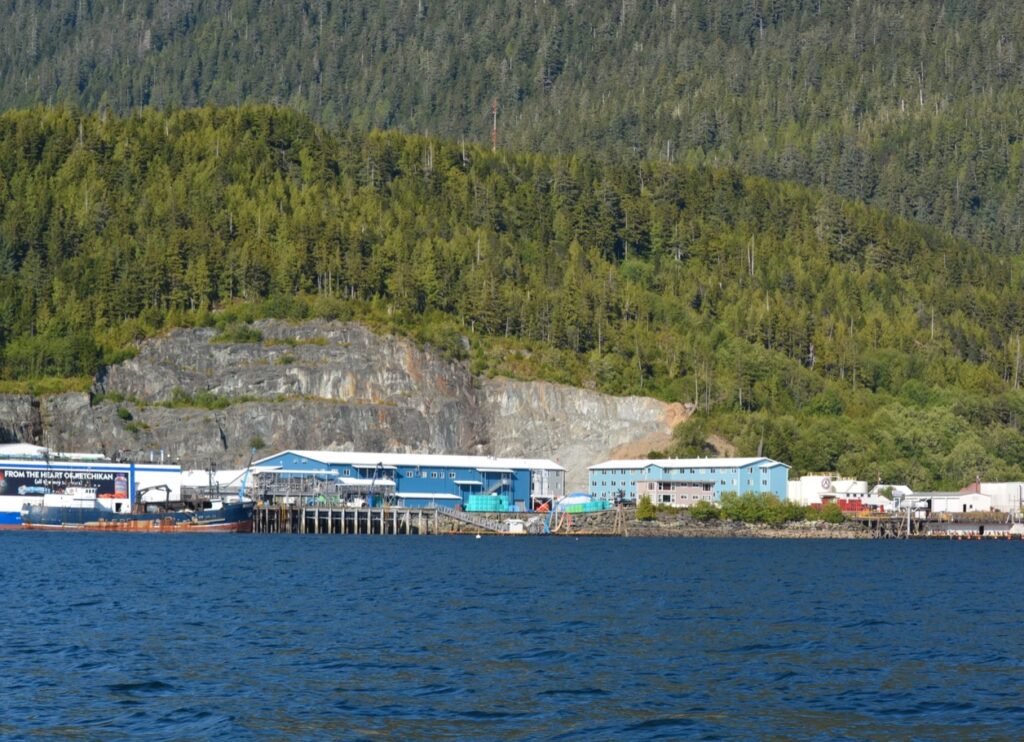
Trident’s Ketchikan plant. Photo credit: Trident.
“Our Kodiak operations are integral to the Gulf of Alaska fisheries,” said Jeff Welbourn, Senior Vice President of Alaska Operations at Trident Seafoods. “They are highly efficient, multispecies plants, and we are working diligently to find a new owner to support the fleet and the Kodiak community.”
Trident also announced that its regional salmon strategy would refocus operations in Southeast Alaska and Area M.
As the company seeks buyers for its seasonal plants in Ketchikan, Petersburg, and False Pass, it said in a statement, “These are all well-maintained operations that align better with other operators’ strategies. We are optimistic the combination of new ownership and our continued service to the fleet through our other locations will mean little to no disruption for regional salmon fleets.”
To round out the Alaska operations strategy, Trident is retiring or seeking buyers for other assets, such as the historic South Naknek Diamond NN cannery facility and the support facilities in Chignik. The company is also assessing its overall company-owned vessel strategy.
The restructuring effort is not confined to Alaska alone. Trident is also streamlining its head office support functions, resulting in a 10% reduction in workers.
The restructuring effort enables Trident to execute its strategic drive to modernize its processing plants throughout Alaska. In August, the company announced a delay to the three-year plan to build a new, state-of-the-art processing plant in Unalaska’s Dutch Harbor to replace an aging plant in Akutan, Alaska. Construction is likely to resume once the restructuring activities are complete.
“We are modernizing and re-tooling the remaining Alaska plants to be more efficient, effective, and sustainable operations,” the company said. “This will allow us to continue supporting as many fleets and communities as possible across Alaska for the long term.”
The company is also looking at whether it should keep its fleet of fishing vessels.
Trident’s strategy reflects the realities facing U.S. seafood producers in global markets. Across many species, the combination of declining demand, excess supply, and foreign competition has driven prices down, squeezed margins, and displaced U.S. producers from markets that they developed over decades, the company said.
“We are competing against producers in other countries that do not share our commitment to or investments in environmental sustainability, social responsibility, and product quality,” said Bundrant. “Many of our foreign competitors operate with minimal regulatory costs and oversight, inexpensive infrastructure, and exploitive labor practices.”
Overall, I remain confident in the Alaska seafood industry and our role in it. These are significant changes, and we are focused on treating our impacted employees and communities with the respect and compassion they deserve,” said Bundrant. “Embracing these changes and operating a more streamlined company will allow us to reinvest in the communities, people, processes, and assets that enable us to continue our mission of responsibly sharing wild Alaska seafood with the world.”
Trident is a prominent player in the US seafood industry and has plants across Europe and Asia, including China. The list of the Alaska plants are at this company link.
The price of oil is down, and while OPEC is throttling back production on its members, other nations are pumping fossil fuels in greater amounts to fill the gap. Russia, although under sanctions, is selling as much as it can — at a discount — to fund its war with Ukraine. All that may mean a lower price for Alaska North Slope crude in coming months and years.
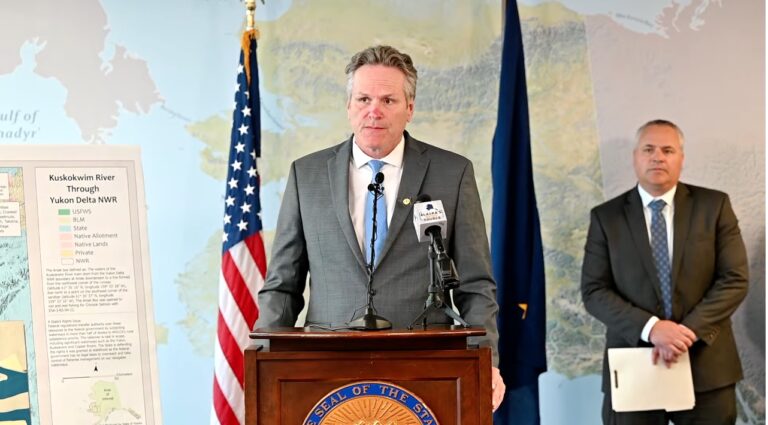
Price of oil is just one factor that will inform the 2025 budget for the State of Alaska, which may be rolled out by Gov. Mike Dunleavy as early as Thursday. Other factors include things like inflationary pressures on state government, with everything costing more, from food for prisoners to ammunition for officers, and paper for the copy machines.
On June 19, Dunleavy signed the state’s 2024 budget into law; he made made $200 million in vetoes to the additions from the Legislature.
That current budget has total expenditures (including capital budget) of $12.3 billion in fiscal 2024, a 10.8% decline from fiscal 2023. It’s an active budget and numbers will change due to supplemental budget additions and other factors.
The 2025 budget, which by statute is due Dec. 15, has been in the works since late summer.
Oil price trends: Alaska North Slope crude oil was forecasted to average $85.25 per barrel for Fiscal Year 2023, which ended in July, and $73.00 per barrel for FY 2024, which ends June 30, 2024.
Then, price of oil is expected to decline further, settling at $70 a barrel by FY 2032, according to a forecast from the Office of Management and Budget in March. There is also a more immediate risk of a price collapse, according to the Rapidan Energy Group.
Permanent Fund reserves: If soaring inflation and lower oil revenue are two of Dunleavy’s biggest budget challenges, there is some relief for the State of Alaska, in that the way the Permanent Fund is structured, earnings from it now pay for as much as 60% of the state operations. There may be as much as $3.6 billion available from the Alaska Permanent Fund Earnings Reserve Account, according to numbers released earlier this year.
Surplus from FY 24? The state’s Updated Revenue Source Book may show a $440 million surplus, but that may be cut in half by the supplemental budget.
PFD: Gov. Dunleavy has always started out the Permanent Fund dividend discussion by proposing a full PFD for all qualifying Alaskans; the Legislature has cut it down every year. If his pattern holds, he will once again ask the Legislature to follow the law and fund the full dividend. This year’s dividend was $1,312. There was language in the final budget that said if there is a large budget surplus due to high oil prices, there may be an additional PFD issued, but that looks doubtful.
Overall budget: Because of inflation and lower oil revenues, it’s likely the governor will propose a budget that is down as much as $100 million from FY 24, a small trim from last year’s proposal.
Education: Gov. Dunleavy has not supported changing the per-student funding formula called the BSA, but instead has opted for one-time funding infusions for education. It’s likely that he won’t bend to pressure from the National Education Association to propose permanent per-student increases. He hasn’t yielded to the union yet, and so he’s not likely to this year.
Public Safety: The governor started out five years ago needing a lot more troopers, and inheriting a crime wave prompted by SB 91, which he promptly repealed with the help of the Legislature. He filled up the Trooper Academies, and gave $25,000 signing bonuses, and then renegotiated with the public safety union to keep new recruits from just leaving the state after serving a year.
Now, Dunleavy is looking at giving Public Safety more resources to do the job. Sources say that may include an enforcement vessel for Southeast Alaska and a Pilatus aircraftfor Troopers, which would allow officers to get into 90% of the runways in Alaska, much more than the current DPS King Air can manage. He may also increase the number of Village Public Safety Officers, and has already appointed a VPSO director, making the VPSOs essentially a new division in the Department of Public Safety.
High cost of living: Dunleavy has said he is concerned about general affordability in Alaska. He may have initiatives he will announce this week that address overall cost of living and ideas that his administration has to make life more affordable for Alaskans.
A budget is an expression of several things. The old saying, “show me your budget and I’ll show you your priorities,” is relevant, but budgets are also expressions of limits — there are never enough funds to meet all the wants, needs, and desires of citizens.
Therefore, the tug-of-war will begin as soon as the budget hits the inboxes of legislators, lobbyists, municipal governments, and nonprofit boards around the state, as each entity vies for a bigger piece of what is always a limited pie.
The 2025 Dunleavy budget will probably come out at about the same time the House Majority Caucus meets this week.
Q. What’s more Democrat than downtown Chicago in August?
A. A presidential convention year, especially when there’s a controversial war going on, (like the 1968 Democratic Convention in downtown Chicago, which devolved into massive protests over the American involvement in the Vietnam War.)
The Alaska Democratic Party will be sending 20 Alaska delegates and two alternates to the 2024 Democratic presidential nominating convention in Chicago, Aug 19-22, 2024. This represents one more delegate than the Alaska Democrats had during the 2020 convention, owing to the fact that Rep. Mary Peltola is a Democrat, which gave Alaska an additional party delegate for the national convention, according to the party’s formula.
The plan for how those Alaska delegates get chosen and how they may be allocated to candidates was just approved by the Democratic National Committee.
The Alaska Democratic Party plan places an emphasis on “diversity, equity, and inclusion,” also known as DEI, which takes the focus off of merit and ability and puts it into a Karl Marx socialist model of “From each according to his ability, to each according to his needs.”
Every Alaskan registered as a Democrat is eligible to be a national convention delegate and may participate in the delegate selection process. But the secret sauce is “identity.” There will be delegates that are from every race and sexual gender pronoun.
But first, led by ADP vice chair and 2022 Democratic candidate for lieutenant governor Jessica Cook, national pledged delegates will be selected from among state delegates at the Alaska Democratic Party State Convention in Juneau on May 18, 2024. Those ADP State Convention delegates come into play after being chosen at State House district organizational meetings on April 13.
The DEI plan ensures the party will have quotas for every possible “identity.”
If more than one presidential candidate meets the Alaska Democratic Party’s ballot access requirements, 17 of the 20 pledged delegates and alternates will be allocated to the presidential candidate(s) based on the results of the party-run presidential preference primary held on April 6. Currently, the party is backing Joe Biden for president and Mary Peltola for Congress. But others are running, such as Marianne Williamson and Minnesota Rep. Dean Phillips. California Gov. Gavin Newsom and Vice President Kamala Harris are waiting in the wings in case Biden takes a turn that prevents him from continuing. Biden will be 82 next November and the actuarial tables are not in his favor.
For many years, Alaska Republicans have held private party-run preference polls during presidential election years, which allows more people to participate than gymnasium-style caucuses.
The Alaska Democrats decided the Republicans had a good plan, and ditched the gymnasium route, starting their own version of private primaries in 2020. The presidential election is not subject to Ballot Measure 2’s open primary and ranked-choice general, but is done through the parties themselves.
Democrats in Alaska interested in being an ADP national delegate, convention page, or standing convention committee member should review the plan and reach out to [email protected]. The plan is available for review at akdems.org.
On Thursday, Democrats will have their annual holiday auction in Anchorage.
Flying in from Juneau to be the guest speaker is Juneau House Rep. Sara Hannan, and the evening will be emceed by Anchorage House Rep. Genevieve Mina. Among the many live auction items are plenty of trips, including trips to Hawaii, Homer, and elsewhere.
Those trips may burn up the fossil fuel, but party is going full-tilt anti-oil behind the scenes with proposed edits to its party platform, which will be voted on at the annual convention.
The party’s Climate Caucus is recommending that the Democrats remove all perceived support for oil and gas development in Alaska and remove support for fossil fuel as part of the energy mix, as first reported byMust Read Alaska:
In November of 2017, then-Alaska Gov. Bill Walker signed a major deal with Chinese government-owned companies to build a gasline across Alaska. A new report shows that, if he had succeeded in partnering with the communist government companies, he could have put the entire nation at risk. The Alaska LNG project included eight compressor stations along the 804-mile route from Prudhoe Bay to the liquefaction plant in Nikiski, the entire project built in collaboration with China.
A major report by The Washington Post says the Chinese military has already broken into the computers of one unnamed oil and gas pipeline in the U.S. The Chinese are probing many smaller energy entities to test vulnerabilities and have vastly improved in their ability to disrupt American infrastructure. The report says it’s likely that Chinese hackers are already inside the computers that run America’s infrastructure, and may be just laying in wait until given the order to act.
The Chinese have infiltrated power and water utilities in America, as well as communications and transportation systems. They have invaded a water utility’s computers in Hawaii, and those at a major West Coast port, people familiar with the incidents told The Washington Post in a story headlined, “China’s cyber army is invading critical U.S. services.”
The hackers, affiliated with China’s People’s Liberation Army, made an attempted incursion into the systems of Texas’s power grid, which operates independently from the major electrical systems in the country, and which covers the state that produces the most oil for America — 42.4% of American oil comes from Texas.
The newspaper’s report comes at a time when Alaska Sen. Dan Sullivan has been raising concerns about China and companies in the United States that are investing in China’s government-owned businesses engaged in advanced technology that can be used against America.
As a member of the Senate Armed Services Committee, Sullivan took to the Senate floor to ask House Speaker Mike Johnson to ensure legislation moves to a vote before the end of January that, at a minimum, would require U.S. firms to report foreign investments that could pose a threat to American national security.
“We have American financial companies that are investing in Chinese Communist Party companies and are producing things like advanced semiconductors, artificial intelligence, quantum computing, and hypersonics– all technologies that are critical to dominating the 21st century battlefield,” Sullivansaid.
“This is a giant American national security issue. . . Right now, we have Republican House Members—hopefully not the Speaker, but certainly the chairman of the Financial Services Committee—who are saying: No, I want to keep it in the dark, what Americans [firms] are doing to make [Chairman Xi Jinping] stronger. That is wrong. Mr. President, 99.9 percent of Americans would think that is wrong. So we need to fix it. The House needs to take leadership on this issue. My Republican colleagues keep talking tough on China. It is time to act.”
In a related development, Duke Energy, a large U.S. utility company with 8.2 million customers, last week said it had disconnected large batteries from Camp Lejeune Marine Corps Base in North Carolina because of the Chinese battery maker’s close links with the ruling Chinese Communist Party. Both Republican and Democrat lawmakers have been raising concerns about the potential security threats posed by the batteries, which may have the capacity to take down electrical grids.
Over the past year, the Chinese hackers have infiltrated computer systems in dozens of critical U.S. entities, the sources told the newspaper, with a goal of creating widespread panic and chaos, and to snarl logistics if there is a confrontation between the U.S. and China in the Pacific, especially if there is a Chinese invasion of Taiwan.
“The recent cyber intrusions seem to be part of a broader military initiative named ‘Volt Typhoon,’ the newspaper reported.
The communist Chinese strategy has changed over the past decade, according to Brandon Wales, the executive director of the Department of Homeland Security’s Cybersecurity and Infrastructure Security Agency (CISA).
While a decade ago, computer break-ins were focused on political and economic espionage, today the Chinese are attempting to compromise critical infrastructure, “in part to pre-position themselves to be able to disrupt or destroy that critical infrastructure in the event of a conflict, to either prevent the United States from being able to project power into Asia or to cause societal chaos inside the United States — to affect our decision-making around a crisis.”
The Chinese have zeroed in on Hawaii as an area for their concentrated interest, as it is the home of the U.S. Pacific Fleet and a logistics hub for military operations. According to the report, Microsoft revealed that Volt Typhoon activities were also targeting entities in Guam, another hub for the U.S. Navy.
Biden had a meeting with China’s head of state Xi Jinping on Nov. 15 in Woodside, Calif., but he did not bring up the matter.
“The topic of Chinese cyber intrusions into critical infrastructure was on a proposed list of talking points to raise in Biden’s encounter with Xi, according to people familiar with the matter, but it did not come up in the four-hour meeting,” the Post reported.
The White House readout of the Biden-Xi meeting is at this link, with a list of the topics the two leaders reportedly discussed.
Nearly six years ago, Alaska Gov. Bill Walker signed a deal with the Chinese government-owned Sinopec, the Bank of China, and China Investment Corporation to build a gas pipeline from Prudhoe Bay to Nikiski, with processing plants on the North Slope and also at tidewater. The gas would be loaded onto ships and taken to China, Korea, and other customers in the Pacific. China was to be entitled to 75% of the gas.
GOV. BILL WALKER BOWS TO CHINA PRESIDENT XI JINPING AS THE PRESIDENT’S CHINA AIR JET STOPS IN ANCHORAGE FOR REFUELING IN 2017.
That deal was tabled when Mike Dunleavy became governor in 2018.
Sen. Sullivan, who has long been sounding the alarm over China, was not shy about confronting U.S. companies that are investing in the Chinese Communist Party’s cyber war initiatives.
“We have, who knows, a lot of financial institutions investing in Chinese companies to make their military stronger. We have financial companies that are investing in the Chinese Communist Party, companies that are producing things like advanced semiconductors, artificial intelligence, quantum computing, hypersonics–all technologies that are critical to dominating the 21st century battlefield. This is a giant American national security issue,” Sullivan said.
“I don’t normally come down to the Senate floor and quote Lenin. I am not a big fan of Lenin. But he purportedly said that ‘capitalists will sell us the rope with which we will hang them,'” Sullivan continued. “There is a little bit of that going on right now here in the United States of America. We have executives in this country and certain financial institutions–by the way, these American financial institutions and executives owe everything to their success by being American, being in the greatest country in the world, with the rule of law and our capital markets and our dynamic economy. Their success is because of the great Nation we live in, and yet some, kind of addicted to making more money–listen to Lenin. They are like, you know, maybe I will do that advanced chip manufacturing investment in the Chinese economy; maybe I will help them a little bit with artificial intelligence or quantum computing,” Sullivan said. Sen. Sullivan’s complete remarks are at this link.
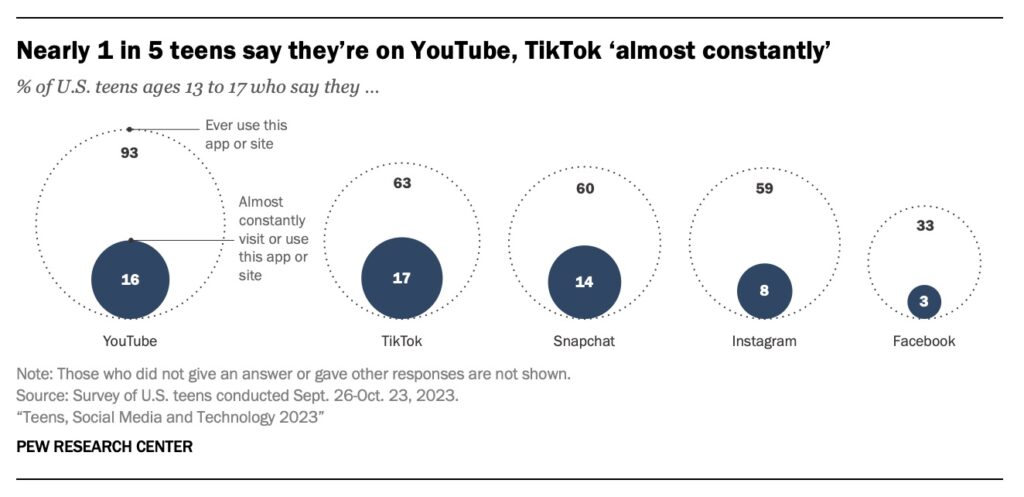
Teenagers in America are using social media platforms at a rate that they describe as “almost constant,” according to a new Pew Research Center survey.
Conducted Sept. 26-Oct. 23 among 1,453 13- to 17-year-olds, the survey covered social media, internet use and device ownership among teens.
Key findings, according to Pew:
YouTube dominates. “Roughly nine-in-ten teens say they use YouTube, making it the most widely used platform measured in our survey.”
TikTok, Snapchat and Instagram remain popular among teens: “Majorities of teens ages 13 to 17 say they use TikTok (63%), Snapchat (60%) and Instagram (59%). For older teens ages 15 to 17, these shares are about seven-in-ten.”
TikTok, a Chinese-developed app, has been linked to anti-semitism attitudes. TikTok’s parent company is ByteDance Ltd., originally was founded by Chinese entrepreneurs, but today, some 60% percent of the company is owned by investors such as Carlyle Group, whose cofounder is David Rubenstein, the father of Gabrielle Rubenstein, the vice chair of the Alaska Permanent Fund.
Teens are less likely to be using Facebook and X/Twitter than they were a decade ago: “Facebook once dominated the social media landscape among America’s youth, but the share of teens who use the site has dropped from 71% in 2014-2015 to 33% today.”
The changing habits of teens with social media apps will inform political campaigns in the future, as candidates adapt to new ways to reach young voters, who are increasingly getting their news and adopting social attitudes from social media. A 2019 survey conducted by Common Senseand SurveyMonkey revealed that 54% of teenagers get news from social media platforms at least a few times a week.
The Alaska Industrial Development and Export Authority has approved a cost reimbursement agreement to undertake feasibility activities of Alyeschem, LLC, the first petrochemical facility in the Arctic.
Alyeschem is developing a small chemical plant in Prudhoe Bay to make methanol and hydrogen from natural gas, carbon dioxide (CO2). and water. The hydrogen will then be used to remove sulfur from diesel produced on the North Slope so that it can be used in engines.
This will eliminate the cost, risk, and emissions from transporting the two highest-volume imports to the North Slope. Methanol is the simplest chemical made from natural gas, yet it has been imported thousands of miles, daily, for over 40 years.
Alyeschem’s project will reduce CO2 emissions by 93%, or 45,000 tons per year, AIDEA said. It will reduce transportation pollution and enable cleaner and cheaper fuel. By eliminating the long supply chain of importing methanol, the project will also reduce wear and congestion on the Dalton Highway along with environmental impacts.
“AIDEA is excited to begin the process for potential investment in Alyeschem as the project could lead to 150 jobs and be a catalyst for economic growth in the region along with the environmental benefits,” AIDEA said in a press release.
Gov. Mike Dunleavy supports the project, which he said addresses a longstanding need in the state for supplying critical chemicals like methanol and utilizing stranded North Slope natural gas.
“Alyeschem’s strategic location on the North Slope creates a unique opportunity to meet the current demand and contribute to Alaska’s economic growth and create jobs. This project allows us to keep more of the value from our raw materials within the state and aligns with our goal of maximizing the benefits of our resources. Together, we’re harnessing the power of North Slope natural gas to drive prosperity, innovation, and a cleaner, more resilient future for Alaska,” Dunleavy said.
JR Wilcox is the president of Alyeschem. Wilcox has a bachelor’s degree in chemistry and a master’s degree in environmental chemistry from the University of Alaska Fairbanks. He has broad experience in the Alaska oil and gas industry, having worked in roles of increasing responsibility for BP, Forest Oil, and Pacific Energy prior to cofounding Cook Inlet Energy. He served as president of CIE through 2014 when he left to found Aleyschem. He is past national Chairman of the IOGCC’s Safety and Environment Committee and Chairman of the Anchorage Chamber of Commerce and was recognized as one of Alaska’s Top 40 Under 40 in 2012.
Craig Graff is chief operating officer of Alyeschem. He has a a bachelor’s degree in chemical engineering from the University of Wisconsin Madison and is a registered professional engineer in Alaska. He worked for Nalco, providing specialty chemicals for oilfields across Alaska until 2007, and then as an engineering team lead for BP until 2020. His responsibilities extended through the Kuparuk, Milne Point, Northstar, Prudhoe Bay, Endicott, and Badami oilfields as well as providing technical oversight for Alyeska Pipeline. As the manager responsible for the chemical budget at Prudhoe Bay until 2020, he was directly responsible for the largest methanol spend in the Alaska oilfields.
More about Alyeschem and the project details are at the company’s website.
The National Science Foundation released another monthly installment of recordsabout federal policy toward indigenous knowledge, which reveal a desire on the part of some to restrict the free flow of information. The records are found at this link.
Last December, the Biden administration released guidancedesigned to promote the use of indigenous knowledge and beliefs in federal agencies’ decisions, but also to give tribes more control over the public release of their indigenous knowledge.
As the Daily Callerearlier reported, the Biden administration hosted “indigenous knowledge” seminars that warned scientists about “disrespecting spirits.”
In pages 3-4 of the most recent installment of records, a National Science Foundation grant reviewer urges the National Science Foundation to restrict “helicopter science” in which non-Native researchers collect data or knowledge in an area inhabited by natives without native consent, arguing that “The taking of Indigenous knowledge by settler scientists is unethical, antithetical to the mission of the NSF, and cannot and should not happen any longer.”
That NSF reviewer, Michelle LaRue of the University of Canterbury, writes, “I am writing to you as both an NSF grantee (awards #1744989 and #1543311) and also as a reviewer of NSF proposals to request greater oversight of proposal activities and award activities that ultimately result in “helicopter science” – the idea of western scientists traveling to a region, taking information, data, and analysing back in their home countries without including or acknowledging local communities or cultures….
“As you are likely aware, there are substantial efforts worldwide to decolonize science….
“The taking of Indigenous knowledge by settler scientists is unethical, antithetical to the mission of the NSF, and cannot and should not happen any longer. To this end, I am requesting that NSF take action by providing scrutiny to proposals and research activities that involve research on Indigenous lands, involving Indigenous communities, or about Indigenous cultures – in the same way other ethical considerations are made in the proposal process.”
This letter was forwarded by NSF official Karla Heidelberg to other NSF staff for their consideration. If the NSF were to adopt LaRue’s proposal, it could restrict scientific collection of information in the vicinity of indigenous populations, stunting the free flow of information and reducing the stock of knowledge.
This information-restrictive mindset is echoed in a March 4, 2022 “Dear Tribal Leader” letter from the White House, which states, “The Administration recognizes that the Federal Government should engage with ITEK [indigenous traditional ecological knowledge] only through relationships with Tribal Nations and knowledge holders.” (see page 72 of the most recent OSTP release).
It is also echoed in a source cited in a federal guidance document for tribal consultation, which says in in footnote 43 that “For Native American communities, the public release of or access to specialized information or knowledge — gathered with and without informed consent — can cause irreparable harm. . .Each community will understand and use the term ‘culturally sensitive’ differently…” (See page 38 of the most recent OSTPrelease, citing Protocols for Native American Archival Materials). This language is also found in footnote 54 of the Biden administration guidance on the use of indigenous knowledge released in December.
These records were released in response to a Freedom of Information lawsuit. When two federal agencies failed to respond to a Freedom of Information Act request about federal policy on indigenous knowledge, the Bader Family Foundation sued them in federal court, compelling the agencies to produce the records covered by that FOIA request. The two agencies sued — the National Science Foundation and the Office of Science and Technology Policy — began producing those records in monthly installments (such as this record andthis one and this one).
Indigenous knowledge and beliefs can be useful, or they can be quackery or harmful superstition. Examples of harmful traditional beliefs include using cautery as a “remedy” for illnesses. Cautery “involves placing a heated metal object …. on the patient’s skin. The procedure is painful, burning the skin and leaving a permanent scar.” And it doesn’t cure the sick.
Despite the uneven quality of indigenous knowledge, the Guidance for Federal Departments and Agencies on Indigenous Knowledge issued by the Biden administration in December says that “Agencies should also include Indigenous Knowledge as an aspect of best available science,” and that “Indigenous Knowledge … may be used in HISA [Highly Influential Scientific Assessment] documents.”
Some tribal governments haveaskedthe Biden administration to provide federal subsidies for tribal review of federal projects and for access to indigenous knowledge. They have also asked the administration to curb access to information under the Freedom of Information Act. (See this record, for example).
Hans Bader practices law in Washington, D.C. After studying economics and history at the University of Virginia and law at Harvard, he practiced civil-rights, international-trade, and constitutional law. He also once worked in the Education Department. Hans writes for CNSNews.com and has appeared on C-SPAN’s “Washington Journal.” This story first appeared in https://libertyunyielding.com
Alaska State Rep. Jennie Armstrong, an Anchorage Democrat who ran as a pansexual and won to represent urban Anchorage, got off easy in the complaint made against her by citizen activist Jay McDonald, who filed a report with the Alaska Public Offices Commission earlier this year saying that Armstrong had not reported a large debt she owed to election attorney Scott Kendall. McDonald also reported numerous other failings of Armstrong’s legally required filings.
Armstrong has over- and under-reported income and expenditures in various amounts, ranging from $50 to about $2,600. APOC staff investigated McDonald’s allegations and found that each of Armstrong’s reports was inaccurate to some degree, and they were in violation of Alaska Statute. A maximum penalty can be made of between $50 and $500 a day, depending on the violation.
But Armstrong is an inexperienced filer, the commission decided, and therefore, reduced the final penalty by about 99%. The Instead of a $32,392 penalty for five inaccurate reports, the commission let her off the hook with less than $324 in fines.
McDonald had also filed a complaint that Armstrong owed a personal debt of nearly $15,000 to lawyer Scott Kendall, which she did not disclose in her required filings. She had hired Kendall to defend her right to run for office, since her recent arrival in Alaska had brought lawsuits against her due to residency issues.
Armstrong barely made the two-year residency requirement; she convinced the court that she had really moved to Alaska and into the district she represents in time to run for office for District 16, Anchorage.
Ultimately the commission fined her $405 for this violation of nondisclosure because, again, she was “an inexperienced filer.”
But the commission dismissed another allegation that she has a close association with Kendall, even though he was an advocate for ranked choice voting and the preservation of his brainchild, Ballot Measure 2, which established Alaska’s unique voting system.
The total penalties for Armstrong by the commission are $728.92. She may appeal it to the Alaska Superior Court within 30 days or ask the Commission to reconsider it within 15 days.
Pro-Palestinian and anti-Semitic protests in our country are shocking. But it also has been predictable: The same protests have been occurring in Europe for years, as Muslims have increased their presence in European countries as “refugees” from Muslim countries only to become violent within short times and reluctant to assimilate with the host country. European politicians have stood by, watched, and let it continue to happen.
Certainly, rather than learning from the European mistakes, the United States has followed suit and welcomed, indiscriminately, radicalized Muslims to this country, too.
It’s no surprise in today’s political environment that university presidents will defend the rights of Muslims while ignoring those very same rights for Jews and others deemed in the “majority.” Even when hate speech is expressed directly at Jews, “woke” authorities simply turn their heads.
Elite university presidents are afraid to do anything that might subject them to criticism for not being “woke” enough. This is the American society that the progressive and far-left activists have been pushing on Americans for years with their identity politics—draw lines between people; make them feel persecuted and sorry for themselves; and get them to hate each other.
But a real irony is that most Jews in the U.S. have been strong far-left activists for many years; I wonder how long it will take my Juneau Synagogue friends to begin rethinking their blind allegiance to far-left politics and activism.
The other irony is that the people most blind to antisemitism and far-left ideology are the so-called “educated elite.” It’s the working-class people whose common sense screams at them that “this is f….d up.” However, the power in our society resides with the oligarchs and the “educated elite.” The “educated elite”—products of those same universities (e.g., Harvard, University of Pennsylvania, MIT, Cornell) that started “Wokism.”
Politics of the pro-Palestinian activists prioritizing their radical beliefs and values; and it clouds their judgment for human rights and justice. Pro-Palestinian activists also misinterpret and misuse the concepts of apartheid, genocide and occupation in reference to Israel’s governing and political standing.
The apartheid and oppression in South Africa (1948 to 1994) was the racial segregation under the all-white government, which dictated that non-white South Africans (a majority of the population) were required to live in separate areas from whites and use separate public facilities.
Today in Israel, Jews make up the majority at 73% (about 7.145 million individuals). The Arab community, spanning various religions, accounts for 21% or nearly 2 million individuals. They are citizens of Israel with equal rights, political participation, and representation.
Genocide is an internationally recognized crime with the intent to exterminate a national, ethnic, racial, or religious group. Between 1950 and 2023, the Palestinian population in Israel, Gaza and neighboring territories grown from 944,807 people to 5,371,230—an increase of the population by 468.5% in 73 years.
Occupation. The Jewish presence in the Israel-Gaza region is, archaeologically and historically, well documented; it is clearly described in every high school and college world history textbooks. The Land of Israel has changed hands many times over the centuries. But it has been the homeland of the Jewish people for nearly 3,500 years.
Indeed, pro-Palestinian and anti-Semitic rhetoric is a classic example of the confusion that far-leftist politicians, media, and educators has created in our youth. In fact, it is not surprising that many of our youth now proclaiming support for the Palestinians in Gaza, even that the Palestinian Hamas terrorists committed atrocious crimes against Israel.
Many rational and peace-seeking Americans are outraged by the Gaza (via Hamas) atrocious attack on Israel on Oct. 7, killing, mutilating, and kidnapping nearly 1,500 individuals in Israel. It is inconceivable how anyone can find moral equivalence between the two sides in the present conflict between Israel and Gaza/Hamas. What Hamas terrorists did was savage, primitive, and far beyond any justification.
World-wide antisemitism, triggered by Israel/Hamas-Gaza war, is a direct result of the far-left ideology that is prevalent today in the West. Progressive and far-left activists attempting to create an ignorant, self-important generation of youth with a corrupt moral compass. Pro-Palestinian activism is a product of the far-left ideology (i.e., white privilege doctrine, critical race theory, systemic racism, transgenderism).
Clearly, school administrators and teachers unions turn the public schools in America into the “Blue Cities” with the far-left “woke” ideology.
Alexander B. Dolitsky was born and raised in Kiev in the former Soviet Union. He received an M.A. in history from Kiev Pedagogical Institute, Ukraine, in 1976; an M.A. in anthropology and archaeology from Brown University in 1983; and was enroled in the Ph.D. program in Anthropology at Bryn Mawr College from 1983 to 1985, where he was also a lecturer in the Russian Center. In the U.S.S.R., he was a social studies teacher for three years, and an archaeologist for five years for the Ukranian Academy of Sciences. In 1978, he settled in the United States. Dolitsky visited Alaska for the first time in 1981, while conducting field research for graduate school at Brown. He lived first in Sitka in 1985 and then settled in Juneau in 1986. From 1985 to 1987, he was a U.S. Forest Service archaeologist and social scientist. He was an Adjunct Assistant Professor of Russian Studies at the University of Alaska Southeast from 1985 to 1999; Social Studies Instructor at the Alyeska Central School, Alaska Department of Education from 1988 to 2006; and has been the Director of the Alaska-Siberia Research Center (see www.aksrc.homestead.com) from 1990 to present. He has conducted about 30 field studies in various areas of the former Soviet Union (including Siberia), Central Asia, South America, Eastern Europe and the United States (including Alaska). Dolitsky has been a lecturer on the World Discoverer, Spirit of Oceanus, andClipper Odyssey vessels in the Arctic and sub-Arctic regions. He was the Project Manager for the WWII Alaska-Siberia Lend Lease Memorial, which was erected in Fairbanks in 2006. He has published extensively in the fields of anthropology, history, archaeology, and ethnography. His more recent publications include Fairy Tales and Myths of the Bering Strait Chukchi, Ancient Tales of Kamchatka; Tales and Legends of the Yupik Eskimos of Siberia; Old Russia in Modern America: Russian Old Believers in Alaska; Allies in Wartime: The Alaska-Siberia Airway During WWII; Spirit of the Siberian Tiger: Folktales of the Russian Far East; Living Wisdom of the Far North: Tales and Legends from Chukotka and Alaska; Pipeline to Russia; The Alaska-Siberia Air Route in WWII; and Old Russia in Modern America: Living Traditions of the Russian Old Believers; Ancient Tales of Chukotka, and Ancient Tales of Kamchatka.