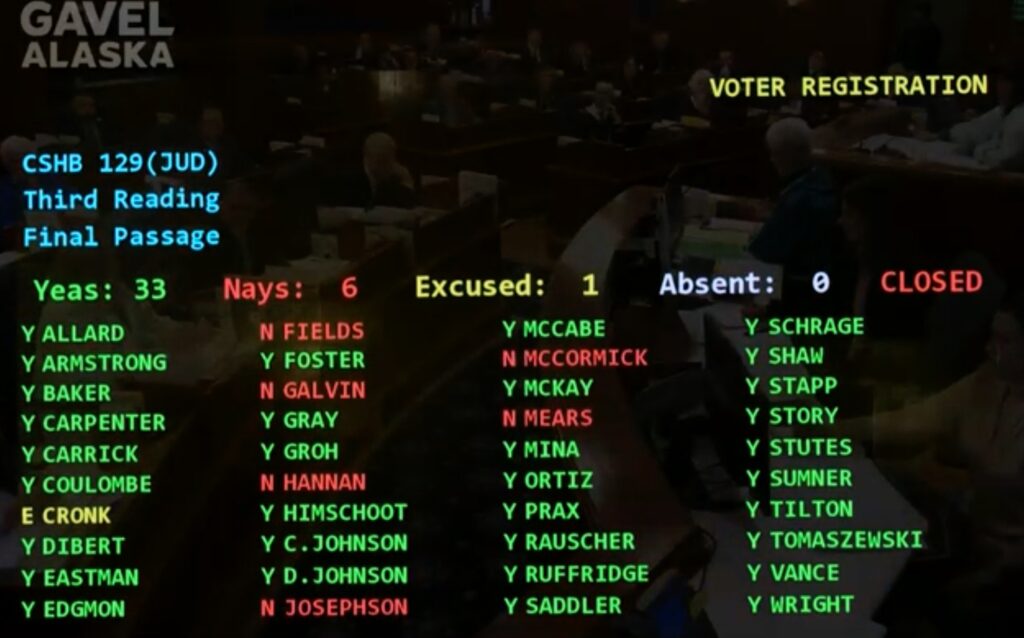
The House of Representatives passed House Bill 129, addressing what is widely seen as an excessive number of registered voters in Alaska.
Recent voter registration statistics show that 106% of possible voters in Alaska are registered. With an automatic registration process, a mobile population and the state’s “intent to return” law contributing, Alaska has more voters than eligible adults.
The legislation introduces targeted measures to enhance the accuracy of voter registration, such as mandating the the director of the Division of Elections send confirmation letters to non-domiciled voters to address potential inaccuracies. Additionally, a streamlined process for canceling voter registrations would make it more efficient to remove outdated or invalid entries.
“This legislation is about restoring the integrity of the process and ultimately to build public trust in one of our most fundamental rights; the right of the people to vote,” said Rep. Sarah Vance, House Judiciary Committee chairwoman.
“Our focus is on legislation that directly impacts the lives of our constituents. HB 129 exemplifies the Alaska House Majority’s dedication to proactive governance, responding to the distinctive needs of Alaskans to fortify the foundation of our democratic principles,” added House Speaker Cathy Tilton.
Call it the Palmetto Bug — a feature of the Democrats’ presidential nominating process, which starts Saturday.
At the urging of President Joe Biden, the Democratic National Committee blew off New Hampshire’s primary on Jan. 23, requiring Democrats going to the polls in the Granite State to write in Biden’s name.
About 80,000 New Hampshire voters wrote in “Biden” for president, while on the Republican side, 176,392 voters voted for Donald Trump, and another 140,288 votes went to Nikki Haley. Over 2,000 votes went to Ron DeSantis, although he had dropped out a few days earlier.
Democrats had tried to force New Hampshire out of its first-in-nation primary position, but lost that game of chicken with the state, which simply moved its primary forward to comply with its state law requiring it to be first in the nation.
Saturday’s South Carolina Democrat Primary is the first time the Democrats are actually going to play. The Palmetto State officially kicks off the Democratic primary season on Saturday after the national party rearranged its schedule and replaced Iowa and New Hampshire as the first-in-the-nation states to vote.
Political pundits credit South Carolina voters with propelling Biden to the White House in 2020 after giving him his first primary victory of the season.
When New Hampshire voters went to the polls last month, Biden’s name wasn’t on the ballot. However, the 46th president won the Granite State primary thanks to a write-in campaign.
The President recognizes that South Carolina voters matter,” South Carolina Democratic Party Chair Christale Spain and South Carolina Executive Director Jay Parmley said in a statement announcing a Jan. 27 First in the Nation Celebration and dinner.
It was almost a statement that backhanded New Hampshire as not mattering to Democrats.
“Black voters matter. And Southern voters matter,” they added. “We are grateful to him for honoring his commitment to our state and to our party by coming back to the place that started his road to the White House. For the first time ever, the backbone of the Democratic Party – Black voters – will choose who they want in the White House first.”
In November, the South Carolina Democratic Party’s Executive Council certified three candidates to participate in the primary: Biden, U.S. Rep. Dean Phillips, D-Minnesota, and author Marianne Williamson. Two candidates filed but were not certified, while another didn’t meet the constitutional requirements to hold the office, the party said in a news release.
Keith Nahigian, president of Nahigian Strategies, a Republican and a veteran campaign strategist, said Saturday’s primary “will be an enthusiasm measuring stick.”
“While he will win South Carolina, it takes place on a Saturday and will show what vulnerabilities he might have going forward in this cycle, especially with certain critical groups like young people and minorities,” Nahigian told The Center Square via email.
“The primary is over but the nomination process is not,” Nahigian added. “The Democratic party has a delegate/convention process with ‘super delegates’ that after the first vote is wide open. Chicago might be very interesting in August.”
Nahigian said that Biden’s team wanted this year’s primary calendar change, adding that in 2020, Biden “was closer to the end than the nomination until South Carolina bailed him out.” This time, Biden’s main challenger, Phillips, “does not have a stronghold in the state,” Nahigian said, adding the Biden team is “not operating from a position of strength.”
“The power of incumbency is a huge advantage when running for the White House but his team has tried to change the whole calendar and has fought to keep people off the ballot,” Nahigian said.
“That takes away time and energy when they should be trying to tell the stories of accomplishment,” Nahigian added. “I believe the third-party candidates this cycle might play a fair more impactful role than in other years rather than primary opponents.”
Groundhog Day may be over for 2024, but the trial of former Rep. Gabrielle LeDoux has its own deja vu quality about it. The original alleged crime took place in 2018, but the former lawmaker, who is a lawyer, knows how to work a court system and delay a trial.
Monday, LeDoux has yet another scheduling and trial-prepping court date in the election fraud case that has dragged on since she was first charged by the FBI in March of 2020, and indicted by a grand jury in June of 2021, on multiple felony counts of voter misconduct in the first degree.
The charges stem from the investigation that started in 2018 against LeDoux, Lisa (Vaught) Simpson, and Caden Vaught after workers are the Division of Elections noticed irregularities in some of the absentee ballot applications and absentee ballots returned for the primary election for then-House District 15, a Muldoon neighborhood that has many immigrant Hmong residents. The Alaska State Troopers, in conjunction with the Federal Bureau of Investigations, conducted the investigation, the essence of which is that LeDoux and her functionaries were overly helpful in marking and returning ballots from immigrants living in at least one mobile home park in both the 2018 primary and general elections.
LeDoux and Lisa Simpson were each indicted on five counts of voter misconduct in the first degree and Caden Vaught was indicted on four counts of voter misconduct in the first degree. They all have entered pleas of not guilty to the charges.
Since then, justice has been delayed numerous times for a variety of reasons, the first few delays related to the Covid pandemic that was still creating scheduling problems in 2021.
Monday’s court appearance at 2:30 pm in the courtroom of Judge Kevin Saxby is supposed to be a trial-setting conference, not the actual trial.
But such court events have come and gone for LeDoux, who is now 75 years old. Even if she is convicted, LeDoux, who is a lawyer, is likely to appeal the charges and delays could continue for her until she reaches her late 70s. More likely than a conviction in this case is some kind of plea agreement with the state.
LeDoux was part of a caucus that called itself the Muskox Caucus. She broke ranks with Republicans and forged a Democrat majority in the House with then-Reps. Jim Colver, Paul Seaton, and Louise Stutes — all Republicans who broke off from the Republican caucus in 2016. The only Republican member of the Muskox Caucus that is still in office is Stutes.
A special meeting of the Anchorage Assembly is scheduled for Friday to allow the Assembly to backtrack on an earlier resolution that advocated for complete removal of the Eklutna Dam, which provides substantial water and power to Anchorage and power to the MatSu Valley.
The Friday meeting is at 12 pm in City Hall, Room 155. AR 2024-40 is item 5.B on the special meeting agenda.
The liberal Assembly had earlier chosen to push for the dam removal.
The dam review and plan is required by a 1991 agreement and has been in the works for years. The Assembly was on board with the Eklutna Tribe, which wants the dam removed and the salmon allowed to swim to the lake.
That Assembly stance was in place until the Assembly learned recently that the Eklutna Hydro Project, co-owned by three of the regions publicly owned utilities, and Anchorage Water and Waste Utility had signed a binding agreement, but when asked by the Assembly for the particulars, said it was confidential.
The secrecy of the agreement left some members of the Assembly who advocated for the dam to be removed with questions: How would that binding secret agreement affect property taxes?
As the Assembly is the body responsible for levying taxes, Assemblywoman Meg Zaletel said it’s time to hit the pause button on what the Assembly’s actual stance should be on the project, which she called a generational project akin to the Port of Alaska expansion.
The Assembly members Chris Constant, Zaletel, and Kevin Cross have provided a new resolution asking for a two-year extension on the plan to balance fish, power, water, and tribal rights. That resolution will also be a topic for Friday’s surprise meeting.
In actuality, the Assembly and the Municipality have little standing in the matter, since the Municipality, with support from voters, sold Municipal Light & Power to Chugach Electric. Further, nowhere in the 1991 agreement is the concept of “restoration” mentioned. That’s a relatively new approach that environmentalists have been pushing.
Rep. Jamie Allard of Eagle River had some thoughts on whether the Assembly was playing fast and loose with the public.
“The Anchorage Assembly’s continued demands calling for restoration of the Eklutna River – only made possible by removing the existing Eklutna Hydroelectric infrastructure – flies in the face of science, good government and common sense. Assembly members making those calls must not have read the 1991 Fish & Wildlife Agreement, because they continue to insist that ‘restoration’ is a consideration of the owners’ coalition. In fact, the only terms used are ‘mitigation’ and ‘enhancement’ of the waters below the dam; ‘restoration’ is nowhere to be found,” she said in a press release.
“Failing reading comprehension – or perhaps woke politics – are no reasons to risk 90% of the Municipality of Anchorage’s water supply, nor gut a reliable, dispatchable and low- cost, low-carbon-footprint energy solution for Southcentral Alaska. One only has to look at recent below-zero temperatures, energy demand and upcoming potential supply shortages to know that removing current energy resources is unwise,” Allard said.
To view the draft Eklutna Hydro Project Fish and Wildlife Program, click on this link.
Eklutna Draft Fish and Wildlife Program public meetings were held in January. To view the presentation from the public meetings, click here.
Public comments must be submitted by Feb. 19. Email your comment to [email protected].
In April, the project owners must submit a final proposed Fish and Wildlife Program to Gov. Mike Dunleavy for formal review. Dunleavy has until Oct. 2 to issue a final decision on the program.
Facts:
The Eklutna Hydroelectric Project is 30 miles northeast of downtown Anchorage. The three project owners are the Municipality of Anchorage, Chugach Electric Association, Inc., and Matanuska Electric Association, Inc.
It is the lowest-cost power in Southcentral Alaska, providing 44% of MEA’s renewable generation portfolio and 25% of Chugach Electric’s renewable generation portfolio. Eklutna offsets approximately 72,500 metric tons of CO2 equivalent each year.
The Project was constructed by the federal government in the 1950s and then sold to the project owners in the 1990s.
At that time, concerns were raised about the dam’s impact on fish and wildlife. During the sale, a binding agreement was entered into by the project owners, National Marine Fisheries Service, U.S. Fish and Wildlife Service, and the State of Alaska (collectively the “Parties”) that requires the Project Owners to develop and propose to the Governor a program to protect, mitigate damages to, and enhance fish and wildlife impacted by the Project (1991 Agreement),” the executive summary states.
Since then, the Eklutna Tribe, membership 70, has become more influential, established government-to-government relations with Anchorage.
Parents of students at Klatt’s Elementary School were notified today that students not picked up immediately were being sent to Ocean View Elementary School for parents to pick them up, after the Klatt Road school boiler’s developed a problem.
The district said in a text message that the school’s boiler in South Anchorage is “down” and cold temperatures made the classroom environment “unsuitable” for students.
Anchorage, in a deep freeze spell, is still in the “green” zone for energy availability, but the warning lights are blinking after key wells in Cook Inlet that provide natural gas have been heavily tapped in recent cold weather. Those lights are blinking enough to have the mayor of Anchorage and local utilities call a last-minute press conference on Thursday to caution residents, while trying not to scare them.
Enstar Natural Gas Company, the largest utility in Southcentral Alaska, is asking people to conserve energy as the below zero temperatures persist through Friday.
Enstar President John Sims said in the nine years he has been with the utility, he has never seen demand so high. Enstar anticipates peak load demand Thursday night.
In the joint press conference with Mayor Dave Bronson and Matanuska Electric Association, Sims said that conservation is always a good idea, and the natural gas supply is stable, for now, but there is at least one well in Cook Line that will need some repairs, after heavy use has caused “sanding,” which can ultimately shut down a well. Fixing it during cold, dark days has significant challenges.
In the Mat-Su Valley, a widespread power outage occurred at the Eklutna Generation Station overnight on Wednesday, when one of the engines at the power plant developed a gas leak in a flange that connects pipes. The leak triggered safety measures to shut down a majority of the engines at the plant. All power was restored within 25 minutes after the system was switched over to diesel. Temperatures in the Valley reached as low as -25 on Wednesday night, -36 in Talkeetna.
The MEA outage was not related to a gas supply issue, but some 12,400 Chugach Electric Association customers also lost power because of a “load shedding event” that is occurring in the Railbelt, Chugach Electric said on Facebook. Load shedding is done to protect the overall system and prevent blackouts and involvesrotating power outages, or reducing power consumption from primary sourcesuntil demand decreases or capacity increases.
Meanwhile, some members of the Assembly are having second thoughts about their resolution that supports dismantling the Eklutna dam. This afternoon, a hasty press conference was called by Assembly Chairman Chris Constant to call for a two-year extension on any changes to Eklutna hydropower, which is a steady supply of power to Anchorage.
“Sponsored by Assembly Members Constant, Kevin Cross and Meg Zaletel, the resolution outlines concerns regarding the development and implications of the Draft Fish and Wildlife Program as proposed and calls for a two-year extension to reevaluate project alternatives and rectify the process,” the trio said of their new resolution, which will evidently replace a prior resolution.
This week the Municipality also sent notices to commercial building owners who have buildings that may experience roof collapses due to the more than 104 inches of snow received so far this year. Building officials say they analyzed properties using Google Earth satellite imagery to determine which buildings have flat roofs that may be at risk. Over 1,000 property owners received the letters because they have roofs with wooden trusses fastened with metal gang nail plates.
The midtown Anchorage neighbors fought it for years. The Jewish preschool nearby protested against having street people so close to the children.
But the Golden Lion Hotel on 36th Ave. was purchased anyway by former Mayor Ethan Berkowitz for use as a drug treatment center.
Mayor Dave Bronson promised to close if elected, but instead it became a low-rent housing solution with 84 rooms after the Bronson Administration capitulated to the liberal majority on the Assembly last summer.
Now, it’s the latest 24-hour homeless shelter that neighbors always feared it would become.
Mayor Dave Bronson declared an emergency due to the cold snap, with temperatures below zero. On Wednesday, he opened up the Golden Lion Hotel for anyone who needs shelter from what has been a tough winter, even by Anchorage standards, with a record amount of snowfall, collapsing roofs, and now plunging temperatures. Although Anchorage has 40% of the state population, it is a magnet for down-and-out Alaskans and has over 60% of the state’s homeless.
Bronson has also expanded the city’s contract with the Aviator Hotel on Fourth Ave., for overnight warming — 8 pm to 8 am. Earlier, his office had indicated that the Aviator would be a 24-hour warming shelter, but now those using it will need to find shelter during the daytime. While the nearby Anchorage Museum had last month guaranteed free admission to all Alaska Natives, it has since paused that policy. Alaska Natives make up 43% of the Anchorage homeless population. The Fifth Avenue Mall may end up becoming that daytime warming place, if others fill up.
In addition to the two hotels, the mayor already established a cold-weather shelter facility at the old Solid Waste Services facility at 1111 E. 56th Ave., also open 24 hours a day.
When he became mayor, Bronson attempted to build a navigation center that would process each person who checked in and get them to the help they need, whether it is drug addiction treatment, job referrals, or housing vouchers. But the Assembly blocked that proposal in a long and drawn-out fight with Bronson, hoping to make him unsuccessful at his signature project. They succeeded.
Then Bronson said the city would buy people one-way tickets back to their hometowns, to places where their families could help figure out solutions for them. But the Assembly also blocked that.
Last year, Bronson reclaimed the Sullivan Arena, which had become a hotbed of drugs and violence, after former Mayor Berkowitz had seized the arena for mass sheltering during the Covid pandemic. In the near future, the Sullivan Arena will return to be an event venue. The cost of repairs to the facility after the street people had their way with it has not been fully quantified by the city, but for now it’s no longer available for nighttime shelter.
The American Civil Liberties Union of Alaska sued the Matanuska-Susitna Borough School District on Wednesday, alleging that a girl in the district who identifies as a boy and is called a “transgender boy” in the lawsuit, is being prevented from using boys bathrooms and locker rooms at school.
The ACLU of Alaska represents a “set of parents bringing the case on behalf of their transgender son. Under this policy, every day, their child faces mental and physical challenges because he is denied access to the boys’ bathrooms, even though he is a boy.”
The ACLU is arguing that if a child says he or she is something, the world must agree and accommodate.
The ACLU says that the child’s right to privacy has been violated because the policy “violates his fundamental right to make his own choices about his body, his name, his gender identity, and the appropriate bathroom for him to use. This policy also violates the Equal Protection Clause of the Alaska constitution because it treats transgender students differently than other students.”
The case was filed in Palmer District Superior Court.
“The MSBSD has forgotten its obligation to protect young people, as well as the constitutional rights that all students – regardless of their gender identity – are entitled to,” said Ruth Botstein, Legal Director for the ACLU of Alaska, in a statement. “The student just wants to be able to go to school like any other kid, to focus on learning and socializing with his peers, and not have constant stress and anxiety about where and when he is going to be able to use the bathroom.”
The lawsuit refers to the child as “X.A.” The child attends an elementary school in the Mat-Su Borough School District.
“X.A. is a transgender boy. This means that he was incorrectly assigned “female” at birth, although he is and identifies as male. X.A. knows that he is a boy and presents to the world as a boy. People who meet him know him as a boy,” the lawsuit reads.
“Gender dysphoria is a serious medical condition recognized in the American Psychiatric Association’s Diagnostic and Statistical Manual of Mental Disorders, Fifth Ed. (2013) (‘DSM-V’), and by the other leading medical and mental health professional groups, including the American Medical Association and the American Psychological Association. Gender dysphoria refers to clinically significant distress that can result when a person’s gender identity differs from the person’s sex assigned at birth. If left untreated, gender dysphoria may result in psychological distress, anxiety, depression, and even suicidal ideation or self-harm,” the lawsuit continues.
According to the ACLU, X.A. always thought of herself as a boy, cut off all of her hair when she was age 3, and renamed herself to a masculine name when she was 7 years old. She “threw fits if anyone tried to get him to wear anything stereotypically girly: pink, rainbows, sparkles, and the like,” according to the ACLU.
X.A.’s parents moved her to a school that they thought was more progressive in the district and would bend to her demands to be treated as a boy, but in 2022, a district policy was put into place to protect both boys and girls in the district from having opposite-sex intrusions into their private spaces.
From the narrative in the lawsuit, it appears that X.A. is biologically a girl who has a boyish personality.
The lawsuit complains that providing a gender-neutral bathroom is not good enough, and that once a school nurse asked X.A. if she was a boy or a girl, making the child uncomfortable once again.
“X.A. was distraught from this interaction. The harmful question revealed that even the ‘gender- neutral’ option was not a safe or private one for X.A.,” the lawsuit contends.
“This incident also revealed that the nurse’s office bathroom accommodation is not sufficient to protect X.A.’s privacy, since using it singles him out, causing both other children and school employees to question his gender identity and to ask him uncomfortable personal questions about his bathroom use and gender identity,” according to the ACLU.
Obsessive habits have been identified with those who have gender confusion, but the lawsuit makes no effort to describe any other health or mental health factors that may be present, such as narcissistic personality disorder.
According to one study, narcissistic personality disorders are common among transgender individuals seeking gender surgery. “The frequency of personality disorders was 81.4%. The most frequent personality disorder was narcissistic personality disorder (57.1%) and the least was borderline personality disorder. The average number of diagnoses was 3.00 per patient,” according to the study published by the National Institutes of Health.
Senate Bill 88 is the dream legislation of the government unions. It would restore a defined pension plan for state, local, and public education employees. But no one knows how much it will really cost, because there is no complete fiscal note on the bill.
SB 88 will now go to the House, where it will likely be referred to at least three committees for vetting, since it is inadequately understood by its Senate sponsors.
Usually, the saying goes in the Legislature, “If you have the votes, then vote. If you don’t have the votes, then talk.” But with the Senate gallery filled with government union representatives, pro-pension senators took up over two hours, mostly justifying why the bill should get approved.
Bill sponsor Sen. Cathy Giessel spoke at length and claimed it is not a gold-plated plan, and she promised, without evidence, that it would “turn the tide on our workforce recruitment and retention issues. We must take significant action now if we want to turn around our economy and attract the brightest in best in all industries, public and private.”
The bill only applies to public employees, however.
The 11 SB 88 sponsors believe that they can turn around the outmigration of people in Alaska by luring them into government jobs with good pension plans. The problem described by the Senate — not enough workers — is being experienced across the country.
“One primary reason that has been cited for recruitment and retention issues is the lack of a quality retirement system that public servants can depend on once they retire,” the Senate majority said in a press release.
In 2006, the state of Alaska transitioned into a defined contribution plan, similar to a 401(k)-retirement plan, as the pension plan began to show signs of crippling costs to the state.
Sen. Bert Stedman, who was one of the senators around in 2006 who pushed to get the pension plan retired and replaced with a contribution plan similar to a 401K, pointed out that there is an incomplete fiscal note with the SB 88, so he was going to be a “no” vote.
“I’m concerned about the cost neutralness of this bill. I don’t think it is cost neutral,” he said. “The normal cost is higher than some of of that calculated over at Leg. Finance.”
Stedman said that the individual retirement account has become a portable item that is used as a pooling mechanism for workers as they change employers. It’s the model across the country now. He noted that on the last pension plan, which he helped end in 2006, the state still owes $6 billion.
But Sen. Jesse Bjorkman of North Kenai, who served as a union representative for his school district, spoke at length about the benefits of pension plans, and said it was “likely cost neutral” and that the matter had been “vetted over a decade ago.”
Americans for Prosperity-Alaska, a grassroots group active in political life in Alaska, will be trying to stop the Legislature from approving this bill.
AFP-AK State Director Bethany Marcum said, “Returning to a defined benefit pension plan would be disastrous to the state’s budget and would cost Alaska upwards of $9 billion in avoidable expenses. Simply put – Alaskans can’t afford this misguided legislation.”