Sunday, August 16, 2026
Home Blog Page 545

Jack Spencer: Time for nuclear energy

By JACK SPENCER | REAL CLEAR WIRE

The silver lining of this month’s United Nations COP28 global warming conference is the growing consensus that nuclear energy is critical to meeting national carbon dioxide reduction goals.

Denying the world access to clean, affordable fuels like gas, oil, and coal is a real problem. But recognizing that nuclear energy must play a pivotal role in our energy future is a major step forward—one that should enjoy widespread support, regardless of one’s views on CO2 reductions.

But to go big on nuclear requires thinking big on nuclear energy policy, and that means questioning the subsidize-first mentality that has defined U.S. energy policy for decades.

The goal should not be to build a few nuclear power plants. Rather, we should strive to create an economically sustainable, competitive, innovative and uniquely American nuclear industry.

This will require a realignment of responsibility. The government’s role should be to protect public health and safety. The private sector’s role should be to operate a competitive commercial nuclear sector.

That means getting rid of the subsidies, rethinking regulation and getting Washington out of nuclear waste management. Washington should have a regulatory role, but not its current role as Nuclear CEO.

The reason is simple: Governments are not good at business, because they make decisions based on politics rather than on good economic sense. This never yields a successful industry.

Some argue that nuclear energy requires more governmental control, suggesting that nuclear presents more financial, technical, and political risks than other industries.

But all big projects have financial risk. Private oil refineries can cost billions of dollars, and projects like skyscrapers, liquid natural gas export terminals and other large industrial projects all require massive capital outlays. Companies and individuals regularly take big financial risks.

Then there is technological risk. But nuclear is not really that different from other industries. With 440 nuclear reactors operating globally, technical risk for existing technology is relatively low. Industry knows how to build and operate nuclear plants.

Possible technological risks with new designs are not beyond the realm of those posed by innovation in other cutting-edge businesses, such as fracking or offshore energy exploration. e. Beyond that, as it pertains to nuclear energy, there is a vast federal research infrastructure in place that the private sector can access to help mitigate that risk.

Political risk, however, is real and uniquely high when it comes to nuclear energy, and it exacerbates financial and technical risk calculations. Any justification for government intervention is based on mitigating government-imposed risk.

But here is the problem.

When government intervenes to mitigate a risk that it has created, it adds another layer of political risk. Worse, it creates dependence, distorts capital flows, incentivizes rent-seeking and lobbying, and forces firms to allocate resources to satisfy politicians and bureaucrats rather than improve its business.

This creates misalignments between responsibility and authorities and undermines economic efficiency.

Even worse, politics often changes, making it difficult to build a sustainable business model around political preferences. At best, this approach could yield a couple of reactors or keep some firms above water, but it won’t produce a robust, competitive, innovative nuclear industry. Failure is likely.

The major question is: How does America minimize political risk and allow the private sector to manage other risks, so that a robust industry can emerge?

It will require changing the Department of Energy’s role, bold regulatory reforms, and solving the problem of nuclear waste management.

We need to get the Energy Department totally out of the nuclear commercialization business. The problem is not that people are not doing their jobs, the problem is the nature of government.

The Department should not be funding grants, loans, or demonstration projects. Nor should it be attempting to improve operations or economics of existing plants or new technologies. The private sector can do these better than government.

The Energy Department has an important role to play in nuclear research and scientific discovery, but it needs to get as far from any commercialization or commercial operations as possible.

What about regulation?

Worthwhile attempts are being made to improve the Nuclear Regulatory Commission. An efficient, predictable, and affordable regulatory process for new reactor technologies is essential.

But America needs to think bigger.

For example, states could be authorized to take a larger role in nuclear power plant regulation. The Atomic Energy Act of 1954 already allows states to regulate some nuclear materials. That should be expanded. States could regulate existing reactor technology, and the NRC could focus on new technologies. Not all states will use this opportunity, but some will.

This is a reasonable proposition because U.S. utilities have been safely operating large light water reactors for over 50 years. America should not be regulating large light water reactors as new, scary technology, because it is neither new nor scary. The regulatory burden should be significantly lifted on those reactors.

NRC personnel should not be the only ones who can review permit applications and other regulatory review work. Private firms should be able to compete for this business. They would lighten the NRC’s load and likely do a quicker job at lower cost.

Lastly, companies should be allowed to build reactors outside the existing NRC regulatory regime if they obtain their own liability insurance against accidents. In exchange they would forgo participation in the federal Price-Anderson program that currently provides liability coverage.

Some might question whether private insurers would cover a nuclear reactor absent a government backstop. But given outstanding safety records of existing reactors and promises that new technologies are safer, this should be an option. Insurance comes in many forms, and no one can predict what could ultimately emerge.

Either way, the insurance industry is extraordinarily sophisticated and does a tremendous job at pricing risk. It will be effective at ensuring that only the safest nuclear plants are built.

Finally, there is the question of what to do with nuclear waste—or, more accurately, spent nuclear fuel.

The federal government took responsibility for managing the nation’s spent nuclear fuel in 1982. By removing responsibility from the spent fuel producers, the 1982 Nuclear Waste Policy Act removed any incentive for the nuclear industry to integrate spent fuel management into its long-term business planning and left it instead to Washington bureaucrats. It should surprise no one that the plan has failed.

Reforms are needed to reconnect the nuclear industry to waste management. Reforms would allow for a private spent fuel industry to emerge that would drive innovation in reactor technologies and spent fuel processing. They would allow the nuclear industry and communities to engage in real negotiations, bound by legal contracts, to build and operate spent fuel management facilities.

There is no question that these proposed reforms are a major departure from the status quo, but they are reasonable, not radical. They would foster good governance and economic progress in the industry. As COP28 representatives discuss how to reduce carbon while raising global living standards, nuclear energy should be on the front burner.

Jack Spencer is a Senior Research Fellow in Energy and Environmental Policy at The Heritage Foundation. This article was originally published by RealClearEnergy and made available via RealClearWire.


How tax-exempt nonprofits skirt U.S. law to turn out the Democrat base in elections

By STEVE MILLER | REAL CLEAR WIRE

Even as Democrats such as Sen. Sheldon Whitehouse warn of “right-wing dark-money network seeking to undermine the future of democratic elections in the United States,” progressives have far outstripped Republicans in harnessing the power of putatively non-partisan, nonprofit organizations that push the boundaries to win elections.

More than 150 progressive nonprofits spent $1.35 billion on political activities in 2021 and 2022, according to data compiled by Restoration of America, a conservative political action committee. Although there are no readily available estimates of comparable conservative efforts, observers say they are overmatched.

“The liberal nonprofit sector is much bigger than the conservative nonprofit in the political arena,” said Bradley Smith, a former commissioner with the Federal Election Commission and founder of the conservative Institute for Free Speech.

The progressive nonprofits include faith-based groups, ethnic activist operatives, and colleges and universities, which have taken on an outsized part of the Democratic party’s election strategy.

The groups work around legal restrictions on nonprofits that accept tax-deductible donations by selectively engaging in nonpartisan efforts including boosting voter education and participation.

But, like the estimated $332 million that Meta CEO Mark Zuckerberg and his wife Priscilla Chan donated to public elections offices to help run the 2020 elections, much of it winds up in the hands of groups that operate in liberal strongholds and work with reliably Democratic constituencies.

This is in part how two influential groups, the Voter Participation Center and its partner group, the Center for Voter Information, increase Democratic turnout.

Both have the stated mission of encouraging people in specified demographics – “young people, people of color and unmarried women” – to vote. All three groups are part of the Democratic Party’s base. Voters in these groups are up to two-and-a-half times more likely to vote when engaged by a nonprofit, according to research from Nonprofit Vote, an advocacy group for tax-exempt activist groups.

The value of these groups was underscored when the Biden administration prepared to compose his executive order directing federal agencies to “expand citizens’ opportunities to register to vote.” In July 2021 officials met with leading progressive operators, including Democracy Fund, Fair Elections Center, FairVote, the Southern Poverty Law Center, Al Sharpton’s National Action Network and the George Soros-backed Open Society Policy Center, according to an internal administration email obtained by the Foundation for Government Accountability, a conservative nonprofit that is suing the administration to obtain records related to the executive order.

The Democratic Party’s stance on issues, from climate change to voting procedures, is also echoed by their nonprofit allies. The Fair Elections Center, for example, calls those who questioned the outcome of the 2020 presidential race “election deniers” who oppose the right to vote. Their stance echoes President Biden, who said last year that there were “more than 300 election deniers on the ballot” for the midterms, adding that “It’s damaging, it’s corrosive, and it’s destructive.”

Significant funding for these and other voting activist operations flows from the same sources that put millions of dollars into Democratic and progressive campaigns.

Among them:

The Tides Foundation, with $1 billion in revenue in 2020, funds the moveon.org PAC while also giving to the Voter Registration Project, League of Women Voters, and Project Vote. The foundation is one of several Tides nonprofits that operate in the charity world of progressive funding, giving to groups that advocate for abortion rights, gun control, and “equity” causes. Tides is also a partner of Black Lives Matter.

New Venture Fund, formed in 2006 as Arabella Legacy Fund, lobbies for progressive causes, including election laws, in 41 states, and in 2020, according to a civil rights lawsuit filed by a former employee, “disbursed nearly $500 million to address progressive issues such as racial justice.” The lawsuit contends New Venture engaged in prohibited partisan political activity, which is disputed by New Venture. New Venture is also a key financial supporter of progressive voting groups American Votes, NAACP National Voter Fund, and Fair Elections Center.

The Silicon Valley Community Foundation since 2020 has given $106 million in grants to nonprofits for voter education and turnout. It was the primary conduit of Zuckerberg’s millions in grants that went to public elections offices around the U.S. in 2020 and has donated money to Planned Parenthood and Democracy Now, while its employees have donated exclusively to Democratic candidates.

The number and funding of electorally active progressive nonprofits have increased dramatically during the past decade. Their get-out-the-vote efforts are replacing those of political campaigns, which traditionally relied on their own staffers to engage voters.

Much of the switch from party and campaign activity to nonprofits stems from a changing political landscape, which de-emphasizes the short-term goals of candidates (winning elections) to a longer-term vision for party dominance, said Sasha Issenberg, author of “The Victory Lab: The Secret Science of Winning Campaigns.” His 2012 book chronicled this shift through the increasing use of micro-analytics and social science in voter targeting, a strategy first dominated by Republicans, then updated and refined by Democrats. That refinement was carried out by younger individuals who were comfortable with a collectivist mindset, he said.

A “historical volunteer culture” set the table for a blossoming of the nonprofit base of the left, Issenberg told RealClearInvestigations. “When you had this era of innovation on the left, it set upon a culture that was already in place and wanted to perfect this idea.”

The progressive voter groups adroitly navigate tax rules that allow 501(c)(3) nonprofits to engage in voter participation and get-out-the -vote drives provided the effort is not aimed to benefit a political party.

These groups have access to solid voter and other demographic data, along with large teams of experienced community organizers, said Erick Kaardal, a Minneapolis-based attorney who has filed dozens of election-related lawsuits, some in connection with his role as special counsel for the conservative Thomas More Society.

“These groups are very good at legal compliance,” Kaardal said. When conservative nonprofits violate the rules, their liberal opponents “justly file complaints.” But Republicans, he said, “are novices … and [conservative nonprofits] also lack the resources [progressives] have. It’s not unfair; they have paid big money to have this well-oiled machine and to keep it legal it takes those resources.”

Today, tax-exempt entities drive the efforts to get out votes and register voters while engaging in advocacy that virtually copies the platforms of leading elected Democratic officials.

Under the guise of civic engagement or voter advocacy, the advocacy nonprofits pepper email inboxes with fund-raising pitches while alleging that efforts to reform or stem practices that lead to ballot fraud are tantamount to voter suppression. “In a crucial state that decided control of the U.S. Senate in the last two elections, Georgia voters are no stranger to voter suppression schemes,” reads an email sent to constituents by Vote.org, seeking to raise money to combat voter integrity measures passed by Republican lawmakers in 2021.

Vote.org describes itself as the largest “nonpartisan voting registration and get-out-the-vote (GOTV) technology platform in America,” while its correspondence often echoes statements made by Democrats including Sen. Elizabeth Warren, Democratic gubernatorial candidate Stacey Abrams of Georgia, and President Biden. “Threats to democracy” and voter “suppression” are a common term in Vote.org’s press releases and in social media posts. The organization largely embraces the Democratic party’s position that voter integrity measures backed by Republicans – including voter ID laws and restrictions on mail-in ballots – are almost always aimed at voter suppression. Voter.org also focuses on areas and groups that may be less likely to vote, which tends to include young and minority voters that Democrats count on.

“The overall upshot of how we make the selections is based on where voter turnout isn’t matching the demographics of the area,” said Nick Hutchins, a spokesman for Vote.org. “We want the vote to be accessible to everyone.”

A Leftward Disparate Impact

As a result, seemingly neutral efforts have a disparate impact that helps Democrats far more than Republicans.

“There’s a line of administration and politicking here, and unless you hit every constituent in the same way, it will have disproportionate effects,” said Ryan Williamson, co-author of the book, “Nationalized Politics: Evaluating Electoral Politics Across Time.”

The charities that fund voter registration have been created by an activist league with roots in community organizing from Barak Obama’s 2008 presidential candidacy.

“The proliferation of these nonprofits has accelerated in the last few years, and it was engineered by the Obama campaign in 2008,” Hans von Spakovsky, a senior legal fellow at the Heritage Foundation, told RCI.

That was the same year the nonprofit Arabella Legacy Fund was founded by former Clinton administration appointee Eric Kessler with a stated mission of “environmental preservation and protection.” Arabella’s application cited Bible verses to support its proposed environmental advocacy. In 2009 the group became the New Venture Fund, which has provided millions of dollars to voting nonprofits. Arabella became the for-profit Arabella Advisors, which handles strategy and management for New Venture and a host of other, similarly partisan nonprofit enterprises.

Courting, creating, and funding nonprofits by progressives is now a core Democratic Party strategy, one that has proven successful as Democrats have prevailed or outperformed historical expectations in national elections.

“They are after a new American majority, and that includes people of color, women, students, LGBT, and [progressives] have a strategy for each group,” said Ned Jones, deputy director of the conservative Election Integrity Network. “It’s all about registering voters and getting a ballot in their hands, and they know what they’re doing,”

Republicans, he said, are far behind. “The opposing team doesn’t have the funding, the structure or the system to do what progressives are doing.”

This article was originally published by RealClearInvestigations and made available via RealClearWire.

Hispanics say inflation is top concern

By CASEY HARPER | THE CENTER SQUARE

Hispanic Americans cite inflation as a key concern for elected officials to address heading into the 2024 election year, according to newly released polling data.

Prices on a range of goods and services have risen about 20% since President Joe Biden took office. In recent months that increase has slowed, but those prices still remain much higher than when Biden took office.

“Inflation, jobs and the economy, healthcare, crime/guns, and housing costs are top priorities, and there is strong support for policies to address them,” the survey reported, adding that “food and basic necessities, housing/rent, and gasoline are the principal worries regarding inflation.”

Hispanics were nearly split in their approval of President Joe Biden.

The November poll was conducted by the Democratic polling group BSP Research, on behalf of UnidosUS and Mi Familia Vota and surveyed nearly 3,000 eligible Latino voters.

After inflation, jobs and the economy are the second biggest issues for Hispanics, followed by health care, and crime and gun violence.

Breaking: Cargo ship laden with lithium batteries catches fire, diverted to Dutch Harbor

41

A Panamanian-flagged tanker carrying 828 metric tons of lithium batteries caught fire and has been diverted to Dutch Harbor.

According to interagency communications, on Dec. 25, the Panamanian-flagged M/V Genius Star XI experienced a fire in its #1 cargo hold. The cause of the fire is believed to be lithium-ion batteries that ignited during heavy seas.

The vessel crew used its CO2 fire suppression system, and the fire was believed to be extinguished and reported no injuries onboard.

The ship diverted from its original destination of San Diego to Dutch Harbor.

On Dec. 28, the USCG Sector Anchorage Command Center was notified of a second fire, in the #2 cargo hold. The second fire is suspected to have ignited in the same manner as the first reported fire.

The Genius Star is currently cooling the cargo hold boundaries (top hatch and accessible bulkheads (side walls) by using seawater seawater, due to having run out of its CO2 suppression system on the first fire.

Nobody has accessed the cargo hold, and the master does not intend to allow anyone to access that watertight, secure space.

Alaska Chadux Network and has contracted TNT Marine Salvage, which hired Resolve Marine to deploy the vessel “Resolve Pioneer” to aid in firefighting operations on Dec 29.

Alaska Chadux Network is an industry-funded 501(c)(4) nonprofit oil spill response organization headquartered in Anchorage that maintains 17 response ready equipment hubs throughout Southcentral and Western Alaska.

The U.S. Coast Guard District 17 launched the Coast Guard cutter Alex Haley, to gain greater situational awareness and determine if additional assistance is needed.

The plan for the vessel is to transit to Dutch Harbor, still under its own power without any known propulsion or steering issues at this time, and utilize a mooring buoy located west of Hog Island near, but not in Dutch Harbor.

The vessel is still en route to Dutch Harbor maintaining “standoff from Areas-to-be-Avoided” along the islands, with an estimated arrival of Dec. 29. It has a crew of 19 onboard. The approximate propulsion fuel load (diesel) is 135,000 gallons. The vessel’s cargo is 828 metric tons of lithium-ion batteries.

Alex Gimarc: Removing the Eklutna Dam

By ALEX GIMARC

Must Read Alaska reported a few weeks ago that the Anchorage Assembly asked the legislature to approve removal of the Eklutna dam, ostensibly to rebuild a salmon run gone for at least a century. 

This is the same Assembly majority that has managed to turn the homeless problem in town into a festering sore on the body politic.  That festering sore has been financially lucrative for one of their members (Meg Zaletel) who they have determined not to have a conflict of interest.  

With the decision to support removal of the Eklutna dam, the Assembly manages to get themselves into the energy business, and into the ever-contentious Cook Inlet fish wars while they pander to the 70 or so members of the Eklutna Tribe, something that apparently makes them feel good.  The rest of us, not so much.  

Their request is so well thought out that I am reminded of PJ O’Rourke’s observation:

“Giving money and power to government is like giving whiskey and car keys to teenage boys.”

With this recommendation, the Assembly majority has finished the whisky and is inserting the car keys into the ignition.

A deeper dive into the three issues revolving around the removal of the Eklutna dam is probably worth our time.  From here, the issues include the following.  There are likely more, but this is a start:

  • Electrical generation
  • Anchorage water
  • How many fish?

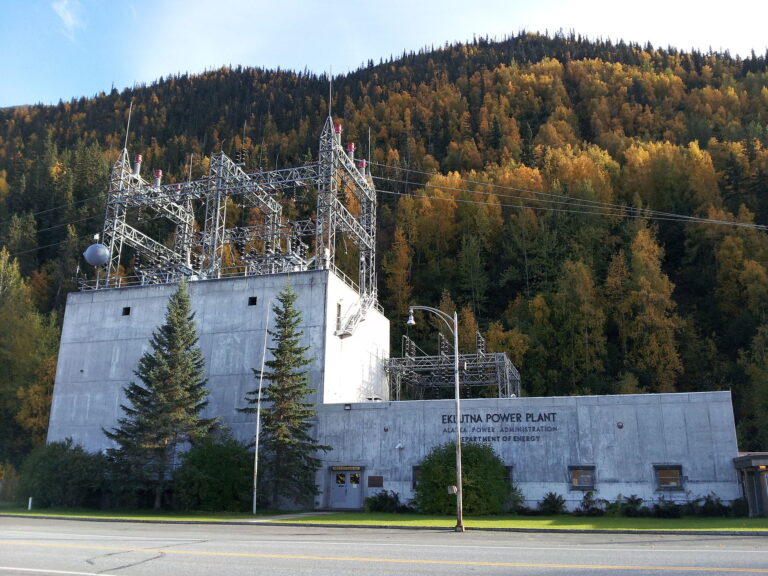
The Eklutna hydro station has been operating since 1955. It was sold to the three electric utilities, Chugach, MEA and ML&P in 1991. That sales agreement set a 30-year clock on returning the river to its natural state. Chugach and MEA published a draft of their Fish and Wildlife Program in Oct. The fourth utility involved is AWWU, as Anchorage gets 90% of its water from the same infrastructure used to generate electricity.

Eklutna hydro generates 40 – 47 MW of clean, reliable, carbon free electricity, just over 5% of all electricity generated in the Railbelt. The Eklutna dam raised water level in the lake some 24’ from its natural level. That natural level changes throughout the year based on snowmelt. The intake is at the bottom of the lake, 60’ below the current surface. AWWU’s water comes off a tap to that piping system.  

Advocates for removing the dam believe there is enough water available to support rebuilding the salmon runs, generating electricity and supplying water for Anchorage if the dam is removed. The immediate question is how will this water be allocated? Whose needs are most important? Our experience in the endangered species world is that the needs of the fish ALWAYS override those of the humans (delta smelt in California and snail darter in Tennessee).

Today, 90% of the flow is used for electrical generation. 10% of that flow is used for drinking water. Cut that flow in half, and output from Eklutna hydro will necessarily drop by a similar percentage.  The intake was blocked for some weeks to months following the 1964 quake by an underwater landslide.  It can be blocked again.

Additionally, there are two stocked salmon runs below the Eklutna hydro plant in its tailrace that need continual waterflow.  

Perhaps the best analysis of Eklutna lake for the presence of salmon was a Sept 2017 paper by Loso, et al. They found no direct evidence in cores taken from the lake bottom for a red salmon population, though Eklutna tribal elders promised them they were a fishing village before the first dam was built in 1929. 

Total population estimated entirely on Eklutna oral tradition is in the vicinity of 1,000 reds/year. It is up to the reader to determine how valuable those 1,000 fish/year are, especially since very few of them will be caught.

Note that salmon here in Upper Cook Inlet are gregarious. Silvers exploit flooding, spawning in places far outside their normal creeks and streams.  All five species of salmon go up Rabbit Creek, as they also do in Campbell Creek. Very few salmon go up Eagle River. There is a small red run up a closed creek on Joint Base Elmendorf-Richardson.   

If the Powers That Be make the decision to remove the dam, they will base that decision on all the “trust me” claims by the advocates like the Eklutna Tribe and Trout Unlimited that there will be no noticeable impact if the dam is removed.  Of course, the advocates have no response other than trust me to questions about replacing lost electrical generation and what happens when the water levels are too low to support current water use during a dry year(s).

I would suggest the following questions be answered before any discussion of dam removal:

  • How do you plan to provide drinking water for Anchorage in the event of low water levels in the lake? Who or what makes the allocation decisions?  And who or what has priority?

  • How do you plan on replacing 5% of Railbelt electrical generation with something that is at least as clean and reliable as hydro?  That generation needs to be online before the dam is removed.  Nobody has it budgeted.  

  • What impact of reduced water flow has on the two stocked run at the Eklutna tailrace?  Do the needs of the new Eklutna fish outweigh those of the stocked fish in the tailrace and their user group?  If so, why?  

I always get worried when all the Usual Suspects demand immediate action to right an environmental wrong, especially when their response to all questions are “trust me.”  I get more worried when the Rocket Scientists on the Anchorage Assembly are onboard.  

We might get lucky. This might work out nicely. But the costs and pain level should it not will be substantial in terms of cratering electric reliability and drinking water availability. Are those costs and that risk worth the feel-goodism associated with removing yet another dam? Should be an interesting discussion.

Alex Gimarc lives in Anchorage since retiring from the military in 1997. His interests include science and technology, environment, energy, economics, military affairs, fishing and disabilities policies. His weekly column “Interesting Items” is a summary of news stories with substantive Alaska-themed topics. He was a small business owner and Information Technology professional.

King County records over 1,050 fentanyl deaths this year

17

Washington’s King County recorded three fentanyl deaths in 2015.

But in 2023, the annual deaths from the drug has reached 1,050, and the year isn’t over. That represents a 47% jump over last year’s record-setting fentanyl fatalities.

The synthetic opioid that is killing so many Americans is being smuggled over the U.S. border from labs in Mexico.

Half of the county’s overdose deaths this year involved a combination of fentanyl and methamphetamine, according to a report by the Seattle Times.

Another 82 King County overdose deaths await pending toxicology reports, the report says.

American Indian and Alaska Native residents have by far the highest death rate from opioid overdoses, the Washington State Health Department says.

That statistical trend that is impacting Native families is mirrored nationally, according to the Centers for Disease Control and Prevention.

The National Center for Health Statistics says there has been a 33 percent rise in drug overdose deaths including fentanyl among American Indians and Alaska Natives from 2020 to 2021, the second largest increase among ethnic groups in America. Native Hawaiians and Pacific Islanders have seen a 47% jump in deaths.

Alaska’s fentanyl deaths went from 9 in 2018 to 145 in 2021. Some 633 overdose deaths involving opioids occurred in Alaska between 2018 and 2022, according to the Department of Health.

Top Republicans demand White House provide communications between Joe, Hunter Biden

By COREY WALKER | THE CENTER SQUARE

U.S. House Oversight Committee Chair James Comer and House Judiciary Committee Chair Jim Jordan are investigating allegations that President Joe Biden urged his son to dodge congressional subpoenas.

Comer and Jordan sent a letter Wednesday to Edward Siskel, assistant to the president and White House counsel, requesting documentation on any communications from the White House on Hunter Biden’s deposition. The chairmen suggest that the president may have attempted to impede the probe into Hunter Biden as part of the House’s impeachment inquiry.

The chairmen are seeking “documents and communications sent or received by employees of the Executive Office of the President regarding the deposition of Hunter Biden,” and “documents and communications sent or received by employees of the Executive Office of the President regarding President Biden’s statement about his family’s business associates on December 6, 2023.”

On Dec. 13, Hunter Biden refused to attend a closed-door deposition and spoke to reporters outside the Capitol, denying allegations that his father was involved in his business dealings.

“Let me state as clearly as I can: My father was not financially involved in my business – not as a practicing lawyer. Not as a board member of Burisma, not in my partnership with a Chinese private businessman, not my investment at all nor abroad, and certainly not as an artist,” Hunter Biden said.

Hunter Biden asserted that he would only testify in a public setting, fearing that Republican lawmakers would leak his testimony and misrepresent it.

During a news conference the same day, White House Press Secretary Karine Jean-Pierre told reporters that President Biden was “certainly familiar with what his son was going to say.”

Comer and Jordan argue that Jean-Pierre’s comments indicate that the President Biden had “​​advanced knowledge that Mr. [Hunter] Biden would choose to defy two congressional subpoenas.”

The congressmen wrote that Pierre’s comments have triggered an investigation into whether President Biden encouraged his son to ignore the subpoenas.

“In light of Ms. Jean-Pierre’s statement, we are compelled to examine the involvement of the President in his son’s scheme to defy the Committees’ subpoenas,” the letter reads. “The Committees have accumulated substantial evidence that Hunter Biden’s business endeavors have improperly included his father, and the President has made false claims about his knowledge and involvement in these schemes.”

The congressmen are looking into whether President Joe Biden ”corruptly sought to influence or obstruct the Committees’ proceeding by preventing, discouraging, or dissuading his son from complying with the Committees’ subpoenas.”

Biden’s alleged actions could “constitute an impeachable offense,” the congressmen wrote.

Trump returns to Colorado ballot after GOP appeal to U.S. Supreme Court

By JOE MUELLER | THE CENTER SQUARE

 The Colorado Republican Party is appealing to the U.S. Supreme Court in a case where the state Supreme Court ruled to remove Donald Trump from the 2024 Republican presidential primary ballot.

The appeal automatically places the former president on the March 5, 2024, primary ballot when certification takes place on Jan. 5, 2024, due to a stipulation in the Colorado Supreme Court ruling, according to a news release from Democratic Secretary of State Jena Griswold. However, if the U.S. Supreme Court declines to hear the case or if it affirms the Colorado Supreme Court, Trump would not appear on the ballot.

In a 4-3 decision on Dec. 19, the Colorado Supreme Court ruled Trump should be “disqualified from holding the office of President under Section Three of the Fourteenth Amendment to the U.S. Constitution.” In the 213-page document that included dissents from justices, the court stayed the ruling until Jan. 4 and kept the stay in place in the event of an appeal.

The American Center for Law and Justice announced it filed a petition for certiorari on behalf of the Colorado GOP on Wednesday.

The 45-page petition argues the president is not covered in Section Three of the 14th Amendment, and that the state Supreme Court’s decision violates the party’s First Amendment right to association. The petition also notes eight cases recently decided or pending to remove Trump from the 2024 primary ballots.

Most courts have rejected these lawsuits on jurisdictional grounds, but the Colorado Supreme Court has followed its own path and split from the others, warranting this Court’s review,” the petition states.

In a footnote to the statement about the Colorado Supreme Court, the petition states the “drastic effects” of the ruling “necessitate this Court’s immediate review.”

“The prompt hearing of this case is necessary to prevent the Colorado Supreme Court’s decision from having an irreparable effect on the electoral process,” the petition states. “Petitioner is prepared to abide by whatever expedited processes this Court may set.”

The case to remove Trump from the ballot, Anderson v. Griswold, was filed by six Republican and unaffiliated Colorado voters in September. A Colorado District Court ruled in favor of Trump, stating his speech on Jan. 6, 2021, “incited imminent lawless violence” but didn’t meet the definition of “engagement” found in the U.S. Constitution. The case was then appealed to the Colorado Supreme Court.

“Donald Trump engaged in insurrection and was disqualified under the Constitution from the Colorado Ballot,” Griswold said in a statement on Thursday. “The Colorado Supreme Court got it right. This decision is now being appealed. I urge the U.S. Supreme Court to act quickly given the upcoming presidential primary election.”

Griswold’s office said the state’s 2024 presidential primary ballots will be sent to military and overseas voters on Jan. 20. The ballots will be mailed to active registered voters on Feb. 12 and the first day of in-person voting will be Feb. 26.

Maine Secretary of State removes Trump from ballot

By TOM GANTERT | THE CENTER SQUARE

The state of Maine removed Donald Trump from its 2024 presidential primary ballot because its secretary of state said he engaged in insurrection during the Jan. 6 riot at the U.S. Capitol.

The decision was announced Thursday by Secretary of State Shenna Bellows, a Democrat.

“I do not reach this conclusion lightly,” Bellows said in a media release. “Democracy is sacred… I am mindful that no Secretary of State has ever deprived a presidential candidate of ballot access based on Section Three of the Fourteenth Amendment. I am also mindful, however, that no presidential candidate has ever before engaged in insurrection.”

The decision in Maine came after the state of Colorado put Trump back on its ballot after that state’s Supreme Court ruled he could be removed from their 2024 primary ballot.

There has been a movement across the country to remove Trump from the presidential primary ballot due to his actions during Jan. 6, 2021. In Michigan, that state’s Supreme Court ruled Wednesday that Trump could be on the ballot. Oregon, California and New Hampshire are other states reviewing Trump’s status as a presidential candidate.

“Another day, another illegal and corrupt act by the desperate radical Democrats weaponizing government against President Trump, Joe Biden’s top political opponent,” Elise Stefanik, a Republican U.S. House of Representative from New York, said in a media release. “The Far Left Democrat Maine Secretary of State just unilaterally removed President Trump from the ballot. This is election interference, voter suppression, and a blatant attack on democracy. The Supreme Court must overturn this unprecedented and unconstitutional action now.”