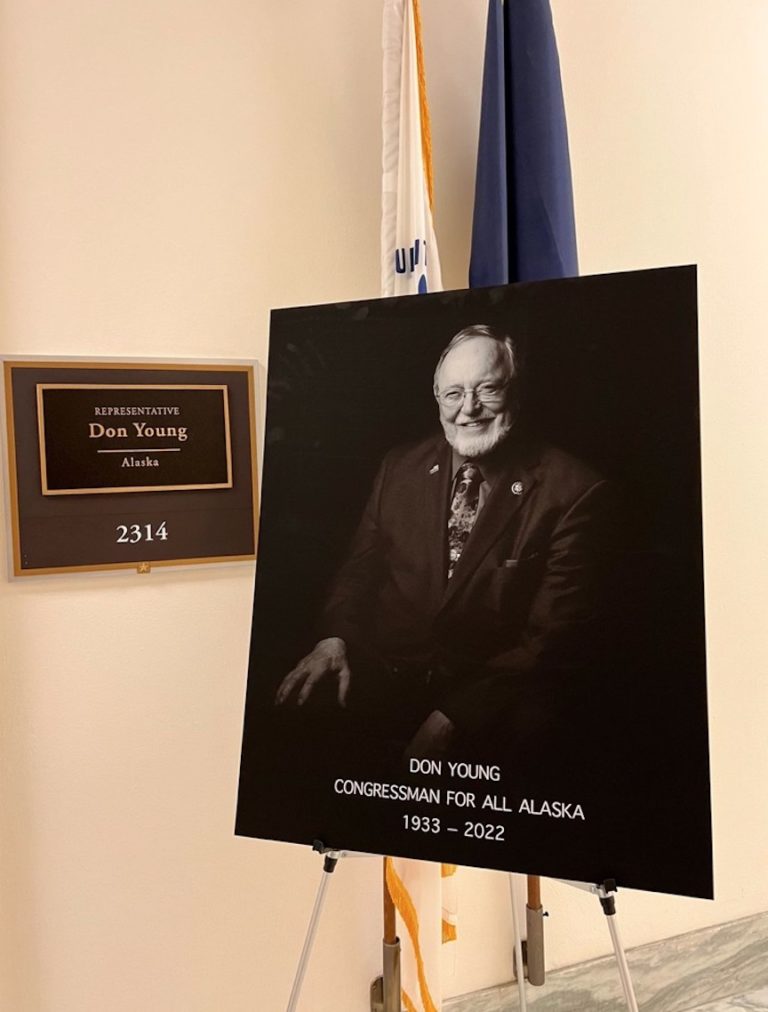
Will the Anchorage Assembly name the Port of Alaska after the late Congressman Don Young, who was Alaska’s sole congressman for 49 years? Or will it take a pass? The decision could be made during Tuesday night’s regular Assembly meeting, after it was postponed in September. There are several leftist members of the Assembly who have taken a hard line against the late congressman.
Young, who died March 18, 2022, was one of just 44 Americans who have ever been laid in state in the U.S. Capitol. Even President Joe Biden went to his service. Young, who was bipartisan Republican, was instrumental in the designation of the port as a “commercial strategic seaport” in support of national defense. He wrote the law requiring the U.S. Army Corps of Engineers to dredge the port each year, and he pushed through hundreds of millions of dollars for the intermodal expansion project, known as the Port of Alaska Modernization Program.
Now, radicals like Assemblywoman Karen Bronga say the late congressman was unfit to have a port named for him: “The naming of a volcano after him is, in my opinion, way more fitting.”
But the city’s naming panel, made up of Jim Jansen, Gail Schubert, Amanda Moser, and Aaron Leggett, held public hearings last summer and advanced the name for approval by the Assembly.
A motionis on the agenda to reconsider the matter, should it pass on Tuesday. That reconsideration may take place next month:
“If reconsideration passes, it is the intent of the Chair to ask for postponement to the meeting of February 27th. Ordinance No. AO 2023-81, an ordinance of the Anchorage Municipal Assembly adopting the Public Naming Panel’s unanimous recommendation to name the Port of Alaska as the Don Young Port of Anchorage; and amending Anchorage Municipal Code Chapter 11.50, certain other sections of the code and Anchorage Municipal Code of Regulations accordingly, Mayor’s Office. Assembly Memorandum No. AM 585-2023. Information Memorandum No. AIM 150-2023. (PUBLIC HEARING WAS CLOSED 9-12-2023. REFERRED TO THE NAMING PANEL 9-26-2023. PUBLIC HEARING WAS RE-OPENED 9-26-2023. PUBLIC HEARING WAS CLOSED 12-19-2023. POSTPONED INDEFINITELY 12-19-2023. MOTION TO RECONSIDER TO POSTPONE INDEFINITELY AO 2023-81 WAS GIVEN BY MR; RIVERA 12-20-2023, SECONDED BY MR. CONSTANT. MOTION TO RECONSIDER IS ON THE FLOOR.) Information Memorandum No. AIM 233-2023.”
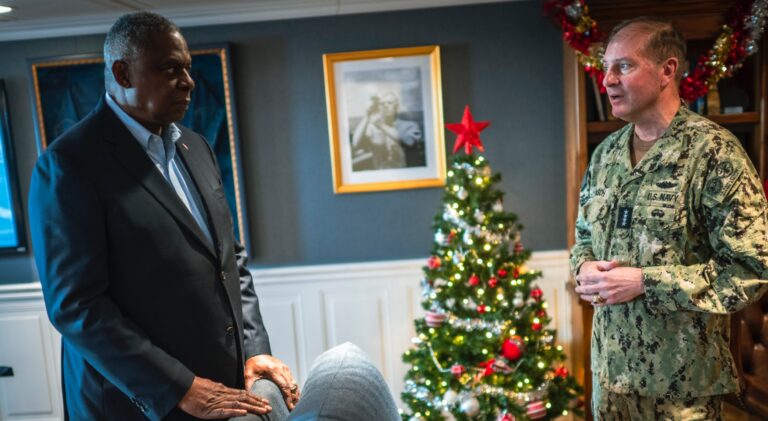
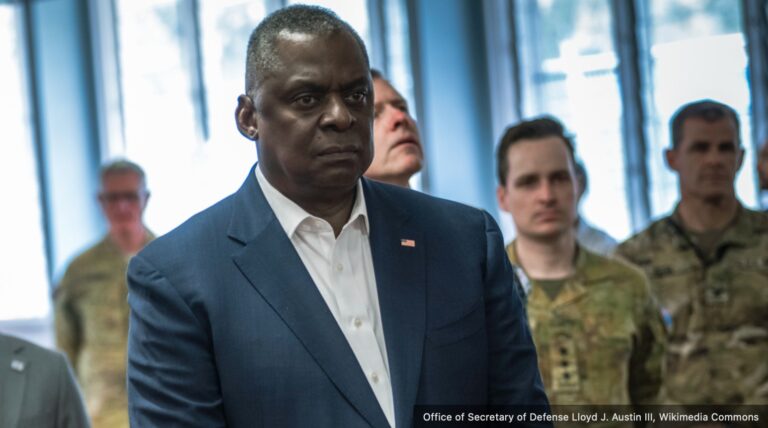
Nine days after first being admitted to the hospital under a shroud of secrecy, Secretary of Defense Lloyd Austin remains bedridden at Walter Reed National Military Medical Center, Bethesda, Maryland.
The Department of Defense issued a statement on Monday evening, detailing some of the course of events that led to the Pentagon not revealing to the president or American people that the secretary was in the intensive care unit of the hospital. Austin and the Biden Administration have been criticized for their lack of transparency, considering the unstable state of the world and ongoing conflicts that the United States is involved in, particularly in the Middle East.
“Since resuming duties on Friday evening, the secretary has received operational updates and has provided necessary guidance,” Pentagon Press Secretary Air Force Maj. Gen. Pat Ryder said Monday evening. “He has full access to required secure communications capabilities and continues to monitor [Defense Department] day-to-day operations worldwide.”
Austin had some undisclosed elective surgery on Dec. 22. He spent the night at Walter Reed and was discharged on Saturday, Dec. 23. The press secretary said that Lloyd worked from home through the holidays. But he experienced severe pain and was admitted to Walter Reed’s intensive care unit on Jan. 1.
At some point between Dec. 31 and Jan. 1, Secretary of State Antony Blinken said he spoke with Austin, but the health situation was not revealed to him.
Austin was conscious but in quite a bit of pain, Ryder said, who added he assumed Austin was administered some sort of pain medication and did not know if at any time Austin was unconscious.
On Jan. 2, Gen. C.Q. Brown, the chair of the Joint Chiefs of Staff, was informed that Austin had been hospitalized the night before.
Austin underwent testing and evaluation while in the ICU, and on Jan. 2, “certain authorities” were transferred to Deputy Defense Secretary Kathleen Hicks “due to the secretary’s condition, and on the basis of medical advice,” Ryder said. Hick was not told that she was the top authority at the Pentagon.
Members of Austin’s and Hicks’ staff were notified that the transfer of authority had occurred through normal email notification procedures, Ryder said. However, no one outside his inner circle was told that he was in intensive care. Neither the president nor Hicks were informed of the gravity of his medical condition.
On Thursday, Jan. 4, at 4 a.m., the U.S. Air Force conducts an air strike in Bagdad, Iraq, killing one of the leaders of an Iraqi military group. The Pentagon later said the strike was approved by Austin before he was hospitalized. Ryder held a scheduled press conference on Jan. 4, but did not tell reporters that the secretary was hospitalized.
On Jan. 4, Austin’s chief of staff notified Hicks and the White House National Security Advisor of the secretary’s hospitalization and ICU stay. Ryder has since said that Austin’s chief of staff had been sick with the flu, which caused the delay in notification of Hicks and the president.
Once notified of the hospitalization, Hicks “immediately engaged on drafting a public statement and congressional outreach,” alongside Austin’s chief of staff, Ryder said. Hicks was in Puerto Rico vacationing at the time and the president was in the Bahamas.
On the afternoon of Jan. 5, just 15 minutes before the press corps was notified, congressional members were told of the hospitalization, but few details were provided.
That announcement did not disclose his stay in intensive care or that the White House hadn’t been informed for three days that he was in the hospital.
Ryder said the Defense Department is currently reviewing how it can improve its notification procedures, to include White House and congressional notifications.
“I want to underscore that Secretary Austin has taken responsibility for the issues with transparency, and the department will be taking steps to improve our notification procedures,” Ryder told reporters during a briefing at the Pentagon on Monday. “I’m also personally committed to keeping you informed.”
“Nothing is more important to the secretary of Defense and the department than the trust and confidence of the American public we serve, and we will continue to work hard every day to earn and deserve that trust,” he said.
While acting as the secretary, Hicks made routine operational and management decisions for the department “and was fully authorized and ready to support the president on other military matters should the need have arisen,” Ryder said. But his statement is contradicted by the fact that she did not know she was the top person in command.
Austin resumed his full duties as secretary on Friday night.
White House spokesman John Kirby said President Joe Biden looks forward to having him back on the job.
“There is no plan for anything other than for Secretary Austin to stay in the job,” Kirby said to members of the press.
Tuesday, Jan. 9 marks the ninth day Austin, age 70, has been continuously hospitalized. Although he is not in the ICU, he is in a private area of Walter Reed, where he is said to be working from his bed. The nature of his illness has still been kept a secret.
Austin has been hospitalized for 10 out of the last 20 days, since his initial admission to the hospital on Dec. 21. According to the National Institutes of Health, the average stay in American hospitals is 5-1/2 days. Extended hospital stays can lead to infections and other health complications.
United Airlines found loose bolts on door plugs of several Boeing 737 MAX 9 planes, while the planes were being inspected after all of the aircraft were grounded by the FAA. The inspections came after a panel flew out of the fuselage of Alaska Airlines Flight 1282 on Friday night as the plane left Portland for Ontario, Calif.
A door plug is a panel that fills a spot where an emergency exit can be installed. All of the MAX 9 planes with this configuration are still grounded.
United owns 79 MAX-9 aircraft, more than any other airlines. United has canceled 200 MAX 9 flights since the grounding of the planes and expects significant cancelations on Tuesday.
“Since we began preliminary inspections on Saturday, we have found instances that appear to relate to installation issues in the door plug — for example, bolts that needed additional tightening. These findings will be remedied by our Tech Ops team to safely return the aircraft to service,” United said in a statement.
Passengers aboard Alaska Airlines Flight 1282 were mostly uninjured, although the depressurization of the cabin was strong enough that the cockpit door was whipped open, and seat parts were torn from the plane, according to the National Transportation Safety Board. There were no passengers in the two seats next to the missing panel.
There may have been warning signs: According to the NTSB, 37 days after the brand new jet was placed into service, a pressurization “fail light” lit up in the cockpit. The light went on Jan. 3 and again Jan. 4, and the flight crew flipped the switch to the system’s backup and reported it to maintenance. It was tested by maintenance and reset, said NTSB Board Chair Jennifer Homendy, who described the procedure as “very normal.”
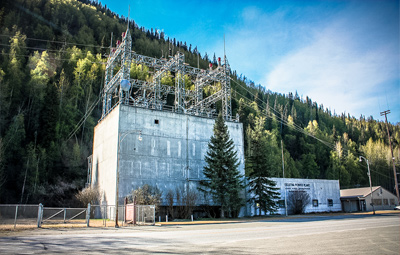
The Eklutna Dam currently provides the least expensive energy to Southcentral Alaska’s residents and businesses, but that might be a thing of the past if activists get their way this year.
A group of environmental organizations, collaborating with the Native Village of Eklutna, have called for the removal of the dam, to potentially revitalize a salmon run that the collective believes has been harmed by the dam’s presence.
Currently, 6% of the overall power generated by Chugach and Matanuska Electric comes from the Eklutna hydroelectric project. Along with that generation, nearly 90% of Anchorage’s drinking water also comes from the lake and associated flow from the project, making the project a critically important piece of infrastructure.
The owners – Chugach Electric, Matanuska Electric and the Municipality of Anchorage – have been engaged on a renewal of a 1991 agreement dealing with fish and wildlife management associated with the project. After spending nearly four years studying various mitigation plans – and engaging with both required and additional stakeholders impacted by the dam’s presence – they have developed a draft plan that lays out a compromise among competing proposals and a solid path forward; best suited to meet all the requirements of the original agreement.
But, even after all the consultation with the environmentalists and others, the collective wants the dam removed, with little concern over the impacts to power, water or costs.
The owners are holding a series of public meetings to get input on the draft plan. For all our readers and followers in Southcentral Alaska, please make plans to attend one or more of them.
Soon, a final draft will go to Gov. Mike Dunleavy, whose administration will make the final call on how to move forward. The activists are commenting; don’t let their voices be the only ones the governor hears.
The meeting dates, times and locations are:
January 16 –Palmer Community Center (Depot), from 2 pm to 4 pm and 6 pm to 8 pm
January 17 –Arctic Rec Center (Anchorage), from 2 pm to 4 pm and 6 pm to 8 pm
January 18 – The Workplace & Event Center (Eagle River), from 2 pm to 4 pm and 6 pm to 8 pm
For more information on the project, to see the draft proposal and to learn more, you can visit www.eklutnahydro.com.
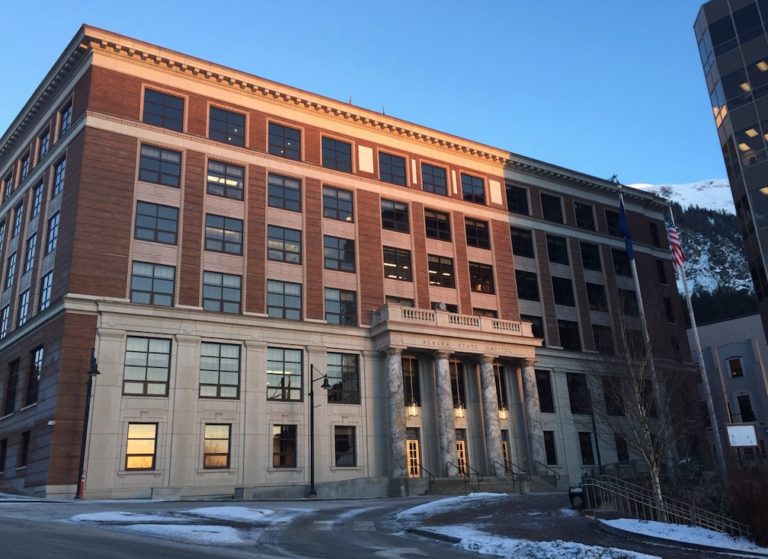
The Legislature has released the first tranche of “prefiled bills” for the second session of the 33rd Legislature, which starts next week. They involve everything from creating a psychedelic medical task force to enacting a bed tax.
Here are the bills that lawmakers from around the state want to have deliberated and made into law after they gavel into session next Tuesday. A second set of pre-filed bills will be released later this week:
HB 218 FIREFIGHTER WORKERS COMP REQUIREMENTS, Rep. Dan Saddler HB 219 REPEAL ASSISTIVE TECHNOLOGY LOAN PROGRAM, Rep. Saddler HB 220, ROOM RENT TAX, Rep. Andrew Gray HB 221, SUBDIVISION OF UNPLATTED LAND, Rep. Ashley Carrick HB 222, PERMANENT FUND APPROPRIATIONS/INVESTMENTS, Rep. Jesse Sumner HB 223, TAX & ROYALTY FOR CERTAIN GAS, Rep. George Rauscher HB 224, TRANSMITTAL OF APPROPRIATION BILLS, Rep. Craig Johnson HB 225, POSTING OF UNOFFICIAL ELECTION RESULTS, Rep. Gray HB 226, PHARMACIES/PHARMACISTS/BENEFITS MANAGERS, Rep. Sumner HB 227, ELECTRIC UTILITY LIABILITY, Rep. Rauscher HB 228, MENTAL HEALTH/PSYCHEDELIC MED. TASK FORCE, Rep. Jennie Armstrong HB 229, ALASKA VETERANS’ POPPY DAY, Rep. Will Stapp HB 230, OUT-OF-STATE TEACHING EXPERIENCE & SALARIES, Rep. Rebecca Himschoot HB 231, MUSEUMS: NOTICE TO ACQUIRE PROPERTY, Rep. Carrick HB 232, DISABLED VETERANS: RETIREMENT BENEFITS, Rep. Rauscher HB 233, RATES: MOTOR VEHICLE WARRANTY WORK, Rep. Frank Tomaszewski HB 234, MISSING/MURDERED INDIGENOUS PEOPLE;REPORT, Rep. C.J. McCormick HB 235, MISSING PERSON REPORTS, Rep. McCormick HB 236, UA MAJOR MAINTENANCE MODERNIZATION, Rep. Stapp HB 237, TEMPORARY PERMIT FOR LAPSED NURSE LICENSE, Rep. Mike Prax HB 238, CRIMINAL MISCHIEF 3RD DEGREE, Rep. Andy Josephson HB 239, WORKERS’ COMP & POST-TRAUMATIC STRESS, Rep. Josephson HB 240, DEFENSE OF PUB. OFFICER: ETHICS COMPLAINT, Rep. Josephson HB 241, REPRODUCTIVE HEALTH: LEGAL PROTECTIONS, Rep. Josephson HB 242, EXTEND SENIOR BENEFITS PAYMENT PROGRAM, Rep. Sarah Vance HB 243, BISON DRAW PERMIT APPLICATION FEE, Rep. Mike Cronk HB 244, REFINED FUEL SURCHARGE, Rep. Josephson HB 245, DIR DEPOSIT PFD IN INVESTMENT ACCT, Rep. Saddler HB 246, VOTER PREREGISTRATION FOR MINORS, Rep. Andi Story HB 247, READING IMPROVEMENT PLANS FUNDING, Rep. Story HB 248, INFORMED CONSENT FOR PELVIC EXAMS, Rep. Josephson HB 249, MILITARY AND VETERAN FAMILY HELP DESK, Rep. Cliff Groh SB 157, ESTABLISH SUNRISE REVIEW BOARD, Sen. Rob Myers SB 158, SCHOOL GRANTS AND BOND DEBT REIMBURSEMENT, Sen. Myers SB 159, ALASKA VETERANS’ POPPY DAY, Sen. Forrest Dunbar SB 160, PLANNED COMMUNITIES, Sen. Myers SB 161, TAX EXEMPTION FOR FARM USE LAND, Sen. Jesse Bjorkman SB 162, STATE RESIDENCY: SELL/RENT REAL PROPERTY, Sen. Dunbar SB 163, ANIMAL ADOPTION RECORD, Sen. Myers SB 164, STATE PARK PERMITS FOR DISABLED VETERANS, Sen. Bjorkman SB 165, DEFENSE OF PUB. OFFICER: ETHICS COMPLAINT, Sen. Matt Claman SB 166, MENTAL HEALTH/PSYCHEDELIC MED. TASK FORCE, Sen. Forrest Dunbar SB 167, MUNICIPAL PROPERTY TAX EXEMPTIONS, Sen. Myers SB 168, COMPENSATION FOR WRONGFULLY SEIZED GAME, Sen. Bjorkman SB 169, RESIDENTIAL PREPAID RENT & SECURITY DEPOSIT, Sen. Elvi Gray-Jackson SB 170, EXTEND SENIOR BENEFITS PAYMENT PROGRAM, Sen. Scott Kawasaki SB 171, RESIDENCY REQ: HUNTING, TRAPPING, FISHING, Sen. Bjorkman SB 172, EXTEND SENIOR BENEFITS PAYMENT PROGRAM, Sen. Shelley Hughe
The news that the U.S. Department of Defense failed to inform the American public that its Secretary of Defense was hospitalized in Walter Reed for four days represents a stunning breach of transparency standards. It is also a measure of reputational damage from which Secretary Lloyd Austin will never recover. He must be forced to resign.
The original admission – dropped at the end of a Friday to minimize exposure – that the Secretary received multi-day treatment for an unidentified elective surgery introduced immediate and intense scrutiny from national security reporters. It drew a formal admonishment from the Pentagon press.
The issue may have died there, but the subterfuge further grew the story. Additional reporting revealed some critical details not released by the Pentagon in its Friday announcement: Austin was in in-patient intensive care, generally reserved for those in immediate danger. Meanwhile, his Deputy Secretary of Defense, Kathleen Hicks, was vacationing in Puerto Rico.
Many questions now must be answered: Who was adjudicating the Pentagon’s support for the war in Gaza? Who was coordinating with Israeli defense minister Yoav Gallant on behalf of the U.S. military? Who approved the Jan. 4 strike into Baghdad that killed a militia leader believed responsible for attacks on American troops? Who coordinated that strike and its aftermath with defense officials in the Middle East? These are the kinds of actions that require leadership from inside the Pentagon. Why did the Deputy Secretary of Defense remain on vacation with the Secretary incapacitated?
Further, still – what is the health status of our Secretary of Defense? Only a severe condition would introduce multi-day hospitalization amidst multiple crises in the Middle East, a log-jammed war in Ukraine, and new Chinese threats against Taiwan. The statement Austin released late Saturday in an attempt to tamp down the controversy reveals he is “on the mend” – whatever that means – and looks forward to “returning to the Pentagon soon.” How long is he out? This seems much more serious than elective surgery – the line the Pentagon press officers are sticking with. What is his medical status at age 70?
More questions still: What did the Pentagon press officers know, and when did they know it? Surely, they are aware of the protocol for publicly announcing medical procedures for cabinet officials. Who was in on the deception? The Secretary of Defense travels with an entire operations center around him at all times: note-takers, communications experts, and intelligence analysts. These people all report to defense officials, who report to other defense officials. It’s hard to believe the Pentagon’s press office was unaware that the Big Boss was in the hospital. In fact, hiding the Secretary of Defense during a tumultuous work week for the American military surely involved the collusion of multiple senior officials.
The Pentagon could have avoided all these questions and all of this controversy with a press statement upon Austin’s entering the hospital and updates throughout. U.S. Air Force Major General Pat Ryder held two press briefings during Austin’s hospital stay – he could have provided updates on his boss’ condition from behind the podium. More importantly, he should have told us who was running the Pentagon. It’s unclear how the nation is to believe anything coming out of the Pentagon press office in the coming months.
The American Secretary of Defense walks the earth with the most essential information any of us can have. He renders decisions on behalf of this country that kill many people in other countries. Lloyd Austin represents American power to much of the world. He runs an enterprise that costs American taxpayers north of $840 billion and employs more than three million workers. We get to know where our Secretary of Defense is at all times. We get to know when he’s on vacation. We get to know when he’s in the hospital.
Lloyd Austin cannot recover from this breach of trust. In fact, he cannot be trusted any longer. If he wants to keep his hospital visits private, he should be allowed to do so – as a private citizen.
Joe Buccino is a retired U.S. Army Colonel public affairs officer and the former communications director of U.S. Central Command. He also served as the spokesman for Acting Secretary of Defense Patrick M. Shanahan. This column first appeared at Real Clear Defense and is reprinted with permission.
Attorneys general from 25 states, including Alaska, have signed onto a brief that backs former President Donald Trump in Colorado, where a legal battle rages over whether he will be allowed to appear on the primary ballot.
In a 22-page “friend of the court” brief, the attorneys general called on the high court to strike down a Colorado State Supreme Court decision barring Trump, using as its rationale the Constitution’s 14th Amendment’s “insurrectionist” ban.
The Colorado Supreme Court removed Trump from the ballot over his culpability in the Jan. 6, 2021 disruption of the certification of the presidential election. The Supreme Court of the United States has agreed to hear the case.
The top attorneys for the states — all Republican run — argue that the Colorado Supreme Court overstepped its authority.
The “Colorado court’s decision will create widespread chaos,” they wrote. “Most obviously, it casts confusion into an election cycle that is just weeks away. Beyond that, it upsets the respective roles of the Congress, the States, and the courts.”
The legal brief says the U.S. Supreme Court’s immediate intervention is required.
“Now that the Colorado court has intruded into an arena where courts previously have feared to tread, swift intervention is essential,” the attorneys wrote. ““Our country needs an authoritative, consistent, and uniform answer to whether former President Trump is constitutionally eligible for President, Granting the Petition would at least be a step in that direction.”
The 14th Amendment was adopted after the Civil War and has been so seldom used that there is no legal precedence to advise the justices on what “engaging in insurrection” actually means.
In addition to Alaska Attorney General Treg Taylor, those from Alabama, Arkansas, Florida, Georgia, Idaho, Iowa, Kansas, Kentucky, Louisiana, Mississippi, Missouri, Montana, Nebraska, New Hampshire, North Dakota, Ohio, Oklahoma, South Carolina, South Dakota, Tennessee, Texas, Utah, Virginia, and Wyoming signed the brief.
If I lived in Anchorage I would be knocking on doors to promote Chris Tuck for mayor. I cannot recall ever voting for a Democrat but I would vote for him without reservation.
While I don’t agree with those who say the state is a victim of “Dunleakage economics,” I do believe that our state economy is in fact both leaking dollars and consuming far more than it’s producing, spending one-time reserves – including irreplaceable oil – to meet ongoing needs.
So the mayor of our largest city needs a fluency in economic common sense now foreign to state government and absent in Anchorage government (also absent in Juneau muni government by the way).
As a legislator, Chris Tuck had very superior public finance experience, and he originated ideas about money and banking that could have very much helped the state (and still can), but the Alaska Legislature is not always open to new ideas even when those ideas have been used successfully in other states.
Here we are in 2024, and I don’t know how much could be expected to come from state government to fix our weak economy, but I know Chris Tuck very well and anticipate his repairs to the municipal economy will be inspirational to and copied by the rest of the state.
I moved to Alaska from New Hampshire 50 years ago last year, and the economy I found here was one of hard work and innovation. My mother still has the letters I sent back in which I said that most Alaskans were working two high-paying jobs, had three business schemes, and had already accumulated enough reserves to pay cash for a farm or business.
Alaska and New Hampshire are the only two states that have neither a sales tax nor an income tax, so I think comparisons are useful. About a year ago, using numbers being frequently mentioned in the national press, I did an admittedly cursory calculation revealing that a working-age male in Alaska was 130 percent more likely to be on SNAP than his counterpart in New Hampshire.
It doesn’t surprise me that through much of 2023 the Alaska media talked about the Dunleavy administration’s inability to keep up with new SNAP applications at the very same time the same media regularly ran stories about the private sector’s inability to fill vacant positions. (Don’t forget that when economists report the unemployment rate they’re only reporting about the people actively looking for work.)
We’ve somehow eroded our work ethic by spending our oil money. One day an historian will write that in the Alaska petroleum era we focused on food stamps over factories. I don’t believe for a minute that our economic plight is due to the Jones Act, the high cost of energy, low education spending, courts delaying resource development, or too few state taxes. Government has not only owned all the land but now pays for almost all health care, more than half of all food sold at retail, and perhaps most family-wage jobs.
A dominant government has been unable to overlook people who believe an economy can only be found in handouts. I know one person working in law enforcement who says that for some population cohorts food stamps and fentanyl seem to be correlated. Recently we split in two the state department that hands out food stamp credit cards, and we touted that as progress. We’ve spent decades and at least hundreds of millions of dollars tilting at windmills such as promoting a North Slope gas line without once asking the owners of North Slope gas – people actually engaged in that industry – why they haven’t built a gas line.
We doubled our population, with a state government work force grown to meet it, while our oil production dropped by 80 percent; and we regularly (ballot measures in 2014 and 2020, and annual legislation) take a run at increasing taxes on petroleum leases agreed and inked long ago, to then curse the oil giants for not investing more here. Attorneys have run for office, and once elected we have let them renege on our word.
Chris Tuck is not an attorney, and he’s a man of his word. He is the man to run Alaska’s largest city in this time of decadence and discord. Propose something stupid to him and he will tell you it’s a stupid idea even if you flew to Alaska on your own jet.
When a governmentally owned enterprise is essential to the economy and that government fails to spend enterprise revenues at least equal to depreciation then taxpayers are being hoodwinked. That is a root cause of the Anchorage port debacle. Four or five years ago, when the late Ben Stevens was a state executive chief of staff, he ordered me to attend an Anchorage Assembly meeting and tell them they were liars regarding an aspect of port finances. When I had done that, and thanked the Assembly for letting me do it, Mark Begich, former Anchorage Mayor and U.S. senator, thanked me, shook my hand and told me someone had to set the Assembly straight.
We still have good Alaskans around, still can bring Alaska back; but we have to elect real Alaskans, which is why I write this today. I’ve been a registered Republican for decades but political parties have nothing to do with the scarcity of leadership sometimes found in government.
My expectation is that during his first several weeks as mayor, Chris Tuck will assemble the cruise ship companies and the governor to form a successful revenue bond port financing secured by a portion of cruise passenger head tax income, satisfactory to the cruise line association for rebuilding the port. Because of Juneau City/Borough misspending of head tax income, found by federal courts in summary judgement to have broken commerce laws going back well into the 19th century, the cruise line association can veto any spending of that head tax. But the income remains so large that each year Juneau solicits spending ideas for the money (almost 1.7 million passengers to Juneau last year). This is the municipality that gave a grant of taxpayers’ money to “teach drag queen lessons,” spent what the cruise line association told me was $17 million of head tax income on a brass whale, and is now planning to spend $20 million on a ski area tram it imported from Europe.
All Alaskans would be better served by spending on the Anchorage port, and Mayor Chris Tuck will bring intelligence to Anchorage city government that Juneau taxpayers will envy. He can and likely will quickly move the port discussions beyond simply naming the port!
Chris Tuck is an honest broker in the organized labor component of our economy, and having that economic constituency at the table when decisions are made is necessary – or else nothing moves, which is what too often happens in Anchorage. He is respected, and Anchorage voters deserve no less. I’ve never been a member of a labor union but I fully accept the role private sector unions play in ensuring family wage jobs for highly skilled labor. Alaska cannot return to the superior economy we once had if we leave those family wage jobs behind.
While I may have logged timber in every one of New Hampshire’s 10 counties before relocating to Alaska, I was born and raised in the part of New Hampshire where Quebec, Vermont, and Maine all meet, gaining exposure to several cultures and industries. Two towns, with a combined population of 16,000 shared a pulp and paper mill employing 2,500 in the mill and 1,000 in the woods, and that mill was owned by a Sicilian, then known in the financial press as God’s Banker. He garroted himself while incarcerated in an Italian prison, but not before he visited my high school, accompanied by a priest wearing a tall red hat, who was his interpreter. (Joking about doing the garroting himself, of course.) It was the beginning days of the Vietnam War, and in his motivational message God’s Banker told us that Russian communist boys were tougher than we were and studied harder. I wasn’t Catholic but I believed him.
New Hampshire was a complicated little place back then. My father, a Live Free or Die Republican and World War II veteran, who voted for General LeMay to be vice president, was an enforcer for the Teamsters Union for about 35 years. He drove Mack tractors from the end of the road system north of Quebec City, south to Wilmington, Del., hauling pulp and paper. When I was 10 years old, I saw one of the M1 Garands I now own used in a labor action when a nonunion trucking outfit had found a way to go around the trucking rights into Quebec. The first time I saw my father knock a man down I was six years old, and the fellow was a relative of the trucking company’s owner – mouthing off during a labor action. The owners were Italians, and the drivers were Frenchmen.
It was a few years later that I understood why my father had to knock the man down: he was a man with the impressive and unusual ability to double-deck 55 gallon oil drums, and people at the nearby laundry and the nearby factory would sometimes walk over during their breaks to watch him do it. So he was a man who had to go down at the first few punches, or else he would be a real handful.
The labor unions, that huge pulp and paper mill complex, the Catholic Church, and all the other elements toiled together to produce a very good economy and a very high standard of living even with only one income being the norm in almost all families. Except for one state trooper for both towns, and an elected county sheriff I could not have told anyone where to find any government official.
As mentioned, Alaska had an even more impressive economy and productive workforce than NH did, but now we don’t. Anchorage, and the entire state of Alaska need to return to the productive economy we once had; and we need to do it despite government, its 37.5 hour workweek, and its vast tracts of locked-up land, food stamps and fentanyl. Chris Tuck is the right man to be mayor of this one key city, and he is arriving to the position none too soon.
Please believe me when I say I can tell that progress will be made once Chris Tuck becomes mayor, and I really haven’t seen much progress in Anchorage for some time. During the past several years I have offered to bet many Anchorage business people that the Anchorage mid-town has more Class A and Class B office and retail space that has been vacant for 5 years or longer than Juneau has Class A & B space, vacant and occupied, and every single person has responded that I would win that bet; yet how often have you heard the current mayor and assembly, or any economic development nonprofit in Anchorage address that?
Forgive me for being so blunt but rhetoric and churning of the current mayor, of most of the assembly Anchorage has today and has recently had, plus the economic ideas espoused by Bill Popp amount to nothing more than one bad joke on taxpayers. Thank you for your time, and thanks to MustReadAlaska for producing this dispatch.
Tom Boutin is a Juneau resident who has served as chief of staff for the Alaska State Bond Committee, the Alaska State Pension Investment Board and the Alaska Retirement Management Board. He also was the CEO of the Alaska Industrial Development and Export Authority, a state-owned bank, appointed by Gov. Mike Dunleavy. In addition, he worked for many years in the forest products industry.
The continued erasure of America’s historic statues continues under President Joe Biden. Late last year, a statue dedicated to reconciliation between the northern and southern states was removed from Arlington National Cemetery after a brief hold was placed on the removal by a judge.
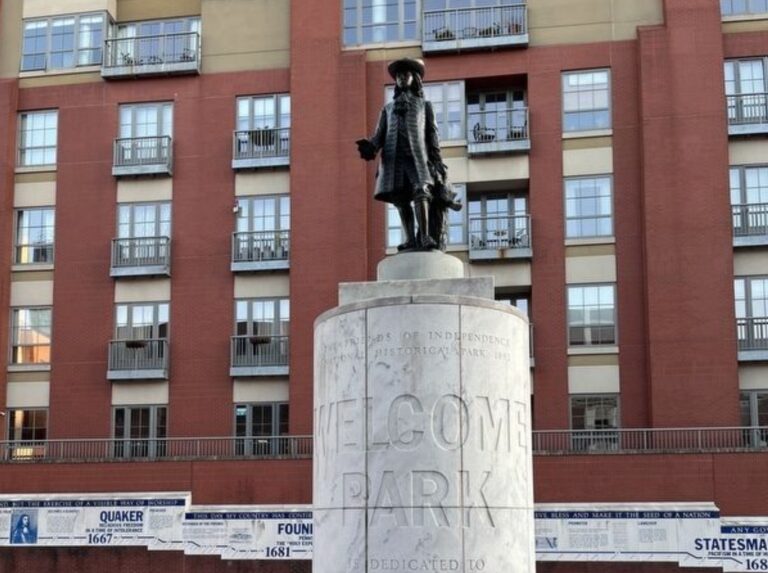
Now, it’s the founder of Pennsylvania, William Penn, who is being cancelled.
The Penn statue that sits atop his historic home site will be removed from the property, according to the U.S. Park Service. In its place, more memorials to American Indians will be installed.
Penn was a Quaker who came to America to avoid religious persecution in England. By most accounts, he was a stellar advocate for democracy, justice, and fairness to indigenous people.
“The National Park Service proposes to rehabilitate Welcome Park to provide a more welcoming, accurate, and inclusive experience for visitors. Welcome Park was designed by the internationally acclaimed design firm Venturi & Scott Brown Associates. The park is located on the site of William Penn’s home, the Slate Roof House, and is named for the ship, Welcome, which transported Penn to Philadelphia. The design and construction of Welcome Park was funded by the Independence Historical Trust and was completed in 1982,” the Park Service said.
The proposed “rehabilitation” of Welcome Park includes “expanded interpretation of the Native American history of Philadelphia and was developed in consultation with representatives of the indigenous nations of the Haudenosaunee, the Delaware Nation, Delaware Tribe of Indians, the Shawnee Tribe, and the Eastern Shawnee Tribe of Oklahoma,” according to the agency.
“The reimagined Welcome Park maintains certain aspects of the original design such as the street grid, the rivers and the east wall while adding a new planted buffer on three sides, and a ceremonial gathering space with circular benches. The Penn statue and Slate Roof house model will be removed and not reinstalled. In a separate and future effort, new exhibit panels will be installed on the south site wall to replace the Penn timeline,” the Park Service said.
Penn befriended local Indians and ensured that they were paid fairly for their lands. He learned several Indian dialects in order to negotiate land deals without interpreters. Penn introduced laws in the colony that guaranteed that if an Indian was wronged by a European settler, there around be a fair trial, with both Indians and Europeans in equal numbers on the jury.
“Penn chose to acquire lands for his colony through business rather than conquest. He paid the Indians 1200 pounds for their land under the treaty, an amount considered fair, according to ushistory.org. “Voltaire praised this ‘Great Treaty’ as ‘the only treaty between those people [Indians and Europeans] that was not ratified by an oath, and that was never infringed.'”
The public is invited to submit comments on the proposed design for the “rehabilitation” of Welcome Park for a 14-day period from Jan-21, 2024, through the National Park Service’s Planning, Environment and Public Comment athttps://parkplanning.nps.gov.
Comments submitted through social media, phone calls, email or mail will not be accepted.