Saturday, August 15, 2026
Home Blog Page 533

FAA, Alaska Airlines keeps Boeing 737 Dash-9 MAX aircraft grounded; passenger lawsuits spread

The Federal Aviation Administration, having grounded the Boeing 737 Dash 9 MAX aircraft earlier this month, said it is still investigating Boeing’s manufacturing practices and production lines, including those involving subcontractor Spirit AeroSystems. The FAA said it is bolstering its oversight of Boeing, and examining potential system change. 

Alaska Airlines, which owns 65 of the new jets, is still experiencing schedule disruptions across its routes.
 
After the door-plug incident occurred on an Alaska Airlines jet on Jan. 5, the FAA announced requirements for an inspection and maintenance process as a necessary step before the FAA contemplates any further steps in the process to return Boeing 737 Dash 9 MAXs to service, the agency said.

The first 40 inspections that are part of that process are now complete, and the FAA is reviewing the data from them.

“All 737-9 MAX aircraft with door plugs will remain grounded pending the FAA’s review and final approval of an inspection and maintenance process that satisfies all FAA safety requirements. Once the FAA approves an inspection and maintenance process, it will be required on every grounded 737-9 MAX prior to future operation. The safety of the flying public, not speed, will determine the timeline for returning these aircraft to service,” the agency said on Wednesday.

Ben Minicucci, CEO of Alaska Airlines, also issued a statement on Wednesday, reassuring the public that the airlines had not only grounded the jet before the FAA took the same action, but is deploying its own quality-control staff to the Boeing plant to oversee the construction of jets that Alaska Airlines has purchased.

Meanwhile, several passengers aboard Alaska Airlines Flight 1282 who saw the door plug blowout are taking legal action, seeking compensation for associate traumas. Other passengers have already filed suit against Boeing, but the new lawsuit, filed in Seattle on Wednesday, points out that Alaska Airlines was concerned enough about the aircraft that it had pulled it from its over-water route to Hawaii. The jet had been delivered to Alaska Airlines from Boeing in October.

Spirit AeroSystems, which built the fuselage that ailed, issued no updates this week relating to the near-catastrophe that took place as the Alaska Airlines flight 1282 was climbing out of Portland International Airport en route to Ontario, Calif.

All three companies — Alaska Airlines, Boeing, and Spirit AeroSystems — have embraced DEI, a Diversity, Equity, Inclusion hiring system that prioritizes social engineering goals over skill, experience, and performance.

Boeing’s problems go beyond its DEI human resource strategy. The Wall Street Journal reports that a Boeing aerospace engineer published white paper in 2001 for an internal technical symposium.

The engineer, John Hart-Smith, “warned colleagues of the risks of the subcontracting strategy, especially if Boeing outsourced too much work and didn’t provide sufficient on-site quality and technical support to its suppliers,” the newspaper reported. 

“The performance of the prime manufacturer can never exceed the capabilities of the least proficient of the suppliers,” Hart-Smith wrote in the paper. “These costs do not vanish merely because the work itself is out-of-sight.” 

As Alaska Airlines and its passengers suffer from the Boeing-created near-disaster, United Airlines is also taking heat after video surfaced of its CEO Scott Kirby allegedly dressed in drag and publicly performing as a drag queen, raising further concerns about the seriousness of the company regarding safety and its focus on diversity, rather than quality control. United has over 70 o the Boeing 737 Dash 9 MAX aircraft, although the planes represent a smaller portion of United’s fleet than they do over at Alaska Airlines.


The FAA is supporting the National Transportation Safety Board’s primary role in the investigation into Alaska Airlines Flight 1282. FAA has also embraced DEI, establishing hiring targets that include bringing into the agency people with psychiatric problems and severe mental disabilities, as outlined in the agency’s own documentation.
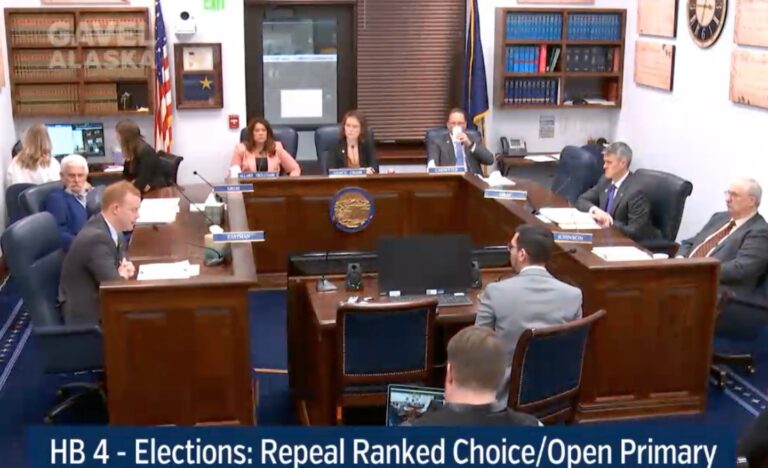

Repeal of Ballot Measure 2, ranked-choice voting, moves out of House Judiciary Committee

The House Judiciary Committee voted to move House Bill 4 out of committee to its next committee of referral: Finance. The bill would repeal Ballot Measure 2 from 2020, a measure approved by voters to create a novel and untested voting scheme in Alaska that includes open primaries and ranked-choice voting general elections, a combination used in no other state.

Alaska has become a cheap way for liberal Outside interests to promulgate political changes since it is a very inexpensive media market. Alaskans for Better Elections, funded by some of the most effective liberal entities at work in politics today, was able to convince more than 50% of voters that the current system for electing people — one vote at a time — robbed them of choice. The ranked-choice proponents say voters should be allowed to rank their top choice, second choice, third choice in a system that requires machine counting, since the recalculation of the second and third choice votes is so time-consuming and prone to human error.

Rep. Ben Carpenter, a member of the committee, said that the measure was passed because of another element inserted by the Ballot Measure 2 proponents — the prohibition on “dark money.” Carpenter pointed out that the group Alaskans for Better Elections used the so-called dark money to scare people about the term “dark money,” because Alaskans are leery of Outsiders trying to influence elections. That scare tactic worked, he said, but now many Alaskans realize that they were duped into voting for Ballot Measure 2.

Rep. Sarah Vance of Homer, who chairs the committee, said in her sponsor statement for the bill: “The ballot measure that transformed Alaska’s election system in 2020 passed by a narrow margin of less than 1 percent. The campaign led Alaskans to believe the ballot measure would do away with ‘dark money’ only and that it would give them ‘more options’ in voting. Most Alaskan’s did not know that it would upend our way of voting that has always been one person equals one vote. Many voters have expressed buyer’s remorse since passage. In fact, recent polling shows that that majority of Alaskans strongly agree to repeal rank choice voting.”

A Dittman Research poll shows that 51% of voters in Alaska want to repeal Ballot Measure 2. 84% of Democrats want to keep ranked choice voting and 81% of Republicans want it repealed.

Besides Rep. Vance, co-sponsors of the bill include Reps. George Rauscher-Sutton, Kevin McCabe-Big Lake, and Frank Tomaszewski-Fairbanks, all Republicans.

The bill passed out of committee on a vote of 5-2, with the Democrats on the committee voting against passage. Democrats have been particular beneficiaries of Ballot Measure 2 and see it as a way to improve their chances in a state that is still conservative leaning.

Last May, the House State Affairs Committee, which was the first committee to hear the bill, passed the bill out of committee at the end of the legislative session. In that committee, it was also the Democrat, Rep. Andi Story of Juneau, who voted against moving the bill.

At the same time the repeal is working its way through the Legislature, a citizen group is working to repeal ranked-choice voting. Alaskans for Honest Elections turned in signatures on a petition to have the question put to voters during either the primary or, more likely, the general election later this year. Alaskans for Honest Elections has been hounded by the Outside-funded Alaskans for Better Elections, which is fighting to retain the new system that ushered in Democrat Rep. Mary Peltola in 2022’s election cycle, and also helped Sen. Lisa Murkowski by taking away the Republican primary election, which she would not have been able to win, according to polling.

If HB 4 passes both bodies — and it is unlikely to be heard in the Democrat-dominated Senate majority — voters would not face the question on the ballot and voting would return to the way it was done before 2022.

Backpedaling: Whites, blacks won’t pay more at Anchorage Museum; memo says race policy on pause

A statement issued by the Anchorage Museum has rescinded its new rule that gave Alaska Natives free admission to the museum, while all other races and ethnicities had to pay.

The memo reads:

“We recently issued a press release announcing a new policy offering free general admission to Alaska Native visitors. I want to let the public know that we have made the decision to pause the policy to assure the program is implemented in the best way.

“The Anchorage Museum is a community asset, and we want to make sure all policies involving access and availability are in line with the community’s expectations while following all legal guidelines.

“We remain deeply committed to the goals of honoring Indigenous people and improving access to their cultural belongings. In the upcoming weeks the Anchorage Museum, together with its board of directors, partners, advisers, and experts, will study possibilities and how best to implement any changes that accomplish these goals. We will announce any further policy changes as they occur.

“The Anchorage Museum is pleased to provide opportunities for free access to the museum. Details can be found at our website, (www.anchoragemuseum.org).”

Gov. Dunleavy appoints Cathy Muñoz designee commissioner of Labor

7

Cathy Muñoz has been acting commissioner of the Department of Labor and Workforce Development. On Wednesday, Gov. Mike Dunleavy made it official.

Muñoz is now the commissioner designee of the Department. 

“Cathy has been working diligently at the Department of Labor since the month I took office,” said Governor Mike Dunleavy. “As I’ve seen her lead the department as Acting Commissioner, it has become clear that she is the right person to continue to lead the department as an appointed and confirmed commissioner.”

Muñoz’s appointment as Commissioner is subject to legislative confirmation. She has good relations throughout the Legislature, known for fairness, intelligence, and courtesy.

Muñoz joined the Department of Labor and Workforce Development in December 2018 as Deputy Commissioner under Commissioner Tamika Ledbetter, who left last year to pursue other work. Muñoz was named acting commissioner in January, 2023.

She represented Juneau for four terms as a member of the Alaska House of Representatives, and three terms on the City and Borough of Juneau Assembly. 

Workforce development has been a key priority throughout Muñoz’s public service career.

In the Legislature, she served as chairwoman of the Community and Regional Affairs Committee and was a member of the House Finance Committee. She advocated for the University of Alaska vocational training programs and also sponsored a provision in state law allowing for tax credit contributions to vocational education programs.

Muñoz holds a Bachelor of Arts degree in Political Science from the University of the Pacific, Stockton, Calif. She serves on numerous boards and commissions including the Salvation Army Advisory Board, the Juneau Parks Foundation and the Advisory Board of the University of Alaska Southeast.

Commissioner-designee Muñoz resides in Juneau.

Bill Elam, Kenai assemblyman, files for House D-8

Kenai Borough Assemblyman Bill Elam has filed a letter of intent with the Alaska Public Office Commission for the State House District 8. The position is now held by Republican Rep. Ben Carpenter, who is running for Senate against Sen. Jesse Bjorkman of Nikiski. The seat represents Nikiski, a part of Soldotna, Hope, and Moose Pass on the Kenai Peninsula.

Already filed for the House seat is Republican John Hillyer, a veteran of the U.S. Air Force. With the current open-primary system being used under the Alaskans for Better Elections method, the top four finishers in the Aug 20 primary will appear on the Nov. 5 general ballot, even if they are all Republicans.

Elam, who works as a network administrator for Central Peninsula Hospital, has been on the Assembly’s lands committee and served as a liaison for the Kenai Borough School District.

Candidates have until June 1 to file for House and Senate races.

Alaska Revenue Commissioner Crum joins 29 other states opposing ‘Natural Asset Company’ land grabs

It’s “hide the decline” time with this one “nature trick,” per the New York Stock Exchange.

Alaska Revenue Commissioner Adam Crum has signed on with 29 other states opposing a proposal in front of the Securities and Exchange Commission that would allow “Natural Asset Companies” (NACs) to be traded on the New York Stock Exchange as part of a eco-land preservation system that promises, mysteriously, to yield profit as it ties up productive land. Read the proposal at this SEC link.

Alaska would be a target for such a scheme, since more than 60% of the state is owned by the federal government, Commissioner Crum said.

“To convert natural assets into financial capital, IEG has developed an accounting framework to measure ecological performance. Natural assets produce an estimated $125 trillion annually in global ecosystem services, such as carbon sequestration, biodiversity and clean water,” according to a description by the New York Stock Exchange.

This is carbon sequestration, next generation.

“The NAC is a transformational solution whereby natural ecosystems are not simply a potential resource to extract, but an investible productive asset which provides financial capital to responsible stewards of ecological resources. As a publicly traded equity, NACs will enable investors to allocate capital efficiently to meet their sustainability objectives,” the NYSE says.

It’s all part of ESG — Environmental, Social, Governance — the new fad in woke company and government management, where social and environmental goals are part of a social scoring system.

While it sounds somewhat benign on the surface, Crum and other states’ officers signing the letter say this novel accounting trick is even a threat to national security.

“Alaska’s focus on food security will be hampered if farmers can’t access lands and waters for crops and livestock. Access to Mining districts for critical minerals could be cut off, and petroleum industry workers could find themselves shut out of large swaths of productive lands. This shift, influenced by the administration’s environmental priorities, could lead to increased dependence on external sources for critical minerals and energy, as resources within the US become restricted under NACs,” Crum said, according to the letter obtained by the Daily Caller News Foundation.

“Our concerns with this proposal are many. However, the fatal flaw underlying the concept under consideration is the attempt to create economic value from processes not backed by economic activity,” the officials argue. “First, NACs are private entities which make a business out of reducing economic activity. Second, NACs rely on untested methods of accounting which we do not believe have any place in the public markets. Third, NACs present serious national security concerns.”

The fact that NACs “cannot make money through productive use of the lands they will manage” is of concern to the officials, and they contend that the alternative accounting system used to value NACs – standards that deviate from Generally Accepted Accounting Principles (GAAP) – “are not suitable for use in the US capital markets,” the state officials say in the letter.

What’s worse, is there are no controls on foreign companies’ investments in NACs, which could allow enemy nations to essentially shut down land to destroy the American economy by ending mining, ranching, and energy development.

According to the Daily Caller News Foundation, the House Natural Resources Committee has the SEC’s proposed new rule on the table for scrutiny. Republicans have concerns about productive land use and management as well as private interests potentially taking control of public lands.

The Republicans on the committee are concerned that the concept of NACS was developed by Intrinsic Exchange Group Inc. (IEG), a private company incorporated in Delaware. Douglas Eger, the CEO of Intrinsic Exchange Group, says, ” As a conservationist, I preserved 7,000 acres of land 100 miles NW of New York City in partnership with The Open Space Institute and The Trust for Public Lands,” on his LinkedIn page. His idea seems to be to put all public land in America into a gigantic land trust that companies can make a profit from. It’s a cyber currency scheme but for ecological goals.

Stranger still, the New York Stock Exchange has acquired a minority stake in IEG and has even obtained a seat on IEG’s board of directors.

In IEG’s words, “Intrinsic Exchange Group (IEG) is introducing a new type of company whose equity captures the value of natural assets and the ecosystem services they produce. Natural Asset Companies (NACs) are fundamentally different than traditional companies because they are chartered to protect, restore, and grow the natural assets under their management to foster healthy ecosystems.”

“IEG partnered with the New York Stock Exchange (NYSE) to create a special listing section for NAC equities, and we are going through the process of obtaining SEC approval for the NAC listing rules, based on IEG’s NAC Reporting Framework,” the company writes on its website.

“By taking a NAC public through an IPO, the market transaction will succeed in converting the long-understood – but to-date unpriced – value of nature into financial capital. This monetization event will generate the funding needed to manage, restore, and grow healthy ecosystems around the world and bring us closer to achieving a truly sustainable, circular economy,” IEG writes.

The proposed rule change due to the efforts of the NYSE, which has a seat on the IEG board, seeking SEC approval for the “unique listing requirements tailored to NACS and incorporating IEG’s accounting methodology.”

Read the letter at the Daily Caller.

Rep. Andy Josephson, Democrat warhorse in Alaska House, hit with multiple campaign finance complaints

A series of complaints against Rep. Andy Josephson is a shot across the bow of the longtime Anchorage Democrat standard-bearer for failing to truthfully file his campaign finance documents and for his lack of transparency with the public agency watchdog, the Alaska Public Offices Commission.

Josephson has been accused by citizen activist Jay McDonald of multiple campaign finance violations, some of which mirror a previous cases involving Republican then-Rep. Lance Pruitt, also of Anchorage. For one offenses listed for Pruitt that is almost identical to the offense allegedly committed by Josephson, Pruitt was fined by APOC over $19,000. But Josephson’s improperly filed documents could draw a fine much higher, if APOC treats Republicans and Democrats fairly, because the amounts involved in Josephson’s alleged misdeeds are much higher than in the Pruitt complaint.

The complaint filed earlier this month alleges that Josephson, a seasoned politician with numerous election campaigns under his belt, has inconsistently reported campaign expenditures and debts, leading to questions about the transparency and legality of his campaign finance practices. Some of the key accusations are:

  1. Unclear Expenditures to Ship Creek Group: Josephson’s campaign filings reportedly show expenditures totaling $74,635.14 to Ship Creek Group, labeled vaguely as “Paid communications”. This lack of specificity in reporting raises concerns about the nature of these payments and is what Pruitt was fined for in 2020, when Democrats at the Ship Creek Group filed their complaint against him for being not specific enough in 2016 and 2018 campaigns.
  2. Inconsistent Reporting of Debts: The complaint highlights a particular instance where Josephson reported a $10,000 debt to Ship Creek Group without specifying its purpose. This debt was reportedly never mentioned again in subsequent filings, questioning the resolution of this liability.
  3. Discrepancies with Democratic Party Debt: Josephson’s reports show inconsistencies in the amount of debt owed to the Alaska Democratic Party. Notably, a reduction of $500 in the reported debt appears without explanation, and a $625 check payment to the party was allegedly not disclosed.
  4. Failure to Report Campaign Debts Timely: Josephson is accused of not disclosing two mailer debts in the appropriate reporting period, a requirement as per the state statute.
  5. Non-Disclosure of Debts to Vendors and Staff: In his year-end report, Josephson claimed a final campaign debt of $0. However, the same report allegedly failed to account for unpaid amounts to two vendors and two staff members, totaling at least $1,729.50. On the report, Josephson says the checks to employees were never cashed, which means he still owes the debt to them. Another check to Amber Lee Strategies is reported as never cashed; this is a personal debt that Josephson has to report.
  6. Inadequate Disclosure of Expenditures to Ship Creek Group: The nature of several large payments made to Ship Creek Group remains murky, with Josephson listing these as “paid advertising” or for “paid communications” without further details, a violation.

Josephson has been involved in at least five state office elections, demonstrating experience with APOC’s reporting requirements. The complaint suggests that his reporting irregularities may have provided him with an unfair campaign advantage over his opponents.

APOC staff has accepted the complaint as having been filed correctly by McDonald, and Josephson has been notified of the complaint. APOC staff will now weigh the merits of the case and refer staff recommendations to the commission.

The Alaska Democratic Party, in one of its ad campaigns, uses Rep. Josephson as an example of someone who exemplifies one of the values of the Alaska Democrats, specifically the value of “Truth.”

Yet he has claimed in past campaigns that Anchorage Police and Fire Departments endorsed him, something that would be illegal for the departments to do.

Amazon opens massive distribution center in midtown Anchorage, could be market disrupter to Fred Meyer and Carrs, which are trying to merge to compete

As big-union-protectionist Democrats like Rep. Mary Peltola try to stop Kroger (Fred Meyer) and Albertson’s (Safeway) from merging, as retailers try to compete with Amazon better, the world’s largest retailer is already moving into the 49th state in a big way.

Amazon announced the recent opening of a massive delivery station in Anchorage, marking its first major investment in Alaska. Amazon said in a statement that the midtown Anchorage site, which is 66,000 square feet, started operating in November and is still ramping up.

This is a distribution center that is larger than a football field; it has 100 employees.

As it turns out, the free market is moving faster than lawsuits and regulators trying to interfere with free enterprise.

Alaskans can order all kinds of food through Amazon and have it delivered to their doorstep, whether there’s rain, snow, or sleet.

Gov. Mike Dunleavy praised the entry of the world’s largest retailer into Alaska: “Alaska is open for business, and I’m excited about Amazon’s decision to invest in Alaska. E-commerce has transformed life in the 21st century, and Amazon’s new delivery station in Anchorage helps Alaska capitalize on the jobs and other benefits this growing sector creates.”

It’s not the merger or prices that unions and their main Rep. Mary Peltola are worried about with the proposed merger of Kroger and Albertson’s. The unions are worried about unions and their power over workers.

Interestingly, Amazon is not unionized — not yet, anyway. And although unions and Peltola have said nothing about the massive retail shift this new Amazon distribution system represents, Amazon is going to accelerate the changing marketplace in Alaska by delivering goods even sooner to those on the road system. This will make it even harder for Fred Meyer and Carrs to compete.

The station, located in an old Sears warehouse, is a “last mile” distribution center, where orders arrive and are loaded onto Amazon delivery vehicles. Much like a post office, Amazon employees sort packages by zip code and organize delivery logistics for Amazon and delivery subcontractors

While once Sears was a dominant player in Alaska, but it faded as an empire and was replaced largely by Walmart. Sears has just 12 stores left in the United States, while Amazon, which is majority owned by Jeff Bezos, went from a garage in Seattle to a behemoth that is increasingly moving to robotics for sorting and delivery.

According to some sources, Amazon has more than 100,000 robot workers in warehouses now. A robot worker works 22.8 hours a day every day and only needs an hour or two at the most to recharge batteries. It needs no days off and can work seven days a week. The growing robotic workforce at Amazon is said to have replaced up to 400,000 humans.

“We support more than one million employees around the world who are innovating and working to serve customers in our global fulfillment centers, retail locations, data centers, corporate offices, tech hubs, and headquarters in the Puget Sound region of Washington state and Arlington, Virginia,” Amazon reports.

The Anchorage delivery station has already created more than 100 of full-time and part-time jobs in the region, offering a starting pay of $20/hour, which comes with healthcare benefits, 401K, dental, vision and access to promotion opportunities such as Career Choice. Benefits are available to all employees starting on the first day of employment. 

“We are thrilled to welcome Amazon to Anchorage and look forward to seeing the positive impact on our local economy.  We are confident that this will be a win-win for both Amazon and Anchorage. We are committed to working with Amazon to ensure that their operations in our city are successful and that they have a positive impact on our residents and businesses,” said Mayor Dave Bronson of Anchorage.

Since 2010, Amazon has invested more than $20 million in the state, including infrastructure and employee compensation, which added more than $15 million into Alaska’s GDP, Amazon said. In 2021, Amazon launched its first Amazon Air gateway at Fairbanks International Airport. 

Once the delivery station reaches full operations later this year, Prime customers located in Anchorage can expect faster and more convenient delivery on eligible items available on Amazon.com, the company said.

Meanwhile, on Monday, the state of Washington, where Amazon is located, sued Kroger to stop the merger with Albertson’s. Washington is the home base for Amazon, which also owns Whole Foods Market and delivers its food through Amazon infrastructure. Washington State has a dog in the fight, as it collects taxes from Amazon and seeks to protect that tax base.

Rep. Peltola has been fighting the merger of Kroger-Albertson’s since last summer, along with Joelle Halle, president of the Alaska AFL-CIO who said in a release, “This mega-merger would hurt all Alaskans, but especially the workers at potentially impacted stores. A successful mega-merger would likely lead to store closures and hundreds – possibly thousands – of lost jobs, many of which come with family-sustaining wages, top of the line health insurance, and a pension. Alaskans should be thankful Representative Peltola is speaking up on this issue and defending Alaska consumers and workers from the harmful impacts of a corporate monopoly.”

Peltola is vehemently against the merger of Kroger-Albertson’s: “Alaska already has an incredibly concentrated grocery store market, and potential divestments of stores resulting from the merger would threaten both competition and basic food security in many communities across the state. The five largest jurisdictions by population in Alaska are Anchorage, the Matanuska-Susitna Borough, Fairbanks, Juneau, and Kenai-Soldotna. In each of these communities, Fred Meyer (Kroger) and Carrs (Albertsons) are the primary competitors selling groceries and household goods. If the proposed merger goes through, store closures and reduced competition could result in a significantly reduced competition, or even a near-monopolistic landscape in a state that already has some of the highest costs of living in the United States.”

With the entry of Amazon’s massive growth in Alaska, the marketplace has just gone through a radical shift on the Alaska road system. The Federal Trade Commission may give Amazon an even bigger edge by preventing smaller companies from merging in order to compete.

But for now, it appears that the decision from the FTC may be delayed until the Washington State lawsuit plays out, which will give Amazon time to get its foot further in the door in small markets.

As these market forces and regulatory overreach play out, Three Bears, a Wasilla-based grocery chain, has just purchased several more properties in Alaska with the eye on expanding its own footprint.

And Albertson’s announced that with the merger it will sell off all of its Carrs stores in Alaska — but it’s unclear who will buy them.

Evelyn Dutton: Education freedom and the case for school choice in Alaska

By EVELYN DUTTON

From the moment I embarked on the quest for the ideal preschool for my firstborn in 2003 to now, two decades later, as a parent to five biological and two adopted children, and a former foster parent to five more, my journey through Alaska’s educational landscape has been diverse and enlightening.

It’s clear to me: Education is not a one-size-fits-all affair. Each family, with its unique dynamics and complexities, mirrors the world we are preparing our children to enter.

The critical question we face as parents and guardians is: How do we best prepare our children for their future in their first 20 years of life? How do we assess their unique needs and abilities to place them in the right learning environments? The quest for suitable educational avenues is not just a personal journey but a pivotal choice that shapes our children’s future.

As I reflect on my two decades of parenting, I’ve grappled with these questions: What schools and educational approaches are best for my children? What if the public education options don’t align with my child’s needs or our family values? These are questions many of us face, and they underscore the importance of being informed and empowered to make choices.

The desire to provide better for our children than what we had is universal. This journey can be particularly daunting in the face of special circumstances, personality conflicts, or values that we fear may be compromised. We have the freedom to choose and advocate for what’s best for our children. Taking the time to reflect and research better options is not just a responsibility but a commitment to their future – a future we want to craft with minimal regrets.

Looking back, I acknowledge my mistakes and realize that, armed with better information about my children’s educational options, things could have been different. This realization fuels my advocacy for educational freedom.

I urge you to join me in supporting an education system that meets the diverse needs of our youth. The task of shaping our future adults and citizens is monumental and requires our active involvement. It begs the question: who are we entrusting with this critical responsibility? Are we content with the status quo, or do we yearn for more — more voice, more impact, more support, and more options?

In this spirit, I invite you to the “Alaska School Choice Celebration,” co-sponsored by Brave Nation and Americans for Prosperity Alaska. Mark your calendars: Jan. 22, 2024, from 4-7 pm at The Alaska Native Heritage Center. This is a fantastic opportunity for us to come together, discuss, and explore the possibilities that school choice offers. It’s a chance to connect with like-minded individuals and experts, and to learn more about how we can empower our children’s education.

Alaska School Choice is not just a concept; it’s a movement towards empowering parents and guardians to actively shape and tailor their child’s education to align with their family’s specific needs and values. The futures of our children and educational freedom are at stake. I implore you to be a part of this movement. Join us at the Alaska School Choice Celebration and seize the opportunity to explore and embrace the best possibilities for your children’s education. Their futures, and ours, depend on it.

Evelyn Dutton is a mother and advocate with Americans for Prosperity Alaska Chapter