Saturday, August 15, 2026
Home Blog Page 532

Bob Maier: Eklutna water, hydro power, and what the Anchorage Assembly is not telling ratepayers

By BOB MAIER

An issue left undiscussed in the conversation concerning the water which Eklutna Lake provides addresses the authority which the Regulatory Commission of Alaska has over-seeing the fiscal rates charged by the Anchorage Water and Wastewater Utility.

If those opposing the Hydro Power provided by Eklutna Lake prevail the AWWU Ratepayers will be in for a rate increase shock.  The RCA would be replaced by the Anchorage Assembly as the rate setting authority.

A history of the attempts to change the RCA’s relationship with AWWU is as follows.  

During the 24th State Legislature, House Bill 108 was one of the Municipality of Anchorage’s legislative priorities.  HB 108 was introduced by Rep. Tom Anderson at the behest of then-Mayor Mark Begich.  HB 108 would have amended the relevant State Statute that dealt with the fiscal regulation of Anchorage Water and Wastewater Utility. removing the RCA allowing the Municipality and the Anchorage Assembly to set rates.  

In 2005, HB 108 passed the State House but failed to pass the State Senate.

The reason that Anchorage Water and Wastewater Utility is fiscally regulated by the RCA was due to the ‘linkage’ between AWWU and Municipal Light & Power.  

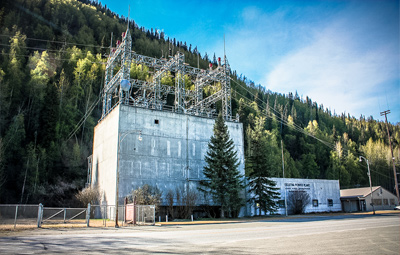
With the sale of ML&P to Chugach Electric that “linkage” is now replaced by Municipal Hydro Power, part of the ownership group for the Eklutna Lake hydro project.  Alaska Statute AS 42.05.711(b)(2) defines how that Statute now applies to Municipal Hydro Power.       

During the RCA hearings on the sale of Municipal Light & Power to Chugach Electric, the issue of fiscal regulation of the Anchorage Water and Wastewater Utility ratepayers was discussed. Despite the efforts and arguments of municipal officials before the RCA, the Municipality was unsuccessful in wresting the control of Anchorage Water and Wastewater Utility from the RCA. 

Lines 14-19 on page 70 of the RCA’s Order approving the sale of ML&P – (Order Number 39 of Docket Number U-19-020) – states:

“Based on the finding that MHP will be competing with other electric operating entities and public utilities under the MEA PPA, we also find that MHP is fully regulated under AS 42.05 pursuant to the AS 42.05.711(b)(2) exception to the exemption from regulation granted by AS 42.05.711(b).  With this finding, and contrary to the expectation of the MOA, Anchorage Water and Wastewater Utility will remain subject to regulation under AS 42.05 pursuant to AS 42.50.711(b)(2).”

Those words “and contrary to the of expectation of the MOA” defines what is going on here with the Anchorage Assembly’s current approach to the Eklutna Dam issue and Anchorage Water and Wastewater Utility’s relationship with the RCA.

We have a recent example of the ratemaking philosophy that the Anchorage Assembly utilizes: Solid Waste Services is owned by the Municipality of Anchorage, which also sets the rates for the Ratepayers.  On Oct. 25, 2022, the Anchorage Assembly passed AO2022-91(S-1). This Ordinance authorized rate increases for the years 2023, 2024 – (5%), 2025 – (6%), 2026 – (5%), 2027 – (6.80%) and 2028 – (2.90%).  

These are on top of the 2021 and 2022 rate increases.

In 2022, being able to see six years out into the future until 2028 what the fiscal situation of Solid Waste Services will be, along with how the economy will perform in general, is absurd to anyone reading this.  

Should the Anchorage Assembly ever succeed in getting control of fiscally regulating Anchorage Water and Wastewater Utility, the AWWU ratepayers can only look to the Solid Waste Services ratepayers to see what their future holds.

Wednesday, Jan. 17, 2024 the opinion page of the Anchorage Daily News led with a guest editorial penned by the chair and vice-chair of the Anchorage Assembly, advancing the Assembly’s position for the removal of the Eklutna Dam.

Nothing in that piece mentioned the regulatory effects on the Anchorage Water and Wastewater Utility ratepayers, which are addressed here. Perhaps the ADN should offer another opportunity to Christopher Constant and Meg Zaletel in order to explain to the Anchorage Water and Wastewater Utility ratepayers why they did not address this in their opinion column.                                             

The elimination of Municipal Hydro Power through the removal of the Eklutna Dam continues an evolving history of the Municipality attempting to wrest the fiscal control of Anchorage Water and Wastewater Utility from the RCA. And once again, they are keeping the Anchorage Water and Wastewater Utility ratepayers in the dark about this aspect of their attempts.

During the entire campaign encouraging voters to approve the sale of Municipal Light & Power, never once did the Municipality or Chugach Electric Association inform the public of the regulatory fiscal effects on the Anchorage Water and Wastewater Utility ratepayers.  

The same is true today for the Anchorage Assembly now encouraging the removal of the Eklutna Dam, which by the way, was approved by unanimous vote. 

Residing in Anchorage Bob Maier is both a property taxpayer and utility ratepayer.
Drama in Legislature turns into yawner as veto override goes down late Thursday

26

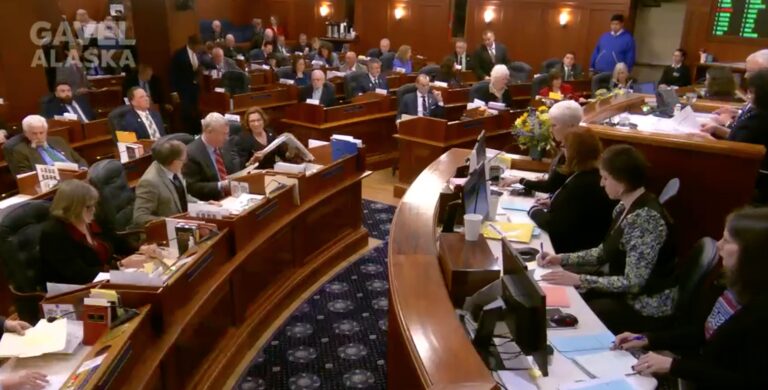
A surprise joint session of the Alaska Legislature was held Thursday night, with only a few hours notice to members.

The session turned out to be a yawner, and within about 10 minutes the two bodies did not override Gov. Mike Dunleavy’s veto of a portion of education funding from last year’s appropriation bills and gaveled out. There was not a single floor speech for or against. All the legislators are able to count, and they all knew what the outcome would be — there would be no override. It needed 45 votes and they didn’t have the votes.

But the drama did create a new and interesting precedent, one that will be tested time and again until it ends up in the Alaska Supreme Court some day.

It started on Tuesday, when Rep. David Eastman said on the House floor that a joint session was “required” by the Alaska Constitution to determine if members want to override the governor’s veto of some of the additional education spending — above and beyond the regular funding formula — that was appropriated in 2023.

It came down to grammar. The Alaska Constitution wording is that “bills vetoed after adjournment of the first regular session of the legislature shall be reconsidered by the legislature sitting as one body no later than the fifth day of the next regular or special session of that legislature.”

It’s never been interpreted to mean that the Legislature must hold a vote. The “shall” is tied to the “no later than” portion, meaning that if they want to override, they need to do it within five days.

Based on the sentence structure in the Alaska Constitution, the words “shall be reconsidered” refer to the clause “no later than the fifth day” — part of the verb phrase and giving direct restrictions to that verb.

“Shall be reconsidered” does not refer to “by the Legislature sitting in one body,” which is a prepositional phrase describing who and how they meet if they meet.

There is no precedent in Alaska history for interpreting it the way Eastman and the House Democrats interpreted it. Additionally, nothing in the Constitution indicates that it intends to force the two bodies together.

A joint session can, after all, only occur with an invitation from one body to the other. Without an invitation, the other body cannot just barge in and force a special session. There are uniform rules for how this takes place and the Constitution in no place forces the House to invite the Senate for an override vote.

But House Democrats pounced and decided Eastman was right. They argued that the Constitution demands a joint session. Legislative Legal disagreed with them but they were undeterred.

Then, Republican Reps. Ben Carpenter and Sarah Vance were swayed by the persuasiveness of Rep. Andy Josephson, a Democrat. They flipped and went with Eastman and the Democrats fo the joint session, and the calculus went from 20-20 to 23-17. That meant the earlier vote to not go into joint session had flipped, and the session was on for 8 pm. It was House Speaker Cathy Tilton’s decision in the end.

Although surprising to see Democrats like hard-core Rep, Alyse Galvin and Josephson agreeing with Wasilla’s Rep. Eastman, who is one of the most conservative members of the Legislature, the Democrats wanted to get everyone on the record so they could later use the vote as a campaign weapon to punish those who voted against the override.

Thus, they were willing to sign on to an argument from Eastman, whom they had tried to remove from the Legislature for two years due to what they said was his attempted insurrection against the U.S. government, due to his membership in Oath Keepers and his attendance at a Jan. 6 2021 rally for President Trump.

Also surprising, if Eastman actually believes his argument in 2024, then he and the Legislature have violated the Constitution for the last several years by not forcing the joint session to consider vetoes.

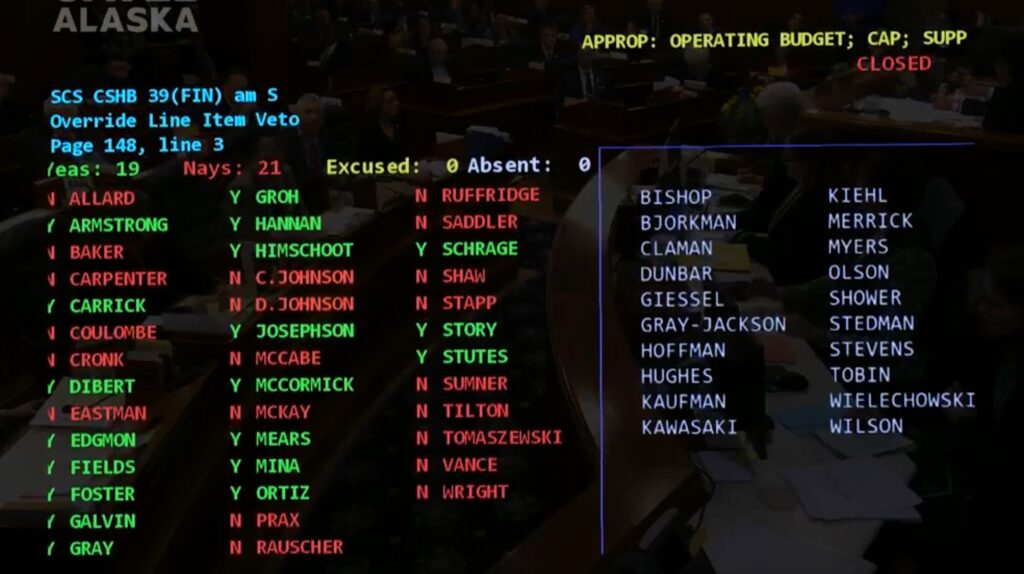
House vote on veto override.

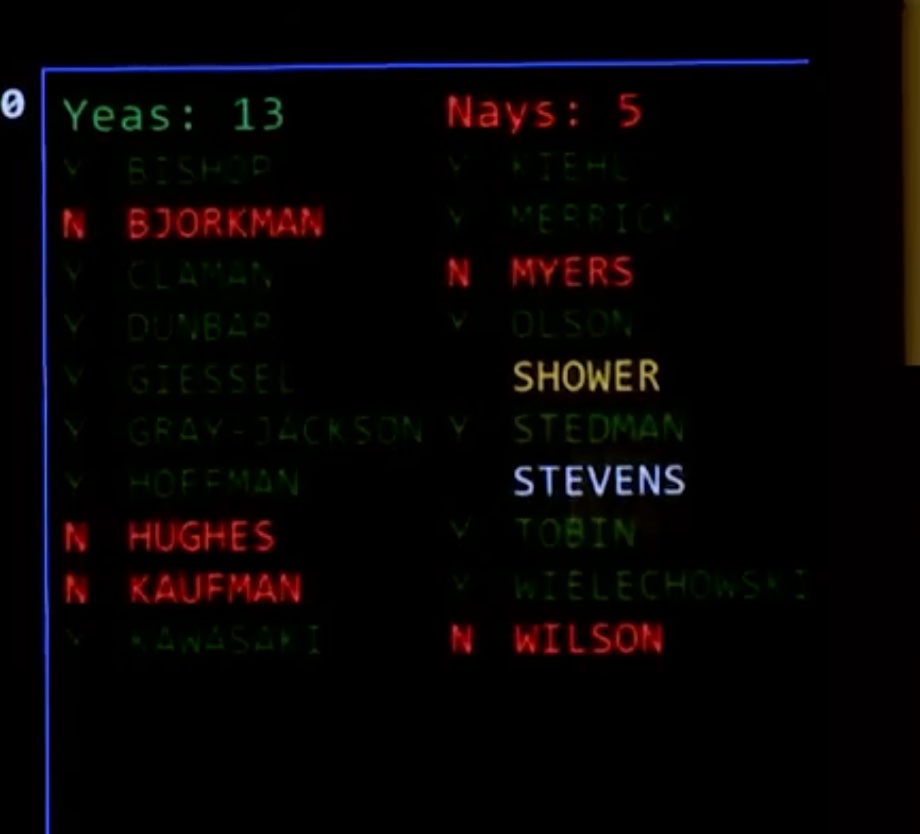
In the end, legislators had 33 to override, and 26 against the override. Most of the Senate, which is dominated by Democrats, voted in favor of the override. Eagle River Republican Sen. Kelly Merrick, along with Republican Click Bishop, Bert Stedman, and Cathy Giessel voted to override.

Republicans in the House generally voted against the override.

Senate vote on veto override.

And with that, the joint session adjourned.

Postal carrier arrested for stealing, cashing checks from mail in Anchorage

A former Anchorage United States Postal Service postal carrier was arrested Wednesday in Missouri after a federal grand jury in Alaska returned an indictment charging him with fraud and theft for allegedly stealing checks from the mail.

According to court documents, Nha Xiong, 25, altered bank checks, using Whiteout to remove the name of the intended recipient, and wrote his own name on the checks to make it appear as if the checks were made out to him. Xiong would then deposit the altered checks into his bank account.

From November to December 2021, Xiong deposited six stolen checks from Northrim Bank, Bank of America, KeyBank, and Mt. McKinley Bank into his bank account, totaling over $39,000.

Xiong is charged with one count bank fraud, in violation of 18 U.S.C. §1344(2), and one count theft of mail by a postal employee, in violation of 18 U.S.C. §1709.

Xiong will make his initial court appearance on a later date before a U.S. District Court judge for the District of Alaska. If convicted, Xiong faces potential fines and up to 30 years in prison.

The U.S. Postal Inspection Service and the U.S. Postal Service Office of Inspector General are investigating the case.

Homeland Security Committee finishes work and calls on House to impeach Secretary Mayorkas

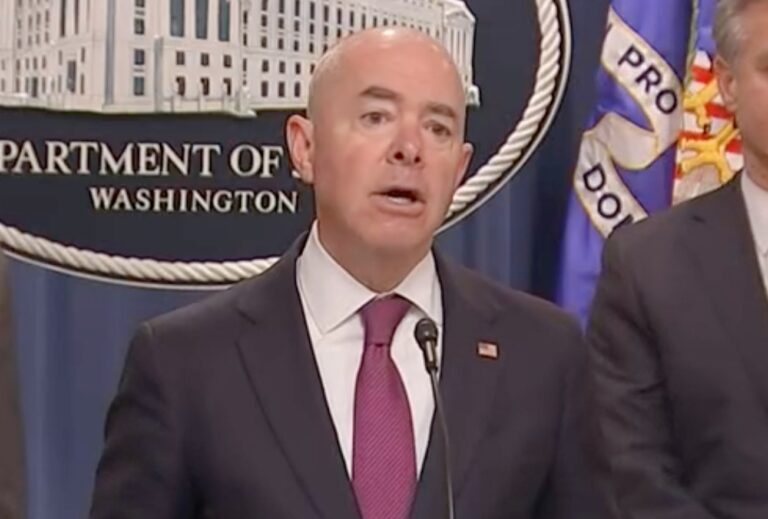
Led by Congressman Mark Green of Tennessee, who chairs the House Committee on Homeland Security, all 17 Republican members of the committee on Thursday called on the U.S. House of Representatives to impeach Department of Homeland Security Secretary Alejandro Mayorkas, an appointee of President Joe Biden.

Hearings ended Thursday, after a week of proceedings. Up next: Charging him with failure to protect the nation’s border from the surge of illegal immigrants. Three articles of impeachment have now been filed against Mayorkas for dereliction of duty, violating laws, and creating a national security threat.

A majority vote in the House is needed to impeach Mayorkas over these “high crimes and misdemeanors.” Two-thirds of the Senate would need to convict him in order to remove him from office, and Democrats control the Senate.

“The truth is that Secretary Mayorkas has disregarded court orders, laws passed by Congress and has lied to the American people,” Green said during the hearing Thursday. “Who wants a secretary that can just disregard the fundamental pillars of the Constitution? We cannot tolerate that, whether they are a Republican or Democrat.”

Green, who is a medical doctor, has led a nearly year-long investigation and subsequent impeachment proceedings, and “having exhausted all other options to hold him accountable, it is unmistakably clear to all of us—and to the American people—that Congress must exercise its constitutional duty and impeach Secretary Mayorkas.”

Majorkas has “consistently, willfully, and systemically refused to follow the laws passed by Congress, abused his authority, and breached the trust of Congress and the American people on numerous occasions. The result of his failure to fulfill his oath of office has been a border crisis that is unprecedented in American history—a crisis that has cost the lives of thousands of Secretary Mayorkas’ fellow Americans,” he said.

A hearing, “Voices for the Victims: The Heartbreaking Reality of the Mayorkas Border Crisis,” examined the impact of Secretary Mayorkas’ intentional border crisis on Americans, including testimony from moms who have been forever impacted by his refusal to enforce the laws of the United States. Unfortunately, Secretary Mayorkas chose to meet with Mexican officials rather than testify before Congress and face these mothers,” Green said.

The committee held its first impeachment hearing last week titled, “Havoc in the Heartland: How Secretary Mayorkas’ Failed Leadership Has Impacted the States.”

The hearings follow the committee’s nearly year-long investigation into the causes, costs, and consequences of the unprecedented crisis at America’s borders and the impact on Americans and Tennesseans. 

The Committee held its first hearing on Jan. 10, with testimony from three border-state state attorneys general who agreed that, in addition to the crisis wreaking havoc in their states, Mayorkas’ actions rise to the level of impeachable offenses.

Throughout the five-phase investigation that culminated in these impeachment proceedings, the Committee published detailed reports of its findings, totaling nearly 400 pages:

Green’s office said the reports conclusively establish that Secretary Mayorkas is chiefly responsible for the chaos and devastation that has unfolded at America’s borders over the past three years.

“His willful and systemic refusal to follow the laws passed by Congress has incentivized unprecedented mass illegal immigration. He has abused his power by directing his Department to implement policies contrary to federal statute and abandoning viable enforcement initiatives, and he has breached the public trust by willfully misleading Congress and the American people on numerous occasions about the consequences of his decisions and the operational realities on the border. As a result of his refusal to follow the law and abuse of power, the criminal cartels have been empowered, Americans and migrants alike are suffering in record numbers, and cities and states across the country are assuming massive financial costs,” Green’s office said.

The Committee conducted 10 full and subcommittee hearings, gathering testimony from more than two dozen witnesses.

The committee, along with the House Oversight Committee, conducted transcribed interviews of chief and deputy chief patrol agents responsible for the Border Patrol’s nine Southwest border sectors as part of this investigation.

These senior agents said:

Throughout the process, Secretary Mayorkas refused to cooperate with committee requests for him to appear and provide testimony on his handling of the crisis and his alleged refusal to enforce U.S. law. 

Bill to make PFD statutory formula constitutionally protected is in House Judiciary on Friday

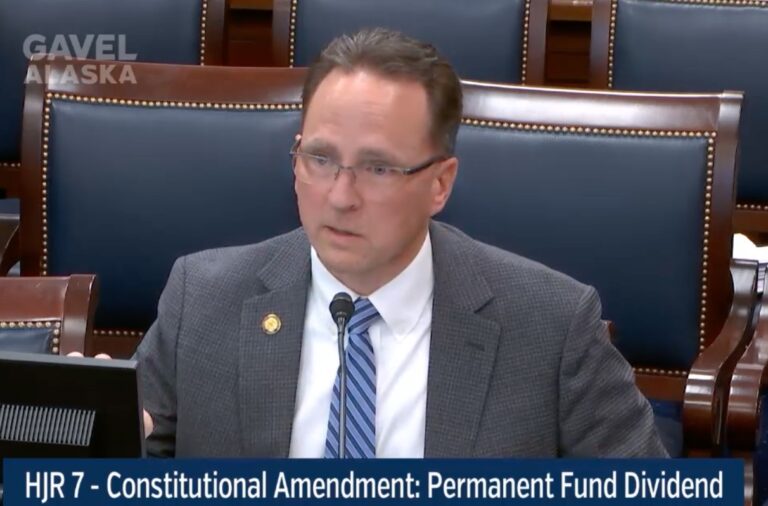
A bill offered by House Ways and Means Chair Rep. Ben Carpenter of North Kenai, requiring the state to pay an annual Permanent Fund dividend based on a statutory formula — not based on each year’s legislative whim — was discussed and analyzed in the House Judiciary Committee on Wednesday. It will be the topic of public testimony on Friday.

Carpenter, speaking to the committee to advocate for HJR 7, said that for almost 30 years Alaskans could count on their annual dividend checks to come as the state legislature followed the law that created the statutory formula.

In 2016, Gov. Bill Walker broke trust with the people of Alaska when he vetoed a large portion of the dividend. Subsequent to his veto, a court case was filed and the Alaska Supreme Court decided that the dividend was merely an appropriation like any other.

That set up a contradiction, since there is an existing statute that provides a formula for how the dividend, which represents a portion of the wealth that originally came from Alaska oil royalties, will be arrived at each year.

Although the Legislature could have chosen to return to the statutory dividend calculation, each year since Walker halved the dividend, the Legislature has been caught up in ongoing battles over how much it will give to the people, and how much it will give to government.

In essence, what used to be an amount that was calculated and not fought over is now a yearly battle.

The bill would not set the amount in stone in the Alaska Constitution. It would only require the Legislature to follow statute. That’s because the Alaska Supreme Court said the payment was statutorily defined and the Legislature can change the statute and change the formula, but must then stick to the formula.

Neglecting to constitutionalize the PFD would allow lawmakers the ability to shirk their obligation to address the shortcomings of Alaska’s fiscal and economic planning, he said. That has how it’s been done for the past eight years, since Gov. Walker made the decision to veto half of Alaskans’ counted-on dividend.

Being sensitive to the occasional vagaries of the investment portfolio of the Alaska Permanent Fund or inflationary pressures, HJR 7 would not allow the Legislature to ever dip into the corpus of the fund. That is protected by the Alaska Constitution.

Amendments to the bill from committee members were due at 5 pm Thursday. Public testimony will be taken on HJR 7 when the committee meets again on Friday at 1 pm.

Wednesday’s committee discussion can be watched at this link.

Dunleavy introduces bills to keep rape kits moving through justice and medical systems with accountability program

Alaska Gov. Mike Dunleavy introduced legislation requiring that all law enforcement agencies and healthcare providers participate in a statewide sexual assault examination kit tracking program.

Current regulations require law enforcement agencies to submit sexual assault exam kits to the laboratory within 30 days, but there is no corresponding requirement for healthcare providers to notify law enforcement of kit completion. It is a gap in the chain of accountability.

The proposed legislation addresses the accountability gap by mandating that healthcare providers inform law enforcement of a completed sexual assault kit within seven days of collection. The additional requirement expedites examinations, and creates an accountability timeline, the Governor’s Office said.

HB 275 and SB 193 propose that the timeline for updating and notifying victims on their examination be within 14 days of kit testing, is in line with recommendations from the Sexual Assault Kit Initiative working group, and other reform-minded groups.

“Public safety is my top priority and ensuring the swift and transparent tracking of sexual assault examination kits is essential for both accountability and the well-being of survivors,” Dunleavy said.  “This legislation addresses identified gaps in the existing system.”

That system includes one already initiated by the Dunleavy Administration. The Department of Public Safety now has a web-based Sexual Assault Examination Kit Tracking System. The system provides survivors with a method to check the status of their kit without having to call or email the investigating law enforcement officer. 

Boundary Commission to meet Friday for update on Hoonah’s request for a new ‘Xunaa’ borough

The Alaska Boundary Commission will meet on Friday, Jan. 19 to hear an update on the petition of the Southeast city of Hoonah to create a new borough in Alaska.

The proposal would encompass Elfin Cove, and Funter Bay, where some residents don’t want to be involved with the proposed borough, which would be known as the Xunaa Borough.

Elfin Cove, population of maybe 20, is now in the Hoonah-Angoon Census Area, and is in what is called the Unorganized Borough, as is Game Creek, which is also included in the proposal, population 18. Hoonah has a population of about 937.

The extension of the proposed Xunaa Borough into the other tiny communities meets resistance in part due to the fact that the borough could tax the residents but not deliver services.

The City of Hoonah’s website dedicated to the new borough proposal can be found at this link.

The Local Boundary Commission’s meeting starts at 9 am in Room 106 of the Atwood Building in downtown Anchorage. The meeting is also available toll free by calling (888)788-0099.

To join the meeting via Zoom, use the following link:

https://us02web.zoom.us/j/89640340348?pwd=V3dSMHpiM2xKZ04xVTdVS2t0Mkl4Zz09

Meeting ID: 896 4034 0348 

Passcode: 152855

Meeting materials, including past minutes and agendas, are at this link.

Supreme Court declines to take Alaska government worker union dues case

7

The U.S. Supreme Court took a pass on a contentious issue regarding union fees and government employees. The case stems from the 2018 landmark case, Janus v. American Federation of State, County, & Municipal Employees. The high court’s decision leaves intact a lower court ruling that says government employees who are not union members can, indeed, be required to pay fees covering contract negotiations that end up possibly benefiting them.

The recent request for the Supreme Court review was brought by the State of Alaska, which sought to stop the practice of automatically deducting union fees from state workers’ paychecks without workers’ explicit consent on a signed consent form.

The Alaska Supreme Court had previously ruled that such deductions don’t violate the Janus decision. Consent is adequately provided through membership and dues-deduction forms signed by union members, the appeals court said.

The U.S. Supreme Court made no comment on why it denied the State of Alaska its day in court to take Janus up a notch.

The Janus case had been a significant turning point in labor law, ruling that non-union government employees could not be compelled to pay union fees, a major blow to public employee unions, which are now the most powerful in the nation due to the rapid expansion of government. Currently, over 7.1 million employees in the public sector belonged to unions, according to the Bureau of Labor Statistics.

As of September, there were nearly three million employees in the federal workforce, a number that has tripled since 1944, according to USAFacts.org.

Hall-Jensen, Dem. associate of Mayor Berkowitz and Gov. Walker, runs for House District 16, Anchorage

Carolyn Hall-Jensen, a registered Democrat associated with far-left political forces in Alaska, is running for House District 16 to represent the West Anchorage neighborhood in the Legislature. It’s an area that has been tough for conservatives to win; some precincts in the area voted for Joe Biden in 2020.

That District 16 seat is now occupied by the far-left Rep. Jennie Armstrong, a Democrat, who is said to be not running for reelection after her first term. Although she filed a letter of intent to run with the Alaska Public Offices Commission, she has allowed her campaign site, jennieforalaska.com, to expire.

Even if she ran, Armstrong would have a tough time winning against Hall-Jensen, who has deep ties with insiders in Democrats circles.

Hall-Jensen may cause concern to some conservatives, however, since her campaign chair is far-left Bill Falsey. Falsey ran for mayor of Anchorage, did not win, and threw his support to far-left Forrest Dunbar for the runoff. Dunbar lost to Mayor Dave Bronson.

Falsey was also city manager for Democrat Mayor Ethan Berkowitz and Falsey signed the recall petition to try to remove Gov. Mike Dunleavy from office shortly after Dunleavy was sworn in.

Hall-Jensen’s campaign treasurer is Austin Mahan, who does campaign accounting for Democrats and who worked for Democrat Anchorage Assemblyman Chris Constant.

Hall-Jensen’s husband is part of a political operation to which many lobbyists and sitting legislators pay handsomely to not be mentioned in.

Hall-Jensen was communications manager for former disgraced Democrat Mayor Ethan Berkowitz. She was operations manager for the failed campaign of Bill Walker for governor in 2022; Walker was considered a false-flag Republican until he became an undeclared candidate, losing to incumbent Republican Mike Dunleavy.

Thus, as a communications professional who has a lot of experience in politics, it makes her a likely win for that West Anchorage district, which has only become more liberal in recent years.

Candidates have until June 1 to file for state elected office, and so there may be other entrants in the race for House District 16 as the filing season heats up.