Sports Illustrated announced on Friday that its laying off most, if not all, of its union-represented staff. The notice came from the magazine’s union members who shared it on social media.
The Sports Illustrated Union and The NewsGuild of New York announced in a joint statement that employees were notified on Friday that the Arena Group, publisher of Sports Illustrated, “is planning to lay off a significant number, possibly all, of the Guild-represented workers at SI.”
Arena Group said in a regulatory filing that it had missed a payment to Authentic Brands Group on the license to operate Sports Illustrated, once the preeminent source for sports journalism, and thus had lost the license to publish.
In a post on X/Twitter, the unions wrote, “”This is another difficult day in what has been a difficult four years for Sports Illustrated under Arena Group (previously The Maven) stewardship. We are calling on ABG to ensure the continued publication of SI and allow it to serve our audience in the way it has for nearly 70 years.”
Last year, the magazine was embroiled in scandal after it became known that it was using artificial intelligence to produce some of its stories, under the names of fake writers.
In December, CEO Ross Levinsohn was fired by The Arena Group’s board of directors. Also fired was Operations President and Chief Operating Officer Andrew Kraft, Media President Rob Barrett, and the corporation’s counsel, Julie Fenster.
Photo credits: Sports Illustrated
The magazines, published since 1954, also lost sight of its main audience when it put a photo of a transgender on the cover for its swimsuit edition, starting with Leyna Bloom in 2021 and Kim Petras in 2023, and also started using clinically obese models in swimsuits in its annual world-famous swimsuit edition, which has been published since 1964. All this was reminiscent of the Bud Light transgender marketing faux pas — an effort to be more in line with “Diversity, Equity, and Inclusion” goals. The cover of the 2022 swimsuit edition featured a heavy-set model.
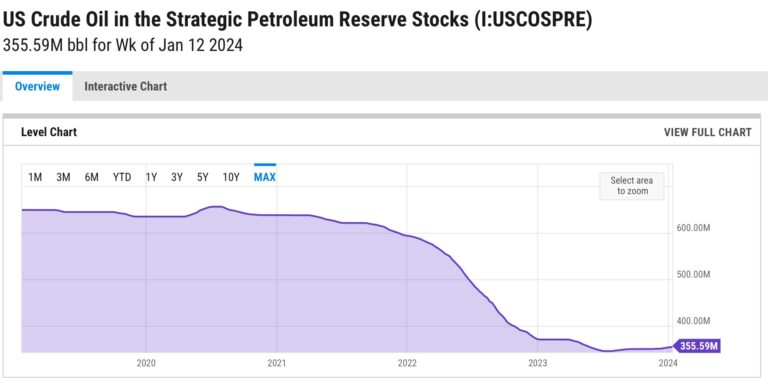
The nation’s emergency oil reserves are down to seeds and stems, but the Biden Administration has now fulfilled its December promise to purchase 3.2 million barrels of oil for the Strategic Petroleum Reserve.
That leaves nation’s emergency supply of oil 17 million barrels short of where it was in January of 2023, with only 300 million to go to restore it to Trump Administration levels.
The Biden Administration has been draining the reserve to tamp down gas prices during the past three years, selling off record-setting amounts of oil at a pace that has alarmed some energy analysts.
“The 3.2 million barrels are being purchased for an average price of $75.96, well below the average of about $95 per barrel that SPR crude was sold for in 2022, securing a good deal for taxpayers. To date, DOE has purchased a total of 17.03 million barrels of oil for the SPR for an average price of $75.75, as well as accelerated nearly 4 million barrels of exchange returns, pursuant to its strategy to refill the SPR,” the Energy Department wrote on Friday.
In earlier news releases from December, the government said it would buy back oil at a price lower than $72 a barrel, but the $4 delta is due to the commodity not hitting the administration’s hoped-for price.
Analysis from the Department of the Treasury shows the sell-off of the emergency supply reduced gas prices for consumers by “as much as 40 cents per gallon,” the Energy Department said.
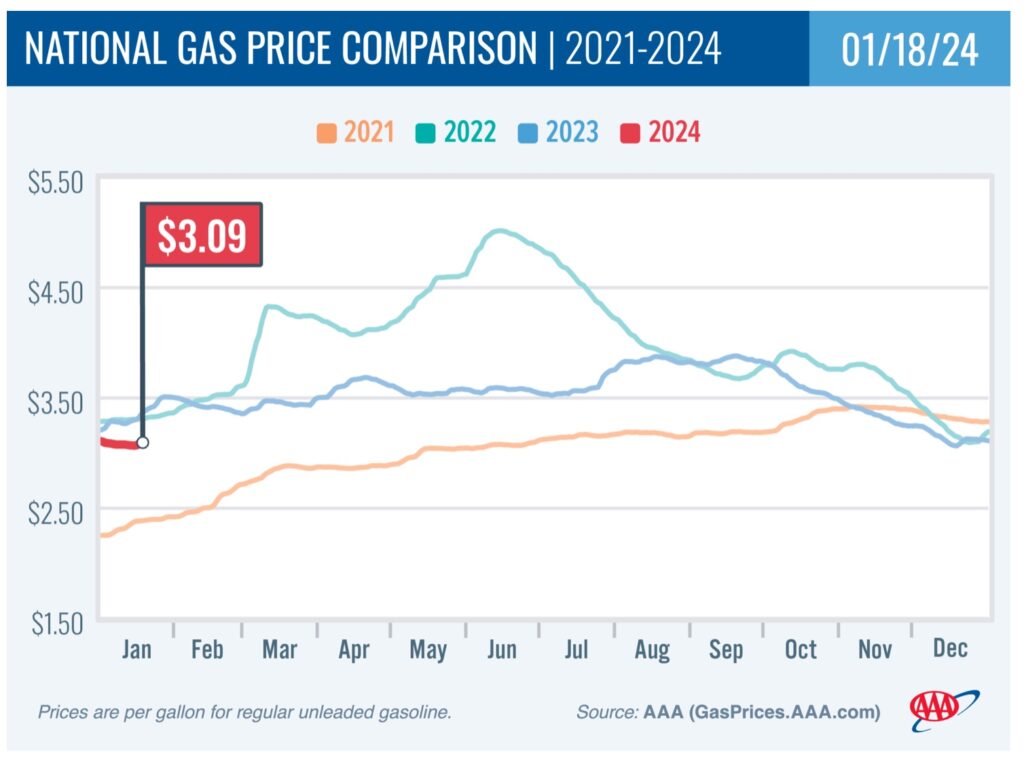
AAA reports the average price of regular gas in America today is $3.082 per gallon. In Alaska, the average is $3.53, and Hawaiian drivers are paying $4.67, the highest in the nation, followed by Californians, who pay $4.51, largely because of high taxes.
The current national average is three cents more than a month ago but 26 cents less than a year ago.
According to AAA, gas prices are well over what they were when Biden took office. In January 2021, at the end of the Trump Administration, drivers paid an average of $2.39 per gallon.
The Anchorage School District has sent a note to all parents in the district asking them to flood a 10 am Saturday hearing that concerns SB 140, a permanent increase to the state’s Base Student Allocation — the funding formula for the basic cost of providing education in Alaska.
For several years, the funding formula has stayed stable, while one-time increases have been appropriated during a time when oil production is low and the financial wellness of the state has been uncertain.
The additional funding would give $300 per enrolled student, in addition to the current funding formula. The bill has had a number of amendments to it involving charter and correspondence students, which are now incorporated into the current version.
Margo Bellamy, the president of the Anchorage School Board, has sent a letter to the House Rules Committee, supporting the bill, but not some of the additions to the bill.
“Certain provisions of the bill have merit, while others are concerning,” Bellamy wrote.
For instance, Bellamy opposes additional support for deaf children, an item in the bill added by Rep. Jamie Allard of Eagle River, who is legally deaf.
“ASD faces a $98 million structural deficit for FY25. A combination of inflationary pressures without a corresponding permanent increase in funding has resulted in this daunting situation. To close this deficit, ASD is faced with draining its emergency reserves and implementing significant cuts to programs, services, and staff – choices that will all impact student outcomes and undercut our current efforts to transform the District through initiatives Anchorage and implementation of the Alaska Reads Act,” Bellamy said. The district has made no effort to reduce its spending , even though it has known for years that Gov. Mike Dunleavy doesn’t want an increase of automatic spending without corresponding accountability. The district just keeps spending as though there is no end of money supply.
Bellamy said the $300 increase in the bill will actually provide the district with less money than what was received from what was vetoed from the budget last year in one-time education funding.
“Since 2016, inflation in Anchorage has risen nearly 27%, while the BSA has risen just 0.5%. This imbalance is eroding public education across our state,” Bellamy said.
The rate of inflation nationally since 2016 has been 18%, according to officialdata.org. But education costs have outpaced the rate of inflation substantially. It’s not just Alaska — education costs are higher than inflation across the country.
“Whether total investment, employment, or revenue is considered, education currently is the biggest and the most rapidly expanding major American industry,” says a contributor to Imprimis, a publication of Hillsdale College.
According to OfficialData, “$100 in 2022 is equivalent in purchasing power to about $82.01 in 2016, an increase of $-17.99 over 6 years. The dollar had an average inflation rate of 3.36% per year between 2016 and 2022, producing a cumulative price increase of -17.99%.”
The Anchorage School District wants a permanent increase of the Base Student Allocation of $1,413, Bellamy said, plus an inflation-proofing of the BSA going forward.
The bill itself is just a vehicle. The title reads, “”An Act relating to funding for Internet services for school districts; and providing for an effective date.” It’s been stuffed full of all kinds of other amendments however. The bill’s sponsors are the Senate’s liberal majority: Sen. Lyman Hoffman, Click Bishop, Matt Claman, Gray-Jackson, Loki Tobin, Jesse Kiehl, Forrest Dunbar, and Gary Stevens, Senate president.
The FAA has created a panel of experts thatbegan meeting this month to investigate causes of fatigue among air traffic controllers. The committee is delving into the science of sleep to see what may be impacting the fatigue of controllers and what can be done about it.
In 2015, a study by NASA of 3,200 air traffic controllers found that 20% had made significant on-the-job errors in 2014, which many of the surveyed controllers blamed on fatigue. One third of controllers said that fatigue posses a “high” or “extreme” safety risk.
The air traffic controllers union says the cause of widespread fatigue reported among air traffic professionals is the system not having enough certified controllers.
The three-member panel is to provide a final report to the FAA in about six weeks. Members include:
Mark Rosekind, a safety and sleep/fatigue professional and former National Transportation Safety Board (NTSB) member, will chair the panel.
Charles Czeisler, chief and senior physician, Division of Sleep and Circadian Disorders, Departments of Medicine and Neurology, Brigham and Women’s Hospital.
Dr. Erin Flynn-Evans, head of the NASA Ames Research Center Fatigue Countermeasures Laboratory.
Mark Littlefield of Eagle River made it official this week, filing with the Anchorage Clerk to run in a special election being conducted to fill the remaining year of Assemblyman Kevin Cross’s term in office. Cross is stepping away from public life after serving two out of his three-year term for Eagle River/Chugiak.
Littlefield enlisted in the U.S. Air Force and came to Alaska in 1982, retiring from active duty in 1995 and going to work for the Municipality of Anchorage. He retired last fall after 28 years doing work such as being a street maintenance operator, solid waste service operator, street maintenance supervisor, and superintendent of road maintenance for the Chugiak, Birchwood, Eagle River Rural Road Service Area.
In his most recent position with Eagle River Street Maintenance, from 2010 to 2023, Littlefield supported the community by managing the contract workforce through many road renovations, landslides, the 2018 earthquake, and the 2022 Hiland Valley avalanche. In 2020, he was awarded the Municipality of Anchorage Supervisor of the year for his service as the Superintendent of Eagle River street maintenance.
Mark has also served on the Eagle River Parks and Recreation Board of Supervisors, as the alternate to the Eagle River Valley Community Council, and was recently appointed the mayor’s seat at that council.
He was previously served on his HOA board of supervisors.
“I strive to be a conscientious conservative individual that is dedicated to any position that I hold,” Littlefield said. “I strongly feel that we all have our own financial worries and believe that any elected official and public servants have an obligation to be not only transparent but great stewards of the taxes that are paid to support our great community.”
Littlefield continued, “I promise to strive to support our great community to the best of my ability. I look forward to earning the trust and votes of the people of Eagle River, Chugiak, and Birchwood in coming months, and hope to make our community proud on the Assembly.”
So far, Littlefield is the only candidate to file with the Municipal Clerk, although Cody Raymond Anderson has filed a letter of intent with the Alaska Public Offices Commission, allowing him to begin running for the seat. Filing deadline is Friday, Jan. 26, in the Municipal Clerk’s office or Municipal Election Office. See all the current candidates for various offices in the March-April election at this link.
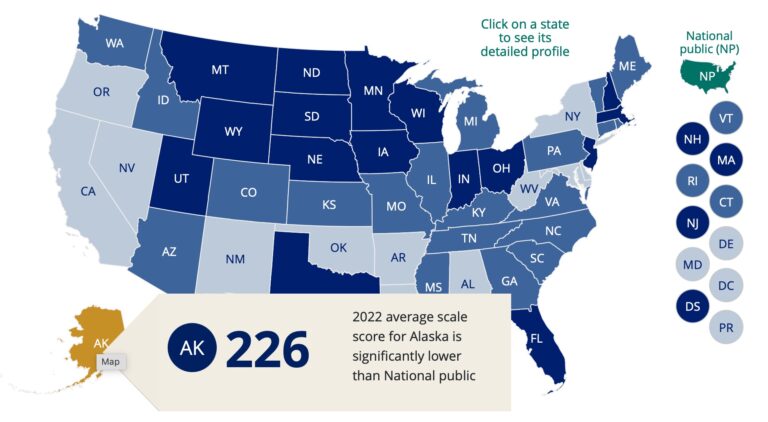
Alaska’s school proficiency standards are evidently too high. But soon, more Alaska students will be “above average,” because what is considered proficient is changing.
The Alaska Board of Education on Wednesday adjusted down the state’s test score standards for what is considered proficient for the different grade levels.
The changes, proposed by the Dunleavy Administration through the Department of Education and Early Development, will be applied to the Alaska System of Academic Readiness (AK STAR) tests.
DEED Commissioner Deena Bishop said that while these changes may lower expectations for proficiency, it does not mean that Alaska’s standards are now subpar. It’s just that Alaska is not at the top, but at least remains in the top third.
At one point in Alaska history, Alaska students were at the top in national standardized tests. In the 1990s, only rural schools were consistently showing student performance in the 25th to 30th percentiles. Since the 1990s, the proficiency has steadily dropped in all Alaska schools, and now Alaska has some of the worst test scores in the nation.
In the fall of 2022 results of the National Assessment of Educational Progress (NAEP), also known as the Nation’s Report Card showed that nationwide, U.S. averages in fourth-grade mathematics wiped out all incremental gains made since 2005, and fourth-grade reading since 1992.
The Alaska Policy Forum has been documenting Alaska school performance for years.
Alaska experienced alarming decreases in mathematics since 2019, the NAEP scores showed, according to APF.
“Fourth graders dropped six points in mathematics, and eighth graders dropped four points. Every 10 points on the NAEP represent roughly one year of learning. By that rule of thumb, Alaska’s fourth graders lost more than half a year of math learning, while eighth graders lost nearly as much,” wrote Sarah Montalbano, a researcher and writer for the Alaska-based public policy think tank.
What’s more, “reading scores are still approximately a full year of learning behind the national average, and 2.1 years behind Florida, which was third in fourth-grade reading. Only 28% of Alaska’s fourth graders were proficient in mathematics, and only 24% were proficient in reading in 2022.”
According to APF’s Montalbano:
“Alaska has changed its standardized assessments several times during the time frame examined here. During the five years between the 2009-2010 school year and the 2013-2014 school year, the paper-based Standards Based Assessment (SBA) was administered to students grades 3-10 with exams in reading, writing, and math.”
In the 2014-2015 school year, Alaska adopted the Alaska Measures of Progress, a computerized assessment and combined reading and writing into an English Language Arts assessment. The assessment was canceled in the 2015-2016 school year due to “repeated technical disruptions” that rendered the test invalid.
That assessment was replaced by the Performance Evaluation for Alaska’s Schools (PEAKS) in the 2016-2017 school year. PEAKS was canceled in the 2019-2020 school year due to the Covid-19 pandemic’s abrupt closure of schools in the spring of 2020. Finally, the Alaska System of Academic Readiness (AK STAR) was implemented in the 2021-2022 school year, Montalbano wrote.
The decision to revise the cut scores for student proficiency in Alaska reflects another pivotal moment in an ongoing national debate on the levels of expectation Americans should have for their publicly funded education system.
Businesses, event planners, rural Alaskans, and every-day Costco members will have another option to purchase bulk food and other goods in Anchorage, when a new Costco Business Center opens at 1074 N. Muldoon Road in Anchorage, near the Tikahtnu Commons.
Costco Business Centers are already located in 12 states. On Feb. 2, Alaska will get one of these “super bulk” stores that caters to restaurants, hotels, rural cooperative buying clubs, and companies that use large quantities. It will be a huge benefit for rural Alaskans who want to buy in bulk on their shopping and medical trips to Anchorage.
Costco, which has consumer warehouse outlets in Juneau, Anchorage (two with one on the way), and Fairbanks, is the second large food seller to expand its Alaska market footprint in just three months.
Amazon opened up a major distribution center in November in midtown Anchorage.
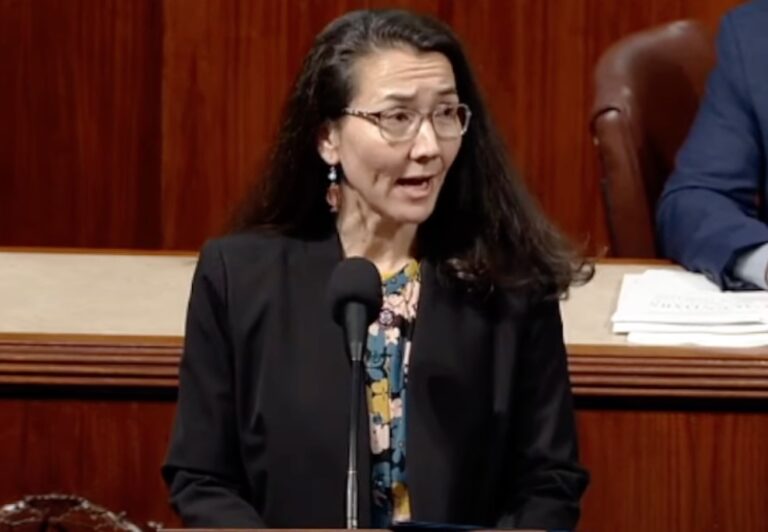
Meanwhile, Alaska’s Rep. Mary Peltola is trying to tamp down competition by preventing Kroger and Albertson’s from merging to compete in this ever-changing free marketplace, where other businesses are quickly making their moves.
Peltola was on the House floor earlier this week proclaiming that the Federal Trade Commission had postponed a decision on the merger until later this year and that she continues to fight the merger of Kroger and Albertson’s. This is a position consistent with the Big Labor unions who support her.
Peltola is following in the footsteps of Sen. Elizabeth Warren and Rep. Alexandria Ocasio-Cortez, whohave attacked the grocery business sector relentlessly, even though the companies are having to pay ever-higher wages to union-controlled workforces and even though shareholders were measurably harmed by the Biden Administration’s economic shutdowns and mandates in 2020 through 2022, shutdowns that have been proven to have caused drastic harm to the economy.
Amazon distribution center is one of the biggest game changers in the Alaska consumer zone, cutting delivery times dramatically for online shoppers. Amazon now operates its own cargo flights through Amazon Air and also has warrants to acquire minority share in Atlas Air Cargo; both operate with daily Amazon cargo coming through Ted Stevens Anchorage International Airport. The new 66,0000-square-foot sorting center in midtown Anchorage is where packages get put on vans for delivery on the Alaska road system.
Three Bears is also in expansion mode. Three Bears has 13 grocery stores with more on the way in Eagle River, Cooper Landing, Ketchikan and North Pole.
Walmart has stores in Anchorage, Eagle River, Wasilla, Fairbanks, Kodiak, Kenai, Ketchikan — nine retail units across the state. IGA has eight stores in Alaska and Alaska Commercial Company has 33 stores, primary in very-rural Alaska.
At a recent Anchorage School District Governance Committee meeting, ASD School Board member Dave Donley proposed a new and more transparent policy defining a parent’s role in transgender and gender nonconforming students. His goal was to take mere guidelines and convert them into policy on which all board members would have to vote.
Currently, these administrative guidelines are “mere suggestions” for the school staff to follow.
Policies, on the other hand, are a mandate and must be followed by the school staff.
Here is how the new policy would read: “If a student or parent requests transition(s) regarding gender, legal name, or pronoun during the school year, the principal will hold a meeting with the student and parent(s) to discuss their desires and concerns.”
Donley wanted to empower parents and affirm their rights to parent their kids.
Now, the district has Administrative Guidelines which leave the parents totally out of the decision making process on gender transitioning, pronoun usage, gender identification and bathroom usage. Read that set of guidelines here.
Donley’s proposed new policy also provides a means for a student who would not have a parent’s support to appeal to the superintendent and the board.
But member Andy Holleman, who is a former president of the Anchorage teachers’ union, had a problem with Donley’s new policy. He said, “It would be an incredibly awkward situation” for students to use the appeal process.
Board President Margo Bellamy noted that these are administrative guidelines only, not policy. Once again, they appear to be mere suggestions, not mandated policy.
Bellamy then asked if there were any challenges from parents on these guidelines.
This is a “Catch-22” question. How could parents challenge the guidelines when their student’s transition/pronoun usage is kept secret from them?
Here is the form for “gender issues”. Note that parents are found nowhere on the document:
Superintendent Jharrett Bryantt stated that he was unaware of any widespread issues, and he does not intend to make any changes to the administrative guidelines until he hears from the U.S. Department of Education. Bryantt is kicking this can down the road with no decision — just like the budget crisis.
It appears the federal government has more power over our students than students’ own parents.
It does seem odd that the school board could put this guidance in place without the federal government involvement and now the district cannot change the guidance until it hears from the federal government, per Superintendent Bryantt.
The school staff then stated that only parents can put information into the “system.” Per the staff, a parent has to put the preferred pronouns into the system; a student cannot do that.
That contradicts the administrative guidelines, which state that a parent does not have to sign off on the gender transition or pronoun usage of a student.
Bellamy also said that these guidelines were put into place in 2016, when she was in charge of the Equity office and that the district followed guidance from the federal government.
However, it looks like the guidance actually came from the National Education Association and other liberal organizations such as the ACLU. Here is a link to the NEA “Legal Guidance on Transgender Student Rights.”
Note that Bellamy did have the date right — the NEA guidance is dated 2016.
Superintendent Bryantt could not provide the federal guidance that he alluded to. He also did not want to put the guidelines into policy until after the U.S. Supreme Court rules on the issue.
Board Vice Chairman Carl Jacobs, who is up for reelection this spring, wanted to table the question until the federal government rules. He seems to want to hide behind this “rock” prior to the election so he is not accountable for not supporting parents’ rights.
The board does not want to put these Donley guidelines into policy because then it would have to vote on the policy and be held accountable by the public.
The board can hide behind this “rock” and not be answerable to the public when it is election time.
Those board members up for reelection and hiding behind the gender transition/pronoun usage/gender identity “rock” are Pat Higgins, Carl Jacobs, and Dora Wilson.
Parents should demand that board members take a stand on the various gender identity issues, especially those members who are up for reelection.
Why does a school board believe it should hide secrets from parents?
By hiding secrets from parents, schools are putting a wedge between parents and their children. With more and more of these government wedges, the nuclear family is on the way to destruction.
Until the administrative guidelines are put into policy, the ASD staff should treat these guidelines as “mere suggestions” to be disregarded.
The governance committee voted 2-to-1 to not put the guidelines into policy.
But you have a vote in the next election as well and board members are very aware of that.
David Boyle is the education writer for Must Read Alaska.
This past July, the National Institutes of Health stopped funding any research at the Wuhan Institute of Virology. The United States taxpayers had previously provided $2 million in research grants to Wuhan through the Ecohealth Alliance.
The memo stating that the NIH will no longer fund research at the Wuhan Lab made no mention about Covid-19 originating at that lab.
Instead, it cited the Wuhan Institute of Virology’s non-responsiveness and a determination by National Institutes of Health that the “institute’s research likely violated biosafety protocols present a risk.” It also stated that the NIH believes the Wuhan lab will continue to violate these safety standards in the future.
But wait! The government is still giving grants to the Ecohealth Alliance. Almost $50 million in US taxpayer moneysince 2020 has gone to projects that include “capturing bats, pangolins and other animals to find new and dangerous viruses in remote parts of the world.” Those grants last until August 2027.
The Ecohealth Alliance did a very poor job managing the research at Wuhan and yet we are still funding this group to perform the same type of research at other locations.
In 2019, the World Economic Forum and Bill Gates held a by-invitation-only pandemic planning exercise at Johns Hopkins University. They were worried about a possible pandemic and if nations would respond effectively. I imagine a lot was learned that could have helped us six weeks later when the Covid-19 virus spread throughout the world. It was great timing, seemingly coincidental.
This week, the World Economic Forum is holding its meeting in Davos, Switzerland. One of the topics of discussion is “Disease X.” The globalists are very concerned about this disease producing another pandemic.
Tedros Adhanom Ghebreyesus, director-general of the World Health Organization, is attending the World Economic Forum to help plan for how to respond to future pandemics. Ghebreyesus believes we need to prepare the global health system for this next round of pandemics and it would cost “close to a trillion dollars.” The World Health Organization did not name a disease but said another virus could emerge and planning must be done.
Although the WHO said it didn’t know what Disease X is, China has meanwhile created a new Covid-type virus that killed 100% of “humanized” mice in eight days. The scientists involved in this research are linked to the Chinese military. This new Covid strain is called GX_P2V. The poor pangolin is involved in the research once again.
This virus is reported to be 20 times more deadly than Covid-19. It infects the “lungs, bones, eyes, tracheas and brains” with the brain being the cause of death. The death was graphically defined. The mice “had quickly lost weight, exhibited a hunched posture, and moved extremely sluggishly.” The day before death, their eyes turned completely white.
Professor Richard Ebright, a Rutgers University chemistry professor, stated he had serious concerns about this study. He had even more concerns over the fact that the preprint didn’t discuss what biosafety levels or biosafety precautions were taken. Déjà vu back to the research at Wuhan from 2016-2019 that produced Covid-19.
According to Snopes.comthe WHO may say this new disease could be 20 times more deadly than Covid, but that statement must be taken in context. WHO is looking at a worst case scenario, much like it did during the Covid-19 years.
These kinds of statements are used to extract more money to do research. Remember what WHO director Ghebreyesus said: The world needs to be prepared for a trillion dollar cost.
Pay attention as this scenario continues to develop. The government is here to help you: More vaccines, more lockdowns, more masks are coming your way.
If that happens, there will be more deaths, more economic downturns, more inflation, more school closures with students losing their futures, and more despair for many. It’s a path toward total control of us, our lives, and our future.
Linda Boyle, RN, MSN, DM, was formerly the chief nurse for the 3rd Medical Group, JBER, and was the interim director of the Alaska VA. Most recently, she served as Director for Central Alabama VA Healthcare System. She is the director of the Alaska Covid Alliance.