Monday, August 10, 2026
Home Blog Page 465

Tim Barto: Cautionary tales of gender transitioning heard in House Judiciary Committee

By TIM BARTO

Hats off to House Judiciary Committee Chairwoman Sarah Vance and Vice Chairwoman Jamie Allard, who held hearings on three bills on Monday:

1) HB386, introduced by Attorney General Treg Taylor, would crack down on self-righteous miscreants who find it trendy to block traffic and obstruct other public places so everyone can be inconvenienced by their political protests.

2) HB105, introduced by Education Commissioner Deena Bishop, will empower parents to keep fully informed about what’s going on with their children in public schools, to include if information is being kept from them about their children’s use alternative names and pronouns; and

3) HB338, which will make medical practitioners liable for the damage they cause to children as a result of gender transition procedures.

All three of these bills have merit and are significant for their efforts to fight against the extreme actions of far left protesters, schoolteachers and administrators, and medical providers, but this article will focus on HB338, as it is a piece of legislation that will curtail the insanity and downright evil that is being perpetrated on children. It is an issue on which Alaska Family Council is leading the effort to educate Alaskans in order to protect children. 

Introduced by Rep. Allard of Eagle River, the bill will make medical practitioners financially culpable for the harm they inflict on minors through puberty blockers and surgical procedures. Four rather unique individuals were invited to provide expert testimony, and their statements brought conviction to save children, and condemnation to those who promote and practice treatments that harm children.

Allard attempted to obtain testimonies from Alaska doctors and therapists who support the legislation, but these professionals feared becoming targets if they came forward. Some of them experienced threats during the Covid pandemic and they were worried their actions would be brought to vindictive medical licensing boards, jeopardizing their licenses to practice, as evidenced by what happened to some doctors in Alaska who held contrary opinions during the first two years of the pandemic. Allard turned to nationally known experts in the field. 

The first testimony came from Stephanie Winn, a Licensed Marriage & Family Therapist from Portland, Oregon. Winn describes herself as a “left-leaning therapist who was once trained to provide so called gender affirming care,” but who changed her mind about providing such care to children once she began to see the harm it caused. 

Winn listened to the painful testimonies of de-transitioners and those who regretted their decisions to undergo the radical procedures involved in gender transitioning. Her 2020 pivot to being gender critical led to harassment and slander directed towards her, jeopardizing her reputation, income, and even her safety; however, she felt it her ethical duty to remove herself from further participation in the practice.

Winn decided that her personal safety was less important than helping young, vulnerable, mentally ill patients, so she joined colleagues from around the world who now favor therapy ahead of what she called “the most unconscionable medical scandal of our time.” 

Recompense is appropriate, she said, because of the litany of health risks involved: inability to have children or breastfeed, weakened bones, osteoporosis, painful or prolonged urination, loss of bladder control, loss of sexual sensation, increased cardiovascular disease and cancer, early onset Alzheimer’s and dementia, diabetes, and metabolic disorders. Furthermore, there are no accurate predictors of patients who will persist with their transition or who will opt for de-transitioning.

Winn’s testimony was followed by Dr. Ivan Abdouch, retired professor from the University of Nebraska Medical School. Abdouch served as the Medical Director of the Omaha Gender Identity Team, guiding the management of many gender transition individuals for various Midwest states.

Abdouch said the question of what to do with children experiencing gender identity issues is whether to medicate and operate, or wait. His advice is to wait. In fact, it should never be done, he added, especially since there are at least 18 mental conditions that can be confused as gender dysphoria.

Abdouch outlined three facts that should be considered when deliberating the issue of using drugs or surgery on minors:

1) There are no current generally accepted standards of care;

2) No one can determine with accuracy the gender trajectory of any child or adolescent;

3) Treatment effects are universal and lifelong.

Abdouch asked the legislators to keep in mind this question:  What is an acceptable number or percentage of children who experience irreversible lifelong harm from gender treatment? Any answer other than zero, he advised, is indicative there are things other than safe medical practices involved.

Abdouch admitted he is not in favor of government management of medical practices, but when there is such potential harm to children at stake then someone has to step in.

The next expert to testify was Ari DeWolf, Director of Outreach for Do No Harm, an organization dedicated to speaking out against the harmful effects of gender transitioning of minors. Like the first two speakers, DeWolf described himself in a manner that most people would not expect to hear from someone speaking out against a topic so popular in today’s culture. He’s a gay, half-black, Jewish conservative. 

His uniqueness defied stereotypes and would have made him susceptible to gender transitioning treatment as a minor. DeWolf spent a great deal of time studying this issue and focusing on the parents affected by the procedures. Parents are seeing their children turn against them by schools and medical professionals, and these institutions are taking advantage of young people. 

Matt Sharp, Senior Counsel for Alliance Defending Freedom, was the final expert to speak. His clearly stated goal is to protect children, and he feels that can be done better through compassionate, effective mental health care than through medical procedures promoted by activists and profit-driven gender clinics, though, have put an emphasis on drugs and surgery. 

The legal recourse afforded by HB338 is necessary to put a stop to the irreversible effects of gender transitioning, which include preventing healthy puberty, radically altering hormonal balances, interfering with mental and emotional development, and removing healthy body parts.

Limiting freedom for minors is a legitimate function of government, as it is done with limiting or prohibiting children from signing contracts, voting, buying alcohol or tobacco, or getting tattoos. Minors lack experience and judgment, and if doctors are making these life-altering decisions for them, or at least leading them in that direction, then the state has the authority, indeed the obligation, to step in.

Public testimony on this bill is scheduled for 1 pm on Wednesday, April 17. Here is the email address to the Judiciary Committee: [email protected].

Tim Barto is a regular contributor to Must Read Alaska, and is vice president of Alaska Family Council, the Alaska organization leading the fight to protect minors from the harmful effects of gender transitioning treatments.
Randy Ruaro: Exposing the shadowy grip of Arabella Advisors, New Venture Fund in Alaska

By RANDY RUARO

In accordance with the Tenth Amendment of the Federal Constitution and state rights, Congress promised Alaskans that, upon voting for statehood in 1959, Alaska would control resource development decisions on state land and have access to state resources.

Those promises are under attack from within the federal government (Biden Administration) and its’ left-wing political supporters. A battle is going on right now over control of resource development decisions and the ability of Alaskans to work and feed their families.

Alaska and AIDEA, the state’s economic and development corporation, are on the front lines in this fight.

Every time a group surfaces with a catchy Alaskan name claiming a need to stop resource development, jobs, and economic development, Alaskans should ask “Who is paying for this effort to influence public opinion?”

Research by AIDEA and others shines a light on Arabella Advisors and its’ many tentacles as a key player in the world of dark money politics. Connections between Arabella Advisors and influential funds, such as the “New Venture Fund,” and groups like “Salmon State” raise serious questions about the extent of their influence and motives.

Recent reports highlight the influence of foreign billionaires, their donations, and murky financial dealings orchestrated by Arabella Advisors and its “New Venture Fund.”

For example, here in Alaska, Salmon State is funded in part by the New Venture Fund with donors such as George Soros and Swiss billionaire, Hansjörg Wyss. The largest foundations in the world are using this dark money lobbying network to influence policy in Alaska.

In 2018, the New Venture Fund spent $88 million to influence environmental programs. This dark money organization controls media through the “States Newsroom,” which, in Alaska, operates the Alaska Beacon, an online news organization, making it one of the biggest media influencers in the state. 

The New Venture Fund is administered and overseen by Arabella Advisors. The New Venture Fund claims to be a tax-exempt non-profit with the IRS. A tax-exempt non-profit is not supposed to engage in partisan politics (IRS Revenue Ruling 2007-41).

The actions of the New Venture Fund, being so egregious in terms of acting as a blatantly political arm of liberal donors, have attracted the attention of prosecutors and are currently under investigation.

Organizations like the New Venture Fund, with hundreds of millions of dollars of donations from rich billionaires want to impose poverty and suffering on Alaska for a political agenda. They are a threat to this state. Because AIDEA’s mission supports resource development, jobs, and benefits Alaskans, it is a target. However, AIDEA’s commitment to jobs and economic development will not waiver.

The fight against dark money political and social engineering is not just a battle for Alaska; it’s a battle for the integrity of the democratic process. Alaskans must rally together to reclaim our autonomy and demand transparency and accountability from those who seek to undermine the promises made by the federal government to Alaska for statehood.

The Alaska Legislature should consider a bill next session placing donor disclosure requirements on entities such as the New Venture Fund and Salmon State to bring dark money connections into the light.

Randy Ruaro is the Executive Director of the Alaska Industrial Development and Export Authority (AIDEA), the State of Alaska’s economic development and finance authority. Ruaro most recently served as Governor Dunleavey’s Chief of Staff and Special Assistant for Statehood Defense. He has over 20 years of experience providing administrative oversight to state agencies and implementing policies supporting resource development, infrastructure, and job growth.

We support Carmela Warfield for GOP chair

By PAULETTE SIMPSON, JUDY ELEDGE AND RHONDA BOYLES

Alaska is home to 140,804 voters who have chosen to register with the Alaska Republican Party. Our Republican coalition of like-minded voters is nearly double that of Alaska Democrats.

These 140,804 Republican voters present both a blessing and a challenge for Party leadership as it strives to give voice to our voters and convince independent voters to support our candidates.  

As active, committed Party stalwarts, we have served with and under nine different Republican Party chairs and held leadership positions both within the Party and with Alaska’s Republican women groups.   

Over decades we have devoted countless hours to the cause of conservative governance at the local, state, and national levels and have striven to remain faithful to our Party’s statement of enduring principles.

For a state party to function, our leaders must not only share our values, but be competent and professional in their management of our coalition, our finances, and our communications.  

We also know that leaders cannot succeed if they are not deeply respectful, inclusive, and transparent – and that is why we are in full support of Carmela Warfield for state Party chair. 

For several years, Carmela has been president of the Hillside Community Council, serves on the board of directors of HALO, and is a delegate to the Federation of Community Councils, the largest group of community councils in Anchorage. These are not easy groups to lead.

Carmela has earned the respect of numerous party affiliated volunteers, and never wavers from her commitment to the values we as Republicans share.  

Carmela has served as both a district and regional chair, and most recently led one of the largest regional Presidential Preference Polls in the state and went on to successfully help guide her region’s district conventions.

Carmela Warfield is the competent professional our Party needs now. Please join us in supporting Carmela’s bid for Party Chair.

Paulette Simpson, Rhonda Boyles, and Judy Eledge are longtime members, officers, and activists of the Alaska Republican Party whose work on behalf of Alaska Republicans in the Interior, Southcentral, and Southeast spans over 75 years.

AIDEA and partners appeal ANWR oil and gas lease suspension by Biden Administration

It’s on to the Supreme Court. But first stop, the Ninth Circuit Court of Appeals.

The Alaska Industrial Development and Export Authority, along with the Kaktovik lnupiat Corporation, Arctic Slope Regional Corp., and the North Slope Borough, have filed an appeal with the Ninth Circuit over the Biden Administration’s cancelled leases in the Arctic National Wildlife Refuge.

The appeal challenges an August 2023 ruling by U.S. District Court Judge Sharon Gleason regarding the suspension and moratorium of the Arctic National Wildlife Refuge Coastal Plain 1002 Area oil and gas program mandated by the Tax Cuts and Jobs Act of 2017.

In that lawsuit, AIDEA said the lease termination violated a statute that directs the Interior Department to award leases covering at least 400,000 acres in ANWR. Gleason dismissed the lawsuit.

Gov. Mike Dunleavy said of the decision, “The State of Alaska has long been at the forefront of fighting for our state rights and pushing back against federal overreach. The federal govemment‘s actions regarding the ANWR leases not only undermine our state’s autonomy but also hinder our ability to harness our rich natural resources for the betterment of all Alaskans which was guaranteed in the 2017 Tax Act. This appeal is crucial in our ongoing efforts to assert Alaska’s rights and potential.”

Statements were also made by the partners in the lawsuit:

“Kaktovik is the only village within the project area. Our involvement in this appeal is about protecting the rights and future of our people. The decisions made by the Department of Interior have significant implications for our community, and it’s essential that our voices are heard in this matter,” said Charles Lampe, President of Kaktovik liiupiat Corporation.

“The Department of the Interior seems to believe that they care about this land more than we do. The elected leaders of the North Slope spoke in unison in opposition to this rule and the rulemaking process. To refuse to listen to our voices is to say that you know better – better than the people who have been this land’s stewards for the past 10,000 years, and who depend on its continued health for their own survival. We deserve the same right to economic prosperity and essential services as the rest of this country, and are being denied the opportunity to take care of our residents and community with this decision. it is insulting and, unfortunately, representative of the federal government’s treatment of our indigenous voices for decades,” Mayor Josiah Patkotak of the North Slope Borough said.

Sen. Lisa Murkowski said she was the lead author of the section of the Tax Cuts and Jobs Act that mandated the lease program and at least two lease sales by the end of this year. She said the Department of the Interior’s recent actions violate the law.

“My team and I invested countless hours in crafting this legislation, ensuring it balanced economic development with environmental stewardship. lt’s crucial that the clear intent and plain direction of this law, to responsibly harness the energy potential of the 1002 Area for the benefit of Alaskans and the nation, are fully realized,” she said.

Dark-money group linked to George Soros just reserved $4 million in TV ad buys to support Peltola

In a move that shows how worried the Democratic Party is over the ability of Alaska Rep. Mary Peltola to hang on to her seat in November, a shady group called “Vote Alaska Before Party” has just reserved nearly $4 million in television ads for the fall in Alaska. All of it is in support of Peltola.

The Vote Alaska Before Party group is really a subset of the congressional Democrats through their House Majority PAC, which was far-and-away the largest donor to Vote Alaska Before Party in 2022.

When the House Majority PAC announced its $186 million in ad buys last week to major media, it proudly mentioned major cities like Phoenix and Portland.

Read CNN’s Key Democratic group pours $186 million in battle for House and preps for ‘trench warfare’ with GOP

“We need four seats to win back the majority. That’s it,” Mike Smith, president of House Majority PAC, told CNN. “It’s a very tough four seats. Every single one of those is going to be trench warfare. We’re going have to invest a lot of money, hence the $186 million, but there’s a clear path to doing it.”

CNN continued: “Nothing has been reserved in Alaska to help Mary Peltola, but Smith said each media market has a different set of circumstances dictating when to place an ad buy, suggesting that Alaska would be on the group’s list for later in the cycle.”

The PAC left out Alaska because Alaskans famously don’t like Outside money — especially from the likes of George Soros and Nancy Pelosi — to muck around in Alaska races. House Majority PAC was trying to fly under the radar; the Vote Alaska Before Party group reserved the media buy, and while the cash transfer is not yet showing on federal reports, that kind of big money comes from one place — the House Majority PAC.

It’s a repeat play from 2022, but times three. While it got her elected in 2022, this time the Democrat cavalry is coming to save Peltola, after recent polling shows she is slipping in popularity. In January of 2023 she had a positive of 57% and negative of 28% among Alaskans in an Ivan Moore Alaska Survey Research poll. In March of 2024 she is now at 51% positive and 41% negative.

The reservations for ad time in Alaska media markets break down to the Anchorage television market with $2.669 million, Fairbanks with $956,520, and Juneau with $345,084. It is a record-setting amount for a congressional race in Alaska, which is considered a cheap media market.

The money that fuels Vote Alaska Before Party is coming from the usual suspects: George Soros, Tom Steyer, Michael Bloomberg, Nancy Pelosi, and other big donor names — all anti-Second Amendment, radical environmentalist types from New York, San Francisco, Boston, and Washington, D.C. Labor unions and tribes such as the Puyallup Tribe of Washington state, also factor as big donors to the mother ship that floats Vote Alaska Before Party.

In 2022, the House Majority PAC was the largest contributor to Vote Alaska Before Party, with over $1.7 million. Sealaska Corporation came in second as a donor to VABP with $90,000, and Chugach Alaska Corporation chipped in $50,000, according to Open Secrets.

The House Majority PAC received $5 million from George Soros in 2022, which is why it had some spare money to give to the Vote Alaska Before Party fund to help Peltola, who seemed like a long shot at the time. Soros gives to campaigns and PACs through another fund, Democracy PAC, which he seeded with $125 million, and which is run by his son.

View the donor list for the House Majority PAC, where the money is housed before it goes to Vote Alaska Before Party at this link.

Vote Alaska Before Party spent $1.8 million for Peltola in the 2022 cycle, and none for Republicans. Of that $1.8 million, the group spent $1.66 million for media buys, a third of what it intends to spend on TV alone this fall, telling Alaskans to vote for Peltola.

The top expenditure for Vote Alaska Before Party is Waterfront Strategies, which is the No. 1 vendor for Democratic PACs, labor unions, and left-of-center nonprofits, spending $206 million in the 2018 election cycle, according to Influence Watch. Among its clients are the Democrats Senate Majority PAC, House Majority PAC, Women Vote, League of Conservation Voters, Climate Action and the government labor union, AFSCME.

Waterfront Strategies was paid $1.23 million by Vote Alaska Before Party in 2022. The left-leaning Lottsfeldt Strategies was paid $100,000.

Waterfront Strategies, a for-profit company based in Washington, D.C., has a parent company — GMMB, which was founded by Jim Margolis, a campaign consultant for President Barack Obama, Hillary Clinton, Kamala Harris, and John Kerry, and who represents other high-profile Democratic campaigns.

The entire Vote Alaska Before Party operation is a pop-up similar to Bristol Bay Action, which is an Outside group popped up and paid for by dark-money Sixteen Thirty Fund, a subset of Arabella Advisors, which supports leftist candidates and causes in Alaska.

Campbell, Treadwell: Mike Robbins is Alaska Republican Party’s most qualified for chair

By ALASKA LT. GOVS. CRAIG CAMPBELL AND MEAD TREADWELL

Our state and our nation face the greatest challenges testing the foundation of our freedoms and prosperity since the election of Ronald Reagan.

The Second Amendment is under direct attack by our own federal government, jeopardizing our constitutional rights. Meanwhile, inflation has significantly reduced the buying power of Alaskans, and soaring interest rates have placed home ownership out of reach for many.

Additionally, our public schools, some of the lowest performing in the nation, are distracted by non-educational agendas which often sideline essential educational objectives and marginalize Title IX protections for women in sports. To reverse this progressive destruction of our state and nation, we must have strong leadership in the Alaska Republican Party (ARP).

Over the next four years, our state needs an inspirational leader who can articulately communicate the conservative message of the ARP across our state. A person who can instill confidence with Alaskans that the ARP provides the best opportunity for achieving their goals in life. A person who can stimulate grassroots action to elect conservatives at the local, state, and federal levels. A person recognized for past achievements in fundraising, campaigning, recruiting, and teamwork. That person is Mike Robbins.

Mike Robbins, a steadfast conservative and the current ARP Vice Chair, stands out as the most qualified candidate for ARP Chair. Under his leadership as the Freedom Club Chair, Mike substantially increased financial donations to the ARP and established the party’s major donor program, the Founders Club, ensuring that the party had the financial resources available to support local and state elections. Mike’s ability to articulate conservative values and mobilize grassroots support has provided electoral successes across Alaska.

Looking forward, Mike envisions an ARP that not only safeguards our freedoms but also fosters policies that enhance the quality of life for all Alaskans. He is committed to advancing solutions that address our educational challenges, strengthen our economy, and uphold our constitutional rights, including the Second Amendment.

Please join us in supporting Mike Robbins for ARP Chair—a principled leader with the vision, credentials, and experience needed to lead our party and effectively advocate for the interests of our great state at the 2024 ARP State Convention. He is the right choice for ARP and Alaska.

Craig Campbell and Mead Treadwell served as the 10th and 11th lieutenant governors of Alaska, respectively. Campbell is national committeeman for the Alaska Republican Party.

Soldotna former teachers’ union president challenges State’s evidence involving sexual abuse of minor

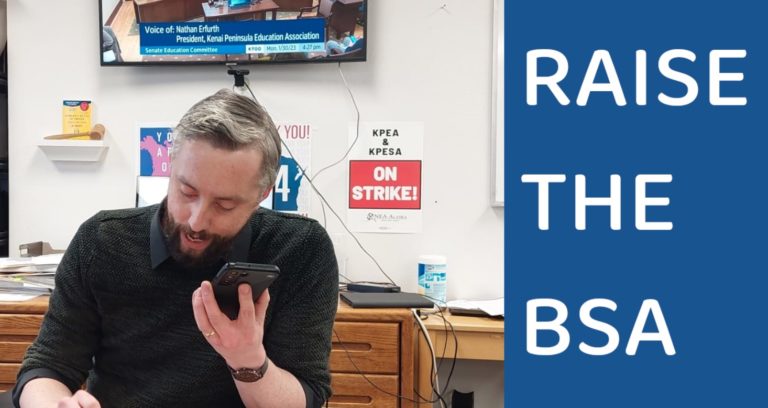
Nathan Erfurth, a former teacher at Soldotna High School and president of the local teachers union, was in court last week for another evidentiary hearing involving the five counts against him for alleged sexual abuse of a minor over whom he had authority.

The hearing surrounding the interpretation of recorded conversations that may be pivotal to the case. Erurth has pleaded not guilty after his arrest in April of 2023, for crimes associated with having a sexual relationship with a former student who was a minor. His attorney says that the transcript of a phone call between Erfurth and the girl is inaccurate and misrepresents what was said in the conversation, which was played for a grand jury last year.

During the recent hearing at the Kenai Courthouse, Derleth played audio clips from the recordings for the judge last week in the Kenai courthouse, aiming to demonstrate inconsistencies between the state’s interpretation and what they contend to be the actual dialogue.

At one place in the recording, where the former student allegedly asked Erfurth if he regretted “sleeping with her,” the defense attorney said the actual words were if Erfurth regretted “taking her in,” which might have another meaning. The audio recording was of poor quality. Erfurth contends he was answering a different question than that which the district attorney says he was answering.

Assistant District Attorney Julie Matucheski maintained that the state’s transcripts are accurate and said Erfurth is merely concocting an interpretation that would possibly exonerate him.

The trial was set to begin on April 15, but the defense and prosecution will now submit more statements to the judge over the coming weeks, and the judge, Kelly Lawson, will likely address the challenges to the evidence before the next trial date in June.

Erfurth was a political advocate for more funding in education, testifying in front of the Senate Education Committee in 2023 in favor of raising the base student allocation — the permanent funding formula — for Alaska school districts. In a March commentary published in the Kenai Peninsula Clarion, he wrote, “Public education funding is an investment in our schools, students, businesses and local economy. Now is the time for the Alaska Legislature to pass a meaningful increase to the base student allocation.”

In January, Erfurth sought to have the grand jury indictment thrown out, saying that over the course of several recorded hours of conversation between him and the alleged victim, he never admitted he had had sex with her. He faces 42 counts in the case.

The original Alaska State Troopers public report stated: “On April 3, 2023, the Alaska State Troopers received a report that 34-year-old Soldotna resident Nathaniel E. Erfurth had sexually abused a minor over multiple years. The Alaska Bureau of Investigation’s Soldotna Major Crimes Unit launched a thorough investigation into the allegations. Investigators determined that while Erfurth was employed as a high school teacher in the Soldotna area, he had sexually abused a female juvenile multiple times between 2017 and 2019. For approximately the past two years, Nathaniel has been on full-time release from teaching while serving as the Kenai Peninsula Education Association (KPEA) president. On May 20, 2023, Investigators arrested Erfurth without incident, and he was remanded to Wildwood Pretrial Facility on one count of Sexual Abuse of a Minor in the Second Degree and one count of Sexual Abuse of a Minor in the Fourth Degree. Investigators did not find evidence that Erfurth sexually abused any other minors.”

Gifted in Seattle: Programs for fast-learning students cut in favor of diversity, equity, inclusion

Seattle Public Schools faces a wave of criticism as it dismantles its Highly Capable Cohorts program for gifted students, a move administrators claim will lead to more diversity, equity and inclusion in the district. The shift replaces the old program with a new one initiated in 2021: the Highly Capable School Neighborhood Model, a whole-classroom approach in which students of all capabilities are in the same classroom, but the teacher individualizes learning plans for each student.

There won’t be extra staff for that model, leading some critics to question how sincere the district is at addressing needs of gifted learners, who can become problem students if they suffer from chronic boredom. In addition, teaching gifted students is a specialty, as is teaching students with learning disabilities. In Seattle, slow learners and fast learners will be in the same class, and teachers will have to adapt.

According to the district’s website, the decision reflects a commitment to addressing historical inequities by altering how advanced learners and highly capable students are identified and served.

The Washington Policy Center has criticized the change, saying it is racially motivated.

Senate Bill 5044 was passed by the Washington Legislature in 2021 and signed into law by Gov. Jay Inslee, adding diversity, equity, inclusion, and anti-racism curricula to existing cultural competency training for school board directors, district staff, and school staff.

The school district says the new model will offer improved services, and will be “more inclusive, equitable, and culturally sensitive.”

In Anchorage, the Anchorage School Board is planning to cut the IGNITE program for gifted students in its upcoming budget. the plan is to cut the program from 20 teachers down to two teachers who would be tasked with covering 60 elementary schools and a total of 2,000 gifted students in Anchorage.

Biden’s Education budget chops charter school grant program, adds $22 million for Office of Civil Rights

The Biden Administration has proposed $82.4 billion for the next year’s Department of Education budget, marking a $3.1 billion increase from the previous fiscal year. It’s a nearly 4% increase in the budget for a Department that many Americans think should be dismantled.

The surge in funding is meant to address challenges students have faced due to learning disruptions caused by the governments’ own closures of schools during the Covid pandemic and to give more power to the agency’s enforcement arm in the Office of Civil Rights.

But it also sets a new baseline of funding for future years’ budgets, much in the way that the Alaska Base Student Allocation resets a baseline of funding going forward.

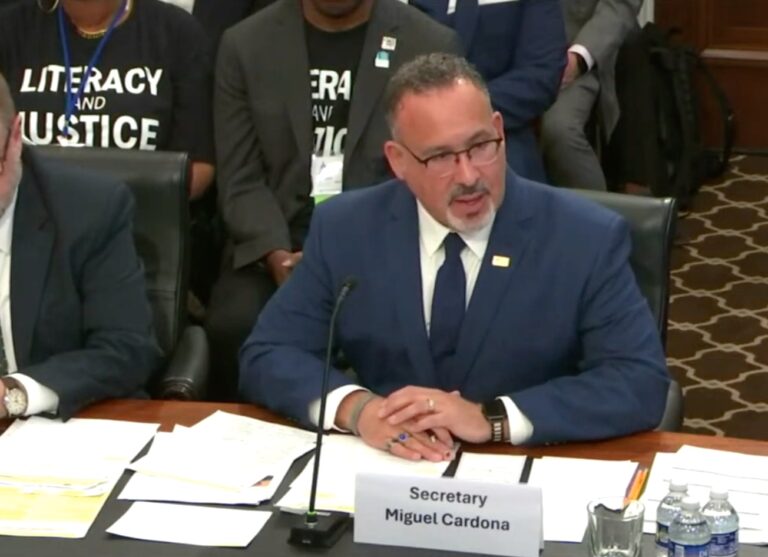
Education Secretary Miguel Cardona presented the department’s budget last week to a House Appropriations Committee.

He said $22 million increase for the Office of Civil Rights has tripled its workload over the past 15 years, saying that a rise in antisemitism and anti-Arab discrimination is to blame and that his agency needs more money.

In other settings, he has admitted that the complaints are usually about antisemitism, and rarely are anti-Arab.

The last budget for the Office of Civil Rights was $161.3 million. Biden is proposing it be raised by 7.4% to $173.3 million.

The Office of Civil Rights investigates discrimination in educational institutions and has become more recently known for defending pornography, literature that pushes LGBTQ ideology, and how-to sex manuals in school libraries.

Cardona highlighted during the hearing what he said is a disproportionate targeting of “LGBTQI and BIPOC” (Black, Indigenous, and People of Color) literature. Cardona emphasized the Department of Education will use the extra money to target Title 1 schools (students in poverty) staff, student support initiatives, English learner programs, and higher education-related endeavors.

The budget reduces support for charter schools, cutting the grants for them by $40 million, and reallocating it to other areas. Cardona told the committee that he does not support public funding for charter schools. When asked by House Rep. Chuck Edwards of North Carolina about the cuts, Edwards reminded Cardona that his staff had previously said the “cut was due to a lack of interest. Can you help me better understand the basis in that statement?” Edwards asked for surveys and data that would support the statement that there is a lack of interest in charter schools.

Cardona said the demand for the competitive grant to support charter schools has been decreasing.

“In some pockets of our country there’s not a greater demand for charter schools,” Cardona explained. He said the department would be able to make the same number of awards as previous years. In followup questions from Edwards, Cardona said he would have his staff send answers later.

Rep. Edwards also gave Cardona an earful about the Biden plan to have taxpayers pay for the student loans of college students.

“I’m gonna give you a chance right now, in the time that I have left, to explain to that working class why this proposed program this debt relief program is fair and not turning its back, our back, on those folks that have calluses on their hands and really have built this country.”

“I’m talking about the folks that are plunging toilets every day and cutting pipes and laying bricks, that didn’t have an opportunity to go to college and now we’re asking them to pay for the education of the folks that you’re trying to describe there. Those are different classes.

“Mr. Secretary, one of the things that I continually hear from folks in my district and from all around America is that Washington seems to have forgotten so much of the working class, and I see no better example of that than the student debt relief program that’s being suggested right now – where folks with dirt and grease under their fingernails are being asked to pay for folks’ college education that wear a crest on their sport coat,” Edwards said.

“So, tell the bricklayers and pipe fitters out there right now — you have the floor for a minute and three seconds — why they should feel good about paying for these student debt relief programs,” he continued.

Cardona said that the student loan debt relief was a big help to the working class, but Edwards disputed that remark.

“The parents of those children that are laying bricks and fitting pipes have already made their decision, they’re into their career and they’re being asked to pay for a different class of folks’ education. I find that just tremendously unfair and I’ll be anxious to go back and play your comments over to the folks back at home and see if you’ve convinced them.”

Read Secretary of Education Miguel Cardona’s opening remarks to the committee at this link.