On TruthSocial, President Donald Trump came out with an enthusiastic early endorsement of Congressman Nick Begich, who was sworn in as Alaska’s replacement for Mary Peltola just 130 days ago. Presumably, Begich will be running for reelection in 2026.
“Congressman Nick Begich is doing an incredible job representing the Great People of Alaska, a State I love, and WON BIG THREE TIMES, in 2016, 2020, and 2024! A very successful Businessman, Nick knows the America First Policies required to Create Great Jobs, Cut Taxes, Strengthen our Economy, and Eliminate Government Waste. He will never stop fighting to Secure our Border, Stop Migrant Crime, Halt the Flow of Illegal Drugs, Strengthen our Military/Vets, Champion American Energy DOMINANCE, and Defend our always under siege Second Amendment. Nick Begich has my Complete and Total Endorsement — HE WILL NOT LET YOU DOWN!” Trump wrote.
Trump wasn’t always a Begich supporter. He had been told by politically connected people in Alaska to back Nancy Dahlstrom for Congress, but Dahlstrom did not come out ahead in the primary, and she withdrew her name from the general election ballot in order to not split the Republican vote.
Then, in September, Trump was convinced by Alaskans to endorse Begich, who had been a Trump supporter and campaign donor since the president first ran for office in 2016 and who has been an advocate for the America First agenda from the outset.
Lawmakers love to tinker. They can’t help themselves. Deep in the DNA of nearly every politician is the pathological belief that the worst thing a legislature can do for the public is … nothing.
Forget Jefferson’s old maxim that “the government which governs best, governs least.” Sorry, Tom, what really excites the political class is meddling. Tampering. Grabbing whatever levers of power they can reach. It’s not ideological. It’s instinctual. And it’s on full display right now in Juneau.
When lawmakers aren’t slashing the Permanent Fund dividend or floating new taxes to prop up budget-busting boondoggles like unsustainable pensions and a broken education system, they’ve found a new arena for flexing muscle: a turf war over constitutional boundaries.
Exhibit A: Senate Bill 183.
On paper, it looks harmless, dull, even. Just a bit of “cleanup” language. (Pro tip: most power grabs start out looking boring.)
The bill would force executive branch departments to hand over information to the Legislature’s auditor in any format the auditor or their legislative overlords demanded. Refusal? That would be illegal.
This is more than oversight. SB 183 blatantly infringes on executive branch autonomy. It empowers legislative auditors to dictate how data, including sensitive or proprietary information, is delivered, regardless of operational burden or security risks. That’s especially problematic in complex areas like oil and gas tax audits, which often involve trade secrets and confidential commercial data.
Imagine a state employee, already buried in technical work, being told to repackage geophysical models or Medicaid financials — not because it’s necessary, but because a legislative staffer prefers PowerPoint over Excel, with 12-point Allegri font in off-black. Sound absurd? That’s exactly the kind of power this bill hands over.
So why is this happening? Simple: a long-running feud. Legislative auditors and Department of Revenue staff have been at odds for nearly a decade, under multiple governors and commissioners. The friction finally came into the open during a House Rules Committee hearing.
Revenue officials testified they’d already provided the requested data. The problem? The format. Legislators wanted the data redone their way — even if it meant hundreds of extra hours for agency staff.
The auditor’s response? Too bad. Get to work. And make sure the color palette is pleasing.
This bill isn’t about transparency. It’s about control. It’s a legislative overreach that sets a dangerous precedent: allowing lawmakers to micromanage executive branch functions under the guise of “accountability.” Today it’s data formatting. Tomorrow, who knows?
Rep. Chuck Kopp insists courts will uphold this power play. He might want to check his case history. In 2020, the Legislature tried a similar move, inserting language into a Covid-era bill that would automatically reject the governor’s appointees if not confirmed by a deadline. The Alaska Supreme Court, hardly a fan club for the current governor, struck it down as a clear overreach.
Maybe, just maybe, in the closing days of session, lawmakers could set aside this petty bureaucratic feud. How about focusing on, say, passing a budget? Avoiding new taxes? Not driving the economy into a ditch?
Just a thought.
Suzanne Downing is founder and editor of Must Read Alaska.
ConocoPhillips Alaska announced a net income of $327 million for the first quarter of 2025, according to figures released today in conjunction with parent company ConocoPhillips’ quarterly earnings. The result reflects continued investment and operational momentum in Alaska.
During the first quarter of 2025, ConocoPhillips Alaska paid an estimated $362 million in taxes and royalties, with $251 million to the State of Alaska and $111 million to the federal government.
That’s down from the $437 million in taxes and royalties reported for the first quarter of 2024, reflecting reduced earnings and commodity price impacts.
The company also invested more than $1 billion in capital during the quarter. The rise is largely attributed to activity at the Willow project, where ConocoPhillips completed its largest-ever winter construction season.
“This quarter’s accomplishments are significant,” said Erec Isaacson, president of ConocoPhillips Alaska. “We achieved critical milestones on Willow, keeping us on track for first oil in 2029.
Isaacson emphasized the company’s broader strategy for Alaska, highlighting development potential in Kuparuk and the Western North Slope, and crediting the state’s fiscal policy for enabling continued investment.
“We continue to deepen our Alaska portfolio through optimization and exploration. We have a strong pipeline of resource opportunities across our operated assets which will drive growth in Kuparuk through Nuna, Coyote, and viscous developments, and in Western North Slope satellite reservoirs. This continuing activity underscores our commitment to Alaska and demonstrates the effectiveness of state fiscal stability in our state,” Isaacson said.
Since 2007, ConocoPhillips Alaska has paid more than $46 billion in taxes and royalties, approximately $36 billion of which went to the State of Alaska, while earning around $28 billion for its investors during that same period.
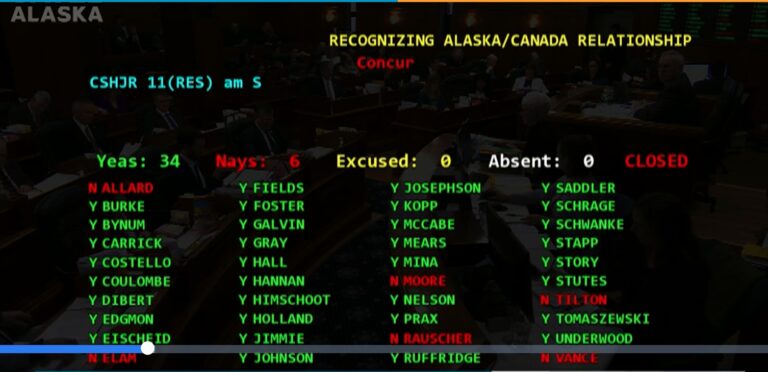
House Joint Resolution 11, a shot over the bow of President Trump’s international trade negotiations that are under way, has passed both the House and Senate.
It’s a resolution that has the Legislature wandering into international affairs, praising the mutual interests and collaborative efforts between Alaska and Canada, all the while that trade talks are happening. The resolution waxes about the importance of cross-border cooperation in areas such as trade, infrastructure development, environmental stewardship, and indigenous relations. A brainchild of Rep. Chuck Kopp, a Republican who caucuses with the Democrat majority, the resolution does not acknowledge that President Donald Trump is trying to get Canada to stop the flow of deadly fentanyl and illegal aliens into the United States, and also is seeking to create more fair trade conditions for the US, and that this resolution may irritate the president by its appearance of meddling. It could cause Trump to lose interest in helping Alaska recover from the Biden-era economic sanctions.
In March, the Trump Administration imposed 25% tariffs on Canadian steel, aluminum, cars, and parts not compliant with the United States-Mexico-Canada Agreement. Canada responded with 25% tariffs on $52 billion worth of U.S. imports. This week, Canadian Prime Minister Mark Carney met Trump in Washington to address strained trade and security ties.
Carney begged Trump for tariff relief, calling Canada America’s “biggest client,” but Trump did not budge on tariffs during that meeting. Carney was later quoted saying “serious trade discussions” can now begin, though no concrete agreements were announced at the White House.
Meanwhile, the Alaska Legislature is trying to make nice with its border neighbor and send a message that it’s not in alignment with President Trump.
The joint resolution does not need the governor’s signature as it is a statement of the opinion of the Legislature.
The bells of St. Peter’s Basilica rang out and the crowd outside cheered as white smoke emerged from the chimney at the Sistine Chapel at 3:47 pm, Rome time, signaling the successful election of a new pope.
The announcement ends days of anticipation following the death of Pope Francis.
The smoke indicates the 115 cardinal-electors reached a two-thirds majority vote. The traditional smoke signal is produced by burning the ballots with a chemical additive, marked the culmination of a secretive process steeped in centuries of tradition. Black smoke indicated earlier that a vote had failed to reach that majority.
The identity of the new pontiff remains unknown at this writing, but this article will be updated as we learn who will lead the world’s 1.4 billion Catholics.
President Donald Trump on Thursday announced a framework for a new trade agreement with the United Kingdom, describing it as a major step toward putting the United States at the center of a new global trade order.
Speaking from the Oval Office, Trump said the deal would expand market access for American products and strengthen the long-standing relationship between the two nations.
“This is turning out to be a great deal for both countries,” the president said.
Prime Minister Keir Starmer, in office since 2024, participated in a phone call with Trump during the announcement.
“We can finish ironing out some of the details, but there’s a fantastic platform here,” Starmer said, calling the agreement “historic” and saying it will create jobs on both sides of the Atlantic.
The deal, still in its framework stage, is the first to emerge from the Trump administration’s current trade negotiations following a series of sweeping tariff increases announced last month.
On April 2, Trump declared “Liberation Day” for American trade and introduced broad new tariffs, including a 25% duty on foreign automobiles and a 145% tariff on Chinese goods. A week later, he paused some of those tariffs for 90 days to provide time for trade negotiations with allied nations.
Under the proposed agreement with the UK, the United States will apply a 10% tariff on up to 100,000 automobiles imported from the UK, a rate lower than the 25% applied to other foreign automakers. Commerce Secretary Howard Lutnick said the lower tariff would protect UK jobs while maintaining fairness for U.S. producers.
Lutnick also stated that the deal would provide $5 billion in new market access for American exporters and noted the U.S. maintains a relatively balanced trade relationship with the UK, unlike with other major partners.
In a post on social media, Trump celebrated the deal:
“Today is an incredible day for America as we deliver our first Fair, Open, and Reciprocal Trade Deal… America will raise $6 BILLION DOLLARS in External Revenue from 10% Tariffs, $5 BILLION DOLLARS in new Export Opportunities… and enhance the National Security of both the U.S. and the UK.”
Trump said the agreement includes the creation of an “Aluminum and Steel Trading Zone” and a more secure pharmaceutical supply chain between the two nations.
Talks with China are to begin this weekend. Right now there’s a 145% tariff on Chinese imports to the US, and 125% on US goods exported to China. Talks between the two countries are expected to begin this weekend.
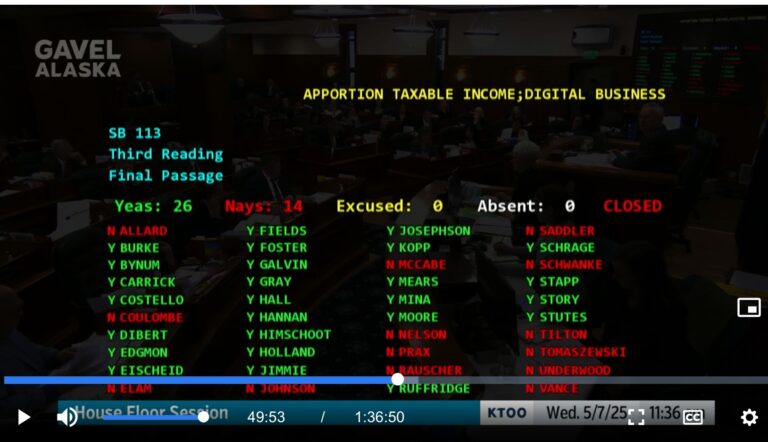
On Wednesday, the House voted in favor of a new internet-based corporate tax, Senate Bill 113, the creation of Democrat Sen. Bill Wielechowski.
The final vote was 26-14, with Republicans Jeremy Bynum, Mia Costello, Chuck Kopp, Justin Ruffridge, and Will Stapp joining the Democrats to pass it. It had earlier passed the Senate.
SB 113, titled “An Act relating to the Multistate Tax Compact; relating to apportionment of income to the state; relating to highly digitized businesses subject to the Alaska Net Income Tax Act, sponsored by the Senate Rules Committee and presented by Sen. Bill Wielechowski, bill amends Alaska’s corporate income tax code to target out-of-state, highly digitized businesses (e.g., Amazon, Etsy) conducting digital transactions with Alaskan consumers.
SB 113 targets businesses deriving 50% or more of their Alaska sales from intangible property or electronically delivered services (e.g., online retail, digital services). Those businesses, many of them small family enterprises, will pay corporate tax to the State of Alaska. The high rate of Alaska’s corporate tax may drive many businesses to stop doing business in Alaska.
The bill’s rushed process in the House drew criticism from Rep. Sarah Vance for limiting debate and public input, potentially overlooking long-term impacts on Alaskan businesses and consumers. The bill only had 1.5 hours of committee review before the final vote.
All Democrats in the Legislature voted for the tax. The Republicans who opposed the tax didn’t have sufficient time to bring in experts from conservative groups like the Tax Foundation or the Reason Foundation to explain how the Multistage Tax Compact would work in this case, and the tax’s impact on rural Alaskans.
Despite the Multistate Tax Compact goal of avoiding double taxation, its apportionment methods, such as the shift to market-based sourcing that SB 113 is using, can lead to inequities, misaligning tax liabilities with business activities, and creating complexity and burdensome paperwork for small business owners. Businesses worry that uniform rules don’t account for diverse industry practices, leading to unfair tax burdens. Regulations that will be adopted to enact this tax may also end up being unfair to businesses.
For example, Business A that sells in Alaska will now pay corporate income tax that is apportioned to them in ways that might not be accurate. If Business A uses Quickbooks, LegalZoom or another service to help it sort out the confusion, that becomes an extra cost that Business A must bear, and that extra cost will be passed along to the consumer.
Alternately, the thousands of small businesses that provide goods and services using internet-based stores can simply choose to not do business in the high-corporate tax state of Alaska, where the corporate tax is 9.4%, the third highest in the nation.
Etsy has a page dedicated to helping the small business sellers sort out their tax liabilities. You can read it at this link.
Editor’s note: This column was first published on Feb. 23, but is being republished due to its relevance to the last two weeks of the legislative session. The author, Dan Fagan, passed away last month.
An epic showdown is brewing in Alaska between two powerful forces. But it’s not the traditional Republican versus Democrat battle we’re used to.
The question many are asking is this: How can a state where President Donald Trump carried by double digit percentage margins, and Republicans outnumber Democrats in the legislature, face the real danger of taking a sharp turn to the left?
Anchorage Republicans State Sen. Cathy Giessel and Rep. Chuck Kopp, are among several GOP members joining with Democrats to battle Republican Gov. Mike Dunleavy.
So many GOP legislators working arm in arm with Democrats means conservative Republican legislators have little to no power.
But that’s not the case with Dunleavy. The governor is uniquely positioned to take on the Legislature. He’s backed by Trump, a majority of Alaskans, and the ever-growing national MAGA movement. And Dunleavy seemingly has a veto proof veto pen to use against some the more left-leaning policies pushed by the Democrat-controlled Legislature.
If Dunleavy, who earned the nickname “Big Mike,” stands strong, there may be little legislators can do to advance their agenda.
The two sides clearly have very different visions for the future of Alaska. When Trump signed a historic comprehensive executive order designed to open up Alaska to resource development, Sen. Giessel accused the president of turning the state into a colony.
Giessel, along with Kopp, are two of the legislators pushing hard to bring back a pension retirement system for state workers. Even though the old pension plan was dropped 20 years ago, the state is still several billion behind in pension obligations. If the plan had not been abandoned, the debt would be considerably higher. Bringing it back will surely begin to sink the state deeper into debt when it comes to pension obligations.
Neither Giessel, Kopp, nor any advocate of bringing back state pensions will say what the fiscal note of such an expensive plan would be.
Giessel pushing for new state income taxes while bringing back costly pensions for state workers could be a tough sell.
Dunleavy is expected to veto a pension plan and Giessel’s call for income taxes.
Dunleavy may now also have to use his veto pen to block new oil taxes. Yet another Republican, Sen. Rob Yundt, proposed a close to 10% tax on Hilcorp. Yundt’s tax is almost identical to the one proposed by serial oil taxer and Democrat Bill Wielechowski last year.
Yundt, who represents a conservative Mat-Su Valley district, campaigned against new taxes. Critics say the Yundt Tax comes at a bad time. Dunleavy and Trump are trying to woo new investment to Alaska from oil and gas companies. And there is new momentum when it comes to building a gas pipeline with Trump in office.
Another showdown issue between the Democrat controlled Legislature and Dunleavy comes with education spending. Alaska is dead last in the nation when it comes to test scores. Yet the $2.7 billion spent on K-12 education in the state ranks in the top five in the nation per capita.
Dunleavy is open to more education spending, but he wants accountability measures added. The Legislature’s majority, supported heavily by the very powerful teacher’s union, oppose any accountability. They want to double down on more spending.
Since 2003, Alaska has more than doubled its per-student spending. That’s twice as high as the inflation rate. This session, legislators proposed a 43% increase in education spending over three years.
The battle lines are clearly drawn. A Democrat controlled Legislature with big plans to grow state government with new taxes, generous benefits for state employees, and an adversarial approach to Trump, versus Gov. Dunleavy’s hope to grow resource development and the private sector economy.
Some argue Dunleavy is a lame duck with only two years left in his second term. But he could end up being one of the state’s most consequential governors in Alaska’s short history. Big Mike seemingly is the only person able to stop the Democrat-controlled Legislature and its plan to pass state policies mirroring California, New York, Oregon, and Washington.
Dan Fagan hosts a morning drive radio show on KVNT on 1020 AM 92.5 FM and 104.5 FM. It’s streamed live on 1020KVNT.com
The Juneau Arts & Humanities Council has released a public statement addressing recent federal advice to remove diversity, equity, and inclusion language from its materials. The Trump Administration will be cutting off funding for race-based or other inherently discriminatory programs.
The move comes one month after the Alaska Humanities Forum lost its federal funding from the National Endowment for the Humanities.
In the press release, the JAHC emphasized its long-standing commitment to inclusive practices and cultural safety, noting that its efforts are informed by the strength and resilience of leaders, staff, and beneficiaries from across the Juneau community.
The Council says it draws inspiration from the core cultural values of the Tlingit, Haida, and Tsimshian peoples—Haa Latseení (Strength of Mind, Body, and Spirit) and Wooch.Yáx (Social and Spiritual Balance)—to guide its mission and work. Its executive director appears to be a white binary-gender-identifying male.
In February 2025, the JAHC was notified by a federal funding agency that maintaining public DEI statements could put funding at risk. In response, the board convened an emergency meeting, attended by trustees and executive leadership. While the board could not reach a unanimous decision on how to proceed, it agreed to form a committee tasked with revising the language in a more strategic and culturally responsive manner.
That committee, operating under the JAHC’s Arts and Cultural Safety Committee, included local arts leaders and trustees.
The Council’s May 7 statement said it was responding to a real-time attack on inclusive practices by the Trump Administration and was making a difficult choice between complying with federal guidance or risking funding vital to its programming and strategic goals.
“The very purpose of these directives from a federal level is to create lateral conflict,” the statement reads. “We understand experiencing anger surrounding these decisions, but do not want this to pit the JAHC against the communities we serve.”
Anger is apparently what has made the executive director decide to resign in response.
Phil Huebschen, who lists his gender pronouns as “he/she/they” on his LinkedIn profile, told the Juneau Empire he will be leaving the organization on May 14. He has only been the executive director for two years and three months. If there’s no DEI focus, he said he just can’t be part of the council.
The council’s operations manager, Reggie Schapp, will take over as interim executive director.
Looking ahead, the board is encouraging residents to share their perspectives via email at [email protected].