
By Greg Sarber
This article was originally published 5/3/2026 in Seward’s Folly, the author’s personal Substack.
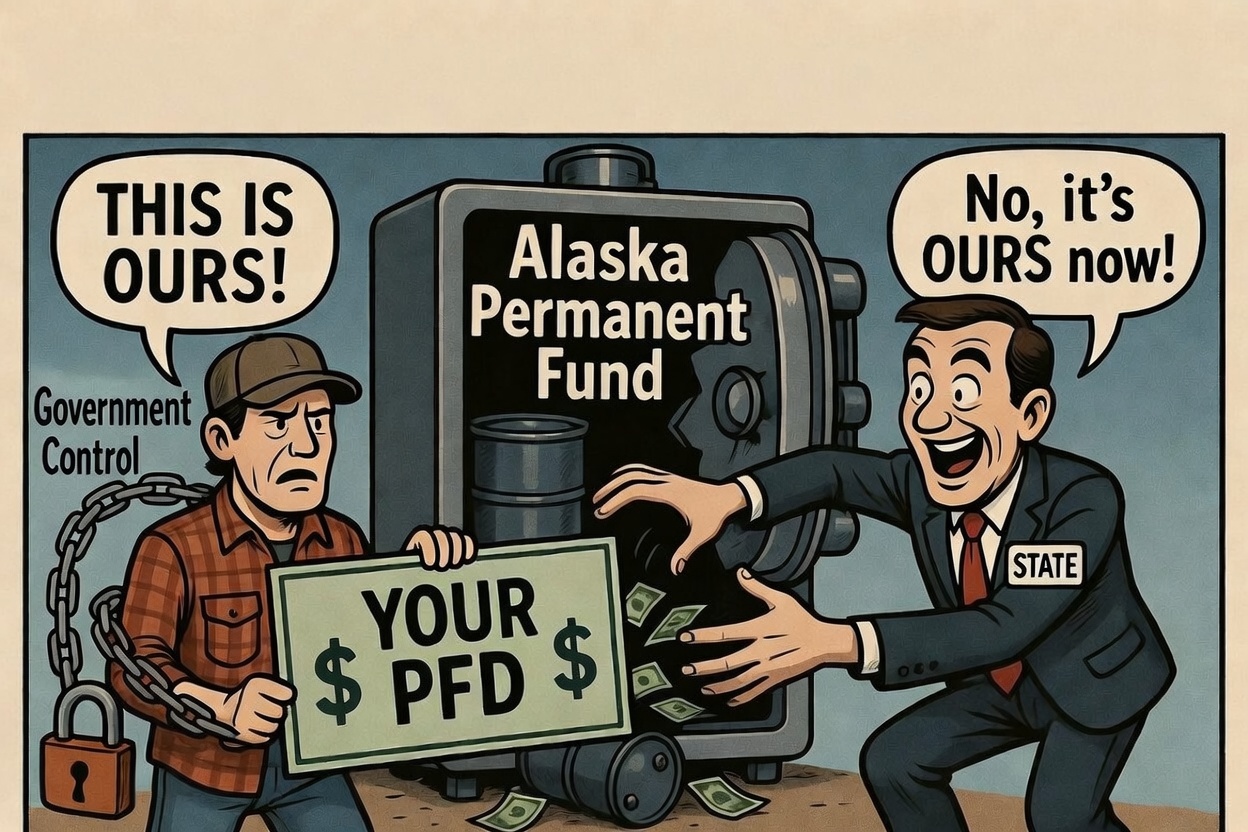
In a recent article, I used the term “stolen” when describing how the legislature has been seizing a portion of every Alaskan’s PFD check annually since 2016. An individual commented on the article, saying, “The author doesn’t understand basic law. No one is stealing one’s PFD. You must own or have in possession the item for it to be stolen. The PFD is an appropriation made at the discretion of the legislature”. This individual is dead wrong, and this illustrates a huge misunderstanding that many Alaskans have about what the Permanent Fund dividend is and who owns it.
The statutory language creating the dividend allocated 50% of the fund earnings for the legislature for the state budget and 50% to pay the citizens a dividend. Unfortunately, in 2016, Governor Bill Walker changed that. He was incapable of balancing the state budget, so he changed the PFD from a dedicated statutory transfer to an annual legislative appropriation. Effectively changing the law by executive order and legalizing the legislature’s ability to steal a portion of the citizens’ PFD without consequence. This was challenged legally, and the Alaska Supreme Court agreed with Walker that the dividend could be changed legislatively, which might seem to support the points being made by the person who commented. However, the court made no ruling on who owned the dividend, which is the essence of the argument.

The real issue we have been fighting over ever since 2016 is who owns the Permanent Fund earnings. To answer that question, we need to go back to before statehood and look at how the discovery of oil influenced Alaska’s becoming a state.
Oil was discovered in the then-territory of Alaska at Swanson River on the Kenai Peninsula in 1957. Before that time, Congress was concerned that Alaska would not be viable as a state due to its small population and the lack of industry. The discovery of oil in Alaska changed that. Alaska’s first Governor, William Egan, credited that discovery as providing the final justification needed for Alaska to become a state.
When that happened in 1959, Congress’s statehood act explicitly required the state to retain subsurface mineral rights on lands conveyed from the federal government to ensure the mineral and petroleum wealth of the state would be protected.
Similar language was also included in the Alaska Constitution. Article VIII, Section 2 says, “The legislature shall provide for the utilization, development, and conservation of all natural resources belonging to the state, including land and water, for the maximum benefit of its people”. This means you do not directly own any petroleum or mineral resources under the property you own in Alaska. However, you collectively own all petroleum under state or private lands. We can debate if this means the legislature or the people own the resources, but we don’t have to; two previous governors have defined that for us.
The great Alaskan Governor Jay Hammond thought the constitution meant that the Permanent Fund belonged to the people. Governor Hammond saw this day coming. He knew the legislature had no financial discipline, and there would come a time when they would dip into the fund. To protect it, Hammond wanted the citizens of Alaska to have some skin in the game, so when the legislature tried to raid our Permanent Fund, the citizens would rise in rebellion against them. That is why he helped create the annual dividend from the fund, to ensure the people knew they had ownership of it.
Alaska’s second Governor, Walter Hickel, defined that for us further. He said that the citizens of Alaska own the resources of the state collectively. Slow at first to accept the idea of a dividend from the fund, later in his career, when Hickel saw how important the PFD was to the average Alaskan, he became a supporter.
In summary, the state constitution and the opinions of three of our governors say the mineral resources of Alaska belong to Alaskan citizens. They intentionally wrote the statute that created the PFD, requiring 50% of the earnings of the fund to be paid to each Alaskan as their share of the state’s resources. When the legislature takes a portion of the PFD from the citizens, they are stealing it. Their theft is a despicable act, and every legislator who votes to approve this year’s state budget with funds from a raid on our dividend spits on the memory of our great former governors William Egan, Walter Hickel, and Jay Hammond.
Greg Sarber is a lifelong Alaskan. He is a petroleum engineer who spent his career working on Alaska’s North Slope. Now retired, he lives with his family in Homer, Alaska. Greg is a former board member of Alaska Gold Communications, Inc., the publisher of Must Read Alaska.



