
A direct response to “The Rapidly Closing Window on AKLNG” and the urgency narrative being used to shut down questions Alaska hasn’t finished asking.
Originally published 5/21/2026 in the author’s personal Substack.
Rep. Kevin McCabe published a piece today titled “The Rapidly Closing Window on AKLNG.” I want to respond to it directly, because the urgency he is manufacturing deserves a precise answer, and because the public record he is asking Alaskans to accept at face value is materially incomplete.
I want to be clear about my position before going further. I support North Slope gas development. I support getting Alaska LNG to market. I support the AKLNG pipeline project. What I do not support is the specific financial structure being built around it, because that structure was not designed around what Alaska needs. It was designed around what Glenfarne needs to collect 45Q federal tax credits, and what Japanese institutional investors need to satisfy their ESG disclosure requirements. Those are not the same thing as Alaska’s interests, and Rep. McCabe’s piece does not address that distinction.

What Rep. McCabe Confirmed in His Own Public Exchange With Me
Rep. McCabe and I had an extended public debate in the comments of one of his prior Substack posts. Since he has now blocked me from his Substack, I want to make sure the record of that exchange is available to his readers, because several things he confirmed there are directly relevant to the urgency argument he is making today.
When I pressed him on why the carbon capture component was truly necessary for this project, he wrote: “Glenfarne would not be here without the ability to sequester CO2 on the slope. Japan would not buy our gas or invest in a purchase agreement without CCUS.”
That is an important admission. He was not describing an energy policy requirement. He was describing a foreign capital market compliance requirement. The $1.3 billion carbon capture system embedded in this project exists to satisfy the ESG credentialing demands of Swiss and Australian institutional investors and Japanese LNG buyers operating under mandates set by their own capital markets. Alaskan ratepayers are not the primary audience for that system. They are the ones being asked to accept the seismic risk and the permanent monitoring liability it creates.
He also confirmed in that same exchange that he considers a component of the HB 50 statutory framework, the tree carbon credit bill inserted to secure enough votes for passage, to be, in his words, “kind of a scam.” Senator Shelley Hughes, now running for Governor, said the same thing on the Senate floor while voting yes. Those are the people who passed the framework Rep. McCabe is now asking Alaska’s legislature to build upon urgently.
The Buyers Rep. McCabe Names Today Are the Same Buyers in Dunleavy’s CO2 Import Scheme
Today’s piece lists Glenfarne’s preliminary offtake partners: TotalEnergies, JERA, Tokyo Gas, CPC Taiwan, PTT Thailand, and POSCO Korea. Rep. McCabe presents them as evidence of commercial momentum and competitive urgency.
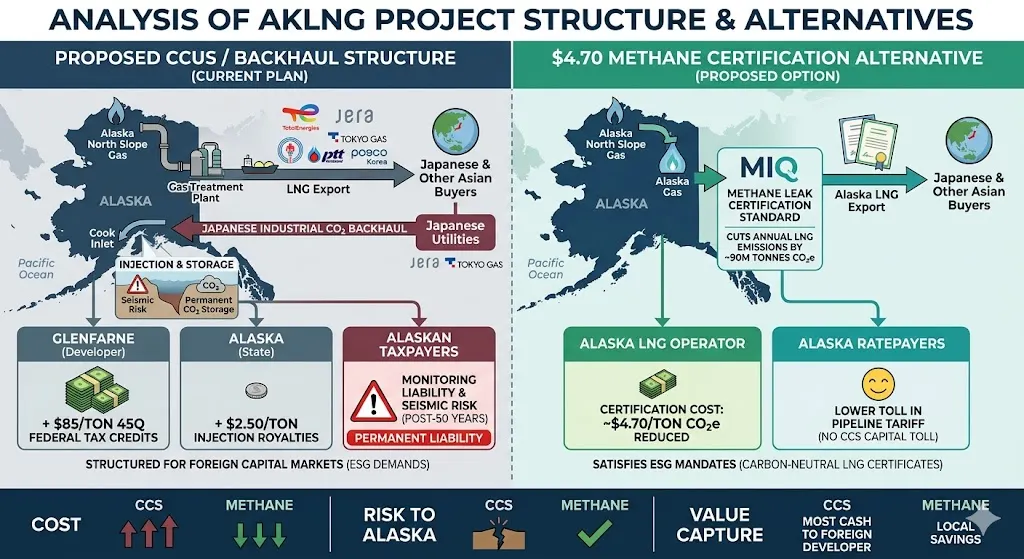
What he does not mention is that JERA and Tokyo Gas, the Japanese utilities on that list, are exactly the entities whose cross-border CO2 transport relationship with Alaska was discussed at the White House Japan State Dinner on April 10, 2024, three weeks before the final HB 50 vote. The Dunleavy administration’s DNR Commissioner John Boyle described the arrangement publicly: export energy to Japan, then backhaul Japanese industrial CO2 to Alaska for permanent injection into Cook Inlet under the Class VI framework HB 50 established.
So the same Japanese buyers whose ESG requirements Rep. McCabe says make the CCUS component non-negotiable for LNG purchases are also the intended source of industrial CO2 that would be shipped back to Alaska for permanent geological storage. Alaska would export LNG. Alaska would then receive Japan’s industrial emissions. Alaska would inject those emissions into a seismically active Cook Inlet basin. Glenfarne would collect $85 per ton in 45Q credits on every ton injected, whether it originated in Alaska or Japan. Alaska would collect $2.50 per ton in injection royalties. After 12 years the trust fund stops being funded. After 50 years the permanent monitoring obligation transfers to Alaska taxpayers with no hard cap and no private party contractually responsible.
The “closing window” Rep. McCabe is describing is the window for this arrangement to be locked in before Alaskans understand what they are agreeing to host.
The Financial Terms Nobody Is Advertising
Rep. McCabe’s piece cites the Department of Revenue’s $26 billion revenue projection over the life of the project as justification for restructuring Alaska’s property tax regime under HB 381. He does not mention that this analysis was presented to the legislature by GaffneyCline, a UK energy advisory firm owned by Baker Hughes, which had announced a strategic alliance with Glenfarne just days before GaffneyCline’s first legislative appearance on this project. That conflict of interest was never disclosed to legislators. It is on the public record.
The injection royalty rate in the enrolled HB 50 statute is $2.50 per ton. That number was amended on the Senate floor from $10 per ton by Senator Olson’s Amendment 1. Rep. McCabe conceded this in our prior exchange after I uploaded the enrolled bill and the Senate amendment. At $2.50 per ton, Alaska receives less than three cents on every dollar of 45Q federal credit value generated by using Alaska’s geology.
The Gas Treatment Plant at full operations is projected to generate approximately $595 million annually in 45Q credits to the operator. The state corporate income tax liability on those credits in every modeled year through 2062 is zero. HB 381’s property tax restructuring eliminates the 20-mill statewide property tax in exchange for a throughput-based structure that DOR projects will generate a fraction of current law collections for municipalities.
Rep. McCabe calls this a deal that benefits Alaska. The arithmetic calls it something else.
The $4.70 Option Nobody Proposed
The ESG credentialing requirement driving the CCUS design is real. Japanese and Korean LNG buyers do have ESG mandates. The question Rep. McCabe’s piece does not ask is whether a $10.9 billion geological injection system is the only way to satisfy them.
It is not. The MiQ methane leak certification standard, a third-party framework already verifying 20 percent of US natural gas production, satisfies the same ESG disclosure box for the same Asian buyers. The IEA found in June 2025 that reducing methane leaks alone could cut annual LNG emissions by close to 90 million tonnes of CO2-equivalent, with approximately half achievable at no net cost. The certification cost under MiQ is approximately $4.70 per tonne of CO2-equivalent reduced. The CCS route costs $85 per tonne in federal cash to the operator, plus the capital recovery toll embedded in the pipeline tariff that Alaska ratepayers would pay for decades.
Carbon-neutral LNG certificates have been traded since 2019. Northeast Asia, the buyers AKLNG is targeting, is the primary destination market. Japanese and Korean utilities are already purchasing them. The buyers have demonstrated they will accept this mechanism from other suppliers.
Nobody in the Governor’s office or the legislative majority has publicly explained why Alaska chose the $10.9 billion option over the $4.70 option. The answer, when you follow the financing structure, is straightforward. Methane certification does not generate $85 per ton in 45Q federal tax credits for Glenfarne. Geological carbon injection does. The ESG compliance goal and the $10.9 billion price tag were never the same thing. Dunleavy’s framework built them together so that the only path to compliance ran through the credit collection mechanism.
The Offtake Agreements Are Still Preliminary
Rep. McCabe’s own article uses the word “preliminary” to describe the offtake agreements with TotalEnergies, JERA, Tokyo Gas, CPC Taiwan, PTT Thailand, and POSCO Korea. Preliminary agreements are not bankable commitments. No lender underwrites a project on preliminary agreements. The gap between 13 preliminary MTPA and a financed 16 MTPA final investment decision is not a procedural formality. It is the entire commercial question.
Presenting conditional commercial expressions of interest as a reason to restructure Alaska’s property tax regime before those conditions are resolved is sequencing that benefits the developer, not the state.
The TAPS Comparison Does Not Hold
Rep. McCabe invokes the 1972 and 1973 legislatures that passed TAPS enabling legislation as the historical standard Alaska should meet today. The comparison is rhetorically powerful and historically imprecise.
TAPS moved oil through a pipeline above ground across permafrost and delivered royalty revenue directly to Alaska from a resource Alaska owned. The liability window closed when the oil was delivered. There was no permanent underground injection at industrial scale. There was no trust fund that stopped being funded after 12 years while a 50-year post-injection waiting period began. There was no transfer of permanent monitoring obligation to Alaska taxpayers for a substance that would remain underground indefinitely. There was no foreign developer positioned to collect hundreds of millions in annual federal tax credits on Alaska’s geology while Alaska collected $2.50 per ton.
TAPS was Alaska capturing value from its own resource on terms Alaska controlled. What is being proposed now is structurally different, and calling it the same thing to create the same urgency is not an honest comparison.
This Is Not a Closing Window
Rep. McCabe ends his piece by saying the biggest obstacle to Alaska LNG is the Alaska Legislature. He may be right about the legislature’s pace. He is wrong about why it is hesitating.
The legislature is not blocking this project because legislators are feckless or because forty years of inertia have calcified into habit. The legislature is hesitating because the structure of what is being proposed, when examined in its documentary detail, raises questions that have not been answered with documentary evidence. They have been answered with competitive urgency. Those are not the same thing.
A window implies an opportunity that might pass if Alaska does not move. A door being pushed shut implies something different: deliberation being foreclosed before the public has finished reading what is on the other side. That is what the urgency narrative is doing. The Dunleavy administration built a framework around foreign ESG capital requirements and a federal credit program with a documented 90 percent noncompliance history. Rep. McCabe is now using Canada’s FID timeline to prevent Alaskans from sitting with those facts long enough to act on them.
North Slope gas is a generational asset. It deserves terms that return genuine value to Alaska. The current structure does not do that, and no amount of competitive urgency changes the arithmetic.
What Alaskans Can Do
HB 381 and SB 280 are still moving. The votes have not been cast. Alaskans have the ability to contact their representatives and senators before that changes.
The ask is specific and it is not anti-development. Do not hand Glenfarne a deal structured around collecting 45Q federal tax credits using Alaska’s geology at $2.50 per ton in royalties, while embedding the Japanese CO2 import architecture Dunleavy built into HB 50, while transferring permanent monitoring liability to Alaska taxpayers, while a GaffneyCline analysis produced by Baker Hughes’s subsidiary serves as the financial justification.
Demand the $4.70 methane certification alternative be formally evaluated and publicly rejected or accepted on the merits before HB 381 moves to a floor vote. Demand disclosure of all preliminary offtake agreement terms. Demand an independent review of the GaffneyCline analysis given Baker Hughes’s undisclosed strategic alliance with Glenfarne. Demand a public accounting of what the Japanese CO2 backhaul arrangement means for Alaska’s permanent geological liability before any vote is cast.
The door is being pushed shut. You still have time to ask what is written on the other side of it.
Find your Alaska legislators at akleg.gov. Senate and House switchboards: (907) 465-4648.



