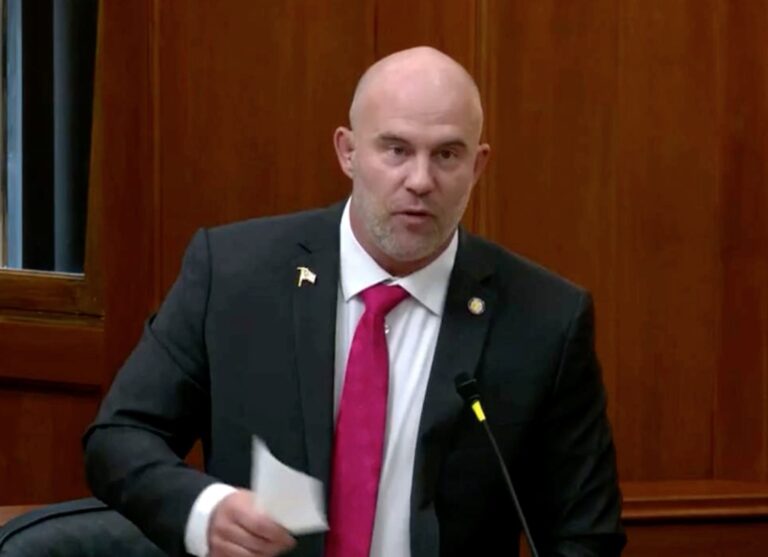
In a rare public rebuke, Sen. Rob Yundt of Wasilla took aim at Gov. Mike Dunleavy on Wednesday, criticizing him on the Senate floor and blaming his administration for Alaska’s ongoing budget woes.
Yundt, a Republican who made waves by introducing a state income tax proposal shortly after taking office, accused Dunleavy of presenting an unbalanced operating budget.
“Your budget reflects your priorities,” Yundt said during his speech. “A billion and a half dollars upside down. It shouldn’t even be legal.”
Yundt didn’t stop at budgetary critique — he also turned to the looming 2026 election, warning the two Republican candidates already in the race for governor to take note of the fiscal challenges.
While Dunleavy’s proposed budget does rely on $1.5 billion in reserve funds, the authority over state spending rests with the Legislature as the appropriating body. All Dunleavy can do now is veto spending — he cannot add it back at this stage.
Under current law, a full Permanent Fund dividend (PFD) is required, and Dunleavy has continued to budget accordingly. The Legislature, however, has resisted changing the statute — a point of tension since 2016, when Gov. Bill Walker vetoed half of the dividend.
Earlier this week, Dunleavy sent a letter to the Finance committees of the House and Senate, removing all but two of his budget amendments for the year, in order to take pressure off the budget.
Yundt, while critical of the governor, has not offered legislation to repair the broken dividend law that the Legislature has refused to follow since 2017. Nor has he suggested cuts to spending.
The Yundt floor speech comes after he has developed a reputation in Juneau as an ally of the Democrat-led majority, spending hours with the Democrat leaders, both during daytime and after hours, and burning bridges of trust with his fellow Republicans.
He attacked this writer earlier this session, with this statement:
Now, Yundt has attacked the de facto head of the Alaska Republican Party — the sitting governor– throwing political punches right and left as he expresses his “frustration.”
The New York Times quietly edited its early articles on the Covid-19 pandemic to scrub the phrases “China virus” and “Wuhan virus,” only to hit President Donald Trump for using the same terms weeks later, according to a review of archived versions of several early pandemic stories.
“Whistle-Blower On China Virus Succumbs to It,” reads the headline of a Feb. 6, 2020, story describing the death of Li Wenliang, an ophthalmologist who raised the alarm about the spread of a SARS-like pneumonia with friends on social media and later died with Covi-19. By the next day, the headline on the outlet’s website read differently: “Chinese Doctor, Silenced After Warning of Outbreak, Dies From Coronavirus.”
The Times also deleted references to the “Wuhan virus” to describe the emerging novel coronavirus from stories in January and February 2020, according to archived versions available in LexisNexis reviewed by the Daily Caller News Foundation. None of the stories disclose the change through corrections or clarifications.
A Feb. 11, 2020 article about the virus’ spread in Indonesia originally stated that “Indonesia has three laboratories capable of testing for the Wuhan virus.” The article was quietly amended a day later to read, “Indonesia has three laboratories capable of testing for the new coronavirus.”
A spokesman for the New York Times said the paper “intensely pursued every theory and lead on the origins of Covid-19” in a statement to the DCNF.
“The New York Times has intensely pursued every theoryand leadon the origins of Covid-19, documented the political debate, funding, influence, and shifts in thinkingamong the scientific community, and reported on China’s censorshipcampaign that has stifled the search for truth,” said New York Times External Communications Managing Director Charlie Stadtlander. “The Times has helped readers navigate the coronavirus pandemic through independent, verified reporting, and rejects any insinuation that we displayed bias in this process.”
The revelation comes amid Trump’s pushback against the legacy press for years of distorted coverage, including a lawsuit against the board of the Pulitzer Prizes for a 2022 statement that defended awarding the prestigious national reporting prize to the Times in 2018 for stories on “Russiagate.” The suit describes the media frenzy as “a debunked, self-authenticating scheme between partisan opposition research organizations, top levels of law enforcement and the media.”
The Pulitzer Board asserted in the 2022 statement that none of the reporting had been discredited despitecontrary evidence.
The Pulitzer Prizes have become a complete joke. ProPublica won the Pulitzer Prize for public service Monday for its “Life of the Mother” series, which erroneously implied that a Georgia woman who died after taking an abortion pill died because of the state’s abortion laws.… pic.twitter.com/Bwaf04ZoVI
A search of LexisNexis, an online database that compiles thousands of news sources, reveals other examples of the phrase “Wuhan virus” being deleted by the Times without a trace.
“Health officials say the Wuhan virus probably originated from [Chinese horseshoe bat] or a similar species,” reads the original caption of a photo in a Jan. 28, 2020, article.
By Jan. 29, 2020, the caption of the same photo in the same article did not mention the virus at all: “A Chinese horseshoe bat in flight. There are more than 1,200 species of bat, making up about a quarter of all mammalian species.”
By March 18, 2020, the Times alleged that President Donald Trump’s use of the terms “China virus” and “Wuhan virus” ignored “a growing chorus of criticism that it is racist and anti-Chinese” — without disclosing its own apparent editorial gaffes.
The Times’ editorial policy was not uniform. Some references to the “Chinese virus” and the “Wuhan virus” remain online.
A story dated Jan. 23, 2020, refers to “the Wuhan virus” in a discussion about the genetic similarities between the emerging novel coronavirus and a cousin virus at the Wuhan Institute of Virology. An op-ed the same day by Yanzhong Huang, a senior fellow for global health at the Council on Foreign Relations, also refers to “the Wuhan virus.”
A Jan. 27, 2020, story makes mention of the “Wuhan coronavirus”: “Some 110 patients in 26 states are being evaluated for infection with the Wuhan coronavirus.”
“The Chinese virus is spreading,” reads a Feb. 4, 2020, story from the business desk.
As the press corps peppered the president with questions about the term “China virus,” the White House’s official account hit back, pointing out even CNN used the term before it became a political flashpoint.
“Spanish Flu. West Nile Virus. Zika. Ebola. All named for places. Before the media’s fake outrage, even CNN called it “Chinese Coronavirus,” reads a March 18, 2020, tweet.
The China Daily, an English-language newspaper published by the Chinese Communist Party’s propaganda department, echoed the narrative found in the Times that the phrase “Wuhan virus” was stigmatizing.
“US Democrats have slammed Trump and other Republicans for using ‘Chinese’ or ‘Wuhan’ when referring to the virus in public statements and social media posts,” the paper stated on March 21, 2020.
Trump defended his use of the term “China virus” as important to push back on CCP propaganda claiming the virus originated with U.S. military officers. The CCP reiterated the argument on April 30 that “Covid-19 may have emerged in the US earlier than the US official timeline, and earlier than the outbreak in China,” which is not consistent with the epidemiology.
The issue gained salience again in the spring of 2021 in the wake of the World Health Organization-China mission to Wuhan to investigate the virus’ origins. The mission’s conclusions were swayed by Chinese authorities, according to mission chief Peter Ben Embarek. The report dismissed a lab origin as “extremely unlikely” while lending credence to the theory that the virus had been imported from outside of China through frozen food. Within hours, Director-General, Tedros Adhanom Ghebreyesus said that “all hypotheses remain on the table” and more studies were needed.
On May 20, 2021, the Chinese Americans Civil Rights Coalition, Inc. sued Trump for defamation over his use of the terms “Chinese virus,” “China virus,” “Wuhan virus,” and “Kung Flu virus.” Media outlets around the world reported on the complaint, including Axios and Der Spiegel. The coalition maintains no web presence.
Congressman Nick Begich is flipping the script on Alaska’s share of oil revenues. In the budget reconciliation bill going through Congress, he has also thrown a life ring to Alaska legislators struggling to balance the state budget.
In what could be one of the most important developments for Alaska’s economy and ailing state budget, Begich, has advanced a budget reconciliation proposal to increase Alaska’s share of federal leasing revenues from 50% to 90% starting in 2035.
This would dramatically strengthen the state’s long-term fiscal outlook at a time when state lawmakers are looking to tax Alaskans and to actually dissolve their Permanent Fund dividends. This could instead grow the Alaska Permanent Fund dividend to new heights.
Under the Mineral Leasing Act of 1920, Section 35 (30 U.S.C. § 191), Alaska typically receives 50% or less of the revenues generated from oil and gas leases on federal lands within the state. Although the Alaska Statehood Act of 1958 states that Alaska is entitled to 90% of revenues from mineral leases on certain federal lands in the Arctic National Wildlife Refuge, that formula has unenforced provisions. In general, the State of Alaska receives 50% of revenue from oil and gas leases on most federal lands, as outlined in the Mineral Leasing Act.
Begich’s increase to 90% represents the most significant boost in Alaska’s revenue share since the Trans Alaska Pipeline System went into service, restoring parity that many Alaskans have long advocated.
Congressman Begich was the leader in crafting the Alaska-specific revenue-generating provisions of the budget reconciliation bill.
“This is a major victory for Alaska and for American energy independence,” said Congressman Begich. “I’m proud to see our work move forward and am grateful to Chairman Westerman and my colleagues on the committee for their partnership championing Alaska as the pathway to the kind of federal revenue generation that also generates economic prosperity and growth.”
The budget reconciliation proposal mandates a wide slate of energy development measures to get that revenue going, including:
Six offshore lease sales in Cook Inlet in the next 10 years with 90/10 revenue split immediately
Four lease sales in the Arctic National Wildlife Refuge, 90/10 split starting in 2035
Biennial lease sales in the National Petroleum Reserve–Alaska, 90/10 split starting in 2035
These provisions are projected to generate $18.5 billion in federal revenue and savings, which would help reduce the nation’s budget deficit.
A deeper dive into what Begich got into the budget bill for Alaska resource development policy:
1. Coastal Plain Leasing (ANWR) — Section 80121
• 4 Major Lease Sales Mandated: Minimum of 400,000 acres per sale in ANWR’s Coastal Plain over the next 10 years.
• Permitting Certainty: Reinstates 2020 Record of Decision; deems NEPA/ESA satisfied to block future lawsuits.
• Revenue Boost: Alaska’s share of receipts increases to:
o 50% from FY25–34
o 90% from FY35 onward
2. National Petroleum Reserve–Alaska (NPR-A) — Section 80122
• Lease Sales Reinstated: At least 4 million acres must be offered every two years.
• Alaska Impact: Water access for remote energy or mineral development could benefit.
House Majority Leader Steve Scalise of Louisiana praised Congressman Begich’s early and active leadership on the measure, noting his success in advancing provisions that prioritize Alaska’s economic interests and unleash its vast energy potential. In a press conference on Tuesday, Scalise named Begich and praised him for his hard work.
“From the moment he stepped foot in Washington, Rep. Nick Begich has been hard at work for the people of Alaska to ensure Alaska’s economy thrives with new opportunities. His legislative contributions to our one big, beautiful reconciliation bill through the Committee on Natural Resources generate significant revenue by resuming lease sales, encouraging domestic energy production and development by mandating lease sales in ANWR, and unleashing Alaska’s bountiful resources to the benefit of the state and the country,” said Majority Leader Scalise. “As a freshman member, Rep. Begich hit the ground running to fulfill our promises to the American people, and I am grateful to have his dedicated service, insightful contributions, and incredible work ethic here in the House. I’m also thankful to Chairman Westerman for his leadership and for working with Rep. Begich to include this important legislation.”
Begich has been working on this budget package since being sworn in 125 days ago.
Chairman Bruce Westerman of Arkansas of the House Natural Resources Committee also credited Begich’s efforts.
“Unlocking responsible energy production in Alaska significantly increases revenue and will shore up U.S. energy supply chains for generations to come,” Westerman said.
The reconciliation package now moves forward in the legislative process, with its Alaska provisions expected to have lasting impacts on the state’s economy, budget stability, and role in national energy strategy.
The package must pass the House floor and then, once in the Senate, will face a rigorous review.
The US Department of Justice today announced the seizure of nine internet domains linked to major distributed denial-of-service (DDoS)-for-hire operations, in a coordinated international crackdown that highlights the growing role of Alaska in global cybercrime enforcement.
Federal authorities partnered with international counterparts, including Poland’s Central Cybercrime Bureau, which simultaneously announced the arrest of four administrators behind some of the seized websites.
These criminal enterprises offered illegal “booter” or “stresser” services that allowed paying users to launch DDoS attacks, flooding systems with traffic to crash websites, servers, or even entire networks. The US seized nine domains associated with platforms such as Cfxapi, Cfxsecurity, Neostress, Jetstress, Quickdown, and Zapcut. The platforms facilitated widespread DDoS attacks, including targeting schools, government agencies, and other entities worldwide, with services offered for as little as $10 per attack.
The takedown is part of Operation PowerOFF, an ongoing multinational effort to dismantle DDoS-for-hire infrastructure.
Notably, the District of Alaska has emerged as a key partner in these cybercrime investigations. According to the Justice Department, over the past four years, more than 11 individuals have been charged in Los Angeles and Anchorage for operating or facilitating such services.
“DDoS for hire criminal booter services impact internet services for victims in every corner of the United States, including Alaska,” said US Attorney Michael J. Heyman for the District of Alaska. “This threat highlights the continued need to pursue cybercrime services like booter providers. We remain committed to bolstering our collaborative partnerships in the U.S. and abroad to address threats to critical internet infrastructure and services.”
The US Attorney’s Office for the District of Alaska has been involved in charging defendants related to these DDoS-for-hire services. For instance, in December, a defendant was charged federally in Anchorage, for being an administrator of significant booter services. The indictment remains under seal, but it is part of the broader effort to dismantle these illegal platforms.
In 2018, the US Attorney’s Office in Alaska charged David Bukoski for operating Quantum Stresser, a major DDoS-for-hire service responsible for over 50,000 attacks worldwide, including targets in Alaska.
In one case tied to a previous sweep, a Palmer-based individual was indicted for offering access to stresser tools that disrupted services across the country, impacting everything from public schools to gaming platforms. Law enforcement officials say Alaska’s growing digital infrastructure, especially in rural and underserved areas, makes it particularly vulnerable to internet-based attacks that can cut off essential communications.
The domains seized in the current action were involved in hundreds of thousands of DDoS attacks worldwide. Although many advertised themselves as legitimate testing tools, federal investigators with the Defense Criminal Investigative Service found ample evidence, such as thousands of incriminating communications, demonstrating that both providers and users knew the attacks were illegal.
“Booter services facilitate cyberattacks that harm victims and compromise everyone’s ability to access the internet,” said U.S. Attorney Bill Essayli for the Central District of California. “This week’s sweeping law enforcement activity is a major step in our ongoing efforts to eradicate criminal conduct that threatens the internet’s infrastructure and our ability to function in a digital world.”
To further prevent future misuse, authorities have launched an online advertising campaign to reach individuals searching for DDoS tools. The campaign, spearheaded by Homeland Security Investigations, DCIS, and Dutch authorities, uses keyword-triggered ads to deter potential offenders and educate the public on the legal risks of DDoS activity.
The seizures were authorized by the court and carried out by DCIS’s Cyber-West Resident Agency. Other major contributors who were credited to the takedown effort included the FBI field offices in Anchorage and Los Angeles.
Although it was a chilly April in Juneau — the fourth rainiest on record — the folks at the National Weather Service are bracing for climate change, even if they are not using that phrase, which has been phased out by the Trump Administration.
Starting June 2, the National Weather Service offices in Fairbanks and Juneau will begin issuing official heat advisories to warn the public about dangerous hot weather. It’s a change from how they’ve handled heat in the past; previously, they used general alerts called Special Weather Statements.
The new heat advisories are aimed at giving clearer warnings when the weather could become a health risk.
Here’s how it will work:
In the Fairbanks area, advisories will be issued when the forecast calls for: 85°F or higher in certain interior zones and 75°F or higher in other nearby zones.
In the Juneau area, advisories will be issued when the forecast calls for: 80°F or higher across all zones.
Unlike some other weather alerts, these heat advisories don’t require high temperatures to last for multiple days. If the forecast hits the temperature threshold for a single day, the advisory will be issued.
The change is meant to make it easier for people to recognize and respond to what may feel like sweltering weather to Alaskans, who are less accustomed to high temperatures.
Cell phone bans in schools are all the rage. Recently, New York became the fourth state to embark on one, as part of a budget deal for the coming school year. For many adults, the bans make intuitive sense: Who wants kids distracted on their phones while the teacher is teaching? Maybe getting rid of them could even reduce bullying or improve youth mental health? Phone Free New York founder Raj Goyle, while speaking of New York’s prospective ban, claimed, “If you look at the data in schools that have one … test scores rise, bullying decreases, depression decreases.” But is that true?
Given acclamations from the schools that have implemented them, you’d think so. Orange County schools in Florida made headlines for being one of the first and most restrictive districts to implement a ban on cell phones. Florida passed a statewide ban in 2023, but Orange County, with Orlando as its seat, went further, banning phones for the entire school day, not just during classes.
Within months of Orange County’s ban taking effect, educators claimed to see “remarkable change,” including fewer fights and better focus in class. But it’s rare to see any intervention have such a rapid effect. To examine whether school data supported these claims, I put in a public records request for the hard numbers.
The request was for numbers on serious bullying incidents, overall high school and middle school grade point averages, student mental health referrals, and suspensions due to cell phone use.
Data was provided by the district’s manager of public records. The school district had data only on the most serious bullying incidents, which rose sharply during the year of the ban, from 2 to 12. Certainly, many more minor bullying incidents are missed in this data, but the schools apparently have no data to suggest they decreased. Unfortunately, the district did not have data on assaults, so it is unclear which data support the district’s public statements about fewer fights. Grade-point averages largely remained static (high school GPA improved slightly, going from 2.82 to 2.95, whereas middle school GPA barely budged from 2.84 to 2.88).
But mental health referrals increased rather than decreased. The number of screenings for mental health increased by one hundred, whereas referrals increased by nearly 1,500. Disciplinary offenses involving phones increased, perhaps not surprisingly, but – most worrying – this included 662 reported suspensions. Suspensions are well knownto be harmful to youth, reducing academic engagement, and are even associated with adult arrests.
Thus, taken together, these statistics suggest outcomes that are mainly static or negative, including real harm in the form of suspensions. The numbers contrast with the rosy picture portrayed by school officials.
A public-records comparison of Orange County’s ban with Rhode Island’s Providence County turned up similar numbers, with data here provided by City of Providence Public Records. Over the same two-year period, bullying got worse, GPAs remained static, mental health referrals increased, as did cell phone discipline incidents. A caveat is that Providence County school authorities could not pinpoint the start of the ban, so this shouldn’t be considered as neat a pre/post comparison as the internal comparison for Orange County alone.
Schools in Cranston, R.I, which do not have a cell phone ban, and where some schools encourage cell phone use in education, appeared to be a better comparison with Orange County. Records produced by Norma Cole, the assistant superintendent, showed the outcomes were more mixed. Bullying increased, as with the other schools. High school GPAs actually increased (an apparent reflection of the school’s encouragement of cell phone use in education) though middle school GPAs decreased slightly. There were more mental health referrals, but fewer students actually received services. Overall, Cranston schools had somewhat better outcomes.
This is just descriptive data taken from a small number of schools. From such data, it’s not possible to say that cell phone policies are increasing bullying or mental health issues. However, the figures do warn us that increased suspensions could cause harm. We can also see tantalizing clues that cellphone bans, at very least, do not appear to help, though it’s worth noting cell phones may have some value in emergencies such as shootings or fires. Broad claims of success often made by teachers and school administrators don’t match the data.
A recent study in Britainfound that cell phone bans in schools, including the most restrictive variety, do not improve student grades, behavior, or mental health. A recently published research review from Queensland University of Technology likewise concluded that current evidence is unable to support the effectiveness of cellphone bans. One recent Florida study found that kids with smartphones are actually healthier than those without, albeit teaching kids how to use them wisely is also important.
As noted two years ago in RealClearPolitics, the evidence linking new technology and smartphones to outcomes such as mental health is weak, so the failure of cell phone bans should not be a surprise. The current public records request data fits those other observations. The cellphone ban debate is a reminder that, often, what we think should be helpful to kids and what actually is helpful can be two very different things. The research review from the Queensland University of Technology ultimately concluded, “Our consolidated findings showed little to no conclusive evidence that ‘one-size-fits-all’ mobile phone bans in schools resulted in improved academic outcomes, mental health and wellbeing and reduced cyberbullying” and recommended media/digital literacy instead to help youth cultivate their online experiences.
Christopher J. Ferguson is a professor of psychology at Stetson University in Florida and author of “Catastrophe! The Psychology of Why Good People Make Bad Situations Worse.”
With the state facing a sharp drop in oil revenue forecasts, Alaska Gov. Mike Dunleavy has asked legislative leaders to eliminate all but two of his proposed budget amendments for fiscal year 2026, as he prioritizes essential state needs over discretionary spending.
In a letter sent to House and Senate Finance Committee chairs, Dunleavy spoke to the fiscal urgency driven by declining oil prices. “We should only be focused on the most critical items to preserve our reduced cash flows and liquid reserves in this lower price environment,” he wrote.
The governor’s request leaves just two amendments on the table: capitalizations for the Disaster Relief Fund and the Fire Suppression Fund. He emphasized the need for these funds to maintain “operational integrity” and ensure readiness for natural disasters and wildfires statewide.
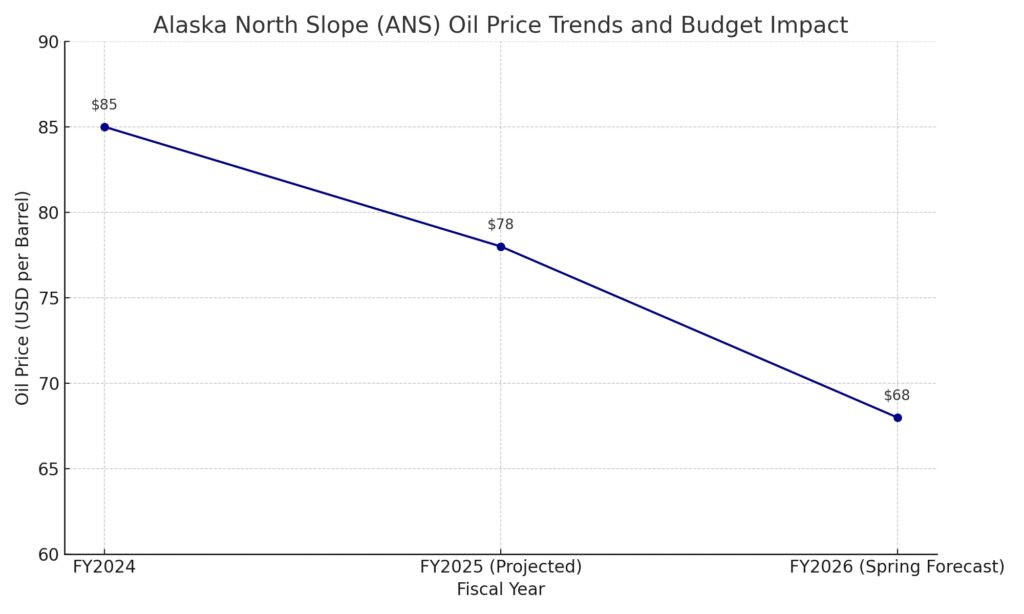
Alaska’s state budget relies on the most recent revenue forecast from the Department of Revenue. The FY 2024 budget was supported by an average Alaska North Slope oil price of over $85 per barrel. FY2025 projections were lowered to $78. But the department’s Spring 2025 forecast, released a few weeks ago, projects an FY2026 average of just $68 per barrel — a roughly 20% decline from the prior estimate. Right now, the price of North Slope crude is $65.53 per barrel.
That drop represents a loss of hundreds of millions of dollars in expected revenue. Dunleavy noted that recent decisions by the Organization of the Petroleum Exporting Countries to increase supply suggest prices may remain depressed in the near future.
“In this environment, we must separate our needs from our wants,” Dunleavy stated. He also pointed to ongoing uncertainty about future oil prices and federal funding levels, cautioning that the state must prepare for further volatility.
By withdrawing his other budget amendments, Dunleavy is seeking to reduce new spending commitments and safeguard Alaska’s limited financial reserves. His pared-down proposal puts the onus on lawmakers to keep the budget lean as they enter the final stretch of the legislative session.
Lawmakers in the House and Senate are dominated by Democrats and their enablers, and they may ignore the governor and challenge him to veto his own amendments, which he will likely do without political penalty, since he is term-limited.
The Alaska AFL-CIO posted a video highlighting the May 5 rally in Anchorage, with images of people and their signs protesting the Trump Administration.
While they protested Trump creating more jobs in America, they were taking a stand for China, and for Joe Biden policies. Anchorage, one of the most diverse cities in the US, but this protest, as evidenced by the video below, was 99% white people, mostly older retirees.
In one clip from the video, a protester wearing a USAID vest is seen taking pictures or video of the protest.
What could be more Democrat than USAID “retiree” attending a protest against Trump, while misusing an official government vest?
USAID vests are issued for official use by employees, contractors, or partners conducting authorized activities, such as humanitarian aid or disaster relief. Using such a vest for personal purposes, like attending a protest in Anchorage, may violate federal regulations, including those governing the misuse of government property (18 U.S.C. § 641, which addresses theft or misuse of public property.)
USAID was one of the first agencies dissolved by President Trump, who folded its necessary functions in to the State Department under Secretary of State Marco Rubio, after it was discovered to be fostering terrorism abroad.
For the union bosses to highlight a discredited and dishonorable agency is odd. Here’s the video:
Electric May Day celebration in Anchorage, Alaska yesterday! Our community came together to stand up for workers in every sector and demand answers from our federal delegation.
In internal polling released late last year by the Teamsters, which polled 1.3 million of its members, 59.6% favored endorsing Trump, compared to 34% for Harris. At the same time, the AFL-CIO never released its internal polling specifics, which may indicate they don’t want the public to know how the rank-and-file union members really feel about Trump.
The Alaska Chamber of Commerce has issued a strong letter of opposition to Senate Bill 113, warning state lawmakers of what it calls “harmful” and unclear provisions in the proposed tax legislation. The bill, version 34-LS0564\A, is designed to alter how Alaska apportions corporate income and to impose taxes on what it describes as “highly digitized businesses.”
In a letter addressed to members of the Alaska House of Representatives, Alaska Chamber President and CEO Kati Capozzi expressed concern over both the content of the bill and the legislative process behind it. According to the letter, the House Finance Committee moved SB113 forward without public testimony, which is highly unusual, especially for a bill with “an indeterminate fiscal note” and significant implications for the state’s tax structure.
The Chamber, which represents over 700 businesses employing 58,000 workers statewide, warned that the bill creates new burdens for companies operating in Alaska, especially those engaged in digital commerce. It could increase costs for both consumers and local businesses.
“In the sections addressing highly digitized commerce, the bill throws away the long-held tenets of apportionment when it comes to corporate income tax for some companies while appearing to exempt others,” the letter states.
The Chamber pointed to last-minute changes that exempt public utilities and telecommunications companies as evidence of the bill’s vague language and poor vetting.
While proponents of SB113 have suggested it targets large e-commerce corporations, the Chamber contends that the bill will have far-reaching consequences beyond its intended scope.
“This bill will have a significant impact on Alaska businesses and other major Alaska business partners who do a large portion of their business transactions online,” the letter reads.
Over 60% of vendors using the Amazon platform are small businesses. With the platform Etsy, 88% of Etsy sellers run their businesses by themselves, and only 5% hire helpers. Some 95% of Etsy sellers run their businesses from home, and 89% are sole proprietorships, both hallmarks of small businesses. Over 90% of eBay sellers are independent small business owners or individuals.
One of the most pressing concerns raised is the potential for the bill to drive up costs across the state. By imposing corporate income taxes on out-of-state businesses that deliver goods to Alaska — businesses which may now fall under Alaska’s jurisdiction under the proposed rules — the Chamber argues the law would effectively raise prices on consumer goods and services.
“To say this has no impact on Alaskans is untrue and disingenuous,” the Chamber said. “These businesses will pass on the increased tax to both Alaska consumers and Alaska businesses.”
SB113 remains under consideration by the Alaska House of Representatives following its passage in the Senate. An effort to table the bill on Monday failed by a significant margin, with many Republicans unwilling to table the controversial bill.