In an administrative order signed Friday, Gov. Mike Dunleavy ordered a hiring freeze and travel restrictions across most state departments.
The order, effective immediately, freezes out-of-state travel, hiring, and the development of new regulations across all executive branch agencies.
The last time that Alaska state government had a hiring freeze was in March of 2020, implemented after a sharp drop in oil prices.
The fiscal directive comes as Alaska grapples with declining oil prices and production — factors that have significantly reduced one of the state’s primary source of revenue. According to Dunleavy’s order, oil prices averaged nearly $85 per barrel in fiscal year 2024, buoyed in part by geopolitical instability stemming from Russia’s invasion of Ukraine. However, recent decisions by the Organization of Petroleum Exporting Countries to increase production have driven oil prices down. The Alaska Department of Revenue’s spring forecast projects a drop to $68 per barrel in FY 2026, translating to hundreds of millions of dollars in lost revenue for the state’s general fund.
In the 1980s, oil production funded nearly 90% of Alaska’s unrestricted general fund revenues. Today, it accounts for roughly 40%. Despite having reserve accounts, including a $2.8 billion Constitutional Budget Reserve, a $1 billion Power Cost Equalization Endowment Fund, and a $407 million Higher Education Investment Fund, the Governor’s Office stated that the combined value of these accounts would not sustain state operations for a full year.
“This order is a necessary step to preserve Alaska’s fiscal stability and ensure the continuity of essential government services,” the directive states. It outlines an effort to refocus agency operations on “core mission objectives” and streamline government expenditures.
Travel: All out-of-state travel by state employees is now prohibited, regardless of the funding source. Waivers may be granted by the Governor’s Office in cases where travel is essential to public safety or critical state responsibilities. In-state travel must be limited to essential business, with agencies encouraged to use remote communication tools.
Hiring: A freeze is now in place for all hiring across state agencies.
The hiring freeze applies to:
• All full-time, part-time, non-permanent, and seasonal positions in bargaining units and in the partially exempt and exempt service.
• Requests to establish new positions.
• Requests to extend non-permanent positions.
• Positions that provide administrative support and maintenance to the exempted agencies set forth below.
Exempted Agencies:
• The hiring freeze does not apply to positions essential to protect Alaska citizens. This category includes Alaska State Troopers, corrections and probation officers, airport police and fire officers, Office of Children Services, Division of Public Assistance, and employees that provide patient, resident, or food services at 24-hour institutions.
For purposes of this order, the following are considered 24-hour institutions:
• Correctional Facilities
• Juvenile Justice Facilities
• Alaska Military Youth Academy
• Pioneer Homes
• Alaska Psychiatric Institute
• Alaska Vocational Technical Center
• Mt. Edgecumbe High School
Regulations: Agencies are barred from introducing new regulations unless already posted for public comment. Waivers may be requested in cases where regulations are necessary for public safety or essential services.
The order applies to all executive branch agencies, including departments, boards, commissions, and public corporations. It will remain in effect until officially rescinded.
The order is a preventive measure to avoid deeper financial challenges in the future.
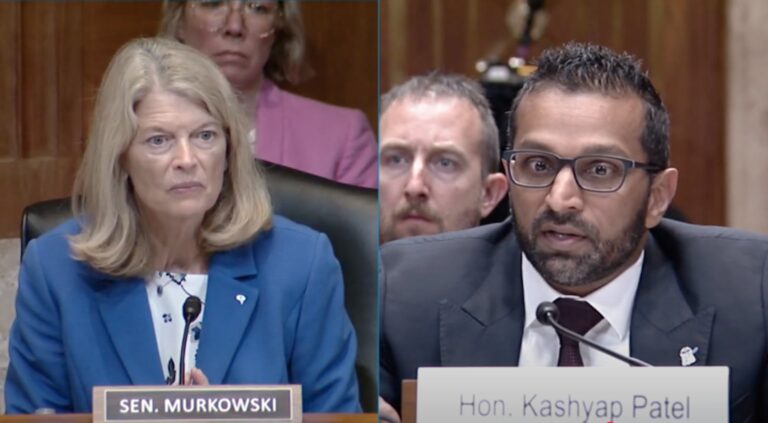
In a political pivot, Sen. Lisa Murkowski, who previously voted against the confirmation of Kash Patel as FBI director, now says she is actively working with him — praising parts of his approach while pushing for concrete action on longstanding justice issues affecting Native communities and public safety in Alaska.
During a Senate committee hearing this week, Murkowski engaged in a substantive exchange with Director Patel, focusing on the Missing and Murdered Indigenous Women and Girls crisis and Alaska’s worsening fentanyl epidemic.
“This is a week that a lot of Alaskans are paying attention to,” Murkowski began, referencing the national recognition of Missing and Murdered Indigenous Women and Girls Awareness Day. She commended past efforts like Operation Lady Justice under the Trump administration and noted Patel’s new initiative, Operation Not Forgotten, which she said must be more than a name—it must come with real resources.
“I need to be able to give folks back home the comfort that they need to know that these cases … will not be dropped,” Murkowski told Patel. “What can you share with me this morning?”
Patel, in response, highlighted his recent meetings with tribal leaders and families of victims, including the parents of 14-year-old Emily Pike, whose unsolved murder continues to haunt a reservation community in Arizona.
“Every crime in this country will be treated equally,” Patel said, adding that he is pushing for more FBI presence on reservations and direct engagement with tribal communities, including a liaison position at FBI headquarters.
While Alaska lacks the reservation system and formal tribal law enforcement structures found in the Lower 48, Murkowski emphasized the state’s unique challenges and criticized the FBI for inadequate communication with victims’ families.
“It’s radio silence out of the agency,” she said, urging Patel to fund more Victim Service Coordinators in Alaska’s FBI offices.
The discussion also touched on the rising tide of fentanyl deaths in the state, with Murkowski pointing to a 40% increase in overdose fatalities in 2023, making Alaska the only state where numbers are still climbing. “We ought to be able to intercept drugs more effectively,” she said, noting Alaska’s limited access points for trafficking.
Patel assured her that the FBI is increasing resources in Alaska and pledged to continue collaborating on both fentanyl interdiction and the MMIWG crisis.
“We will work with you and your office to make sure Alaska is not forgotten,” he said.
The public exchange, while cordial and constructive, marks a notable shift in Murkowski’s stance on Patel. Her initial opposition during his confirmation process centered on concerns about his political background and ties to former President Donald Trump’s inner circle. But now, with Patel in office and wielding significant influence over federal law enforcement priorities, Murkowski appears committed to engaging him directly to ensure Alaska’s needs are addressed.
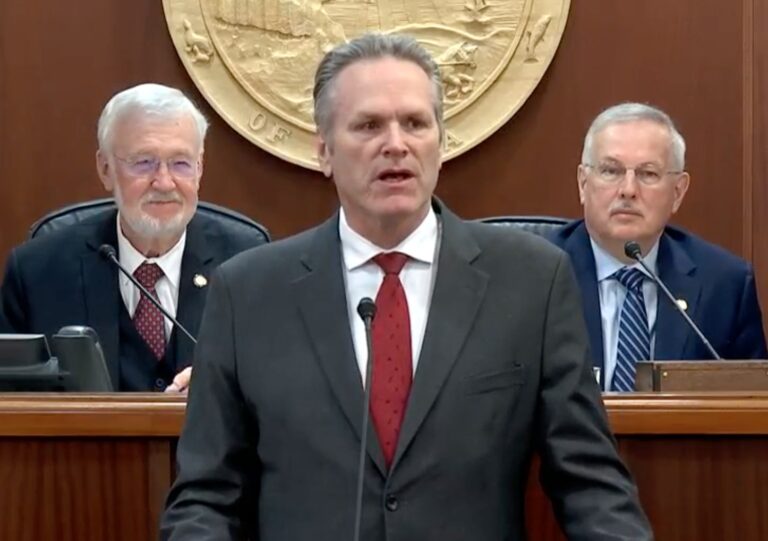
Gov. Mike Dunleavy issued a formal message to both chambers of the Alaska Legislature on Friday, urging lawmakers from both parties to work with his administration on a comprehensive fiscal strategy aimed at addressing the state’s long-standing budgetary challenges.
In his letter to the House and Senate, read into the record, Dunleavy emphasized the urgency of developing a durable, long-term fiscal plan.
With Alaska facing ongoing revenue uncertainty, particularly from declining oil prices, and the 2026 election cycle on the horizon, the governor warned that the opportunity for bipartisan cooperation on a sustainable fiscal framework may be slipping away.
Several tax-related proposals have surfaced during the current legislative session. Dunleavy reiterated his stance on fiscal policy.
“As I have consistently stated since my first term, a truly durable fiscal plan must include revenues, but it also requires clear guardrails: spending limits, statutory and regulatory reviews, and policies that make Alaska the most competitive state in the nation for investment and new business growth,” he wrote.
“Equally important is the need to evaluate all current state spending and government functions-not only for efficiency, but for their relevance and long-term impact. Any serious effort to stabilize Alaska’s fiscal future must also focus on diversifying our economy and creating new industries, which in tum broadens the economic base for potential revenue,” Dunleavy wrote.
“As such, I cannot support standalone tax measures. I am issuing this message to reaffirm my long standing position as Governor: the Legislature and the Executive Branch must establish a joint team to develop a comprehensive, sustainable long-term fiscal plan that ensures stability and fosters economic growth,” he wrote.
Dunleavy called on legislative leaders to form a joint working group with the executive branch after the session to begin crafting legislation around what he described as the “core components” of a sound fiscal policy. “By transmittal of this message, I am formally requesting legislative leadership join me in convening a joint team to begin this process,” he wrote.
Washington state is the lead state a coalition of 15 states in a federal lawsuit challenging President Donald Trump’s executive order declaring a “national energy emergency,” and his order to agencies to hurry up on environmental reviews for fossil fuel projects.
The lawsuit, announced by Democrat Washington Attorney General Nick Brown, was filed in U.S. District Court for the Western District of Washington. Brown said the emergency declaration is unlawful and aimed at locking the nation into continued reliance on fossil fuels.
Other states joining the case are Democrat-run: California, Arizona, Connecticut, Illinois, Massachusetts, Maine, Maryland, Michigan, Minnesota, New Jersey, Oregon, Rhode Island, Vermont and Wisconsin. This is Brown’s 17th lawsuit against the Trump Administration.
“This is not a serious or lawful effort by the president. It is all about eliminating competition and shackling America to dirty fossil fuels forever,” Brown stated at a news conference.
Trump’s executive order was issued Jan. 20, moments after he took the oath of office, and included strong support for Alaska’s oil economy. His order ignored solar, wind, and other renewable energy sources, which have proven costly.
“Our Nation’s current inadequate development of domestic energy resources leaves us vulnerable to hostile foreign actors and poses an imminent and growing threat to the United States’ prosperity and national security,” the order stated.
According to Brown’s office, since the order’s signing, federal agencies have already begun fast-tracking fossil fuel projects, sidestepping critical reviews mandated by the Clean Water Act, the Endangered Species Act, and the National Historic Preservation Act.
The lawsuit argues that Trump’s invocation of a national emergency is baseless and in direct contradiction to the original intent of the National Emergencies Act.
The case could set the stage for a major legal battle over the scope of presidential authority and the future of environmental policy in the United States.
The Alaska Supreme Court on Friday issued a ruling in Gregory Smith v. Municipality of Anchorage that overturns the Superior Court’s dismissal of an appeal that challenged the Anchorage’s campsite abatement process.
The case stems from a June 2022 notice posted by the Municipality at Davis Park, a notorious occupation of public property. The notice announced a “zone campsite abatement” to clear the area of unauthorized campsites. Anchorage Municipal Code outlines procedures for such abatements, including a requirement to post notice and a provision allowing appeals to the Superior Court within 30 days.
Six individuals, including a man named Gregory Smith, filed an appeal, arguing that the abatement process violated due process by allowing the seizure of personal property without a hearing and infringed on Eighth Amendment protections against cruel and unusual punishment by removing essential items from homeless individuals.
The Superior Court dismissed the appeal, concluding that its jurisdiction was limited to reviewing whether the posted notice met the legal requirements of the municipal code, not the broader decision to abate the campsite. The judge found that since the appellants did not dispute the notice’s compliance with the code, their claims fell outside its authority.
In a unanimous opinion authored by Chief Justice Peter Maassen, the Alaska Supreme Court reversed the dismissal.
The Supreme Court held that the Superior Court’s jurisdiction actually extends beyond the notice’s legal sufficiency to include substantive challenges to the abatement decision itself, such as the constitutional issues raised by Smith. It is unusual for a Superior Court to handle constitutional questions of this nature, and this represents a major win for the ACLU.
The ruling emphasized that the municipal code’s language, which describes the posted notice as a “final administrative decision” subject to appeal, does not restrict review to the notice alone.
The court also pointed to the legislative history of the AMC, noting that prior versions allowed administrative hearings on the legality of campsites and property disposition, suggesting no intent to narrow judicial review.
The Supreme Court also addressed the Municipality’s submission of a minimal two-page administrative record, consisting only of the posted notice.
The Municipality argued that the record limited the court’s ability to review constitutional claims.
The Supreme Court has rejected this, instructing the Superior Court to determine whether the administrative record is sufficient for meaningful appellate review.
The case was remanded back to the Superior Court for further proceedings, handing the American Civil Liberties Union of Alaska a temporary win, in that it has filed a brief supporting Smith’s appeal.
House Bill 209 would be a game changer for our Permanent Fund dividends. The overarching impact of the bill, offered by Anchorage Rep. Zack Fields, would be to transform the PFD — your annual share of Alaska’s oil wealth — into a targeted entitlement program.
When the dividend program was envisioned by Gov. Jay Hammond, it was never intended to be any such thing. Gov. Hammond envisioned a mechanism through which all Alaskans would become enfranchised participants in the benefits of our state’s resource development.
This bill would restrict qualification for a PFD check only to individuals who don’t file federal taxes or who make $50,000 or less in annual income. Additionally, the bill would cap the PFD at $1,000 permanently, regardless of the performance of the Permanent Fund. Also, the PFD would not be inflation proofed.
The PFD is not a handout. It is a dividend paid to you for your share of Alaska’s resource wealth. If you own shares of stock in General Motors and your shares pay a dividend, does GM call you and say, “Sorry, but your income disqualifies you from receiving your money”? Obviously not. Yet, HB 209 would have this be the ‘new normal’ for Alaskans.
Achieving a fiscal balance while confronting declining state revenue continues to be paramount. However, disenfranchising tens of thousands of Alaskans from a program established for all Alaskans is not the way to do it.
Rep. DeLena Johnson represents District 25, including Palmer, Butte, Lazy Mountain, and the Walby Lake area.
This Mother’s Day, treat Mom to delightful foraged dandelions. With dandelions blooming throughout Alaska, there is a perfect opportunity to gather sustainable greens and flowers that will add a special touch to your Mother’s Day table. Below, you’ll find some recipe suggestions for dandelion iced tea, a salad with citrus vinaigrette, sunny dandelion eggs, and dandelion baked halibut.
Mother’s Day celebrates the unconditional love and nurturing spirit of moms. Reflecting on moments spent gathering dandelions for your mother serves as a beautiful way to honor her. Dishes inspired by dandelions can showcase vibrant greens and blossoms, providing a meaningful way to pay tribute to her with simple creations that remind us of the joys that nature offers.
Dandelions truly are a gift from God, despite being unjustly labeled as undesirable invasive weeds. They are a dense superfood, rich in multiple vitamins, including A, C, and K, and they also provide essential minerals such as iron, potassium, magnesium, calcium, and beta-carotene.
All parts of the plant are edible, including the roots, stems, leaves, and blossoms. Dandelions are considered safe to eat in large amounts and have been harvested as food and medicine for over a thousand years.
Dandelions (Taraxacum officinale), also known as the lion’s tooth flower, originated in Eurasia and have evolved over millions of years to survive in diverse climates and soils. Since ancient times, they have been used as a nutritional source, with references to dandelion salads, teas, and wine found in Roman and Chinese texts dating back to around 900 CE. It is believed that the 17th-century European settlers purposely transported the dandelion to North America. Its presence in the new world is noted as occurring around the time of the Mayflower, according to an article published by the National Library of Medicine.
Since their arrival in North America, dandelions have spread across the continent, becoming a familiar sight. Today, their resilience and adaptability have led some to regard them as an undesirable invasive weed, while others continue to appreciate their value as both food and medicine.
According to Rosalee De La Foret in her book Alchemy of Herbs, herbalists value dandelion leaves for the potential they provide in aiding liver health, digestion, and as a diuretic. She also states that the dandelion root is used by herbalists for arthritis and to support the health of people with cancer. Dandelion is also used topically to treat skin conditions.
Dandelions are pollen-producing plants that benefit bees and other pollinators essential for our planet’s survival. However, some individuals may develop allergies to dandelion pollen, similar to allergies caused by goldenrod and ragweed. Herbalist Rosemary Gladstar warns in her reference guide, Medicinal Herbs, that allergies can also stem from the milky latex found in dandelion flowers and stems. She advises, “If a rash develops upon use of this latex, just discontinue the treatment.”
For culinary applications, dandelion blooms are valued for their beautiful vibrant burst of color in dishes. You can also enjoy them as fritters, fry them in butter, and use them to make jam and wine. Their slightly bitter flavor complements a wide range of ingredients, making them a versatile choice in both savory and sweet recipes.
Dandelion leaves possess a savory sharpness that enhances and brightens a fresh salad and complements milder lettuces. They can also be sautéed just until they start to wilt and finished with olive oil, lemon juice, garlic, turmeric, salt, and pepper, or prepared with a balsamic option. Additionally, the leaves can be transformed into a delicious pesto with walnuts, garlic, lemon, seasonings, and Parmesan cheese. They also provide a finishing touch to egg dishes, imparting a unique earthy essence to scrambled eggs, frittatas, or quiches. The potential is limitless.
The dandelion root can be used in various dishes, including roasted vegetables and stir-fries, or infused in apple cider vinegar to make salad dressings and marinades. Roasted dandelion roots have a distinct flavor with bitter undertones that can be used as a coffee replacement or supplement to reduce caffeine intake. Harvesting dandelions for their roots is most effective later in the summer when the roots have fully developed and grown larger.
Teas made from dandelion may include the leaves, flowers, or roasted roots of the dandelion plant. These teas can also incorporate additional ingredients, such as mushrooms, herbs, spices, and honey.
All the potential opportunities to include dandelions in your meals can create an exciting culinary adventure and a way to introduce a healthy superfood to your diet that is free of cost and sustainable to harvest.
When foraging for dandelions, make sure the area is free of contamination caused by lawn maintenance or road traffic. Be sure to correctly identify the plants, as lookalikes may potentially be toxic. Before eating dandelions, always wash them well to remove any dirt or insects. The young, tender leaves in spring are the most desirable, as they become increasingly bitter as the plant matures.
Dandelions are a plant that you do not need to worry about overharvesting. Those who consider dandelions an invasive weed attempt to eradicate them each summer, pulling them by their roots and dousing them with herbicides. Nevertheless, dandelions continue to expand their reach, offering their heavenly gifts to pollinators, animals, and humans in new and distant regions, far beyond their origins in Eurasia.
Like our mothers, the dandelion is a remarkable wonder of nature that offers both sustenance and healing with incredible resilience and adaptability, thriving in Alaska’s harsh surroundings despite numerous challenges. Its ability to flourish in unexpected ways reflects the strength and perseverance that our mothers exhibit in their daily lives.
It serves as a reminder of the nurturing qualities found in both dandelions and mothers, who overcome adversity to create beauty and sustenance. Just as the dandelion disperses its seeds to ensure future growth, so too do mothers cultivate hope and possibility for the generations to come.
Mother’s Day is a day for us to honor the special person in your life, whether she a mother or simply someone who embodies a motherly energy. If you are not inclined to try out dandelion recipes, you could always bring her a dandelion bouquet instead.
Below are a few dandelion recipe ideas.
Iced Dandelion Blossom Tea
Iced Dandelion Blossom Tea
Ingredients:
2 ½ cups of fresh dandelion flower heads
5 cups of water
2 tablespoons of honey, more or less to taste
1 lemon, washed and juiced (approximately 2 tablespoons)
For the garnish:
10 to 12 fresh dandelion leaves
5 to 6 fresh dandelion blooms
Makes 5 to 6 servings.
Preparation:
Harvest the dandelion flowers when it is sunny and the blooms are fully open. Gently rinse the blossoms under cold water to remove dirt and insects. Then separate the yellow petals from the green base to remove and discard the bitter portion of the bloom. This process will yield just over one cup of clean yellow petals.
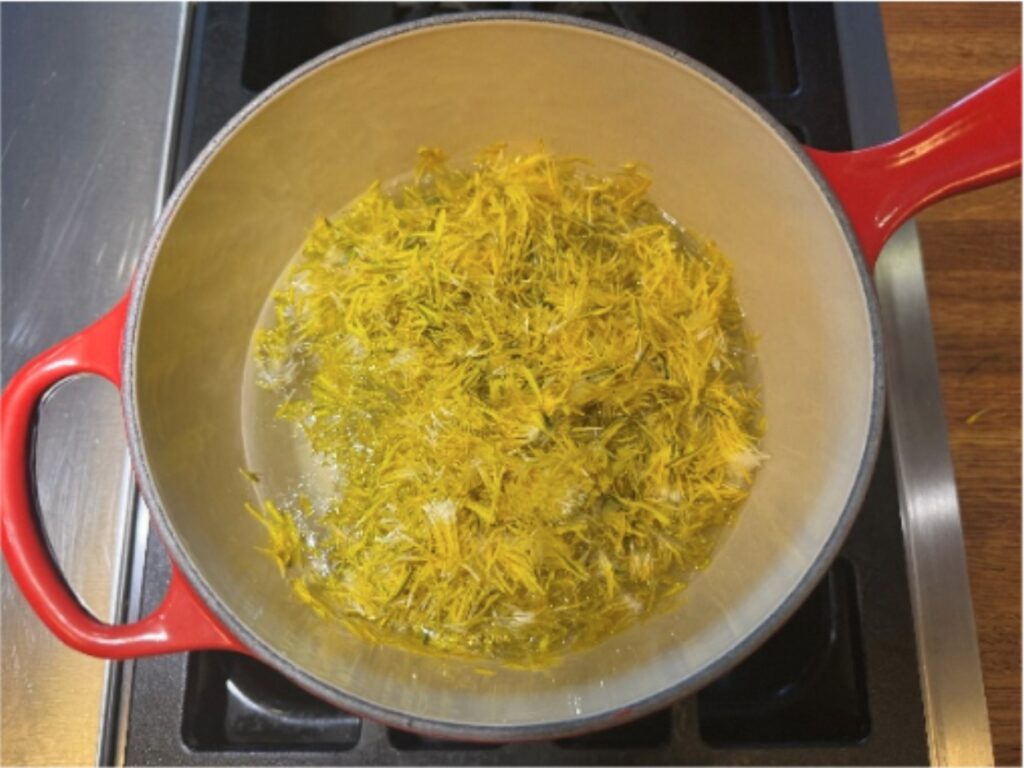
Simmer the blossoms
Bring the water to a boil. Turn off the heat and immediately add the dandelion petals, the lemon juice, and the rind of the lemon for extra zest. Let it steep for 15 to 30 minutes to extract the floral flavor.
Remove the lemon rind and strain the tea through a fine mesh sieve, discarding the petals. Add the honey and stir until it dissolves, taste, and add more honey if desired. Chill the tea in the refrigerator for about an hour.
Serve the dandelion tea in a glass, poured over ice, and garnish it with a couple of fresh dandelion leaves and a bloom.
Enjoy the fresh flavor of this cool beverage!
Dandelion Walnut and Citrus Salad
Dandelion Walnut and Citrus Salad
Ingredients:
For the salad:
4 cups fresh young dandelion greens
½ cup red onions, thinly sliced
½ cup walnuts, toasted
½ cup feta cheese, crumbled (optional)
1 orange, segmented and cut into small bite-sized pieces
2 to 3 fresh dandelion blooms for garnish, gently rinsed and patted dry
For the citrus vinaigrette:
1 orange, freshly squeezed (approximately 3 tablespoons of orange juice)
1 lemon, freshly squeezed (approximately 2 tablespoons of lemon juice)
1 teaspoon mustard (yellow, brown, and Dijon all work well)
1 ½ teaspoons honey
½ teaspoon ground ginger
¼ cup extra-virgin olive oil
Sea salt and freshly ground pepper, to taste
Makes 4 servings.
Start by preparing the vinaigrette. In a small bowl, whisk together the orange juice, lemon juice, mustard, ginger, and honey until well combined. Alternatively, you can use a hand immersion blender to combine. While continuing to whisk or blend the mixture, slowly drizzle in the olive oil into the vinaigrette. Season with salt and pepper to taste.
Thoroughly rinse the greens in cold water to remove soil or insects. Remove the stems from the dandelion greens, then tear the leaves into bite-sized pieces. Rinse the greens again and remove excess water by spinning them in a salad spinner or by patting them dry.
Dandelion Walnut and Citrus Salad ingredients
Combine the salad ingredients in a large bowl by tossing together the dandelion greens, red onion, walnuts, feta cheese, and orange segments. Drizzle the citrus vinaigrette over the mixture and gently toss it again to coat it with the dressing. Season with salt and pepper to taste.
Finish the dandelion salad by topping it with some vibrant yellow dandelion petals. Gently pinch off the green base from the bottom of the bloom to remove the petals from the washed dandelion blooms and sprinkle them over the salad.
Note: If you are preparing several items for a brunch service, this salad can be conveniently prepped in advance, with the final tossing of the ingredients occurring just before serving. Begin by preparing the dressing and storing it in a separate container. Next, combine all salad ingredients except for the orange sections and the flower bloom garnish. Just before serving, gently toss the salad greens with the orange sections and citrus dressing. Finally, top the salad with the flower petals as a garnish and serve.
Alternative suggestion: If you don’t have time to harvest dandelion greens, this salad recipe works well with other bitter greens such as kale, arugula, Swiss chard, collard greens, or mustard greens.
Sunny Dandelion Eggs
Sunny Dandelion Eggs
Ingredients:
6 eggs
1 cup of dandelion greens, washed and torn into bite-sized pieces
2 to 3 ounces of cheese (Asiago, Gruyere, Fontina, Swiss, and white cheddar all work well)
1 tablespoon butter, room temperature
Sea salt, freshly ground pepper, and ground cayenne pepper to taste
Makes 3 servings of two eggs each.
Preheat the oven to 375°
Start by buttering the bottom and sides of a small baking pan. Next, line the pan with dandelion greens, and then sprinkle cheese evenly over the greens. Make small indents where you will place each egg to ensure they sit properly in the baking pan.
Make a bed of cheese and dandelion greens for the eggs.
Then crack the eggs into the baking pan, being careful not to break the yolks. Sprinkle salt, pepper, and cayenne pepper over the eggs. Finish by garnishing the eggs with a few small pieces of dandelion greens.
Bake in the oven at 375°F for 15 to 20 minutes, or until the egg whites are set and the yolks reach your preferred consistency. Once you remove the dish from the oven, allow it to cool for a minute or two to allow the eggs set. Serve while still hot, and enjoy.
Serve while hot and enjoy with a side of dandelion salad or hash brown potatoes.
Bonus dandelion suggestion for halibut.
Dandelion Baked Halibut.
Dandelion Baked Halibut
Ingredients:
1 large filet of halibut
1 cup of dandelion greens, washed and torn into bite-sized pieces
1 to 2 tablespoons butter, room temperature
Sea salt, freshly ground pepper, and ground cayenne pepper to taste
Total servings depend on the size of the halibut filet.
Preheat the oven to 375°.
Begin by buttering the bottom and sides of a small baking pan. Next, place dandelion greens in the bottom of the pan. Season all sides of the halibut by lightly sprinkling it with salt, pepper, and cayenne pepper, or use a spicy seasoning of your choice.
Place the halibut in the pan on top of the dandelion greens and spread a layer of butter evenly over the top. Then, lightly season the top surface of the halibut with an even coating of your chosen spices.
Bake in the oven at 375°F. The baking time will vary based on the size of the filet, typically ranging from 12 to 20 minutes. Be careful not to overbake.
This preparation provides a fantastic way to enjoy dandelion, adding a savory element that complements the mild flavor of halibut.
Serve the dish hot from the oven for the best flavor, and enjoy!
Brenda Josephson is a Haines resident. She holds degrees in Culinary Arts and Food Business Leadership from the Culinary Institute of America, Hyde Park, New York. She enjoys spending time fishing, foraging, and savoring Alaska’s abundance of natural and wild foods with her family.
The Alaska Superintendents Association issued a formal statement after meeting with Gov. Mike Dunleavy. The superintendents publicly urged the governor to not veto House Bill 57, legislation that he has indicated he plans to veto because it contains none of the education reforms he has asked for.
House Bill 57 is spending for schools without any real expectation from the schools for improving results.
The letter emphasized a unified stance among superintendents in support of HB 57, a bill that started out as a ban on cell phones in schools, but which became the Legislature’s vehicle for funding schools at a much higher rate.
Gov. Dunleavy informed superintendents during the meeting that he intends to veto HB 57 unless two policy provisions are included: Open enrollment between school districts and additional charter school expansion measures.
He also raised concerns over literacy incentive funding being tied to a separate bill, Senate Bill 113, indicating a preference for those funds to be handled independently. SB 113 is the tax on internet businesses.
The superintendents also praised the Legislature for the quick passage of SB 113, the Etsy Tax, which raced through the House and Senate with no analysis.
Valley Republican Women of Alaska responded to the unfolding drama by posting a clever meme showing Gov. Dunleavy with a big veto stamp in his hand, shown above on this page. Soon, other Republican women’s clubs around the state were sharing the same meme.
In the Must Read Alaska newsletter, the Question of the Week survey asked readers if they think the governor should veto HB 57. The response was 89% “Yes” from 640 participants in the three-day poll of Alaska conservative activists:
I am 73 years old and have lived under eight different popes. I even recall the news of the 1958 conclave.
I was shocked when the first non-Italian pope in 450 years was elected in 1978. I was shocked at the assassination of JFK, RFK and MLK. I was pleasantly shocked by Ronald Reagan’s two landslides. I was shocked at the multiple heretical moves and musings of Pope Francis.
But nothing prepared me for this: an American pope, from the diocese of my own birth, who was not on anyone’s radar screen as papabile. Give the College of Cardinals credit: They can still administer electro-shock treatments to the world.
We are going to likely have undignified insults traded between the White House and the Vatican. I hope Pope Leo will not respond in kind to Trump’s often childish musings. Pope Francis, who was quite practiced at snide and even crude insults, might have done so. But Trump would do better to allow Vice President JD Vance do the talking.
But this is a pope who has done the following:
Openly criticized America’s efforts to control our own border, which flies in the face of the Church’s own teaching. And it is interference in the domestic politics of a sovereign nation. The Church’s role is to save souls. What about these millions of illegals, who have broken our laws?
Ousted the most godly and humble bishop in America, Joseph Strickland, after he went “out of bounds” from his Texas diocese to picket the LA Dodgers. If you never heard of this, it is because the mainstream media buried it. Strickland, along with thousands of other Catholics, was protesting a vicious anti-Catholic parody that took place by the “Sisters of Perpetual Indulgence”, an LGBTQ mockfest, in a pre-game ceremony.
During Covid, Leo approved the use of non-valid confessions over the telephone, despite clear Church teachings against this practice.
He has been part of Pope Francis’ heretofore unheard of tactic, known as the “synodal magisterium.”
Now Leo’s first immediate gestures might — might — be a harbinger of a change of heart.
He blessed the people, unlike Pope Francis, who asked the people to bless him.
He wore the traditional red cape of a newly-chosen pope, the mozetta … unlike Francis.
He chose the name of a long-suffering and traditionalist pope of the 19th century, Leo XIII.
He has made strong statements on the sanctity of innocent human life.
There have been surprise conversions in the 267 popes, the most noteworthy being Pope Vigilius. He was an “Insider” currying the favor of Empress Theodora in the 500s. He maneuvered the exile and possible murder of the previous and very humble Pope Silverius, who excommunicated two influential bishops for adhering to the Monophysite heresy, a heresy which stated that Jesus was not fully human. If Theodora used her influence to elevate Vigilius to the papacy, he promised to restore the excommunicated heretic bishops.
So — the Empress got Vigilius into the Shoes of the Fisherman. To restore these bishops would be to endorse a heresy. Catholics — and all current Christian denominations — believe in the “hyperstatic union”: that Jesus is fully God and fully Man. Not a 50-50 thing. Not 90-10. He is 100% God and 100% human. This impossibility is what makes Truth a divine mystery.
Theodora waited. And waited. And waited. She wrote Vigilius, “Our dearest friend and pope” about why he was balking at restoring these Monophysite bishops. His reply of 538 AD, is justly famous:
Far be this from me, Lady Augusta; formerly I spoke wrongly and foolishly, but now I assuredly refuse to restore a man who is a heretic and under anathema. Though unworthy, I am vicar of Blessed Peter the Apostle, as were my predecessors, the most holy Agapetus and Silverius, who condemned him.
There is a church-approved prophesy that came out of, of all places, Akita, Japan in 1973. I have visited the miraculous statue, a wooden and Japanese-looking Virgin Mary, which shed tears. The Japanese respect all religions, and this miracle was broadcast on live television at the time.
“The work of the devil will infiltrate even into the Church in such a way that one will see cardinals opposing cardinals, bishops against bishops. The priests who venerate me will be scorned and opposed by their confreres…churches and altars sacked; the Church will be full of those who accept compromises, and the demon will press many priests and consecrated souls to leave the service of the Lord.
This told accurately what would happen, and thus stands the Biblical test of authentic prophesy.
The news behind this man, Robert Prevost, now Pope Leo XIV, is too early. The Catholic Church just made an apparent hairpin turn to the Left. Let me emphasize “apparent”. If Leo wants to really make news, he could restore Bishop Strickland, who certainly was no heretic, but worried about a pope who was flirting with Church dogma like it was his own toy.
If faithful Christians were praying for a good and holy pope, they might have one now. Yet they must now pile on and redouble their prayers. Vigilius is not on the list of saintly popes, but if he made it into Heaven, we can ask him to add his own pleas to the Almighty.
But Peter and Paul are there, and Paul rightly corrected Peter in Galatians 2:11-14. Let us hope that we will have bishops and cardinals who will dare to do the same, if Leo goes the way of his predecessor.
Their fate, however, might become a newly minted word: Strickland-ized.
Bob Bird is former chair of the Alaskan Independence Party and the host of a talk show on KSRM radio, Kenai.