Wednesday, June 3, 2026
Home Blog Page 1106

Rep. Jim Jordan to FBI director Wray: ‘Why did you take the Homer couple’s copy of the Constitution?’

31

Rep. Jim Jordan of Ohio grilled FBI Director Christopher Wray about why, during a raid of a Homer, Alaska home belonging to a pair of Trump supporters, the agency took the couple’s pocket copy of the U.S. Constitution.

Jordan’s questions about the FBI raid took place during a House Judiciary Oversight Committee meeting concerning events of Jan. 6, when election protesters surged into the U.S. Capitol.

Paul and Marilyn Hueper were held at gunpoint and handcuffed for four hours on April 28, 2021, while the FBI and other law enforcement agencies searched their home, looking for House Speaker Nancy Pelosi’s laptop computer, as well as any evidence, such as clothing, that would show Marilyn Hueper was actually inside the U.S. Capitol on Jan. 6.

It was a case of mistaken identity gone quite wrong.

According to Rep. Jordan, the Hueper’s door has now been repaired, after having been broken down by the agency raiders. The Huepers say the door has a plywood patch on it, but has not been repaired and still has a visible hole.

Wray had no answers about that raid. He said he would not discuss any investigation, he said.

The FBI has returned the couple’s cell phone and laptop, but Rep. Jordan wanted to know if the FBI had retained the data from their electronic equipment. Wray would not answer that either, nor discuss why the Constitution was taken into evidence.

Read: FBI breaks into Homer couple’s home, looking for Nancy Pelosi laptop

Marilyn Hueper said the pocket Constitution was the kind a person could find for a dollar. It hadn’t been read and the binding had not been broken, but was something she had pulled out of a box in a closet with the thought that she should read it and refresh her constitutional knowledge. There were no markings in it, “but they confiscated it and put it in as part of the evidence against us.”

The copy has been returned to the Huepers, unblemished.

The computers that were returned to them, however, are now damaged with “screwed up security settings,” Paul Hueper said, so the Huepers have not been able to actually use them.

“This has hurt our spa business,” he said, because the computers are an integral part of their business at the inn they keep in Homer, which has a lot of seasonal trade.

The Huepers have now filed a written rebuttal to the application for a warrant made to the U.S. District Court. They say the assertions made in the warrant application show no probable cause, and the warrant was granted based on flimsy information.

Twelve agents, FBI, Capitol Police, and other agents, broke down the door to their home and told Marilyn and Paul Hueper to put their hands up on April 28, 2021. Paul counted seven guns trained on him when he came out of the bedroom. The agents cuffed the couple and their guests and held them, interrogated them, and searched the home.

Finally, they showed Marilyn a photo of someone they said was her.

“They showed me a different view, where it could have been me,” Marilyn said. The photo was a side shot where only the hair and coat were visible. “They purposely withheld the picture where I could have easily seen it was not me.” Eventually they showed her the photo above on the right — at the end of their search — where the person-of-interest’s face was clearly shown.

“I said oh no, that is not me, I would have never worn that sweater,” she said. “She is wearing this hideous sweater that I would never be caught in. She has detached earlobes, and mine are attached. She has arched eyebrows, and I don’t.”

Marilyn Hueper said the agents told her she had been positively ID’d. Marilyn said that Wendy Terry, special agent in Anchorage, went to Matthew Scobel, the federal magistrate judge in Anchorage, for a warrant based on the positive ID.

“At this point, they said it was a trespassing misdemeanor but if we did not cooperate, they said they would charge me with obstructing justice,” she said.

When Marilyn said, “That’s not me,” she said the agent told her “so you want to go there,” as if she was lying and obstructing justice.

The couple is inviting others who have been harassed by law enforcement over their innocent activities on Jan. 6 to consider joining a lawsuit with them to challenge the FBI over the constitutional violations committed by the agency. People can get more information and contact the Huepers through WethePeopleStand.org.

Breaking: Grand jury indicts former Rep. Gabrielle LeDoux for voter fraud

46

A grand jury indictment against former Rep. Gabrielle LeDoux was announced today by the Alaska Department of Law.

Earlier this year, two misdemeanor election-tampering charges against LeDoux were dropped, but eight charges remained, and a hearing was set for later this month.

LeDoux, an Anchorage Republican who represented District 15 (JBER-Muldoon), along with Lisa Vaught Simpson and Caden Vaught all face various charges relating to LeDoux’s 2014 and 2018 House races. Simpson had been LeDoux’s chief of staff in the Legislature and sometimes roommate in Juneau. Caden Vaught is her son.

“On June 2, 2021, an Anchorage grand jury indicted Gabrielle LeDoux, Lisa (Vaught) Simpson, and Caden Vaught on multiple counts of voter misconduct in the first degree. These charges stem from the investigation that started in 2018 after the Division of Elections identified some irregularities in some of the absentee ballot applications and absentee ballots returned for the primary election for House District 15.  The Alaska State Troopers, in conjunction with the Federal Bureau of Investigations, conducted the investigation,” the Department of Law wrote.

Among the suspicious voting patterns in District 15, ballots were requested by seven people who were dead, and several other people say they never cast a ballot, although ballots were received by the Division of Election in their name.

An investigation was started by the State Troopers, and the case was also referred to the FBI. Previous charges included allegations that the three were principles and accomplices who knowingly provided false information on voter registration forms to show a residence address in House District 15, when there is evidence that Simpson and Vaught were not living, and had no intent to live, at the addresses provided at the time of the election. 

The previous charging documents also alleged that LeDoux solicited a similar action by other individuals in 2014 in order to ensure they could vote in the House District 15 election. But the grand jury is focused on the 2018 election, when the Division of Elections found numerous ballots linked to a single address.

“The charges involve alleged conduct that took place in both the 2018 primary and general elections. Ms. LeDoux and Ms. Simpson were each indicted on five counts of voter misconduct in the first degree and Mr. Vaught was indicted on four counts of voter misconduct in the first degree.  On June 10, 2021, all three defendants appeared, either in person or by phone, in court at a Superior Court arraignment and entered pleas of not guilty to the charges.  The date of their next court appearance has yet to be set.”

If convicted, the defendants could face a maximum of 5 years in prison.

Read: Rep. LeDoux says charges against her are FAKE NEWS

Read: LeDoux faces charges for District 15 voter fraud

Read: Charlie Chang now dead, LeDoux says

LeDoux ran for reelection in 2020, but lost in the primary to David Nelson, a young, clean-cut Republican new to election politics. She has maintained her innocence throughout, but the Hmong community in District 15 lost faith in her, and withdrew their important endorsement.

This story will be updated. Check back.

Unanimous: Anchorage Republican Women resolve to support Tshibaka for Senate

17

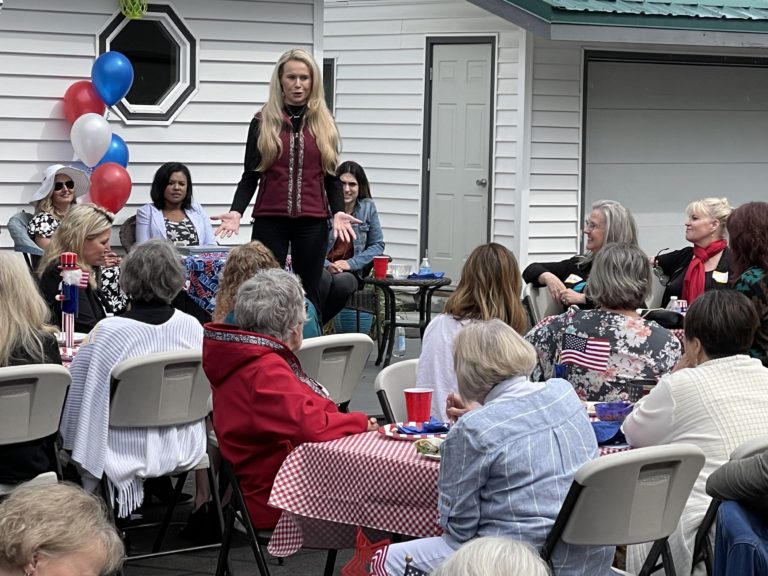
At the annual salad lunch of the Anchorage Republican Women’s Club, a powerhouse subset of the Alaska Republican Party, a unanimously supported resolution was announced saying the club is requesting the party’s State Central Committee endorse Kelly Tshibaka for U.S. Senate.

Tshibaka was the keynote speaker at the luncheon, which included attendees Mayor-elect Dave Bronson former Lt. Gov. Loren Leman, former Rep. Alyce Hanley, former State Senate President Drue Pearce, Rep. David Nelson, Rep. Tom McKay, former Rep. Sharon Jackson, and Eagle River Assemblywoman Jamie Allard.

Club President Judy Eledge read the resolution, which stated that the Alaska Republican Party had censured Sen. Murkowski, had vowed to find someone else to run as a Republican, and had asked Murkowski to not run as a Republican. The resolution also said that the club had fully vetted Tshibaka in accordance with party rules.

“We endorsed her,” said Eledge, explaining the resolution.

This is the second Republican women’s club in the state to endorse Tshibaka. The Republican Women of the Kenai passed a similar resolution several weeks ago.

The State Central Committee meets on July 10 in Fairbanks, where the matter is likely to be on the agenda. At the last meeting in March, 70 percent of the party voted against Murkowski and in favor of finding a new Republican candidate for Senate. Two weeks later, Tshibaka threw her name in the ring.

Read: New poll shows Tshibaka beating Murkowski and Gross on ranked-choice ballot

Legislative update: A tax is on the table, and a new ‘dividend fund’ plan is heard, conference committee stagnates

35

House Judiciary Committee on Wednesday heard alternative plans to the governor’s proposal to put the Permanent Fund dividend matter before voters.

Sen. Natasha von Imhof presented her plan, which is a competing concept to Gov. Mike Dunleavy’s, and would take $6.7 billion from the Alaska Permanent Fund, create a new fund, and pay dividends to the public that would start at about $500. According to her analysis, it would not require a broad-based tax.

When she got pushback on the fact that the smaller dividend is, in fact a tax on the people, she explained that it’s not a tax, it’s just “less free money.”

The dividend from the new fund would be up to 5 percent of the new fund’s market value, the same as used through the SB 26 formula to establish the maximum allowable draw from the Permanent Fund. It would operate as a mini-fund dedicated to dividends only, leaving the corpus of the Permanent Fund untouched and the spendable portion of the Permanent Fund just for government.

Von Imhof sits on Senate Finance, which has so far ignored Gov. Mike Dunleavy’s plan to essentially return to the 50-50 dividend calculation from the available portion of the Permanent Fund, which is a statute that has been ignored since 2016, by putting the formula in the Alaska Constitution; this would require a vote of the people. His plan, Senate Joint Resolution 6, was part of his call for the special session. Critics say it would also require a tax and they want him to propose a full fiscal plan to make the numbers work.

House Judiciary also heard Rep. Adam Wool’s proposal for a 2.5% income tax and a dividend of about $1,000. That plan, along with von Imhof’s, appears to have little broad-based support in the Legislature.

Meanwhile, the first Senate Finance hearing on the governor’s plan, SJR 6, is scheduled for Friday at 1:30 pm.

Read: Way-back machine: What voters advised lawmakers to do in 1999 when asked about using the Permanent Fund for government

Special session ends on June 18 and with one week to go, there is no operating budget, no capital budget, no mental health budget, and no Permanent Fund dividend. “Pink slips” indicating a possible government shutdown, would go out one week from today, on June 17.

House Bill 69, the operating budget, had $4.43 billion in state unrestricted funds when it was passed by the Senate for Fiscal Year 2022. The capital budget has $274.6 million, leveraging $1.9 billion in federal funds for roads, bridges, and other infrastructure.

The Permanent Fund’s Earning Reserve Account — the fund’s spendable portion — has more than $11 billion that is unencumbered, and the Legislature could transfer some of that into the constitutionally protected corpus of the Fund, to put it off-limits for spending, thus allowing the fund to grow faster. SB 26 limits the amount that can be used from the earnings reserve fund for government and the dividend.

The Legislature faces a challenge with the public because the Permanent Fund corpus balance is nearly $82 billion, just $18 billion short of what many legislators have said would be needed to never have to talk about broad-based taxes again.

To further the public perception challenge, at the beginning of the year, when the Permanent Fund was at $73 billion, the corporation’s own forecast said it would not reach $80 billion until 2030. Yet six months later it has blown past $80 billion.

Sources say that while the committee hearings have lightly dotted the special session calendar, the full House and full Senate are expected to meet on Monday, but conference committee work is the hold-up.

Alaska joins 17-state coalition to fight climate change lawsuit by Earth Guardians

Alaska Attorney General Treg Taylor has joined a 17-state coalition of attorneys general to intervene in Juliana v. United States, a lawsuit brought on behalf of 21 children, which states that their constitutional rights are being violated by climate change and government policies that do not stop climate change.

The youth, who say their rights to life, liberty, and property is being violated, are scheduled to be in court for oral arguments on a legal motion on June 25 in a case that has dragged on for over five years. Earth Guardians is the youths’ legal team.

The 17 attorneys general have moved to intervene after both Presidents Barack Obama and Donald Trump administrations sought to have the case dismissed, arguing that the U.S. Constitution gives the judicial branch no such policy-making power, which resides exclusively in the legislative and executive branches.

The Circuit Court of Appeals for the Ninth Circuit agreed with the federal government’s position and in early 2020, ordered the district court to dismiss the case. The court said that the matters should be addressed by the executive and legislative branches, not the courts.

The  U.S. District Court for the District of Oregon failed to dismiss the case. Now, the Biden administration is preparing to have settlement talks with the plaintiffs after a U.S. District Court judge ordered attorneys for the plaintiffs and the Department of Justice to convene for a settlement conference.

The court also scheduled oral argument on the youth plaintiffs’ Motion for Leave to File Second Amended Complaint, to be held telephonically on Friday, June 25, 2021 .

When judging a similar lawsuit in Kanuk v. State of Alaska in 2014, the Alaska Supreme Court reached the same conclusion as the Ninth Circuit, that it is inappropriate and unlawful for courts to hear this type of case.

“Both the Ninth Circuit and the Alaska Supreme Court have already decided that this type of lawsuit is outside of any court’s jurisdiction,” said Attorney General Taylor. “With the change in federal administration and its recent litigation positions, there is a significant chance the current federal defendant will not adequately represent Alaska’s interest in bringing this case to its already-decided close.”

Alaska, joined Alabama and Arkansas, Georgia, Indiana, Louisiana, Mississippi, Missouri, Montana, Nebraska, North Dakota, Ohio, Oklahoma, South Carolina, Texas, Utah, and West Virginia, in filing the motion to intervene.

Kelly Tshibaka launches digital ad campaign over 435 days before 2022 primary election

It’s evident that Kelly Tshibaka means business about running for U.S. Senate against Sen. Lisa Murkowski. This week, online ads for the Republican’s candidacy started showing up on Alaskans’ internet browsers.

Tshibaka’s digital ad talks about her upbringing in Alaska, and how the state gave her family a leg up. She says Murkowski has enabled President Joe Biden to take apart Alaska’s oil and gas economy, which is the job sector that would give other families the opportunities hers had.

The ad is running on social media sites, some websites, and streaming services like YouTube. It’s unusual to start an ad campaign so soon, but Tshibaka still has name recognition hurdles to clear, while Murkowski is a household name in Alaska. The ad buy also shows that Tshibaka is confident of her fund-raising ability.

Read: New Democrat poll shows Tshibaka winning in ranked-choice voting in Alaska

“Every Alaskan story is unique,” Tshibaka says in the ad. “Mine started in the ‘70s when my parents moved here. They were homeless for a while, but eventually they made it into the middle class. These days, though, they wouldn’t have that same opportunity.”

Today’s Alaska is not the same place, and that worries her as an Alaskan.

“That’s because with Lisa Murkowski’s support, the liberals in D.C. are attacking our resource industry. They’re shutting down our jobs. Every Alaskan should have the same opportunity that my parents had – to work an honest job, put a roof over their head, and maybe even send their little girl to college,” Tshibaka says in the ad.

Acting in Anchorage: LaFrance takes over as acting chair, Constant becomes acting vice chair of Assembly

Anchorage Assemblywoman Suzanne LaFrance of South Anchorage is the new acting chair of the Assembly, while Chris Constant of downtown has become acting vice chair.

The two replace Acting Chair Felix Rivera and Acting Vice Chair John Weddleton, but the situation is temporary.

The Assembly could reorganize again once Mayor-elect Dave Bronson is sworn into office and Acting Mayor Austin Quinn-Davidson returns to her seat on the Assembly, representing West Anchorage.

Chris Constant

The Anchorage government has been in “acting” mode since Oct. 23, when former Mayor Ethan Berkowitz resigned after a scandal erupted. Quinn-Davidson, who was chair of the Assembly, became acting mayor that day, temporarily reorganizing the Assembly and blocking anyone from taking her seat. It’s possible that Quinn-Davidson will not actually return to the Assembly, as she is rumored to be a pick for a position in the Biden Administration.

Warren Buffett major investors land in Juneau, talk with governor about Alaska energy potential

Berkshire Hathaway executives flew into Juneau to scout the state for investment potential for energy, logistics, ports, and the cargo hub of the Ted Stevens Anchorage International Airport. They met with Gov. Mike Dunleavy in Juneau on Tuesday. The Dunleavy Administration has been inviting private capital investment in Alaska, and investment houses are flush with cash right now.

Berkshire Hathaway, founded by Warren Buffett, is one of the most reputable companies in the world with one of the strongest balance sheets. It has $150 billion in cash, twice the size of the Alaska Permanent Fund.

For an apex investor to come to Alaska and meet with the governor, something had to have happened. As it turns out, Gov. Dunleavy started the conversation with Buffett a year ago in a letter he sent inviting Warren or his lieutenants to come learn about Alaska, and about potential for renewable energy investments in Alaska.

Berkshire Hathaway Energy in recent years expanded into solar, wind hydro, and geothermal projects and has one of the largest renewable energy portfolios in the U.S.

Renewables in Alaska are an untapped potential, including the newer technology of “pumped hydro,” which is an ability to use excess wind electricity to reverse-pump water back into a reservoir to store for later use as hydro energy when the wind dies down. This would open up a whole new world for smaller communities shackled with higher energy costs, sources say.

Tim Barto: Why are people not working?

By TIM BARTO

Employers want to hire employees but can’t get people to apply for or accept the jobs. This phenomenon is unknown in American history, and it’s one that does not seem to make any sense after 14 months of layoffs, business closings, and general economic hardship.  

Can it be that Americans are taking in so much money through unemployment compensation and other government benefits that going to work is, well, more work than it’s worth?  

Logic seems to answer that question with an unequivocal “Yes,” but the Biden Administration and others on the president’s side of the aisle argue that stories of people opting for government handouts instead of seeking work are anecdotal; that it’s just a theory without studies or statistics to back it up. The president says people want to work, but there are millions of job openings in the country that are going unfilled.

So let us look at some numbers and also hear some anecdotal stories from Alaskans who have been impacted by the current situation. These personal stories are reflective of what’s going on in the real world. To slough them off because they go against what someone wants to be true is to be in denial.  So, let’s listen to the stories and then make up our minds about whether a causal relationship exists.

A view of the national situation through Bureau of Labor Statistics numbers shows that in February 2020, the last month before the coronavirus pandemic struck the United States, there were 6.9 million job openings, and the unemployment rate was 3.6%.  

BLS’s most recent report tallied the current number of nationwide job openings at the end of March 2021 at 8.1 million. The United States’ unemployment rate for April 2021 was 6.1%.  In Alaska, it was slightly worse at 6.7%, which computes to 23,600 Alaskans out of work. Nationally, there are 9.8 million people who are currently categorized as unemployed, meaning there are 1.7 million more people without jobs than there are jobs available, but . . . that still means there are 8.1 million jobs in the United States waiting to be filled. 

The largest number of these available jobs are in hospitality industries such as hotels and restaurants, what BLS refers to as the accommodation and food services fields.  

Speaking of food services, a new restaurant, Lime Leaf by Basil Ginger, opened in my hometown of Eagle River earlier this year. Eagle River likes its eating establishments, and new restaurants, especially unique ones, pique our interests. Lime Leaf opened to such rave reviews and was doing such bang-up business from the start that they had to go to reservations only. And then, according to their own social media page, tragedy struck, and their head chef had to leave due to a family emergency. But there’s more to the story.  Their post continued, stating “. . . on top of that, we have had trouble getting enough staff.”

Staff for a restaurant means waiters, waitresses, cooks, and dishwashers.  Restaurants have been hammered over the past year by Covid-19 fears and, even more so, by government-mandated shutdowns.  Waiters, waitresses, cooks, and dishwashers have been out of work.  People seeking entry level jobs, like dishwashing, have a chance at getting their foot in the door for a paid job, yet this restaurant had trouble getting enough staff.  

My own 26-year-old son was furloughed by the local university earlier this year. Having moved into a new apartment the same week his pink notice arrived, he filed for unemployment compensation to bridge the gap until his flood of resumes struck paydirt. If felt like forever to him, but it wasn’t actually too long before he had a couple job offers from which to choose. They weren’t as lucrative as the job he’d had with the university, but they were paying jobs with benefits.  

“Pop,” he told me, “I’m only going to be making $30 more every two weeks than I was getting from unemployment.”  I was incredulous, but he was telling the truth, although unknown to him it wasn’t the complete truth.

It turns out my son is actually bringing home less money than he was getting from unemployment, as his gross income has the usual deductions – federal taxes, social security taxes, retirement account contributions, and medical insurance premiums – all adding up to a net income that is $300 less per month than what he was getting on the dole. He is happy to be working and productive, but he admits to seeing how people could be influenced to stay home and play X-Box instead of driving into work for less money.  

Oh yeah, driving. He has to spend money on gas, which is less money in his pocket. People collecting unemployment don’t have to spend money to drive to work.  

So how much do unemployed Alaskans get in unemployment compensation and other government benefits?  According to a 2020 study by the Foundation for Government Accountability, low-wage Alaska workers earn an average of 11 percent more while unemployed than while gainfully employed.  

But there’s more. Unemployed Alaskans can receive unemployment compensation ranging between a low of $56 per week to a high of $370 per week. If non-cash welfare programs – such as Medicaid, food stamps, and housing vouchers – are included, a non-working single parent with two children could earn just north of $5,700 per month, or nearly $33 per hour. Each dependent, you see, provides an unemployed parent with an extra $75 per week; so someone with has two children and is collecting unemployment receives $150 per week on top of unemployment compensation they are already receiving.   

Back to my son. One of his close acquaintances works for Franz Bakery in Anchorage. A couple weeks ago she mentioned that the company was having difficulty filling entry-level positions so I figured I would talk to her boss.  Larry Brandt is the general manager at Franz Bakery, and he reported that his company was gearing up for their annual increase in business. Warm weather, it turns out, causes people to head toward dormant barbecue grills to cook hot dogs and hamburgers at a prodigious rate, so the bakery heats up production of buns when the ice melts.  

Roughly a month ago, Franz published openings for entry-level jobs. Response was dismal.  After a couple weeks, Brandt made the pay and benefits package more prominent a feature in his help wanted notices:  $20 per hour plus medical, dental, and vision coverage. 

The response this time was noticeably different.  People applied for the positions and the bakery is now at full staffing, a fact that allows Brandt to say his operation has been fortunate. Asked if any of his employees actually quit to take advantage of unemployment benefits, Brandt said he is aware of only one such incident within his company.  An employee opted out rather early in the pandemic, making it clear that he could be well compensated without working eight hours a day in a hot bakery. 

As a local business leader, Brandt talks with other people who run other businesses with 100 to 200 employees on payroll.  Many of those other business managers, he confides, are not so fortunate, especially those who manage large stores owned by big corporations.  They are understaffed and struggling to find workers to fill vacancies.  Some of them have turned to offering signing bonuses for cashiers and stockers.  

So, what does it take for some of those other unemployed people to join the workforce?  Let’s turn to an employment recruiter.  

Billy Hughes is an Alaskan who recruits employees for a large real estate firm, is a licensed realtor himself, and has his own staffing and consulting company. Suffice to say, Hughes is not afraid to work; in fact, he likes it so much he helps find jobs for other people, including real estate agents, property managers, landscapers, marketers, and general laborers.  

He has interviewed 150 people since the start of this year, and only 24 of those interviews resulted in people accepting and actually starting new jobs. Keep in mind, please, that these are people who were pre-screened to meet certain job requirements, and for whom behavioral assessments were conducted.  In other words, these are people who applied for jobs, were qualified for jobs, and were offered jobs.  Yet, just under one-sixth of them ended up accepting job offers. Fully 126 of them either did not return calls, did not follow up after an offer was made, accepted a job and then failed to show for work, or simply turned down the position.  

Asked if any of those applicants who turned down the positions actually expressed that their reason for doing so was because they were making enough from unemployment wages, Hughes said approximately five of them fell into that category.  Most others simply did not return calls or give reasons for not accepting the offers, so their motives are left to speculation.

Hughes works with employers who need unskilled laborers to dig post holes, deliver flyers, and hang signs.  One of these employers was paying $12 to $13 per hour for such work last year but is now having to offer $20 to $30 because he cannot get enough applicants to work for the previous wages.  

Hughes, a 10-year veteran and Army Airborne Ranger who admits to holding a conservative philosophy, said that people just have to “do the math” to realize the issue at hand.  Jobs are available, especially at the entry-level, but people are just not taking them.  

Yet somehow these people have money, and that money is coming from somewhere. That somewhere is unemployment compensation and other government benefits. On the other hand, people who want to work are able to make good wages and put in plenty of hours.  (See previous paragraph regarding $20 to $30 an hour to dig post holes.)  

But it’s not just post-hole digging and sign-hanging jobs that are not getting filled. Medical practitioners are also having difficulties finding people to fill vacancies. Wade Erickson, M.D., is the founder of Capstone Clinic, a prominent medical business headquartered in Wasilla, and one that has been at the forefront of COVID-19 testing.  Capstone is a successful business with clinics or employees located throughout much of the state, including Anchorage, Eagle River, Fairbanks, Juneau, and Ketchikan. The company is currently running radio spots all over Alaska, advertising jobs for swabbers and screeners who stand to make $15 to $20 per hour. This is the first time Dr. Erickson has resorted to radio advertising to fill vacancies. The reason? Not enough applicants. Much like Franz Bakery, Capstone’s openings are usually filled with ease, often by word of mouth by employees or others within their respective industries.  But Capstone needs people right away and they’re not getting them.  

Capstone has been hiring consistently for the past year due to its COVID-19 testing work, and it has been a struggle for most of that year.  Dr. Erickson is of the opinion that it’s the increased unemployment benefits that are keeping applicants at bay.  His company pays well and goes to great lengths to keep its employees safe. Some of the positions involve data entry – sitting at a computer and not interacting with the public, and even those positions are not attracting applicants.  

Another Southcentral-based health business, this one a successful dental practice, is having difficulties hiring dental assistants, positions that require minimal experience but pay twenty-plus dollars per hour.  They are also struggling to hire dental hygienists, occupations that pay well over $50 per hour.  The dental proprietors said they are not the only such business with this problem.  They communicate regularly with their tooth-fixing colleagues, and all of them express the same concern:  they can’t get enough people to fill their job openings. 

Are all these anecdotes proof that high unemployment insurance payments are causing people to stay home instead of looking for work?  Perhaps not, but one has to be in grave stage of denial to think they don’t mean anything.  Plenty of pre-COVID studies show that collecting unemployment insurance reduces the intensity put forward in looking for a job.   

The Foundation for Government Accountability cites the following studies:  Eardley (2019), Canon and Liu (2014), Moffit (2014), Filges et al (2013), Farber and Valetta (2013), Schmeider et al (2012), Krueger and Mueller (2008), and Lalive et al (2004). This volume of research pretty solidly substantiates the idea that people are content to collect government subsidies than put themselves out there to find work.

So, is this the type of information needed to convince folks that enough is enough when it comes to compensating people for not working?  Twenty-three states think it is. 

Last month, Governor Dunleavy joined the several other governors who were putting an end to the $300 weekly bonus provided by the federal government. That federal bonus added $300 onto what individual Alaskans were already receiving in unemployment compensation.  If an Alaskan was getting the top tier weekly compensation of $370, the federal government bonus made it $670 per week. 

If we do the math, as Billy Hughes suggested, we find that $670 per week comes to just under $17 per hour, which is higher than the $15 minimum wage being touted by so many as necessary for a living wage.   

Perhaps this proliferation of unemployment compensation has replaced the need for a minimum wage, or perhaps this is one of those opportunities to not let a good crisis go to waste.  It all seems eerily like a guaranteed basic income; government subsidies replacing the traditional work ethic.  

A couple states are fighting against this largess of government subsidies, going so far as to actually reward people for going back to work. 

The state of Montana is offering $1,200 to unemployment recipients who accept a job and stay on that job for four weeks.  

Arizona is offering $2,000 for individuals who start a full-time job, and $1,000 to those accepting part-time work.  The Grand Canyon State is also instituting community college scholarships for unemployed workers, and even three months of childcare assistance for parents returning to the workforce.  

So now we’ve reached the point where state governments are paying people to go back to work. It’s not exactly fiscal conservatism but it’s better than paying them not to work.  

Tim Barto is employed full-time as vice president with the Alaska Policy Forum.