Saturday, June 13, 2026
Home Blog Page 1005

Alexander Dolitsky: Fables of how Swan found happiness, and Sun and Moon quarreled

2

By ALEXANDER DOLITSKY

These two literary fables, “How Swan Found Happiness” and “The Quarrel between Sun and Moon,” are incorporating the style and motifs found in the northern oral narratives. The main purpose of these fables is to explain, to teach, and to exemplify how to behave in society.

Although my literary tales do not provide an authoritative moral code by which to live, they convey a moral directive in imploring readers to examine the extent to which we humans are victims of circumstances versus the extent to which we are the makers of our own destiny.

While written in a traditional style, my tales contain lessons relevant to today’s social and political challenges, such as regional conflicts and territorial disputes, displacement of people from their homelands to foreign lands, adaptation to new social and physical environments, and the search for happiness, faith and peace in the turbulent and ethnically diverse global society in which we now find ourselves. In other words, how we might begin to get along with one another and understand, respect, and tolerate our neighbors’ traditions, beliefs, customs, accents, and rights, while at the same time preserving our own unique ethnic identities and core cultural values. 

How Swan Found Happiness

This happened long, long ago, when people lived off the gifts of the land and sea, when winter did not quarrel with summer, and when Rivers of Ice (majestic glaciers) proudly stood in the mountain valleys. In those faraway times, Raven reigned as master of the sky; Wolf prowled deep into the tangled forest; Beaver swam unbothered in the secluded ponds; and Fox hunted freely alongside the flowing brook. All of these creatures lived where they should be living, where their ancestors, after living there many long years, had left them a memorable legacy. They were at home.

Only white Swan was a stranger in this faraway land, struggling to find his natural place. A ferocious wind had blown up from the sea and swept him away from his native flock, carrying him far inland into this strange land. When he tried to rest in a forest meadow, Raven would screech down at him and Wolf would chase after him. If he landed in the middle of the pond, Beaver would threaten him and chase him off, too. When he landed on the river, Fox, fussing about on the bank, would rush toward him, defending her burrow from the foreign white bird. 

So, it was that Swan found himself hurrying from one place to another in search of a welcoming, compassionate, cozy home—in search of happiness.

Owl, noticing the lone Swan flying about unable to find his place, spoke to him. “Listen, Swan, you will never find peace on this land that is so strange and foreign to you. You will never find love and happiness here. You should fly away to another place.”

Ruffling his feathers, Swan replied, “And where would I fly to? A wind from the sea carried me here against my will. It took me away from my native flock. Time will pass,” he assured Owl, “and my forest neighbors will become friendly. One day, they will accept me into their world.”

Owl listened attentively, turned his head to the right, then to the left, peered at Swan with huge round eyes, blinked, and said, “Come see me in the spring, when the salmonberries begin to ripen and the red salmon are just about to swim up the river to spawn. If by spring you have found happiness, a new home, and love in this land, I’ll give you my respect. If not, I’ll give you my advice.”

Swan flew away into the cold winter. For months he hid in the forest out of sight of the animals, away from their homes. When spring arrived, he flew back to where he had met Owl and confessed to him, “I’m so tired. I haven’t been able to find happiness, a new home, and the love of others in this land. Tell me what to do! Where should I go? Where should I live?”

Owl pondered for a moment and replied, “To find the happiness you seek, you must overcome your fears. You will be tested three times. Each time you must defeat evil and cowardice with kindness and bravery. Here is my feather. Fly wherever it flies and stop wherever it stops.”

The feather took flight, sailing off toward the setting sun, Swan flying along behind it. How long they flew, who can say? They flew across seven forests. The feather flew ahead, finally alighting in a forest meadow. Landing behind it, Swan caught sight of Wolf sitting still in the meadow. His leg was caught in a trap! Seeing Swan approaching, Wolf growled softly at him, then yelped in pain.

Having no choice, Wolf begged Swan to help him get free from the trap. Swan pricked up his ears, thinking: “He chased me out of the forest. He wanted to rip me to pieces, to shred me. How can I trust him? I will only make myself easy prey for him! But, if I help him, maybe we will become friends, and he will share with me his forest home.” Swan wanted to trust Wolf, but he was afraid. Wolf yelped in pain again. He looked at Swan, his eyes filled with desperation. “I must help him, even if he might try to tear me to shreds,” decided Swan.

Swan approached the howling Wolf. Using all of his strength, he pressed his beak between the trap’s jagged jaws and pried with all of his might, until at last the trap sprung open, freeing Wolf’s leg. Wolf stood up on all fours and limped away. At the forest’s edge, he turned and smiled his thanks to Swan.

Owl’s feather took to the sky again, and Swan followed. They flew across seven lakes. The feather, light as a faded autumn leaf, softly descended onto a lonely, sleepy lake. And so did Swan. Swan’s heart began pounding when he heard Beaver’s tail slapping the water nearby. “Oh, Beaver will attack me and kill me,” frightened Swan whispered to himself, as he paddled quietly to the edge of the lake to hide in the tall grass. 

Beaver was building a dam. But spring thaw had brought a flood. No matter how many sticks and branches Beaver put in place, he could not stop the water that poured out of the lake and into the stream. Swan watched as Beaver swam back and forth with branches, crawling along more and more slowly with each trip as he ran out of energy; he could not do it by himself. Swan knew if Beaver did not get his dam built, he would never survive the cold winter. 

So, Swan said to Beaver, “I can help you build the dam. I can bring you many twigs and branches, and together we will stop up this stream. And for my help, maybe you’ll allow me to live on this lake.”

In response, Beaver turned his back and set off to weave some branches into the dam. “Well,” contemplated Beaver to himself, “I can’t do this by myself. I need help. The lake is big, enough for two.” Turning back to Swan, Beaver indignantly muttered, “Fine, help me. And you can live here, too. But only at the other end of the lake.” Beaver then sank into the water and continued his work.

Swan brought many twigs and branches. Working together, Beaver and Swan built a dam so strong no flowing stream could penetrate it. Swan watched as Beaver used his last ounce of energy to dive down and crawl into the safety of his dam. 

The feather flitted off over Swan’s head, again floating in the direction of the sunset. Swan took flight behind it. They flew across seven rivers. The feather landed on the bank of a tumbling brook, with Swan landing beside it, not far from Fox’s den. Spotting Swan, Fox, fearing for her kits, began to fuss. She tried to fool Swan, walking slowly away in hopes of enticing the white bird away from the den.

“Don’t be afraid of me,” pleaded Swan. “I have landed here in search of happiness, and not to get your kits. I’ll be a kind and true neighbor; I’ll protect your den.” 

Swan turned to Fox for an answer, but Fox squinted her eyes and looked back at Swan in puzzlement. “Protect us?” she wondered. “That strange white bird could be trying to trick me. But, then, he does seem to be sincere.”

“I’ll warn you of danger from the sky and bravely defend your home and your kits,” continued Swan.

“Swan would be able to see everything from up in the sky,” considered Fox. “Indeed, he could be a very helpful neighbor and is too proud and trustworthy for deceit.”

“All right, I’ll share this place with you, but right now I need to go hunting,” she said, running off into the woods.

“What’s that?” Swan puzzled. Suddenly he found himself standing right at the very place Owl’s feather had first flown from in search of happiness. All around him, on the lakes and ponds, water lilies burned fire red, birds sang… And directly in front of him stood a female Swan of unusual beauty. He had never seen such a graceful swan in all his life. Behind the female Swan sat Owl, looking at him with frank admiration.

“In following the feather, you feared nothing; you listened to your heart, not your fears,” said Owl. “You withstood all tests and challenges. You defeated evil with good deeds. By offering help, you gained friendship; and by your courage, you acquired freedom. Thus, you have found happiness, love, and your home.

”The two swans thanked Owl for his wisdom and good words. They spread their wings wide, and together flew into the unbounded blue sky, over the forests, lakes, and rivers—their new place.

 So, the two swans became mates. They loved each other and lived happily in their new home for many, many years.

The end.

The Quarrel between Sun and Moon

So, it was. One time, Sun and Moon got into a quarrel about who was more important and who should be the master of Earth.

Said Sun to Moon: “When I rise, every living thing on Earth rises with me—the people, animals, forests, and fields. I bring them warmth and light. Every living thing originates from me and every living creature depends on me. Without me, there would be no life.”

Moon replied, “And when you disappear beyond the horizon, I come to replace you. I bring quiet and comfort to all. The oceans and seas are attracted to me with their incoming and outgoing tides. I reveal the stars in the heavens. At night, I become a beacon for all living creatures, a compass for people and animals. Without me, there would be no life.” 

Sun and Moon argued endlessly on and on, neither able to convince the other who was more important and who deserved to rule Earth. They were so stubborn, they could hear only their own voices; neither could hear the other’s reasons. 

Finally, growing tired of arguing, they agreed to ask Day and Night to decide which of them was more important.

“Day—tell us. Which of us is more important? Who has the right to be the master of Earth? Sun or Moon? You decide!”

Lit up in bright, iridescent colors, Day, drawing from his own brilliant insight, pondered the questions and replied, “From sunrise to sunset, I see Sun; I encounter only him. He brings light, warmth, joy, and energy to all. Yes, yes, sometimes he does also bring misfortune—drought, harsh heat, fires . . . But without Sun, I would not have a place on Earth! Yes, Sun is more important. Sun should be the master of Earth!”

Sun smiled at Day with gratitude, glowing yet brighter from a thrilling pride. “Yes, I am more important,” he muttered to himself giddily.

Sun and Moon then turned to Night. 

“Night—tell us. Which of us is more important? Who has the right to be the master of Earth? You be the judge!”

Night grew dark, then even darker—pitch dark, becoming quiet, like a dove. Then said Night in a soft voice, “From sunset to dawn, I see only Moon. I live alone with Moon and all of the stars. Moon brings serenity, rest, and mystery, and, after sunset, she lights the Earth. Yes, sometimes her tides are too high. And sometimes she disappears, leaving the world in darkness.”

Night’s voice was so quiet and calm, Sun, Moon, and Day had to lean in to hear it. “But without Moon,” continued Night, “I could not exist! She is my partner and my neighbor. Moon is worthier. Moon should rule Earth!”

Shining bright and full, Moon glanced at Night gratefully; and with a newfound confidence Moon whispered under her breath, “Yes, sometimes a whisper speaks louder than a shout. All in all, I am more important!”

Thus, Sun and Moon failed to resolve their argument. They did not know whom to ask or where else to turn for advice.

Hovering silently nearby, Wind, hearing the quarrel of Sun and Moon, grew exasperated by their pride and arrogance. Suddenly blowing in from all directions, Wind addressed Sun and Moon in a loud voice, “I exist in all regions. I travel everywhere. I gather clouds that neither of you can penetrate, devastating Earth at will with hurricanes, storms, and tornadoes. When I come with my frost, I freeze the entire land. I cover the rivers and lakes with ice. And when I arrive with snow, I cover all of the land with it. I hide everything under the snow. But I also bring cool, drying breezes and caress all living creatures. 

“I watch over you from all remote corners of Earth during both day and night. I scatter clouds to reveal your beauty and power. If not for me, you would remain hidden behind the clouds forever. Indeed, without any one of the three of us, there would be no life on Earth.

“Who of you is more important, you ask? I’ll tell you,” Wind resumed. “To me, everything is equal and everyone is important. But it is the one who lives in peace, the one who appreciates others and treats them with kindness, and who endeavors to make life better for everyone—that one is worthiest!”

Embarrassed, Sun and Moon lowered their heads. Memories of their long debate now filled them with shame. “So, how should we settle our argument? How can we once again find peace between us? Doesn’t someone have to be the master of Earth?” they asked Wind sheepishly.

Wind stepped back and drew a deep breath. Puffing up his powerful cheeks, his huge round eyes of an ox wide and bulging, he looked at Sun and Moon with a penetrating stare.

“You agree between yourselves,” he spoke. “Day is for Sun. And Night is for Moon.”

Sun and Moon lowered their eyes; they stood silent and still. 

“You are both important and worthy,” continued Wind. “Each of you is the master of your own realm. Live in this world in peace—for yourselves and for others!”

And that’s all.

Alexander B. Dolitsky was born and raised in Kiev in the former Soviet Union. He received an M.A. in history from Kiev Pedagogical Institute, Ukraine, in 1976; an M.A. in anthropology and archaeology from Brown University in 1983; and was enroled in the Ph.D. program in Anthropology at Bryn Mawr College from 1983 to 1985, where he was also a lecturer in the Russian Center. In the U.S.S.R., he was a social studies teacher for three years, and an archaeologist for five years for the Ukranian Academy of Sciences. In 1978, he settled in the United States. Dolitsky visited Alaska for the first time in 1981, while conducting field research for graduate school at Brown. He lived first in Sitka in 1985 and then settled in Juneau in 1986. From 1985 to 1987, he was a U.S. Forest Service archaeologist and social scientist. He was an Adjunct Assistant Professor of Russian Studies at the University of Alaska Southeast from 1985 to 1999; Social Studies Instructor at the Alyeska Central School, Alaska Department of Education from 1988 to 2006; and has been the Director of the Alaska-Siberia Research Center (see www.aksrc.homestead.com) from 1990 to present. He has conducted about 30 field studies in various areas of the former Soviet Union (including Siberia), Central Asia, South America, Eastern Europe and the United States (including Alaska). Dolitsky has been a lecturer on the World Discoverer, Spirit of Oceanus, andClipper Odyssey vessels in the Arctic and sub-Arctic regions. He was the Project Manager for the WWII Alaska-Siberia Lend Lease Memorial, which was erected in Fairbanks in 2006. He has published extensively in the fields of anthropology, history, archaeology, and ethnography. His more recent publications include Fairy Tales and Myths of the Bering Strait Chukchi, Ancient Tales of Kamchatka; Tales and Legends of the Yupik Eskimos of Siberia; Old Russia in Modern America: Russian Old Believers in Alaska; Allies in Wartime: The Alaska-Siberia Airway During WWII; Spirit of the Siberian Tiger: Folktales of the Russian Far East; Living Wisdom of the Far North: Tales and Legends from Chukotka and Alaska; Pipeline to Russia; The Alaska-Siberia Air Route in WWII; and Old Russia in Modern America: Living Traditions of the Russian Old Believers; Ancient Tales of Chukotka, and Ancient Tales of Kamchatka.

Read: Neo-Marxism and utopian Socialism in America

Read: Old believers preserving faith in the New World

Read: Duke Ellington and the effects of Cold War in Soviet Union on intellectual curiosity

Read: United we stand, divided we fall with race, ethnicity in America

Read: For American schools to succeed, they need this ingredient

Read: Nationalism in America, Alaska, around the world

Read: The case of the ‘delicious salad’

Read: White privilege is a troubling perspective

Read: Beware of activists who manipulate history for their own agenda

Read: Alaska Day remembrance of Russian transfer
Pebbled: Climate change and predictions for the future that were wildly wrong

By MARK HAMILTON

Climate change is an anti-developer’s dream. It’s a topic everyone is familiar with and it can assign dire warnings to virtually anything, because it is a prediction of the future.  

Remember I asked you to develop your own filter so you can pick your experts? Before you panic, check if the source has correctly predicted anything.  Nonetheless, regulations have been established that account for that fear-based future.  I’ll introduce one in a bit.  In the meantime, recognize this about the future.  Identify and examine these last ditch arguments about development projects in Alaska.    

“Well it might be alright for now, but what about the unknowable future?”

The predictions have been all wrong for generations. From the Competitive Enterprise Institute, just a few of the more flamboyantly wrong predictions:

1966: Oil gone in 10 years

1967: Dire famine by 1975

1968: Overpopulation

1969: Everyone will disappear in a cloud of blue steam by 1989

1970: World will use up all its natural resources by 2000

1970: Urban citizens will require gas masks by 1985

1970: Nitrogen buildup will make all land unusable

1970: Decaying pollution will kill all the fish

1970s: Killer bees!

1970: Ice Age By 2000

1970: America water rationing by 1974 and food rationing By 1980

1971: New Ice Age coming by 2020 or 2030

1972: New Ice Age by 2070

1972: Oil depleted in 20 years

1974: Space satellites show new Ice Age coming fast

1974: Another Ice Age?

1974: Ozone depletion a ‘Great Peril to Life’

1976: Scientific consensus planet cooling, famines imminent

1977: Department of Energy says oil will peak in 1990s

1978: No end in sight to 30-year cooling trend

1980: Acid rain kills life in lakes

1980: Peak oil in 2000

1988: Regional droughts (that never happened) in 1990s

1988: Temperatures in DC will hit record highs

1988: Maldive Islands will be underwater by 2018

1989: rising sea levels will obliterate nations if nothing done by 2000

1989: New York City’s West side highway underwater by 2019

1996: Peak oil in 2020

2000: Children won’t know what snow is

2002: Famine in 10 years if we don’t give up fish, meat, and dairy

2002: Peak oil in 2010

2004: Britain will be Siberia by 2024

2005: Manhattan underwater by 2015

2006: Super hurricanes!

2008: Arctic will be ice free by 2018

2008: Al Gore predicts ice-free Arctic by 2013

2009: Prince Charles says we have 96 months to save world

2009: UK Prime Minister says 50 Days to ‘Save the planet from catastrophe’

2009: Al Gore moves 2013 prediction of ice-free Arctic to 2014

2013: Arctic ice-free by 2015

2014: Only 500 days before “climate chaos”

We deal with climate every day in our lives. We can handle the future.  We prepare to the best of our ability; we monitor how that preparation is doing; and we react to adjust that preparation. You do it all the time with your insurance policies, your finances, your education, your job and so forth.

In the Pebble project, the developer had excellent knowledge of the climate at the site because of the existence of the Iliamna airport about 18 miles away.  The project has nearly 80 years of meteorological data.The engineering requirements for the main water collection pond are formidable.  

Here is how you must design it:

First, account for the wettest 20 consecutive years at the site, then lay over that the largest snowpack in 100 years, with the assumption that it will all melt in 24 hours (that’s a bunch of heat and wind).  

Add to that the largest 24-hour rainfall in the data (which you might expect in July or August). Then add additional safety (called freeboard) to the holding capacity.  

This accounts for the “500-year flood” with an additional safety margin.  

This is required even though the last 17 years have shown less precipitation than the average and the last 30 years have very little variance.  Now, the requirement is not terribly hard to design for; it just means you will have to build a bigger containment pond than you might otherwise, and there is nothing lost having it about 1/3 full for the life of the mine.  

What frustrates me a little is this simple reality; if such events happened, if you really believed they were remotely possible, to heck with the mine that by this engineering requirement would still be standing; what about the villages along the rivers in Bristol Bay?  They would all be washed to the bay.  So what if the mine is still standing? If these are conceivable future events, let’s begin to fortify or relocate the human beings certain to be in danger with or without a mine.

The “Pebbled” series at Must Read Alaska is authored by Mark Hamilton. After 31 years of service to this nation, Hamilton retired as a Major General with the U. S. Army in July of 1998. He served for 12 years as President of University of Alaska, and is now President Emeritus. He worked for the Pebble Partnership for three years before retiring. 

Pebbled 1: Virtue signaling won out over science in project of the century

Pebbled 2: Environmental industry has fear-mongering down to an art

Pebbled 3: The secret history of ANWR and the hand that shaped it

Pebbled 4: When government dictates an advance prohibition

Pebbled 5: EPA ‘just didn’t have time’ to actually go to Bristol Bay

Pebbled 6: The narrative of fear

Pebbled 7: The environmentalists who cried wolf

Pebbled 8: Build your media filter based on science, not narrative

Pebbled 9: The history of hysteria

Pebbled 10: Mining 101

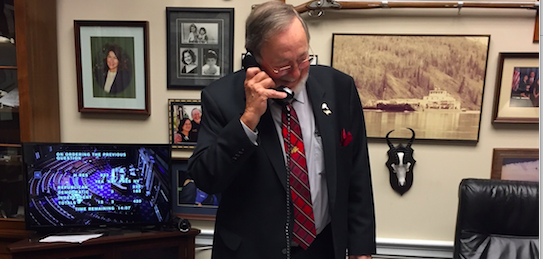
Congressman Don Young is in it to win it

Congressman Don Young filed last April to run for his 26th term in Congress. But some have asked if he is really running or if he is a lion in winter.

On Nov. 15, 2021, he let Alaskans know Don Young is in it to win it.

Young announced his campaign team, with Art Hackney, vice president of Axiom Strategies, in charge as lead strategist, and Matt Shuckerow as consultant and advisor. Curtis Thayer is treasurer of the campaign, and Sen. Josh Revak is the campaign chair. It’s a team that has a lot of election wins in its sails.

Young is the Republican Party’s longest-serving member of the House of Representatives and of Congress in history, having represented Alaska for 25 terms. He has never lost an election since 1973.

He is Dean of the House, the longest-serving current member.

Young is being challenged by four other Republicans: Gregg Brelsford, Randy Purham, Shannon Scott Evans, and Nick Begich III.

“A lot has been said about my intentions to seek reelection, but let me be clear: I’m running to continue serving the Alaskan people in Congress and I’m running hard,” Young said. “I’m excited to announce key members of my 2022 campaign team, including my friend and fellow Army tanker Senator Josh Revak as my Campaign Chair. With so much on the line in 2022, including the likelihood we retake the House with a robust Republican majority, I’m running to ensure Alaska has a strong and experienced voice to effectively challenge the Biden administration’s many failed policies, including their constant attacks on our economy and the Alaska energy sector. I look forward to once again working with Alaskans from across the state to build a strong and successful campaign.”

Revak, a Purple Heart recipient, previously served as military and legislative affairs liaison for both Congressman Young and Sen. Dan Sullivan before being elected to the Alaska State Legislature.

“The fire in Don Young’s belly remains as strong as ever and he’s focused on running another hard-fought campaign to represent Alaska in the U.S. House of Representatives,” Revak said. “Congressman Young has time and again proven that he is an effective and tireless voice for Alaska; someone willing to speak loudly and carry a big stick when it comes to advancing our priorities and pushing back against Nancy Pelosi and Joe Biden’s radical anti-Alaska agenda.”
 
Hackney is a longtime political consultant and now vice president for Axiom Strategies (the strategy firm behind Virginia Governor-elect Glenn Youngkin recent campaign victory). Hackney has helped advise the Young campaign in 21 previous election cycles. Hackney most recently served a senior strategist and consultant on the winning Bronson for Mayor campaign in 2021.

“Don Young is a no frills, straight shooting advocate for Alaska. He’s never backed down from a challenge, especially when it comes to battling it out over Nancy Pelosi and AOC’s misguided policies,” Hackney said. “Don is the type of leader that wins the fights Alaska can’t afford to lose. We’re confident we’ll have the resources and grassroots support to build an energized campaign in 2022.”
 
Longtime political aide Matt Shuckerow has experience as a Young alumnus, having served as press secretary for Young in the early part of his career. He also worked for Gov. Mike Dunleavy, Anchorage Mayor Dave Bronson, and recently led U.S. Sen. Dan Sullivan’s 2020 reelection bid as campaign manager. Shuckerow has a new political communications firm, Fathom Strategic, based in Anchorage.
 
“I’m honored to have worked with our congressional delegation over these many years to advance Alaska’s interests,” Shuckerow said. “Having been on the ground firsthand, there’s no question Don Young is the type of leader Alaska needs in Congress. No amount of political ambition can replace Don Young’s experienYounce. He gets it done, he knows the path of least resistance for Alaska priorities, and he works closely with the Governor, the Legislature, and communities and mayors across the state to ensure doors always open for Alaska.”

Young is consistently ranked as one of the most effective lawmakers in Congress by the nonpartisan Center for Effective Lawmaking.

No Democrats have filed to challenge Young. Alyse Galvin ran against him with the backing of the Democratic Party during the last two election cycles, but during her second run, she suffered a greater loss than her first run, when her name recognition was a barrier. Once Alaskans got to know her, fewer of them voted for her in 2020, and Young won 54.5 to 45.3 percent.

Rodney Dial: I stand with those unwilling to allow their rights to be turned into privileges

By KETCHIKAN MAYOR RODNEY DIAL

Today the Alaska Municipal League is holding a multi-day conference in Anchorage.  This event brings hundreds of elected officials together to discuss topics of mutual concern to influence State and Federal decision making.   As Mayor of the Ketchikan Gateway Borough, I want to be there, but I can not in good conscious attend for the following reasons.

For the first time in AML’s history, attendees have been notified that they must submit proof of vaccination or a negative test, and agree to a release of liability.   It’s straightforward they say…upload your proof of either to an app, get a green stamp next to your name and you are now worthy to attend.

It’s not like you have to be vaccinated, they say… you can be tested.  For me, the mere statement of “you can be tested” as some alternative, infers a complete personal disconnect that they have already been conditioned to accept a new normal, as if in their mind the process of showing health papers to engage in an activity is somehow materiality different than showing vaccination papers to do so.

In response to the “show your papers” requirement, I asked the director of AML for a few minutes to address (remotely from Ketchikan) my peers….the request was denied. 

I had hoped to start a discussion on how these actions normalize a behavior that has on many occasions in our past turned into a grave error.  

That grave error is segregation and discrimination. We have done this before with Native, African and Japanese Americans…and here we go again, this time with the unvaccinated and those who refuse to submit to unnecessary health procedures (testing without symptoms). In each case the justification was exactly the same, just repackaged…always about safety of one group vs. the other.   

Additionally in each instance, the majorities at the time supported the efforts, and as we now look back they were seen as being on the wrong side of history… every time.

In our lives if we are lucky, we get one or two “Braveheart moments.” These are opportunities to truly stand against the many, to take the difficult path, and make a difference for those that come after.

With that in mind I say to the elected officials at the AML conference…

I see many of my countrymen, assembled in Anchorage, normalizing actions in support of tyranny. You took an oath to support the rights of free men (and women) and free they are. But what are you as elected officials if they loose their freedoms?

Will you fight for their rights? Or will you run from your responsibility to maintain your elected status? Fight and you may die (politically); run, and you’ll maintain your elected status…at least a while.

And at the end of your elected career, many years from now, would you be willing to trade all the days, from this day to that, for one chance – just one chance – to truly stand for the very principle this country was founded on, and tell the citizens we serve that you were willing to risk your political lives so that they would never loose their freedom?

Please consider the side of history you want to be on.

As for me, I’ll stay here in Ketchikan with my fellow Alaskans, including those being turned into 2nd class citizens for their personal health decisions. I stand with those unwilling to allow their rights to be turned into privileges, doled out on the basis of their obedience.  Enjoy your conference. 

These are my own personal comments and I am not speaking for any other entity.

Rodney Dial is the mayor of Ketchikan.

FBI raid on Project Veritas founder’s home has similarity to raid on Homer, Alaska couple’s home in April, as agents looked for Nancy Pelosi’s laptop

A Homer, Alaska couple, whose home was wrongly raided in April by federal agents who said they were looking for House Speaker Nancy Pelosi’s stolen laptop, can relate to what happened to investigative journalist James O’Keefe last Saturday.

Read: U.S. Sen. Dan Sullivan asks DOJ Merrick Garland to apologize for raid on Homer couple’s home

O’Keefe, the founder of the conservative-oriented Project Veritas, had his home raided by the FBI this month, looking for evidence that O’Keefe had stolen President Joe Biden’s adult daughter’s diary. FBI also raided the homes of other members of the Project Veritas team.

O’Keefe runs the investigative news organization that has conducted dozens of video sting operations, exposing waste, fraud, abuse, and election and government malpractice. He uncovers things that the mainstream media never thinks of looking at.

And he did, in fact, come into possession of the diary, but he never published any of it, and he turned it over to the police, he said, so it could get back to Ashley Biden.

Similar to what happened to Marilyn and Paul Hueper of Homer in late April, the FBI handcuffed O’Keefe during the raid and made him stand in his underwear for hours, while they ransacked his home in Westchester County, NY.

The raid on O’Keefe’s home was so egregious that even the liberal ACLU has issued a statement condemning it, saying “the precedent set in this case could have serious consequences for press freedom. Unless the government had good reason to believe that Project Veritas employees were directly involved in the criminal theft of the diary, it should not have subjected them to invasive searches and seizures. We urge the court to appoint a special master to ensure that law enforcement officers review only those materials that were lawfully seized and that are directly relevant to a legitimate criminal investigation.”

The Biden Administration’s Justice Department blundered similarly last April, when FBI agents decided that Marilyn Hueper had illegally entered the U.S. Capitol, made her way to the House Speaker’s Office, and had stolen the laptop. It was not until October that the FBI found the real culprits — in New York. It was a case of mistaken identity, when the raid took place at the Huepers’ home. A review of the documents in the case show sloppy investigation methods and a rush to judgment by the FBI and other federal agents, such as the Capitol Police.

But by then, the Huepers had found their lives made much more difficult, as they’ve been put on a special “search” list at TSA. Air travel has become all but impossible for them.

Unlike the New York ACLU, which has strongly condemned the FBI in the O’Keefe raid, the Alaska chapter of the ACLU was silent on the raid of the Huepers’ home.

In the case of O’Keefe, the matter got even weirder, as the FBI apparently leaked secret information gained in the raid to the New York Times, which then published a story.

O’Keefe is a frequent critic of mainstream media outlet such as the Washington Post and the New York Times. He is reviled by America’s corporate media. Critics are charging collusion between the FBI and the New York Times.

“This is just beyond belief,” said University of Minnesota law professor Jane Kirtley, a former executive director of the Reporters Committee for Freedom of the Press to Politico. “I’m not a big fan of Project Veritas, but this is just over the top. I hope they get a serious reprimand from the court because I think this is just wrong.”

O’Keefe has said that as a journalist, he was denied legal protections afforded to other journalists. His lawyers are, like the ACLU, asking for the oversight of a special master when the phones’ data are reviewed.

“The Department of Justice’s use of a search warrant to seize a reporter’s notes and work product violates decades of established Supreme Court precedent,” O’Keefe lawyer Paul Calli wrote to prosecutors, Politico wrote.

In the April raid in Homer, the FBI also took a cell phone and computer belonging to Marilyn Hueper, and didn’t return them for weeks, after agents had combed through everything.

Reached in Homer, Marilyn Hueper said she was surprised that the FBI would conduct such a raid against a journalist, but after her own experience, not all that surprised. She has still not been paid back for the damage the federal agents did to her home, although the agents did return to her the copy of the U.S. Constitution that they took from the house as evidence against her.

“O’Keefe already turned the diary over to the police, and never reported on it. They were coming after his sources,” Hueper said. “This is a direct assault on freedom of the press, and the confidentiality of their sources. And all the same unnecessary, over the top shock and awe tactics the FBI used against us — guns and handcuffs and battering rams and agents climbing all over the place.”

She said that an investigation could have been done with a knock on the door. “They just can’t help but push the max intimidation button,” she said. “Are we in Cuba or America? Can anyone tell any more? I can’t.”


O’Keefe has since published a statement on the Project Veritas website about the incident:

I awoke to the news that apartments and homes of Project Veritas journalists, or former journalists, had been raided by FBI agents. It appears the Southern District of New York now has journalists in their sights for the supposed “crime” of doing their jobs lawfully and honestly. Or at least, this journalist. 

I had to think long and hard before making this statement. It’s a decision that only I can make. They don’t want me to defend myself and immediately tried to silence me. That’s why the cover letter for the Grand Jury Subpoena we received contains this language:

The Government hereby requests that you voluntarily refrain from disclosing the existence of the subpoena to any third party. While you are under no obligation to comply with our request, we are requesting you not to make any disclosure in order to preserve the confidentiality of the investigation and because disclosure of the existence of this investigation might interfere with and impede the investigation.

But while the Department of Justice requested us to not disclose the existence of the subpoena, something very unusual happened. Within an hour of one of our reporters’ homes being secretly raided by the FBI, The New York Times, who we are currently suing for defamation, contacted the Project Veritas reporter for comment. We do not know how The New York Times was aware of the execution of a search warrant at our reporter’s home, or the subject matter of the search warrant, as a Grand Jury investigation is secret.

The FBI took materials of current, and former, Veritas journalists despite the fact that our legal team previously contacted the Department of Justice and voluntarily conveyed unassailable facts that demonstrate Project Veritas’ lack of involvement in criminal activity and/or criminal intent. Like any reporter, we regularly deal with the receipt of source information and take steps to verify its authenticity, legality, and newsworthiness. Our efforts were the stuff of responsible, ethical, journalism and we are in no doubt that Project Veritas acted properly at each and every step.

However, it appears journalism itself may now be on trial. 

Late last year, we were approached by tipsters claiming they had a copy of Ashley Biden’s diary. We had never met or heard of the tipsters. The tipsters indicated that the diary had been abandoned in a room in which Ms. Biden stayed at the time, and in which the tipsters stayed in temporarily after Ms. Biden departed the room. The tipsters indicated that the diary included explosive allegations against then-candidate, Joe Biden. The tipsters indicated that they were negotiating with a different media outlet for the payment of monies for the diary. The tipsters were represented by attorneys who handled the negotiations with Project Veritas. 

We investigated the claims provided to us, as journalists do. We took steps to corroborate the authenticity of the diary. At the end of the day, we made the ethical decision that because, in part, we could not determine if the diary was real, if the diary in fact belonged to Ashley Biden, or if the contents of the diary occurred, we could not publish the diary and any part thereof. We attempted to return the diary to an attorney representing Ms. Biden, but that attorney refused to authenticate it. Project Veritas gave the diary to law enforcement to ensure it could be returned to its rightful owner. We never published it. 

Now, Ms. Biden’s Father’s Department of Justice, specifically the United States Attorney’s Office for the Southern District of New York, appears to be investigating the situation, claiming the diary was stolen. We don’t know if it was, but it begs the question: in what world is the alleged theft of a diary investigated by the President’s FBI and his Department of Justice? A diary! This federal investigation smacks of politics. Project Veritas never threatened or engaged in any illegal conduct. 

Should the Southern District of New York try to take away our First Amendment rights to uncover and publish newsworthy stories without government intimidation, be assured, Project Veritas will not back down. 

Nothing stops at Project Veritas. 

Let me be clear. Our mission is to serve the public’s right to know by illuminating, revealing and exposing information others wish to hide for the wrong reasons. To quote Lord Acton, we believe everything kept secret degenerates. We don’t mislead or conceal. We investigate facts and potential newsworthy information. Sometimes, as was the case here, after we investigate, we decide to not publish a news story. Project Veritas will run from nothing, and we will hide from nothing. We exist for the very purpose of discovering and revealing the truth, in hope to make the world a more transparent place.

Now, this is not the first time we have been attacked and it will not be the last. We know why.  We’ve investigated powerful people, and, in many ways, we are the tip of the spear, but we never break the law. Our rule is to act as if there are 12 jurors on our shoulders all the time. The truth will vindicate us.

When the FBI and the Southern District of New York seize reporter’s notebooks, it is not just an attack on Project Veritas. It is an attack on every American and our sacred right to free speech and a free press. The First Amendment is first for a reason: it guarantees all the other rights that follow, because it’s about accountability. Without accountability, freedom itself is an illusion. 

So, the great question is: Is this an indicator in the direction that America is going? 

We’ve gone far beyond the point of partisan politics in this country. They ask us to focus on our divisions. They don’t ask us to focus on the things which unite us. What unites us is so much more powerful than what divides us.

The First Amendment doesn’t just matter to people on one side.  It matters to people on all sides. 

That is why I’m calling on all Americans, and especially all journalists, to stand with us for the right to free speech, the free press, and to send a message that the politics of fear will not prevail in the United States of America.

Vaccine passport needed for Alaska Municipal League annual conference in Anchorage

The Alaska Municipal League kicks off three days of meetings for city officials from around the state. But anyone who plans to attend must show proof that they have been vaccinated with a Covid-19 shot. Optionally, they can show a negative Covid test. The event takes place at the Captain Cook Hotel Nov. 15-17.

Attendees must upload their vaccination papers into the AML “CrowdPass” portal, using the instructions shown above. CrowdPass is a government-approved information-gathering system.

The event is expected to draw 400 or more local municipal officials, mayors, borough assembly and city council members, municipal managers, administrators, attorneys, and other appointed officials or municipal staff. Many state and federal officials attend, alongside Alaska’s business leaders and community organizations.

The organization said that it will take other measures to prevent the spread of Covid, including testing on site, vaccinations on site, distancing, and mandatory masking.

DRAFT AGENDA

Alaska Municipal League 71st Annual Local Government Conference

Sunday, November 14

4:00 pm            Registration Open

6:00 pm            Networking Reception                                                              Quarterdeck

First-time Attendees and Newly Elected Officials

Monday, November 15

7:00 am            Registration open

7:30 am            Breakfast                                                                                 Discovery Ballroom

  • Announcements – Nils Andreassen, Executive Director, Alaska Municipal League

8:00 am            Opening Session                                                                       Discovery Ballroom 

  • Welcome – Pete Petersen, President, Alaska Municipal League
  • Land Acknowledgement

9:15 am            Untold Stories 

Since the beginning of the coronavirus pandemic, local governments have served on the front lines, working to protect the health and wellbeing of our residents, and driving economic recovery in our communities. Together, local governments have highlighted our critical role and the key services cities and boroughs provide, demonstrating to the public and to our federal partners that local government matters.

Now, we have an opportunity to tell the full story of our efforts and how we have made incredible differences in the lives of our residents through the CARES Act and American Rescue Plan Act, historic investment in our nation’s counties and cities. Let’s demonstrate how local governments are helping our residents stay in their homes and keep food on the table. How we are supporting small businesses. How we are steering our communities into the future and helping our residents THRIVE.

11:30 am          Break

12:00 pm          Lunch and Funders Forum                                                         Discovery Ballroom

                        Moderated by Lisa Parker, City Council, City of Soldotna

1:00 pm            Break                                                                                       Exhibit Hall

1:15 pm            Concurrent Sessions

  • Regional Water and Sewer Utilities                                     Endeavor Room

Moderated by Mark Springer, Mayor, City of Bethel

  • John Nichols, Director, Rural Utility Management Services, ANTHC
    • Chris Cox, Alaska Rural Utility Collaborative
  • Structuring Health and Retirement Benefits                        Fore Deck

Moderated by Nikki Velock, Council, City of Wasilla

  • Josh Franzel, Managing Director, MissionSquare
    • Thomas Showalter, Services Director, Alera Connect HR
  • Alaska Municipal Climate Network                                     Mid Deck

Moderated by Michelle Hale, Assembly, City and Borough of Juneau

  • Carole Triem, Assembly, City and Borough of Juneau
    • Willy Dunne, Assembly, Kenai Peninsula Borough 
    • Donna Aderhold, Council, City of Homer 
  • Childcare and Early Learning                                                 Adventure Room

Moderated by Terry Haines, Council, City of Kodiak

  • Stephanie Berglund, CEO, thread Alaska
    • Anna White, Program Manager, Early Childhood Success, Institute for Youth, Education, and Families, National League of Cities
    • Shawnda O’Brien, Director, Division of Public Assistance, DHSS
  • DCRA Municipal Refresher – Elections                                 Club Room 1
    • Mike White and Melody Nibeck, Local Government Specialists, DCRA 

2:30 pm            Networking Break                                                                     Exhibit Hall

3:00 pm            Concurrent Sessions

  • Alaska’s Broadband Strategy                                                Endeavor Room

Moderated by Nils Andreassen, Executive Director, Alaska Municipal League

  • Hallie Bisset, Chair, Alaska Broadband Task Force
    • Christine O’Connor, Alaska Telecommunications Association
  • Housing and Homelessness                                                 Adventure Room

Moderated by Valerie Therrien, Council, City of Fairbanks

  • Chris Kolerok, Director, Public Policy and Government Affairs, Cook Inlet Housing Authority
    • Daniel Delfino, Director, Planning Alaska Housing Finance Corporation 
    • Brian Wilson, Executive Director, Alaska Coalition of Housing and Homelessness
    • Kelda Barstad, Program Officer, Alaska Mental Health Trust Authority

Moderated by Fannie Suvlu, Mayor, City of Utqiagvik 

  • Jake Kowalski, Government Finance Officers Association
    • Tim Mearig, Director, Facilities, Dept. of Education and Early Development 
    • Tim Sandstrom, Director, Rural Programs, Alaska Energy Authority
  • Benefiting from SEMT                                                         Mid Deck

Moderated by John Whiddon, Council, City of Kodiak

  • Katherine McDonald, Office of Rate Review, DHSS
    • Sheavon Brunelle, SEMT Coordinator, State of Alaska
  • DCRA Municipal Refresher – Open Meetings Act                 Club Room 1
    • Jed Cox and Mike White, Local Government Specialists, DCRA

4:15 pm            Afternoon Break                                                                       Exhibit Hall

4:30 pm            Committee Meetings

  • Legislative Position Committee                                           Endeavor Room
    • Sabrena Combs, Chair, Legislative Position Committee 
  • Resolutions Committee                                                       Endeavor Room
    • Jim Matherly, Chair, Resolutions Committee

5:30 pm            Nominating Committee                                                            Library

The AML Nominating Committee will conduct this formal meeting to develop and approve the final candidate slate for the AML board of directors. 

  • Pat Branson, Chair, Nominating Committee

6:00 pm            Awards Dinner                                                                         Fore Deck

A relaxing evening recognizing municipal leadership in Alaska. 

  • Elected Official of the Year
  • Municipal Employee of the Year
  • Vic Fischer Lifetime Service Award
  • Emerging Municipal Leader Award

7:30 pm            Adjourn Day One 

Tuesday, November 16

                        AMAA Concurrent                                                                     Quarterdeck

7:30 am            On-site Registration and Testing

7:30 am            Breakfast and AML-JIA Business Meeting                                  Discovery Ballroom

  • Kevin Smith, Executive Director, AML Joint Insurance Association
  • Joe Evans, Founding Trustee, AMLJIA Board of Trustees

8:30 am            Announcements

8:45 am            Concurrent Sessions

  • Cybersecurity                                                                     Endeavor Room

Moderated by Lyn Carden, President, Alaska Municipal Management Association

  • Rita Reynolds, Chief Information Officer, NACo
    • Jacob Wylie, Support Engineer, WaveRider 
    • Brian Sams, President, Tanium

Moderated by Bruce Botelho, former Alaska Attorney General and mayor of Juneau

  • Dawn Begay, Native American Affairs Coordinator, City of Albuquerque, NM
    • Terry Sloan, Intergovernmental Tribal Liaison, City of Albuquerque, NM
    • Christopher Constant, Vice Chair, Anchorage Municipal Assembly
    • Meghan “Sigvanna” Topkok, Council, Nome Common Council, and Staff Attorney, Kawerak Inc. 
    • Dennis Robinson, Vice Mayor, City of Unalaska, and Qawalangin Tribal Council board member
    • Steven Eisenbeisz, Mayor, or John Leach, Municipal Administrator, City & Borough of Sitka  
  • Encouraging Alaska Business Development                         Mid Deck

Moderated by Stephanie Nowers, Assembly, Mat Su Borough

  • Jon Bittner, Director, Small Business Development Center
    • Katie Ashbaugh, Buy Alaska
  • Professional Development Opportunities                            Adventure Room

Moderated by Melissa Jacobsen, Alaska Association of Municipal Clerks

  • Tim Rahschulte, PDA Leadership
    • Teri Cothren, VP, Workforce Development, University of Alaska Anchorage 
  • DCRA Municipal Refresher – Title 29 Jeopardy                    Club Room 1
    • Jeff Congdon and Lydia Mielke, Local Government Specialists DCRA

10:00 am          Senator Lisa Murkowski                                                            in all rooms

10:15 am          Networking Break                                                                     Exhibit Hall

10:30 am          Concurrent Sessions

Moderated by Rob Palmer, Borough Attorney, City and Borough of Juneau

  • Ranked Choice Voting                                                         Adventure Room

Moderated by Meghan Topkok, Council, City of Nome

  • Jason Grenn, Alaskans for Better Elections
    • Gail Fenumiai, Division of Elections, State of Alaska
  • ARPA Implementation, Reporting and Compliance              Fore Deck

Moderated by Brent Johnson, Assembly, Kenai Peninsula Borough

  • Eryn Hurley, National Association of Counties
  • Municipal Bond Packages and Cash Management               Mid Deck

Moderated by Joan Miller, Alaska Government Finance Officers Association

  • Deven Mitchell, Alaska Municipal Bond Bank Authority
    • Garrett Macdonald, Cashvest by ThreePlusOne
  • DCRA/AEA Municipal Training – PCE and Bulk Fuel Loans    Club Room 1
    • Lydia Mielke and Jed Cox, Local Government Specialists, DCRA
    • T.W. Patch, Director of Planning, Alaska Energy Authority

11:45 am          Break   

12:00 pm          Lunch                                                                                       Discovery Ballroom

Gubernatorial Candidates Debate

  • Mike Dunleavy, Republican (invited)
  • Les Gara, Democrat (confirmed)
  • Bill Walker, Independent (confirmed)

1:15 pm            AML Membership Announcements                                           Discovery Ballroom

  • Legislative Position Committee – update to members on 2022 Position Statement
  • Resolution Committee – update to members on 2022 resolutions submitted
  • Nominating Committee – update to members on the slate of AML Board candidates
  • Board Candidates – candidate one-minute intros

2:00 pm            AML and Partner Program Services                                           Discovery Ballroom

  • Affiliate Reports
    • Melissa Jacobsen, Past President, Alaska Association of Municipal Clerks 
    • Lyn Carden, President, Alaska Municipal Management Association
    • Scott Bloom, Alaska Municipal Attorneys Association
    • Joan Miller, Alaska Government Finance Officers Association
    • Rich Everidge, Chief, Alaska Fire Chiefs Association 

2:45 pm            Networking Break and Exhibitor Drawing                                   Aft Deck

3:15 pm            Concurrent Sessions

  • Ports and Harbors – Coastal Infrastructure                          Fore Deck

Moderated by Alvin Osterback, Mayor, Aleutians East Borough

  • Mike Fisher, Northern Economics
    • Rachel Lord, Executive Director, Alaska Association of Harbormasters and Port Administrators
    • Kolby Hickel, Port of Alaska, Municipality of Anchorage
    • Robert Venables, Executive Director, Southeast Conference
  • Quality of Life                                                                     Mid Deck

Moderated by Walter Sampson, Assembly, Northwest Arctic Borough

  • Nick Farline, Valdez Parks; Alaska Recreation and Parks Association
    • Beth Weigel, Museum Director, Juneau-Douglas City Museum
  • Modernizing (Online) Sales Tax Collection                           Adventure Room

Moderated by Suzanne LaFrance, Assembly, Municipality of Anchorage

  • Clinton Singletary, Tax Administrator, Alaska Municipal League
    • Karl Kaufman, Landye Bennett, Blumstein LLC
  • Partnering with Nonprofits                                                 Endeavor Room

Moderated by Liz Lyke, Assembly, Fairbanks North Star Borough

  • Laurie Wolf, President & CEO, Foraker Group
  • State Procurement Partnership                                           Club Room 1

Moderated by Dawn Wesley, Shared Services Director, Alaska Municipal League

  • Linda Polk, Office of Procurement, Department of Administration
    • Jonathon Harshfield, State Property Manager, Department of Administration 
    • Mindy Birk, Procurement Policy Officer, Department of Administration 

4:30 pm            Afternoon Break

6:00 pm            Trivia Night                                                                              Fore Deck

                        A fun event to socialize and reconnect. 

8:00 pm            Adjourn Day Two          

Wednesday, November 17

8:00 am            Breakfast – AMLIP Annual Meeting                                           Discovery Ballroom

8:30 am            Elections                                                                                   Registration Desk

Vote for new board members and officers

9:00 am            Annual Meeting                                                                        Discovery Ballroom

                        Members take actions on:

  • Policy Statement
  • Resolutions
  • Elections

Concurrent Sessions

                        Grant Writing Workshop

12:00 pm          Adjourn Annual Conference

12:00 pm          ARSSTC Annual Member Meeting                                             

4:30 pm            Side Session – Coastal Caucus

Suzanne Downing: Journalism’s biggest fail yet is the criminally produced Steele Dossier

By SUZANNE DOWNING / MUST READ AMERICA

The infrastructure-pork bill is in the rearview mirror, Democrats have finished off the champagne, and they have turned their focus to the President Biden’s Build Back Better Act, with $1.75 trillion to be added to the existing $30 trillion national debt.

Americans can expect the corporate news media to shamelessly promote this spending package, and media has every reason to do so – there’s pork galore in it for newspapers and news broadcasters.

Under the BBB Act, the federal government will pay for one half of journalists who cover local news. All news companies have to do is show they cover “local” news, at least some of the time.

Here’s how it works: The BBB gives a tax credit of up to $25,000 per “local” news journalist for the first year, and then $15,000 for each subsequent year for four years. That’s 50 percent of a $50,000 reporter for year one and 30 percent for three years, giving news organizations the ability to use existing revenues to pay for political reporters on news that is not strictly local — more political reporting from Washington and more reporting with spoon-fed conclusions from D.C. think tanks that prop up the liberal narrative.

The legislation also provides a tax deduction of up to $150,000 for the cost of producing sound recordings, which includes television, movies, live theatrical production, and podcasts.

The corporate media bailout can’t come at a worse time for the credibility of journalism. In a Gallup poll this year, just 36 percent of all Americans have a great deal or fair amount of trust in mass media; 89 percent of Republican-aligned voters do not trust the media.

Exhibit A is the Steele Dossier, also known as the Trump-Russia investigation. To review, it was political opposition research funded by the Hillary Clinton campaign in 2016-17 to tie Donald Trump to a conspiracy with Russia. In an effort to win the presidency, Clinton damaged the republic.

Former FBI director Robert Mueller was brought on as special counsel to investigate the origins of the dossier. In a 448-page report, he officially debunked the entire Steele Dossier and other non-dossier conspiracy charges that Democrats and the corporate media had spun against Trump in 2016.

This month, Department of Justice special counsel John Durham won an indictment against one of the main actors – a Russian spy — for lying to the FBI about sources he used in the conspiracy dossier.

According to the indictment, on July 31, 2016, the FBI, using the Steele Dossier as its shield, opened up an investigation it called “Crossfire Hurricane” to determine if the Trump campaign was coordinating with the Russian government. The investigation was exclusively based on the now-discredited opposition research produced by Clinton’s campaign law firm and a research group called Fusion GPS, all funded with millions of dollars from both the Clinton Campaign and the Democratic National Committee.

The indictment against Russian operative Igor Danchenko describes that Clinton’s campaign was fully responsible for the ginned-up lies against Trump:

“Earlier that year, a U.S.-based international law firm (“Law Firm-1”) acting as counsel to the Hillary Clinton Presidential campaign (the “Clinton Campaign” ), had retained a U.S.-based investigative firm (U.S. Investigative Firm – 1”) to conduct research on Trump and his associates. In or about June 2016 , (“U.S. Investigative Firm – 1)”, in turn , retained U.K. Person-1, a former officer in a friendly foreign intelligence service (“Foreign Intelligence Service – 1 ), and his U.K-.based firm to investigate Trump’s purported ties to Russia,” the grand jury has charged. 

“During the U.S. presidential election season and afterwards, U.K. Person-1 and employees of U.S. Investigative Firm -1 provided the Company Reports to multiple media outlets and to U.S. government personnel,” the grand jury indictment says. 

In 2017, the Trump-hating mainstream media bit down hard and published the dossier. Local papers parroted the reports from the big boys — the Washington Post. Last week, the Washington Post pulled it down off of its website, and admitted that “parts “of the report have been discredited.

No kidding. All of it is discredited, according to both Mueller and Durham.

The real criminal here is Hillary Clinton, and the Clinton campaign, which committed treason against a duly-elected president. Clinton, and most of her surrogates, including the collaborating media, will never face charges.

Axios, an independent digital news agency, calls the Steele Dossier reporting “one of the most egregious errors in modern journalistic history, and the media’s response to its own mistakes has so far been tepid.”

The Steele Dossier was quite simply a plot to overthrow the president, and the mainstream media got caught helping the attempted coup.

This is the same media that is now going to pimp the Build Back Better Act on behalf of Democrats in Congress, and get tax credits as their reward.

The House may vote on the $1.75 trillion Build Back Better Act this week, with its rich rewards for the lying, scheming, and treasonous corporate media.

Suzanne Downing is the publisher of Must Read Alaska and Must Read America.

Trump takes on Congressman Don Young, wants to back primary challenger

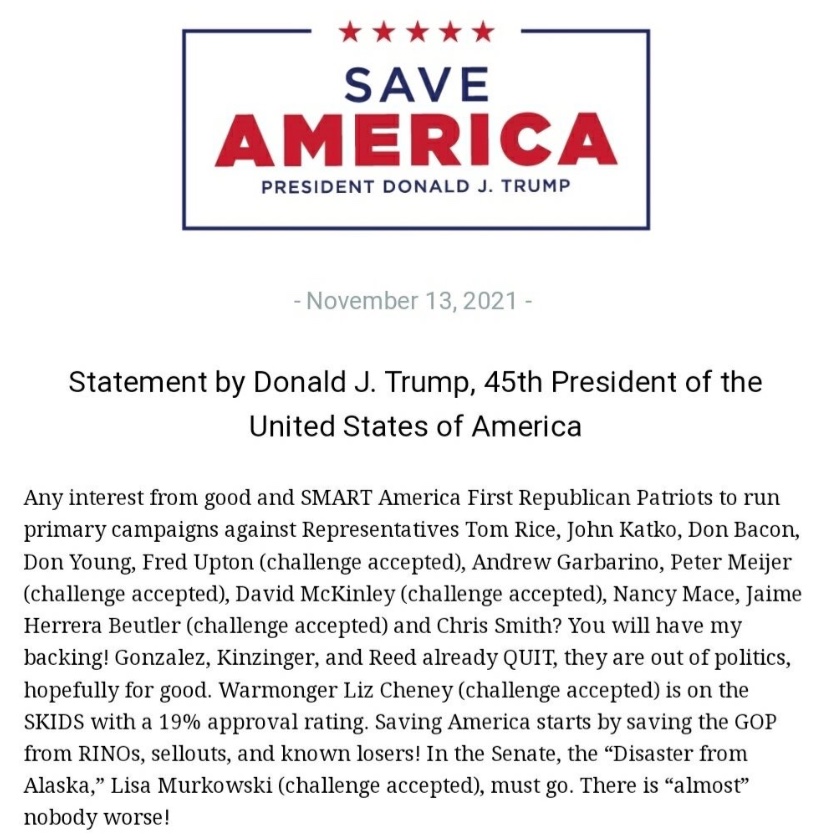
Former President Donald Trump is going after Congressman Don Young, just as he is going after Sen. Lisa Murkowski. He wants both of them retired and considers them “Republican in Name Only.”

In a message on Saturday, he said he was looking for someone to primary Young and several other House of Representative members from around the country, including Rep. Liz Cheney, who he called RINOS, sellouts, and losers. He said he was looking for Republican Patriots.

“You will have my backing!” he said.

Perhaps Trump has not heard or met Nick Begich, a Republican who filed for Congress in October.

Nick spoke in Sterling, Alaska at a Bikers for Trump rally in 2020, and FEC reports show he donated over $500 to Trump’s campaign. He is the grandson of former House Rep. Nick Begich, who died in a plane crash in 1972.

Nick was Congressman Young’s campaign co-chair in 2020 and has told the congressman on numerous occasions that he would someday file for the seat.

Young has served as Alaska’s lone congressman since the elder Begich died and there was a special election held the following March. He is the Dean of the House, the longest-serving member, which is an honorary title.

Trump didn’t say why Young had fallen out of favor with him. He recently was one of 13 House Republicans who voted for the massive infrastructure bill, and President Joe Biden’s Chief of Staff Ron Klain credited Young for putting the deal together.

The infrastructure bill has received criticism from some conservatives for having unnecessary spending in it.

The two Republicans congressional candidates will be on an open primary ballot, in which the top four vote-getters will be on the General Election ballot, where the voters will rank them according to their preference.

In 2020, Young won 192,126 votes to win with 54 percent against Democrat Alyse Galvin, who had 159,856 votes. Trump won Alaska’s majority with 189,951 votes, or 52.8 percent.

In 2018, Young won with 149,779 against Galvin’s 131,199 votes.

Trump has already endorsed Alaskan Kelly Tshibaka in her race against Sen. Lisa Murkowski. Tshibaka is headed to Mar-a-Lago in February for a fundraiser with the former president.

Fairbanks Mayor Jim Matherly challenges Sen. Scott Kawasaki

8

Fairbanks Mayor Jim Matherly has filed for State Senate for the newly designated district Seat P, challenging Sen. Scott Kawasaki. District P was District A under the previous political boundary plan.

Matherly, who is politically popular, has won four elections in a row in Fairbanks, two for City Council and two as mayor. His term as mayor ends next fall.

“It’s a logical progression for me. I think I’m ready for this. Redistricting didn’t hurt either,” he said, referring to the redrawn boundaries that were finalized last week.

A third generation Fairbanksian, his mother and grandfather were born and raised in the Golden Heart City.

Matherly first ran for Borough Assembly in 2000. Although he lost, he ran in 2010 for City Council, and became the first two-term mayor since Rep. Steve Thompson.

“Fairbanks has been really good to me and I’m grateful to serve them. Fairbanks has always wrapped its arms around me,” he said.

Matherly spent 25 years in radio, and 25 years in banking. He’s done over 3,000 weddings as a DJ, and still does fundraising events, including political events and wedding parties. He has six children, including three in high school in Fairbanks.

“With ranked choice voting I am not sure what to expect,” he said. “I just know I’m in it. I think I have a pretty good shot if I work hard at it.”

Also filing for office is Aaron Gibson, a member of the Fairbanks City Council. It appears he is filing for Rep. Steve Thompson’s seat. Thompson has told people he is not going to run.