Wednesday, May 6, 2026
Home Blog Page 980

Boom: Sen. Sullivan leads Senate to knock down Biden vaccine mandate for businesses

U.S. Sen.Dan Sullivan on Wednesday voted with all 49 Senate Republican colleagues and two Democratic senators, to overturn President Biden’s unconstitutional vaccine mandate for businesses. Sullivan and Sen. Mike Braun of Indiana used the Congressional Review Act (CRA), an expedited process for Congress to eliminate an executive branch rule.

Sullivan and Braun’s joint resolution, S.J. Res. 29, provides congressional disapproval of the rule submitted by the Department of Labor entitled “COVID-19 Vaccination and Testing; Emergency Temporary Standard,” which would result in hundreds of thousands of Americans potentially losing their jobs.

The House must also approve before the Biden mandate can be invalidated using the CRA method. Companion legislation, H.J. Res. 65, in the House of Representatives currently has 212 supporters, with every Republican, including Congressman Don Young, cosponsoring the resolution.

“President Biden’s unconstitutional vaccine mandates have been wreaking havoc on American businesses and hard-working families across the country, including in my state of Alaska. It’s an issue my team and I hear about from constituents on a daily basis,” Sen. Sullivan said. “I am glad to see a bipartisan majority of U.S. senators standing up today for hard-working Americans by rejecting this gross federal overreach from the Biden administration. These mandates are not supported by the Constitution or statute, a fact that courts just keep reaffirming as they hand down loss after loss for the President and his administration.

“In 2020, Congress and President Trump worked in a bipartisan way on an agreement that we would provide relief to American businesses on the condition they keep their employees. Now, Joe Biden is taking a sledge hammer to that employer-employee connection. Firing hard-working Americans who have made the personal choice not to get vaccinated not only undermines the significant work Congress and the Trump administration did to save millions of jobs during the pandemic, it also exacerbates the workforce shortages employers are already facing. No one should ever be forced to choose between getting vaccinated or putting food on the table for their families because of an unconstitutional mandate,” Sullivan said.

BACKGROUND:

  • On September 9th, President Biden announced vaccine mandates that extend to 80 million private sector workers, and additional mandates on millions of federal workers and contractors.
  • To implement this mandate, the Occupational Safety & Health Administration (OSHA) issued an Emergency Temporary Standard (ETS). Employers that fail to comply will be fined $13,653 for each offense, and willful violations will result in a $136,532 penalty. This rule places unrealistic compliance burdens on employers—especially at a time when business and supply chains are already under duress. For example, 30 days after publication, all requirements other than testing for employees must be in place. In addition, 60 days after publication, all testing requirements must be in place.
  • The Congressional Review Act (CRA) can be used by Congress to overturn certain federal agency regulations and actions through a joint resolution of disapproval. If a CRA joint resolution of disapproval is approved by both houses of Congress and signed by the President, or if Congress successfully overrides a presidential veto, the rule at issue is invalidated.

Watch Sen. Sullivan remark about the CRA vote at this link.

U. Penn transgender swimmer is smashing records in women’s meets — unfairly

Until 2019, Will Thomas had been competing in swimming as a male. He was a middling quality swimmer. The he took a year off due to Covid, grew his hair, changed his name to Lia, and made the outward physical and chemical transition to appearing as a woman.

Now, Thomas is competing on the University women’s swim team and smashing records. He doesn’t swim faster than before, but he’s now competing against women who don’t have the upper-body advantage that he does.

In two events — the 200-yard freestyle and 500-yard freestyle — Thomas has the fastest times, and the season has just started. H/she is one of two swimmers in each category to meet the “A” qualification that results in an invitation to the national championships in March. H/she has already broken the conference record in the 200 by 3.22 seconds, and in the 500 by 2.25 seconds at the Zippy Invitational.

Thomas’ dominance in the pool is unusual to do from the Ivy League, which has had only one swimmer — Cristina Teuscher — win a women’s NCAA individual title in any event.

Thomas is the national top seed thus far in two NCAA events and fifth in a third — the 1,650-yard freestyle.

To compare, Alaskan and Olympic Gold Medalist Lydia Jacoby swam the 100-yard breaststroke in 59 seconds at the the Alaska state high school swimming and diving championship in November. The famous Seward swimmer’s time was a state record and will likely rank her at the very top among American high school swimmers. It was a remarkable swim.

But if Jacoby had raced in the boys’ 100-yard breaststroke final, her time would have put her in sixth place.

If the boys’ champion, Patrick Foy, a sophomore from Juneau, had decided to take a year to transition to appearing as a female, his time would have wiped out the fastest woman ever, of any age, during any time in Alaska. As a boy, Foy may end up with pretty good results on the national level. With that said, although he was over four seconds faster than Jacoby, his ranking will not be nearly as good as hers. They are in different categories, ones that reflect physiological differences.

Boys are significantly faster at swimming than girls, as a rule, thus boys and girls are in two different, incomparable categories when it comes to many sports. Foy’s 100-yard breaststroke is quite good, while Jacoby’s breaststroke, though four seconds slower, is phenomenal. Much like a bicyclist has a clear and unfair mechanical advantage over a runner, young males have a clear physiological advantage over young females — an advantage so clear and unfair that they belong in different categories. 

Thomas told the University of Pennsylvania student newspaper that, “Being trans has not affected my ability to do this sport and being able to continue has been very rewarding.” It’s certainly been rewarding for him. He is soundly defeating his female competition at the NCAA Division 1 level and taking home the medals.

It’s not rewarding for his competitors, however. Allowing biological males to compete in female swimming competitions denies every female swimmer their rightful, promised opportunity, after these girls and women have trained hard, day after day, year after year for most of their young lives, just so they have a shot at their moment in the sun.

Men swimming in women’s divisions are destroying the sport for women. Schools that permit it should be found in violation of Title IX. Women athletes would be in their right to sue for discrimination because of the unfair advantage these men clearly have.

Thomas would still have ample opportunity to compete in NCAA swimming even if he weren’t allowed to do so against women. Thomas would just have to compete against those athletes who share his physiological advantages. 

In the likely event that Thomas goes on to win multiple events at the NCAA women’s national swimming championship and break multiple national records by large margins, women swimmers are wondering: Who is he going to brag to?

Family Partnership Charter School wins 10-year renewal from Anchorage School Board

After the Anchorage School Board had earlier postponed action on the recharter application by Family Partnership Charter School, the homeschool, parent-driven, student-centered charter school has won its 10-year recharter, with an enrollment cap of 1,850 students and an opportunity to increase to 3,000 students.

With 1,850 as the cap, the school will be able to see a 10 percent growth each year for over the next five years. At 1,850, the school will be providing education to about 4 percent of the Anchorage School District students.

“Parent after parent, student after student, staff member after staff member, proudly testified on behalf of our school. As I sat and listened to these testimonies, my heart filled with pride and love for our students and their families,” wrote FPCS Principal Jessica Parker. “It is the highest honor of my life to partner with you as you lead your students to their best possible futures. Our charter states our school is a bridge between home-school students and formal education; we are also a bridge between home-school students and their futures, which are full of possibilities.”

Parker said that she heard during the school board meetings that Family Partnership is the future of education. 

“We have a formula that works – parents and educators working together to provide options for children’s individualized learning plans. We are closing the achievement gap for students.  We are providing career and college opportunities. We are inspiring young athletes. We are helping struggling students with flexibility and choices that help them prioritize medical or personal struggles.  There are many reasons families choose to home-school, tailoring education to fit the child.  To quote one of our founders, Happy Chronister, ‘We cut the jacket to fit the kid, not the kid to fit the jacket.’ Home-schoolers are flourishing,” she wrote, thanking parents for taking the time to testify on behalf of the school. “We would not have won this fight without your voice,” she said.

Some on the Anchorage School Board are leery of homeschooling in general, and uncomfortable that so many are fleeing the traditional classroom in Anchorage to work under the guidance of FPCS. In the end, the board supported the renewal due to the pressure of multiple testimonies in favor of it, voting 4-2, with board member Dave Donley recusing himself because his children attend that school.

The school’s first charter application was presented to the Achorage School District in 1996 and unanimously approved in January 1997.  Final approval by the State of Alaska Board of Education approval came on June 23, 1997.   FPCS opened its doors a week later.  

Canadian man charged in ransomware attack on Alaska state computer

7

A federal indictment unsealed Tuesday in Alaska charges a Canadian man with committing cyberattacks on a health-related computer owned by the State of Alaska.   

According to court documents, 31-year-old Matthew Philbert, of Ottawa, Ontario, Canada, conspired to and damaged a state computer in April, 2018.

In a parallel investigation, the Canadian authorities also announced cyber charges against Philbert relating to attacks on Canadian computers. He was arrested on Nov. 30 by Ontario Provincial Police, and remains in custody. Investigators believe he was not acting alone, but there are no other indictments.

Philbert is charged with one count of conspiracy to commit fraud and related activity in connection with 10 or more protected computers and, had he been successful, would have modified and impaired medical examination, diagnoses, and treatment or care of more than one person, the grand jury indictment says. His actions are seen as a threat to public health and safety.

The indictment in the District of Alaska is part of an ongoing national effort by the Department of Justice to address cybercrimes that target U.S. citizens from abroad.

Canada’s criminal investigation began after the FBI contacted the Ontario Provincial Police in January, 2020 about ransomware attacks on Alaska coming from Canada.

Dave Donley kicks off campaign for school board reelection with Gwennie’s fundraiser

6

The lone conservative on the Anchorage School Board has started his reelection campaign. Dave Donley will welcome supporters at Gwennie’s Old Alaska Restaurant in Spenard on Wednesday, Dec. 15 from 5:30 to 7 pm.

Donley has fought against mask mandates and Critical Race Theory, and in favor of students learning the Pledge of Allegiance. He has advocated for a budget that is right-sized for the shrinking number of students the district has.

Donley is a former state senator and representative.

Anchorage Assembly votes to end mask mandate early

The Anchorage Assembly voted unanimously on Tuesday to end the mask mandate emergency ordinance in Anchorage at midnight.

Assemblywoman Meg Zaletel declared victory, saying the mandate did “what it was intended and set our city on a better path” for the health of the community.

The mask ordinance, which was controversial, was voted into law in October and would have expired next week, unless extended by another emergency ordinance.

Several members of the public showed up to the Assembly meeting in Guy Fawkes masks, in apparent protest of the mask mandate.

Bronson names Michael Kerle as police chief

Anchorage Mayor Dave Bronson today named Michael Kerle as Anchorage’s next Chief of Police.

“Deputy Chief Kerle’s qualifications, career experience, and dedication to APD speaks for itself” said Mayor Bronson. “I appreciate his willingness to continue serving the Municipality of Anchorage as the next police chief. Deputy Chief Kerle is dedicated to protecting all communities in Anchorage. Public safety for our residents in the Muni is our number one priority as we seek to make Anchorage the safest city in America to work, live, and play.”

Kerle has served with the Anchorage Police Department for 25 years and is currently serving as the deputy chief. Kerle began his law enforcement career in 1996 when he joined APD as a recruit in the Academy. He was promoted to deputy chief in February, 2020.

Kerle was born and raised in Bridgewater, Massachusetts. He traveled the world with the United States Army as a commissioned officer before settling in Alaska in 1995 to be closer to his wife’s family.

Over the course of his 25 year career at APD, he has held positions in the patrol division, special operations, and crime suppression.

He has a bachelor of science degree from the University of New York, is a graduate of the Police Executive Leadership Graduate Program and the Administrative Officer’s Course from the Southern Institute at the University of Louisville, the FBI Hazardous Devices Executive Management School, and the SWAT Commanders’ School.

Kerle takes over for current Police Chief Kenneth McCoy, who is retiring in February to accept a position outside the municipal government.

Michael Tavoliero: Our entire delegation needs to go

By MICHAEL TAVOLIERO

Our Alaska congressional delegation — Sens. Lisa Murkowski, Dan Sullivan, and Congressman Don Young — are DC sell-outs and should be retired with the upcoming elections in 2022 for Murkowski and Young, and the 2026 for Sullivan. 

Think about it: We have a congressional delegation which continues to treat our state as a colony and our country as a collective influenced and controlled by Washington, DC.

Alaska’s evolution from territory to statehood was a result of Franklin Delano Roosevelt’ New Deal Democrats and post WWII national security preparation. Roosevelt’s presidency was one of the largest centralizations of power and control by the federal government. This was exactly what the US Constitution authors and our Founders warned us not to do.

Most of Alaska’s constitutional convention delegates were devoted followers of the FDR administration, in other words, they were prepubescent Marxists. 

Granting statehood to Alaska involved getting it past the federal concerns of financial solvency. Without economic development through natural resource management, the hopes of private sector financial solvency were slim. Since statehood, the federal government has done everything it could do to shut down our economy.

Historically, Alaska’s success was a litmus test that produced more government as opposed to private enterprise. A utopian cornucopia promised by our constitutional convention resulted in statehood.

Robert B. Atwood, chairman of the Alaska Statehood Committee, addressing the constitutional convention in 1955 stated, “This document [Alaska’s proposed state constitution], once it is backed with ratification of the people, must be real and indisputable proof that Alaskans are ready, able and willing to undertake all the responsibilities of self-government.”

He continued, “Alaskans want all of the successes and all of the basic principles that have made this nation great, written into their constitution, perpetuated there and enlarged and expanded, and we all know they want none of the failures that have led to clumsy, inefficient, costly and complicated government. They don’t want duplications and unwise restrictions and all the other abhorrent developments that come from an inflexible constitution.”

Ironically, at statehood to now, our dependence upon the federal government grows as Alaska’s constitutional policy inflexibly failed to recognize basic American fundamentals. 

Our state constitution and subsequent legislation and regulations require Alaskans to forget about such foundational principles as limited government, private property mineral and subsurface rights, and the capitalist economic system, and instituted a massive bureaucracy with immense regulatory control. With the requirement of the mini-Blaine amendment in our constitution as a prerequisite to enter the union, Alaska’s progeny now suffer one of the poorest performance outcomes and one of the highest costs in education of any state in the nation.

Think about it: In Alaska, is anyone not employed directly or indirectly by government?

Did you know that if you add all government employment (federal, state, local, contractors), Alaska has more government employees than any other state and any other nation per capita?

Alaska was one of the favorite petri dishes for the American Marxist’s hopes for utopia. It has surreptitiously been guised as a red state yet its own fiscal policies and its relationship to the federal government demonstrate the actions of a blue state. 

The result in 1959 gave Alaskans the largest land mass state with the smallest population and greatest natural resource development potential in the union. 

What an incredible opportunity!

Sadly, it entered the union of the greatest country in the world and in history with the legislative and regulatory baggage triggering one of the nation’s worse and most expensive state bureaucracies.

In 1959, Alaska, now possessing the sovereignty of a state, began the process of self-determination chained by Marxist ideology founded upon the ramifications of the Mini-Blaine Amendment, state controlled mineral and subsurface property rights, the Antiquities Act of 1906, the Jones act of 1916, absence of federal land conveyances, and the 16th and 17th amendments of the US Constitution and the list goes on.

The federal government’s regulatory power can object to any uses of state land. We have areas of Alaska specifically selected by the state as allowed in our Statehood Agreement, that have huge nationally strategic mineral resources that we can’t develop because of the federal government.

How many Alaskans know that we have yet to receive all the lands promised in our statehood act almost 63 years ago.  

Isn’t it time to make this so?

Is Alaska really a sovereign state?

In June of 2019, Professor James Broughel of Mercatus Center, George Washington University, published “A Snapshot of Alaska Regulation in 2019.” What he revealed was Alaska’s administrative code had 52,570 restrictions, 5.8 million words, and would take 8 weeks to read. He stated, “Individuals and businesses in Alaska must navigate these different layers of restrictions to remain in compliance.”

Add to this, municipal or borough regulations are often more restrictive than those of the state. No matter how you frame it compliance with these restrictions cost our citizenry time, energy, and capital.

The hope of freedom under Article I of the Alaska State constitution was never realized by the spawning of Alaska Marxists who contravened that hope with empty promises and clandestine actions.  

On March 11, 2020, Covid 19 took control of the Alaska’s state and local government apparatuses creating the greatest economic and social debacle in the state’s history. Almost everything about this pandemic, the government got wrong, yet regardless of our government’s failure its citizenry continues to suffer the monolithic tragedy of oppression and deprivation promulgated by government. 

We can argue California, New York or other Democrat strongholds are more tyrannical, but look at Alaska. The greatest natural resource potential of any state in the nation and perhaps the world with locks, chains, and chastity belts on anything remotely productive.

Which leads me to the reality of our congressional delegation. 

During the candidacy of Donald J. Trump and the first 2 years of his presidential administration, Congress was controlled by Republicans, an unbelievable possibility for conservative “hope and change.”

In response, the Alaska congressional delegation, Murkowski, Sullivan and Young, together with other Republican Marxists, did everything they could to cancel him.

The greatest opportunity for reform and the implementation of Trump’s contract with the American voter, his 100-day action plan to Make America Great Again, was directly sabotaged by Alaska’s congressional trio with every opportunity.

The only president ever to address the possibilities of Alaska’s nature resource development was stabbed in the back multiple times by Alaska’s own Republican congressional delegation.

Now, with President Biden, Murkowski, Sullivan and Young openly and shamelessly supported the Biden infrastructure package. If that isn’t proof positive that this trio is out of touch with Alaska, all three of them supported anti-fossil fuel, radical environmentalist Deb Haaland to be Interior Secretary. She subsequently suspended the Trump administration development of ANWAR. 

That is a bookend litany of their deplorable actions, not their empty words. They sold out our state, our country, our voters and, most importantly, they sold out the future of our children.

This is such a sad tribute to the greatest natural resource development state in the nation. Increased federal dollars. Increased federal control. Decrease in our control of our state. 

Senator Sullivan, Senator Murkowski, and Congressman Young, you have all lost your way.

It is time to retire. 

Michael Tavoliero is a realtor in Eagle River, is active in the Alaska Republican Party and until recently chaired Eaglexit.

Cliff Groh, Democrat, files for House for new District 23 – Government Hill, Eagle River

Cliff Groh, longtime political commentator, has filed a letter of intent with the Alaska Public Offices Commission to run for what is the new House District 23. It stretches from Government Hill, where he lives, wraps around JBER and encompasses part of Mountainview and a portion of Eagle River.

Groh is a big-government Democrat and proponent of taxing Alaskans’ incomes. On Twitter, he recently said, “Alaska needs more revenues. Some should come from a broad-based tax aimed particularly at high earners, including non-residents. This would help keep us out of a downward spiral…”

The area of town he lives in used to be in District 20, a liberal district that is now represented by Rep. Zack Fields. Groh ran for that district in 2018, but lost to Fields in the primary. His new district stretches north into conservative areas, rather than south into the heart of downtown Anchorage and the South Addition.

Groh worked as a legislative aide in the Alaska Legislature and worked for the Alaska Department of Revenue. He was a municipal attorney, a petroleum taxation attorney, a prosecutor, and a criminal defense attorney, according to his extensive bio. He writes frequent opinions that appear in the Anchorage Daily News on the topic of Alaska’s fiscal crisis and he is on the board of the progressive group “Alaska Common Ground.”

All House and Senate seats (except one) are up for election this year due to the redistricting process that redrew political boundaries in order to assign an even number of residents to each political district. The Redistricting Board shifted boundaries in Anchorage as a result, as Anchorage has been losing population, while the Mat-Su Valley has grown significantly.

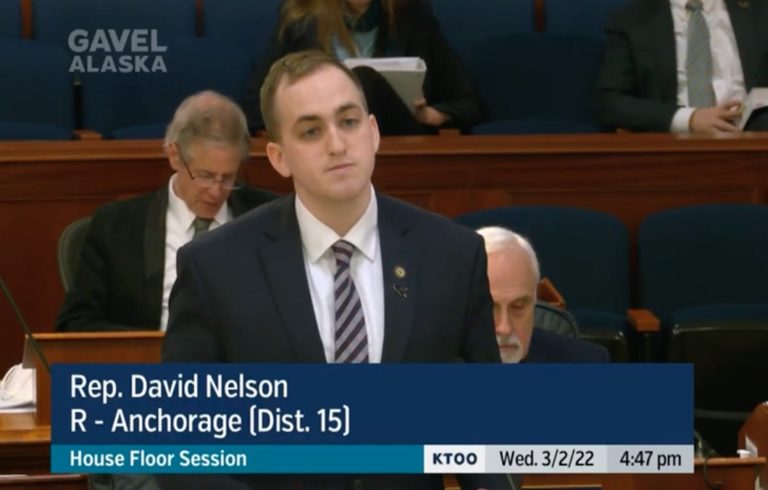
The district now known as 23 is also the home of Rep. David Nelson (who represented District 15 under the old map.) Nelson is running for reelection.

House District 23 – Senate District L – Government Hill/JBER/Northeast Anchorage