Monday, May 11, 2026
Home Blog Page 876

Assemblyman Constant says a man left death threats, but Anchorage police chief says it didn’t happen

Candidate for Congress and sitting Anchorage Assemblyman Chris Constant claims that he has received multiple death threats. He is referring to two phone messages left on his voice mail from a disgruntled constituent who was rude and disrespectful. Whether the caller made an actual threat is in dispute.

But last week during an especially hot Assembly meeting, during which the air conditioning had failed in the Loussac Library’s Assembly Chambers, Constant became agitated about a side door being left open without a police officer stationed at it. He disrupted the meeting to ask why the door was open, and Municipal Manager Amy Demboski informed him that the temperature in the room was 80 degrees and yes, there was a security officer outside. At some point, Constant must have described his fear of a death threat to Demboski.

Soon thereafter, Manager Demboski reached out to the Anchorage police chief on Wednesday to ensure that the matter was being taken seriously: “I had a discussion at the Assembly meeting tonight with Assembly member Constant and he told me he has had numerous death threats in the past two weeks. Are you aware of those threats? Has APD received these threats from Assembly Member Constant and have they been reviewed/assessed for credibility?” Demboski asked the chief. “Any information you can share would be appreciated; I just want to ensure Mr. Constant has provided APD with information to assist in situations like these.”

Chief Michael Kerle responded to Demboski that a review found there was no threat: “Assembly member Constant is referring to two voice messages left for him. We have reviewed this and found no credible threat. We have identified the person who left the messages and will have an officer reach out to him and let him know his messages are not welcome. We will also coordinate with city legal to see if there is any crime committed. In the past, city legal has refused to refer charges on such calls,” the police chief wrote.

Must Read Alaska obtained the notes via a public records request made last week of any communication on the matter between the Mayor’s Office and the Police Department.

“I listened to the voicemails Mr. Constant alleged were death threats and all I heard was someone who disagreed with him politically, I didn’t hear a death threat in those recordings,” Demboski told Must Read Alaska.

Constant, in an essay on his campaign website, refers to the “multiple” threats and provided links to a story written by the South Florida Gay News, the reinforces the claim. That story led off with a description of the tearful sense of victimization that Constant experienced when he listened to the two phone messages:

“Tears welled up in his eyes as Christopher Constant played the recording of a telephone call to his office,” the story started. “The gay assemblyman for the City of Anchorage, Alaska, is conditioned to intimidation tactics, but this call adds a dangerous layer to the game.”  

According to the news site, the man said, “I wanna see you get smoked so bad and you’re going to too.”

“I’m not afraid of you homosexuals,” the man was described as saying. “It disgusts me. Pervert!”

Constant turned over the tape to the Anchorage Police Department, according to the South Florida Gay News and according to the notes between Manager Demboski and Chief Kerle.

“He fights back tears when talks about his love for Alaska, his dog, mountain biking and, sadly, how his campaign for Congress is revealing old prejudices,” the news group wrote.

“This is the reality of what the race is and he is just the one who is willing to say it,” Constant said to the Florida reporter. “Just know this, this is what makes me strong, we make the difference for all the kids coming forward in a world that is not going to be like this anymore.” 

Constant’s campaign has focused the issues of interest to him and the LGBTQ community.

Read the South Florida Gay News report at this link.

On his website, Constant writes that after the Supreme Court invalidates the 1973 abortion ruling known as Roe v. Wade, it will go after the gay community.

“It’s more important than ever to support LGBTQ+ candidates. With the U.S. Supreme Court expected to overturn Roe v. Wade next month, LGBTQ+ rights are next. Electing LGBTQ+ candidates sends a message to the nation that we will not accept hate and intolerance. We are working toward a better future, not willing to fall into a darker past. As an openly gay man, Chris Constant has experienced homophobia and bigotry for most of his life,” his website states.

“These threats and hate speech are despicable, and are only becoming more common. We need to overcome these horrible elements of our society by electing progressive leaders to the highest offices of our country,” Constant’s page says.

“This is the latest in a series of death threats Chris has received over the past three years. These death threats are not due to Chris misusing his elected office, giving out contracts to supporters or failing in his duty as an elected official. They are for enacting mask mandates to protect our hospitals and the medically fragile, for voting to transform our homelessness response system and for banning discredited and trauma-enducing conversion therapy. They are for standing up to a mayor who has routinely violated municipal code and lied to the public about his actions. These threats come from a place of fear. The fear is that Chris Constant is working to create an equitable future where all Alaskans have hope and opportunity, not just some,” the essay states. Read the entire Constant Pride Month essay at this link.

Analysis: Alaska Senate is wild card this election season, as Senate president and Minority leader decline to run

The past three years has been anything but dull in the political arena of Alaska. The Legislature has its share of fighting. While most of the attention on internal squabbling has focused on the Alaska House of Representatives and its six years of slim majorities, the Senate escaped focus. That is, until now.

The Alaska Senate did not always have the benefit of being the most quiet and outwardly stable arena of lawmaking in Alaska. For six years, ending in 2012, a bipartisan coalition of all Democrats and more-than-a-few Republicans dominated the upper legislative hall, serving as a backstop against a Republican-dominated House and then-Gov. Sean Parnell, also a Republican. That wall of resistance ended in the 2012 elections, and the formation of an almost exclusively Republican majority in 2013 has been intact, imperfectly at times, since then. 

This year appears to be a watershed in how the state’s lawmaking bodies constitute themselves. Record levels of retirements in both the House and the Senate guarantee a lot of new faces being sworn in next January.

But it is the Senate, unique in the country due having just 20 senators, where the vacancies have the greatest sway and impact. 

Four senators are not seeking election, including the Senate President Peter Micciche and the Senate Minority leader Tom Begich. This is the first time in living memory such a dual vacancy occurred by that manner.

Sen. Natasha von Imhof of Anchorage and Sen. Lora Reinbold of Eagle River are also not seeking another term. Combined, nearly a quarter of the Senate will be cycled out before Alaska voters cast a single ballot. 

The consequences of this week’s official filings are huge. It has been an open secret in Juneau that the Senate Republican caucus has for four years been split virtually right down the middle of its membership, primarily on issues related to the Permanent Fund dividend. Though the controversy over the dividend really ignited when former Gov. Bill Walker vetoed part of the PFD in 2016, the Senate infighting really developed a year later during the formation of the operating budget.

Then-Sen. Mike Dunleavy, a member of the Finance Committee since he entered the Legislature in 2013, voted against the budget once a unilateral reduction of the annual dividend was included in the bill.

Dunleavy was followed in a later vote by Shelly Hughes of Palmer in rejecting a budget relying on reduced dividends (both left the majority caucus over those disagreements). Dunleavy eventually resigned his Senate seat in early 2018, and was elected Governor that fall. 

The Senate organization of 2018 was marked by the divide over the dividend and the use of the Permanent Fund’s earnings. There were real attempts by the Senate Democrats to entice a handful of Republicans to cross over as they had done in 2007, and put them back into power. 

Democrats’ efforts were stymied by the ability of Republicans to still remain together. Micciche’s predecessor, Cathy Giessel of Anchorage, initially announced a caucus in 2019 that would balance the rights of individual lawmakers to vote their conscience on key issues with the need of a legislature to do its constitutionally mandated work.

This, combined with the election of a Republican governor and what appeared to be a Republican-dominated House, seemed enough of an enticement for Senators to hold their tongues and work together. 

But that arrangement was in tatters by the summer of 2019, with Giessel expelling members of the caucus from key leadership positions and committee chairships over voting differences on the dividend. (Giessel, along with fellow member of leadership John Coghill, were voted out by Republicans in the 2020 election. Giessel, like Walker, is seeking a return to office, while Coghill is seeking the congressional seat made vacant by Congressman Don Young’s passing in March). 

As 2021 began, it was unclear, until the first day of the legislative session, whether there would be a Republican or a Democratic-led Senate. And yet, when the gavel came down, it was Micciche of Soldotna who was made President by his peers, and who installed a caucus that demonstrated, at least on paper, that Republicans were in charge. 

But if on paper the Republicans ruled the Senate, in practice they were a divided caucus to the point of paralysis. The majority caucus of the House and Senate traditionally meet at least once a week. In 2022, it was reported that the Senate majority held less than a handful of meetings. Reasons for this were unclear, though Senators said, on condition of anonymity, that the decision was Micciche’s attempt to manage the combustible relationships between members. Getting Senators who otherwise would not talk to each other in a confined space appeared a recipe for disaster, and Micciche was managing those dynamics. 

Though some criticized what was perceived as fecklessness on the part of the Senate President, others saw the conundrum Micciche was placed: keep the Republicans together in a loose, uneasy alliance, or shatter the caucus and allow the Democrats to officially run the agenda.  

Another key dynamic was the makeup of the Senate Democratic caucus. Past leaders included Sen. Johnny Ellis, a brilliant but bitter and ruthless politician who saw the role of the Democratic caucus to inflict misery on Republicans at all costs. Ellis was succeeded by Sen. Berta Gardner, whose years leading the caucus were spent in serving as a perpetual proxy for the Walker administration. 

The election of Sen. Tom Begich as leader of the Senate Democrats marked a significant transition for the party’s prospects. Begich, the son of a former congressman and the brother to a former United States senator, was and is considered one of the chief political operatives of the Democratic party.

Representing a downtown bastion (Begich succeeded Ellis upon his retirement), the Democrats’ leader had a liberal base that would return him thanks to his political pedigree and reputation, allowing him leeway to work Republicans and the heft to hold back some of the bombastic members of his caucus, a departure from what Sen. Ellis encouraged and Sen. Gardner appeared unable to stop. 

For the past two years, large parts of the Senate Republican caucus voted against their body’s final budget over differences in how it was crafted by its architect, Sen. Bert Stedman of Sitka. In order to lift the budget off its floor, Sens. Stedman and Micciche relied, initially with some, eventually for all, of Sen. Begich’s caucus to pass it. This leverage afforded the Senate Democrats, and Begich in particular, an effective swing vote status in the impaired chamber. 

This dynamic played itself out in the waning months of this year’s session. There is an old saying muttered in the Capitol that “it’s always 2 on 1.” The “3” in that equation are the House, the Senate, and the Governor. By May, the equation was set, and it was the Senate and Gov. Dunleavy’s Administration combining forces on issues such as a higher dividend, the reading bill, and crime, against a House majority that was dominated by members of the Bill Walker Caucus opposing any Republican initiative. 

Once morning broke on May 19, the first time Alaskans were not facing a special session prospect in four years, the dam had broken over the Walker Caucus in the House.

The Permanent Fund Dividend was set at the largest amount in state history, though the energy rebate, funded by the Constitutional Budget Reserve, failed by a single vote (Walker Caucus member Rep. Grier Hopkins of Fairbanks casting that rejection, as his finger paused over the red or green button).

But the Senate Majority and Democratic Caucus appeared to have reached an agreement on bills that could pass, and most did, marking the 2022 session one of the more productive ones in recent memory. 

Micciche’s retirement makes him the third consecutive Senate President to not come back after their term ended (though Micciche is leaving by his own volition while his two predecessors were defeated in their bids for re-election). The retirement of Tom Begich leaves a vacancy in the Democratic caucus along with a seat that will, it appears, be filled by a person who currently staffs for him. 

With two leaders exiting, and the field of play very much undecided for most members of the Senate, what kind of organization will take shape is an open question.

Some politicos are betting on 2023 finally being the year the Democratic caucus is given the keys to majority power with the agreement of several Republicans. There is some credence to that. Unlike the House, which has almost a 100% turnover rate from 10 years ago, several members of the old bipartisan coalition are still around, including Sens. Stedman and Gary Stevens of Kodiak. And Rep. Matt Claman, a downtown Anchorage Democrat, is preparing an all-out assault for the seat held by Republican Sen. Mia Costello of Jewel Lake. 

However, some of these key potential coalition members are in comparatively tough races. There is also the prospect of new entrants who will fill the strategic vacuum left by Tom Begich and Peter Micciche.

Tuckerman Babcock, a former chair of the Alaska Republican Party and former chief of staff to Dunleavy, is running for Micciche’s Senate seat. Organizing a majority caucus is as much about relationship building and diplomacy as it is dealing with party platforms and policy agendas. 

The massive potential for the Senate membership to be remade actually makes the “senior chamber,” unlike the House, the most potentially explosive arena for politics in Alaska this year.

Perfect storm: Drought of baby formula came at the same time breastfeeding dropped 69% in America

(Pictured above, infant formula nearly out of stock at the West Dimond Fred Meyer on Friday evening.)

One foster mother standing at the infant formula section at Carrs on Northern Lights and Minnesota on Saturday said she had been all over Anchorage looking for formula for her foster baby, who was on her hip. She had not yet found the formula that her foster baby could use.

“What about those moms who cannot afford to drive all over town?” she wondered aloud.

It’s fallout from the Covid-19 pandemic: Health experts are saying that a decline in breastfeeding since the pandemic hit in 2020 is contributing to the infant formula shortage, which may last through July, as the Biden Administration and the private sector struggle through supply chain and production issues.

Breastfeeding is complicated business. Stress can prevent moms from being able to produce milk. The difficulty of finding child care during the pandemic combined with the challenge of finding babysitters, led to uncertain schedules for families. These are among the hurdles for moms being able to breastfeed. Moms who got Covid may have been too sick to breastfeed. Other reasons a baby would need formula is that they are in foster care or have specific health issues.

In Anchorage, the shelves were nearly bare in the infant formula section during a walk-through on Friday and Saturday of several grocery and drug stores. All stores visited by Must Read Alaska are either out of formula or keeping inventory locked up.

The shortage of formula is also due to a government recall of several types of formulas made by Abbott Nutrition, which provides nearly 50% of all formula sold in America. It’s also because of a drop in births during the pandemic, and then a surge. In addition, new mothers have stopped breastfeeding.

Research from Demographic Intelligence shows that after birth rates crashed in 2020, “the demand for formula was anemic.” But by early 2021, “births came roaring back, leading to very high year-over-year growth rates.” Democraphic Intelligence also found the number of breast-fed one-year-olds declined from roughly 34% in 2020 to roughly 14% in 2022, “reversing decades of growth.” It’s a 69% decline in breastfeeding in two years.

“During the pandemic, many new mothers were unable to get the care and help they needed to successfully breastfeed because of Covid-19 restrictions, experts said. For example, many mothers had shorter hospital stays and were discharged before their baby latched successfully or their milk came in. Parents also had less support and in-person assistance from doulas and peer-support groups, as well as from family and friends, as people reduced contact to avoid exposing newborns to the coronavirus,” according to a report from the Advisory Board, an online publication for health professionals.

The Biden Administration has invoked the Defense Production Act, which requires suppliers to “direct needed resources to infant formula manufacturers before any other customer who may have ordered that good.” And the Biden Administration is importing millions of bottles of three Nestle infant formulas that are scarce in the United States. Two shipments of formula have arrived in Indianapolis and Virginia.

But in Alaska, infant formula is still in extreme short supply and is expected to be at crisis levels through July.

In the Drama section: Assembly creates hostile work environment for conservative assistant library director, as it conducts an illegal inquisition in public session

Must Read Alaska’s Suzanne Downing finished touring the Loussac Library early Friday afternoon. Minutes later, Assemblyman Chris Constant announced in a public meeting that Must Read Alaska had been seen touring the library with the city manager and the city human resources director, a tour being given by Assistant Library Director Judy Eledge.

Constant knew of the tour because an employee of the library had quickly reached out to the assemblyman with a “sightings” report. Constant was making the point on the record that the Bronson Administration was not at the meeting because City Manager Amy Demboski and Human Resources Director Niki Tshibaka prioritized giving Must Read Alaska a tour of the library, rather than attending the inquiry that the Assembly has opened up regarding the assistant library director.

Downing was getting familiar with the library operations and challenges, as political pressure from the Assembly to usurp the Executive Branch’s legal authority to operate the city continues to heat up in Anchorage politics. The Anchorage public libraries are at the heart of a growing culture war in Alaska’s biggest city, and have become a kind of religious fortress for the partisan Left.

Pride Month display at Loussac Library.

Constant’s comment became part of the official record during his Friday afternoon inquisition that was held with the intent to cause stress to, and force the resignation of Assistant Library Director Eledge. The meeting was part theater, coming on the heels of a savaging report from Alaska Public Media that called Eledge a racist.

It was a meeting that the Assembly had been warned was likely illegal.

Assemblywoman Jamie Allard phoned in, but also quickly left the meeting after she became uncomfortable that the Assembly was actually breaking the law as it pertains to the rights of employees of the city.

“This is clearly an orchestrated political attack directed at a municipal employee. I believe this is inappropriate and likely a violation of law. I will not participate in this witch hunt,” Allard said, before excusing herself from the meeting that was organized by Assembly Chairwoman Suzanne LaFrance and Vice Chairman Constant.

Eledge is a civic leader and educator in Anchorage, the president of the Anchorage Republican Women’s Club, and was an elector for the Republican Party. She was initially appointed the director of the library, but because she does not have a masters degree in library science, the Assembly would not confirm her; she is assistant library director, and a new director is to start in August.

The Assembly had been advised in writing in advance by the Bronson Administration not to verbally disparage city employees like Eledge during an open meeting, but the members proceeded with the meeting anyway, allowing attacks in spite of the legal warning from the Law Department that they need to take such matters up in executive session. LaFrance and Constant were careful to use Eledge’s job title, rather than her name, during their criticisms, but have still opened themselves up to a discrimination complaint that Eledge herself now has the right to pursue.

Even the City’s Ombudsman has piled on in the witch hunt, taking a side with the cabal of critics of Eledge, who is managing library operations until the permanent library director arrives.

Bronson was elected in part by parents and other citizens concerned about the grooming of children going on in the library during Drag Queen Story Hour, a sanctioned event under the previous Administration.

Teen Underground room in the Loussac Library features plenty of gay nonfiction and multiple copies of a critical race theory book, “Stamped,” in a prominent location.

Ombudsman Darryl Hess also made damaging statements to Alaska Public Media. He allowed former library employees to skip going to the Human Resources Department because, he said in writing, HR Director Niki Tshibaka is married to a candidate for U.S. Senate, and therefore the employees don’t trust Tshibaka, and preferred to go to Hess.

The media ally of the Assembly, the Anchorage Daily News, latched onto the story and has made it the focal point of its latest attack on the Bronson Administration, one of many missiles the newspaper has launched against the mayor since he took office last June. So important was it that the readers see this particular attack piece, the editors have even removed the paywall on it. You can read the ADN story without paying for it at this link.

A former assistant library director, who has since moved out of state, lodged a complaint to the Office of Equal Opportunity, saying that Eledge said, “If it weren’t for the white man and his oil the natives would still be living in caves.”

“[Jacob] Cole’s email detailed additional disparaging comments he said Eledge made about Alaska Natives and other groups. She complained about ‘white guilt and white apologists,’ he wrote,” according to the ADN account.

“The things that Judy Eledge has said that have shocked and disturbed me are many but these are the ones I can best remember,” Cole wrote in the email, according to the ADN.

The inquisition started with a letter to Municipal Manager Amy Demboski on Thursday, in which LaFrance and Constant demanded answers to a series of personnel and operational questions. Demboski said the Assembly is inappropriately trying to take over the functions of the executive branch and she had no intention of allowing that to happen. It’s another separation of powers issue.

LaFrance and Constant voiced concerns that several funded positions at the library have gone unfilled. Assemblyman Kevin Cross noted that across all industries, it’s hard to find good workers, but Constant argued that something else is going on that is creating the worker shortage at the library. “It’s something else,” he stated.

The entire meeting was not recorded as required, but a portion of it is on YouTube:

Notes from the trail: Peltola ups her sign game as congressional race enters last week for primary

With over 98,000 votes already in, the race for Congress is nearing its first pivot point — the June 11 deadline for ballots for the special primary election. Some candidates are running through the tape, while others have faded on the turns. Some observations:

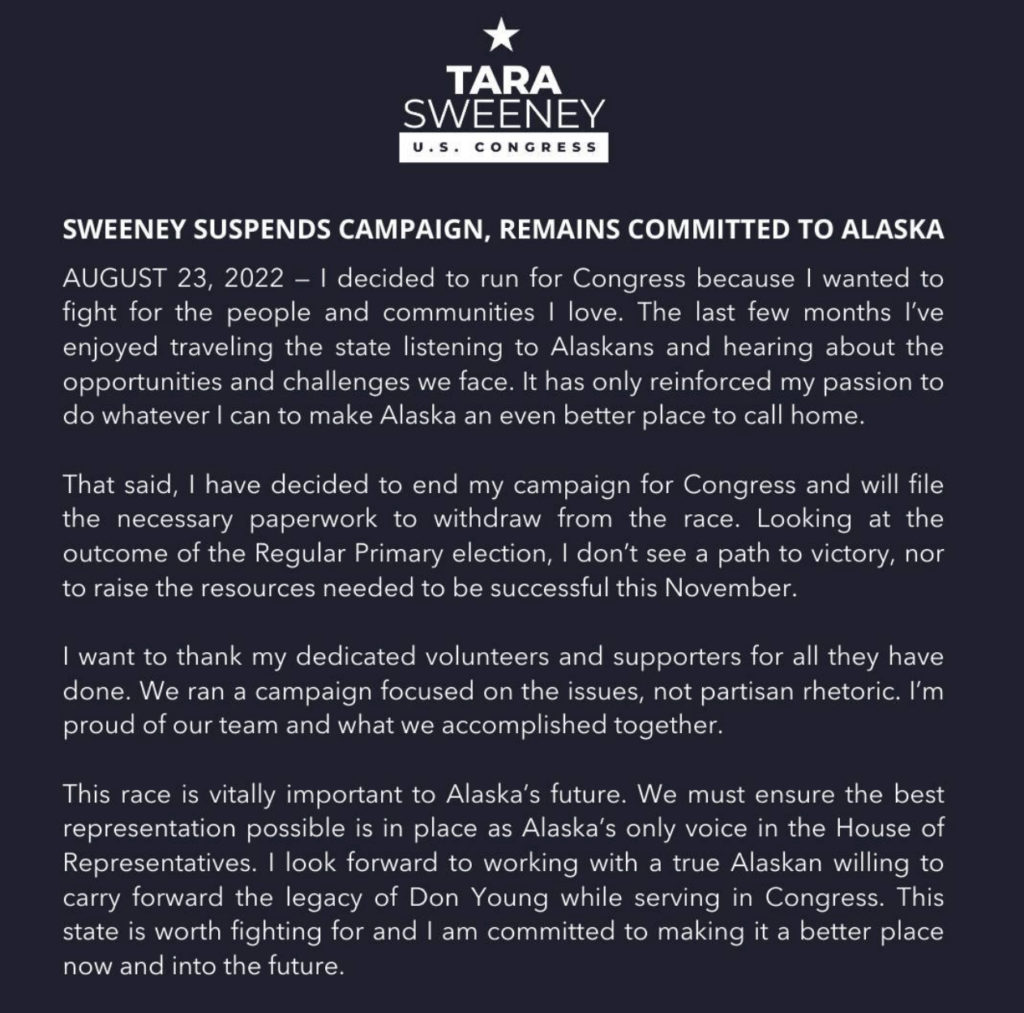
Media buys: Everything is placed, so there are not many new media buys to report since Tuesday. Al Gross moved another $40,000 into media, which brought his totals to about $235,000, for radio, broadcast, and cable from May 31 through the June 11 period. Tara Sweeney’s campaign has has no new media buys since Tara’s independent expenditure group placed a $50,000 purchase on May 25, bringing that broadcast and cable total to $231,000 (plus what her own campaign has spent, which puts the total spend over $305,000). Sarah Palin is still at $30,000 for radio. Mary Peltola has $18,000 in radio, mainly in Juneau, where she also has TV.

Door-knocking: The only campaign doing traditional door-knocking seems to be the pro-Nick Begich camp, and that is begin done by Americans for Prosperity Action. They have a massive door-knocking effort underway this weekend across Southcentral, with as many as 50 volunteers.

Sightings: Tara Sweeney is available to meet with people at the Girdwood Brewing Co. on Friday evening, 5-7 pm. Sarah Palin had a tele-rally with former President Donald Trump. Peltola is having a fundraiser in Juneau at the whale sculpture this weekend. It looks like the weather will be good in Juneau. Nick Begich has a private fundraiser in Stuckagain on Saturday and a big fundraiser on June 9 at a hangar in Anchorage. Al Gross was in Sitka last week and is in Wasilla and Palmer today after speaking at the Democrat Bartlett Club in Anchorage a few days ago.

Endorsements: Donald Trump Jr. Dan Bongino, Sen. Rand Paul all came out for Sarah Palin in the past three days, while Alaska Rep. George Rauscher, Stephanie Taylor, and Shelton Prout (Kodiak) are new endorsements for Nick Begich.

Al Gross has five Republican endorsers, very few fellow doctors, and lots of Democrats backing him for Congress. He looks like he’ll be in the final four, from the size of his list and the spend of his dollars right now on advertising.

New York Times: The story by the New York Times on the congressional race finally posted this week. You can read it at this link, but it will probably be behind the paywall. Here are the first paragraphs of purple prose about breakup:

“The race began, fittingly, in the spring season known here as breakup.

“As sheets of ice cracked into pieces across the rivers, melting snow exposed the gravel and dust on roads, and preparations began for hunting and fishing, dozens of congressional campaigns were springing to life with barely a few days of planning. Candidates held solemn conversations with their families, advisers hastily secured website domains and the endorsements and donations began flooding in.

“The unexpected death in March of Representative Don Young, the Republican who represented Alaska’s sole congressional district for nearly half a century, has given rise to a crowded and raucous race to succeed him. No fewer than four dozen Alaskans — political veterans, gadflies, and even a man legally named Santa Claus — are running to succeed Mr. Young as the lone representative in the House for the state’s 734,000 people.

“The list of candidates is sprawling. It includes former Gov. Sarah Palin, who is endorsed by former President Donald J. Trump; Nick Begich III, whose grandfather held the seat before Mr. Young; four Alaska Natives, including one, Tara Sweeney, who served in the Trump administration; Jeff Lowenfels, a retired lawyer and a prolific local gardening columnist; and Mr. Claus, a portly, bearded North Pole councilman and socialist.

“That’s a lot of people to do research on and figure out,” said Morgan Johnson, 25, as her black cat, Edgar, prowled across the counter of her plant shop in Juneau. “I get stuck on one person’s Instagram for an hour — now I have to do that for 48 people.”

New York Magazine: The urban New York publication has a story about Alaska’s “Weird New Election System,” ranked choice voting mess and how it is vexing both candidates and voters. Democrats are struggling, the magazine reports. Read it here.

Must Read Alaska Show: Nick Begich was the most recent guest for the Must Read Alaska Show. Watch it on Facebook or call it up at any of your podcast providers (Google Play, iTunes, Pandora). Others have appeared, including Jeff Lowenfels, Tara Sweeney, Santa Claus, John Coghill, and we’ve invited both Sarah Palin and Chris Constant.

Pride and prejudice: Chris Constant, running for Congress, wrote an essay for Pride Month saying it is important for gays to be elected and claiming that he has been threatened and belittled for being gay. His essay is here. We’re waiting for confirmation on the alleged threats.

More alphabet pride: Mary Peltola chimed in for Pride Month with this alphabet soup comment: “May we remember the activists—mostly QTBIPOC—who came generations before us and fought hard for change, for equality, and for civil rights. Today we continue the fight for our neighbors, our loved ones and our youth. LGBTQIA2S+ Alaskans deserve to love and live freely and safely.”

In honor of Pride Month, candidate Andrew Halcro posted photos of himself from 2013 at a gay parade in Anchorage, above.

Offenses: Andrew “See why Halcro makes perfect sense!” Halcro still cannot figure out how to make his campaign ads legal. The “Paid for” part has to be in a box, per the Federal Elections Commission. He has racked up dozens of violations at this point, but doesn’t seem to care. Also, he still has not filed his financial report with the Clerk of the Congress, per law, and it is apparent he is not going to reveal his financial possible conflicts so the public can take a look. Candidate Josh Revak has also failed to file his financial disclosure, as required by law.

A fake Twitter account was posted recently that appears to belong to Mary Peltola, catching the eye of wary Democrats who asked Peltola if the account belonged to her. It does not, and she has reported it to Twitter:

Gas prices jump 5 cents overnight, reaching another all-time high

CASEY HARPER / THE CENTER SQUARE

Gas prices increased another 5 cents overnight to reach yet another record high, marking another week where costs rose every day as economists worry about how consumer spending will impact the economy overall.

Gas prices have jumped 14 cents in just the last three days.

The national average for a gallon of unleaded gas is $4.76 as of Friday, according to AAA, topping the previous day’s average of $4.72, which was its own all-time high. Gas prices are well over $4 in every state, topping $5 in seven states and more than $6 on average in California.

Diesel gas prices also hit a new record Friday, reaching a national average price of $5.58. Rising energy costs are in part driving 40-year-high inflation.

As gas prices rise, consumer consumption is dropping. Consumption has declined at a rate of 3% to 5% the past seven weeks, according to DataTrek, suggesting that the high costs are affecting behavior.

The Bureau of Labor Statistics’ most recent consumer price index data reports that energy costs have risen faster than any other category of good or service in the last 12 months.

“The all items index increased 8.3 percent for the 12 months ending April, a smaller increase than the 8.5-percent figure for the period ending in March,” BLS said. “The all items less food and energy index rose 6.2 percent over the last 12 months. The energy index rose 30.3 percent over the last year, and the food index increased 9.4 percent, the largest 12-month increase since the period ending April 1981.”

As a result, many Americans are struggling to make ends meet. The prices have a political cost, as well, drawing fresh criticism for President Joe Biden’s energy policies, in particular his blocking of new oil leases and pipeline development.

“Joe Biden said he can’t ‘click a switch’ to make gas prices go down, but he clicked a switch to make them go up,” said Daniel Turner, executive director of the energy workers advocacy group, Power the Future.

Friday MRAK newsletter: How did Sen. Tom Begich pull that one off?

The Friday newsletter, in abbreviated form, is occasionally posted on the news site. But you don’t have to guess if it will be here: Get your own in your inbox by signing up under the Newsletter tab above.

Good morning from Somewhere in Alaska … Let’s have a great summer weekend and enjoy this great land, but first …. Thank you for all your support for this conservative news project. I appreciate all MRAK readers!

Guns are the target: Recounting his recent visit to Uvalde, Texas, where 21 people were killed in a school shooting, including 19 children, and his visit to Buffalo earlier this month, where 10 people were killed in a supermarket shooting, President Biden says the nation needs to crack down on guns, enact red flag laws, and raise the age to access them.

“I want to be very clear. This is not about taking away anyone’s guns,” Biden said. “It’s not vilifying gun owners. In fact, we believe we should be treating responsible gun owners as an example of how every gun owner should behave. I respect the culture and the tradition and concerns of lawful gun owners.”

That is not exactly truthful, but it is what he read on the teleprompter.

“At the same time, the Second Amendment, like all other rights, is not absolute,” Biden said.

Biden called for a ban on “assault weapons” and high-capacity magazines through reinstating the 1994 Federal Assault Weapons Ban. Since that is unlikely, he called for alternatively raising the legal age to purchase them from 18 to 21. That appears to be more likely, but doesn’t really solve any of the problems we’re seeing with mental health in America. It’s just a way to “do something.”

Ballots in: 97,858 voted ballots had been received at the Alaska Division of Elections by Wednesday, about 1,465 ballots per day for the past six days in the special primary election for Alaska’s one congressional seat. 
The chart below shows the number of ballots from each district (using the old district numbers). Column 1 = District, Column 2 = Number of ballots mailed, Column 3 = Number of ballots received.

Meanwhile, Alaskans have 8 days to get their ballots in the mail. You can vote in person now, too. Info here.

Alaska Democratic Party is excited it groomed new candidates, but in reality… The Dems didn’t field candidates in 42% of Senate seats and 30% of House seats. Read more here.

Forrest Wolfe files to run, Liz Snyder bows out, Tom Begich slips away, and more election filing capers Who is in and out in all the races, as of the Wednesday deadline. Read more here.

How did Sen. Tom Begich pull that one off? No one knew Sen. Tom Begich wasn’t going to run. No one, that is, except Loki Tobin, his aide. 

The state senator secretly burned two House members in his district — Rep. Zack Fields and Rep. Harriet Drummond, who are redistricted into the same House race this year. That took some doing.

Fields or Drummond would have run for Senate had they known Begich wasn’t going to run. But with just five minutes to go before the 5 pm deadline on June 1, Begich’s aide hit the “file” button and then faxed in her paperwork to the Division of Elections. Fields and Drummond were left out in the cold. It was a smooth operation that even the Alaska Democratic Party didn’t know about.

Fields is paired to run against Rep. Drummond in the new District 17. Meanwhile, with his aide as the shoo-in, Sen. Begich will be able to control that seat in the same manner he controlled redistricting of all of Alaska, by being the master puppeteer with Redistricting Board members Melanie Bahnke and Nicole Borromeo, texting in real time as political maps were drawn, telling them what to do and how to maneuver. (Refresh your memory about that with this link and exclusive Must Read Alaska story).

Alaska Native leader files for U.S. Senate Edgar Blatchford is a Democrat, and former mayor of Seward. He and Pat Chesbro are the Democrats running against Murkowski. The Alaska Democratic Party is not amused. Read more here.

Listen as Anchorage Assembly gets a real earful — of the National Anthem If ever there was a protest song….this was it. 
But wait! Four Assembly members could not bear to stand for the National Anthem, including National Guard member Forrest Dunbar. Read more and see video here.

Anchorage ballots mailed for downtown Assembly seat Several are running to fill the 12th seat that voters approved last year. The 12th seat is for downtown Anchorage, which the Clerk has renamed “North Anchorage” as it extends east. The seat is designed for a leftist to win. Read more here.

Anchorage ending Sullivan Arena shelter On June 30, all the homeless fellows will be out of the Sullivan. It’s the end of the Berkowitz era for shelters. Read more here.

Woke Marines show pride month prowess with rainbow bullets You really cannot make this stuff up. Read more here.

Listicle: 100 ways Biden Democrats made it harder to afford everything The list of actions the Dems have taken to make energy cost more. Read more here.

Fundraiser for Charlie Pierce At Evangelo’s in Wasilla tonight (Friday, June 3), a fundraising dinner and auction for Charlie Pierce for governor, taking place starting at 5:45 pm. Then on Saturday, Pierce will be at the Sterling Community Center for a meet and greet.

Check Must Read Alaska later today for a new edition of “Notes from the trail.”


Are you managing campaigns? Are you providing campaign services? Advertise in Must Read Alaska! Contact John Quick at [email protected]. With 59 races for House and Senate, and with several running for Congress and U.S. Senate, let Must Read Alaska help you find a good fit.


Major problem: Huge part of the country in danger of summer rolling blackouts The green energy transition is going to be more than a little bumpy for America. It is going to cause suffering. Read more here.

Daniel Smith: Assembly is drunk with power This power grab to dismantle the mayor could not be more obvious. Just stop. Read more here.

Kelly Tshibaka: Murkowski brought us Haaland, who brought Alaska disaster There was no excuse for the tie-breaking vote in committee to advance Haaland’s nomination to the Senate floor. Read more here.

Tom Boutin: Join me in voting for John Coghill for Congress He has the experience, wisdom, and heart. Read more here.


Podcast with Chris Bye, Libertarian candidate for U.S. House Bye talks with John Quick about his race. View it on Facebook
Podcast with Jeff Lowenfels Lowenfels is running for Congress. The podcast is on MRAK Facebook.
Podcast with Jack Coghill Coghill, former senator from North Pole, is running for Congress. Watch it here.
Podcast with Charlie Pierce Kenai Borough Mayor has cut the mill rate and balanced the budget on the Kenai. Watch it here.
Podcast with Danika Baldwin Instagram influencer is going big with her new Alaska travel business, and she has a zillion views on social media, as she shows off Alaska. John Quick interviews her. Tune in here.
Podcast with Rep. David Eastman John Quick hosts this show with the representative from Wasilla; they talk about the PFD and more. Tune in here.
Podcast with Santa Claus That guy named Santa Claus in North Pole, who serves on the City Council, was our podcast guest on Monday. He’s running for Congress. On our Facebook feed here and on podcast channels here.
Podcast with Rep. Laddie Shaw John Quick talks with the retired Navy SEAL and lawmaker about what’s ahead in the final two weeks of session. More here.
Podcast with Tara Sweeney Candidate for House Tara Sweeney joins us on Facebook live, and on all our stations, including Pandora. More here.

Alex Gimarc: Anchorage Assembly morphs into local parliament, controlling executive branch of government

By ALEX GIMARC

Public anger at the Anchorage Assembly metastasized this week with pubic testimony on Assemblyman Chris Constant and Assembly attorney Bill Falsey’s attempt to rewrite the Municipal Charter to allow them to remove an elected mayor on a whim. 

As with masking and Covid-19 foolishness the last couple years, testimony didn’t go all that well for the Assembly. Who knew their action would trigger a negative reaction from the general public?

Their problem is that the Municipal Charter already has a technique to remove mayors who are not up to snuff, a technique interestingly enough not considered by the current majority when our pants-less former mayor, Ethan Berkowitz, opted out of the political gene pool last year. That technique is called a recall. It is not often used. It works even less often, as two sitting Assembly members can attest to.

From here, AO 2022-60 is an attempt to rewrite the Muni Charter without the benefit of public participation or approval. Why the rewrite?  Apparently Constant, Falsey and the other members of their merry band found a problem not apparent to anyone else in the 102-year history of Anchorage or 47-year history since merging with the Anchorage Borough.  

Someone should be in awe of their legal knowledge and their proposed solution. I’m not.  It appears many of my neighbors aren’t either.  

If you take a look at AO 2022-60, it allows the Assembly to remove a duly elected mayor from office on any one of a list of 12 nebulous offenses.  They even throw in a get out of jail card that allows them to do their dirty deed on anything else they can come up with. 

Falsey and Constant crafted the language from an existing Anchorage ordinance language that allows the Assembly to do the same thing to any member or members of boards and commissions.  It’s never been done, by the way, but they want to break the separation of powers between the legislative and executive to put the Assembly in charge completely. It is good to be king.

There is a form of governance where the legislature, or more properly the majority party or coalition controls the executive. That would be a parliamentary system of government. Think Great Britain, Canada, Oz or New Zealand. There are others, but these are the most obvious. 

Transfer of power in a parliamentary system allows the party in power, whatever their majority comes up with, to select the executive, who serves until the party loses the next election or the majority no longer wants the executive to serve, a no confidence vote, at which point, elections are held for a new parliament, and a new (or the same) executive is chosen.  

But this is their very form of government, agreed to by the people, the provinces, the judiciary, and the nation as a whole.  

Here in Anchorage, the Assembly majority is attempting to install what amounts to a parliamentary form of government by a simple 8-3 majority vote, which they think will empower the current majority to remove an elected mayor, replacing that mayor with one of their own for just as long as they want that newly installed mayor to serve.  If you don’t believe me, look how long past the 6-month mandatory mayoral election their Berkowitz replacement, Austin Quinn-Davidson was allowed to serve.

Now, I am silly enough to believe that when you change your basic form of governance, you at least ought to make your case to the voters.  Same goes with charter amendments, which this most certainly is.  But the Assembly majority chooses to push it as a simple ordinance, gaming testimony and public outrage by moving the topic to the end of meetings and then gaveling out abruptly, which tells me more than I need to know about the courage of their convictions.  Hint:  None of either is observed. 

But if the current majority proposes to play this little game, I have a suggestion.  

Let them pass it. Let them remove Mayor Dave Bronson and the three minority Assembly members, replacing them with more compliant politicians. But one day, there will be a 6-5 majority in the other direction, at which time those of us on the other side of the political fence will be able to do a little housecleaning of our own.  As Kurt Schlichter so wisely noted:  You are really not going to like playing under your new rules.  

This Assembly majority has been remarkably tone deaf over the last few years.  Every single time they come up with something so awful that they trigger public outrage, they have reverted to the “sit down and shut up” mode they enjoy so much.  It is up to us to stop them.

Alex Gimarc lives in Anchorage since retiring from the military in 1997. His interests include science and technology, environment, energy, economics, military affairs, fishing and disabilities policies. His weekly column “Interesting Items” is a summary of news stories with substantive Alaska-themed topics. He was a small business owner and Information Technology professional.

Laid an egg: Alaska Democrats excited they’ve groomed new candidates, but they failed to field a candidate in 42% of Senate and 30% of House races

The Alaska Democratic Party is tooting its horn for recruiting over 10 candidates to run, by grooming them into races with the help of a company called Movement Labs. Working with Movement Labs, the party is taking credit for recruiting:

  • David Schaff, House District 9, running against Republican Rep. Laddie Shaw.
  • Caroline Storm, House District 10, running against Sue Levi, also a Democrat not mentioned by the party, and Republican Craig Johnson.
  • Danny Wells, House District 15, running against Republican Rep. Tom McKay, and Republican David Eibeck.
  • Jennie Armstrong, House District 16, running against Republicans Joel McKinney and Liz Vazquez, and Constitution Party Rick Beckes.
  • Genevieve Mina, House District 19, Downtown Anchorage.
  • Andrew Gray, House District 20, the seat held by Democrat Rep. Ivy Spohnholz, who did not file for reelection.
  • Donna Mears, House District 21, since Democrat Rep. Liz Snyder is not seeking reelection.
  • Maxine Dibert, House District 31, against Republican Rep. Bart LeBon, who the party said in its release had initially caucused with Democrats, but “later turned tail after he became intimidated by the Alaska Republican Party and apparently fell fearful of Governor Mike Dunleavy.”

The Alaska Democratic Party is also excited they convinced Rep. Matt Claman to run against state Sen. Mia Costello in Senate District H, “where she has walked out of step with her constituency unchecked for far too long.”

The party was dead silent on one of its standard-bearers, Anchorage Assemblyman Forrest Dunbar, who has filed for Senate; they were silent on Rep. Geran Tarr, running for that seat. And the Democrats were mum on some of their other Democrats candidates, such as Roselynn Cacy, running for Senate Seat E in South Anchorage and Janice Park, running for Senate Seat F.

Democrats had nothing to say about longtime Democrat leader Cliff Groh, who volunteered to run for House Seat 18 against another Democrat, Lyn Franks, and Republican Rep. David Nelson.

Although Sen. Tom Begich, Senate Seat I, declined to run again and handpicked his successor at the last minute (Loki Tobin), the Democrats steered clear of taking any credit for Tobin, a Native of Nome and leader in the LGBTQ movement.

The Democrats also went out of their way to distance themselves from their old friend and former candidate Bill Walker, endorsing Democrat Les Gara for governor, if only for the reason that Gara and his running mate Jessica Cook are “the singular pro-choice gubernatorial ticket during a tumultuous, uncertain time when the fundamental right to abortion services stands imperiled as the Supreme Court’s conservative majority appears poised to overturn Roe v. Wade.”

Then the party turned its back on the entry of the only Alaska Native who has entered the race U.S. Senate, by ignoring Democrat Edgar Blatchford of Nome, and endorsing Pat Chesbro, a middle-aged white woman from Southcentral.

“ADP is thrilled that Democrat Pat Chesbro, who by announcing her candidacy for U.S. Senate last month provided Alaska voters with the opportunity to vote for the only reliable pro-choice candidate in the race,” the party said.

The Democrats equivocated on their choices for U.S. House. Earlier they had only endorsed Chris Constant, but now they’ve expanded their approval, but it’s all very carefully worded: “Six great Democratic candidates are also running for Congress. We encourage all voters to pour over the campaigns of Christopher Constant and Mary Peltola and vote for one Democrat in the U.S. House Special Election,” they said.

The Democrats skipped over their massive failure to recruit a single candidate for many Senate and House districts:

The Alaska Democratic Party conceded eight seats — 42 percent of all 19 Senate seats up for election — to Republicans by failing to field candidates in the following Senate Districts:

  • Senate Seat A, Sitka (Stedman, Sheldon)
  • Senate Seat C, Kodiak, Cordova, Anchor Point (Jones, Smith, Stevens)
  • Senate Seat D, Kenai (Babcock, Bjorkman, Cizek)
  • Senate Seat L, Eagle River (McCarty, Merrick, Trotter, Wright)
  • Senate Seat N, Wasilla (Clayton, Wilson, Wright)
  • Senate Seat O, Wasilla (Massie, Shower)
  • Senate Seat Q, Fairbanks (Bennett, Myers, Serkov)
  • Senate Seat R, Fairbanks (Bishop, Verhagen)

Republicans did not field Senate candidates in three Senate districts:

  • Senate Seat B, downtown Juneau (Kiehl)
  • Senate Seat I, downtown Anchorage (Tobin, Herndon)
  • Senate Seat S, Bethel (Hoffman, Keppel)

Democrats failed to field candidates in 12 House districts: 5, 6, 7, 8, 23, 25, 26, 27, 28, 29, 33, and 40.

In House races, Republicans didn’t field candidates in eight districts — 18, 19, in Anchorage, nor in 37, 38, 39, and 40, rural districts.