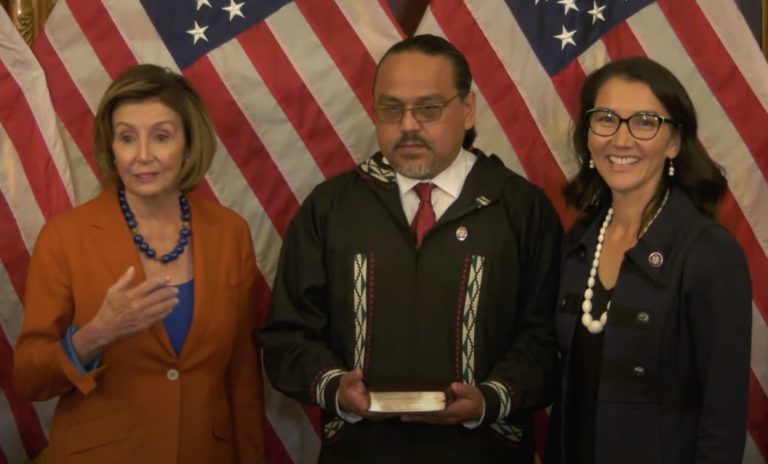
Congresswoman Mary Peltola, sworn in to serve out the late Congressman Don Young’s remaining weeks of office, has submitted her first bill: House Resolution 8888, legislation that creates an Office of Food Security in the Department of Veterans Affairs.
The purpose of the office is to better assist veterans in getting information about government benefits. The office would be staffed by a career government worker as the director. One of the main purposes of the office would be to collaborate, train and otherwise assist other agencies on how to get veterans signed up for SNAP benefits and WIC benefits.
“To develop and provide training, including training … for social workers, dietitians, chaplains, and other clinicians on how to assist veterans with enrollment in Federal nutrition assistance programs, including the supplemental nutrition assistance program and the special supplemental nutrition program for women, infants, and children established by section 17 of the Child Nutrition Act of 1966,” the bill states.
With grocery prices up 13.5% over the past 12 months, many Americans are struggling to make ends meet. The solution for members of the military, according to the U.S. Army, is to apply for food stamps, or SNAP.
HR 8888 would also require the department to develop annual reports, and track food insecurity among veterans via racial characteristics, as well as gender, gender identity, and sexual orientation.
At this point in the bill’s history, it has passed out of the Committee on Veterans’ Affairs at lightning speed; the fiscal cost to taxpayers is not yet determined.
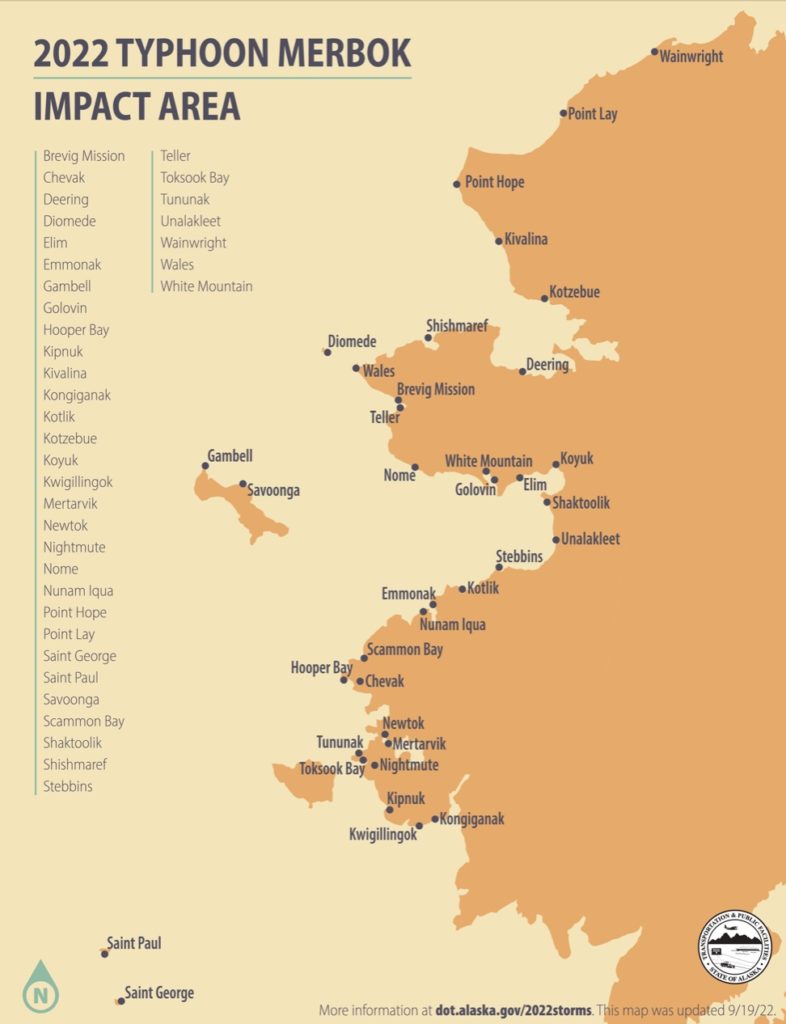
President Joe Biden approved Alaska Gov. Michael Dunleavy’s request for a federal disaster declaration to support Western Alaska’s recovery from the impact of Typhoon Merbok, which struck a large swath of the coast on Sept. 17 and 18. The announcement was made Friday, two days after Dunleavy made the request to the federal government. All members of the Alaska congressional delegation signed a letter of support for the declaration.
The federal disaster assistance through FEMA supplements state, tribal, and local recovery efforts in the areas affected by the remnants of Tropical Storm Merbok, which left flooding and landslides, and extensive damage to infrastructure.
The president’s action makes federal funding available to governments, tribes, individuals and organizations in the Regional Educational Attendance Areas of Bering Strait, Kashunamiut, Lower Kuskokwim, and Lower Yukon. Assistance may include grants for temporary housing and home repairs, low-interest loans to cover uninsured property losses, and other programs to help individuals and business owners recover from the effects of the storm.
Timothy Manner of FEMA was appointed the Federal Coordinating Officer for federal recovery operations for this disaster.
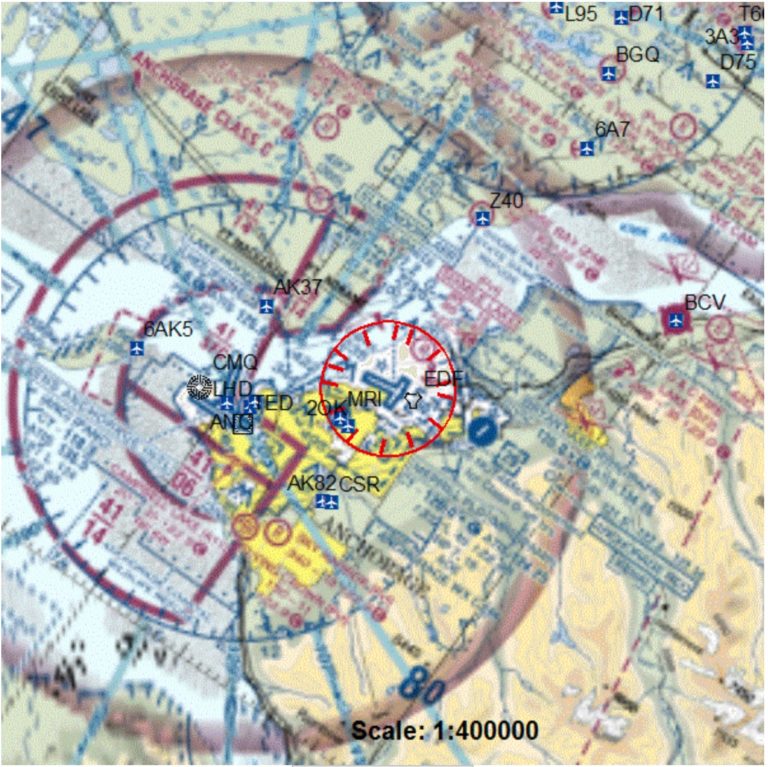
Vice President Kamala Harris is leading a delegation from the United States to the state funeral of former Japanese Prime Minister Shinzo Abe. Her plane will stop in Anchorage for fuel on Sunday. A temporary flight restriction has been declared for the area around Joint Base Elmendorf Richardson for a couple of hours, which will impact private and commercial flights in the area.
Harris will also visit South Korea during the trip, planned for Sept. 25-29; this is her first official visit to either Japan and South Korea.
Abe, who stepped down in 2020, was assassinated on July 8 by a gunman who shot the former prime minister while he was giving a campaign speech near Yamato-Saidaiji Station in Nara City, Nara Prefecture, Japan.
In Alaska and across America, calling someone who is conservative a “Nazi” is now par for the course for the Left. It’s the main toxic dish they serve when trying to discredit or destroy people who have an opposing point of view. Must Read Alaska, which defends civil discourse, has even been the target of attempted intimidation by those who use the “Nazi” name-calling politics of destruction. Exhibit A:
The communication director for the Alaska Democratic Party throws around the Nazi term freely in this social media post from 2021.
This week, former presidential candidate Hillary Clinton compared President Donald Trump supporters to Nazis, as she spoke to a liberal crowd in Austin, Texas.
At the Texas Tribune Festival, funded in part by the same Arnold Ventures funds that brought Alaska ranked choice voting, Hillary Clinton referenced speeches by Adolph Hitler, and said Trump supporters raising their arms at a Trump rally reminded her of Hitler. The Trump supporters were raising one finger in support of Trump, but that’s not what Hillary saw or took away from photos of the Ohio rally. She said she saw a Nazi salute.
The president of Russia, Vladimir Putin, has also gotten in on the “Nazi” fear-mongering. He called Ukrainians “Nazis” no less than 9 times in his Wednesday speech, in which he hinted he may use nuclear weapons against Ukraine. He has described Ukraininan soldiers as Nazis repeatedly this year.
Even conservatives have been tempted to pile on, calling people “mask nazis” or “vaccine nazis” in reference to the imposition of draconian Covid measures on the general public or children, in specific.
A generation ago, calling someone a Nazi was enough to bring a libel or defamation lawsuit in America. It was considered de facto libel, just like calling someone a murderer if they had not been convicted of murder. After all, Nazis killed millions of people — Jews, gypsies, gays, and disabled and for generations, one did not use that word to simply describe someone with opposing views.
Now, the word is strewn about so widely in political discourse that the public has become desensitized to it. With so few alive today who remember the Nazis, the term has morphed into simply a way to try to cost someone their livelihood or to intimidate people into silence. It’s a manifestation of cancel culture that the Left has wrought upon America in 2022.
There’s no telling what might happen should someone actually file a lawsuit for being called a Nazi. The ACLU saysthat no one has the right to not be called a Nazi. And a case in 2019 wasthrown out by the court. It appears in 2022, the term Nazi can be applied to anything, even people defending their country from invasion, such as Ukrainians.
President Putin is attempting to win over the sympathies of the liberals in America, and to make Europeans fear taking sides. In numerous remarks in 2022, Putin has referred to Ukrainians as Nazis.
Putin’s remarks in full, released by the Kremlin on Wednesday, Sept. 21, the same day that President Joe Biden spoke to the United Nations General Assembly:
The subject of this address is the situation in Donbass and the course of the special military operation to liberate it from the neo-Nazi regime, which seized power in Ukraine in 2014 as the result of an armed state coup.
Today I am addressing you – all citizens of our country, people of different generations, ages and ethnicities, the people of our great Motherland, all who are united by the great historical Russia, soldiers, officers and volunteers who are fighting on the frontline and doing their combat duty, our brothers and sisters in the Donetsk and Lugansk people’s republics, Kherson and Zaporozhye regions and other areas that have been liberated from the neo-Nazi regime.
The issue concerns the necessary, imperative measures to protect the sovereignty, security and territorial integrity of Russia and support the desire and will of our compatriots to choose their future independently, and the aggressive policy of some Western elites, who are doing their utmost to preserve their domination and with this aim in view are trying to block and suppress any sovereign and independent development centres in order to continue to aggressively force their will and pseudo-values on other countries and nations.
The goal of that part of the West is to weaken, divide and ultimately destroy our country. They are saying openly now that in 1991 they managed to split up the Soviet Union and now is the time to do the same to Russia, which must be divided into numerous regions that would be at deadly feud with each other.
They devised these plans long ago. They encouraged groups of international terrorists in the Caucasus and moved NATO’s offensive infrastructure close to our borders. They used indiscriminate Russophobia as a weapon, including by nurturing the hatred of Russia for decades, primarily in Ukraine, which was designed to become an anti-Russia bridgehead. They turned the Ukrainian people into cannon fodder and pushed them into a war with Russia, which they unleashed back in 2014. They used the army against civilians and organised a genocide, blockade and terror against those who refused to recognise the government that was created in Ukraine as the result of a state coup.
After the Kiev regime publicly refused to settle the issue of Donbass peacefully and went as far as to announce its ambition to possess nuclear weapons, it became clear that a new offensive in Donbass – there were two of them before – was inevitable, and that it would be inevitably followed by an attack on Russia’s Crimea, that is, on Russia.
In this connection, the decision to start a pre-emptive military operation was necessary and the only option. The main goal of this operation, which is to liberate the whole of Donbass, remains unaltered.
The Lugansk People’s Republic has been liberated from the neo-Nazis almost completely. Fighting in the Donetsk People’s Republic continues. Over the previous eight years, the Kiev occupation regime created a deeply echeloned line of permanent defences. A head-on attack against them would have led to heavy losses, which is why our units, as well as the forces of the Donbass republics, are acting competently and systematically, using military equipment and saving lives, moving step by step to liberate Donbass, purge cities and towns of the neo-Nazis, and help the people whom the Kiev regime turned into hostages and human shields.
As you know, professional military personnel serving under contract are taking part in the special military operation. Fighting side by side with them are volunteer units – people of different ethnicities, professions and ages who are real patriots. They answered the call of their hearts to rise up in defence of Russia and Donbass.
In this connection, I have already issued instructions for the Government and the Defence Ministry to determine the legal status of volunteers and personnel of the military units of the Donetsk and Lugansk people’s republics. It must be the same as the status of military professionals of the Russian army, including material, medical and social benefits. Special attention must be given to organising the supply of military and other equipment for volunteer units and Donbass people’s militia.
While acting to attain the main goals of defending Donbass in accordance with the plans and decisions of the Defence Ministry and the General Staff, our troops have liberated considerable areas in the Kherson and Zaporozhye regions and a number of other areas. This has created a protracted line of contact that is over 1,000 kilometres long.
This is what I would like to make public for the first time today. After the start of the special military operation, in particular after the Istanbul talks, Kiev representatives voiced quite a positive response to our proposals. These proposals concerned above all ensuring Russia’s security and interests. But a peaceful settlement obviously did not suit the West, which is why, after certain compromises were coordinated, Kiev was actually ordered to wreck all these agreements.
More weapons were pumped into Ukraine. The Kiev regime brought into play new groups of foreign mercenaries and nationalists, military units trained according to NATO standards and receiving orders from Western advisers.
At the same time, the regime of reprisals throughout Ukraine against their own citizens, established immediately after the armed coup in 2014, was harshly intensified. The policy of intimidation, terror and violence is taking on increasingly mass-scale, horrific and barbaric forms.
I want to stress the following. We know that the majority of people living in the territories liberated from the neo-Nazis, and these are primarily the historical lands of Novorossiya, do not want to live under the yoke of the neo-Nazi regime. People in the Zaporozhye and Kherson regions, in Lugansk and Donetsk saw and are seeing now the atrocities perpetrated by the neo-Nazis in the [Ukrainian-] occupied areas of the Kharkov region. The descendants of Banderites and members of Nazi punitive expeditions are killing, torturing and imprisoning people; they are settling scores, beating up, and committing outrages on peaceful civilians.
There were over 7.5 million people living in the Donetsk and Lugansk people’s republics and in the Zaporozhye and Kherson regions before the outbreak of hostilities. Many of them were forced to become refugees and leave their homes. Those who have stayed – they number about five million – are now exposed to artillery and missile attacks launched by the neo-Nazi militants, who fire at hospitals and schools and stage terrorist attacks against peaceful civilians.
We cannot, we have no moral right to let our kin and kith be torn to pieces by butchers; we cannot but respond to their sincere striving to decide their destiny on their own.
The parliaments of the Donbass people’s republics and the military-civilian administrations of the Kherson and Zaporozhye regions have adopted decisions to hold referendums on the future of their territories and have appealed to Russia to support this.
I would like to emphasise that we will do everything necessary to create safe conditions for these referendums so that people can express their will. And we will support the choice of future made by the majority of people in the Donetsk and Lugansk people’s republics and the Zaporozhye and Kherson regions.
Friends, today our armed forces, as I have mentioned, are fighting on the line of contact that is over 1,000 kilometres long, fighting not only against neo-Nazi units but actually the entire military machine of the collective West.
In this situation, I consider it necessary to take the following decision, which is fully adequate to the threats we are facing. More precisely, I find it necessary to support the proposal of the Defence Ministry and the General Staff on partial mobilisation in the Russian Federation to defend our Motherland and its sovereignty and territorial integrity, and to ensure the safety of our people and people in the liberated territories.
As I have said, we are talking about partial mobilisation. In other words, only military reservists, primarily those who served in the armed forces and have specific military occupational specialties and corresponding experience, will be called up.
Before being sent to their units, those called up for active duty will undergo mandatory additional military training based on the experience of the special military operation.
I have already signed Executive Order on partial mobilisation.
In accordance with legislation, the houses of the Federal Assembly – the Federation Council and the State Duma – will be officially notified about this in writing today.
The mobilisation will begin today, September 21. I am instructing the heads of the regions to provide the necessary assistance to the work of military recruitment offices.
I would like to point out that the citizens of Russia called up in accordance with the mobilisation order will have the status, payments and all social benefits of military personnel serving under contract.
Additionally, the Executive Order on partial mobilisation also stipulates additional measures for the fulfilment of the state defence order. The heads of defence industry enterprises will be directly responsible for attaining the goals of increasing the production of weapons and military equipment and using additional production facilities for this purpose. At the same time, the Government must address without any delay all aspects of material, resource and financial support for our defence enterprises.
Friends, the West has gone too far in its aggressive anti-Russia policy, making endless threats to our country and people. Some irresponsible Western politicians are doing more than just speak about their plans to organise the delivery of long-range offensive weapons to Ukraine, which could be used to deliver strikes at Crimea and other Russian regions.
Such terrorist attacks, including with the use of Western weapons, are being delivered at border areas in the Belgorod and Kursk regions. NATO is conducting reconnaissance through Russia’s southern regions in real time and with the use of modern systems, aircraft, vessels, satellites and strategic drones.
Washington, London and Brussels are openly encouraging Kiev to move the hostilities to our territory. They openly say that Russia must be defeated on the battlefield by any means, and subsequently deprived of political, economic, cultural and any other sovereignty and ransacked.
They have even resorted to the nuclear blackmail. I am referring not only to the Western-encouraged shelling of the Zaporozhye Nuclear Power Plant, which poses a threat of a nuclear disaster, but also to the statements made by some high-ranking representatives of the leading NATO countries on the possibility and admissibility of using weapons of mass destruction – nuclear weapons – against Russia.
I would like to remind those who make such statements regarding Russia that our country has different types of weapons as well, and some of them are more modern than the weapons NATO countries have. In the event of a threat to the territorial integrity of our country and to defend Russia and our people, we will certainly make use of all weapon systems available to us. This is not a bluff.
The citizens of Russia can rest assured that the territorial integrity of our Motherland, our independence and freedom will be defended – I repeat – by all the systems available to us. Those who are using nuclear blackmail against us should know that the wind rose can turn around.
It is our historical tradition and the destiny of our nation to stop those who are keen on global domination and threaten to split up and enslave our Motherland. Rest assured that we will do it this time as well.
Nick Begich III is a 44-year-old conservative Republican running for Alaska’s only seat in the US House of Representatives. He and his wife Dharna have a 10-year-old son, Nicholas. Nick was born in Alaska and currently lives in Chugiak.
Yes, he is a part of the well-known, primarily democratic, Begich family. However, he comes from a different branch of that family tree. At a very young age, following the divorce of his parents, he was sent to Florida where he was raised by his mother’s parents. They instilled the strong conservative Christian values he holds today.
His involvement with the Republican party started when he was still in high school. He organized a group of like-minded students who, though too young at that time, were referred to as part of the official organization of “Young Republicans.” Following high school, he earned a BBA at Baylor University then an MBA at Indiana University. His wife finished her education at Purdue University and is a pharmacist at Providence Hospital in Anchorage.
Of note is the fact that they paid for their own education.
Nick worked for Ford Motor company for a few years and then started his own business. He is the founder and executive chairman of FarShore Partners, a full-service custom software and product development design agency that provides technical expertise locally and internationally.
Nick returned to Alaska 18 years ago, when he was in his 20s. During the last 18 years he has demonstrated his natural leadership ability in multiple public service arenas. He became the co-chair of the Alaska Republican Party Finance Committee (2017-19) and co-chair of Alaskans for Don Young (2020).
He served on the Alaska Policy Forum, whose vision is “an Alaska that continuously grows prosperity by maximizing individual opportunities and freedom.” He was board president from 2018 – 2021.
He was elected to the Board of Directors of Matanuska Telephone Association (MTA) in 2016 – 2022. While on the MTA Board, he served on and was elected president of the MTA Foundation Board (2017-2021). The goals of the Foundation Board are to promote technology awareness, economic development and enhance entrepreneurship through education and community involvement. In addition, he has invested in a variety of businesses statewide helping to create jobs and strengthen Alaska’s economy.
Nick stands for the following:
Prosperity through resource independence
American energy security
Alaska’s role in national security
Veterans
Development of Alaska’s critical minerals
Lowering Alaska’s energy costs
Restoring Alaska’s timber industry
Ensuring sustainable fisheries
Securing our Second Amendment freedoms
Focusing education on the student
Enhancing Alaska’s tourism
Lowering health care costs for Alaskans
Protecting American freedom from judicial activism
He is running a high-energy campaign, traveling statewide to meet other Alaskans, to discuss their views and concerns, and to answer any questions they may have.
We hope the future involves a political forum where all the candidates are in attendance and where the questions are NOT provided to the candidates in advance. This will give us, the voters, the opportunity to judge each candidate based on their knowledge of and potential solutions for various state issues.
Take the opportunity to meet Nick. His entrepreneurial experience, his demonstrated leadership ability, and, his dedication to understanding Alaska’s diverse issues makes him unquestionably the most qualified person to represent all of Alaska in the U.S. House of Representatives.
How does one explain Anchorage Superior Court Judge Jack McKenna’s outlandish decision against Rep. David Eastman, saying he may not be sworn in until the court decides whether he is sufficiently politically acceptable to the Judiciary?
McKenna is not stupid. He knows that, regardless of what one thinks of Rep. Eastman, the Oath Keepers or their role in Jan. 6, 2021 at the U.S. Capitol, Eastman is an American citizen, entitled to the protections of the United States Constitution, including the rights of free speech and association. McKenna also knows that if the Alaska Court System attempts to prevent Eastman from taking office, the decision will be reversed in federal court because of constitutional protections of the First Amendment.
McKenna is not attempting to damage Eastman politically. He knows he’ll be reelected on Nov. 8. If this ruling has any effect on that election, it will help Eastman in his Wasilla district. So what’s the point?
By this ruling, which has made national headlines, McKenna inserted himself into the ongoing political campaign to discredit the Republican Party by associating it with the events of Jan. 6, and, by implication, with former President Donald Trump.
McKenna is not acting as a judge. He is assuming the role of a calculating political operative. He knows that if the election of 2022 is about President Joe Biden and his record, the Democrats will lose. If instead it’s about Trump, and Jan. 6, Democrats can win.
Legally, McKenna’s ruling is inexplicable. Politically, it makes perfect sense.
So how can Gov. Mike Dunleavy justify his elevation of McKenna to the Superior Court bench? Alaska’s Constitution vests in him, as governor of Alaska, the power of judicial appointments.
As Dunleavy has painfully learned in the past four years, this power is illusory. Judicial appointments can only be made of candidates who have been approved by the Alaska Judicial Council, which is controlled by the three members appointed by the Alaska Bar Association. They, along with the Chief Justice of the Supreme Court, have a majority on the council. They refuse to approve any judicial candidate who does not share their judicial activist philosophy. As a result, Alaska’s judiciary is entirely dominated by ideological soul mates.
The Alaska Supreme Court and Superior Courts are partisan, imperial, and unaccountable. They have been for over 40 years. It doesn’t matter who the people elect as their governor. It’s out of his hands as the judiciary is controlled by the lawyers.
In the case of McKenna, he was the least objectionable of the candidates Dunleavy was forced to choose from. One can only imagine how bad the other choices were. Until this system is changed, Alaskans can expect more Jack McKennas, and there’s nothing they can do about it.
Unless, of course, Alaska’s Constitution is amended, and the Alaska Bar Association’s control of the Judicial Council is eliminated. In the Alaska Legislature, numerous efforts have been made over the years to propose such an amendment. But it’s been proven politically impossible to achieve the needed two-thirds supermajority required. The politicians in black robes who populate our judiciary have enough political allies in the Legislature to prevent passage of such an amendment.
So what can be done? Fortunately, there is a solution in Article XIII, Section 3 of Alaska’s Constitution. It calls for a referendum, every 10 years, on the question of calling a constitutional convention. This year, on Nov. 8, Alaskans can vote for Ballot Measure 1, calling a convention. If it passes, delegates to the convention may, by majority vote, propose an amendment which would put an end to this judicial tyranny. If subsequently approved by the people, Alaska’s lawyers would no longer control the judiciary.
A grass roots campaign is being conducted on behalf of Prop 1 by ConventionYES. It’s are focused on putting the Permanent Fund Dividend formula into the Alaska Constitution, taking that power away from the Legislature. Such an amendment can only be proposed by a convention. Ballot Measure 1 will rise or fall on the question of the dividend, and its future.
But an unavoidable subsidiary issue is judicial reform, which likewise will only be proposed by a convention. If you are outraged by the political antics of Judge McKenna, you should not only vote yes on Ballot Measure 1, you should join the effort of ConventionYES. It will succeed if it can get its message heard. Fortunately for proponents of Ballot Measure 1, Judge McKenna has just illustrated clearly why voters should choose hope over the fear that opponents of the measure are trafficking. Judge McKenna is Exhibit A for why someone would want to vote “yes” on Ballot Measure 1 on Nov. 8.
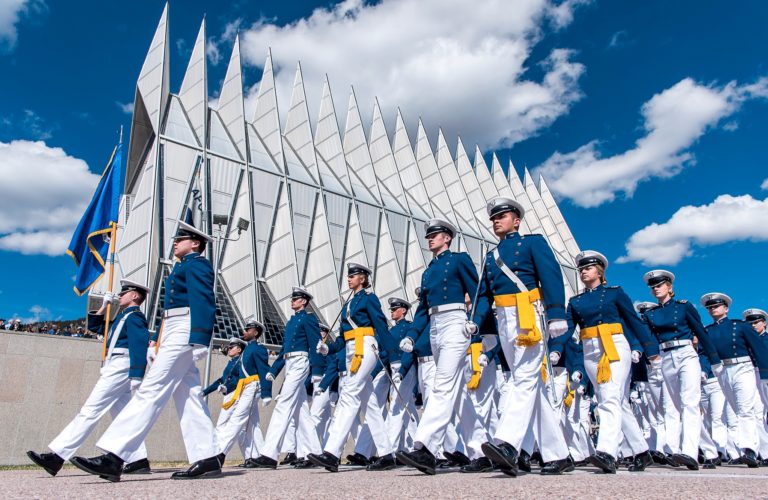
The United States Air Force Academy in Colorado Springs, Col. is teaching new cadets to stop saying “mom” and “dad,” and instead to use words that recognize other possible genders.
The lesson slide titled, “Diversity & Inclusion: What it is, why we care, & what we can do,” tells cadets to use gender-neutral language whenever possible, including saying “y’all” and “folks” instead of saying men, women, male or female. Boyfriends and girlfriends are to be called “partners.”
The lesson includes advice to avoid “stereotypes, bias, and microaggressions.” Cadets are also told not to use the terms “you guys,” “terrorists,” or even “colorblind.”
The Air Force Academy has pushed back against the intense criticism is has received, issuing a statement that says, “It is the diversity of Airmen and Guardians coming from all corners of our nation who perform the Department of the Air Force’s hundreds of critical mission sets that make us the best, most innovative Air and Space Forces the world has ever known.”
They did it: They used the word “airmen” in their statement.
“USAFA develops leaders of character that can lead diverse teams of Airmen and Guardians inclusively, to enhance innovation and win future conflict,” the Academy spokesperson said.
Oops. They did it again.
In addition, the storied institution has encouraged men who identify as men, also known as “cisgender men” to not apply for a fellowship that is set aside for what the academy refers to as “gender minorities.”
The academy sent an email on Sept. 14 informing cadets that the 2023 application for the Brooke Owens Fellowship for “undergraduate women and gender minorities interested in aerospace” is due by Oct. 10.
The application for the Brooke Owens Fellowship is “People of your gender are underrepresented in aerospace. If you are a cisgender woman, a transgender woman, non-binary, agender, bigender, two-spirit, demigender, genderfluid, genderqueer, or another form of gender minority, this program is for you. If you are a cisgender man, this program isn’t for you..”
A recent front-page article in the Juneau Empire caught my attention. It was titled “Southeast Alaska Food Bank asks for help in the face of hard times”. The article described the large increase in Juneau residents seeking food assistance over the past six months. Facing longer lines of people, the Food Bank is running out of supplies before everyone is served. Contributing to this situation is the general supply chain slowdown along with higher food costs due to inflation that have impacted everyone’s buying power.
Understandably, the Food Bank is asking everyone for help so that people won’t go hungry.
As the Food Bank has been forced to raise their prices, its traditional partners, comprised of other non-profits and church groups, are also under increased economic pressure.
Some of this may have been inevitable due to Covid, but it was also predictable, and stands in sharp contrast to some of the priorities embraced by the local Assembly.
Assembly members and city staff seem to be more preoccupied with justifying spending an estimated $42 million on new city offices rather than understanding what is happening in Juneau’s lagging economy. There are lots of reasons to build new offices, they say. First, it will save money, they say. Second, it’s being touted as an investment in democracy and the future. Maybe, but struggling families now can’t wait 50 years for the savings to materialize – the time currently estimated it will take for this project to break-even.
The obsession to build a massive arts and culture center also comes to mind. Rejected by voters once, the Assembly seems determined to resurrect it with an even larger price tag. Combined with what were supposed to be fairly modest improvements to the Centennial Hall Convention Center, the total project could now surpass $77 million.
With Juneau’s declining population and narrow tax base, it’s hard to understand how Juneau residents could possibly support a facility of this size with enough frequency to pay the light bill. That Juneau will attract significant numbers of out-of-town patrons with the community’s high transportation costs and limited hotel accommodations is just a pipe dream.
But that’s not all. A third project is also being considered, a new city museum. Price tag: unknown.
Juneau’s Assembly blithely insists these are needed improvements that will enrich our town and make life better for all concerned.
Tell that to the Food Bank and its patrons.
It’s almost as if the Assembly is unaware that their extravagant spending risks driving more residents either out of town or into the Food Bank lines.
There is another warning on the horizon.
Juneau’s school buildings are underutilized as our student counts continue to decrease. Juneau’s “peak” school enrollment was 5,701 in 1999. Based on city forecasts, it will be 4,225 in October 2022 and by 2032, Juneau’s total school enrollment will drop to 3,035, a loss of almost 2,700 students in over 20 years.
With all this as a backdrop, Juneau voters will be expressing their opinion on Assembly spending priorities when marking their ballots in the municipal election occurring now. Specifically, two propositions on the ballot, Proposition #1, a $35 million general obligation bond to partially pay for a new city hall, and Proposition #3, the renewal of a “temporary” 1% sales tax, deserve their attention.
Both of these propositions will add significantly to future city operating costs and need to be modified before being approved by voters.
For the record, I am not against improving Juneau’s arts and culture facility, its government offices, or maintaining our schools. These facilities do play an important role in Juneau’s quality of life and make Juneau a better place to live and work.
But the sponsors of these projects and other costly undertakings would be wise to scale them appropriately to the size of Juneau’s population and the financial ability of its taxpayers. Jacking up property taxes precipitously at a time when our economy is still in recovery isn’t the answer.
And the Food Bank should be a higher priority than it apparently is now.
Juneau City Manager, Rorie Watt, has correctly identified the problem when he stated in his most recent Budget Message, “…the FY23 budget appears to demonstrate a structural deficit that future Assemblies will need to wrestle with. Going forward, the Assembly must take corrective action to build a budget that pays for itself with current revenues.”
No one wants to say no to someone’s grand project. No one wants to say that you must do more with less.
But someone has to make the hard choices.
If the Juneau Assembly won’t, then voters should.
After retiring as the senior vice president in charge of business banking for Key Bank in Alaska, Win Gruening became a regular opinion page columnist for the Juneau Empire. He was born and raised in Juneau and graduated from the U.S. Air Force Academy in 1970. He is involved in various local and statewide organizations.
Running for governor, former Alaska Gov. Bill Walker did the unthinkable this week: He asked people to donate to his campaign with the promise that he would forward a whole $1 out of every $10 donated to relief efforts for Western Alaska, through the Alaska Community Foundation.
It’s as though he had not discovered people could donate directly to the American Red Cross, the community foundation, or other disaster relief providers who are already helping the people impacted by the Sept. 17 storm.
Walker, whose net worth is said to be millions of dollars, could easily write a $100,00 check himself to a relief fund, and could at least take the charitable deduction on his taxes. Those who donate to the Walker-Drygas campaign will not be able to take such a write off.
Walker’s strategy of mocking the governor for missing debates during the emergency response appears to have backfired. Walker’s emissary Scott Kendall bashed the governor for not declaring a disaster before the storm hit. He’s running behind in the polls, and now he’s using human suffering as a reason to donate to his campaign. There’s no handbook that tells candidates not to do this, because evidently no campaign advisor has ever thought any campaign would be so tacky.
Robert Maguire, research director at the watchdog group Citizens for Responsibility and Ethics in Washington, told CNBNC that people need to do their diligence.
“Some of these campaigns and committees have gotten really good at making emotional appeals that apply to donors’ preexisting political beliefs,” Maguire was quoted as saying on “American Greed.” “Sometimes that can sort of short circuit the part of your brain that says, ‘Wait, I should be doing a little research before I give this money’.