By John Haxby
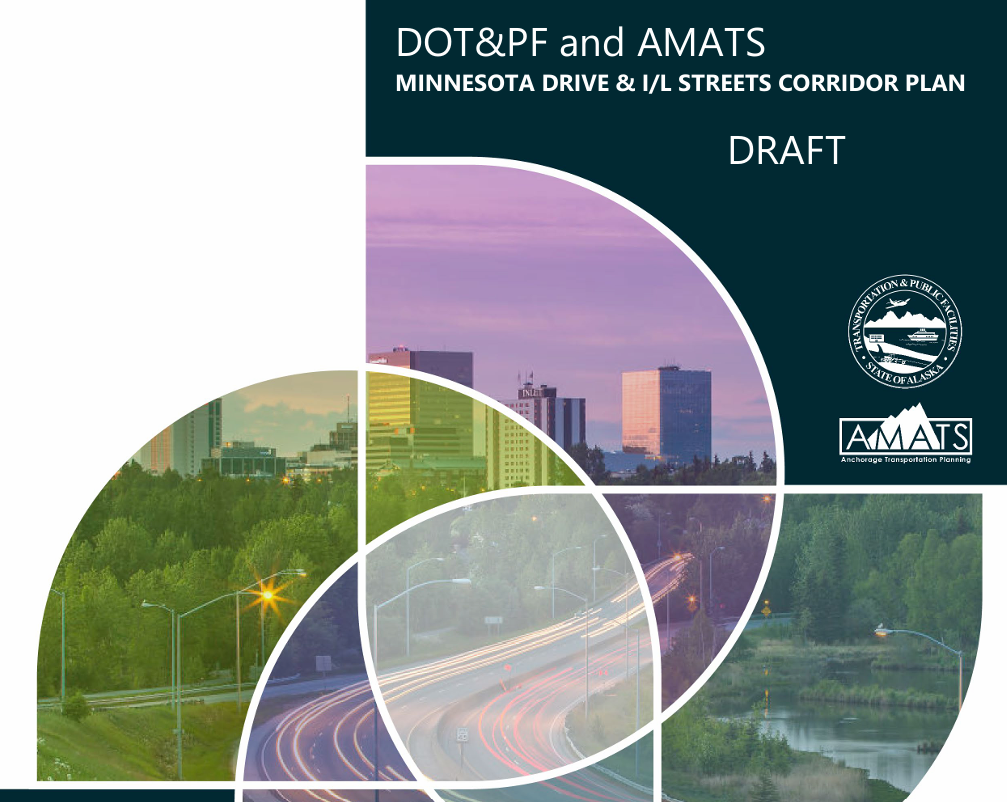
I attended the Turnagain Community Council meeting on May 7, 2026, where the Draft Minnesota Drive & I/L Street Corridor Plan was unveiled. The draft was prepared by R&M Consultants, Inc. for the Alaska Department of Transportation and Public Facilities (DOT&PF) and Anchorage Metropolitan Area Transportation Solutions (AMATS). There was significant resistance to the proposed plan, as there should be.
I have analyzed the plan in depth, and now it’s time for the assembly to look into it and get to the bottom of it. A back of the envelope estimate by the R&M Consultants presenter indicated the initial I/L street portion of the project was about $12 million, so the whole corridor would be an estimated $50 million.
Rather than committing tens of millions to a city changing project on a major north/south transportation corridor, my analysis concludes that prior to any continued engineering and any construction, a 12-month real-world pilot project be put into place. This would include temporary blocking/reallocation of lanes, and temporary signalized pedestrian crossings.

This will give real-world, real-user feedback on this plan.
Don’t Waste Millions: Test First
Before Anchorage commits tens of millions of dollars to permanent reconstruction and roadway reallocation along Minnesota Drive and the I/L Street corridor, the Municipality and DOT&PF should first implement a full 12‑month pilot project using temporary traffic control devices, temporary striping, temporary pedestrian crossings, and temporary lane reallocations.
A real-world pilot project would provide substantially more useful information than conceptual modeling and consultant projections alone. Anchorage’s climate, freight dependency, snow removal realities, seasonal darkness, and roadway operations differ dramatically from the urban environments where many modern “complete streets” concepts are commonly implemented.
A temporary pilot would allow the public and decision-makers to directly observe:
- Actual congestion impacts
- Freight movement impacts
- Winter snow storage and snow-removal impacts
- Emergency response impacts
- Pedestrian crossing activation frequency
- Real bicycle and pedestrian utilization during winter conditions
- Public acceptance or rejection of the proposed changes
- Operational impacts during peak traffic periods
- Impacts during major snow events and freeze-thaw cycles
Importantly, Anchorage has already experienced a smaller-scale real-world lane reallocation experiment along 5th Avenue downtown. That temporary conversion of one lane to non-motorized use was widely viewed as operationally problematic and was ultimately removed. Since 5th Avenue functions as an important connector into the Minnesota Drive downtown system, this prior experience is highly relevant and demonstrates why real-world testing matters.
Rather than committing immediately to permanent infrastructure reconstruction costing potentially tens of millions of dollars, Anchorage should first validate whether the proposed corridor transformation functions effectively under actual Anchorage conditions
Major Concerns with the Draft Corridor Plan
1) Internally Inconsistenty on Population, Capacity, and Demand
The draft corridor plan projects that the population within the corridor study area will decline from approximately 25,894 residents in 2019 to approximately 22,852 residents by 2050 — a decline of roughly 11.7%.
At the same time, the plan recommends removing approximately one-third of general-purpose vehicle capacity in key portions of the corridor by reducing six travel lanes to four travel lanes.
This creates a fundamental inconsistency:
The corridor population is projected to decline
The roadway capacity is proposed to decline by approximately 33%
Yet employment along the corridor is simultaneously projected to increase substantially
This conflict becomes even more pronounced when compared against the Municipality’s broader public policy direction. The Mayor has publicly promoted a “10,000 homes in 10 years” initiative intended to encourage growth, housing expansion, and increased economic activity within Anchorage. However, this corridor plan simultaneously relies upon long-term population decline projections to justify roadway capacity reductions and lane reallocations. These two planning assumptions do not logically fit together. If Anchorage is actively pursuing major housing growth and long-term economic expansion, reducing capacity on one of the city’s most important freight and commuter corridors appears inconsistent with that stated objective.
The report projects employment growth from approximately 29,839 jobs to over 37,000 jobs by 2050.
This raises an obvious question: If corridor employment, freight activity, and regional economic activity are projected to increase, why is roadway capacity being substantially reduced?
The report itself acknowledges that Minnesota Drive is a critical freight and regional transportation corridor connecting the Port of Alaska, the airport, downtown Anchorage, and major commercial areas.
The proposed lane reductions appear driven primarily by planning philosophy and corridor transformation objectives rather than demonstrated future capacity deficiencies. The report itself acknowledges that no corridor intersections are projected to fail Level of Service standards through 2050.
This is therefore not primarily a congestion-relief project. It is fundamentally a corridor redesign initiative intended to reprioritize transportation modes.
2) Operational Risks Due to Anchorage’s Climate and Winter Operations
Anchorage is not Portland, Seattle, Minneapolis, or Copenhagen. Anchorage experiences: long winters, severe freeze-thaw cycles, extended darkness, heavy snow events, significant snow-storage limitations, frequent delayed snow removal, and extreme seasonal variation in bicycle and pedestrian activity.
In practice, Anchorage already struggles to maintain its current roadway network after major snow events. It can take approximately four days after significant storms for many roads to return to normal operational conditions.
The draft corridor plan repeatedly references reducing maintenance burdens and improving snow storage. However, the proposed improvements would likely increase maintenance complexity by introducing
- Protected bicycle facilities
- Buffered pathways
- Expanded pedestrian infrastructure
- Refuge islands
- Additional signal systems
- More complicated intersection geometry
- Additional striping and delineation
- Narrower roadway clearances
These facilities often require specialized snow-clearing equipment and multiple passes during winter operations.
The report provides no meaningful quantitative analysis regarding: winter bicycle utilization, seasonal pedestrian demand, maintenance cost per user, lifecycle maintenance obligations, snow-removal staffing requirements, or long-term operational costs.
This omission is significant because Anchorage’s operational realities differ substantially from many cities where these concepts originated.The Corridor’s Freight Function Appears Undervalued
3) The Corridor’s Freight Function Appears Undervalued
Minnesota Drive is one of Anchorage’s primary north-south freight corridors.
Anchorage is uniquely dependent upon the Port of Alaska for food, fuel, freight, and consumer goods. The city maintains only a limited supply chain buffer for critical goods.
The corridor serves port freight movement, airport freight movement, commercial distribution, commuter traffic, and regional logistics operations.
The report repeatedly acknowledges the importance of freight mobility, yet simultaneously proposes lane reductions, additional pedestrian crossings, additional stop events, elimination of free right turns, lower design speeds, and more signalized interruptions.
Even if these changes do not create catastrophic traffic collapse, they will likely increase vehicle idling, travel times, corridor friction, freight delays, operating costs, and fuel consumption.
These increased transportation costs ultimately flow into:
- Consumer prices
- Retail prices
- Freight rates
- Distribution costs
- Cost of living increases
This is particularly concerning given Anchorage’s already high transportation and logistics costs.
4) The Plan Assumes a Large Modal Shift That May Never Materialize
The corridor plan heavily emphasizes:
- “Complete streets” concepts
- Multimodal transportation
- Reduced single-occupancy vehicle usage
- Increased bicycle and pedestrian usage
- Lane reallocation
However, the plan provides little evidence that Anchorage’s actual transportation behavior supports these assumptions.
Even in locations throughout Anchorage where bike paths and sidewalks already exist and are actively maintained with specialized equipment, actual winter bicycle and pedestrian usage remains relatively low compared to roadway vehicle usage.
The report does not provide existing winter bicycle counts, projected winter bicycle demand, cost-per-user analysis, seasonal utilization analysis, quantified emissions reductions, or demonstrated modal conversion projections.
Instead, the report largely assumes that if infrastructure is built, usage will increase. That assumption may not hold true in Anchorage due to severe climate conditions, long commuting distances, seasonal darkness, car dependency, geographic spread of development, and freight dependency.
If the projected modal shift does not occur, the likely outcome will simply be:
- Reduced roadway capacity
- Slower travel speeds
- Increased congestion
- Increased idling
- Increased maintenance costs
- Greater operational complexity without meaningful transportation transformation.
5) Public Input Appears Limited and Potentially Unrepresentative
The report documents advisory committee meetings, workshops, farmers market events, community council outreach, and stakeholder meetings.
However, the report does not provide attendance totals, public support percentages, representative survey data, corridor user polling, freight industry polling, winter commuter surveys, or statistically representative public sentiment analysis.
Recent community reaction suggests the broader public may be substantially more skeptical of lane reductions than the report reflects. At the Turnagain Community Council meeting on May 7, significant concern was reportedly expressed regarding:
- Lane reductions
- Narrowed roadway geometry
- Reduced vehicle capacity
- Congestion impacts
- Anchorage’s winter realities
This suggests the corridor plan may not yet reflect broad public consensus. This is not popup events, or community council events, this is user/driver consensus, and cost/user analysis.
Conclusion
The draft Minnesota Drive and I/L Streets Corridor Plan proposes a substantial transformation of one of Anchorage’s most important transportation corridors.
The proposal appears driven primarily by contemporary urban planning philosophy emphasizing traffic calming, lane reallocation, multimodal transportation, reduced vehicle dominance, and corridor character transformation.
However, Anchorage’s unique realities raise substantial concerns regarding whether these concepts are operationally appropriate for the city. The plan reduces roadway capacity despite projected employment growth and increases operational complexity during already difficult winter maintenance conditions. It potentially increases congestion, idling, and transportation costs. It assumes large modal shifts without demonstrating likely demand, commits to potentially enormous long-term capital and maintenance costs, and appears to understate the corridor’s critical freight and logistics role.
Before permanent reconstruction occurs, Anchorage should implement a 12‑month pilot project using temporary lane reallocation, temporary crossings, temporary striping, and temporary traffic control devices.
A full-year pilot would expose:
- Real winter operational impacts
- Actual public usage patterns
- Freight movement impacts
- Snow-removal challenges
- Emergency response impacts
- Real-world public acceptance or rejection
A pilot project would provide decision-makers and taxpayers with real Anchorage-specific operational data rather than relying primarily on theoretical planning assumptions.
Given the scale, cost, and long-term implications of this proposal, a temporary pilot should be considered a necessary prerequisite before permanent implementation.
John E. Haxby is an Alaska resident for 50 years, engineer, land developer, investor, and AKRR neighbor.