A Centers for Disease Control and Prevention panel is considering adding Covid-19 vaccinations to the list of recommended childhood vaccines. The decision is expected to come from the annual meeting on vaccines on Thursday, at which time officials decide which vaccines should be recommended to certain age groups and individuals.
While the CDC doesn’t mandate shots for children, several states have laws that say they adopt the CDC vaccine guidelines automatically. Mainstream media has criticized Fox News analyst Tucker Carson for saying the CDC is going to mandate the shots; for many states, the CDC guidelines are indeed a mandate because for children to attend school, they must be current on the CDC list of shots. All states adopt the CDC vaccine list with minimal variation.
The CDC itself went into damage control over Carlson’s claim: “Thursday, CDC’s independent advisory committee (ACIP) will vote on an updated childhood immunization schedule. States establish vaccine requirements for school children, not ACIP or CDC,” the CDC said on Twitter, not discussing the nuance that the CDC actually does trigger mandates.
Children are given a long list of vaccines as a requirement to attend school, including for diseases such as measles, mumps, diphtheria, pertussis, chicken pox, and hepatitis A and B. The list of vaccines have a long history of usage, and some side effects are accepted with them. Sometimes side effects to vaccines can be severe, but it’s a societal decision that the spread of a disease is a worse outcome. Diseases such as polio and smallpox have had crippling and deadly results. Vaccines are given to children starting at a very young age, starting at birth with a hepatitis B shot.
With Covid-19 shots, there is less known about long-term side effects and pharmaceutical companies have no legal liability because these shots are being used under an emergency authorization to prevent the spread and severity of Covid.
CDC already recommends that people ages 5 years and older receive one updated (bivalent) booster if it has been at least 2 months since their last COVID-19 vaccine dose, whether that was their final primary series dose, or an original (monovalent) booster. The Covid booster shot schedule has been variable in nature, but appears to be heading toward at least one booster shot per year, as the virus mutates.
Democrat Les Gara was the attack dog. Politically homeless Bill Walker wanted a do-over as governor and didn’t want anyone to remember his first go-round. And Charlie Pierce was like the church elder in the room.
But ultimately it was Gov. Mike Dunleavy’s night at the fights. He took a steady stream of punches from the Left — Gara and Walker — and prevailed by making no mistakes and not getting caught flatfooted during KTUU’s and KTOO’s Debate for the State. Dunleavy gave opposition researchers nothing to work with to attack him in ads.
The biggest news of the night came when Gov. Mike Dunleavy asked former Gov. Bill Walker if there was anything he regretted about his deals with China on the Alaska gas line.
Walker began flapping his arms animatedly, and said Donald Trump supported his gas line deal.
Then Dunleavy asks him if he would do it over again.
“No, of course not,” Walker said, visibly anxious. The gas line was Walker’s signature issue during his 2010 and 2014 run for governor, and now he was admitting his strategy would have been a bad one.
During the debate, the positions of Walker and Gara were nearly indistinguishable. They both favor abortion and more education funding without any accountability from schools. They were two leftist former elected officials who hate the governor and want to take his job.
Dunleavy took the punches, but pointed out that they are both litigators, and he mentioned that they only wanted to attack him, they didn’t want to stand on their own records, and he couldn’t blame them for not wanting to do so.
Walker, who unsuccessfully pushed over nine income taxes during his time as governor, said he hoped he would not have to resort to taxation on Alaskans. Gara said he didn’t see how Alaska could pay for all the things he wants without taxes, and he mentioned punishing oil companies.
Pierce reminded viewers that during the pandemic, he refused to shut down the Kenai Peninsula, keeping businesses open to the extent that he had the power to do so. He pointed to his strong private sector business career and said he will always cut government before taxing people.
In closing statements, Gov. Mike Dunleavy asked voters to mark him first, and Charlie Pierce second. Pierce asked voters to mark him first and Dunleavy second. Neither Walker nor Gara made any such statement about ranking each other, although in past debates Walker has said that his voters should rank Gara second.
After the debate, Walker snubbed Dunleavy by refusing to shake his hand.
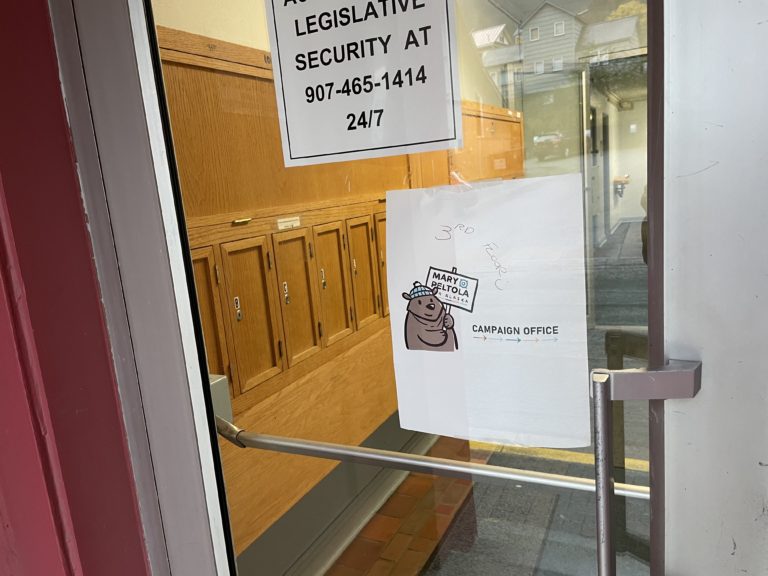
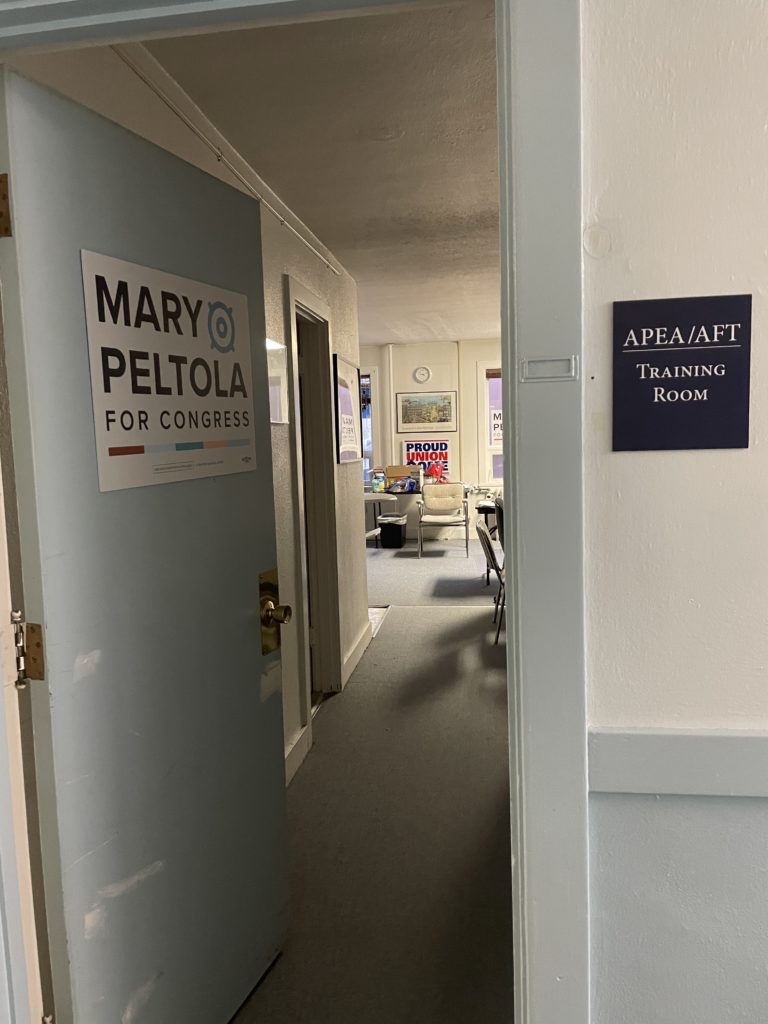
Congresswoman Mary Peltola knows which side of the bread her campaign butter is on. She has embedded her Juneau campaign office in the suites of the Alaska Public Employees Association – AFT – AFL-CIO, which is located in a building owned by the Alaska Legislature, right across from the Alaska Capitol.
The art-deco style building was once known as the Assembly Apartments. It was given to the Legislature by the Juneau Community Foundation to be used for 33 studio apartments for legislators and staff. The building needs a lot of renovation before it can be restored to apartments and it won’t be ready to lease until 2024, according to the Legislative Council.
While it was built as an apartment building, in recent years it has been a hotbed of lobbying offices, and during the Covid pandemic, the state had a Covid testing site set up in the building for people to go through before they came through the doors of the Capitol.
Mary Peltola’s office is embedded in the biggest public employee union in the state of Alaska.
The Alaska Public Employees Association-American Federation of Teachers is the largest lobby for government workers in Alaska and is always one of the largest contributors to campaigns and independent expenditure groups that exclusively support Democrats for elected office.
It’s possible that Peltola could not find someone in the private sector to rent an office from in Juneau, and it’s also possible the lease that APEA-AFT has with the Legislature allows them to sublease their space to political campaigns. But to be embedded in the Alaska Public Employees Association is certainly a strong message about Peltola priorities.
Under ranked choice voting, Peltola, a Democrat, was able to win the seat in Congress, even though as a Democrat, she represents a minority of Alaska voters. Her campaign is presenting her as a bipartisan person who can represent all Alaskans, but her links to unions and lobbyists are a growing concern to regular Alaskans.
She is running against three conservatives – Nick Begich, Sarah Palin, and Chris Bye. Conservative voters have not effectively ranked other conservatives on their ballots, which led to the August special election victory of Peltola, whose party has only 77,038 registered Democrats in Alaska, while the Alaska Republican Party has 144,045 registrants.
Part III: Chairman Xi emulates Mao, but has a Steal and Scale initiative that Alaska was going to provide the fuel forcolonization.
Bill Walker’s mistake in signing away Alaska’s gas to China was no small error in judgment. It was a move so catastrophic it could have made Alaska a multi-generational economic colony of China.
While former Gov. Walker was sealing a deal in 2017 with the Communist Chinese, getting China to agree to pay for 75 percent or more of the Alaska gas line and tie up Alaska’s gas exports to China for decades, China was also advancing its “Steal and Scale” economic strategy across America to abscond with U.S. companies’ technologies, and bring them to scale in order to sell them back to the United States.
Since the 1940s, manufacturing has continued to move offshore from America to China, where labor and lives are cheap, and where power is centralized in a corrupt and brutal government. Now, Americans are realizing the price they’ve paid for all those cheap goods, made by the slaves of the government of China.
“Steal and Scale” is the unacknowledged sister of China’s Belt and Road Initiative, which is investing in 150 countries around the world and exerting China-centric control over them. Belt and Road and Steal and Scale are the centerpieces of Chairman Xi Jinping’s economic and foreign policy, which is to stretch China’s influence through economic dominance. As of August, 2022, 149 counties were listed as having signed on the dotted line for the Belt and Road Initiative.
Essentially, that was what Walker signed on for. He was not an official signatory on Belt and Road itself, but the $35 billion the Chinese were investing in Alaska’s gas line was, in fact, the same thing, giving China economic control over construction of a $9.2-billion gas treatment plant on the North Slope, a $12.7 billion 800-mile gasline to Nikiski, and a $16.8-billion liquefaction plant in Nikiski, where the gas would be condensed for transportation to China, with small amounts available for contracts to Japan, Vietnam, and South Korea.
Notably, Walker did not sign this agreement to compromise Alaska’s sovereignty while on U.S. soil. The Chinese did not come to Alaska and sign the agreement, although they could have. It was Alaska that was begging them for the money, and so Walker went to China, hat in hand. In Beijing, he met with President Xi, and signed away Alaska’s sovereignty on behalf of the 734,000 Alaskans who had no idea that he was compromising Alaska’s gas to three companies owned by the Chinese government.
Today, if Bill Walker had remained in office, the China gas line might be half built, if all had gone according to Walker’s risky plan. Walker had promised Alaskans he would have it up and running by 2025. By then, he’d be long gone from office, even if he had won reelection in 2018.
Steal and scale is a polite way of describing China’s economic strategy with the United States, which started under Chairman Mao Tse Tung and now continues under Chairman Xi, who considers Mao his political role model.
Chairman Mao was a mass murderer who was responsible for far more deaths than Hitler or Stalin. Between 1958 and 1962, Mao’s Great Leap Forward policy led to between 15-55 million starvation deaths, as he transformed China from an agrarian to industrial economy. It was a a famine policy that reduced the need for food. There are hardly words to describe the brutality that existed in China under Chairman Mao
Across America in those years, mothers would admonish their children, “Eat your food. There are starving children in China.” And that was true. It was planned starvation.
Chairman Xi is Mao’s protege, amalgamating power at a rapid pace, running a country that has total surveillance on its citizens, a country where “social credit” will determine whether you eat or go hungry.
Any company that does business with China is required to have a Communist Party “minder” in the “C Suite,” someone who is stealing technology from American companies and sending the plans, formularies, and blueprints back to China.
China’s surveillance state is by far the most oppressive in the world. As described in a Wednesday story in the Wall Street Journal, it starts when a citizen steps out of his front door in the morning. The day starts with a mandated Covid test administered by workers in white hazmat jumpsuits. For those who don’t pass, they are prevented from going to any public space, including parks.
“Surveillance cameras keep watch over the city streets. In a cab on the way to work, the driver requires you to scan a QR code for a government database tracking people’s movements. Scan again when stopping by Starbucks for coffee and then again at the office,” writes Brian Spegele, of the Wall Street Journal.
“If the database shows you’ve crossed paths with someone infected by the virus, you’ll likely be forced into quarantine. It may be in a hotel room, at a converted convention center, or if lucky, at home with an alarm installed on the front door,” he writes.
“The Chinese state has stretched far deeper into citizens’ lives since Mr. Xi took power in 2012. Covid has pushed the controls to entirely new levels. Such measures are increasingly testing the faith of Chinese citizens in a government that is no longer delivering the supercharged economic growth that underpinned popular support for decades,” the story continues.
The Journal describes the fate of a 6-year-old Chinese boy who tested positive for Covid days after landing in Shanghai on a domestic flight. The government put 400 of the boy’s contacts into quarantine, and then went after secondary contacts.
“Authorities descended on an IKEA after determining that a close contact of the boy had also visited the store, then left. Verified video footage showed people attempting to escape as security officers tried to barricade shoppers inside,” the newspaper writes.
Chairman Xi’s plan is to put the Chinese Communist Party in even greater control of Chinese life. The party has censored social media, and also limited private enterprise’s expansion. And Xi is consolidating power.
“And he increasingly looks like the most consequential Chinese politician since Mao Zedong, the man most responsible for creating the People’s Republic of China. Indeed, in Xi’s campaign to strengthen his and the CCP’s authority, he appears to be modeling himself after Mao,” the Cato Institute wrote in 2020. “Which should make the rest of us very nervous.”
If indeed Xi is Mao reinvented and amplified, then Alaska narrowly escaped from becoming the fuel that would power the Steal and Scale dynasty that is preparing for war with America.
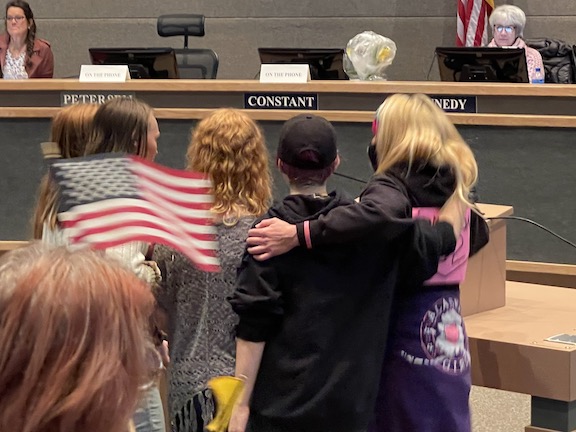
A man who told the Anchorage Assembly that the homeless problem in Anchorage is primarily among Natives, and that Native villages and corporations need to help solve the problem, has prompted members of the Assembly to ponder how to censor the public’s free speech at the Assembly.
The Assembly has already taken its first steps toward censorship by eliminating the first half hour of public participation that was a standard of the meetings until this month. The reason stated was that the Assembly didn’t want to hear from the public so much. The Assembly leadership also enforces its speech rules in an uneven manner, singling out those it disagrees with for harsh treatment; punishment includes being forcibly ejected from the meetings. The Assembly has created rules for what constitutes an “actual disturbance” (clapping when the Assembly leaders don’t want to hear clapping), and has limited signs in the Assembly Chambers to letter-sized pieces of paper.
The leadership of the Assembly on Tuesday sent out a press release condemning the man for his statements, which the leadership said was racist. The Anchorage Daily News has also labeled the man’s statement as racist.
Chairwoman Suzanne LaFrance and Vice Chair Christopher Constant wrote, “As the Assembly Leadership, we want to speak out against the racist and offensive statements made by the member of the public. Unfortunately, this is not the first time racist views have been expressed in the Assembly Chambers. The First Amendment gives wide latitude to members of the public to express opinions, even hateful ones, and this latitude extends to the Assembly Chambers.”
In that statement, the chair and vice chair appear to realize that there is only so much they can do, but they can at least call the man’s remarks “racist.”
“We are saddened by the pain the statements have caused to our friends, neighbors and community members who are Alaska Native. We want everyone in our community to feel welcome, safe and valued. Our community is full of rich and diverse cultures that should be celebrated and acknowledged for their important contributions to our society, culture, government, schools, and economy. We recognize that there is much work to be done to end racism and ensure that everyone is treated with respect,” the two wrote.
The Assembly is majority white, with two Hispanics on the 12-member body — Jamie Allard and Felix Rivera. There are no Alaska Natives who serve on the Anchorage Assembly.
“As to the comments the member of the public made pertaining to housing and homelessness, the Assembly will continue to work diligently with the community and the Administration to solve this complex issue until everyone who resides in the Municipality of Anchorage feels welcome and has a place to call home,” LaFrance and Constant wrote.
The Anchorage Daily News described it in the expected fashion: “A man’s racist testimony about Alaska Natives during an Assembly meeting last week ignited a larger conversation about how city officials and residents should respond when people make false or derogatory statements, especially during public meetings.”
The newspaper, in describing the testimony, gave the verdict that the man’s comments were “generalizations, stereotypes and untrue.”
After the man had finished speaking during his three minutes allowed at the podium, a visibly angry Assemblyman Forrest Dunbar began to argue with him, in violation of the rules of the Assembly that prohibit sitting members from badgering the public who is speaking.
Dunbar asked the man, “Where did you learn all this false nonsense?”
That’s when Assemblywoman Jamie Allard called for a point of order and said, “Let’s just not debate. I understand both perspectives and I just hope we can move on and not debate.” She was trying to calm the tension that Dunbar had created by harassing a witness who expressed a point of view that was not in alignment with the Assembly. Although she is Hispanic (one of two on the Assembly), the Left has called her racist and a Nazi, and she was interested in stopping the acceleration of the dispute started by Dunbar with the man at the podium.
The largest newspaper in Alaska wrote: “Many said that Lazer’s blatant statements laid bare often-repeated misinformation and the anti-Indigenous ideology at play in Alaska’s communities — and further exposed how testimony during the public meetings has been used to spread messages of bigotry and misinformation.”
Now, a professor emeritus from the University of Alaska has weighed in with a letter to the Assembly about how to handle speech that is racist, hateful, or not welcome. He wants the public censored.
According to Steven Aufrecht, professor emeritus of Public Administration at the University of Alaska Anchorage, some speech just pollutes the public discourse. And, he says in his recommendations to the Assembly, some people should just be banned from speaking at the Assembly, although the rules must be tightened up in order for that to work.
“Charles Fox and Hugh Miller, two public administration scholars, many years ago suggested some conditions for participation in a public discourse. Without these, democracy cannot thrive,” Aufrecht wrote to the Assembly.
The professor’s recommendations to the Assembly continued. According to his letter, some people just pollute the public discourse because their brains are polluted with misinformation:
“Pollution of Public Discourse
“What’s that? If toxic chemicals get into the water system, the whole system has to be cleaned out before people can drink the water again.
“When people come to the public forum, but insult their fellow citizens, spout half truths and complete lies, don’t learn the complexity of issues, they are really civic outlaws who pollute the public forum.
“Our progress to finding alternatives that we can all reasonably live with is thwarted. Instead, the public forum is cluttered with rhetorical litter – lies, falsehoods, innuendo and clear cut slanders – that have to be cleaned up before we can go on.
“But it’s not as simple as picking up trash. People’s brains have been polluted, misinformation has been planted, and people have lost trust in others, healthy debate dissolves into hostile conflict.
“The point of civic debate, theoretically, is to work out our disagreements. We:
“1. share ideas about the problem, the possible solutions
“2. identify facts,
“3. forecast consequences and costs.
“That’s the ideal. Separating the objective from the emotional is never easy. We want to allow for emotion in testimony, but we also must draw a line when emotion becomes polluting of the discourse and derails sincere attempts to deal with issues.
“Recommendations
“Point of the Assembly having the public speak is:
“Hear their preferences
“Hear the reasons for supporting one action/path over another
“Gain additional facts about the costs (financial or other), impacts, etc. about one option versus another
“Identify options that meet the needs of the most people, or minimally inconvenience the fewest people
“Get a sense of how many people support a position (though good polling would be more accurate than counting people at meetings)
“Actions that pollute the public discourse:
“Repetition of the same information
“Addressing unrelated issues
“Intentional misinformation
“Personal insults and attacks
“Trying to get one’s preferred outcome through physical or verbal abuse and intimidation rather than reason and information
“Strategies to encourage good public discourse and to discourage pollution of public discourse.
“Clarifying what is expected of speakers
“Written guidelines for oral testimony
“Video guidelines
“Written public testimony form to help people focus their presentation
“State your preference – A, B, C etc.
“Facts supporting your preference
“Reasons for your preference
“How does it affect you?
“How does it affect others?
“Costs/Savings it might entail
“Additional facts/points that have not been raised
“Offer the public a summary of the basic options, supporting data, costs, and impacts and ask speakers to address those points – particularly if they have something to add or refute
“Assembly chair or members ask questions guiding the speaker toward answering the questions on the public testimony form – “Do you have any new facts to add to the discussion?”
“Use of technology to get the public’s views
“Electronic surveys people can take live at meetings to show support for one or another option or point – these can be done via cell phones and can show results on the screen. People watching from home should also be able to participate.
“Online written, possibly audio and video, options that people can use to submit their testimony. The Alaska Redistricting Board had this option on their website which allowed people to submit written testimony online. The testimony was then made available for all to see online. Board members got packets of the testimony.
“Investigate what other participation technology options are already in use in classrooms, in government public hearings, in business settings
“Consequences for people who violate the Assembly ground rules
“There’s a difference between people who genuinely have trouble organizing their thoughts and those who are intentionally trying to disrupt the meetings. The former should be encouraged and given help. The latter should be given alternative ways to submit their input other than oral testimony at Assembly meetings.
“There can be a hierarchy of offenses.
“Level 1: Worst
“Intimidation – name calling, insults, slurs directed at other members of the public or at Assembly members or administration representatives. This includes physical and verbal threats that occur inside and outside the chamber.
“Intentional disruptions that unnecessarily delay the proceedings. This is trickier, however the Assembly needs the power to keep order at meetings and to eject people who regularly disrupt meetings and do not stop when asked to,
“Level 2: Bad
“Regular harangues that are disruptive rather than sincere attempts at resolving an issue
“Level 3: Minor
“Repetition of things already said (this can be handled with electronic polls)
“Difficulty organizing one’s thoughts – this needs understanding, unless it is something that happens repeatedly from the same person, in which case, moving to written testimony or referral to Public Testimony Guidelines
“Hierarchy of penalties – should be appropriate to the offense
“Banning from public meetings (online access is available and ability to make online written testimony means the person can still hear what is happening and can still participate, but without disrupting the public discourse.)
“Banning from making oral testimony at public meetings. Again, they can still submit written testimony, all of which should be available to the public.
“This is a start. Obviously there are legal issues to be resolved. But I believe that the ability to watch the Assembly meetings online and to submit written testimony means that people who are banned from giving public oral testimony or even from attending meetings because of disruptive behavior, can still have access to their First Amendment rights. The rules, warning steps, and penalties have to be clearly stated, and even handedly meted out for this to work,” the professor concluded.
In a growing movement among Alaska Republicans, two more Alaska Republican Party affiliate organizations have voted to censure U.S. Sen. Mitch McConnell of Kentucky for his libelous and incessant ads in opposition to Senate candidate Kelly Tshibaka.
The District 26 Republican Committee and the Mat-Su Republican Women’s Club passed separate resolutions on Tuesday, bringing to six the number of committees of the Alaska Republican Party, including two powerful women’s clubs, that have voted to censure McConnell; this also includes four of the 40 organized Republican districts in Alaska.
Other affiliate groups of the Alaska Republican Party that have passed their own resolutions Districts 6, 9, 30, and the Anchorage Republican Women’s Club. All have standing as voting members of the Alaska Republican Party’s State Central Committee. The party chair has issued a mild statement that doesn’t mention McConnell, but says people should do their own research on Tshibaka.
More Republican officers have told Must Read Alaska they are working on similar resolutions telling McConnell, of Kentucky, to butt out of Alaska elections.
Tshibaka is the endorsed candidate of the Alaska Republican Party, which in March of 2021 had voted overwhelmingly to censure Sen. Lisa Murkowski and went so far as to ask her to leave the party.
“This just shows that Alaskans don’t like to be told what to do by Lower 48 outsiders, especially those who are spending millions of dollars in false attack ads to meddle in our elections. The Alaska Republican Party has endorsed Kelly Tshibaka over Lisa Murkowski, so Alaska Republicans are telling Mitch McConnell to butt out.” said Mary Ann Pruitt, consultant to the campaign.
“Lisa Murkowski was rejected by the Alaska Republican Party, asked not to run as a Republican. The only Republican running is Kelly Tshibaka. Mitch McConnell is breaking every rule there ever was regarding getting Republicans elected,” said former three-time Alaska Republican Party Chairman Tuckerman Babcock, who is a candidate for Senate on the Kenai Peninsula.
Both the Mat-Su Republican Women’s Club and District 26 are in the Mat-Su Valley, with District 26 being the closest Valley district to Anchorage, reached via the Knik River Bridge. It is a very conservative district.
Alaska airwaves are filled with McConnell’s ads from the Senate Leadership Fund, a campaign group he controls. McConnell has endorsed Sen. Lisa Murkowski and is using Republican donations to the SLF to block an endorsed Republican.
Bert L. Cottle, former mayor of Valdez and also former mayor of Wasilla, has died, Must Read Alaska has learned. He passed early Wednesday morning.
Gov. Mike Dunleavy issued a statement: “My family and I are sad to hear of the passing of our dear friend Bert Cottle. My administration is thankful for all the work Bert did for Alaska. Bert was truly one of the good guys. Our thoughts and prayers go out to his family and friends during this difficult time.”
Mayor Cottle was a lifelong Alaskan who was born and raised in Wasilla. He graduated from Wasilla High School and Trinidad State College in Trinidad, Colorado. Cottle served as a police officer in Valdez for 22 years, and for 10 years as Valdez mayor. He also worked for 13 years with the Alaska Gasline Port Authority.
After serving as mayor of Wasilla for two terms, he filed as a candidate for mayor of the Matanuska-Susitna Borough, but withdrew due to health reasons, citing the rigors of chemotherapy.
His career of service also includes three years on the Alaska Alcohol Beverage Control Board; three years on the Alaska Municipal League Board (past president); and three years on the Alaska State Homeland Security Task Force. Cottle’s affiliations include: Pioneers of Alaska (past president); Benevolent and Protective Order of Elks #2537; Eagles Aerie #1971; longtime NRA member; Advocate for Victims of Violence; FBI Association; Youth Coalition Task Force; and, Wasilla Area Seniors.
Cottle was a candidate for then-District 12 for the Alaska House of Representatives in 2010, and he was a candidate for Alaska State Senate Seat R in 1998.
Wasilla Mayor Glenda Ledford issued a statement on Wednesday: “It’s a sad day for not only for the city of Wasilla but the state of Alaska with the passing of Bert L. Cottle. He was a true Alaskan, always ready to promote the city and state. You will be missed my friend.”
This story will be updated as more details are known.
You’ve heard of Drag Queen Story Hour for kids. This is different, and a more graphic story that is definitely not a subject for children, even if it is in the school libraries.
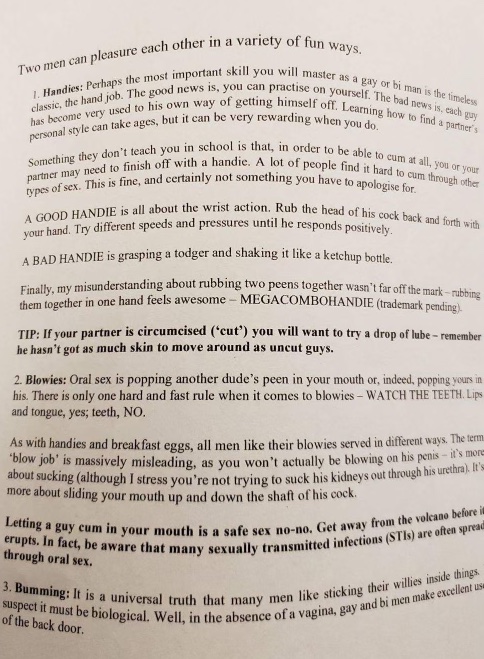
Anchorage resident and House candidate Jay McDonald used his three minutes of testimony time in front of the Anchorage School Board on Tuesday night to give the board members an elementary lesson in how to have gay sex.
He read a passage from “This Book is Gay,” by Juno Dawson. It’s a book marketed to young adults but which is available in at least three school libraries in the Anchorage School District — an elementary, middle, and high school.
McDonald wasn’t able to get through the entire passage, which included explicit instructions on how to give a satisfying hand-job orgasm and a blow-job orgasm between male partners. He never got to the part about anal sex. He was interrupted by Board member Carl Jacobs.
But McDonald made it though enough of the explicit passage to make his point, and told the Anchorage School Board that he had been told numerous times by school officials that the book was not in the school library stacks. Board Chair Margo Bellamy, who had dialed into the meeting from her hotel room, called for a point of order, and was visibly uncomfortable.
Not only is the book in the library stacks, it’s in at least one elementary school and has been checked out at least 38 times, McDonald said, referring to the data available online.
Jay McDonald gives the school board a dose of what children are exposed to in school libraries.
Jacobs said the reading of the book violated decorum and that McDonald needed to get to the point. McDonald responded that he had just one question: What is the learning outcome that is expected from this book?
“The passage I read was right after a chapter explaining in detail how to meet men for sex anonymously online and through apps,” McDonald explained after leaving the board meeting Tuesday. McDonald is a candidate for House District 12, running against a liberal.
Amazon.com describes the book as a “bestselling young adult non-fiction book on sexuality and gender! Lesbian. Gay. Bisexual. Transgender. Queer. Straight. Curious. This book is for everyone, regardless of gender or sexual preference. This book is for anyone who’s ever dared to wonder. This book is for YOU.”
“There’s a long-running joke that, after ‘coming out,’ a lesbian, gay guy, bisexual, or trans person should receive a membership card and instruction manual. THIS IS THAT INSTRUCTION MANUAL. You’re welcome,” the book promotion says.
There have been instances over the last few days of climate activists committing acts of vandalism and destruction as a form of protest.
It’s happened before. Remember the ELF (Earth Liberation Front) committing arson against car dealerships in the 1990s?
At the National Gallery of London, two anti-oil activists poured tomato soup on a Van Gogh painting this weekend. A short time later another group visited a grocery store, also in the UK, and proceeded to remove milk from the cooler and pour it on the floor.
can (sort of) intellectually understand the Van Gogh event, even though I completely disagree with the tactic. He’s a world-famous painter and defacing one of his works was certain to draw attention, even if it didn’t create much sympathy for their cause.
The pouring out of the milk I don’t understand at all, nor do I really want to do any research to find out if the perpetrators voiced a rationale for their actions. They’re idiots and I don’t have any interest in what they have to say. Pouring out milk that some mother might want to buy so she can feed her kids is not protesting; it’s utterly petty and self-centered.
The goal of these activists is, ostensibly, to stop “climate change”, which would, presumably, ensure that everyone on earth lives some sort of climate-utopian better life. What that would actually look like I don’t know, and I’m not sure they do either. The bottom line is if you want to protest something, vandalism and the destruction of property are not the way to convince people your cause is just.
I’m not going to get into the whole “is climate change real” debate here, other than to say I believe climate is changing because it always has changed. The simple fact that it’s possible to find fossils of aquatic life on 10,000-foot-tall mountains, or the remnants of tropical flora buried under the arctic tundra should be enough to prove that fact. What I do not believe is that driving my car is going to destroy the planet.
So, what were these activists actually protesting? Oil, among other things. One of the most terribly bad, horrifically evil supervillains, according to climate change activists, is the oil industry. They tell us if we don’t stop drilling, the entire world will look like Mars or the moon in three years. Or something. And exactly how bad are oil companies and the products they produce? Well, I have a bit of experience there, because for six and a half years I actually worked in an oilfield – Kuparuk on Alaska’s North Slope. I can’t speak about other fields and the companies that operate them, but Kuparuk was the most environmentally conscious place I’ve ever been.
Here are just a few examples.
Wildlife has the right of way at all times on the North Slope. Herds of caribou, thousands of them, move through the field each summer. If there is a caribou, or three hundred, on a road blocking traffic, everyone stops. They don’t harass them or blare their horns. Everyone waits until they move. That’s true regardless of what animal might be in the road. I once sat in a pickup truck for fifteen minutes waiting for a red fox to decide it wanted to trot off into the tundra. Interfering with the animals or walking on tundra in summer without permission is punishable by termination.
There are pipelines there that carry all sorts of products other than oil from one facility to another. They’re built on pilings or columns above the ground, and not just a few inches either; many of them are six or eight feet up. I once watched a training video where a biologist explained one of the reasons why they’d been built so far off the ground: It’s so the caribou can walk under them when the snow melts in summer. They actually studied the caribou herds and determined an ideal height for the pipelines.
There is also a full-time spill response team that will respond to a spill like a fire department would to a fire. (Oh, they have one of those too – with huge fire trucks and everything.) Any liquid spill consisting of more than a cup, I mean a measuring cup like you’d find in a drawer in your kitchen, requires notification of the spill response team.
I remember one incident in winter when a piece of equipment blew a hydraulic hose. There was a trail of hydraulic fluid droplets that covered an area that was about 20 feet square. A coworker and I spent a half hour out in the sub-zero cold digging those tiny little droplets out of the snow and dumping it in hazmat bags so that it could be taken to a hazardous waste facility for disposal. There was so little hydraulic fluid on the ground that if that had happened on the gravel driveway at my house, I would have ignored it. But not up there. If that spill hadn’t been reported, the management at that facility could have faced serious repercussions, including termination, for not reporting it.
What’s the point of all this? The point is that there are oil companies out there that do it right, who actually do care about the environment and about the health of their employees. Maybe the anti-oil activists should do a little research about oil companies before they go throwing their lunch on a masterpiece painting.
Mark Sowers writes novelsat MarkSowersBooks.comand Amazon.com.Born in Honolulu, Hawaii, he was raised in Tacoma, Washington and lived for two years in Greece, while his father did a tour of duty in the U.S. Army. He graduated from Tacoma Community College with an Associates degree, met his amazing wife Marcy and moved to Juneau, where he earned a Bachelor’s degree in history, with minors in economics and political science from the University of Alaska Southeast. He’s always been a reader, and loves both fiction and non-fiction, but there has always been a special place in his heart for fantasy stories. He now lives in Wasilla, Alaska, with his extraordinary wife where they love working in their gigantic yard and keeping the moose away from the crabapple tree by setting off the car alarm.