Wednesday, May 13, 2026
Home Blog Page 839

Save the date: AFP-Alaska is rolling back price of gas to $2.38 — what it was when Biden took office

When Joe Biden was sworn into office in 2021 the average price of gas in America was $2.38. On Aug. 9, Americans for Prosperity-Alaska is going to give Anchorage drivers some financial help by rolling back the price of gas to that amount during a one-day event at a locally owned gas station. The gas station at which the event will take place has not yet been disclosed.

AFP has done these price rollbacks in other parts of the country, with great success. Usually, there are long lines of drivers who wait to fill up their tanks, with AFP paying the difference between what is posted at the pump and the $2.38 that gas used to be — before Biden took office.

“Washington’s reckless spending and crushing regulations have caused inflation to skyrocket, leaving Alaskans paying more at the grocery store and gas pump. This event comes as Washington considers billions in new spending,” AFP-Alaska State Director Bernadette Wilson said in a news release. “Thanks to skyrocketing inflation, Americans across the country can expect to spend an extra $5,200 to maintain the same standard of living as last year, and an extra $1,433 for gasoline.”

poll recently conducted by Public Opinion Strategies for AFP found that 75% of Americans reported that the increase in costs has impacted their consumer behavior over the past year. Most people who were surveyed agreed with the statement that government policies and regulations have caused price increases. 61% of those surveyed blamed President Biden for this increase.

The event will take place between 3-5 pm on Aug. 9, with the location to be disclosed on Aug. 8.

Notes from the trail: Amy Demboski picks Nick Begich and Gov. Dunleavy hits the campaign trail

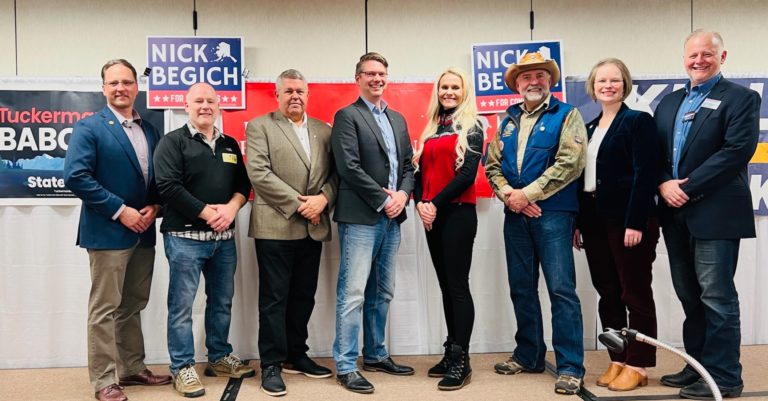
Endorsements: The Nick Begich for Congress campaign announced on Wednesday that Amy Demboski, a former political rival, endorsed his candidacy for Congress. Demboski is a former Anchorage Assemblywoman who ran for mayor in 2015 and is now the municipal manager of Anchorage. Begich ran against her for Assembly once — his first foray into election politics — and he lost to her. Her endorsement is important, as she is considered a solid conservative leader.

Fundraiser: The Dunleavy-Dahlstrom for Governor fundraiser on Wednesday, Aug. 3, from 6-8 pm promises great weather, good friends, and a strong message from the governor for his vision of Alaska’s future. If you want to talk to Suzanne Downing from Must Read Alaska, she’ll see you there.

Walker says he knows better on dividend: Gubernatorial candidate Bill Walker says a big dividend means the state will have to enact massive taxes and end the Permanent Fund dividend program in the future. “It’s that simple,” he said. So simple!

“It takes political courage to be honest with Alaskans about budget troubles and work to find solutions that both ensure economic stability and guarantee dividends for future generations. Buying votes with false promises of huge dividends is fiscally irresponsible and downright dishonest. Alaskans deserve better,” Walker said. His plan “doesn’t depend on the rise and fall of oil prices, and we will always be honest with Alaskans.”

Alaskans door-knocking for Nick Begich are meeting their neighbors.

Knocking for Nick: Americans for Prosperity Alaska has knocked on more than 11,000 doors and talked with 6,000 Alaskans about the congressional campaign.

Senate Candidate Kelly Tshibaka at Wasilla Rotary.

Tshibaka at Rotary: Kelly Tshibaka, who is challenging Sen. Lisa Murkowski, discussed rank choice voting at a Rotary Club meeting in Wasilla, which was also dinner to honor the most recent Medal of Honor recipient, Earl Plumlee, who received the medal on Dec. 16, 2021 for going above and beyond the call of duty during his service in Afghanistan.

RNC Convention news: Nashville’s city council has votes down a contract with the Republican National Committee for the 2024 GOP convention, which probably means Milwaukee is going to be the host city. Milwaukee hasn’t had any significant riots since 2020 but the year is young.

Palin at CPAC: A week and a half before the Aug. 16 primary-general election, congressional candidate Sarah Palin will be in Texas for the Conservative Political Action Conference — CPAC, which is having its summer conference Aug. 4-7 in Dallas. Palin is one of the speakers, along with Donald Trump and other luminaries; the line-up of high-powered speakers is here. Key for her opponents is that Palin won’t be in Alaska talking to voters for the better part of two days during the crucial few days leading up to the special election for Congress.

Kelly Tshibaka: Murkowski lies to voters about birth control because she can’t run on her record

By KELLY TSHIBAKA

As the Aug. 16 U.S. Senate primary approaches, Lisa Murkowski and her allies have decided to launch countless dishonest and deceitful attacks against me, doubtless a sign of their growing desperation. After 21 years in the Senate, it’s telling that Murkowski is doing everything she can to distract Alaskans from her appalling record.

Let’s address the biggest lie first – her outrageous claim that I support banning the sale of birth control pills through the mail.

I and members of my family are among the millions of American women who have taken birth control pills. I do not support restricting their sale through the mail or otherwise. Investing hundreds of thousands of dollars in an ad campaign will not change that fact.

The deceptive ads rely on video taken out of context from one of my many town halls – events Murkowski does not risk doing – when I was answering questions about abortion and other topics. Pills that induce abortions should not be confused with regular birth control pills that prevent pregnancies. 

Sadly, Murkowski and her surrogates have made the conscious decision to exploit and manipulate women’s concerns for political advantage.

But this is not the only way Murkowski is trying to deceive Alaskans.

She claims she supports lowering fuel costs and increasing energy production in Alaska, but she cast the tie-breaking vote to advance President Biden’s nomination of radical environmentalist Deb Haaland to be Interior Secretary. Haaland has since led Biden’s relentless assault on Alaska’s resource industries and the people who depend on those jobs to feed their families.

She claims to support the Willow oil and natural gas project and the King Cove Road, but she enthusiastically voted to confirm the federal judge who later killed both projects. This cost Alaska billions of dollars in investment and thousands of jobs. It also deprived residents of the Aleutians access to an airport to connect them to life-saving medical treatment.

She claims to support the 2nd Amendment, but she voted with Democrats for the Biden-backed gun control bill that undermines our right to bear arms, and consequently lost her endorsement from the National Rifle Association (NRA).

She claims to support public safety, but she was the tie-breaking vote to confirm notorious “Defund the Police” supporter Vanita Gupta to the Department of Justice position responsible for approving grants to local law enforcement.

She claims she wants to secure our borders, but she voted to allow illegal immigrants to remain in this country even if they commit multiple crimes against U.S. citizens.

You get the idea.

Since announcing my campaign last year, I’ve traveled more miles within Alaska than it takes to circumnavigate the globe. What I hear most often from Alaskans is that “it’s time for a change” in our representation in the Senate.

Alaskans are frustrated by the direction of the country and alarmed at how many of the policies coming out of Washington, D.C. are specifically targeted at us. We cannot believe that our senior senator has supported Biden in so many harmful policies instead of fighting to protect Alaska.

As your next senator, I will fight to revive our economy, build affordable housing, and defend our resource industries against the environmental extremists who are determined to turn Alaska into a national park.  

I will stand up for our God-given constitutional rights, including the 2nd Amendment, which have been eroded by D.C. elites. The NRA awarded me its highest rating.

I will advocate for healthcare reform, including increased access to mental health resources, getting veterans benefits in record time, and ensuring our vulnerable Alaskans receive better care. 

I will support parents’ rights to be involved in their children’s education, and immigration policies that promote secure borders. 

And I will listen to the voices of all Alaskans who feel forgotten. You will no longer be ignored. Your voices will be represented in the halls of Congress. 

It is time Alaskans had a U.S. senator they can trust – a U.S. senator Alaskans want, rather than one Joe Biden wants. I have laid out my agenda and vision for our state, appropriately called “It’s Time for a Change.” You can find these policies and principles at www.KellyforAK.com.

In the primary on August 16th, and again on November 8th, I ask for your vote. It is time we had a U.S. senator who is the same person in Alaska as she is in D.C., and who will listen to and advocate for Alaska’s interests, not D.C.’s. It’s time for a change.  

Kelly Tshibaka is a born-and-raised Alaskan, and a candidate for the U.S. Senate in Alaska who is endorsed by former President Donald Trump and the Alaska Republican Party.

Notes from the trail: KINY candidate forum, calm on surface, filled with back drama, body language

Notes from the forum: At a KINY radio forum in Juneau on Monday, the three Alaska congressional candidates on the special general election ballot were asked about everything from the economy to ranked choice voting. For an hour they took turns answering questions from two reporters seated on the other side of a small studio table.

Mary Peltola, the Democrat, said she was optimistic about ranked choice voting weeding out the more extreme candidates. Neither Sarah Palin nor Nick Begich were favorable to the new system, which passed by a very narrow margin in 2020 via Ballot Measure 2.

Polling shows that Peltola will probably win the first round of voting on the ranked choice ballot, and has an actual path to win, but only if Palin edges out Begich for second place. Polling shows Palin, with her high disapproval rating, can’t beat Peltola, which would hand the victory to the Democrat in the second round of counting.

Forum watchers noted both Palin and Peltola studied their notes continuously during the hour and that Palin often read her answers from her notes. Begich did not have notes for the forum.

Peltola appeared better prepared and was more relaxed than Palin; Palin was nervous and scribbling on her notes during much of the hour. Peltola was observed in the video of the forum taking a surreptitious photo of Palin’s notes, which were covered with Palin scribbles. Palin would not make eye contact with either of her opponents, and was seated between them at the table.

In the outer office of the studio was Palin’s boyfriend, Ron Duguay, the retired Florida hockey player formerly with the New York Rangers, who was visibly stressed, rubbing his brows, and keeping his eyes closed during most of the forum as it went down in the other room. Palin’s entourage of three included her campaign manager Chris Perry and Perry’s husband. Peltola arrived alone, and Begich arrived with his campaign manager Truman Reed.

Watch the body language during the forum at YouTube:

Juneau fundraisers: A fundraiser for Sarah Palin on July 31 and a fundraiser meet-and-greet for Nick Begich both brought out crowds. The candidates are running for Congress.

Palin’s boyfriend Ron Duguay puts his arm around her shoulder, lower left, during a fundraiser at the Rie Munoz Gallery in Juneau. Photo: Palin campaign, via Facebook.

Shining Path: Bill Walker says he has a clear pathway for winning the governor’s race in November. He’s redefining “clear pathway” in the way President Joe Biden is redefining recession.

His poll logic boils down to this: His poll by Hays Research Group says that he is within the margin of error if you just test Walker against Gov. Dunleavy. It says Les Gara, the Democrat in the race for governor, is doing a lot less well against Dunleavy than Walker is doing.

But he doesn’t show the numbers for how any of the three do in the three- or four-way race. In other words, in the real world of ranked choice voting, Walker is hiding the numbers, which must indicate that he is the spoiler that hands the win to Dunleavy.

From the way-back machine, Walker’s last race, and his last poll:

Endorsements: The Sealaska Board of Directors on Monday endorsed Bill Walker and Heidi Drygas for Alaska Governor and lieutenant governor, Sen. Lisa Murkowski in the race for U.S. Senate, and the directors will oppose the ballot measure that would initiate a constitutional convention in Alaska.  Last week the board endorsed Mary Peltola for Congress.

Yupiit Nation Chief Mike Williams of Akiak has endorsed Sen. Lisa Murkowski for reelection.

Tom Sconce and the Blue Alaskan scandal: Activist files lawsuit against city clerk for refusing records requests

The head of a group known as Reclaim Midtown filed a lawsuit in Superior Court against Municipal Clerk Barbara Jones for refusal to comply with the Alaska Public Records laws by failing to produce the communications between the Anchorage Assembly and the progressive operative “blogger” known anonymously as the Blue Alaskan. That blogger shut down operations this spring and is now the Alaska Democratic Party’s communication director.

“Ms. Jones failure to follow the state law that guarantees transparency in government is yet another example of the Anchorage political machine’s willingness to disregard important safeguards in our democracy, similar to the Assembly violating the municipal code by indefinitely sealing a similar public records request and the executive session transcripts regarding Anchorage Press “reporter” Tom Sconce,” said Russell Biggs. “Tom Sconce” is an apparent fictitious person with an email address created to help Assembly members in the majority communicate without being discovered to be breaking the Open Meetings Act.

“In both cases, this group of legislators have blocked valid citizens’ requests of what should be publicly available information. Our government and government’s bureaucracy have a duty to obey the law, regardless of how embarrassing or inconvenient that may be. This is particularly relevant when those legislators are withholding evidence of those communications and the information that was shared to news sources for partisan political purposes,” Biggs said.

The case has been assigned to Superior Court Judge Herman Walker Jr.

The lawsuit follows:

Biden appoints FEMA monkeypox czar, as New York, Illinois, and California declare emergencies

By RICHIE MALOUF | THE CENTER SQUARE

U.S. President Joe Biden on Tuesday appointed two federal officials as the administration’s monkeypox coordinators.

Biden named Federal Emergency Management Agency’s Robert Fenton as the White House National Monkeypox Response Coordinator and Dr. Demetre Daskalakis as the Deputy Coordinator. 

Since May 18, the number of cases of monkeypox has gone from 1 to 5,811 in the United States. Alaska has one confirmed case. Nearly all cases are among gay men having sex with multiple partners and spreading the disease among the gay community.

“We look forward to partnering with Bob Fenton and Demetre Dasklalakis as we work to end the monkeypox outbreak in America,” said U.S. Secretary of Health and Human Services Xavier Becerra. “Bob’s experience in federal and regional response coordination, and Demetre’s vast knowledge of our public health systems’ strengths and limits will be instrumental as we work to stay ahead of the virus and advance a whole-of-government response.”

This announcement comes after California, New York, and Illinois have declared state emergencies amid rising monkeypox cases.

The U.S. Centers for Disease Control and Prevention (CDC) has reported 5,811 cases throughout the United States, and the White House plans to accelerate its response to the outbreak and distribute the necessary medical supplies to those who need them. 

“The Administration has made over 1.1 million doses of vaccine available to states and cities across the country to control the spread of the virus, has expanded testing capacity from 6,000 tests per week to over 80,000 tests per week, and has communicated regularly with providers and local health departments encouraging them to utilize tests more often,” the White House said. “The Administration also recently launched its monkeypox research agenda, aiming to galvanize the international community to identify and address gaps in information on the virus to accelerate and strengthen the global response.” 

The administration estimates that its response may require up to $7 billion for tests, vaccines, and treatment options, according to a memo retrieved by The Washington Post. 

Unlike the COVID-19 virus, the Monkeypox virus spreads most commonly through close skin-to-skin contact, not through breathing in airborne particles.

The White House said it would coordinate efforts to ramp up its response to rising case numbers and help those most in need. 

“Over the coming weeks, under the leadership of Fenton and Daskalakis, the Administration will advance and accelerate the United States’ monkeypox response to mitigate the spread of the virus, protect individuals most at risk of contracting the virus, and care for those who have been afflicted with it,” the White House said.

Listicle: The Murkowski earmarks proposed for Alaska

The Chairman of the Senate Appropriations Committee recently published the majority’s proposal for the Fiscal Year 2023 (FY23) appropriations bills.

As a senior member of the Committee and Ranking Member of the Subcommittee on the Interior, Environment, and Related Agencies, U.S. Senator Lisa Murkowski included $491 million in earmarks to support more than 130 projects throughout Alaska. She prioritized investments in workforce development, housing, healthcare, water and wastewater infrastructure, community safety, fisheries research, wildfire mitigation and response, working waterfronts, and Alaska’s military members and their families.

“Alaskans have asked me for help in addressing their community priorities, and in my position on the Appropriations Committee, I successfully advocated for them. I’m proud to have included in these draft bills such a significant investment that will be spread across our state. 

“Alaskans have asked for my help in addressing workforce shortages, food insecurity, and lack of housing. To support Anchorage’s police force, the Alaska State Troopers, and the readiness of our military. To enable the expansion of the port in Dutch Harbor, a significant study of the proposed Alaska Gasline, and the construction of new backcountry trails. And I was able to include funding for each of those priorities.

“In addition, I’ve worked with local leaders to include funding to mitigate the threat of wildfires, remediate contaminated ANCSA lands, and provide safe and clean drinking and wastewater systems. Multiple projects will reduce the cost and increase accessibility to healthcare and childcare. And I continue to prioritize some of the most vulnerable, yet resilient, Alaskans by funding projects for victims of domestic violence, to house those experiencing homelessness, and to support the Alaska Native Justice Center.  

“It is important to remember that this is just one step in the year-long appropriations process. The Committee leadership must still come together to agree on the process for moving all 12 Appropriations bills, so that we can continue our essential work to fund the federal government for the next fiscal year.”

The “congressionally directed spending process” (earmarks) restores Alaskans’ ability to have a voice in federal budget decisions by helping to identify and address needs in the state, she said. Without this process, many of these dollars would flow to other states based on decisions made at federal departments and agencies.

The list of proposed earmarks that Sen. Murkowski included for Alaska for Fiscal Year 2023 is below. 

Agriculture, Rural Development, Food and Drug Administration, and Related Agencies

·         Aniak: $221,000 to TKC Fish Wheel, to construct the Arviiq Regional Economic Development and Training Center.

·         Bethel: $10 million to expand the main training building on the Yuut Elitnaurviat Campus to provide a permanent home for the Kuskokwim Learning Academy.

·         Kenai: $4.7 million to construct a new Kenai Boys and Girls Club clubhouse.

·         Kenai: $1 million to the Alaska Children’s Institute for rebuilding a community theater in Kenai.

·         Kotzebue: $825,000 to the University of Alaska Fairbanks for renovations and safety improvements to the Chukchi Campus in Kotzebue.

·         Nome: $2.3 million to the Norton Sound Health Corporation for construction on a childcare facility.

·         Utqiaġvik: $5 million to Ilisaġvik College to advance and complete the design phase of a new college campus.

·         Wasilla: $17,000 to Family Promise Mat-Su for childcare facility improvements.

Commerce, Justice, Science, and Related Agencies

·         Anchorage: $2 million for replacement of police vehicles.

·         Anchorage: $500,000 to the University of Alaska Anchorage to implement a forensic training program for healthcare providers and advocates. 

·         Anchorage: $250,000 for law enforcement technology and equipment, specifically for the Anchorage Police Department to replace and upgrade cameras.

·         Anchorage: $1.7 million for law enforcement technology and equipment, specifically for the Anchorage Police Department to replace radios. 

·         Bering Sea: $2.75 million for the Bering Sea Fisheries Research Foundation to monitor commercial fisheries in the Bering Sea.

·         Fairbanks/Statewide: $1 million to the University of Alaska Fairbanks to support research on seasonal weather forecasting.

·         Fairbanks/Statewide: $1.75 million to the University of Alaska Fairbanks to conduct baseline marine fishery surveys.

·         St. Paul/Statewide: $250,000 to the Aleut Community of St. Paul Island for surveillance monitoring of fisheries and ecosystems.

·         Statewide: $3 million Alaska Network on Domestic Violence and Sexual Assault to support victim service organizations.

·         Statewide: $4 million to the Alaska Council on Domestic Violence and Sexual Assault to support advocacy organizations and services for victims of violent crime.

·         Statewide: $1 million to the Alaska Police and Fire Chaplains to support counseling and emotional support programs for victims of crime and law enforcement officers.

·         Utqiaġvik: $2.7 million to the North Slope Borough Department of Wildlife Management for marine mammal and co-management research on the North Slope.

·         Yukon River Drainage: $825,000 to the Yukon River Drainage Fisheries Association to support research, surveys, and community engagement.

Energy and Water Development

·         Statewide: $5 million to the Alaska Gasline Development Corporation to assist in conducting the necessary analysis for a Front End Engineering and Design (FEED) study of a liquid natural gas pipeline in Alaska.

·         Ambler: $650,000 to the City of Ambler to expand the City’s current fuel storage capacity to be able to adequately store enough fuel supply for the community’s stove oil and gasoline needs without having to rely on costly air deliveries in winter months,

·         False Pass: $1.25 million for procurement, assembly, and installation of a hydrokinetic power system for the City of False Pass. A hydrokinetic power system will provide alternative renewable energy option to the increasingly high-cost of diesel generation to the residents in the False Pass. 

·         Homer: $300,000 to the U.S. Army Corps of Engineers to conduct the feasibility study for the proposed large vessel harbor expansion in Homer.

·         St. George: $2.5 million to the U.S. Army Corps of Engineers, Alaska District to support priority funding for the federal share for Preliminary Engineering and Design and Construction of St. George Harbor.

·         Unalaska: $5 million to the City of Unalaska for reliability and efficiency upgrades for Unalaska’s electrical distribution system.

·         Unalaska Channels: $25.6 million to the U.S. Army Corps of Engineers to expand Dutch Harbor.

Financial Services and General Government

·         Anchorage: $6 million to the Alaska Community Foundation to support the preservation, processing, and digitization of records of Alaskan leaders.

·         Statewide: $1 million to the University of Alaska Anchorage to expand UAA’s business development services to rural and young entrepreneurs in Alaska.

Homeland Security

·         Anchorage: $500,000 to the Municipality of Anchorage to replace the roof of the Anchorage Emergency Operations Center. 

·         Dillingham: $5 million to the City of Dillingham for shoreline protection for the City’s sewage facility.

·         Ouzinkie: $2 million to the Native Village of Ouzinkie to mitigate potential disaster threat implications from major tsunami events through the construction of an Emergency Response Shelter and Equipment Staging Complex

Interior, Environment, and Related Agencies

  • Anchorage: $13 million to the Municipality of Anchorage for the safe disposal of wastewater in Anchorage.
  • Anchorage: $4 million to implement the Municipality of Anchorage’s Community Wildfire Protection Plan.
  • Chickaloon: $250,000 for the Chickaloon Native Village for a community well.
  • Chignik: $5.3 million to the Alaska Native Tribal Health Consortium for safe drinking water in Chignik.
  • Chugach National Forest: $2.3 million to construct and improve recreational trails and access on the Iditarod National Historic Trail.
  • Craig: $760,000 for upgrades to Craig’s wastewater treatment plant.
  • Denali: $2.2 million for design and construction of pedestrian pathways along the Parks Highway corridor in the Denali Borough. 
  • Eagle River: $4.5 million to the Municipality of Anchorage for the safe disposal of wastewater in Eagle River.
  • Girdwood: $1.6 million to replace the Ruane Road culvert in Girdwood.
  • Girdwood: $2.5 million for a sewer access project, for the safe disposal of wastewater in Girdwood.
  • Juneau: $2.5 million to the City and Borough of Juneau to design and construct a commercial-scale composting facility to serve Juneau residents and businesses.
  • Kenai: $875,000 to the Alaska Electric & Energy Cooperative, Inc. for the installation of a combined heat and power project at the Kenai Peninsula Borough’s Central Peninsula Landfill.
  • Kenai: $2.9 million for the safe disposal of wastewater in Kenai.
  • Kenai: $1.5 million to implement the Kenai Peninsula Borough Community Wildfire Protection Plan.
  • Ketchikan: $1.7 million to the Ketchikan Gateway Borough for wastewater treatment plant upgrades.
  • Kivalina: $8 million to the Alaska Native Tribal Health Consortium to construct a new Kivalina landfill that meets state regulatory standards.
  • Kodiak: $1 million to the Island Trails Network for removal, recycling and recovery of debris from the Alaska marine environment.
  • Kotzebue: $140,000 to build cyanotoxin analysis capacity at the Native Village of Kotzebue.
  • Nome: $1.6 million for safe drinking water distribution and wastewater collection.
  • North Slope: $1.2 million for a wastewater replacement project.
  • North Slope: $2.5 million for the Northern Route of the North Slope Borough Community Winter Access Trails pilot program, which provides for the creation of temporary winter trail access between communities where year-round connecting roads do not exist.
  • Palmer: $6.9 million for wastewater treatment system upgrades.
  • Petersburg: $1.6 million for water treatment plant upgrades. 
  • St. Paul: $3 million to improve solid waste disposal facilities.
  • Seldovia: $746,000 for a sewer line replacement.
  • Seldovia: $414,000 for safe drinking water.
  • Seward: $2 million for the safe disposal of wastewater.
  • Soldotna: $680,000 for a wastewater treatment plant.
  • Soldotna: $320,000 to improve wastewater effluent before discharge to the Kenai River.
  • Soldotna: $960,000 for upgrades to upgrade equipment used to dewater treated solids at the Soldotna Wastewater Treatment Plant.
  • St. George: $3 million to replace the 50-year-old water distribution and wastewater collection infrastructure.
  • Statewide: $2 million for salmon monitoring in the Yukon and Kuskokwim River watersheds.
  • Statewide: $500,000 to the Tanana Chiefs Conference to address the large data gap regarding salmon populations on the Yukon River.
  • Statewide: $880,000 for implementation of the Intertribal Federal Subsistence Cooperative Management Program at the Kuskokwim River Watershed.
  • Statewide: $1.2 million for ecological monitoring in the Yukon and Kuskokwim Rivers.
  • Statewide: $1.5 million for the Denali Commission to develop regional solid waste management plans.
  • Statewide: $1 million for to complete a National Scenic Trail feasibility study to connect Seward and Fairbanks.
  • Statewide: $3 million for the Alaska Native Justice Center for Alaska tribal public safety empowerment activities. 
  • Statewide: $7 million to support the State of Alaska in conducting an inventory and verification of contaminated sites conveyed to Alaska Natives under the Alaska Native Claims Settlement Act.
  • Statewide: $300,000 for the University of Alaska Anchorage to study the need and economic feasibility of constructing and operating a hazardous waste processing facility and landfill in the State of Alaska.
  • Statewide: $250,000 to the Alaska Native Village Corporation Association to build further tribal capacity for the inventory and verification of ANCSA contaminated lands
  • Statewide: $250,000 to the Alaska Native Tribal Health Consortium to build further tribal capacity for the inventory and verification of ANCSA contaminated lands.
  • Valdez: $5 million for the safe disposal of wastewater in Valdez.
  • Wasilla: $5.7 million for improvements to wastewater treatment facilities. 
  • Whittier: $1.2 million for well field upgrades.
  • Yakutat: $5.1 million for a water line extension project.

Labor, Health and Human Services, Education, and Related Agencies 

·         Anchorage: $2.25 million to the University of Alaska to renovate UA’s facilities for nursing education, telehealth training, and inter-professional education programs.

·         Anchorage: $290,000 for Providence Alaska to establish and launch the Alaska Psychiatry Residency Program.

·         Anchorage: $1.2 million to update and improve the Anchorage Neighborhood Health Center.

·         Anchorage: $5 million to Southcentral Foundation towards construction of the Fireweed Specialty Dental Clinic.

·         Anchorage: $500,000 to the Anchorage Neighborhood Health Center to establish a new Dental Assistant Training Apprenticeship.

·         Anchorage: $2 million for a Southcentral Foundation Workforce Development Program, to provide resources and support to students training as nurses, certified medical assistants, dental health aid therapists, and as behavioral health providers. 

·         Anchorage: $400,000 to the Alaska Center for FASD to connect individuals with FASD to services.

·         Anchorage: $750,000 for construction of a Crisis Stabilization Center at Providence Alaska Medical Center.

·         Akiak: $500,000 to the Rural Alaska Community Action Program to recruit and train local community members to become early educators and certified teachers.

·         Bethel: $100,000 to purchase a portable X-Ray and other medical equipment for the Bethel Family Clinic in Bethel.

·         Bethel: $600,000 to the Bethel Family Services Community Health Center to provide well child exams to children in 55 locations throughout YK Delta.

·         Healy: $2.5 million to construct a health center in Healy.

·         Homer: $633,000 to the Seldovia Village Tribe to expand the Homer Health Center.

·         Juneau: $870,000 to renovate and expand the JAHMI Health & Wellness specialty behavioral health facility.

·         Juneau: $750,000 to establish and operate a commercial driver’s license education training program at the University of Alaska Southeast.

·         Ketchikan: $600,000 for facilities and equipment at the Peacehealth Ketchikan Medical Center.

·         Kodiak: $7.9 million to expand the Kodiak Community Health Center.

·         Naknek: $3 million to renovate and expand the Camai Community Health Center.

·         Seward: $5 million to expand the Seward Community Health Center.

·         Statewide: $2.5 million to expand the Alaska Primary Care Association’s community health worker program into rural areas.

·         Statewide: $350,000 to expand the University of Washington’s Alaska Pediatric Residency Track, to increase opportunities for pediatric residents to train in Alaska

·         Statewide: $350,000 to the Boys & Girls Club of Southcentral Alaska to provide behavioral health support to children and youth.

·         Statewide: $2 million to Covenant House Alaska to strengthen Alaska’s workforce and provide pathways to permanent housing.

·         Statewide: $230,000 to Rural Alaska Community Action Program to identify, train, and support a cohort of interested youth peer mentors.

·         Statewide: $950,000 for Bree’s Law Inc. to address and prevent teen dating violence.

·         Unalaska: $500,000 to Iliuliuk Family & Health Services to purchase a CT scanner and fund associated facility and site work to provide expanded health services at the clinic in Alaska.

·         Upper Susitna River Valley (Talkeetna): $2 million for purchase a complete mobile medical unit to provide medical treatment across the Upper Susitna River Valley..

·         Willow: $1 million to expand the Sunshine Clinic in Willow.

Military Construction, Veterans Affairs, and Related Agencies

·         Anchorage: $63 million to build an aircraft maintenance hangar at Joint Base Elmendorf-Richardson.

·         Anchorage: $5.2 million to remove PFAS contaminated soil on Joint Base Elmendorf-Richardson.

·         Fairbanks: $99 million to build a physical fitness center annex at Fort Wainwright.

Transportation, Housing, and Urban Development, and Related Agencies

·         Ambler: $1.5 million to construct a new firehall and search and rescue facility.

·         Anchorage: $5 million to the Port of Alaska to make site improvements.

·         Anchorage: $7.5 million to Providence Community Foundation to provide permanent supportive housing for those experiencing homelessness in Anchorage.

·         Anchorage: $1.6 million to Rural Alaska Community Action Program to address the Anchorage homelessness issue through improving and expanding permanent supportive housing facilities.

·         Juneau: $7 million to build a bridge over the Gastineau Channel between Douglas and Juneau.

·         Fairbanks: $2.5 million to the North Star Council on Aging to expand the Fairbanks Senior Center.

·         Fairbanks: $6.9 million to acquire and expand a facility to provide a permanent location for Presbyterian Hospitality House.

·         Homer: $750,000 to acquire and construct a facility to support South Peninsula Haven House in building a new financial empowerment facility.

·         Juneau: $5 million to provide a building to house multiple nonprofits which serve children and families.

·         Klawock: $500,000 to build a RISE Campus which will include domestic shelter units and outbuildings to support cultural activities.

·         McCarthy: $200,000 to build a fire hall for the Kennicott-McCarthy Volunteer Fire Department.

·         Nome: $2 million to rehabilitate the Bering Sea Women’s shelter.

·         Nome: $5 million to the Norton Sound Health Corporation to construct patient housing and affordable housing for low-income employees.

·         Rural Alaska: $3 million for the acquisition of facilities, including housing, necessary to establish Alaska State Trooper posts in rural locations.

·         Seldovia: $22,000 for a road resurfacing project.

·         Sitka: $1 million to provide basic housing for chronically homeless Sitka residents.

·         Teller: $5.1 million to the Bering Straits Regional Housing Authority to move homes out of the flood zone and construct affordable housing at safe locations.

·         Wainwright: $1.2 million to Tagiugmiullu Nunamiullu Housing Authority to remodel and convert former National Guard Armory buildings into a modern, energy efficient, tribal childcare facility and multi-use community building.

·         Wasilla: $7 million to Set Free Alaska to build a therapeutic campus consisting of recovery residence facilities.

Chess game continues: Assembly overrides mayor’s veto, and can now figure out how to remove the mayor

Over the objections of three conservatives on the Anchorage Assembly, a mayoral veto was overridden on Monday, giving the Assembly the power to remove the mayor whenever it chooses, with the flimsiest of reasons.

Anchorage Ordinance 2022-60 gives the Assembly vast power, both overtly and implied, over the mayor, the ability to hold a knife over the mayor’s head by creating a pathway for the legislative body to remove him for what is a vaguely described “breach of public trust.” Their process for removing him makes the Assembly judge, jury, and prosecutor.

Assemblyman Randy Sulte argued against overriding the veto, saying that if recalls of mayors fail, and the Assembly acts to remove a mayor, then it would be the Assembly getting the “breach of the public trust” wrong.

“I have concerns about us being judge and jury about what is ‘breach of public trust.’ We may not be correct and the public may still trust that person and wish for that person to remain, even though we may feel otherwise,” he said.

Assembly Vice Chair Chris Constant admitted in the meeting that the impetus for the ordinance was an incident that happened during a “wild” regular meeting of the Assembly in October, when the public was up in arms over the Assembly’s latest mask mandate.

“Many people ask ‘Why did you start this project?'” said Constant, the maker of the ordinance. “The day that I decided this project was essential was the day in October when a member of the Administration attempted to turn off the public feed. The second thing they did at that meeting was to dismiss security. And the third thing they did at that meeting was told APD [police] to stand down. And I witnessed the staff of this Administration rallying people in an angry crowd.”

An October, 2021 meeting of the Anchorage Assembly drew a crowd that upset Assemblyman Chris Constant, prompting him to draft an ordinance to allow the Assembly to remove the mayor. Here, they stand for the Pledge of Allegiance at the outset of the meeting.

Constant said the ordinance wasn’t meant to be used to prosecute a mayor for dropping a city-issued cell phone and breaking the screen. But rather it is for “a pattern of behavior that rises to the level of abuse, that regular people would look and ask, ‘How could this person do such a thing?’ That it’s unconscionable that that action should have taken place.”

The Monday meeting was a special meeting in a small room at City Hall, called only for the purpose of overriding the veto, and the meeting was just over a half an hour long. It was supposed to be broadcast live on YouTube, but the Assembly somehow cut the video feed, claimed technical difficulties and only posted a nearly unintelligible audio recording of the meeting instead, a breach of the public trust.

Juneau forum: Peltola hopeful about ranked choice voting while Palin and Begich give it low marks

By MURRAY R. WALSH

The finalists seeking to take the late Rep. Don Young’s seat in Congress met in person at the Juneau Radio Center on Monday to participate in a forum moderated by news reporters Kevin Allen and Greg Knight.  

This was a first-of-its-kind event sponsored by the Juneau and Sitka Chambers of Commerce and the Southeast Conference. The broadcast was heard in Ketchikan, Sitka, and Juneau.

The three were given two minutes each to introduce themselves. Nick Begich gave his standard pitch emphasizing his business background, hinting that Congress had too many professional politicians and needed more people like him. 

Sarah Palin gushed over being back in Southeast Alaska but then emphasized her “connections” across the USA as being valuable for someone in Congress. Mary Peltola, apparently indifferent to Begich’ low regard for professional politicians, gave a long recitation of her political history.

Watch the event at this link:

The first question was “what is the biggest problem in Alaska right now?” 

Palin started off with “inflation” and used it as a springboard for encouraging expansion of resource development in the state, a theme she would repeat several times as the 70-minute program went on.  

Begich took a broader approach saying the problem was dependence on the federal government and the fed’s interference with resource development and Alaska’s need to broaden the economy.  

Peltola also went with “inflation” as well but said the solution was to punish corporations for price gouging, and raise the minimum wage.  She also expressed hope that the pending federal Inflation Reduction Act (Manchin, Schumer et. al.) would help a lot.

Read: Heritage Foundation commentary on Inflation Reduction Act making it all worse  

The next question was: “If you do not win this special election, will you stand for the regular election and try again?” Both Begich and Peltola answered “yes” but Palin may not have understood the question because she went on to chastise ranked choice voting at length.

Palin answered the “What makes you the most qualified?” question by mentioning her “connections across the nation and around the world” as a valuable quality. This might be a reaction to former Sen. John Coghill’s criticism that Palin’s fame could be a problem for her if elected.  The other two repeated their histories from the opening.

Both Begich and Palin agreed that ranked choice voting was bad and should be disposed as soon as possible. Peltola said she is “hopeful” that it will turn out well and she defined “well” as the election of moderate candidates.  

Most of the remaining questions were generic and there were no surprises – let alone any laughs – from any of the contenders. There was a Southeast-specific question about repealing the Roadless Rule (plaything of anti-timber industry groups) and both Begich and Palin called for repealing it. Peltola did not answer the question.

Early voting started Monday in the regular Aug. 16 primary election and the special general election for Congress. The three candidates appearing in the forum are on both sides of the ballot. The special general election will determine who fills out the remainder of Congressman Don Young’s term, and that person will become the incumbent as the race heads to the Nov. 8 general election.

Walsh is a Juneau-based consultant who hosted a talk radio show on KJNO, the talk radio sister station to KINY from June of 2009 to June of 2012.  His listeners were the first people in Juneau to hear about Sarah Palin’s resignation which occurred while he was on the air.