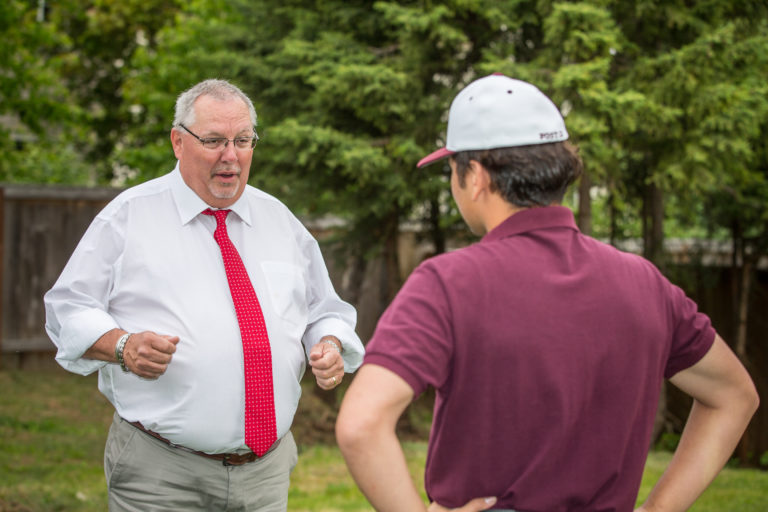
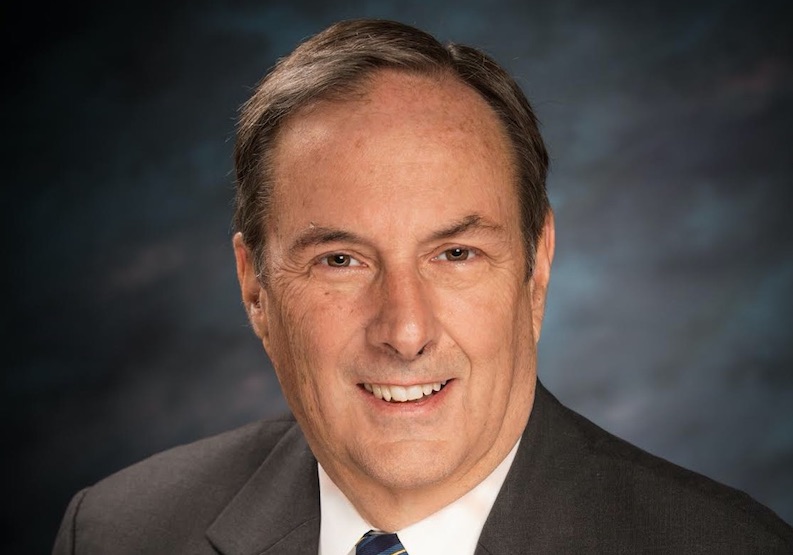
Democrat Denny Wells had five days after the 2022 election was certified to ask for a recount of the House District 15 race, and he met that deadline with the Division of Elections on Monday. With over 7,000 votes cast in that South Anchorage House race, and just a seven-vote difference, he’ll get his recount at 10 am on Thursday in Juneau.
Observing the recount on behalf of Wells will be the architect of Ballot Measure 2 (open primaries, ranked-choice generals) Scott Kendall, who is an election lawyer who generally represents Democrats and no-party candidates. He practices with Cashion, Gilmore and Lindemuth. Also observing for Wells will be Holly Wells, (no relation.) She practices law at Birch, Horton, Bittner and Cherot.
McKay will also have two legal observers at the recount in Juneau to audit the procedure, which should go quickly. Depending on the outcome, Kendall may sue on behalf of Wells for some procedural variation.
In 2018, the race of Republican Bart LeBon vs. Kathryn Dodge in Fairbanks (then District 1) went to a recount, and LeBon won by just one vote.
Must Read Alaska was on the scene for that recount and reported its unusual twist, which pertained to automatic voter registration via Permanent Fund dividend application:
“The vote that decided the matter came from a felon, whose vote was challenged by the Democrats who were observing the process today. They thought he didn’t have his voting rights restored. Then the ballot was also challenged by Republicans for the same reason.
“The felon was automatically registered when he filed for his Permanent Fund dividend.
“The Division of Elections looked into it and said the felon had had his voting rights restored. They decided to count the ballot.
The deadline for Americans to get a Real ID was first set for 2008, but has been repeatedly delayed.
On Monday, the Department of Homeland Security moved the deadline again. It’s now May 7, 2025. The department said that the Covid-19 pandemic has slowed down the adoption of the higher-security ID requirements that travelers will need to have to enter some federal facilities, and to fly on large commercial planes.
Homeland Security said motor vehicle agencies need more time to work through the backlog of applications created when state agencies curtailed services as a precaution during the Covid pandemic.
“This extension will give states needed time to ensure their residents can obtain a Real ID-compliant license or identification card,” Homeland Security Secretary Alejandro Mayorkas said Monday. “DHS will also use this time to implement innovations to make the process more efficient and accessible. We will continue to ensure that the American public can travel safely.”
The Real ID Act passed Congress in 2005. It creates federal security standards for drivers licenses, state identifications, and other identification cards issued by the states and was a response to the increase of terrorist attacks on American facilities, including the Sept. 11, 2001 terrorist attack by Al Qaeda terrorists who boarded commercial planes, hijacked them, and used them as missiles to destroy the two towers of the World Trade Center in New York, and crashed a jet into the Pentagon itself.
Real IDs have a star in the right-hand corner of a driver’s license or identification card. U.S. passports or green card qualify as Real IDs for those who don’t have a Real ID-compliant drivers license or state identification card. Alaska’s Real ID information page is located here. It has not been updated to reflect the new deadline, as of this writing.
As of May, 2022, some 137 million Real IDs had been issued across the states, about 49% of all IDs in circulation.
Perhaps he was just being Trumpian. Former President Donald Trump explained on Monday he doesn’t actually wish to “terminate” the U.S. Constitution.
But meanwhile, he got the dander up of Sen. Lisa Murkowski, who took to Twitter to scold him about the Constitution.
To review for the court of public opinion: Over the weekend, Trump wrote on Truth Social, the social media company he owns, that the magnitude of corruption that took place in the 2020 election calls for some kind of action.
He said, clumsily but correctly, that the Constitution had been violated by mainstream media and the Deep State, and that the elections were interfered with in 2020.
“Do you throw the Presidential Election Results of 2020 OUT and declare the RIGHTFUL WINNER, or do you have a NEW ELECTION? A Massive Fraud of this type and magnitude allows for the termination of all rules, regulations, and articles, even those found in the Constitution,” Trump wrote. In fact, there doesn’t seem to be a constitutional process for overturning a certified election, as much as he would like to have that happen. And terminating the Constitution is, by its nature, unconstitutional.
Trump correctly accused “Big Tech” of working closely with Democrats. He also correctly pointed out that “Our great ‘Founders’ did not want, and would not condone, False & Fraudulent Elections!”
But it’s the “termination” word that got the mainstream media worked into a froth since Saturday. Trump had given his critics a way to distract the public from the real story of corruption and collusion between the FBI, the mainstream media, and social media companies in support of the Biden candidacy for president.
Trump’s controversial post came after Elon Musk, the new majority owner of Twitter, released internal Twitter emails that showed Twitter and the Biden campaign colluded to suppress legitimate news stories about material found on Hunter Biden’s laptop that show that Hunter Biden was using his role on the board of a Ukrainian power company to make introductions of Ukrainian business tycoons to his father, who was then Vice President. The cover-up occurred in the weeks leading up to the 2020 election. Hunter Biden was paid $11 million to sit on the board of Burisma, although he had no prior experience.
Read the U.S. Senate Finance report on Hunter Biden-Ukraine corruption links to Joe Biden:
Trump has now clarified that there should be some remedy for what was, in his view, a rigged election, with crimes of interference committed that prevented free and fair elections. In essence, Trump is calling for justice.
“The Fake News is actually trying to convince the American People that I said I wanted to ‘terminate’ the Constitution. This is simply more DISINFORMATION & LIES, just like RUSSIA, RUSSIA, RUSSIA, and all of their other HOAXES & SCAMS,” Trump wrote on Truth Social on Monday. Trump said that “steps must be immediately taken to RIGHT THE WRONG.”
Sen. Lisa Murkowski was quick to condemn Trump. On Sunday, Alaska’s senior senator wrote on Twitter, “Suggesting the termination of the Constitution is not only a betrayal of our Oath of Office, it’s an affront to our Republic.”
Sen. Dan Sullivan also blasted Trump, saying any suggestion that the Constitution can be discarded is “ridiculous.”
There were betrayals committed against the Constitution by officers of the law, colluding to suppress information about candidate Biden.
One of the betrayals to the Constitution was committed by a group of former intelligence officers — including five former CIA directors — who signed a letter falsely stating that the Hunter Biden laptop was most likely Russian disinformation. The former intelligence officers wrongly used their authorities to give the public bad information.
That letter, with its 50+ signatures, also gave Joe Biden and the Democratic Party a path to disparage the New York Post’s story.
During that same timeframe, FBI officials were meeting weekly with executives at Twitter, and Twitter blocked the New York Post story about Hunter Biden’s laptop, treating it with the same sanctions it usually reserves for child pornography. Twitter in October of 2020 locked the New York Post’s Twitter accountto prevent the story from reaching voters.
“Now that multiple other news outlets have confirmed the legitimacy of the laptop, the letter-writers haven’t repented about themselves spreading clever disinformation meant to influence the election,” noted Rich Lowry in the New York Post.
“And, indeed, the letter-writers played a game. They didn’t actually say that the Hunter Biden laptop story was disinformation, at the same time they created that impression. This has given them plausible — or more accurately, implausible — deniability.
“Cornered about the letter on Fox News, former CIA officer David Priess said the laptop story, just as the letter asserted, had ‘all the classic earmarks’ of Russian disinformation.” That didn’t mean it was disinformation, just that it had the earmarks of disinformation, Lowry wrote.
But during the time leading up to the election, top CIA veterans characterized their remarks much more sharply.
Nick Shapiro, a former top aide under CIA director John Brennan, told Politico, ‘“The real power here however is the number of former, working-level IC officers who want the American people to know that once again the Russians are interfering.”
Shapiro was the one of the main instigators of the letter, which is included here:
The media widely reported the suspicions of these intelligence officers as gospel before the election in 2020.
“If we are right,” the agents wrote, “this is Russia trying to influence how Americans vote in this election, and we believe strongly that Americans need to be aware of this.”
And so it went. While the mainstream media had discredited the original Hunter Biden laptop story before and after the election, and has continued to dismiss it as a nothing-burger story, with just one tweet last week, Trump managed to get the entire Leftist establishment, the media, and even Sen. Lisa Murkowski, to defend the Constitution.
THE MEDIA HAS CEASED TO EXIST, SO THE PUBLIC ASSUMES THAT WHAT THE MEDIA SUPPRESSES IS TRUE, AND WHAT IT COVERS IS FALSE
By VICTOR DAVIS HANSON | AMERICAN GREATNESS
The current “media”—loosely defined as the old major newspapers like the New York Times and Washington Post, the network news channels, MSNBC and CNN, PBS and NPR, the online news aggregators like Google, Apple, and Yahoo, and the social media giants like the old Twitter and Facebook—are corrupt.
They have adopted in their news coverage a utilitarian view that noble progressive ends justify almost any unethical means to obtain them. The media is unapologetically fused with the Democratic Party, the bicoastal liberal elite, and the progressive agenda.
The result is that the public cannot trust that the news it hears or reads is either accurate or true. The news as presented by these outlets has been carefully filtered to suppress narratives deemed inconvenient or antithetical to the political objectives of these entities, while inflating themes deemed useful.
This bias now accompanies increasing (and increasingly obvious) journalistic incompetence. Lax standards reflect weaponized journalism schools and woke ideology that short prior basic requisites of writing and ethical protocols of quoting and sourcing. In sum, a corrupt media that is ignorant, arrogant, and ideological explains why few now trust what it delivers.
Suppression
Once a story is deemed antithetical to left-wing agendas, there arises a collective effort to smother it. Suppression is achieved both by neglect, and by demonizing others who report an inconvenient truth as racists, conspiracist “right-wingers,” and otherwise irredeemable.
The Hunter Biden laptop story is the locus classicus. Social media branded the authentic laptop as Russian disinformation. That was a lie. But the deception did not stop them from censoring and squashing those who reported the truth.
Instead of carefully examining the contents of the laptop or interrogating Biden-company players such as Tony Bobulinksi, the media hyped the ridiculous disinformation hoax as a mechanism for suppressing the damaging pre-election story altogether.
Joe Biden’s cognitive state was another suppression story. The media simply stifled the truth that 2020 candidate Biden was unable to conduct a normal campaign due to his frailty and non-compos-mentis status. Few fully reported his often cruel and racist outbursts of the “lying-dog-faced-pony-soldier” and “you ain’t black”/“terrorist” sort.
The #MeToo media predictably quashed the Tara Reade disclosure. In fact, journalists turned on her in the manner that they previously had insisted was sexist and defamatory “blame-the-victim” smearing.
Joe Biden has long suffered from a sick tic of creepily intruding into the private space of young women and preteen girls: blowing their hair, talking into their ears, squeezing their necks, hugging in full body embraces—all for far too long. In other words, Biden should have expected the Charlie Rose or the Donald Trump Access Hollywood media treatment. Instead, he was de facto exonerated by collective media silence. To this day, despite staffers’ efforts to corral his wandering hands and head, he occasionally reverts to form with his creepy fixations with younger women.
Ask the media today which administration surveilled journalists and they will likely cry “Trump!” Yet their own sensationalist reporting that the IRS was weaponized by Trump was proven a lie when the inspector general notedTrump never went after either James Comey or Andrew McCabe. And it was an untruth comparable to the smear that “nuclear secrets” and “nuclear codes” were hidden away at Mar-a-Lago or that Donald Trump sought to profit from the trove. Nor does anyone remember that Barack Obama went after the Associated Press reporters and Fox News Channel’s James Rosen. Nor do they care that Biden sought to birth an Orwellian Ministry of Truth censorship bureau.
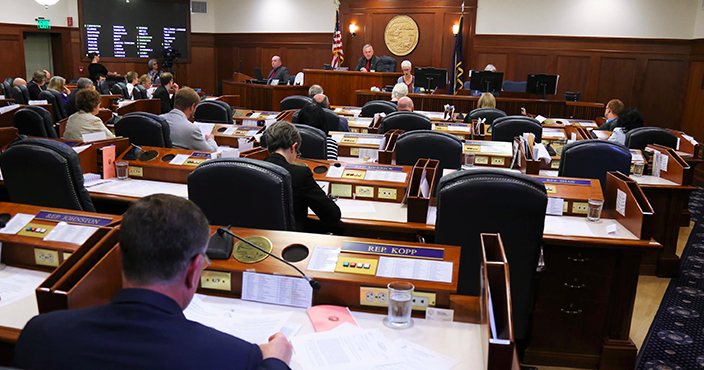
A memo from the Alaska House Coalition makes it clear that Rep. Louise Stutes, now the Alaska House Speaker, will stay with the bipartisan, Democrat-dominated caucus.
So will Reps. Bryce Edgmon and Neal Foster, both of Western Alaska.
“Our coalition has proven its unwavering support for essential services, protecting our Permanent Fund and savings accounts, and providing sustainable dividends,” said Stutes, a Republican of Kodiak. “Alaskans expect us to be ready to work in January and to get the job done on time. We look forward to working across the aisle with our colleagues in the House and Senate, as well as with the administration on bi-partisan solutions to make that happen.”
“From school closures to record outmigration and a declining economy, the challenges facing our state are monumental, ” said Rep. Bryce Edgmon, who switched a few years ago from Democrat to being without a party. “That’s why I’m proud to stand with a coalition who will work hard to put partisan differences aside on behalf of the best interests of Alaskans across the state.”
Rep. Neal Foster, a Nome Democrat, said, “I’m committed to working with my colleagues in the Alaska House Coalition to ensure these priorities are realized this next session.” He was speaking about public safety, and power cost equalization for rural Alaska communities.
That means there is a nearly impossible path for Republicans in the House to form a majority, which would take 21. Indeed, there are 21 elected Republicans, but Stutes is one of them, and Rep. David Eastman of Wasilla is the other. Eastman cannot be seated as a legislator until a judge decides that he is not a threat to democracy. He has been accused of violating the “disloyalty clause” of the Alaska Constitution due to his membership in a patriot group that was associated with the Jan. 6, 2021 disruption at the U.S. Capitol. His case will be heard this month in the Palmer courthouse.
The Democrats have 13 seats and no-party candidates have six, including Bryce Edgmon, Dillingham; Daniel Ortiz, Ketchikan; Cal Schrage, Anchorage; Josiah Patkotak, Utqiagvik; Alyse Galvin, Anchorage; and Rebecca Himschoot, Sitka.
All of the no-party candidates are likely to join the Democrats, giving the House coalition 19 members. With Rep. Stutes, that makes 20, creating a 20-20 split with Republicans, a similar situation that happened in 2019. Then, it took the House until mid-February to get a majority coalition, and in doing so, Republicans who stuck with their party were sidelined into minority status. The majority was 21 to 18, with Edgmon as speaker.
There may be Republicans willing to go over to the Democrat-controlled bipartisan coalition, and some have already signaled they are willing to hear an offer. But the bipartisan coalition won’t need but a couple of them, and thus will pick the most malleable, least drama-prone Republicans to woo with choice assignments.
The Senate, although it has a majority of elected Republicans, organized as a Democrat-led majority, with Sen. Gary Stevens, a Kodiak Republican, as Senate President. The Senate majority has all but three senators in it — Sens. Shelley Hughes, Mike Shower, and Robb Myers were left out in the cold, too small of a group to even have acknowledged minority status.
The statement released by the Alaska House Coalition on Monday was the first official statement from the group on any topic since mid-September.
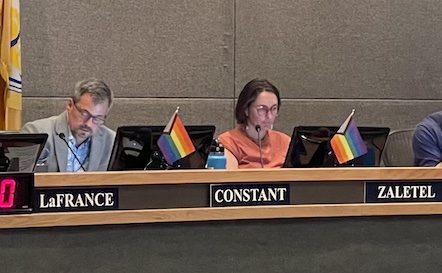
The Anchorage Assembly is about to tax marijuana users and property owners to pay for childcare and pre-K. It has teamed up with the Anchorage School District to levy the taxes for an unproven pre-kindergarten initiative.
Assembly members Suzanne LaFrance and Kameron Perez-Verdia are sponsoring AO 2022-17(S), which they want to be on the April, 2023 ballot. They cannot do this on their own—they need taxpayers to vote to approve/disapprove a change to the charter so they can push their social agenda.
Does this push for “free” early education help our children? Are there data to back this up? These two Assembly members cite little research to support their position.
Alabama has had the best pre-kindergarten system for 13 years, according to National Institute for Early Education Research.
Unfortunately, that investment in high quality has not seemed to pay off in NAEP scores. Over the last 13 years, Alabama has fallen from 47th to 50th in low-income NAEP 4th grade reading scores. Alaska is the only state that scores lower.
They also mention the current economic “crisis” that the Assembly caused by closing businesses and shuttering daycare centers.
They cite the current struggle that families have in feeding their kids and paying bills, not acknowledging this is due to the Assembly shutting down so many businesses for almost two years during the Covid-19 fiasco.
And are families suffering because the federal government has pumped tons of money into the economy, causing rampant inflation?
The Anchorage Assembly is about to push this daycare and pre-k despite the lack of proof that children would be more ready for kindergarten.
The Assembly wants to tax marijuana users and property taxpayers for this childcare and pre-K, following Rahm Emmanuel’s quote, “Never let a crisis go to waste.”
The two Assembly members stated they have support from “members across the political spectrum.” However, no mention was made of who they are. The support comes from a coalition of the marijuana industry, educators, non-profits, and businesses.
The marijuana industry supports this charter change because it is gifted by a freeze on its retail tax of 5% for 5 years. And the charter change also lowers the maximum tax to 10%.
Here’s the kicker. The marijuana tax will be removed from under the tax cap. It will be replaced by an increase in property taxes. By removing this marijuana tax from the tax cap, they can raise your property taxes without busting the tax cap.
But wait — there’s more! The charter amendment also states that funds from the alcohol tax will also be used to fund this program.
But no worry. Per the charter amendment, “It will cost less than a latte once a month for a year…”.
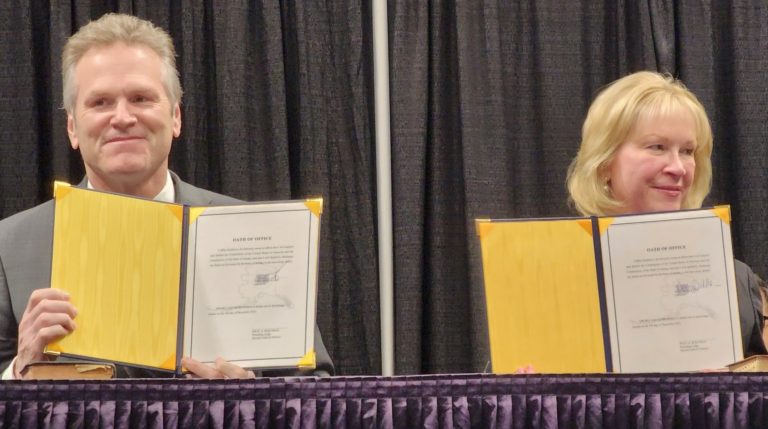
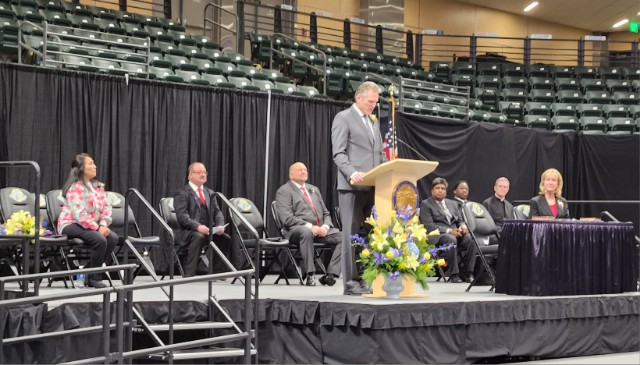
On a snowy December day, Gov. Mike Dunleavy and Lt. Gov. Nancy Dahlstrom were sworn into a four-year term by Judge Paul Roetman of Kotzebue. They each took turns standing before the crowd of about 150 gathered at the Alaska Airlines Center on the campus of the University of Alaska Anchorage and recited their oaths of office. Another 70 watched the ceremony on YouTube.
Roetman had just left the Alaska Judicial Council meeting, where he was being interviewed for the position of Alaska Supreme Court justice, and after swearing in the governor and lieutenant governor privately, in order to meet the constitutionally set noon deadline, swore them in ceremonially at the public ceremony.
Then, Dahlstrom and Dunelavy each gave brief remarks, thanking the people in the room who performed, organized, and who serve Alaskans in various capacities.
Dunleavy spent over 90 seconds thanking his wife Rose and his daughters for their steadfast support. “I couldn’t do this job without her,” he said, adding that Rose is strong, supportive and relaxed, even when times get difficult. He gave her a bouquet of flowers and noted that they recently celebrated their 35th wedding anniversary.
Dunleavy mentioned that there had been fires, earthquakes, a pandemic, and at times his commissioners probably wondered “what’s next, locusts?” He thanked his staff and the 22,000 workers of the State of Alaska. He said he hoped to have a grandchild to bounce on his knee someday, and that he would be able to look at that child and know he had left the state in great shape for future Alaskans.
The attendance was dwarfed by the size of the venue, but spotted in the crowd were very few legislators, including Rep. Cathy Tilton, Rep. Kevin McCabe, Sen. Mike Shower, Sen. Gary Stevens, Anchorage Mayor Dave and Deb Bronson, Alaska Energy Authority Executive Director Curtis Thayer, Alaska Republican Party Chair Ann Brown and National Committeewoman Cynthia Henry. Nick Begich, who ran for Congress in this election cycle, was in attendance.
Not in attendance was Lt. Gov. Kevin Meyer, who is finishing out a 29-year career of public service and who was thanked by Gov. Dunleavy for his service to Alaska.
For Gov. Dunleavy, it was his second swearing-in. His first, four years ago, took place in Kotzebue at the high school gymnasium. It was scheduled to take place in Noorvik, Rose Dunleavy’s hometown, but the planes couldn’t fly due to fog, and so the swearing in was an impromptu event, and a party was held in Noorvik.
Canada’s Veterans Affairs office offered to assist a veteran in committing suicide after she asked to have a wheelchair lift installed in her home, the woman told the House of Commons Veterans Affairs Committee last week.
Christine Gauthier, a retired corporal and competitor representing Canada at the 2016 Paralympics in Rio de Janiero, testified to lawmakers that a VA official had offered in writing to provide her with an assisted suicide kit, which contains medication for someone to end their own lives. Gauthier had been fighting for a wheelchair lift for her home for five years.
“I have a letter saying that if you’re so desperate, madam, we can offer you MAID, medical assistance in dying,” Gauthier said in a hearing before the House of Commons veterans affairs committee, as reported by the CBC.
The case officer remains unnamed but reportedly made similar offers to at least three other veterans, Canadian news outlets reported over the weekend.
The head of a wounded warrior group that supports Canadian veterans says he was horrified to hear of the incident, but it’s not an isolated story. In August, officials confirmed to CBC News that they issued an apology to a veteran who called for counseling, only to get a recommendation by the counselor that he could get assistance with dying.
As many as five Canadian military veterans seeking help for post traumatic stress disorder were offered option of MAID by at least one Veterans Affairs Canada caseworker, and the matter is now in the hands of the Royal Canadian Mounted Police for investigation; the caseworker known to have offered the suicide program is on leave.
MAID is the acronym in Canada for medical assistance in dying. Earlier this year, the practice was legally expanded to be available to those with mental illness; it has been available to terminally ill people since 2016, after in 2015 the Canada Supreme Court ruled in Carter v. Canada that parts of the Criminal Code would need to change to satisfy the Canadian Charter of Rights and Freedoms. The parts that prohibited medical assistance in dying would no longer be valid. The Supreme Court gave the government until June 6, 2016, to create a new law. Read about the history of the MAID laws at the official Canadian government website.
In 2017, researchers in Canada said that doctor-assisted suicide could reduce annual health-care costs by as much as $136.8 billion, according to a report in the Canadian Medial Association Journal.
The savings would far exceed the estimated cost of the MAID program, which was then estimated to be up to $14.8 million a year.
“The take-away point is that there may be some upfront costs associated with offering medical assisted dying to Canadians, but there may also be a reduction in spending elsewhere in the system and therefore offering medical assistance in dying to Canadians will not cost the health care system anything extra,” said Aaron Trachtenberg, an author of the report and a resident in internal medicine at the University of Calgary.
The use of medically assisted suicide keeps expanding in Canada, where health care is socialized, difficult to access, and costly to the public. MAID deaths now comprise nearly 5% of all deaths in Quebec and British Columbia, while in 2020, the doctor-assisted suicides were only 2.5% of all deaths.
It gets worse: Canadian fashion retailer Simons began promoting the Canadian euthanasia program with an ad that focused on the beauty of self-deletion.
The video ad, “All is Beauty,” featured a woman who opted for the program in advance of ending her life. After she starred in the ad, she killed herself, according to her plan. The ad is being criticized for glamorizing suicide and indeed makes it look like a very lovely choice.
A still shot from the ad “All is Beauty” by the Simons fashion retailer in Canada. The ad has been replaced with a Christmas-themed ad for the holidays.
The euthanasia program is now is being recommended by some doctors for disabled babies up to one year of age.
Dr. Louis Roy, of the Collège des médecins du Québec, or Quebec College of Physicians, told the House of Commons’ Special Joint Committee on Medical Assistance in Dying on Oct. 7 that it’s an appropriate alternative for infants who have “severe malformations” and “grave and severe symptoms” and whose “prospect of survival is null, so to speak.”
Krista Carr, executive vice-president of Inclusion Canada, a disability rights group, said infants cannot give consent and doctors’ predictions are “far too often based on discriminatory assumptions about life with a disability.” She called the killing of babies “murder.”
By CRAIG CAMPBELL | ALASKA REPUBLICAN PARTY NATIONAL COMMITTEEMAN
This past Saturday the Alaska Republican Party State Central Committee met for our regular quarterly meeting. This was the first meeting since the November elections that provided an opportunity to review what worked and what didn’t work in this first-ever, ranked-choice voting process.
There’s been a lot of social media frenzy about the actions taken by the State Central Committee on Saturday, mostly by people reacting with emotional rhetoric who have not been actively engaged with the party this past year. So let me provide some background and information on the basis for the SCC vote to sunset the Alaska Republican Party censures of Sen. Lisa Murkowski and state Sen.-elect Kelly Merrick.
Sen. Murkowski and then-Rep. Merrick were censured for their actions that were either not in accordance with the ARP Platform (Murkowski), or for joining an Alaska State House bipartisan coalition after having pledged not to do so to her district leadership during the election cycle of 2020 (Merrick).
Despite those censure actions, both individuals won their respective election in 2022.
It was concluded by a majority of the SCC members on Saturday that the censures were ineffective. While the censure actions may have sent a message that the ARP disapproved of Murkowski’s and Merrick’s actions, the censures did not change votes. In fact, in the case of Sen.-elect Merrick, the ARP censure action may have actually contributed to her victory. Therefore, the SCC members decided to sunset the censures and place a moratorium on any further censure actions until after the April 2024 Alaska Republican Party State Convention, when all delegates for the ARP will gather in Anchorage and can consider how our party should support, or not support, Republicans in the 2024 election.
While some have characterized this action as “Admitting defeat,” it could more accurately be characterized as recognizing that the censure tactic did not work. Since it didn’t, it’s time for the party to develop a different strategy to encourage Republicans to support the party platform and form Republican majorities when Alaskans elect a numerical majority of Republicans to the state House and Senate.
This leads me to the leadership issue. Many social comments blame the Alaska Republican Party for the failure of this past election. While nothing is ever perfect, the Alaska Republican Party worked hard during this election cycle to get Republicans elected. This included withholding support for Republican candidates who had been censured. We had the largest get-out-the-vote program ever conducted by the party in Alaska: we used rapid response media blasts when Republican opponents made dishonest statements about our candidates, we had active phone banking, we gave monetary support to candidates, we conducted an effective poll watching program, we had an election day hub monitoring the election, and we were active vote count observers. We wanted to ensure election integrity in 2022.
I hear some Republicans say they are leaving the Alaska Republican Party because leadership “caved” to the moderates. That is factually wrong. Let me explain party leadership. It starts at the local level. Alaska Republican Party leadership consists of those Republicans elected by Republicans in each of our 40 districts statewide, plus each district gets a bonus vote when that district has a Republican House representative. All in all, the State Central Committee has upwards of 90 members, all elected in local districts by those registered Republicans who participate in the district conventions.
The Alaska Republican Party chair, vice chair, national committeewoman, finance chair, treasurer, secretary, and national committeeman are also active members of the State Central Committee. Therefore, actions taken by the SCC are based on a vote by the majority of members who come from the 40 different districts. Alaska Republican Party leadership did not “cave,” rather it conducted a vote of SCC members, which determined the outcome.
To those who disagree with the SCC actions this past Saturday, I put out a challenge:
Get active with the Alaska Republican Party;
Attend your district meetings;
Get elected district leader or bonus vote;
Attend the quarterly State Central Committee meetings and the state convention;
Nominate and support the people you feel would best lead the Alaska Republican Party; and
Make your voice heard through action.
Sniping on social media is not the way to change the Alaska Republican Party. It’s your party, you can lead it in a conservative, moderate, or any other manner as the majority of the State Central Committee members determine. Instead of quitting, get involved.
Craig Campbell, former lieutenant governor of Alaska, is the Alaska Republican Party’s national committeeman and serves on the Republican National Committee.