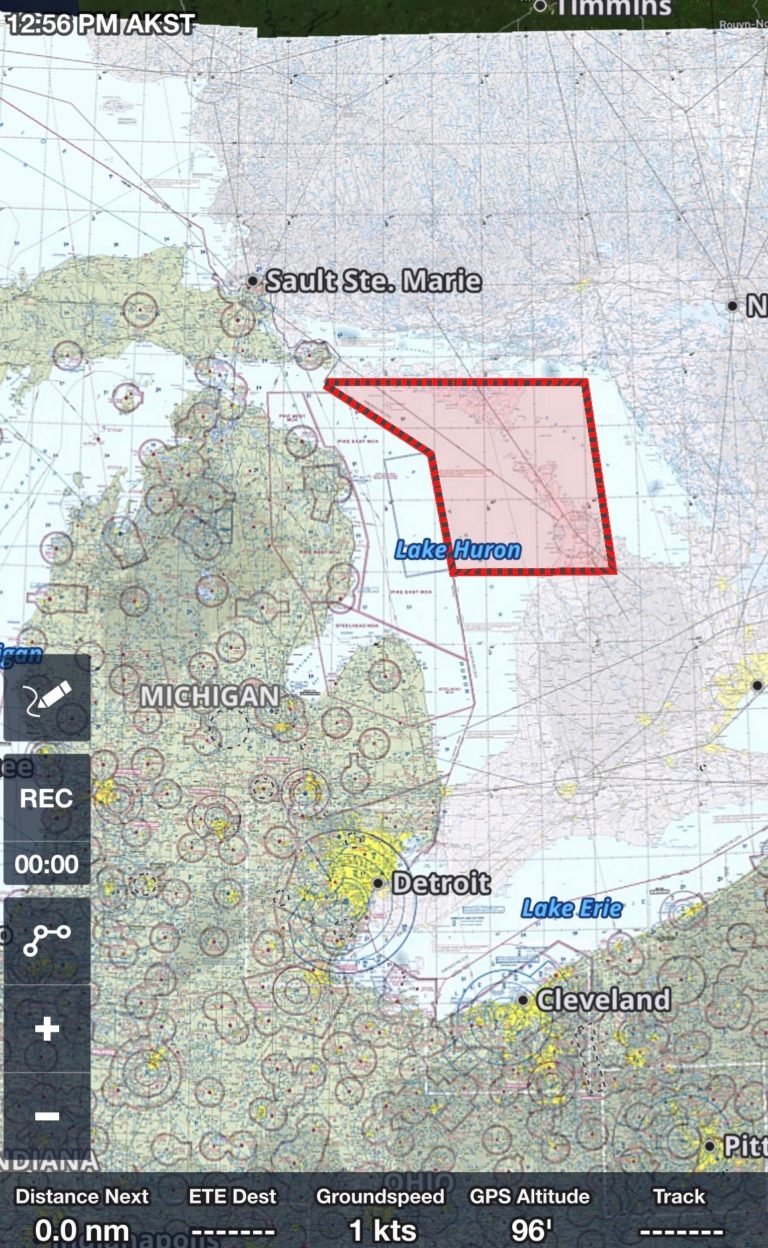
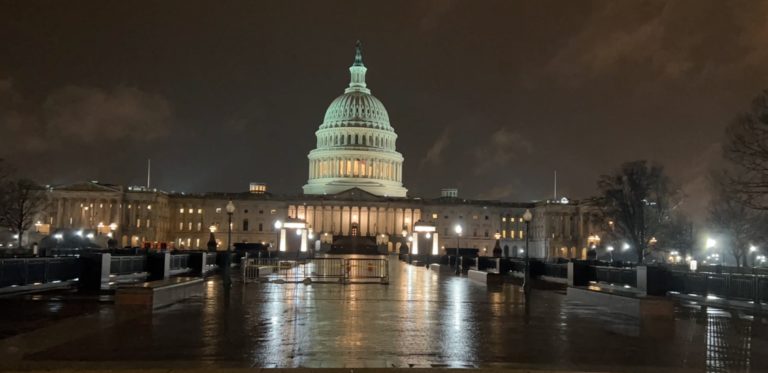
On Sunday, yet another unidentified object was shot down by a U.S. Air Force fighter jet. This one was over Lake Huron, north of Michigan, and is the fourth object shot down in American air space in eight days.
Rep. Jack Bergman and Rep. Elissa Slotkin, both of Michigan, confirmed that pilots were engaged from both the Air Force and National Guard, and it was a F-16 that shot down the object.
On Saturday, air space was briefly closed over a portion of Michigan, but then reopened, without explanation from the FAA.
The object shot down on Sunday was described as octagonal, and at 20,000 feet, which would be a threat to commercial airlines. Military sources tell Must Read Alaska that the Department of Defense knows what the UFOs are, but has not told the public.
The first item to enter U.S. airspace was a China spy balloon that traveled across Alaska and much of the United States before being shot down over the ocean east of Myrtle Beach, S.C. Next, an unknown object was shot down over the Arctic Ocean north of Deadhorse, Alaska. Then, over The Yukon, another item, described as a cylinder, was shot down by U.S. F-22, at the request of Canada Prime Minister Justin Trudeau. On Saturday, air space was briefly closed in Montana, but no action was taken, and Sunday, an item shot from the sky over Lake Huron, which is between Michigan and Canada.
In four years of World War II, the United States supplied 14,798 combat aircraft to the Soviet Union.
More than half (7,925) of the planes were flown over the Northwest Route across Canada and Alaska and accepted at Ladd Army Airfield in Fairbanks by Russian inspectors.
Looking back, some American military experts questioned whether the Soviets needed all of these aircraft. By the end of 1943, the USSR was building a great number of planes in factories in the Ural Mountains and already had technical military superiority over its enemies. In 1943, Soviet industry produced 35,000 airplanes and 24,000 tanks and self-propelled guns, compared with 25,000 airplanes and 18,000 tanks produced by Germany. In fact, despite its smaller industrial capacity and a reduced base of strategic raw materials, the Soviet Union still produced more military equipment than Germany overall, with a total output during the war of 137,000 aircraft (including 112,100 combat planes), 104,000 tanks and self-propelled guns, and 488,000 artillery pieces.
According to some military analysts and American participants in the program, the Soviet Union was stockpiling Lend-Lease equipment for post-war use, and probably used the air route for espionage. During the Korean War (1950‒53), American soldiers reportedly were puzzled to encounter so much American equipment (e.g., jeeps, trucks).
Evidently, the Chinese and Soviets provided military aid to North Korea using the very same supplies they had received from the United States several years earlier. American analysts have yet to grasp the full extent and intention of Soviet secrecy during WWII on matters ranging from combat operations to agricultural production. Information would often have to come directly from Stalin, which led some officials to conclude he “apparently was the only individual in the Soviet Union who had the authority to give some information.”
Some American military experts have alleged that uranium was shipped through Great Falls, and it was also suspected that in May of 1944 U.S. Treasury banknote plates had gone up the air route. Those who worked on the U.S. side of the operation tend to debunk claims of Soviet conspiracy.
Much information attesting to the helpful U.S. attitude toward the USSR and vice versa during the war remains unknown to the general American public. Assertions by post-war commentators that a thorough evaluation of the program might uncover some embarrassing facts likely are due more to the later context of the Cold War and to global foreign affair policies that began during the Truman presidency than to any widespread wrongdoing having actually occurred during the war. This became clear during the U.S. House of Representatives hearing on Lend-Lease matters held during the McCarthy era of the early 1950s, which was tainted with exaggerations and fabrications by members seeking to persecute liberal historians, radical socialists, and anyone perceived as sympathetic to the Soviet Union.
Lend-Lease Supply to the Soviet Union included food
About $11 billion in war materials and other supplies were shipped to the Soviet Union from the United States over four major routes between 1941 and 1945. In addition to military equipment, the USSR received such non-military items as cigarette cases, records, women’s compacts, fishing tackle, dolls, playground equipment, cosmetics, food, and even 13,328 sets of false teeth.
Soviet requests for food emphasized canned meat (tushonka), fats, dried peas and beans, potato chips, powdered soups and eggs, dehydrated fruits and vegetables, and other packaged food items. Dehydration, which made shipping food to the Soviet Union possible under the program, led to a rapid expansion of American dehydrating facilities, which eventually influenced the domestic market and the diet of American people in the post-war period.
Lend-Lease accounts show that, in 1945 alone, about 5,100,000 tons of foodstuffs left for the Soviet Union from the United States; that year, the Soviets’ own total agricultural output reached approximately 53,500,000 tons. If the 12 million individual members of the Soviet Army received all of the foodstuffs that arrived in the USSR through Lend-Lease deliveries from the United States, each man and woman would have been supplied with more than half a pound of concentrated food per day for the duration of the war.
Without a doubt, Lend-Lease food proved vital to the maintenance of adequate nutrition levels for Soviets and other Lend-Lease beneficiaries. In 1944, two percent of the United States’ food supply was exported to the Soviet Union, four percent to other Lend-Lease recipients, one percent to commercial exports, and 13 percent to the United States military.
This aid was made possible due to sacrifices made by the American people and an enormous increase in American agricultural and industrial production—up 280 percent by 1944 over the 1935‒39 average. Between 1939 and 1945, America’s gross national product soared from $90 billion to $212 billion; altogether the United States spent over $315 billion on its war effort. It has been estimated that approximately 50 million Americans (about one-third of America’s population at the time), including 12 million U.S. troops, participated in the war between 1941 and 1945.
Although the Soviet government tried to minimize the importance of Lend-Lease support by arguing that U.S. supplies to the USSR represented only 4–10 percent of total Soviet production during the war, the aid items were in fact essential for that nation’s survival. For example, while Soviet production of steel was about 9,000,000 tons in 1942, under Lend-Lease, the Soviet Union received about 30 percent, or 3,000,000 tons of steel. The Soviet T-34 tank engine and Soviet aircraft used Lend-Lease aluminum. Copper shipments (about 4,000,000 tons) equaled three-quarters of the entire Soviet copper production for the years 1941-44. About 800,000 tons of non-ferrous metals (e.g., magnesium, nickel, zinc, lead, tin), 1,000,000 miles of field telegraph wire, 2,120 miles of marine cable, and 1,140 miles of submarine cable formed an impressive figure, especially when compared to Soviet production.
The Soviet Union also received essential military items under the Lend-Lease Agreement: 14,798 aircraft (not including PBN and PBY patrol planes) from the United States, and nearly 4,570 combat aircraft from Great Britain (equivalent to 17 percent of the 112,100 combat aircraft produced in Soviet plants); 9,000 tanks and self-propelled guns, or 10 percent of the Soviet production; 47,238 jeeps; and 362,288 trucks (compared to the 128,000 trucks manufactured in the Soviet Union during those four years of the war). All of this equipment greatly contributed to the mobility and survival of the Red Army.
Unfortunately, many of these materials deteriorated due to poor maintenance or were wastefully stockpiled due to Soviet carelessness and inefficient infrastructure. Nevertheless, most of the materials were widely used and often admired by Red Army soldiers. In fact, Soviet air ace and three times Hero of the Soviet Union, the legendary Aleksandr Pokryshkin, used a Lend-Lease P-39 Airacobra to shoot down 48 of the 59 Nazi planes credited to him; Grigory Rechkalov, the second highest scoring Allied ace of World War II, shot down 47 of the 61 enemy planes credited to him using the P-39 Airacobra, as well. In 1944, Time magazine reported that:
Russian fighter pilots are tremendously fond of the US-built Bell Airacobra, which they call Cobrushka (“Little Cobra”); they have more than 4000 of them. The Russians were profoundly uninterested in U.S. criticism of Cobrushka on the grounds that it could not fight at high altitude; like any other tactical air force, the Russians do nearly all their fighting below 15,000 ft. Nearly all of the top-scoring Red aces fly Airacobras.
Many non-military and military items were funneled through Great Falls, and the United States reportedly received payment from the USSR for only a small fraction of these items. However, Ladd Army Airfield airplane mechanic Bill Schoeppe knew of two airplanes loaded with 10,000 pounds of gold, valued at about $5.6 million at the time, which traveled from Siberia to the Lower 48 in 1943.
I have been in many discussions about payment for equipment, and I can say I was in two planeloads of gold bullion on the way to Washington, D.C. In each case, the cabin floor was covered with gold, over 5,000 lbs. each. How many more shipments? I don’t know.
No written record has been found thus far of that transaction or of other transactions of a similar nature, as the records of the Foreign Economic Administration’s Division of Soviet Supply have disappeared. The National Archives does not have them and neither does the Department of State. Many of the FEA records were inadvertently shredded in the early 1970s, and DSS records may have been among those destroyed.
Alexander B. Dolitsky was born and raised in Kiev in the former Soviet Union. He received an M.A. in history from Kiev Pedagogical Institute, Ukraine, in 1976; an M.A. in anthropology and archaeology from Brown University in 1983; and was enroled in the Ph.D. program in Anthropology at Bryn Mawr College from 1983 to 1985, where he was also a lecturer in the Russian Center. In the U.S.S.R., he was a social studies teacher for three years, and an archaeologist for five years for the Ukranian Academy of Sciences. In 1978, he settled in the United States. Dolitsky visited Alaska for the first time in 1981, while conducting field research for graduate school at Brown. He lived first in Sitka in 1985 and then settled in Juneau in 1986. From 1985 to 1987, he was a U.S. Forest Service archaeologist and social scientist. He was an Adjunct Assistant Professor of Russian Studies at the University of Alaska Southeast from 1985 to 1999; Social Studies Instructor at the Alyeska Central School, Alaska Department of Education from 1988 to 2006; and has been the Director of the Alaska-Siberia Research Center (see www.aksrc.homestead.com) from 1990 to present. He has conducted about 30 field studies in various areas of the former Soviet Union (including Siberia), Central Asia, South America, Eastern Europe and the United States (including Alaska). Dolitsky has been a lecturer on the World Discoverer, Spirit of Oceanus, andClipper Odyssey vessels in the Arctic and sub-Arctic regions. He was the Project Manager for the WWII Alaska-Siberia Lend Lease Memorial, which was erected in Fairbanks in 2006. He has published extensively in the fields of anthropology, history, archaeology, and ethnography. His more recent publications include Fairy Tales and Myths of the Bering Strait Chukchi, Ancient Tales of Kamchatka; Tales and Legends of the Yupik Eskimos of Siberia; Old Russia in Modern America: Russian Old Believers in Alaska; Allies in Wartime: The Alaska-Siberia Airway During WWII; Spirit of the Siberian Tiger: Folktales of the Russian Far East; Living Wisdom of the Far North: Tales and Legends from Chukotka and Alaska; Pipeline to Russia; The Alaska-Siberia Air Route in WWII; and Old Russia in Modern America: Living Traditions of the Russian Old Believers; Ancient Tales of Chukotka, and Ancient Tales of Kamchatka.
A military aircraft accompanied by two Blackhawk helicopters was seen leaving Deadhorse, flying south this afternoon at about 4:30 pm. Must Read Alaska has exclusive video:
Recovery operations have been ongoing on the Arctic Ocean north of Deadhorse, where the U.S. military shot down an unknown object in U.S. airspace on Friday. The military had tracked the item since Thursday and determined it was unmanned. A jet from Anchorage to Red Dog Mine was rerouted toward Nome to avoid the item on Thursday.
“The object was flying at an altitude of 40,000 feet and posed a reasonable threat to the safety of civilian flight,” said Pentagon Press Secretary Air Force Brig. Gen. Pat Ryder on Friday. Civilian airliners typically fly between 40,000 and 45,000 feet.
President Joe Biden ordered Northern Command to shoot down the object, which has not been described by the U.S. government, other than it was smaller than the China spy balloon shot down over the coast of South Carolina last Saturday.
Military flight with Blackhawks leaving Deadhorse this afternoon, flying by oil platforms. Debris recovery operation? pic.twitter.com/0H5UGRcUYh
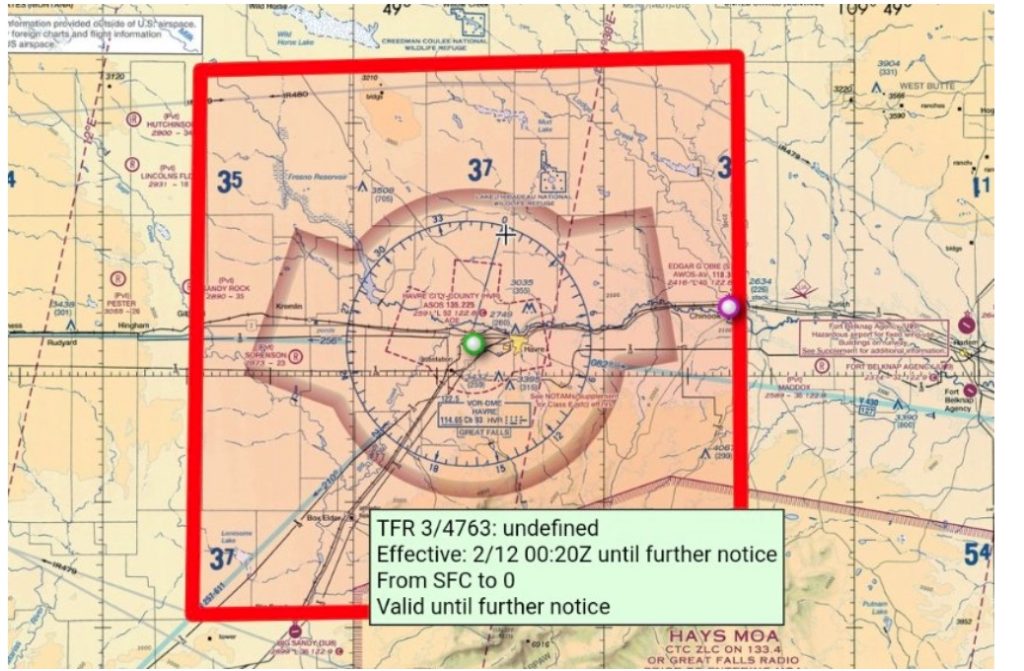
An unidentified object in the air over Havre, Montana prompted officials to issue a NOTAM, an air space closure, near the border with Canada on Saturday. The area is in roughly the same same route as the China spy balloon that crossed Alaska and Canada one week ago, before entering the United States in Montana.
The FAA listed no TFR — temporary flight restriction — over the area. A NOTAM is a notice containing information essential to personnel concerned with flight operations, but not known far enough in advance to be publicized by other means, the FAA describes. It states the abnormal status of a component of the National Airspace System – not the normal status.
Sen. Jon Tester of Montana confirmed the situation, which occurred the same day another object was shot down over Yukon, Canada.
“I am aware of the object in Montana air space and remain in close contact with senior DOD and Administration officials. I am closely monitoring the situation and am receiving regular updates. I will continue to demand answers for the American public,” Tester said in a statement.
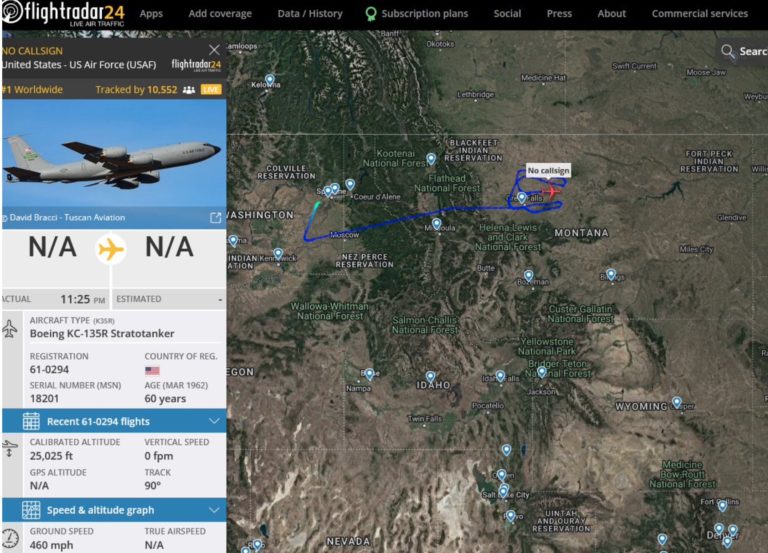
From FlightRadar24, it appeared that a USAF KC-135 tanker with no call sign was doing a flight pattern around Great Falls, Montana.
“I am in direct contact with NORCOM and monitoring the latest issue over Havre and the northern border. Airspace is closed due to an object that could interfere with commercial air traffic — the DOD will resume efforts to observe and ground the object in the morning,” said Rep. Matt Rosendale of Montana. Later, he wrote, “Airspace is reopened – I will remain in contact with defense officials and share more information as it becomes available. Montanans deserve answers.”
On Friday, White House Press Secretary Karine Jean-Pierre said on Friday that having a new openly gay communication director in the White House is “very, very important indeed.”
Jean-Pierre said that new Communication Director Ben LaBolt is making history.
“I also know that Ben is making history as, you know, we believe here in the Biden-Harris White House that representation matters. He will be the first openly gay communications director which is very, very important indeed.”
Kate Bedingfield, the current White House communications director, will leave to work on President Joe Biden’s reelection campaign. LaBolt is a former press adviser to former President Barack Obama and worked as Obama’s press secretary when he was in the Senate.
Biden announced Karine Jean-Pierre as White House Press Secretary on May 5, 2022, and she became the first black press secretary in U.S. history, replacing Jen Psaki.
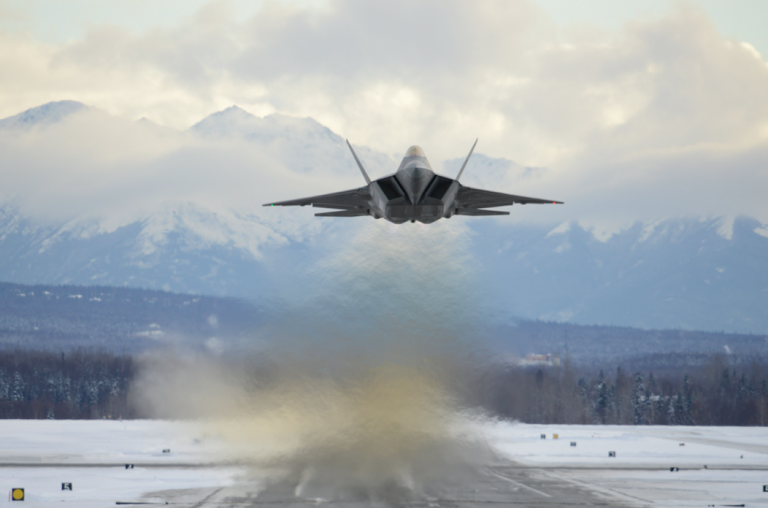
A third unidentified object has been shot down by an Alaska-based F-22 fisher jet, but this one was over the Yukon Territory in Canada. It was requested to be shot down by Canada Prime Minister Justin Trudeau on Saturday. Canadian and U.S. aircraft were scrambled, and a U.S. F-22 successfully hit the object, Trudeau said.
“I ordered the take down of an unidentified object that violated Canadian airspace,” Trudeau wrote on Twitter. “I spoke with President Biden this afternoon. Canadian Forces will now recover and analyze the wreckage of the object. Thank you to NORAD for keeping the watch over North America.”
The item was shot down a day after U.S. jets descended on an object in the Arctic Ocean just north of Deadhorse, Alaska and a week after a China spy airship was shot down over Myrtle Beach, South Carolina. Recovery operations are still underway to pick up the pieces of the object that fell onto the ice-covered Arctic Ocean.
Earlier Saturday, the North American Aerospace Defense Command was tracking a “high-altitude airborne object” over the Yukon.
NORAD confirmed the Trudeau report in a statement that said it had “positively identified a high-altitude airborne object over Northern Canada.”
U.S. Senator Dan Sullivan (R-Alaska), a member of the Senate Armed Services Committee, today released the following statement:
“In the last few days, we’ve experienced unprecedented incidences of not only a confirmed Chinese spy balloon, but other unidentified aircraft that have breached the sovereign airspace of Alaska and the rest of the country. I once again commend our military, particularly the Active Duty and Guard forces in Alaska, who have literally been working around the clock for weeks tracking and eliminating this unprecedented challenge, including the Alaska-based F-22 that just shot down another unidentified aircraft over Canada.
“Their priority mission should continue to be protecting and defending American airspace and, importantly, redoubling efforts to recover, exploit and analyze the unidentified aircraft shot down over Alaska and Canada. This needs to be done as quickly as possible in order to fully understand the nature of the threat we are facing right now. It’s important that the Biden Administration provide to the American people as much information as possible on these sightings or any similar incidents.”
When the framers drafted the Constitution in 1787, they knew their work would be imperfect, and would require amendment. So Congress was empowered to propose amendments with a two-thirds vote, with ratification of three-quarters of the states also required.
All of the 27 amendments to the Constitution have been the result of this process.
But what if the needed amendment involved a reform of Congress itself? What if the vast powers vested in Congress needed to be somehow curtailed? Congress might well refuse to propose an amendment to reform itself. Then what?
An alternative method was included in Article V of the Constitution. If two-thirds of the state legislatures passed resolutions calling for a Amendment Convention, where the proposed amendment would be drafted, Congress would be obligated to call such a Convention. Any proposed amendment drafted by the delegates would need ratification by three-quarters of the states.
In response to reckless deficit spending by Congress, a movement began among the state legislatures to pass resolutions calling for an Amendment Convention to propose an amendment calling for fiscal reform of the Congress. There are varying estimates of the number of such Article V resolutions which have passed, are valid, and can be aggregated to achieve the needed two-thirds.
Some legal scholars believe that there are currently in effect the 34 resolutions needed. Others disagree, and believe the number is less than 34. It’s up to Congress to make this decision, but Congress refuses to make the count, so no one knows for sure.
Congressional members of both political parties are hostile to the power of state legislatures to propose amendments to the Constitution. It’s a power they would prefer to reserve for themselves. So they refuse to even count the number of state resolutions that are valid. As a result, no one knows, for sure, where the movement for a fiscal reform amendment stands. Has the two-thirds requirement been met? If not, how many more resolutions are needed?
In order to determine this question it is necessary for the federal courts to issue an order requiring Congress to conduct a count of the valid Article V resolutions. The Alaska Legislature passed an Article V Resolution calling for a fiscal reform Amendment Convention 40 years ago. Thus the state has standing to file such a lawsuit, seeking a writ of mandamus from the court ordering Congress to do its duty under Article V, and to conduct a count of the fiscal reform Amendment resolutions.
In order to enhance the claim to standing by Alaska’s Attorney General it would be helpful if one or both Houses of the Alaska Legislature were to pass a resolution calling upon the Attorney General to file the lawsuit seeking the writ of mandamus. An effort has begun to try to pass such a resolution in the current session in Juneau.
Reckless spending by Congress has saddled future generations with a $31 trillion national debt. It has also caused rampant inflation. Congressional spending needs to be restrained. This can only be accomplished by an amendment to the Constitution. That can only be achieved by using the procedures set out in Article V which allow the state legislatures to initiate such an amendment.
Congress must be compelled by the federal courts to count the number of valid Article V resolutions it has in its possession. If that number is 34 or more, Congress must be ordered to call an Amendment Convention.
Most state legislators are unaware of the power Article V of the Constitution vests in them. Because they have been given this power, they have a constitutional responsibility to exercise it when the situation warrants. Runaway spending by Congress has resulted in an existential threat to the financial well being of this country. Fiscal reform is desperately needed. It will only come if state legislators recognize their obligations under Article V.
The House and Senate of the Alaska legislature should pass resolutions calling upon our Attorney General to file for an Article V writ of mandamus.
Fritz Pettyjohn voted for an Article V resolution calling for a fiscal reform amendment as a freshman in the Alaska Senate.
Tax filing season is here, and along with it, confusion about what income is taxable.
The Internal Revenue Service provided guidance this week on how it views state payments that are considered relief, refunds, and rebates. The guidance says that part of last year’s Alaska Permanent Fund dividend — the energy relief portion — is not taxable.
Last year’s Permanent Fund dividend was $3,284, the largest in history. But the energy relief portion of the check was $662. That is the portion that will not be considered taxable by the IRS. That leaves $2,622 as the taxable amount of the 2022 PFD.
Issued on Friday, the IRS guidance clears up uncertainty that had earlier prompted the agency to tell taxpayers to hold off in filing their taxes until the agency could provide some answers. Alaska was not the only state to provide various sorts of rebates or refunds last year.
The new guidance follows, as provided by the IRS:
The Internal Revenue Service provided details today clarifying the federal tax status involving special payments made by 21 states in 2022.
The IRS has determined that in the interest of sound tax administration and other factors, taxpayers in many states will not need to report these payments on their 2022 tax returns.
During a review, the IRS determined it will not challenge the taxability of payments related to general welfare and disaster relief. This means that people in the following states do not need to report these state payments on their 2022 tax return: California, Colorado, Connecticut, Delaware, Florida, Hawaii, Idaho, Illinois, Indiana, Maine, New Jersey, New Mexico, New York, Oregon, Pennsylvania and Rhode Island. Alaska is in this group as well, but please see below for more nuanced information.
In addition, many people in Georgia, Massachusetts, South Carolina and Virginia also will not include state payments in income for federal tax purposes if they meet certain requirements. For these individuals, state payments will not be included for federal tax purposes if the payment is a refund of state taxes paid and either the recipient claimed the standard deduction or itemized their deductions but did not receive a tax benefit.
The IRS appreciates the patience of taxpayers, tax professionals, software companies and state tax administrators as the IRS and Treasury worked to resolve this unique and complex situation.
The IRS is aware of questions involving special tax refunds or payments made by certain states related to the pandemic and its associated consequences in 2022. A variety of state programs distributed these payments in 2022 and the rules surrounding their treatment for federal income tax purposes are complex. While in general payments made by states are includable in income for federal tax purposes, there are exceptions that would apply to many of the payments made by states in 2022.
To assist taxpayers who have received these payments file their returns in a timely fashion, the IRS is providing the additional information below.
Refund of state taxes paid
If the payment is a refund of state taxes paid and either the recipient claimed the standard deduction or itemized their deductions but did not receive a tax benefit (for example, because the $10,000 tax deduction limit applied) the payment is not included in income for federal tax purposes.
Payments from the following states in 2022 fall in this category and will be excluded from income for federal tax purposes unless the recipient received a tax benefit in the year the taxes were deducted.
Georgia
Massachusetts
South Carolina
Virginia
General welfare and disaster relief payments
If a payment is made for the promotion of the general welfare or as a disaster relief payment, for example related to the outgoing pandemic, it may be excludable from income for federal tax purposes under the General Welfare Doctrine or as a Qualified Disaster Relief Payment. Determining whether payments qualify for these exceptions is a complex fact intensive inquiry that depends on a number of considerations.
The IRS has reviewed the types of payments made by various states in 2022 that may fall in these categories and given the complicated fact-specific nature of determining the treatment of these payments for federal tax purposes balanced against the need to provide certainty and clarity for individuals who are now attempting to file their federal income tax returns, the IRS has determined that in the best interest of sound tax administration and given the fact that the pandemic emergency declaration is ending in May, 2023 making this an issue only for the 2022 tax year, if a taxpayer does not include the amount of one of these payments in its 2022 income for federal income tax purposes, the IRS will not challenge the treatment of the 2022 payment as excludable for income on an original or amended return.
Payments from the following states fall in this category and the IRS will not challenge the treatment of these payments as excludable for federal income tax purposes in 2022.
For a list of the specific payments to which this applies, please see this chart.
Other payments
Other payments that may have been made by states are generally includable in income for federal income tax purposes. This includes the annual payment of Alaska’s Permanent Fund Dividend and any payments from states provided as compensation to workers.
[1]Only for the supplemental Energy Relief Payment received in addition to the annual Permanent Fund Dividend.
[2] Illinois and New York issued multiple payments and in each case one of the payments was a refund of taxes, which should be treated as noted above, and one of the payments is in the category of disaster relief payment.
During his State of the Union address, President Joe Biden showed that when it comes to taxes, he is playing a game of yards, because companies, in his view, simply make too much money. He’s moving the ball down the field, slowly but surely.
In his “Finish the Job” speech, Biden ran right up the middle of investments set aside by workers who for decades thought they had made wise decisions on their own retirement plans.
Biden, by threatening to add even more corporate taxes, could harm the investments of tens of millions of Baby Boomers, Gen-Xers, Millennials, and Gen-Zers.
Of course, the president promised that Americans making less than $400,000 will not have to pay a penny more in taxes under his plan. But this is a head fake. A tax on corporate profit is a tax on retirement income.
The federal treasury has already collected $1.03 trillion in fiscal year 2023 from individual and corporate income taxes. But it’s never enough. The U.S. government has spent $1.45 trillion in fiscal year 2023, which is $17 billion more than the year before, give or take a few hundred million.
Of the corporations whose money he yearns for, Biden said, “they used those record profits to buy back their own stock, rewarding their CEOs and shareholders. Corporations ought to do the right thing. That’s why I propose that we quadruple the tax on corporate stock buybacks to encourage long-term investments instead.”
The right thing? The right thing is maximizing profits to shareholders, who Biden singled out for criticism, as if there is something immoral about being a shareholder.
Who gets those profits that Biden says are too much? Your grandmother. Your mom and dad. Bus drivers, pilots, engineers, nurses, and machinists. Those dividends go to all of us who were told back in the 1970s that, since pensions were not sustainable, and since Social Security can’t guarantee us anything but an impoverished old age, we needed to start building these new-fangled investment instruments created by the government, we needed to invest in America, and we were encouraged to turn straw into gold during our working years.
Corporations are owned by shareholders, big and small. Take Exxon, for example: Nearly 34% of the company is owned by mutual funds, 26% by other institutional funds, and less than 1% by individual stakeholders.
Corporate profits go into earnings account, and a company’s board of directors makes the decisions about how to distribute those profits to shareholders, which are made up by pension plans, 401Ks, individual retirement accounts, and other financial vehicles. Exxon and other profitable energy companies that Biden has declared war on, pump billions of dollars into pension plans and retirement accounts every year.
The plans Americans are invested in are taxed based on complicated calculations that change over time and depending on a person’s wealth profile. For most Americans, distributions are taxed as ordinary income, and so they may pay the average of 28.4% on that income. The federal government is, without question, skimming its share through taxing this retirement income as it reaches its final destination – your bank account.
In a stock buyback, a corporation can buy its own shares, which may or may not boost the price of the shares still outstanding. This idea that it drives up the stock price is a theory that is much debated. Until Biden signed the Inflation Reduction Act, those stock buybacks were not taxable until investors sold the appreciated shares. Retirement accounts benefited, as their account values grew, and America as a whole benefited from having people with disposable income in their later years.
Then, with the stroke of his pen, Biden signed the Inflation Reduction Act that makes corporations making more than $1 billion a year pay a minimum tax rate of 15% plus a 1% excise tax on stock buybacks, effective as of Jan. 1, 2023. Biden brought the U.S. in-line with the Global Tax Agreement signed onto by countries to stop companies like Apple from setting up their headquarters in tax havens.
This was only Biden’s starting offer. Now he intends to quadruple the stock buyback tax. What will Biden go for next? Whatever it is, he is desperately looking for more cash to pay for the massive government expansion he has planned. It’s a game of yards, and retirement accounts are going to be collateral damage in Biden’s “Finish the Job” initiative.
Of course, there’s some kabuki theater in the corporate tax enacted under the Inflation Reduction Act. Most U.S. corporations already pay more than 15%. Those that don’t will figure out creative ways to adjust their earnings downward.
Taxation changes corporate behavior, but rarely in the way that government intends. The devil is going to be in the details, and tax details seem to get more complicated with every tax law passed.
With stock buyback taxes, we can expect a behavior change as corporations move to dividends, which could transfer the individual income tax base from capital gains to dividends, according to the Tax Foundation. That could mean a tax between zero and 20%, depending on a person’s taxable income and other factors. For most, the taxes on non-qualified dividends is the same as the usual income tax bracket.
This corporate tax increase proposal is one Biden blunder that would definitely “Finish the Job” on the workers of America because this is a trickle-down tax if there ever was one. Retirees will take the hit.