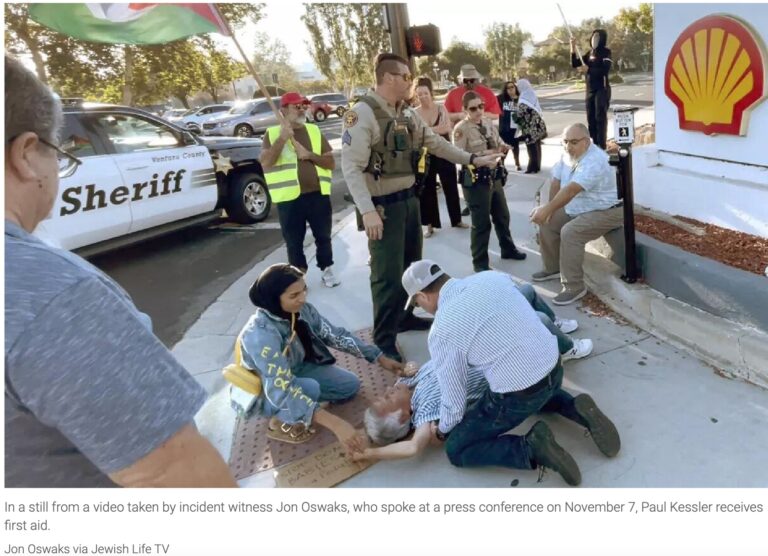
An autopsy performed by the Ventura County Medical Examiner’s office determined the death of a pro-Israeli Jewish man protesting near a pro-Palestine rally in Westlake Village, California to be a homicide. According to the examiner, the finding does not necessarily “indicate a crime has been committed,” because “that’s determined by the [District Attorney’s] office.”
A report from the Ventura County Sheriff says the death occurred at an intersection where both pro-Israel and pro-Palestine rallies were in progress.
The Jewish Federation of Greater Los Angeles says the deceased man, identified as Paul Kessler, 69, was “struck in the head by a megaphone wielded by a pro-Palestinian protestor.”
The sheriff’s latest public report doesn’t say anything about a megaphone, but does say Kessler was “involved in a physical altercation with counter-protestors,” during which he “fell backwards and struck his head on the ground.”
The examiner’s report notes Kessler had a nonlethal injury to one side of his face, along with blunt force trauma to the back of his head consistent with a fall, which could suggest he may have been struck then fallen to the ground.
“The Ventura County Sheriff’s Office is investigating the incident and has not ruled out the possibility of a hate crime,” said the office in a public statement.
Two weeks ago, the Anti-Defamation League, a Jewish anti-hate group claimed there was a nearly 400% increase in reported anti-semitic incidents from October 7 to October 23 over the same period last year.
“It’s a lot of anti-Israel, pro-Palestinian protestors that are celebrating Hamas’ atrocities,” said Aaron Bandler, a staff writer for the Jewish Journal who covers antisemitism, to The Center Square. “The protesters are wearing masks so you can’t really see their faces.”
In California, pro-Israel and pro-Palestine protests have erupted around the state, accompanying a surge in reports of both anti-Jewish and anti-Muslim incidents.
An Anchorage man who allegedly distributed child pornography and fantasized extensively online about anally raping children was allowed to continue his nefarious ways while the FBI dropped the investigation in order to focus on investigating those the agency believed were involved in the Jan. 6 election protest at the U.S. Capitol.
The delay in arresting the man raises an important question about how many other cases of serious nature or other criminal activity the FBI dropped in order to go after Trump supporters.
Brogan T. Welsh, 31, of Anchorage, was indicted in late October in the District of Columbia on charges of distributing child pornography. His arrest came in Anchorage.
Welsh allegedly was a member of a private group on an internet platform specifically set up to chat about sexual exploitation of children and to the sharing of child sexual abuse materials.
In December 2020, Welsh, who by then was staying a place near Richmond, Va., contacted someone on the platform that he believed was the father of a minor child. That person was actually a FBI undercover agent in the agency’s Washington D.C. Field Office.
The agency observed several weeks that Welsh posted links in the group containing numerous images and videos depicting adult males sexually abusing prepubescent boys.
Welsh repeatedly expressed his sexual interest in children, and a desire to travel to the District of Columbia in order to sexually abuse the purported child of the man he believed to be the father.
The Statement of Facts from the investigating agent said, “user ‘gayboy69freak’ expressed interest in urinating on children and disclosed to FATHER he had sexual contact with a younger cousin. Over the course of several weeks APP1 user ‘gayboy69freak’ communicated with FATHER about traveling to engage in sex with the purported nine-year-old boy.”
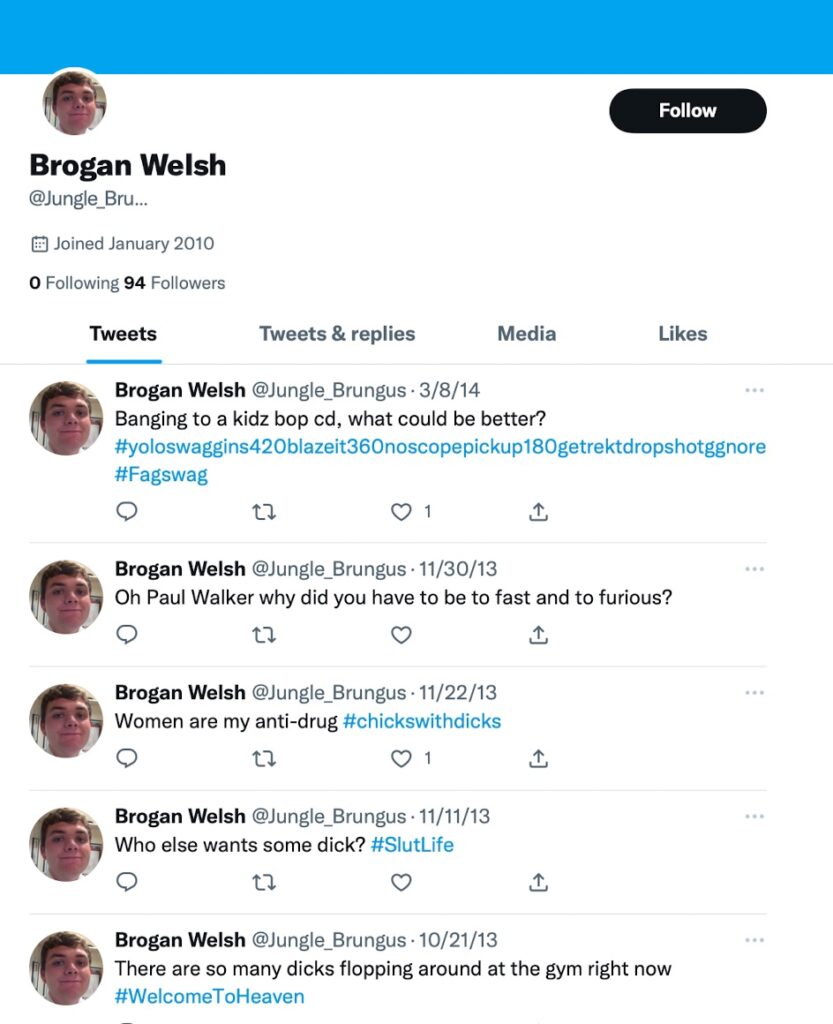
Brogan Welsh’s social media post.
But then, Jan. 6, 2021 came along, and the FBI lost interest in gayboy69freak. It started investigating people who it believed had unlawfully taken part in a mob activity at the U.S. Capitol, where the election was being certified by the Senate.
“On January 6, 2021, FBI, Washington Field Office, this investigation was halted due to events that occurred at the United States Capitol Building that day,” the Statement of Facts said. The agency apparently never looked at it again until in August of 2023, when Welsh’s name was associated with another investigation.
During the months that followed Jan. 6, 2021, the FBI investigated and harassed innocent Alaska Republicans and those in other states. Two of the Alaska targets were reported here at Must Read Alaska, including Paul and Marilyn Hueper of Homer, whose home the FBI forcibly entered on April 28, 2021, in search of then-House Speaker Nancy Pelosi’s laptop and any other evidence that the Huepers had acted unlawfully on Jan. 6 of that year. The investigators took a copy of the U.S. Constitution from the Hueper’s home as evidence of their alleged misdeeds. It turned out to be a case of mistaken identity, but was just one of the many possible situations where the FBI may have stopped chasing possible criminals in order to harass patriotic Americans.
In a similar case of misdirected FBI effort, Anchorage citizen activist Jay McDonald was telephoned on Feb. 8, 2021 and harassed by an FBI agent who pressed him repeatedly to see if he had traveled to Washington, D.C. for the Jan. 6 protests. He had not left the state during that timeframe, but the call felt like a threat. McDonald believes he was targeted because someone associated with Democrats imagined that McDonald would be the type who might go to the nation’s capital, and dropped a tip in the FBI’s tip portal set up to track down Jan. 6 suspects. It was an instance of political harassment.
While the FBI was busy investigating thousands of Americans, the agency let Welsh continue his alleged activity unabated.
The agency only picked up the Welsh case after the Anchorage FBI team stumbled on it during an investigation that was thought to be unrelated.
“In an investigation previously thought to be unrelated, agents in the FBI’s Anchorage Office discovered chats between two users on the same social media application again discussing the sexual exploitation of children. The investigation revealed that Welsh was one of the individuals using the social media application to discuss his interest in sexually abusing children,” the Department of Justice said in a release.
According to the FBI Statement of Facts, gayboy69freak sent the agent several videos. One was titled “[boy + man] 10yo boy getting fu—-d then c– on his little co–.”[Redacted by Must Read Alaska]
“This is a ten (10) minute and forty-five (45) second video that depicts a prepubescent minor male being anally penetrated by an adult male’s erect penis. The boy is laying on his back with penis exposed, while adult male penetrates his anus with his penis,” the agent described.
The other videos were just as graphic in nature, showing the rape of a boy child, as described in the Statement of Facts, which can be read at this link.
Then, gayboy69freak started arranging to meet the “father” so that gayboy69freak could have sex with the man’s son. That was in December of 2020. The FBI, at that point, had collected all of the information it needed to make the case — it had IP addresses for computers, photos of Brogan Welsh, it knew who his parents are, who his landlord was, and what his other online activity was, including names he went by.
That is when the investigation came to a stop.
“On August 4, 2023, FBI Anchorage, in an investigation previously thought to be unrelated, executed SW 3:23-mj-48-MMS. The search warrant authorized the search of an Iphone 14 Pro Max, that belonged to a person other than WELSH. A review of that phone revealed chats between person(s) using the usernames that may be abbreviated as “kirkytillboy” and “captain_awesome” on a social media application (“APP1”) known to law enforcement to be utilized by individuals seeking encounters with minors.” The chat on the Kik app discussed both users want for sexually explicit interactions with a minor, according to the report.
On Oct. 19, 2023, Welsh was in Alaska, back at the place where he had lived in East Anchorage.
“As law enforcement approached the house, they noticed WELSH sitting in a chair near the front door with at least one laptop computer on his lap. Law enforcement were visibly marked as ‘FBI.’ Law enforcement knocked on the door, after which WELSH immediately arose from the seated position, and ran further into the residence, carrying a laptop computer,” the Statement of Facts said.
“FBI breached the residence door because no occupant responded to their requests to open the door. After entry, law enforcement called for people upstairs to meet them downstairs. Law enforcement located WELSH as he descended the stairwell, apparently coming from his bedroom. WELSH claimed to have believed that the law enforcement officers were representatives of the landlord, and that he left because he is not a lawful renter of the residence. Law enforcement later located a laptop computer sitting in the WELSH’s upstairs bedroom on his bed,” the report continued.
“Law enforcement read WELSH his Miranda warnings. During the interview, WELSH admitted that he used APP1, and that he was attracted to teenagers. WELSH said that one laptop computer and one mobile phone were his,” the report said.
In a bedroom, believed to be Welsh’s bedroom, officers located items “Including sex toys that are very small in size and apparently consistent with the body size of an approximate 10-year-old boy, including: a silicon ring, apparently of the type commonly referred to as a ‘cock ring;’ a bag of ‘sensory finger rings’ which are apparently devices for manual sexual stimulation; a very small dildo consistent in size with anal penetration; and the following clothing consistent with a 10-year-old boy and too small for an adult person of WELSH’s size: two pairs of underwear; and one pajama bottom.”
The investigation has revealed that a 10-year-old boy was, in fact, residing at the residence with Welsh.
“Law enforcement personnel on the scene of this search warrant confirmed that the individual who lived at that residence, WELSH, appeared to be the same person as the individual depicted in the North Carolina Driver’s license photograph, the profile pictures on WELSH’s Facebook profile, and the picture sent by the APP1 user to the UC/FATHER in December 2020, as detailed above,” the report said.
Old social media messages still floating around the internet appear to show Welsh in a much earlier era, with the same strange proclivities, fetishes, and sexual appetites.
The Biden Administration will spend taxpayer dollars to convert vacant commercial buildings in economically collapsed urban cores to residential use, including through new financing, technical assistance, and even the sale of federal properties.
Over $100 billion in taxpayer money will be allocated to bail out the commercial real estate sector, but billions more are to be allocated in the way of tax incentives and grants.
“These announcements will create much-needed housing that is affordable, energy efficient, near transit and good jobs, and reduce greenhouse gas emissions, nearly 30 percent of which comes from the building sector,” the White House announced.
With the changing economy that has more people staying home or working from home, and in the same week that WeWork filed for bankruptcy protection, Biden was essentially acknowledging that Bidenomics has failed urban areas.
Office and commercial vacancies across the country are affecting urban downtowns and rural main streets, the White House said, referring to a White House blog that says office vacancies have reached a 30-year high of 18.2%, placing a strain on commercial real estate and local economies.
Biden says these commercial offices can be used for housing.
“The COVID-19 pandemic forced Americans to change how they live and work, with ripple effects felt across the economy. More than one third of households report working from home more frequently now than they did before the pandemic, and workers go to the office about 3.5 days a week, a 30 percent reduction from pre-pandemic norms. The changes are squeezing the commercial real estate market, which is dominated by office buildings but also includes hospitality and healthcare facilities,” the White House said.
“The vacancy rates have reduced foot trafficto the ‘office adjacent’ economy, reducing demand at local businesses, including restaurants, dry cleaners, convenience stores, retailers, and hair salons. Anew initiative announced today by the Biden-Harris administration helps accelerate conversions of commercial properties to residential use, presenting an opportunity to prevent such a loop,” the Biden Administration explained.
All of this is at a level that the Biden Administration believes requires federal intervention, including much that relates to climate change:
New Federal Funding and Repurposing Property
The Department of Transportation released guidance to states, localities, and developers on how the Transportation Infrastructure Finance and Innovation Act and Railroad Rehabilitation & Improvement Financing programs, which combined have over $35 billion in available lending capacity for transit-oriented development projects at below market interest rates, can be used to finance housing development near transportation, including conversion projects.
In addition, DOT released a policy statementwith principles for pursuing transportation projects with the dual goals of increasing affordable housing supply and decreasing emissions.
“By making low-cost financing available for conversions and housing projects near public transportation, this guidance and policy statement will increase housing supply, while encouraging state and local governments to improve their zoning, land use, and transit-oriented development policies,” the White House said.
DOT has new guidance that makes it easier for transit agencies to repurpose properties for transit-oriented development and affordable housing projects, including conversions near transit. Under the new guidance, transit agencies may transfer properties to local governments, non-profit, and for-profit developers of affordable housing at no cost. The new policy has the potential to turn property no longer needed for transit into affordable housing development particularly when combined with loans from TIFIA or RRIF programs.
HUD is releasing an updated notice on how the Community Development Block Grant fund, $10 billion of which have been allocated during this Administration, can be used to boost housing supply – including the acquisition, rehabilitation, and conversion of commercial properties to residential uses and mixed-use development. HUD is also increasing outreach efforts to support municipalities and developers seeking to use HUD tools to finance conversions.
States and localities can also access up to five times their annual block grant allocation in low-cost loan guarantees to fund projects such as the conversion of properties to housing or mixed-use development. In addition, HUD will make awards through a research-related Notice of Funding Opportunity, which can be used to develop case studies that can serve as roadmaps for other localities interested in pursuing conversions.
HUD is also accepting applications for the $85 million Pathways to Removing Obstacles to Housing program, which includes the development of adaptive reuse strategies and the financing of conversions as eligible activities.
The General Services Administration will expand on its Good Neighbor Program to promote the sale of surplus federal properties that buyers could potentially redevelop for residential use. To support this initiative, GSA will work with the Office of Management and Budget to identify current and upcoming sale opportunities, maintain a public list of current opportunities, and affirmatively market resources available to support housing development in all targeted materials for applicable properties.
Leveraging Federal Funding to Encourage Conversions
The White House released a Commercial to Residential Federal Resources Guidebookwith over 20 federal programs across six federal agencies that can be used to support conversions. These programs include low-interest loans, loan guarantees, grants, and tax incentives, which, subject to the requirements of each program, may be used together to increase the economic viability of conversion projects.
To accompany the guidebook, the White House is announcing training workshops this fall for local and state governments, real estate developers, owners, builders, and lenders on how to use federal programs for commercial to residential conversions and achieve additional goals including affordability and building zero emissions housing.
The Department of Transportation will be announcing new technical assistance through direct engagement with federal agencies and third-party intermediaries to support municipalities and developers seeking to use Department of Transportation tools to finance conversions.
Through the Better Buildings Initiative, Department of Energy also launched a commercial to zero emissions housing toolkitthat includes technical and financial guidance on how to achieve zero emissions commercial to residential conversions. DOE’s toolkit highlights how the Inflation Reduction Act can bring more capital to conversions through the DOE Loan Program Office’s loans and guarantee programs and tax incentives, such as the new energy efficient home tax credit, the energy efficient commercial buildings tax deduction, and the clean energy investment tax credit.
Treasury posted a blog that describes tax incentives for builders of multifamily housing. Through the Inflation Reduction Act, several tax incentives may support eligible builders of multifamily housing to lower the investment costs associated with energy efficiency upgrades, clean electricity generation projects, or even the new or substantial reconstruction and rehabilitation of homes meeting certain Energy Star or Zero Energy Ready Home Program energy efficiency standards.
Working with States, Localities, and the Private Sector to Take Action A number of states and localities have taken steps to address the challenge of high commercial and office building vacancies in their downtowns, the White House said.
“As new research from HUD shows, developers commonly use combinations of federal, state and local resources on individual conversion projects. The White House is encouraging all state, local, tribal, and territorial entities to identify all available public tools and land disposition opportunities to facilitate conversions. The White House encourages the private sector, including non-profit organizations and other stakeholders, to engage in capacity building around conversions in support of this effort today,” the administration said.
The Matanuska-Susitna Borough voters have their local elections Nov. 7 — the second Tuesday of November.
On statewide General Election years, that makes it easier for people to cast local, as well as state and federal ballots on the same day. The cities of Houston, Palmer, and Wasilla hold elections on the first Tuesday in October.
On the Nov. 7 MatSu ballot, the big question is whether the teachers’ union candidates will take seats away from budget-conscious conservatives that are incumbents on the MatSu School Board.
Conservatives Ole Larson and Kathy McCollum are the targets for the Alaska Democrats as well as the AFL-CIO-affiliated unions that want to flip the school board. The Democrats have poured tens of thousands of dollars into this effort to flip the most conservative part of the state. They have tried to position their candidates as conservative in order to appeal to voters of this red part of the state.
If you don’t know your assigned polling place, you may find it online by using the Alaska State Division of Elections Online Polling Place Locator, or contact the Alaska State Division of Elections at 1-888-383-8683 (toll free), or the Borough Clerk’s Office at 907-861-8683.
Polls close at 8 pm. Weather in the MatSu could pose a challenge for late voters, as a winter storm watch is in effect for later Wednesday, with blowing snow, mixed precipitation, and heavy snow.
More voter information can be found at the borough’s election website,with unofficial results likely to be posted by 10 pm.
The administration of President Joe Biden has sent more than $1 billion in aid to Palestinians, and proposes sending another $260 million in its FY2024 budget request yet to be approved by Congress, OpenTheBooks.com auditors found.
The U.S. government gave $318.4 million in 2021, $363.9 million in 2022, and $371 million in 2023, a reversal from former President Donald Trump’s August 2018 freeze.
While humanitarian funding is the finest tradition of American generosity, much of its use is now widely understood to have encouraged the culture of Jew hate promoted by Hamas, Palestine Liberation Organization, and the Palestinian Authority.
In 2021, Secretary of State Antony Blinken acknowledged it’s possible the Palestinians could use U.S. aid to restock Hamas’ arsenal of hate.
“We’re going to be working in partnership with the United Nations and the Palestinian Authority to kind of channel aid there in a manner that does its best to go to the people of Gaza,” Blinken said during a press briefing in May 2021. “I’m also sure that the government of Egypt will have some role in that. As we’ve seen in life, as we all know in life, there are no guarantees, but we’re going to do everything that we can to ensure that this assistance reaches the people who need it the most.”
Recently, after Hamas’ unexpected and bloody attack on Israel, Biden announced $100 million in humanitarian aid being sent to Palestinians in Gaza and the West Bank, as the Department of Treasury announced sanctions on the cryptocurrency exchange that aided Hamas, The Washington Post reported.
Biden also said an “unprecedented” aid package was being readied for Israel – $14.3 billion out of a $105 billion package that Congress must vote on to fund Israel, Ukraine, the southern border and more.
In January 2018, the U.S. released $65 million to the UN for Palestinians.
Then-President Trump, sitting next to Israel Prime Minister Benjamin Netanyahu, said he was hopeful for peace in the Middle East and noted that Palestinian support from the U.S. should end.
“That money is on the table,” he said before cutting the aid to zero later that year. “That money is not going to them unless they sit down and negotiate peace. Because I can tell you that Israel does want to make peace, and they’re going have to want peace, too, or we’re going to have nothing to do with them any longer.”
The #WasteOfTheDay is brought to you by the forensic auditors at OpenTheBooks.com
This article was originally published by RealClearInvestigations and made available via RealClearWire.
Riley Rogerson, who left her reporting job for the Anchorage Daily News last month to join the leftist Daily Beast, has finally showed her true colors, and they are Democrat blue. Rogerson now covers Congress at the Daily Beast, something she did for the ADN, paid for by the left-leaning Report for America nonprofit. Report for Americais a project of Google News Lab and The GroundTruth Project, both organizations known for leftist bias.
In a story for the Beast on Nov. 3, Rogerson accused House Speaker Mike Johnson of politicizing the conflict between Israel and Hamas.
“Speaker Mike Johnson’s First Act: Turning Israel Aid Into a Partisan Fight,” Rogerson’s headline reads, and the story is no less biased.
Mainstream media organizations like the Anchorage Daily News purport to maintain neutrality, but it’s common knowledge that leftist control the press in America, even in an era that has seen the rapid rise of conservative media such as Must Read Alaska.
“As Democrats struggle to find their message on the conflict in the Gaza Strip, Speaker Mike Johnson (R-LA) had the opportunity to kick off his unlikely reign atop the House GOP by uniting Republicans and putting Democrats in a tough spot on aid to Israel,” Rogerson wrote.
“Instead, Johnson took the opportunity to do something else: spark a partisan fight that is deepening divisions in the Capitol and all but ensuring aid for Israel will be delayed,” she wrote. That is one way of putting it.
Rogerson was placing blame on Republicans for shifting money from the Internal Revenue Service, which received $14.1 billion from appropriations, $1.8 billion — a full 15% — above the 2023 enacted budget.
“A bill providing $14.3 billion in aid for Israel—’paid for’ with matching cuts to the Internal Revenue Service—narrowly passed on the House floor Tuesday evening, 226 to 196, with 12 Democrats supporting the measure and two Republicans opposed,” she wrote.
In fact, all but 12 Democrats voted against aid to Israel, which has just experienced its 9-11 moment, with an October 7 Hamas’s attack that killed nearly 1,400 and inured another 3,300.
President Joe Biden has said he would veto the plan if it got past the Senate, which it will not likely do, since the Senate is controlled by Democrats.
“In short, while the new speaker may have won a temporary win with a round of headlines about the House GOP passing Israel aid over Democratic objections, Congress is no closer to actually finding a resolution to the standoff,” Rogerson wrote. In other words, it’s not even worth trying to reduce spending in another area to send aid to another country.
A poll earlier this year shows that half of Americans believe national news organizations intentionally mislead, misinform, or try to persuade the public to adopt a particular point of view through their reporting.
The survey, by Gallup and the Knight Foundation, shows that people don’t just lack trust in media, they think the media is actually and actively trying to deceive them.
When asked if they agreed with the statement that national news organizations do not intend to mislead, 50% said they disagreed. Only 25% agreed with the idea that mainstream news organizations don’t mislead on purpose.
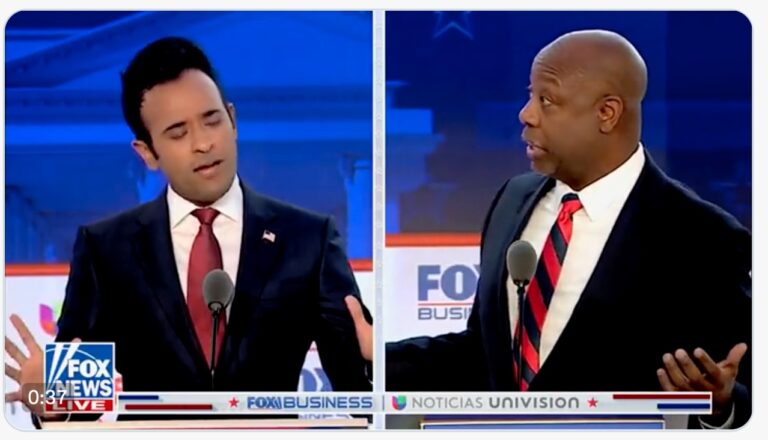
The Republican National Committee announced that five Republican candidates met the qualifications to be on the debate stage on Wednesday in Miami. They are:
– Florida Gov. Ron DeSantis
– Former U.N. Ambassador Nikki Haley
– Entrepreneur Vivek Ramaswamy
– Former New Jersey Gov. Chris Christie
– South Carolina Sen. Tim Scott
This third debate, to be moderated by Lester Holt and Kristen Welker of NBC, and Salem Radio Network’s Hugh Hewitt, starts at 4 pm Alaska Standard Time.
To meet the criteria for being included this time, candidates were required by the RNC to exceed a 70,000 unique donor threshold, with at least 200 from 20 different states or territories, and ratcheted up its polling criteria.
North Dakota Gov. Doug Burgum participated in the first two debates, but did not qualify for the third.
Former Vice President Mike Pence recently dropped from contention, and former Arkansas Gov. Asa Hutchinson was included in the first debate stage, but failed to meet the RNC’s tests for the second and third. The other candidates for the Republicans have quietly slipped away; Larry Elder endorsed Donald Trump.
Former President Trump is not planning to attend the debate and is, at this point, the dominant leader among Republican presidential hopefuls in all polling.
The Republican National Committee ignored that, however, and focused on the candidates who are attending:
“We are looking forward to our third debate in Miami, a welcome opportunity for our candidates to showcase our winning conservative agenda to the American people. We are especially honored to be the first political party to partner with a Jewish organization for a debate in our partnership with the Republican Jewish Coalition, and our candidates will reaffirm the Republican Party’s unwavering support of Israel and the Jewish community on the stage Wednesday night,” said RNC Chairwoman Ronna McDaniel.
The debate, with partnership from the Republican Jewish Coalition and Rumble will air at 4 p.m. in Alaska on NBC News and will be livestreamed on Rumble.
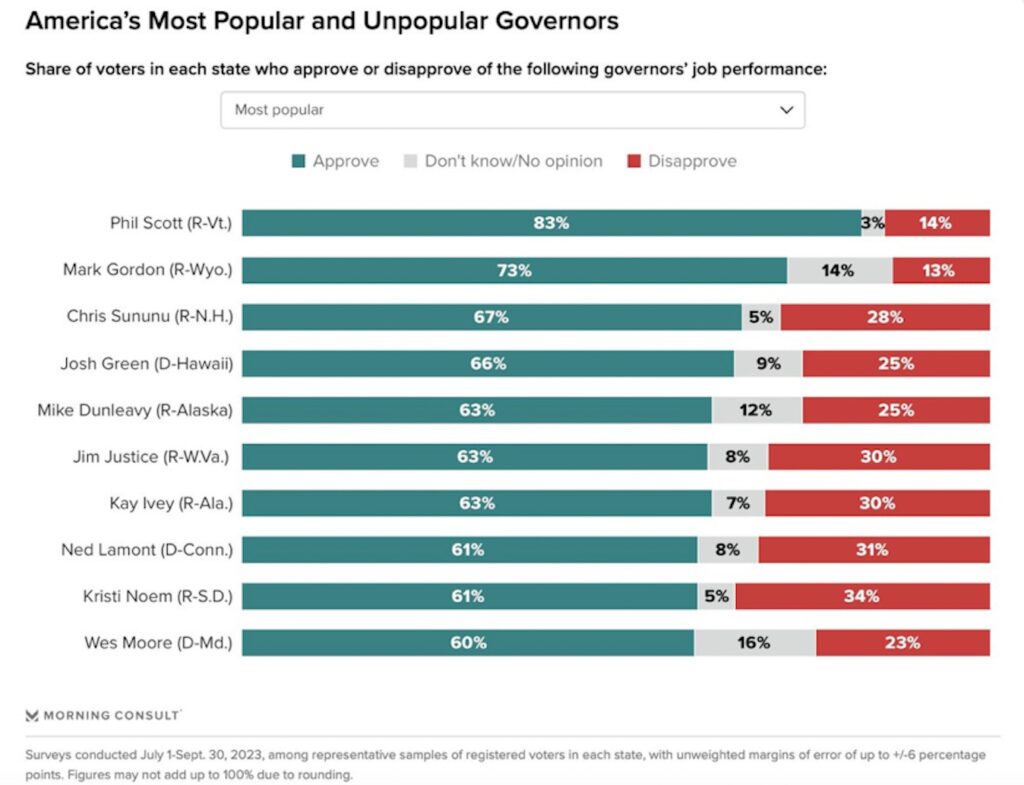
According to the latest Morning Consult poll, Alaska Gov. Mike Dunleavy is the fifth most popular governor. Morning Consult is known for these polls. Over the summer, the poll showed Dunleavy was 10 from the top. Since then, Dunleavy’s popularity has doubled.
Now, Alaska’s governor is even more popular than South Dakota Gov. Kristi Noem.
Gov. Phil Scott of Vermont enjoys the greatest popularity among all 40 governors, and like Scott, seven of the top 10 governors are Republicans. Scott is the nation’s most popular governor for the fourth quarter in a row.
Gov. Mark Gordon of Wyoming, another Republican, has the second spot, followed by Chris Sununu of New Hampshire and Democrat Josh Green of Hawaii.
Dunleavy has a 63% approval rating, with a 25% disapproval rating and 12% who don’t know or won’t say. This is a big change from when he has a 42% approval rating in 2020, after unrelenting attacks by Democrats, including a savage recall campaign against him, which ultimately failed to get enough signatures to make it to the ballot.
The polls are conducted state by state, with only Alaska likely voters answering the approval-disapproval questions about Dunleavy.
Applicants had until Oct. 31 to apply for the vacant seat for House District 40, which covers the farthest north region of the state, from around Kotzebue to Wainwright, Utqiagvik, Prudhoe Bay, and Kaktovik, and dozens of villages in between.
Gov. Mike Dunleavy will appoint the person to finish out the term of Rep. Josiah Patkotak, who was elected mayor of the North Slope Borough in October.
By law, Dunleavy has 30 days to fill the vacancy, which means this week. Patkotak was an undeclared voter, meaning he had no party affiliation. Normally, the parties get involved in recommending a pick to the governor, but this time, it’s all on Dunleavy to decide who best can represent this vast area of the state, now that Mayor Patkotak won’t be returning to Juneau as a member of the House.
Whoever is chosen would have to head to Juneau in January, and then could run for reelection after session is over, typically in May. House members face reelection in 2024.
The applicants who made the deadline are:
Calvin Moto
Eben Hopson
Thomas Baker
Derek B Haviland Lie
John M Monnin
Clay Nordlum
Saima Chase
Davette Rachelle C G E Phillip
Francis Hugo
Judy M. Sellens
Greta Schuerch
Jay Rolf Armstrong
Of those applicants, some may not live in the district, including Davette Phillip, who appears to live in Tuluksak as of Oct. 15, Francis Hugo, who appears to live in Fairbanks as of Oct. 15, and Judy Sellens, who is shown as living in Anchorage.