The Alaska Industrial Development and Export Authority has approved a cost reimbursement agreement to undertake feasibility activities of Alyeschem, LLC, the first petrochemical facility in the Arctic.
Alyeschem is developing a small chemical plant in Prudhoe Bay to make methanol and hydrogen from natural gas, carbon dioxide (CO2). and water. The hydrogen will then be used to remove sulfur from diesel produced on the North Slope so that it can be used in engines.
This will eliminate the cost, risk, and emissions from transporting the two highest-volume imports to the North Slope. Methanol is the simplest chemical made from natural gas, yet it has been imported thousands of miles, daily, for over 40 years.
Alyeschem’s project will reduce CO2 emissions by 93%, or 45,000 tons per year, AIDEA said. It will reduce transportation pollution and enable cleaner and cheaper fuel. By eliminating the long supply chain of importing methanol, the project will also reduce wear and congestion on the Dalton Highway along with environmental impacts.
“AIDEA is excited to begin the process for potential investment in Alyeschem as the project could lead to 150 jobs and be a catalyst for economic growth in the region along with the environmental benefits,” AIDEA said in a press release.
Gov. Mike Dunleavy supports the project, which he said addresses a longstanding need in the state for supplying critical chemicals like methanol and utilizing stranded North Slope natural gas.
“Alyeschem’s strategic location on the North Slope creates a unique opportunity to meet the current demand and contribute to Alaska’s economic growth and create jobs. This project allows us to keep more of the value from our raw materials within the state and aligns with our goal of maximizing the benefits of our resources. Together, we’re harnessing the power of North Slope natural gas to drive prosperity, innovation, and a cleaner, more resilient future for Alaska,” Dunleavy said.
JR Wilcox is the president of Alyeschem. Wilcox has a bachelor’s degree in chemistry and a master’s degree in environmental chemistry from the University of Alaska Fairbanks. He has broad experience in the Alaska oil and gas industry, having worked in roles of increasing responsibility for BP, Forest Oil, and Pacific Energy prior to cofounding Cook Inlet Energy. He served as president of CIE through 2014 when he left to found Aleyschem. He is past national Chairman of the IOGCC’s Safety and Environment Committee and Chairman of the Anchorage Chamber of Commerce and was recognized as one of Alaska’s Top 40 Under 40 in 2012.
Craig Graff is chief operating officer of Alyeschem. He has a a bachelor’s degree in chemical engineering from the University of Wisconsin Madison and is a registered professional engineer in Alaska. He worked for Nalco, providing specialty chemicals for oilfields across Alaska until 2007, and then as an engineering team lead for BP until 2020. His responsibilities extended through the Kuparuk, Milne Point, Northstar, Prudhoe Bay, Endicott, and Badami oilfields as well as providing technical oversight for Alyeska Pipeline. As the manager responsible for the chemical budget at Prudhoe Bay until 2020, he was directly responsible for the largest methanol spend in the Alaska oilfields.
More about Alyeschem and the project details are at the company’s website.
The National Science Foundation released another monthly installment of recordsabout federal policy toward indigenous knowledge, which reveal a desire on the part of some to restrict the free flow of information. The records are found at this link.
Last December, the Biden administration released guidancedesigned to promote the use of indigenous knowledge and beliefs in federal agencies’ decisions, but also to give tribes more control over the public release of their indigenous knowledge.
As the Daily Callerearlier reported, the Biden administration hosted “indigenous knowledge” seminars that warned scientists about “disrespecting spirits.”
In pages 3-4 of the most recent installment of records, a National Science Foundation grant reviewer urges the National Science Foundation to restrict “helicopter science” in which non-Native researchers collect data or knowledge in an area inhabited by natives without native consent, arguing that “The taking of Indigenous knowledge by settler scientists is unethical, antithetical to the mission of the NSF, and cannot and should not happen any longer.”
That NSF reviewer, Michelle LaRue of the University of Canterbury, writes, “I am writing to you as both an NSF grantee (awards #1744989 and #1543311) and also as a reviewer of NSF proposals to request greater oversight of proposal activities and award activities that ultimately result in “helicopter science” – the idea of western scientists traveling to a region, taking information, data, and analysing back in their home countries without including or acknowledging local communities or cultures….
“As you are likely aware, there are substantial efforts worldwide to decolonize science….
“The taking of Indigenous knowledge by settler scientists is unethical, antithetical to the mission of the NSF, and cannot and should not happen any longer. To this end, I am requesting that NSF take action by providing scrutiny to proposals and research activities that involve research on Indigenous lands, involving Indigenous communities, or about Indigenous cultures – in the same way other ethical considerations are made in the proposal process.”
This letter was forwarded by NSF official Karla Heidelberg to other NSF staff for their consideration. If the NSF were to adopt LaRue’s proposal, it could restrict scientific collection of information in the vicinity of indigenous populations, stunting the free flow of information and reducing the stock of knowledge.
This information-restrictive mindset is echoed in a March 4, 2022 “Dear Tribal Leader” letter from the White House, which states, “The Administration recognizes that the Federal Government should engage with ITEK [indigenous traditional ecological knowledge] only through relationships with Tribal Nations and knowledge holders.” (see page 72 of the most recent OSTP release).
It is also echoed in a source cited in a federal guidance document for tribal consultation, which says in in footnote 43 that “For Native American communities, the public release of or access to specialized information or knowledge — gathered with and without informed consent — can cause irreparable harm. . .Each community will understand and use the term ‘culturally sensitive’ differently…” (See page 38 of the most recent OSTPrelease, citing Protocols for Native American Archival Materials). This language is also found in footnote 54 of the Biden administration guidance on the use of indigenous knowledge released in December.
These records were released in response to a Freedom of Information lawsuit. When two federal agencies failed to respond to a Freedom of Information Act request about federal policy on indigenous knowledge, the Bader Family Foundation sued them in federal court, compelling the agencies to produce the records covered by that FOIA request. The two agencies sued — the National Science Foundation and the Office of Science and Technology Policy — began producing those records in monthly installments (such as this record andthis one and this one).
Indigenous knowledge and beliefs can be useful, or they can be quackery or harmful superstition. Examples of harmful traditional beliefs include using cautery as a “remedy” for illnesses. Cautery “involves placing a heated metal object …. on the patient’s skin. The procedure is painful, burning the skin and leaving a permanent scar.” And it doesn’t cure the sick.
Despite the uneven quality of indigenous knowledge, the Guidance for Federal Departments and Agencies on Indigenous Knowledge issued by the Biden administration in December says that “Agencies should also include Indigenous Knowledge as an aspect of best available science,” and that “Indigenous Knowledge … may be used in HISA [Highly Influential Scientific Assessment] documents.”
Some tribal governments haveaskedthe Biden administration to provide federal subsidies for tribal review of federal projects and for access to indigenous knowledge. They have also asked the administration to curb access to information under the Freedom of Information Act. (See this record, for example).
Hans Bader practices law in Washington, D.C. After studying economics and history at the University of Virginia and law at Harvard, he practiced civil-rights, international-trade, and constitutional law. He also once worked in the Education Department. Hans writes for CNSNews.com and has appeared on C-SPAN’s “Washington Journal.” This story first appeared in https://libertyunyielding.com
Alaska State Rep. Jennie Armstrong, an Anchorage Democrat who ran as a pansexual and won to represent urban Anchorage, got off easy in the complaint made against her by citizen activist Jay McDonald, who filed a report with the Alaska Public Offices Commission earlier this year saying that Armstrong had not reported a large debt she owed to election attorney Scott Kendall. McDonald also reported numerous other failings of Armstrong’s legally required filings.
Armstrong has over- and under-reported income and expenditures in various amounts, ranging from $50 to about $2,600. APOC staff investigated McDonald’s allegations and found that each of Armstrong’s reports was inaccurate to some degree, and they were in violation of Alaska Statute. A maximum penalty can be made of between $50 and $500 a day, depending on the violation.
But Armstrong is an inexperienced filer, the commission decided, and therefore, reduced the final penalty by about 99%. The Instead of a $32,392 penalty for five inaccurate reports, the commission let her off the hook with less than $324 in fines.
McDonald had also filed a complaint that Armstrong owed a personal debt of nearly $15,000 to lawyer Scott Kendall, which she did not disclose in her required filings. She had hired Kendall to defend her right to run for office, since her recent arrival in Alaska had brought lawsuits against her due to residency issues.
Armstrong barely made the two-year residency requirement; she convinced the court that she had really moved to Alaska and into the district she represents in time to run for office for District 16, Anchorage.
Ultimately the commission fined her $405 for this violation of nondisclosure because, again, she was “an inexperienced filer.”
But the commission dismissed another allegation that she has a close association with Kendall, even though he was an advocate for ranked choice voting and the preservation of his brainchild, Ballot Measure 2, which established Alaska’s unique voting system.
The total penalties for Armstrong by the commission are $728.92. She may appeal it to the Alaska Superior Court within 30 days or ask the Commission to reconsider it within 15 days.
Pro-Palestinian and anti-Semitic protests in our country are shocking. But it also has been predictable: The same protests have been occurring in Europe for years, as Muslims have increased their presence in European countries as “refugees” from Muslim countries only to become violent within short times and reluctant to assimilate with the host country. European politicians have stood by, watched, and let it continue to happen.
Certainly, rather than learning from the European mistakes, the United States has followed suit and welcomed, indiscriminately, radicalized Muslims to this country, too.
It’s no surprise in today’s political environment that university presidents will defend the rights of Muslims while ignoring those very same rights for Jews and others deemed in the “majority.” Even when hate speech is expressed directly at Jews, “woke” authorities simply turn their heads.
Elite university presidents are afraid to do anything that might subject them to criticism for not being “woke” enough. This is the American society that the progressive and far-left activists have been pushing on Americans for years with their identity politics—draw lines between people; make them feel persecuted and sorry for themselves; and get them to hate each other.
But a real irony is that most Jews in the U.S. have been strong far-left activists for many years; I wonder how long it will take my Juneau Synagogue friends to begin rethinking their blind allegiance to far-left politics and activism.
The other irony is that the people most blind to antisemitism and far-left ideology are the so-called “educated elite.” It’s the working-class people whose common sense screams at them that “this is f….d up.” However, the power in our society resides with the oligarchs and the “educated elite.” The “educated elite”—products of those same universities (e.g., Harvard, University of Pennsylvania, MIT, Cornell) that started “Wokism.”
Politics of the pro-Palestinian activists prioritizing their radical beliefs and values; and it clouds their judgment for human rights and justice. Pro-Palestinian activists also misinterpret and misuse the concepts of apartheid, genocide and occupation in reference to Israel’s governing and political standing.
The apartheid and oppression in South Africa (1948 to 1994) was the racial segregation under the all-white government, which dictated that non-white South Africans (a majority of the population) were required to live in separate areas from whites and use separate public facilities.
Today in Israel, Jews make up the majority at 73% (about 7.145 million individuals). The Arab community, spanning various religions, accounts for 21% or nearly 2 million individuals. They are citizens of Israel with equal rights, political participation, and representation.
Genocide is an internationally recognized crime with the intent to exterminate a national, ethnic, racial, or religious group. Between 1950 and 2023, the Palestinian population in Israel, Gaza and neighboring territories grown from 944,807 people to 5,371,230—an increase of the population by 468.5% in 73 years.
Occupation. The Jewish presence in the Israel-Gaza region is, archaeologically and historically, well documented; it is clearly described in every high school and college world history textbooks. The Land of Israel has changed hands many times over the centuries. But it has been the homeland of the Jewish people for nearly 3,500 years.
Indeed, pro-Palestinian and anti-Semitic rhetoric is a classic example of the confusion that far-leftist politicians, media, and educators has created in our youth. In fact, it is not surprising that many of our youth now proclaiming support for the Palestinians in Gaza, even that the Palestinian Hamas terrorists committed atrocious crimes against Israel.
Many rational and peace-seeking Americans are outraged by the Gaza (via Hamas) atrocious attack on Israel on Oct. 7, killing, mutilating, and kidnapping nearly 1,500 individuals in Israel. It is inconceivable how anyone can find moral equivalence between the two sides in the present conflict between Israel and Gaza/Hamas. What Hamas terrorists did was savage, primitive, and far beyond any justification.
World-wide antisemitism, triggered by Israel/Hamas-Gaza war, is a direct result of the far-left ideology that is prevalent today in the West. Progressive and far-left activists attempting to create an ignorant, self-important generation of youth with a corrupt moral compass. Pro-Palestinian activism is a product of the far-left ideology (i.e., white privilege doctrine, critical race theory, systemic racism, transgenderism).
Clearly, school administrators and teachers unions turn the public schools in America into the “Blue Cities” with the far-left “woke” ideology.
Alexander B. Dolitsky was born and raised in Kiev in the former Soviet Union. He received an M.A. in history from Kiev Pedagogical Institute, Ukraine, in 1976; an M.A. in anthropology and archaeology from Brown University in 1983; and was enroled in the Ph.D. program in Anthropology at Bryn Mawr College from 1983 to 1985, where he was also a lecturer in the Russian Center. In the U.S.S.R., he was a social studies teacher for three years, and an archaeologist for five years for the Ukranian Academy of Sciences. In 1978, he settled in the United States. Dolitsky visited Alaska for the first time in 1981, while conducting field research for graduate school at Brown. He lived first in Sitka in 1985 and then settled in Juneau in 1986. From 1985 to 1987, he was a U.S. Forest Service archaeologist and social scientist. He was an Adjunct Assistant Professor of Russian Studies at the University of Alaska Southeast from 1985 to 1999; Social Studies Instructor at the Alyeska Central School, Alaska Department of Education from 1988 to 2006; and has been the Director of the Alaska-Siberia Research Center (see www.aksrc.homestead.com) from 1990 to present. He has conducted about 30 field studies in various areas of the former Soviet Union (including Siberia), Central Asia, South America, Eastern Europe and the United States (including Alaska). Dolitsky has been a lecturer on the World Discoverer, Spirit of Oceanus, andClipper Odyssey vessels in the Arctic and sub-Arctic regions. He was the Project Manager for the WWII Alaska-Siberia Lend Lease Memorial, which was erected in Fairbanks in 2006. He has published extensively in the fields of anthropology, history, archaeology, and ethnography. His more recent publications include Fairy Tales and Myths of the Bering Strait Chukchi, Ancient Tales of Kamchatka; Tales and Legends of the Yupik Eskimos of Siberia; Old Russia in Modern America: Russian Old Believers in Alaska; Allies in Wartime: The Alaska-Siberia Airway During WWII; Spirit of the Siberian Tiger: Folktales of the Russian Far East; Living Wisdom of the Far North: Tales and Legends from Chukotka and Alaska; Pipeline to Russia; The Alaska-Siberia Air Route in WWII; and Old Russia in Modern America: Living Traditions of the Russian Old Believers; Ancient Tales of Chukotka, and Ancient Tales of Kamchatka.
I served eight years in the House of Representatives and had the privilege to serve with Speaker Ramona Barnes. Ramona was tough, and even though I beat her right-hand guy Ron Larson (which caused Ramona to lose her speakership), she was not vindictive.
In fact, we became good friends and strategic partners. Her most used quote was, “Your word is your bond.” She reminded all that one’s word is the only thing one has when serving in the Capitol. Once the election was over and leadership positions were decided, the Caucus rolled up their sleeves and got to work. Gail Phillips was my first Speaker.
Republicans hold a slim House majority after sitting out four years on the bench in the minority. The alignment that holds the House Majority organization together should be the fact that Alaskans elect more Republicans in both bodies.
With the Senate going over to “the dark side,” it is more important than ever for the House to hang together, or face being hung separate (metaphorically speaking). If both bodies are controlled by the Left, the paradigm will shift with policy in Alaska and have a profound effect on the state’s future. My next article will outline the significant legislative differences between the key members of the Left and Right in both bodies. It will show that Alaska is standing at a major policy intersection, also-known-as “the fork in the road.”
The Democratic agenda is morphing further to the left fork, exemplified by the recently proposed shift to becoming openly hostile toward any hydrocarbon energy production in Alaska. In the past, the Legislature voted unanimously in favor of a number of resolutions regarding the opening of ANWR. Additionally, with the paradigm shift of state funding now coming from your Permanent Fund dividend, the moderate Left must feel empowered to go ahead and throw the oil industry under the bus.
The right fork, is one of Alaskan energy security. Our climate does not allow us much room to be hugging too many trees. If we do not have hydrocarbons for heat and electricity, we will be cutting down a lot of them to keep warm.
That is exactly what is happening in Europe right now! Oh wait, but trees scrub carbon, right? Name your issue and then look at what Anchorage is becoming: A mini Portland, Seattle or San Francisco. Is the rest of Alaska destined to become more Californicated?
House members to watch:
Republican Speaker Cathy Tilton, R-Wasilla. The chief cat herder has her hands full keeping 21 people happy daily (Rule 21). She presides over a razor-thin majority with the Rep. Bryce Edgmon-led Bush Caucus in complete control of House Finance under the watchful eye of master dealmaker, Sen. Lyman Hoffman, D-Bethel.
During the last election cycle, there was substantial House turnover with many new members who are just now learning how “sausage is made” and have yet to understand “the law of unintended consequences.” Tilton succeeded Speaker Louise Stutes, R-Kodiak. One presiding officer from Kodiak at a time, please.
Rep. Thomas Baker, R-Kotzebue. The purported pro-full PFD successor to Rep. Josiah Patkotak will soon be given committee assignments. Watch for Committee on Committee notices. Patkotak was more conservative than some Republicans and many observers were disappointed when he aligned with the Democrats when first elected. Given that Rep. Patkotak was an “Independent,” Gov. Mike Dunleavy was not obligated to appoint a Democrat to replace him. The majority caucus decides how the power deck will be shuffled; will there be a shake up? Welcome to the fray, Rep. Baker. Remember the other Ramona Barnes saying, “When someone is patting you on the back, they are looking for a soft spot that is vulnerable.”
Rep. Sarah Vance, R-Homer is a rising star in the Republican Caucus; she is intelligent, tough, and principled. After spending four years knowing what it’s like to be in the minority, she has landed the chair of the House Judiciary Committee. Her committee has a lot of hot button issues in it. Thus, she holds a lot of power cards in her hand. Vance’s election reform and Sen. Matt Claman’s involuntary commitment bill are two of them, and it will be interesting to see how deftly she plays those other cards. Can she break the Senate gridlock in a body where age and treachery rules? She was smart enough to beat longtime Homer Rep. Paul Seaton. Don’t underestimate her.
Rep. Calvin Schrage, U-Anchorage, is the Democratic Minority Leader. A relatively new player, Schrage is a “Undeclared” who heads up the Democratic minority in the House. He’s what I would call a “smooth operator” and about as “Independent” as Sen. Cathy Giessel and Rep. Louise Stutes are Republican. Watch what he does, not what he says. Conservatives should be glad he’s sitting out these innings on the bench.
Rep. George Rauscher, R-Sutton. One of the senior House members, Rauscher carries an extensive legislative agenda. His experience and calm demeanor should make him a legislative hard hitter in the House. The Democrat-controlled Senate is where his bills will live or die.
Rep. Ben Carpenter, R Kenai, landed the chair of the Legislative Budget and Audit Committee. He’s a proponent of being one of the adults in the room by advocating for a sustainable fiscal policy. The plan that Shower, Carpenter, and some reasonable Democratic counterparts worked on does not have a heartbeat with the fund-big-government, “Three Amigos PFD raid plan.” He is challenging freshman Sen. Jesse Bjorkman, R-Kenai, who teamed up with fellow union-backed Sen. Kelly Merrick, R-Eagle River, to join the Democrat-dominated Senate Majority and make sure public labor contracts are fully funded by your family’s mini Permanent Fund dividends. Carpenter is a solid guy, a former Army officer with real-time battle-hardened combat leadership experience. Bjorkman should be nervous.
Rep. David Eastman, R-Wasilla, is a West Point graduate. David survived a court challenge about his Oath Keepers affiliation thanks to his lawyer, Joe Miller. David is a perpetual loner and a caucus of one. He marches to the beat of a different drum and his philosophical opposite, Rep. Andrew Gray, D-Anchorage, also serves on Vance’s Judiciary Committee. Get out the popcorn when you watch House Judiciary on “Gavel Alaska” with these two wild cards. Spice up the popcorn with fiery Rep. Jamie Allard, R-Eagle River, as vice chair. It’s a good thing Chair Vance has experience homeschooling her children back in the district.
Scott Ogan is a former House lawmaker who served from 1995 to 2004, and Senate lawmaker who served in 2003-2004. He is a legislative analyst for Must Read Alaska.
A one-credit course titled “Why Pronouns Matter” is seeking students for spring semester in Anchorage. The flyer from University of Alaska Anchorage says that the class “Only meets 1 day per week!” and is for people who are “LGBTQIA2S+” or their allies, or for all “who want to know themselves better.”
According to the campus publication “Green and Gold News,” the cutoff for enrollment is Dec. 15, and the instructors need 10 students or they can’t offer the class.
“We need you, this class needs you, and this movement needs you,” the campus publication says. “A 1-credit course also sometimes helps students get over minimum credit requirements, such as needing 9-credits to live in on-campus housing or being full-time at 12-credits to receive full financial aid opportunities.”
In the “Why Pronouns Matter” class the focus “will be on exploring and deepening our understandings of why respectful language matters, which will indeed include discussions of pronoun use, but that is the mere surface level of where we endeavor to go. Through this focal point on identity exploration, we’ll come to better understand our own positionality in the cycle of oppression, and come away with tangible ways we all can be more present in the cultivation of collective liberation. While this course is only 1-credit, it will be a substantial contribution to your personal and professional development. You’ll gain knowledge and skills that employers need on their teams, but you’ll also feel better at connecting with others and more grounded in your own truths.”
Gendered pronouns include she and he, her and him, hers and his, and herself and himself. “Personal preference gender pronouns” (or PGPs) are words that people ask others to use in reference to themselves. Typically, they butcher the English language in the process, and may be plural gender-neutral pronouns such as they, them, their(s), referring to a single human.
Without 10 students in the course, the instructors can’t get paid for cultivating the “movement” of “collective liberation” and “positionality.”
University of Alaska is a publicly funded university with open-access enrollment, meaning that anyone may attend, regardless of academic ability. The university system often promotes a narrative that state budget cuts lead to reduction in essential academic programs.
In 2021, Florida and Texas enacted laws to reduce discrimination against viewpoints on social media platforms. The Texas law was upheld in the Fifth Circuit, whereas the Florida law, sponsored by Gov. Ron DeSantis, was struck down in the Eleventh Circuit.
The Florida law punishing Facebook and Twitter-type social media sites for throttling conservative speech was an unconstitutional violation of the First Amendment, the Eleventh Circuit Court ruled.
“Put simply, with minor exceptions, the government can’t tell a private person or entity what to say or how to say it,” said Circuit Judge Kevin Newsom, writing the opinion on the Florida case. “We hold that it is substantially likely that social media companies — even the biggest ones — are private actors whose rights the First Amendment protects.” Newsom is a Trump appointee.
The U.S Supreme Court has agreed to review both the Florida and Texas cases. At issue is whether the First Amendment prohibits the States from restricting social media firms from engaging in editorial choices about whether, and how, to publish, and disseminate speech.
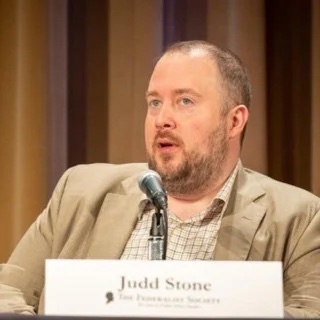
The Alaska Lawyers Chapter of the Federalist Society will host former Texas Solicitor General Judd Stone in discussing the two cases. Stone, who has argued eight cases in front of the US Supreme Court, successfully defended the Texas law (HB20) before the Fifth Circuit and has briefed the US Supreme Court.
Stone will share his analysis about issues arising from social media content moderation and how the Supreme Court might decide the cases.
Before joining the Texas Solicitor General’s Office in 2020, Stone was Chief Counsel for Sen. Ted Cruz, and previously practiced at Morgan, Lewis, and Bockius in their Supreme Court and Appellate Practice Group in Washington. D.C., and at Kellogg, Hansen, Todd, Figel & Frederick. He also served as an Olin-Searle-Smith fellow at Harvard Law School.
Stone began his legal career as a law clerk to conservative Justice Antonin Scalia on the U.S. Supreme Court, to then-Chief Judge Edith Jones on the U.S. Court of Appeals for the Fifth Circuit.
He also clerked for Justice Daniel Winfree at the Alaska Supreme Court. Stone received his law degree from Northwestern University and his undergraduate degree from the University of Texas, Dallas. He is the founder of Stone, Hilton PLLC.
Thursday’s luncheon meeting begins at noon at the Petroleum Club of Anchorage, 3301 C. Street, Anchorage, AK 99503. Members pay $10, and nonmembers pay $20, which includes lunch. Register at this link.
The Supreme Court has refused to take up a challenge to a state law in Washington, which is similar to an Anchorage ordinance that prohibits therapists from using any form of so-called “conversion therapy” with their minor-aged clients.
Three of the more conservative justices dissented from the decision to leave the matter in the hands of Washington State, which has Senate Bill 5722, prohibiting counseling a minor about the hazards or realities of alternate sexual identities or sexual activities that may bring harm.
Brian Tingley, a marriage and family counselor, went to court in 2021 to challenge the 2018 law, saying it violates his First Amendment rights because it curtails his ability to speak freely to young people about issues relating to gender identity or sexual attraction to the same sex.
In 2020, the Anchorage Assemblypassed a similar measure. In Anchorage, it’s only lawful to encourage, assist, medicate, and surgically alter youth in order to meet their wishes to become something they are not.
Any licensed therapist in Anchorage who discourages transgenderism or warns of its risks can be charged; violating the ordinance subjects a counselor to a $500 fine per instance.
Anchorage’s ordinance was passed with the guidance of a nonprofit that specializes in grooming children into sexual identities of various sorts — the Trevor Project, a controversial organization founded by Sam Brinton, the former Biden White House Energy Department appointee who has been charged with stealing women’s luggage.
Justices Clarence Thomas and Samuel Alito wrote dissents from the court’s denial of review.
Thomas said government officials cannot dictate “what shall be orthodox in politics, nationalism, religion, or other matters of opinion or force citizens to confess by word or act their faith therein.”
Washington’s law says “licensed counselors cannot voice anything other than the state-approved opinion on minors with gender dysphoria without facing punishment,” Thomas wrote, adding that he had no doubt that the basic issue of the free speech of counselors would “come before the court again,” and “When it does, the Court should do what it should have done here: grant certiorari to consider what the First Amendment requires.”
Justice Alito wrote that it is “beyond dispute that these laws restrict speech, and all restrictions on speech merit careful scrutiny.”
Justice Brett Kavanaugh noted that he, too, would have granted Tingley’s petition.
Alliance Defending Freedom took up the case on behalf of Tingley, a licensed counselor who has been practicing in Washington State for more than 20 years.
“During that time, he has talked with adults, couples, teenagers, and children to help them identify and achieve the goals that they set for themselves, consistent with their own moral values and religious beliefs. Under Brian’s guidance, his clients have pursued meaningful and positive changes in their lives. But now, Brian’s practice is in jeopardy,” the Alliance said.
“In 2018, Washington passed a law censoring private conversations between counselors and their clients. The law stipulates that if a client wanted to undergo a gender transition, the counselor and client can speak about anything. But if a client wanted to become more comfortable with her biological sex or talk through the emotionally and medically difficult process of de-transitioning, counselors like Brian would be prohibited from having those conversations. Simply by working with clients to achieve the goals they set for themselves, Brian faces fines of up to $5,000 per violation, suspension from practice, and losing his license and livelihood,” Alliance Defending Freedom said.
“But the government doesn’t get to regulate counselors’ speech. This law is a clear violation of both freedom of speech and religious freedom, in a very private setting. That’s why ADF filed a lawsuit on Brian’s behalf challenging Washington State’s unconstitutional law,” the group said.
Evidently, in America in 2023, the government does indeed get to regulate counselors’ speech, however, when it comes to transgenderism and same-sex activity for youth.
Congresswoman Mary Peltola is on a list of more than 30 Democrats in Congress who accepted money from socialist-leaning colleagues Rep. Pramila Jayapal of Seattle and Rep. Alexandria Ocasio-Cortez of New York, who have defended Hamas and who voted against condemning Hamas’ brutal rape and murder of innocent Israelis during their Oct. 7 terrorist raid.
According to a Fox News Digital review of federal filings, Peltola accepted $11,000 from the anti-Israel Democrats, including $6,000 from Rep. Jayapal’s “Build Our Movement” political action committee and $5,000 from Ocasio-Cortez’s “Courage to Change” PAC. Both contributions are for the 2024 election year cycle.
The attack by Hamas on Israel resulted in 1,200 dead that day and hundreds taken hostage. But on CNN, Rep. Jayapal said that people should be “balanced about bringing in the outrages against Palestinians” when she was asked why liberals remained silent over the Hamas terrorists using rape as a weapon of war.
The candidate who received the most money from the far-left progressives who refused to condemn Hamas is Rep. Susan Wild, D-Pa., who hauled over $47,000 from the campaigns of PACs controlled by anti-Israel Democrats.
Rep. Matt Cartwright, D-Pa., received the second-most from The Squad leftists — $25,000 from Jayapal and Ocasio-Cortez’s leadership PACs in the 2022 and 2024 election cycles, with most of that cash ($20,000) coming from Jayapal’s Medicare for All committee, according to Fox News.
“The third-highest money hauler from the anti-Israel Democrats is Rep. Lauren Underwood, D-Ill. Between 2018 and 2022, Underwood took in $23,000 from committees tied to Garcia, Jayapal, Carson, Ocasio-Cortez and Omar, with each of her donations ranging between $1,000 and $7,000,” Fox News wrote.
Ben Petersen of the National Republican Congressional Committee said Rep. Peltola accepted “blood money” and should return it.
“Mary Peltola needs to answer for why she took so much money from anti-Israel Democrats who can’t even bring themselves to condemn a terrorist attack in which 1,200 people were murdered,” Petersen said. “She needs to immediately return the blood money.”