Home Blog Page 520

Over shouting of communists, Anchorage Assembly passes resolution for peace between Israel and a more clearly defined terrorist government

Anchorage Assembly member Karen Bronga was shocked. She said thought that her original resolution calling on the Alaska delegation in Washington D.C. to work cease fire resolution would pass the Assembly unanimously last month. She didn’t think it was controversial. Instead, the majority took a pass and put it in the “postpone indefinitely” basket.

Undeterred, Bronga and other Assembly members — Felix Rivera and George Martinez — brought the resolution back, with some changes. This time it passed 8-4.

Bronga said she had spent time listening to the Jewish community, which was worried about safety, the same thing the Palestinians living in Alaska are worried about. She said she heard about the need to be clear that Hamas is a terrorist organization. “At this point, a cease fire needs to happen. This has to stop,” she said.

Rather than postpone indefinitely, the Assembly was ready to debate and vote on the resolution. While members of the pro-terrorist group Party for Liberation and Socialism, a communist group, yelled at the Assembly from the audience on Tuesday evening, Assembly members expressed their points of discomfort about the resolution.

Assemblyman Daniel Volland said that he was disappointed in the audience members who were clambering for no changes to the original ordinance, and holding up signs that said, “No S Version.” He said the amended version calls for a lasting peace and bilateral cease fire, and the ability to deliver aid. “It also has a ‘whereas’ that says both Jewish and Palestinians have ties to the region and both have been subjected to colonization and oppression.” He also referred to a previous Assembly resolution “that condemned political violence and extremism of all forms.”

Assemblyman Rivera said he opposed changing the original resolution and said this is an instance where “saying a little bit less is actually better. It [the amendment] goes too far for me.” He then said that while he was at a drag show over the weekend, the topic of Gaza was what everyone wanted to talk with him about. He also called it a “sanctity of human life” issue.

Assemblywoman Meg Zaletel said that she spends all of her time working to understand local issues, like the removal of the Eklutna dam and the need for funding for the Port of Alaska. She said that the Gaza situation is out of her lane and she doesn’t feel comfortable weighing in. There are humanitarian crises all over the world, she added, and the Assembly doesn’t insert itself into them.

Assembly Kevin Cross was a hard no. In Anchorage, “our house is on fire, we’re choking on our own smoke, and we’re virtue signaling. There have never been people showing up for anything — rapes and murders … there’s pain in our own streets being ignored while we arrogantly tell people across the globe what they should do.”

Assembly Chairman Chris Constant had to call for the room to come back to order several times as the pro-Hamas crowd shouted their disapproval.

They were angry that the final draft of the resolution acknowledged Israel’s right to exist and defend itself and that Hamas is a known terrorist organization, acknowledged as such by the United Nations.

At the end of the meeting, during public testimony, the pro-Hamas Party for Socialism and Liberation lined up to state their objections to the softened resolution, accusing some members of the Assembly of being condescending. Michael Patterson, one of the leaders of the PSL, said that members of the Assembly had defamed the group and lied about the group’s enthusiastic and joyful response to the killing of a Jewish man who was holding a sign in Los Angeles at a pro-Israel rally, only to be hit in the head by a Palestinian terrorism supporter.


Alex Gimarc: REAP has infiltrated the Chugach Electric Association board. What could possibly go wrong?

By ALEX GIMARC

This is an update on the Renewable Energy Alaska Project (REAP) attempt to access individual energy use data for Chugach Electric Association and Enstar Natural Gas Co. customers. 

REAP’s excuse for making the request was to “assist” both Chugach and Enstar by constructing new rate structures to “encourage” an unwilling and uninterested public to transition to renewable energy.  Must Read Alaska ran a story from the Washington Free Beacon on this Feb 29.

REAP made their request to the Regulatory Commission of Alaska Dec. 18, 2023 and Jan. 29, 2024. The filing was in response to a pair of ongoing tariff revision dockets (cases) before the RCA (U-23-047 and U-23-048) initially filed July 3, 2023. 

The RCA slapped down REAP’s request on Feb 26, 2024, denying their motion to compel Chugach and Enstar to provide customer data. The rate case continues before the RCA. Both orders are embedded in this piece.

This has been quite a rate case. All Railbelt electrical co-ops are involved, as is Enstar. The State of Alaska Department of Law and the feds are involved. Other entities include UAA, AARP Alaska, Ethan Schutt (CIRI?), JL Properties, and at least two renewable energy non-governmental organizations.

This takes us to a discussion about conflict of interest. Rate cases are expensive, costing the utilities tens to hundreds of thousands of dollars to pursue / defend.  Any other entity entering the fray costs the utility, and in turn the utility customers, more money.  REAP’s participation cost someone, perhaps many someones an unspecified amount of additional time and money.  

If you look at their website, REAP owns at least one Chugach Board member, Jim Nordlund, who is also on REAP’s Board of Directors.  I was told Nordlund resigned as REAP Chairman sometime in mid-February. REAP lists Nordlund as an individual at-large constituency member and ex-officio member of the executive committee.

It could be worse, I suppose, as REAP lists Matanuska Electric Association, Alaska Village Electric Cooperative and Kotzebue Electric Association as Board members under “Utility Constituency.”

The immediate question that comes to mind is: When did Nordlund know REAP was going to intervene in the ongoing rate case? How far before Dec. 28, 2023, did he know about it? Most importantly, when did he tell his fellow Chugach Board members that an organization in which he held a leadership position was going to intervene in the ongoing rate case and demand private customer information?

I asked the Chugach Board these questions via e-mail on Feb. 29.  Have not heard back from them as yet.  Somehow don’t think I will.  

How will the Chugach Board handle this and future conflicts of interest? What do they plan to do the next time an outside group asks for customer data they are not entitled to? Better yet, why did the Board fail to notify Chugach members (customers) REAP made this attempt?  

Given the active involvement of REAP in recent Chugach Board elections (they endorsed three candidates last year), it is only a matter of time before they hold a majority on the Board. 

Once they do so, they control the Chugach Electric Association, as the Board hires and fires the CEO. Next time around, Chugach may not be so reluctant to provide private information to a group of committed greens for their political purposes. 

Maybe it is time for the governor and Legislature to consider shutting this little game down before they do some real damage to reliable energy in the Railbelt.  

Alex Gimarc lives in Anchorage since retiring from the military in 1997. His interests include science and technology, environment, energy, economics, military affairs, fishing and disabilities policies. His weekly column “Interesting Items” is a summary of news stories with substantive Alaska-themed topics. He was a small business owner and Information Technology professional.

Reactions: Haley drops, Biden welcomes her voters, and Alaska was top Trump state on Super Tuesday

Donald Trump’s win in Alaska’s GOP Presidential Preference Poll on Tuesday invigorated his supporters and infuriated his detractors.

Alaska Republicans had the most impressive result in the nation for Donald Trump on Tuesday, with 89% of those participating voting for him. That makes Alaska the top state for Trump among the 15 that participated in Super Tuesday.

Only Nevada, which held its Republican caucus on Feb. 19, has posted a higher percentage of support for Trump, at 99%. In the Nevada state-run primary, which does not count toward delegates, Nikki Haley had brought in 30% of the vote, while 63% voted for “none of these.” Trump was not on the official ballot in Nevada.

On Super Tuesday, Alabama followed Alaska with 83% voting for Trump in that state’s primary, where nearly 600,000 people took part. Oklahoma came in at 82%.

Kelly Tshibaka, Alaska director for the Trump campaign, gave credit to Alaskans for taking part in the democratic process:

“I want to express many thanks to those who came to vote and the many faithful volunteers that served at the polls. Republicans across the U.S. have shown overwhelming support for President Trump, and Alaska is no exception. I’m confident President Trump will continue to ride this wave of momentum to victory this November,” Tshibaka said.

Haley suspended her campaign on Wednesday morning in her home state of South Carolina but did not endorse Trump, an indication that she may work against a GOP victory in November.

“It is now up to Donald Trump to earn the votes of those in our party and beyond it who did not support him,” Haley said. “And I hope he does that. At its best, politics is about bringing people into your cause, not turning them away.” 

President Joe Biden welcomed her supporters, saying, “Donald Trump made it clear he doesn’t want Nikki Haley’s supporters. I want to be clear: There is a place for them in my campaign.”

On Tuesday night, Biden had a dark vision of the future under Trump: “Are we going to keep moving forward or will we allow Donald Trump to drag us backwards into the chaos, division, and darkness that defined his term in office? If Donald Trump returns to the White House, all of this progress is at risk. He is driven by grievance and grift.”

Alaska Gov. Mike Dunleavy, who supports Trump, had Alaska’s future on his mind: ““Alaskans are smart — they saw how well Alaska was treated by the Trump administration, and they’ve seen how our state is being treated by the Biden administration. I commend everyone for taking part to help make a change for Alaska. Regardless of who your choice was on Super Tuesday, thank you for being part of history in our great state. And thank you to all the volunteers who were so helpful to everyone who came through the doors of the presidential preference poll.”

The Republican National Committee congratulated Trump: “Congratulations to President Trump – the presumptive Republican nominee for President of the United States!”

Sen. Mitch McConnell, Senate Minority Leader, endorsed Trump on Wednesday morning, saying, “It is abundantly clear that former President Trump has earned the requisite support of Republican voters to be our nominee for President of the United States. It should come as no surprise that, as nominee, he will have my support.”

McConnell said he and Trump had worked well together, and “I look forward to the opportunity of switching from playing defense against the terrible policies the Biden administration has pursued to a sustained offense geared towards making a real difference in improving the lives of the American people.”

View our extensive coverage of Alaska’s Super Tuesday events at this link:

Marjorie Taylor Greene of Georgia, said Haley should support Trump as the presumptive nominee in this spicy interview, in which she told a BBC reporter to “f*** off” after the reporter called Trump supporters “conspiracy theorists” and asked her, “Why don’t you tell us about Jewish space lasers.” Watch here:

Super big results roll in for Super Tuesday: Live blogging, with Trump in nearly clean sweep

9:20 p.m. update: Alaska results are coming in.

In Alaska the total is Trump with 89% at 9,243, Haley 1,226, Ramaswamy 45

Ketchikan District 1: Trump 308, Haley 33, Ramaswamy 2

Sitka District 2: Trump 2

Juneau District 3: Trump 176, Haley 33

Juneau District 4: Trump 133, Haley 24

Juneau votes from out of district: Trump 32, Haley 18

Kodiak District 5: Trump 2

Homer District 6: Trump 229, Haley 12, Ramaswamy 1

Kasilof District 6: Trump 222, Haley 12

Kenai District 7: Trump 188, Haley 17, Ramaswamy 1

Soldotna District 7: Trump 428, Haley 32, Ramaswamy 1

Note: Soldotna’s 427 actually included 162 D8 voters

Sterling District 8: Trump 402, Haley 24, Ramaswamy 1

Nikiski District 8: Trump 685, Haley 44

Anchorage District 9: Trump 408, Haley 112, Ramaswamy 6

Anchorage District 10: Trump 192, Haley 48, Ramaswamy 1

Anchorage District 11: Trump 349, Haley 78, Ramaswamy 4

Anchorage District 12: Trump 193, Haley 31, Ramaswamy 3

Anchorage District 13: Trump 149, Haley 23

Anchorage District 14: Trump 101, Haley 23

Anchorage District 15: Trump 274, Haley 58, Ramaswamy 1

Anchorage District 16: Trump 230, Haley 62, Ramaswamy 1

Anchorage District 17: Trump 77, Haley 25, Ramaswamy 3

Anchorage District 18: Trump 33, Haley 25, Ramaswamy 3

Anchorage District 19: Trump 9, Haley 1

Anchorage District 20: Trump 166, Haley 17

Anchorage District 21: Trump 275, Haley 58

Anchorage District 22: Trump 127, Haley 19

Eagle River District 23: Trump 432, Haley 89, Ramaswamy 4

Eagle River District 24: Trump 434, Haley 69, Ramaswamy 2

Palmer District 25: Trump 539, Haley 42, Ramaswamy 3

Wasilla District 26: Trump 390, Haley 12, Ramaswamy 2

Wasilla District 27: Trump 389, Haley 18, Ramaswamy 2

Palmer/Wasilla District 28: Trump 382, Haley 14

Valdez/Wasilla District 29: Trump 344, Haley 31, Ramaswamy 1

Wasilla District 30: Trump 201, Haley 5

Out of Fairbanks, these unofficial results:

District 31: Trump 216, Haley 58, Ramaswamy 1

District 32: Trump 164, Haley 18

Fairbanks District 33: Trump 331, Haley 29

District 34: Trump 313, Haley 48, Ramaswamy 1

District 35: Trump 252, Haley 48, Ramaswamy 1

District 36: Trump 257, Haley 30, Ramaswamy 1

It’s the biggest Election Day for 2024 — until the August primary and November general election. 854 Republican delegates are being decided today.

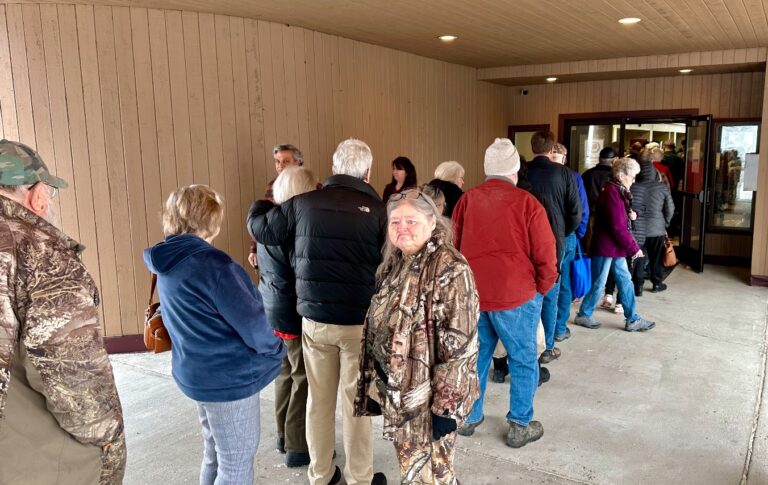
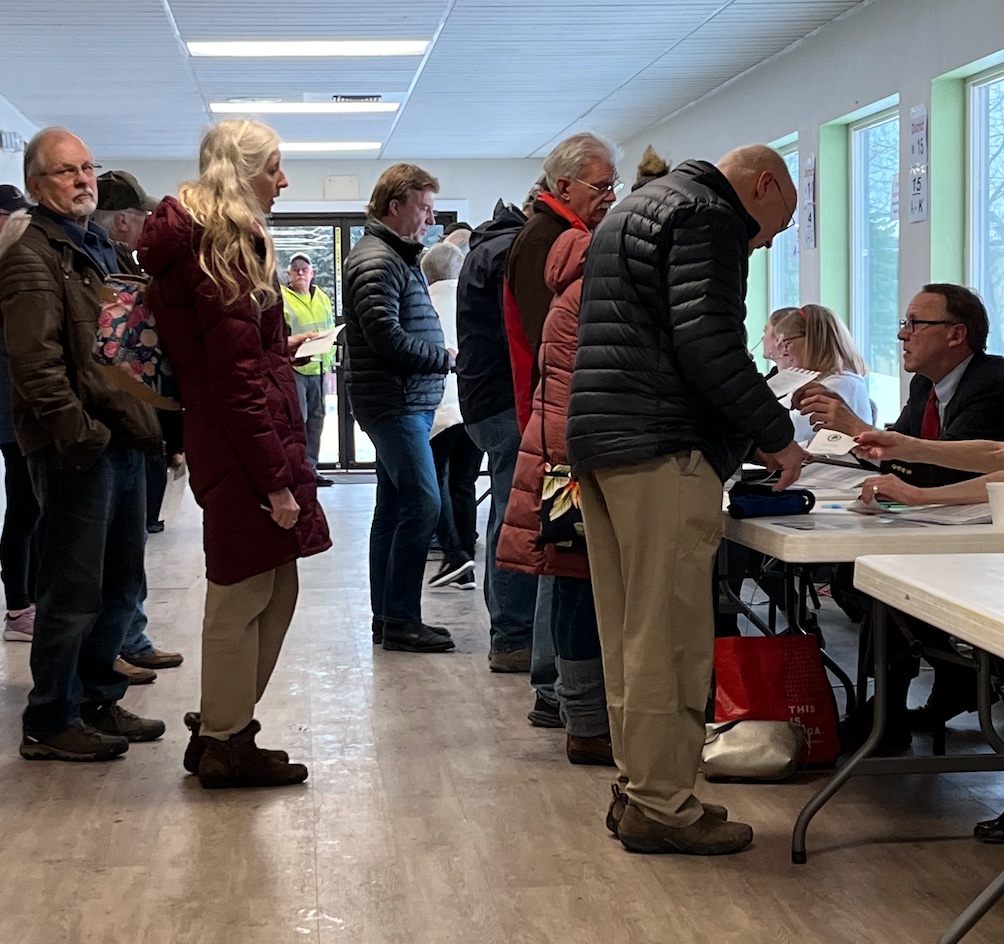
The Presidential Preference Poll for Alaska Republicans have opened and people are lining up to choose their preferred candidates.

We will be updating this story throughout the night, with results from Alaska expected after 8 pm, when the Presidential Preference Poll ends and results are announced by the Alaska Republican Party. National results are being updated continuously below.

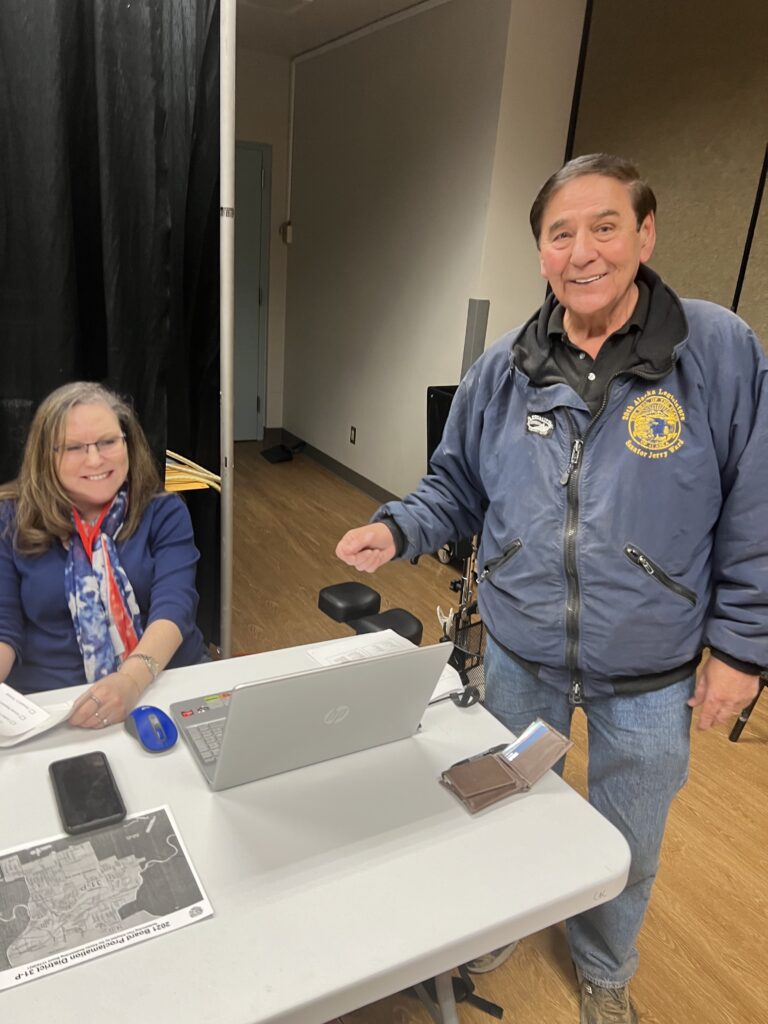
Former Sen. Jerry Ward participated in the Presidential Preference Poll in Fairbanks.

4:50 pm Fairbanks update: Spotted at the Presidential Preference Poll was former Sen. Jerry Ward, who had just finished burying his 92-year-old aunt in Nenana, and was on his way to a memorial moose stew potlatch in her honor. He had to vote out of district due to circumstances.

Check back to get updates as we post them below, as they come in from Alaska and around the country.

At Grace Christian Presidential Preference Poll at 4 pm on Super Tuesday in Anchorage, Carmela Warfield helps out a participant.

4 p.m. Grace Christian update: 20 minute line of cars to get into the parking lot. High turnout. Takes 10 minutes to go through the process. Spotted At Grace Christian, three candidates for Alaska Republican Party chair — Mike Robbins, Carmela Warfield, Nikki Rose.Also spotted: Retiring Party Chair Ann Brown, Power The Future Alaska Director Rick Whitbeck, activists Portia Noble, Jamie Donley.

Soldotna Republicans take part in the Presidential Preference Poll on Super Tuesday.

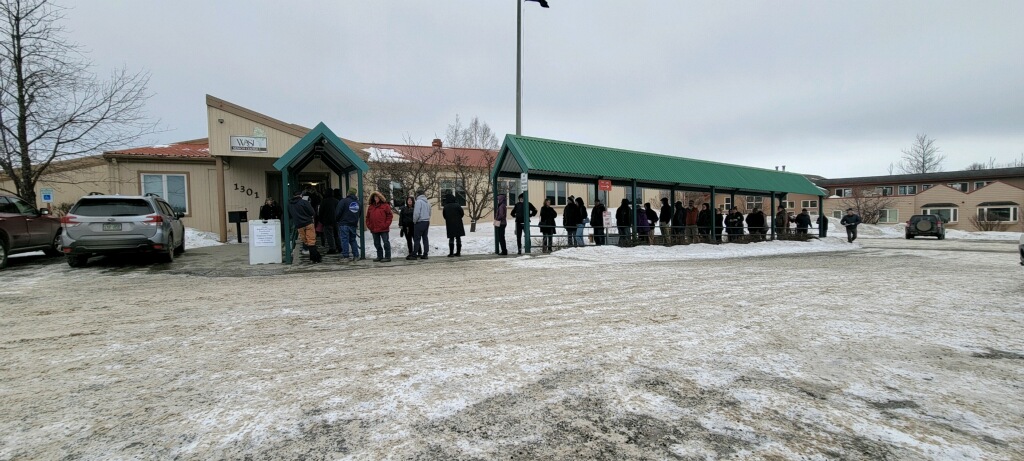
5 p.m. Wasilla update: The line stretches 40 people deep just to get in the door at the Wasilla Senior Center at 1301 South Century Circle. The wind is whipping but enthusiasm is high.

Line stretches out the door in Fairbanks for the Presidential Preference Poll on Super Tuesday.

5:20 pm Fairbanks update: By 3:15 p.m. there was a line from the Carlson Center door all the way outside to the curb. Once inside, one participant reported “many familiar faces and conversations, it was a wonderful crowd, dozens of volunteers. IMO the crowd was energized and enthusiastic. Delighted to have the chance to be participating.”

Volunteers Liz Vazquez and Randy Ruedrich Jr. at the Jewel Lake Church of the Nazarene voting location for the Presidential Preference Poll in Anchorage.

The winning candidate needs 1,215 delegates of a possible 2,429 to become the Republican nominee. Donald Trump goes into Super Tuesday with 273, while Haley has accumulated 43.

Republicans line up at Church of the Nazarene to take part in the Presidential Preference Poll on Super Tuesday.
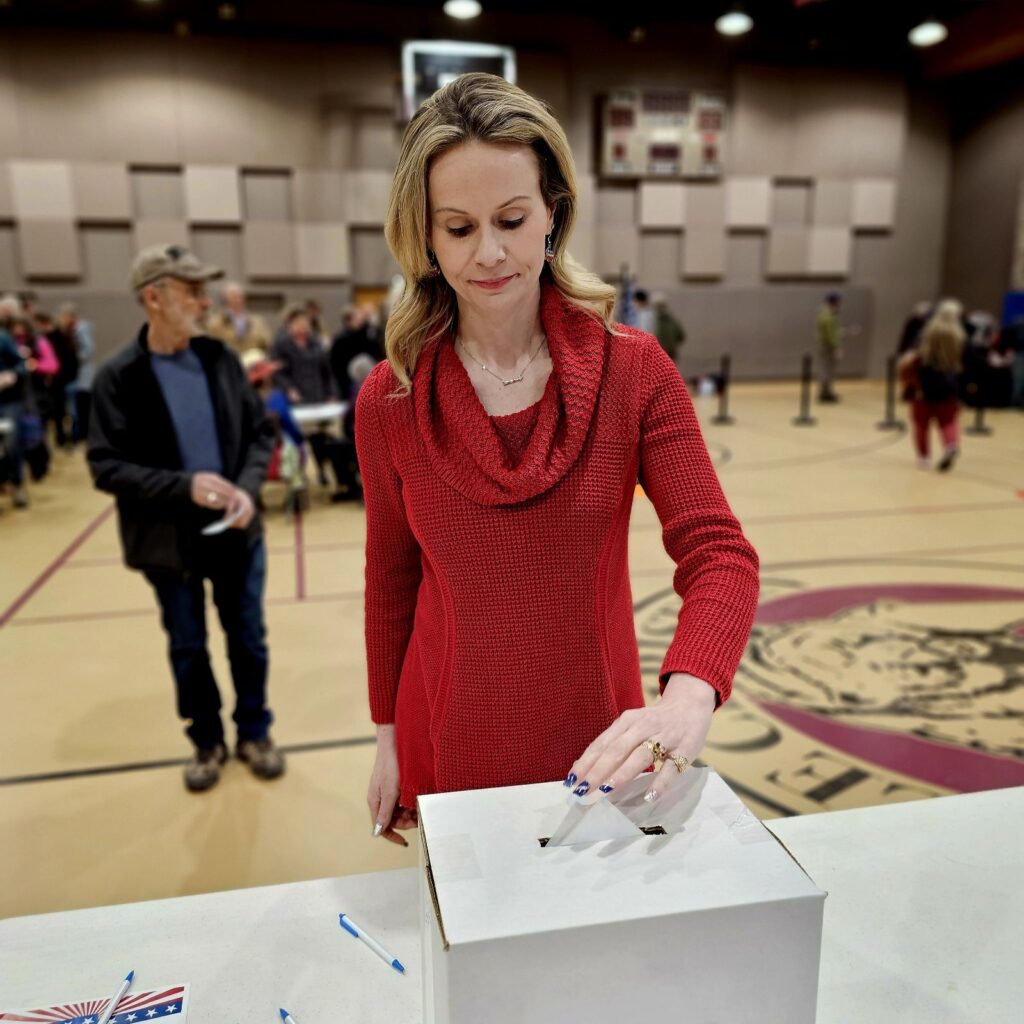
Kelly Tshibaka, state director for the Trump campaign, casts her ballot at the Presidential Preference Poll at Grace Christian in Anchorage on Super Tuesday.

Alabama, Trump 88, Haley 9, 50 delegates at stake

Alaska, 29 delegates at stake

Arkansas, Trump 76, Haley 19, 40 delegates at stake

California, Trump 75, Haley 21, 169 delegates at stake

California also has a jungle primary to determine who will take the place of the late Dianne Feinstein; the top two vote getters will advance regardless of party. They’ll certainly be Democrats Rep. Adam Schiff and Republican Steve Garvey, and probably not Democratic Rep. Katie Porter.

Colorado, Trump 63, Haley, 33, 37 delegates at stake

Maine, Trump 72, Haley 26, 20 delegates at stake

On Tuesday, the U.S. Supreme Court ruled that Maine did not have the authority to keep Trump off of the Republican primary ballot, as its Secretary of State, a Democrat, was attempting to do.

Massachusetts, Trump 61, Haley 36, 40 delegates at stake

Minnesota, Trump 69, Haley 29, 39 delegates at stake

North Carolina, Trump 74, Haley 23, 74 delegates at stake

Republican Mark Robinson won the North Carolina gubernatorial primary.

Oklahoma, Trump 82, Haley 16, 43 delegates at stake

Tennessee, Trump 77, Haley 20, 58 delegates at stake

Texas, Trump 78, Haley 17, 150 delegates at stake

Brandon Hill, a Republican, won the 26th congressional district seat in Texas.

Utah, Trump 58, Haley 41, 40 delegates at stake

Vermont, Haley 50, Trump 46, 17 delegates at stake

Virginia, Trump 63, Haley 35, 48 delegates at stake

Enthusiasm high in Wasilla at the Republican Presidential Preference Poll at 5 pm on Super Tuesday.
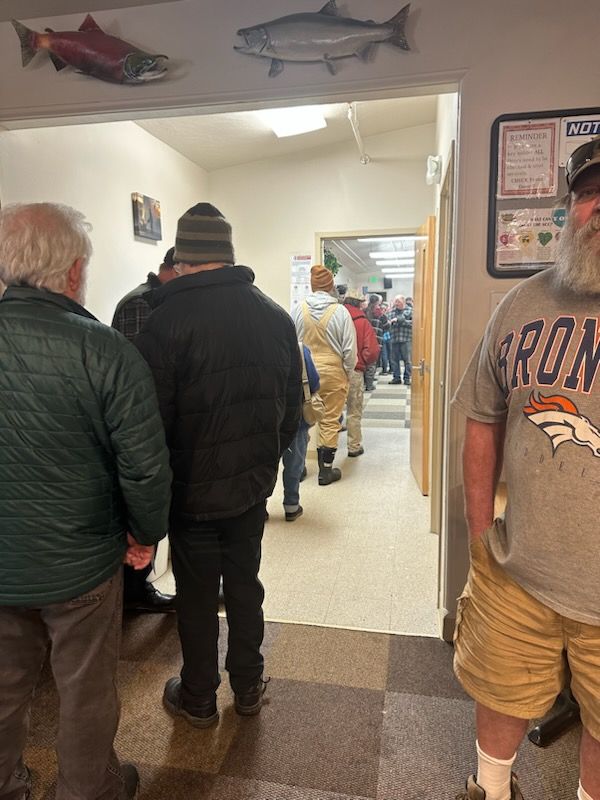
Kenai Peninsula Republicans wait in line to cast their vote in the Republican Presidential Preference Poll in Sterling on Super Tuesday.
Juneau Republicans use a vacant spot at Nugget Mall to conduct the Presidential Preference Poll on Super Tuesday.

Democrat primaries

Breaking: Biden is losing the Democratic caucus in American Samoa to a little-known candidate, Democrat Jason Palmer. Decision Desk HQ made the call after confirming the results with the Democratic Party of American Samoa.

Iowa: President Biden has won the Iowa Democratic presidential caucus. It was a mail-in-only caucus method.

Virginia: Biden has won.

North Carolina: Biden has won.

Vermont: Biden has won.

Oklahoma: Biden has won.

Texas: Biden has won.

Email to Alaska Republicans on Tuesday looked like voter suppression but was just a GOP ‘mistake’

Hanlon’s razor is a rule of thumb filled with political wisdom: Never attribute to malice that which is adequately explained by stupidity.

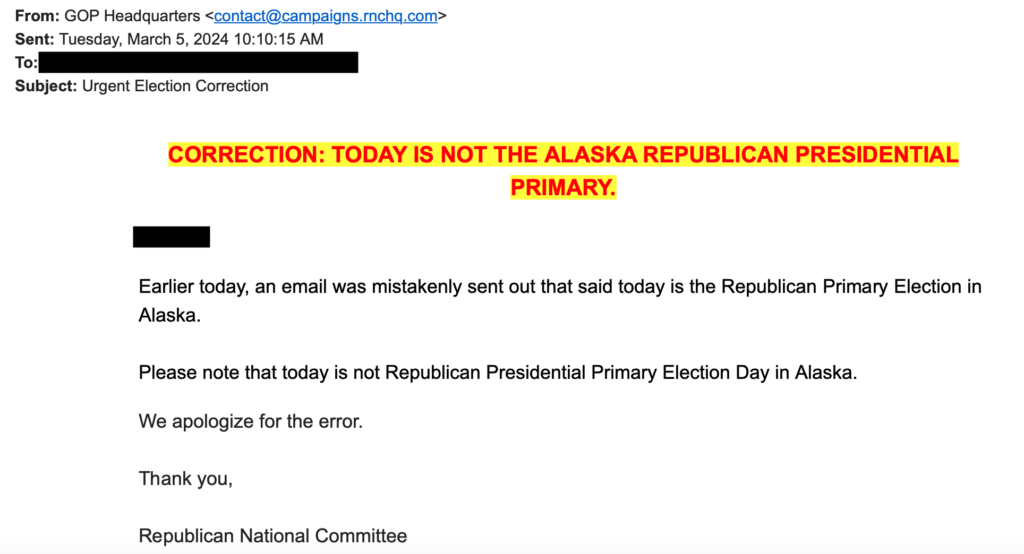
An email received by Republicans in Alaska appears, on its face, to be voter suppression from a bad actor. But it was actually a “mistake” by the Republican National Committee.

The email came from what was listed as “GOP Headquarters.” Some Alaskans thought the Republican Party had been hacked because of the misinformation they were seeing.

The “error” email followed one RNC had sent out, telling Alaska Republicans that today is their “primary” day in Alaska and urging them to vote.

But the correction on the first error makes it look like there is no political event happening in Alaska on Super Tuesday, one Alaskan pointed out.

In fact, Alaska Republicans hold their caucuses by ballot. It is not exactly a primary, but it is a Republican event, sanctioned by the RNC. What is curious is that, so far, only Trump-supporting Republicans have reported getting the emails.

In a Presidential Preference Poll, like the one being held today, Republicans go to designated polling places, show their ID, are verified as Republican registrants by a Republican volunteer, and then get to vote for who they prefer the Republican nominee is for president.

This process takes place Tuesday, March 5, as 14 other states around the country go through either primaries or similar party-run caucuses.

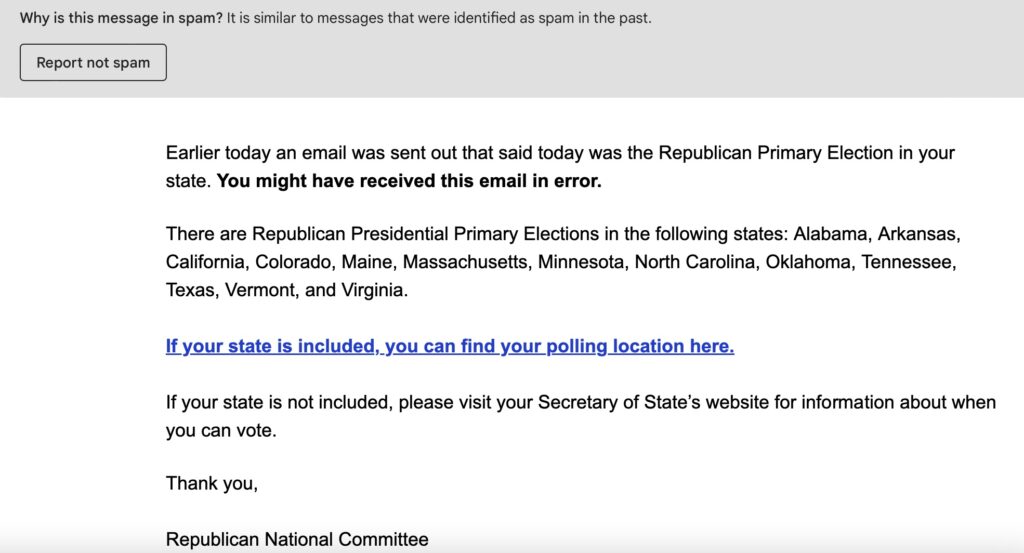
Other Alaskans received an entirely different correction from the RNC midday on Tuesday, but it, too, did not advise them correctly about the Alaska Republican Presidential Preference Poll:

Must Read Alaska reached out to the RNC for an explanation of the first, second, and third emails, which ignored the opportunity to take part in the Presidential Preference Poll, but did not get a response.

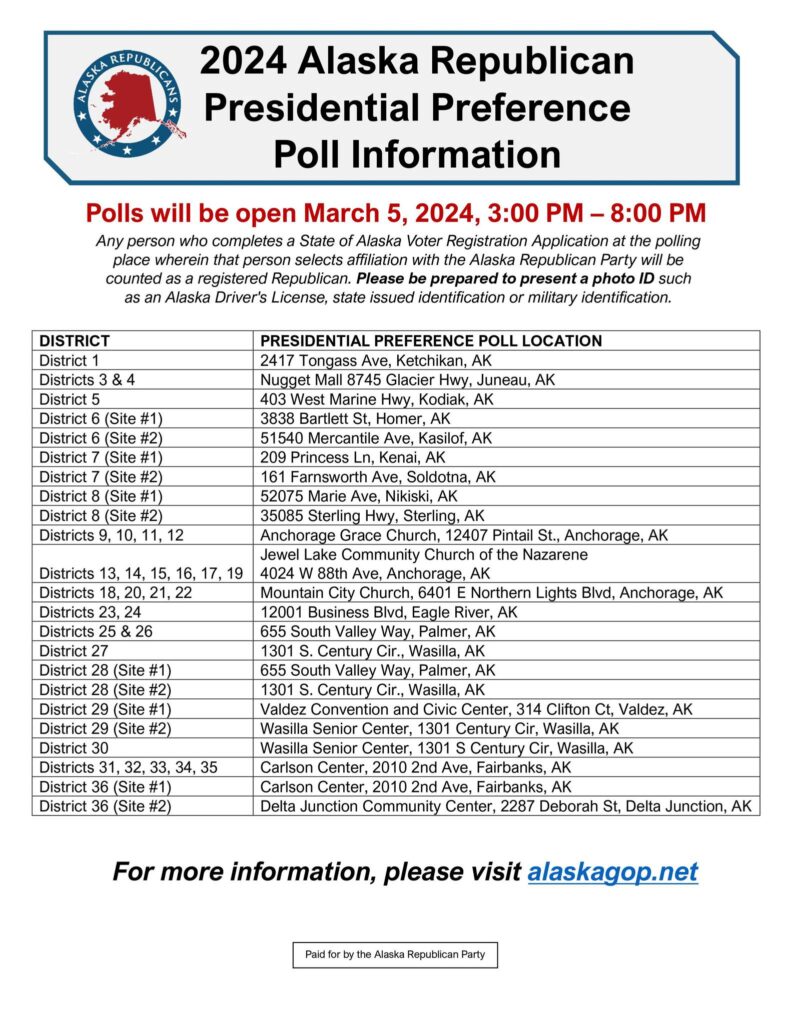
There is very little information available at the Alaska Republican Party website — and no mention of the Presidential Preference Poll on the front page. A visitor to the website must click on the “Events” tab to locate information about the PPP, but there is no call to action.

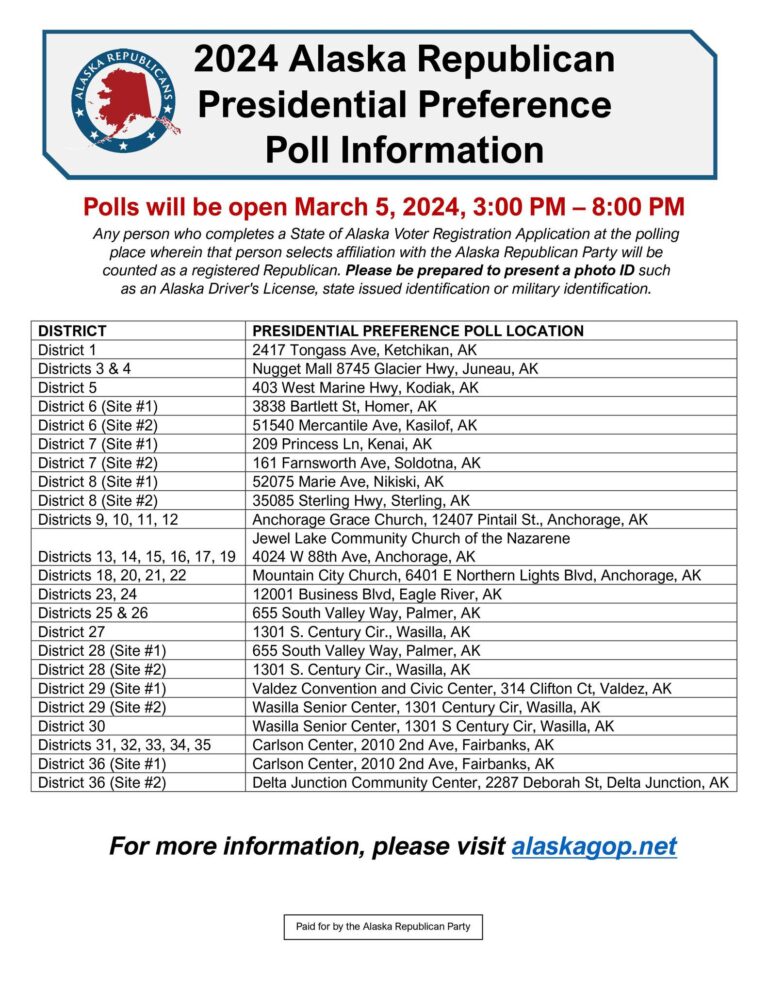
The presidential polling takes place March 5 at the following locations:

Some Alaska voters heard from Sen. Lisa Murkowski today with this text message:

“This is Senator Lisa Murkowski. “I want to share an important message with you. I’m proud to endorse Nikki Haley. America needs someone with the right values, vigor, and judgment to serve as our next President—and in this race, there is no one better than her. Nikki will be a strong leader and uphold the ideals of the Republican Party while serving as a President for all Americans. It is crucial that you join me and make your voice heard, Denise. Your support for Nikki Haley in TODAY’S election will make a difference. Find everything you need to make a plan to vote HERE: NikkiHaley.com/Alaska”

Murkowski-style voters may have received this message, but Trump-leaning voters did not.

Veterans Affairs: Department bans ‘The Kiss’ photo, then quickly reverses itself

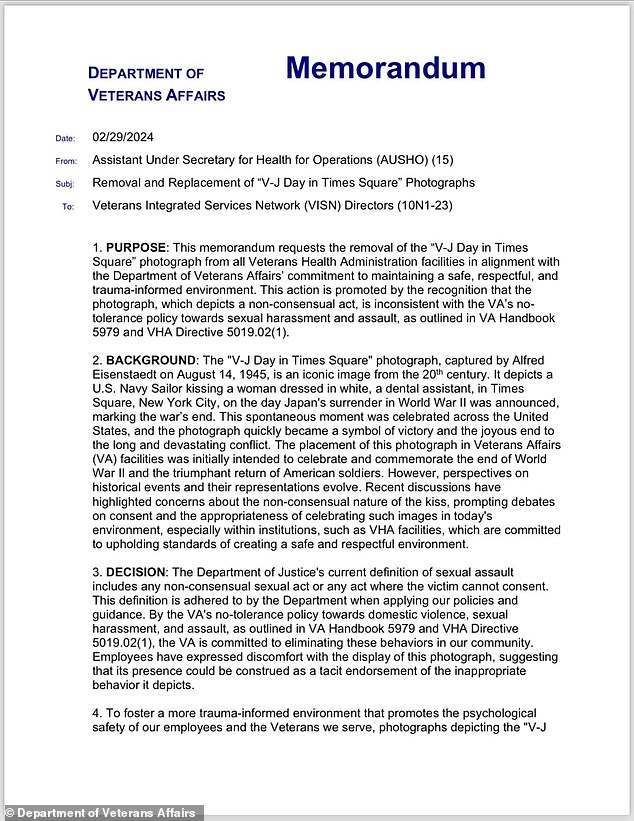
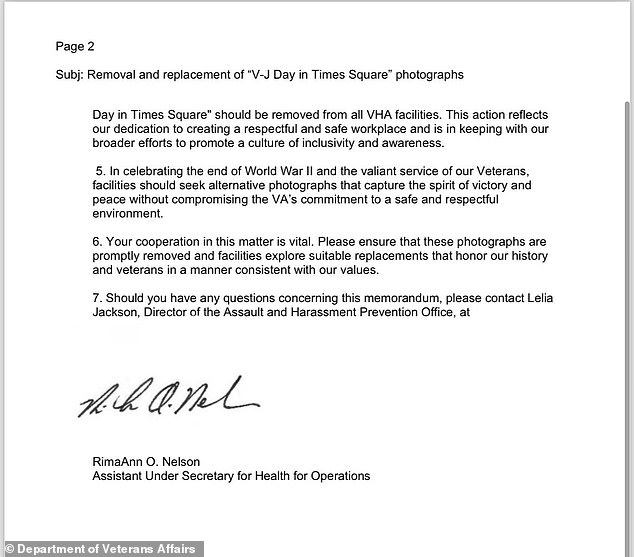
It was a public relations nightmare for the Department of Veterans Affairs. An undersecretary of the department on Feb. 29 banned the historic photo, “The Kiss,” from all of its facilities across America. The memo ordering the removal of the photo said the photo “depicts a non-consensual act” that is inconsistent with VA policy on sexual harassment.

The memo was posted on X/Twitter and the criticism was relentless over the U.S. government going woke. Hours later, Secretary of Veterans Affairs Denis McDonough rescinded the order.

McDonough posted a copy of the Aug. 14, 1945 Life Magazine photograph on X/Twitter, with this message: “Let me be clear: This image is not banned from VA facilities — and we will keep it in VA facilities.” 

The original memo said, “To foster a more trauma-informed environment that promotes the psychological safety of our employees and the veterans we serve, photographs depicting the ‘V-J Day in Times Square’ should be removed from all Veterans Health Administration facilities.”

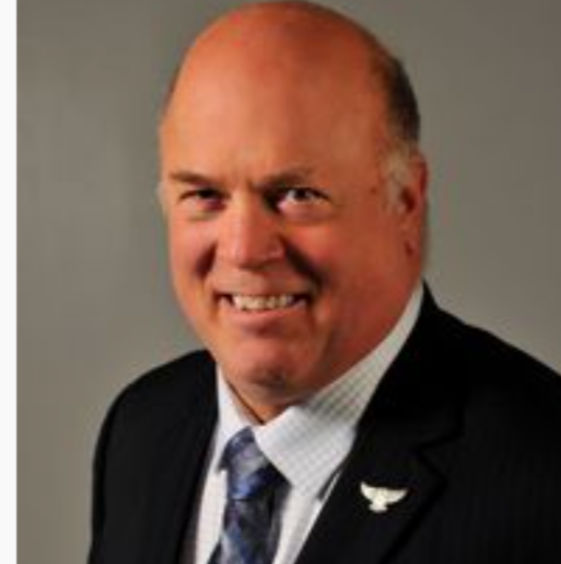
RimaAnn O. Nelson, Assistant Under Secretary for Health for Operations, Veterans Health Administration, Department of Veterans Affairs since Jan. 2, 2022, penned the woke memo banning the iconic photo.

The photo was taken by Alfred Eisenstaedt, a German-born American photographer and photojournalist who worked for Life Magazine. It is formally called “V-J Day in Times Square” but is known to most people simply as “The Kiss.”

V-J Day is the day Japan surrendered to the United States. In New York City and other cities across the country, Americans poured into the streets and celebrated. Navy sailor George Mendonsa planted a kiss on fellow celebrant Greta Friedman, someone he had never met but was inspired to lock lips with on that historic day.

Kevin McCabe: Let’s apply science to our statutes

I filed HB107 a year ago — March 13, 2023. This bill would merely define when we humans consider when and how life begins. We are good at determining when death happens but we have significant political issues defining life.

It was not my intent to get in a huge battle with pro-abortion or planned parenthood folks. I acknowledge (and welcome the idea) however, that HB107 may be used in that arena. The reality is that it was only my intent to apply science to our statutes. 

But first, let me say that I have believed in life at conception since I was in high school. At the time, I was not a Christian or even particularly religious. But I did go to a world-class high school and learned about biology and reproductive organs. Because of that classic education in science I have always believed that life began at conception.

Consider that we spend billions of dollars to send spacecraft to mars to “look for life” which we think would be indicated by evidence of a single drop of water. Evolutionists or people who believe in Darwin’s theory believe that all life began from a single cell amoeba climbing out of the primordial ooze. Most scientists believe that life begins at conception.

As a 17-year-old teenager who understood biology and the science of where life came from, pitting that knowledge against my hormones was difficult. I was still in high school and my girlfriend was pregnant. Our families, while maybe more on the liberal side, were not very understanding where teen out-of-wedlock pregnancy was concerned. So, abortion was a consideration – probably more from me than her. I was frantic as I was on my way to college and bigger things. I thought I did not want this child and I also felt like a huge disappointment even before the big reveal.

At the end of the day, though, we decided to get married and have the baby. Whether or not that was a great choice, given my limited emotional age, is up for discussion. It was, however, a great choice for many other people. 

Let me tell you why.

My oldest son, the “person” who would have been aborted, is my hero. He is a firefighter and lifesaver. Several years ago, a Cessna 206 crashed while taking off from Merrill field and landed on fire in the parking lot of the business my son worked for.

My son had been a ramp rat for a company in Kodiak, as a kid, so he knew what to do and exactly how to save the people trapped in that airplane. And he did not hesitate. He (and several other Alaskans of course) were there in an instant trying to save the people from the burning wreck. It is what Alaskans do, after all. But what if he had not been there with the knowledge he had from a previous job? What if he had not been there at all?

Now he is a firefighter in the MatSu valley. And even with his limited time there, he has probably lost count — as most firefighters, EMS, and LEO first responders do — of the number of people he has helped, or even saved. What if the smoke alarm he installed saved a life? What if even the child he talked to at school remembered how to dial 911, or how to get out of a burning room? 

But what if he were not even here? 

Shouldn’t we all wonder how many military heroes, first responders, Einsteins, Curies, Fords, JFKs, Reagans, and other notable humans have been killed in the womb? What if the life a firefighter saved was yours? What if the life of a relative could have been saved by a first responder who is just not here? 

Also consider that, with the advent of robotics and AI, we must find a way to define when human life begins, when is life a “person.” The science tells us that the human zygote, in the mother’s body, is a totally separate life, with its own DNA and its own path forward. The moral right of self-determination. Does that path include being a hero? A scientist that will find a cure for cancer? Or the person who will save you or a family member?

Scientifically, should we not also consider the aging demographics of our population? How about the huge number of jobs going unfilled because of lack of people? Are we making a mistake with our rampant declaration of “my body, my choice” and using abortion as birth control? It is a conversation we must have, and HB107 is designed to give us a beginning, not an end. It is not designed to limit any health care choices or put doctors in jail. It is merely designed to find a scientifically statutory way to define life.

I know that there is an alleged plurality of people in Alaska who disagree with me. And I accept that. But notable to me is that many of the comments received, by my office, speaking against HB107, are from out of state. I would even venture to say, without counting them, that the majority are from out of state. This makes me wonder what Alaskans really think. Are we being played again by the abortion-industrial lobby? Played over this simple bill that merely defines life?

For me, it is hard to reconcile that against the good that my son, my hero, has done for so many people. 

Rep. Kevin McCabe serves in the Alaska Legislature on behalf of Alaskans in the House District 8-Big Lake area.

It’s Super Tuesday: Facebook, Instagram part of worldwide outage

It’s Super Tuesday, when 16 state primaries and caucuses are going on. And so there’s a social media issue going on with Meta, the global behemoth in the realm of influencing.

The social media site used most in Alaska — Facebook — is experiencing a worldwide outage. It has logged users out and refuses to let them back in with their passwords.

The website Downdetector.com also shows that users are having trouble with Instagram, Messenger, Snapchat, Google, WhatsApp, and other popular websites.

This story, written at 7:15 a.m. Alaska time, will be updated as details emerge. At 7:54 a.m., many users reported they are able to access their accounts, while others report they still cannot.

.

What makes an Alaskan? Alaska Supreme Court says it is basically leaving your bra behind in Alaska

The Alaska Supreme Court has ruled, in the case of Democrat Rep. Jennie Armstrong’s tenuous claims of residency, your home is basically wherever you left your bra behind. Or perhaps your carpetbag.

The legal case was brought by Republican candidate and longtime Alaskan Liz Vazquez, along with Chris Duke, Randy Eledge, Steve Strait, and Kathryn Werdahl, all longtime residents. They said that Armstrong had not met the residency rule for serving in the Legislature, because according to the Alaska Constitution, a candidate must have been a resident for three years immediately before filing for office. For the November, 2022 election, Armstrong would have needed to be a resident by June 1, 2022. Armstrong said she became a resident on May 20, 2019, while the complainants said she wasn’t a resident until June 7, 2019, at the earliest.

Armstrong is a born-and-raised Louisianan, who sold her stuff in 2016 and started traveling around the country. She met Benjamin Kellie, an Alaskan sometime around January, 2019, on a video call set up by a friend. The two became romantically interested and Kellie persuaded her to book a flight. She visited Kellie from May 10-20, 2019. That is when she started imagining life with him. While basking in the steamy waters of Chena Hot Springs on May 14, the two had conversations about how they felt about each other, and four days later, while visiting Seward, they discussed marriage and having children. Between May 18 and May 20, Kellie asked her to move in with him.

On May 20, Armstrong left the state with the intent to return after meeting some prior commitments. She told the Alaska Supreme Court that after she left the state she started looking for return tickets, but eventually decided it wasn’t logistically or financially feasible. She booked a flight back to Alaska on May 25 for travel on June 8. The two married in 2020.

When she applied for a non-resident fishing permit in June of 2019, she listed her Louisiana address as her permanent address. But she told the judges she had no intention to make Louisiana her home, even though she listed it as her home. In later years, she appeared to have fudged some of the dates on her fishing licenses.

The complainants said that there is no evidence Armstrong planned to stay until after June 7, 2019.

In 2023, the Supreme Court allowed Armstrong to be sworn in while the case proceeded.

The court ultimately believed Armstrong’s romantic story about adventuring to Alaska and then deciding to run for office to represent District 16 in Anchorage. The court upheld the Division of Elections certification of the November, 2022 election.

Justice Susan Carney was not convinced, sharing concerns that this new interpretation may invite transient individuals to claim residency with minimal proof. But the bra rule now stands in Alaska, as established by Rep. Armstrong’s summer romance in 2019.